广告
加载中

梁国勇 以国际合作弥合人工智能投资鸿沟

亿邦会展 2026-09-24 17:52
亿邦会展 2026/09/24 17:52

邦小白快读

EN
全文速览

人工智能投资正在全球快速增长,但大多数发展中国家仍面临基础设施薄弱和投资不足的问题。中国在算力建设上已从规模扩张转向系统协同,通过东数西算等实践推动算力、能源和网络布局协调。基础模型的竞争已从单纯追求参数规模转向能力、效率和可治理性,中国头部模型性能正快速接近美国前沿水平。

开放权重是中国基础模型扩大影响力的重要路径,能降低模型获取和部署门槛,让更多人用上人工智能。报告建议以规模和效能并重的政策引导投资,统筹算力和电力建设,同时通过能力建设让更多主体用得起、用得好人工智能。国际合作是弥合投资鸿沟的关键,可以通过多边机制开展技术援助和创新数字基础设施融资机制。

人工智能正在重构全球经济和产业,品牌商需要关注的是用户行为变化和消费趋势。中国依托超大规模用户市场和丰富应用场景,形成了快速迭代的条件,这为品牌商洞察消费者需求提供了数据基础。开放权重模型降低了AI使用门槛,品牌商可以借助AI能力更高效地进行产品研发和营销创新。

在基础设施层面,算力、能源和网络的统筹布局将影响AI服务的成本和稳定性,品牌商应关注数据中心资源约束对AI应用落地的影响。国际投资方向正在从单项技术转向人工智能芯片、大模型和安全,品牌商在技术选型时需重视合作伙伴的整体创新能力。中国经验中的产业适配强调依托真实产业场景形成验证和数据反馈,品牌商应积极在真实业务中应用AI,引导资本投向更有效的解决方案。

人工智能国际投资快速增长,2016年至2025年全球跨境绿地投资累计4420个项目,资本支出约4300亿美元,流向超过120个经济体。这为卖家带来了新的增长市场机会,尤其是发展中国家数字化转型带来的需求。中国经验的产业适配指出,依托真实产业场景形成验证和数据反馈能引导资本投向,卖家可以利用实际运营数据吸引AI相关投资或合作。

政策方面,报告建议以规模和效能并重的政策引导投资,推动投资促进和便利化,卖家可关注各国对AI基础设施和数字贸易的扶持政策。同时,人工智能日益成为外资安全审查重点,卖家在跨境投资或技术合作时需注意合规风险。能力建设是扩大受益范围的关键,报告强调通过技能提升让更多主体用得起、用得好AI,卖家可加强数字化技能培训以抓住AI应用红利。国际合作为落后地区带来技术援助和融资机制,卖家可探索参与多边机制下的新商业模式。

人工智能基础设施的竞争已不是单一算力设备的竞争,而是算力、能源、网络和数据中心布局的系统匹配。工厂在推进数字化时,应关注算力协同和电力资源约束,避免盲目扩张基础设施。中国经验中的要素匹配强调推动算力、能源和网络统筹布局,工厂可以结合自身能耗和数字化需求,合理规划AI应用的基础设施投入。

产业适配是中国经验的重要方面,工厂可以依托真实生产场景验证AI技术,通过数据反馈引导设备升级和工艺优化。报告提到开放权重模型能降低AI使用门槛,工厂可利用开源模型进行质检、排产等场景的开发,降低研发成本。同时,人工智能国际投资重点转向芯片、大模型和安全,工厂在选择技术供应商时需关注其创新能力和安全合规性。政策方面,国家统筹算力和电力建设能为工厂提供更稳定的数字基础设施,工厂可积极参与设备更新和智能化改造项目,享受投资促进和便利化政策。

人工智能行业正呈现投资激增和国际投资加速的态势,服务商应关注客户在算力、电力、材料和水资源约束下的痛点。数据中心用电量在部分集聚地区可占当地用电量的20%至30%,因此为客户提供能效优化和可持续性解决方案是重要机会。

中国算力建设从规模扩张走向系统协同,东数西算和算电协同等实践推动算力、能源、网络和数据中心布局协调,服务商可围绕系统级协同提供规划咨询和集成服务。基础模型的衡量标准正在转向能力、效率和可治理性,服务商在为客户选型时应强调模型的实际效能和治理友好性,而非参数规模。开放权重模型降低门槛,服务商可基于开源模型为客户定制行业解决方案,降低部署成本。产业适配强调依托真实产业场景验证数据反馈,服务商应贴近客户业务场景做垂直化开发。国际投资重点从单项技术转向芯片、大模型和安全,服务商可拓展AI安全评估和合规咨询业务。

人工智能投资分布高度不均,多数发展中国家面临基础设施薄弱和投资不足的问题,这为平台商提供了向新兴市场拓展的机会。中国经验中的普惠扩散强调通过开放权重、架构优化和平台服务降低AI使用门槛,平台商可以构建开放平台吸引中小企业和开发者。

东数西算和全国一体化算力网等政策推动算力布局协同,平台商在运营数据中心或提供算力服务时,需关注电力供应和长期可持续性。报告指出人工智能国际投资中项目资本密集化特征更加明显,平台商在招商时可重点吸引AI芯片、大模型和AI安全领域的高质量项目。同时,人工智能日益成为外资安全审查重点,平台商在进行跨境业务或引入外资时需做好合规风控。规模与效能并重的政策引导投资,平台商应关注投资促进和便利化政策,为入驻企业提供更好的基础设施和融资对接。能力建设和技能提升是扩大受益范围的关键,平台商可组织AI培训和技术服务,降低用户使用门槛,增强平台粘性。国际合作方面,创新发展融资机制和多边技术援助将为平台商提供跨国合作的潜在机会。

人工智能作为通用目的技术正在重构全球经济和产业,但投资和基础设施分布高度不均,导致数字鸿沟可能进一步扩大。这一新问题值得深入研究,尤其是资本、算力与基础设施分布的全球格局。报告显示2024年美国、中国和欧洲分别约占全球数据中心用电量的45%、25%和15%,同时新兴经济体开始成为大型数据中心项目目的地,但电力约束日益突出,这为研究基础设施投资与可持续性提供了实证基础。

中国经验归纳为要素匹配、普惠扩散、产业适配和制度适应四个框架,研究者可将其作为分析发展中国家AI发展路径的理论工具。基础模型竞争正从参数规模转向能力、效率和可治理性,开放权重成为影响技术扩散的重要机制,这一演变对产业政策和创新生态研究有参考价值。国际投资方面,跨境绿地投资4420个项目、4300亿美元资本支出,投资来源集中且资本密集化,同时AI成为外资安全审查重点并延伸至对外投资管理,研究者可探讨安全审查与投资自由化之间的平衡。政策建议提出以规模与效能并重的政策引导投资、以能力建设扩大受益范围、以国际合作弥合投资鸿沟,为相关研究提供了明确的方向性主张。

返回默认

声明:快读内容全程由AI生成,请注意甄别信息。如您发现问题,请发送邮件至 run@ebrun.com 。

我是 品牌商 卖家 工厂 服务商 平台商 研究者 帮我再读一遍。

Quick Summary

Artificial intelligence investment is growing rapidly worldwide, but most developing countries still face weak infrastructure and underinvestment. China has shifted its computing power development from scale expansion to system-level coordination, promoting coordinated layout of computing, energy, and networks through initiatives such as the East-to-West Computing Resource Transfer. Competition in foundation models has shifted from merely pursuing parameter scale to capability, efficiency, and governability, and China's leading models are quickly closing the gap with the U.S. frontier.

Open-weight models represent an important path for Chinese foundation models to expand their influence, lowering barriers to model access and deployment and enabling more people to use AI. The report recommends policies that balance scale and efficiency to guide investment, coordinate computing and electricity infrastructure, and expand the beneficiary base through capacity building so more actors can afford and effectively use AI. International cooperation is key to bridging the investment gap, through multilateral mechanisms for technical assistance and innovative financing mechanisms for digital infrastructure.

AI is reshaping the global economy and industry, and brands need to pay attention to changes in user behavior and consumption trends. China, leveraging its massive user market and rich application scenarios, has created conditions for rapid iteration, providing a data foundation for brands to understand consumer demand. Open-weight models lower the barrier to AI adoption, enabling brands to use AI capabilities more efficiently in product development and marketing innovation.

At the infrastructure level, coordinated planning of computing, energy, and networks will affect the cost and stability of AI services; brands should keep an eye on how data center resource constraints affect AI application deployment. International investment is shifting from single technologies to AI chips, foundation models, and security, so brands should value the overall innovation capability of partners when selecting technologies. The Chinese experience of industrial alignment emphasizes validating and obtaining data feedback in real industry scenarios; brands should actively apply AI in actual business operations to guide capital toward more effective solutions.

International AI investment is growing rapidly. From 2016 to 2025, global cross-border greenfield investment totaled 4,420 projects, with capital expenditure of approximately $430 billion, flowing to more than 120 economies. This creates new growth market opportunities for sellers, especially the demand brought by digital transformation in developing countries. The Chinese experience of industrial alignment suggests that forming validation and data feedback in real industry scenarios can guide capital flows; sellers can use actual operating data to attract AI-related investment or partnerships.

On the policy front, the report recommends guiding investment through policies that balance scale and efficiency, and promoting investment facilitation. Sellers should watch for supportive policies in various countries for AI infrastructure and digital trade. Meanwhile, AI is increasingly becoming a focus of foreign investment security reviews, so sellers should be mindful of compliance risks in cross-border investment or technology cooperation. Capacity building is key to broadening the base of beneficiaries; the report emphasizes skills upgrading so that more actors can afford and effectively use AI. Sellers can strengthen digital skills training to capture the benefits of AI applications. International cooperation brings technical assistance and financing mechanisms to lagging regions, and sellers can explore new business models under multilateral mechanisms.

Competition in AI infrastructure is no longer about single computing devices but about system-level alignment of computing, energy, networks, and data center layout. When advancing digitalization, factories should pay attention to computing synergy and electricity resource constraints, avoiding blind infrastructure expansion. The Chinese experience of factor alignment emphasizes coordinated planning of computing, energy, and networks; factories can rationally plan infrastructure investment for AI applications based on their own energy consumption and digitalization needs.

Industrial alignment is an important aspect of the Chinese experience. Factories can validate AI technology in real production scenarios and use data feedback to guide equipment upgrades and process optimization. The report mentions that open-weight models can lower the threshold for AI adoption, and factories can use open-source models to develop quality inspection, production scheduling, and other scenarios, reducing R&D costs. Meanwhile, international AI investment is shifting toward chips, foundation models, and security, so factories should consider suppliers' innovation capability and security compliance when selecting technology vendors. On the policy side, national coordination of computing and electricity construction can provide factories with more stable digital infrastructure. Factories can actively participate in equipment renewal and intelligent transformation projects and enjoy investment promotion and facilitation policies.

The AI industry is witnessing a surge in investment and accelerating international investment flows. Service providers should focus on clients' pain points arising from constraints on computing power, electricity, materials, and water resources. In some concentrated areas, data center electricity consumption can account for 20%–30% of local electricity use, making energy-efficiency optimization and sustainability solutions a key opportunity.

China's computing power development is moving from scale expansion to system-level coordination. Practices such as the East-to-West Computing Resource Transfer and computing–electricity synergy are promoting coordinated layout of computing, energy, networks, and data centers. Service providers can offer planning advisory and integration services centered on system-level synergy. The benchmark for foundation models is shifting toward capability, efficiency, and governability; when selecting models for clients, service providers should emphasize real-world effectiveness and governance-friendliness rather than parameter scale. Open-weight models lower barriers, so service providers can customize industry solutions based on open-source models to reduce deployment costs. Industrial alignment emphasizes validation and data feedback in real industry scenarios; service providers should develop vertically by staying close to clients' business scenarios. As international investment focus shifts from single technologies to chips, foundation models, and security, service providers can expand into AI security assessment and compliance consulting.

AI investment is highly unevenly distributed, with most developing countries facing weak infrastructure and underinvestment. This creates opportunities for platform providers to expand into emerging markets. The Chinese experience of inclusive diffusion emphasizes lowering AI adoption barriers through open weights, architecture optimization, and platform services; platform providers can build open platforms to attract small and medium-sized enterprises (SMEs) and developers.

Policies such as the East-to-West Computing Resource Transfer and the national integrated computing network are promoting coordinated layout of computing infrastructure. Platform providers operating data centers or offering computing services need to pay attention to electricity supply and long-term sustainability. The report notes that AI international investment is becoming more capital-intensive in nature; platform providers can focus on attracting high-quality projects in AI chips, foundation models, and AI security when promoting investment. Meanwhile, AI is increasingly a target of foreign investment security reviews, and platform providers should manage compliance and risk control in cross-border business or when introducing foreign capital. Policies that balance scale and efficiency guide investment; platform providers should follow investment promotion and facilitation policies and provide better infrastructure and financing connections for companies on their platforms. Capacity building and skills upgrading are key to expanding the beneficiary base; platform providers can organize AI training and technical services to lower usage barriers and increase platform stickiness. In terms of international cooperation, innovative development financing mechanisms and multilateral technical assistance will offer potential opportunities for platform providers to collaborate across borders.

AI, as a general-purpose technology, is reshaping the global economy and industry, but the highly uneven distribution of investment and infrastructure risks widening the digital divide. This emerging issue deserves in-depth research, especially the global distribution of capital, computing power, and infrastructure. The report shows that in 2024, the United States, China, and Europe accounted for approximately 45%, 25%, and 15% of global data center electricity consumption, respectively. At the same time, emerging economies are beginning to become destinations for large data center projects, but electricity constraints are becoming more prominent, providing an empirical basis for research on infrastructure investment and sustainability.

The Chinese experience is summarized under four frameworks: factor alignment, inclusive diffusion, industrial alignment, and institutional adaptation. Researchers can use these as theoretical tools for analyzing AI development paths in developing countries. Competition in foundation models is shifting from parameter scale to capability, efficiency, and governability. Open weights have become an important mechanism affecting technology diffusion, and this evolution has reference value for research on industrial policy and innovation ecosystems. On international investment, cross-border greenfield investment comprised 4,420 projects and $430 billion in capital expenditure, with concentrated sources and growing capital intensity. At the same time, AI has become a focus of foreign investment security reviews and is extending to outward investment management. Researchers can explore the balance between security reviews and investment liberalization. The policy recommendations propose guiding investment with a balance of scale and efficiency, expanding the beneficiary base through capacity building, and bridging the investment gap through international cooperation, providing clear directional propositions for related research.

Disclaimer: The "Quick Summary" content is entirely generated by AI. Please exercise discretion when interpreting the information. For issues or corrections, please email run@ebrun.com .

I am a Brand Seller Factory Service Provider Marketplace Seller Researcher Read it again.

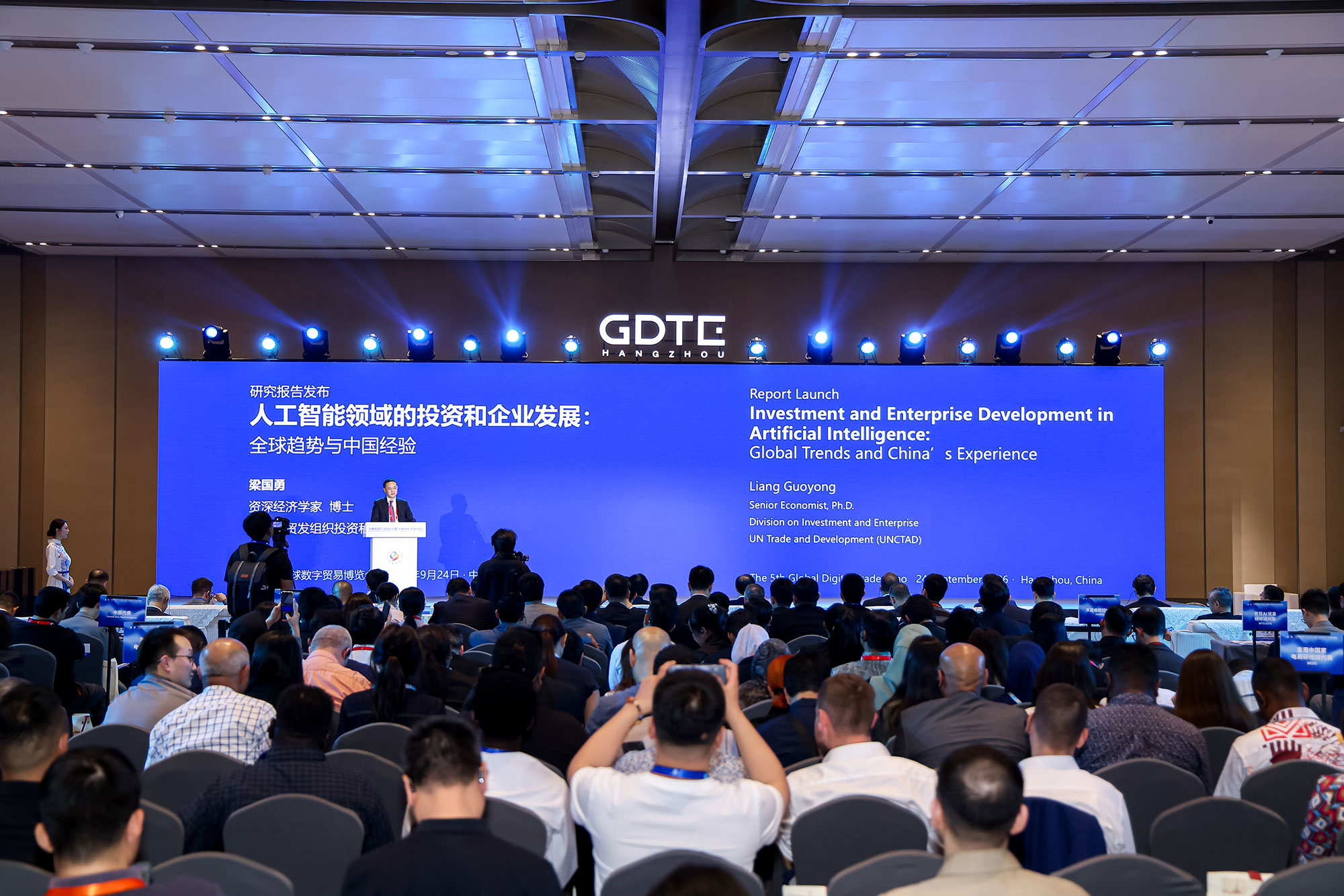
【亿邦原创】9月24日,在第五届全球数字贸易博览会“丝路电商日”启动仪式暨“丝路电商”资源对接会上,联合国贸易和发展组织资深经济学家梁国勇发布《人工智能领域的投资和企业发展:全球趋势与中国经验》报告。

梁国勇指出,人工智能正在重构全球经济和产业,相关投资快速增长,但资本、算力和基础设施的分布仍高度不均,多数发展中国家面临基础设施薄弱、投资不足的困境。

在他看来,中国人工智能发展的经验可以概括为要素匹配、普惠扩散、产业适配和制度适应。面向发展中国家,需要以规模与效能并重的政策引导投资,通过能力建设扩大受益范围,并以国际合作弥合人工智能投资鸿沟。

本文根据嘉宾现场演讲速记及演示材料整理,在不影响原意的基础上有所删改。

以下为演讲实录:

01

人工智能投资激增 数据中心资源约束加剧

人工智能是人类历史上具有革命性意义的通用目的技术,正在深刻重构全球经济和产业。过去几年,全球人工智能投资快速增长,技术应用加速向各行业渗透,但投资分布非常不均衡。人工智能领先国家和大型科技公司持续加大资本投入,多数发展中国家则仍面临基础设施薄弱、投资严重不足的问题。

这种差异意味着,人工智能带来发展机遇的同时,也可能进一步扩大国家之间的数字鸿沟。报告围绕人工智能基础设施投资、基础模型和技术前沿、智能体和人工智能应用、人工智能领域的国际投资,以及中国经验与政策建议五个方面展开分析。

全球数据中心建设正在进入加速扩张期。根据报告采用的数据,2024年美国、中国和欧洲分别约占全球数据中心用电量的45%、25%和15%。与此同时,巴西、印度、泰国、马来西亚等重要新兴经济体开始成为大型数据中心投资项目的目的地。

数据中心投资加快,也使电力、材料和水资源约束更加突出,其中电力供应已经成为数据中心建设的关键限制因素。在部分数据中心集聚地区,相关用电量可占当地用电量的20%至30%。因此,评价人工智能基础设施投资,不能只看建设规模,还要关注能源供给、使用效率和长期可持续性。

02

人工智能竞争从规模转向系统能力 中国形成差异化路径

中国的算力建设正在从规模扩张走向系统协同。“东数西算”、全国一体化算力网和“算电协同”等实践,推动算力、能源、网络和数据中心布局更加协调。这种变化说明,人工智能基础设施的竞争不只是单一算力设备的竞争,更取决于多种要素能否形成系统匹配。

在基础模型和技术前沿,模型参数规模已经进入万亿级,但“更大”并不等于“更先进”。衡量模型的标准正在从单纯追求参数规模,转向能力、效率和可治理性。

从中美基础模型竞争格局看,中国头部模型的性能正在快速接近美国前沿水平,美国在重要模型数量、资本投入和前沿算力等方面仍保持优势。中国则依托超大规模用户市场、数字平台、制造业体系和丰富应用场景,形成了快速迭代的条件。

开放权重是中国基础模型扩大影响力的重要路径。通过降低模型获取、部署和二次创新的门槛,开放模型有助于推动人工智能能力更广泛地扩散。但同时也要看到,先进芯片等关键环节仍然构成现实约束。

03

国际投资快速增长 机遇与挑战同时显现

从国际投资看,2016年至2025年,全球人工智能行业跨境绿地投资累计达到4420个项目,资本支出约4300亿美元,项目流向超过120个经济体。这些投资为发展中国家数字化转型带来了重要机遇,但投资来源仍然较为集中,项目的资本密集化特征也更加明显。

人工智能领域的跨境并购也在明显提速。投资重点从语音、视觉等单项技术,逐步转向人工智能芯片、大模型、人工智能安全以及企业整体创新能力。风险投资、私募股权基金和主权财富基金正在深度参与其中。与此同时,人工智能日益成为多国外资安全审查的重点,相关审查也开始由外资准入延伸至对外投资管理。

这意味着,人工智能国际投资既带来资本、技术和创新能力流动的新机会,也面临安全、规则和发展不平衡等多重挑战。因此,报告在关注资本流动的同时,也把基础设施、人才、产业和制度能力建设作为重要议题。

04

中国经验在于协同 政策重点在于普惠与合作

中国人工智能的快速发展提供了值得关注的经验。首先,数字经济发展奠定了数据、算法和算力基础,成为实现人工智能突破的重要依托。其次,人工智能产业发展取决于技术、资本和人才的协同,也离不开研发投入、商业模式和应用场景之间的匹配。

报告将中国经验概括为四个方面:一是要素匹配,推动算力、能源和网络统筹布局;二是普惠扩散,通过开放权重、架构优化和平台服务降低人工智能使用门槛;三是产业适配,依托真实产业场景形成验证和数据反馈,引导资本投向;四是制度适应,通过开放合作、非股权合作和能力共建,应对投资环境变化。

基于这些观察,我们提出三方面政策建议。第一,以规模和效能并重的政策引导投资方向,统筹算力、电力和数字基础设施建设,推动投资促进和便利化。第二,以能力建设和技能提升扩大受益范围,让更多主体用得起、用得好人工智能。第三,以持续拓展的国际合作弥合投资鸿沟,扩大发展中国家参与规则制定,依托多边机制开展技术援助,创新数字基础设施融资机制,缩小智能鸿沟,促进全球发展。

本文首发于 亿邦动力 官方网站

文章来源:亿邦动力

广告
微信
朋友圈

FAQ回顾

人工智能投资鸿沟是什么?

人工智能投资鸿沟是指全球人工智能投资分布高度不均,资本、算力和基础设施集中在领先国家和大型科技公司,而多数发展中国家面临基础设施薄弱、投资严重不足的困境。这种差异在带来发展机遇的同时,也可能进一步扩大国家之间的数字鸿沟。

发展中国家如何应对人工智能投资鸿沟?

联合国贸易和发展组织在报告中提出三方面建议:以规模和效能并重的政策引导投资,统筹算力、电力和数字基础设施建设;以能力建设和技能提升扩大受益范围,让更多主体用得起、用得好人工智能;以持续拓展的国际合作弥合投资鸿沟,扩大发展中国家参与规则制定,依托多边机制开展技术援助,创新数字基础设施融资机制。

中国人工智能发展经验有哪些?

报告将中国经验概括为四个方面:要素匹配,推动算力、能源和网络统筹布局;普惠扩散,通过开放权重、架构优化和平台服务降低人工智能使用门槛;产业适配,依托真实产业场景形成验证和数据反馈,引导资本投向;制度适应,通过开放合作、非股权合作和能力共建应对投资环境变化。数字经济发展奠定了数据、算法和算力基础。

全球人工智能跨境投资呈现什么趋势?

2016年至2025年,全球人工智能行业跨境绿地投资累计达4420个项目,资本支出约4300亿美元,流向超过120个经济体。投资来源较为集中,项目资本密集化特征明显。投资重点从语音、视觉等单项技术转向人工智能芯片、大模型、人工智能安全和企业整体创新能力,风险投资、私募股权基金和主权财富基金深度参与。

人工智能数据中心建设面临哪些资源约束?

全球数据中心建设加速扩张,但电力、材料和水资源约束突出,其中电力供应是关键限制因素。2024年美国、中国和欧洲分别约占全球数据中心用电量的45%、25%和15%,在部分数据中心集聚地区,相关用电量可占当地用电量的20%至30%。评价人工智能基础设施投资需关注能源供给、使用效率和长期可持续性。

这么好看,分享一下?

朋友圈 分享

APP内打开

+1
+1
微信好友 朋友圈 新浪微博 QQ空间
关闭
收藏成功
发送
/140 0