广告
加载中

中铝物资:AI赋能采购,构建行业高质量数据集

亿邦智库 2026-10-15 10:54
亿邦智库 2026/10/15 10:54

邦小白快读

EN
全文速览

中铝物资依托绿星链通数智化采购平台,把AI能力嵌入采购全流程,实现了效率的大幅提升和管理的透明化,值得关注。

1. 效率提升显著:采购效率提升50%以上,累计交易规模突破800亿元;6人团队支撑年400亿级结算量;供应商接收寻源通知从人工1天压缩到系统10分钟;合同生成从3天压缩到1小时;石油焦采购审批从38小时压降到24小时。平台通过400余个标准化接口打通30余类异构系统,实现一次录入、全程贯通。

2. 智能化应用落地:已上线大宗商品采购策略研判、商品价格监测、供应商智能风控、智能问数、智能客服、智能报告、绿星智审七大AI场景。AI可自动生成采购策略报告、识别价格异常波动、筛查供应商风险,采购员只需输入需求,AI就能生成包含价格、交期、风险的最优方案。

3. 可借鉴的实操经验:物料编码从130万条精简至43万条,实现一物一码一标准;将采购制度、合规要求、风控规则嵌入系统,让系统管事;通过源头直采和流程再造构建端到端自主供应链,增强应对市场波动的韧性。

这篇文章展示了大型央企如何通过数智化采购平台重塑供应链,其中对渠道建设、价格管理、用户生态和数据驱动的决策方式,对品牌商有直接启发。

1. 品牌渠道建设:绿星链通平台从集团内部工具扩展为行业级平台,吸引外部领军企业进驻,如索通发展成为首家外部企业。品牌商可借助此类平台拓展上下游合作,从单一交易转向生态共建。

2. 定价与价格竞争:平台持续跟踪数百种物料的市场价格动态,通过算法识别异常波动并预警,自动生成采购策略研判报告。品牌商可借鉴这种价格监测和数据分析能力,用于自身定价决策和采购成本控制。

3. 用户行为观察与消费趋势:平台沉淀采购全流程、供应商全景特征、采购行为分析等数据集,可深度了解供应商健康度、信用风险和交易偏好。品牌商可运用类似数据洞察用户习惯、优化服务。

4. 数字化转型标杆:中铝物资以人工智能驱动采购转型升级,将AI贯穿全链条,打造智能应用体系。品牌商可学习其以数据为核心、以AI为引擎的数字化路径,提升供应链响应速度和透明度。

中铝物资绿星链通平台为供应商和卖家带来了明确的数字化机遇与风险管控要求,值得仔细解读。

1. 增长市场机会:绿星链通已服务1万余家内外部企业,年交易规模超1000亿元,上架商品60余万条,累计交易规模突破800亿元。对于希望进入央企采购体系的卖家,这是一个规模可观的新渠道。平台还通过绿星商城将50余种农产品、70余类工装产品搬上线,打造从乡村进企业的直销链路,有助于中小卖家减少中间环节、直连央企需求。

2. 合作方式与扶持政策:绿星链通2.0已实现全级次企业上线,集采与自采业务全流程线上流转;中铝物资开展超200场数字化培训,帮助2.7万余家供应商特别是中小微企业熟悉线上操作、融入数字生态。外部领军企业索通发展已作为首家外部企业进驻,说明平台正在开放生态、寻求更多合作伙伴。

3. 风险提示与应对:平台AI模型自动筛查供应商准入资格,累计拦截不符合要求供应商1965家,发现问题122项,同IP预警签约数从13个降至0个。卖家需重视自身工商、司法、舆情等数据健康度,避免因信用风险被系统拦截。

4. 可学习点:供应商接收寻源通知从人工1天压缩到系统10分钟,合同生成从3天压缩到1小时。卖家应提升自身数字化对接能力,以便快速响应平台业务。

文章对制造工厂的启示主要集中在产品生产需求标准化、供应链智能化协同以及数字化转型升级路径上。

1. 产品生产和设计需求:物料编码从130万条精简至43万条,做到一物一码一标准。工厂应重视物料和产品的标准化编码,为上下游高效协同打下基础。平台已覆盖铝土矿、冶炼、工程建设、环保、加工、金融等多个业务领域,说明不同环节的工厂都可接入数智化供应链。

2. 数字化和电商化启示:绿星链通2.0将计划、寻源、合同、订单、履约、结算全流程信息化、标准化、透明化,让每一次采购有据可查。工厂可借鉴这种全流程线上化模式,提升自身采购和销售环节的数字化水平。

3. 商业机会:平台通过源头直采和流程再造构建端到端自主供应链,并拓展进口石油焦等多元化采购渠道。工厂若能在质量、交付、合规等方面满足平台要求,有机会成为大型央企的稳定供应商。

4. AI赋能供应链:包头铝业采购员只需输入需求,AI自动生成包含价格、交期、风险的最优采购方案,订单秒级发出。工厂可利用类似AI工具优化自身采购决策,提高生产效率、降低风险。

中铝物资的实践为供应链服务商提供了清晰的技术趋势、客户痛点和解决方案样板。

1. 行业发展趋势:人工智能正深刻重塑传统制造业供应链,中铝物资把AI作为采购业务转型升级的核心引擎,构建覆盖采购决策、执行、监督、运营全过程的智能应用体系。服务商应关注AI与供应链深度融合带来的新市场空间。

2. 新技术应用:平台采用五层一体AI技术架构,基于NLP、RAG等技术训练采购策略、价格预测、供应商风控、合规监督等行业AI模型,落地七大AI场景。并且已完成DeepSeek本地化部署,推出坤安大模型。服务商可以围绕这些技术方向提供组件化、可复用的AI能力。

3. 客户痛点与解决方案:中铝物资面对的痛点是跨系统对接、数据迁移、制度规则嵌入难等,其解决方案是推行天天读、日清日结工作法,用8个月完成平台1.0到2.0迭代;通过400余个标准化接口打通30余类异构系统,实现数据实时交互。服务商可借鉴这种快速迭代、标准化对接的实施方法。

4. 数据服务机会:平台建设有色金属行业供应链协同高质量数据集,累计形成600GB结构化数据、4.5TB非结构化数据,并打造石油焦、供应商风控、市场行情等可信数据空间,对外输出行业价格指数、供应链风控等数据服务。这为数据治理、数据交易、模型训练类服务商提供了明确的服务方向。

绿星链通作为央国企数智化采购平台的标杆案例,其平台建设、运营管理、生态招商和风险规避做法极具参考价值。

1. 平台最新做法:绿星链通从1.0迭代到2.0,实现全级次企业上线,将计划、寻源、合同、订单、履约、结算全流程标准化、透明化;平台接入400余家企业、3万余家供应商,年交易规模超1000亿元,上架商品60余万条。平台还推出绿星商城,将特色农产品和工装产品搬上线。

2. 招商与生态合作:平台向外部企业开放,索通发展成为进驻绿星链通的首家外部领军企业,双方共同拓展铝用碳素产业链合作。平台商可借鉴这种引入头部企业、从交易平台转向生态共建的招商策略。

3. 运营管理:中铝物资推行五个统一(管理模式、业务流程、系统底座、平台架构、数据标准统一),并通过天天读、日清日结工作法保障项目推进。平台将采购制度、合规要求、风控规则嵌入系统底层,让制度管人升级为系统管事,运营效率大幅提升。

4. 风险规避:AI模型自动筛查供应商准入资格,累计拦截不符合要求供应商1965家;识别异常交易风险、同IP预警签约数从13个降至0个;110项采购流程和93类标准合同文本嵌入系统。平台商应重点建设智能风控体系,从事前预警、事中拦截、事后可查三个维度防范业务风险。

中铝物资的实践展现了央国企在数智化采购和行业数据要素方面的前沿探索,对研究产业数字化、数据要素价值、AI供应链商业模式具有参考价值。

1. 产业新动向:中铝集团以绿星链通平台为载体,用AI赋能采购全流程,从分散、人工、粗放转向集中、标准、数字驱动。这一案例代表大型央国企供应链数字化转型的最新方向,也体现了从企业内部管理工具向行业级赋能平台演进的趋势。

2. 数据要素与高质量数据集:中铝物资入选国家数据局高质量数据集建设先行先试项目,围绕采购全流程、供应商全景特征、市场行情、采购行为分析、知识体系问答五大核心数据集,累计形成600GB结构化数据和4.5TB非结构化数据。其方法论包括源数据识别、清洗标准化、特征构建、标签构建、多源异构知识融合、多模态知识抽取对齐、模型适配,为行业数据资产化提供了完整路径。

3. 政策法规建议与启示:文章显示国家数据局推动高质量数据集和数据基础设施建设先行先试,中铝集团4项成果入选。这为研究者提供了政策落地效果观察样本。同时,平台通过制度规则嵌入系统、合规审查、风控预警等实现了监督向事前事中转变,对完善供应链数字化监管政策具有启示。

4. 商业模式创新:中铝物资构建了数据、模型、应用闭环,打造可信数据空间,对外输出行业价格指数、供应链风控等数据服务;同时引入外部领军企业索通发展,推动从单一合作向生态共建转型。这代表了一种央国企主导的产业互联网商业模式:以采购平台为基础,通过数据服务、生态合作实现价值外溢,形成可复制的数智供应链方案。

返回默认
声明:快读内容全程由AI生成,请注意甄别信息。如您发现问题,请发送邮件至 run@ebrun.com 。

我是 品牌商 卖家 工厂 服务商 平台商 研究者 帮我再读一遍。

Quick Summary

Chinalco Materials, powered by the Green Star LinkChain digital procurement platform, embeds AI capabilities across the entire procurement process, delivering substantial efficiency gains and management transparency—a development worth attention.

1. Significant efficiency gains: Procurement efficiency has improved by over 50%, with cumulative transaction volume exceeding RMB 80 billion; a six-person team supports an annual settlement volume of RMB 40 billion; supplier notification of sourcing opportunities has been cut from one day manually to 10 minutes systemically; contract generation reduced from three days to one hour; and petroleum coke procurement approval time dropped from 38 hours to 24 hours. The platform connects 30+ heterogeneous systems via 400+ standardized interfaces, enabling one-time entry and end-to-end data flow.

2. AI applications in practice: Seven AI scenarios are now live—commodity procurement strategy analysis, commodity price monitoring, supplier intelligent risk control, intelligent data querying, intelligent customer service, intelligent reporting, and Green Star Smart Review. AI can automatically generate procurement strategy reports, identify abnormal price fluctuations, and screen supplier risks. Buyers only need to input requirements, and AI generates optimal solutions covering price, delivery time, and risk.

3. Practical takeaways: Material codes were reduced from 1.3 million to 430,000, achieving one-code-per-item standardization; procurement policies, compliance requirements, and risk control rules are embedded into the system, enabling system-driven management; and end-to-end autonomous supply chains built through direct sourcing and process reengineering enhance resilience to market volatility.

This article illustrates how a large central SOE reshapes its supply chain through a digital procurement platform, offering direct inspiration for brands in channel building, price management, user ecosystems, and data-driven decision-making.

1. Brand channel building: The Green Star LinkChain platform has evolved from an internal group tool to an industry-level platform, attracting leading external enterprises; for instance, Suotong Development became the first external company to join. Brands can leverage such platforms to expand upstream/downstream cooperation, moving from single transactions to ecosystem co-construction.

2. Pricing and price competition: The platform continuously tracks market price dynamics for hundreds of materials, using algorithms to detect abnormal fluctuations and issue alerts, and automatically generates procurement strategy analysis reports. Brands can adopt this price monitoring and data analysis capability for their own pricing decisions and procurement cost control.

3. User behavior observation and consumption trends: The platform accumulates datasets covering the full procurement process, supplier profiles, and procurement behavior analysis, enabling in-depth understanding of supplier health, credit risk, and trading preferences. Brands can use similar data insights to understand user habits and optimize services.

4. Digital transformation benchmark: Chinalco Materials drives procurement transformation with artificial intelligence, embedding AI throughout the chain and building an intelligent application system. Brands can learn from its data-centric, AI-driven digital path to improve supply chain responsiveness and transparency.

Chinalco Materials' Green Star LinkChain platform presents clear digital opportunities and risk management requirements for suppliers and sellers, which deserve careful interpretation.

1. Market growth opportunities: The platform has served more than 10,000 internal and external enterprises, with annual transaction volume exceeding RMB 100 billion, over 600,000 products listed, and cumulative transaction volume surpassing RMB 80 billion. For sellers seeking access to central SOE procurement systems, this is a sizable new channel. The platform also launched Green Star Mall, bringing 50+ agricultural products and 70+ types of workwear products online, creating a direct sales link from rural areas into enterprises—helping small and medium sellers cut intermediaries and connect directly to SOE demand.

2. Cooperation methods and support policies: Green Star LinkChain 2.0 has achieved full-level enterprise onboarding, with both centralized and self-purchasing processes fully online. Chinalco Materials has conducted over 200 digital training sessions, helping more than 27,000 suppliers—especially micro, small, and medium enterprises—familiarize themselves with online operations and integrate into the digital ecosystem. Leading external company Suotong Development has joined as the first external enterprise, indicating the platform is opening its ecosystem and seeking more partners.

3. Risk alerts and responses: The platform's AI models automatically screen supplier qualification, having intercepted 1,965 non-compliant suppliers in total, identified 122 issues, and reduced same-IP contract signing alerts from 13 to zero. Sellers must pay attention to the health of their business registration, legal, and public opinion data to avoid being blocked by the system due to credit risk.

4. Key takeaways: Supplier notification of sourcing opportunities has been reduced from one day manually to 10 minutes systemically, and contract generation from three days to one hour. Sellers should enhance their digital interfacing capabilities to respond quickly to platform business.

The article offers key insights for manufacturing plants, mainly concerning standardization of production needs, intelligent supply chain collaboration, and digital transformation pathways.

1. Product production and design requirements: Material codes were reduced from 1.3 million to 430,000, achieving one-code-per-item standardization. Factories should prioritize standardized coding of materials and products to lay the foundation for efficient upstream-downstream collaboration. The platform already covers multiple business areas including bauxite, smelting, engineering construction, environmental protection, processing, and finance, indicating that factories at different stages can plug into the digital supply chain.

2. Digital and e-commerce implications: Green Star LinkChain 2.0 makes the entire process—planning, sourcing, contracts, orders, fulfillment, and settlement—informationalized, standardized, and transparent, making every procurement auditable. Factories can adopt this full-process online model to elevate digitalization in their own procurement and sales operations.

3. Business opportunities: The platform builds an end-to-end autonomous supply chain through direct sourcing and process reengineering, and has diversified procurement channels such as imported petroleum coke. Factories that meet the platform's requirements in quality, delivery, and compliance can become stable suppliers to large central SOEs.

4. AI-empowered supply chains: At Baotou Aluminum, procurement staff simply input requirements, and AI automatically generates an optimal procurement plan covering price, delivery time, and risk, with orders dispatched in seconds. Factories can leverage similar AI tools to optimize their own procurement decisions, improve production efficiency, and reduce risk.

Chinalco Materials' practice offers supply chain service providers clear technology trends, customer pain points, and solution templates.

1. Industry trends: Artificial intelligence is profoundly reshaping traditional manufacturing supply chains. Chinalco Materials uses AI as the core engine for procurement transformation, building an intelligent application system covering the entire procurement process—decision-making, execution, supervision, and operations. Service providers should watch the new market space created by the deep integration of AI and supply chains.

2. New technology applications: The platform adopts a five-layer integrated AI architecture. Using technologies such as NLP and RAG, it trains industry AI models for procurement strategy, price forecasting, supplier risk control, and compliance supervision, and has implemented seven AI scenarios. It has also completed local deployment of DeepSeek and launched the Kun'an large model. Service providers can offer componentized, reusable AI capabilities around these technology directions.

3. Customer pain points and solutions: Chinalco Materials faced challenges such as cross-system integration, data migration, and embedding institutional rules. Its solutions included adopting daily reading and day-end clearing work methods, completing the iteration from platform 1.0 to 2.0 in eight months, and connecting 30+ heterogeneous systems via 400+ standardized interfaces for real-time data interaction. Service providers can learn from this fast-iteration, standardized-integration implementation approach.

4. Data service opportunities: The platform has built high-quality datasets for nonferrous metals supply chain collaboration, amassing 600GB of structured data and 4.5TB of unstructured data. It has also created trusted data spaces for petroleum coke, supplier risk control, and market conditions, exporting industry price indices and supply chain risk control data services. This provides a clear service direction for data governance, data trading, and model training providers.

Green Star LinkChain serves as a benchmark for digital procurement platforms operated by central and state-owned enterprises. Its platform construction, operational management, ecosystem recruitment, and risk avoidance practices offer valuable reference.

1. Latest platform initiatives: Green Star LinkChain has iterated from 1.0 to 2.0, achieving full-level enterprise onboarding and standardizing/transparentizing the entire process—planning, sourcing, contracts, orders, fulfillment, and settlement. The platform connects 400+ enterprises and 30,000+ suppliers, with annual transaction volume exceeding RMB 100 billion and 600,000+ listed products. It also launched Green Star Mall, bringing specialty agricultural products and workwear products online.

2. Ecosystem recruitment and cooperation: The platform is open to external enterprises. Suotong Development became the first leading external company to join Green Star LinkChain, jointly expanding cooperation in the aluminum-carbon industrial chain. Platform operators can learn from this strategy of introducing leading enterprises and shifting from transaction platform to ecosystem co-construction.

3. Operational management: Chinalco Materials promotes the "five unifications" (unified management model, business processes, system foundation, platform architecture, and data standards), and uses daily reading and day-end clearing work methods to ensure project progress. The platform embeds procurement policies, compliance requirements, and risk control rules into its underlying system, upgrading management from rule-by-persons to system-driven governance, greatly enhancing operational efficiency.

4. Risk avoidance: AI models automatically screen supplier qualification, intercepting a cumulative total of 1,965 non-compliant suppliers; they identify abnormal transaction risks and reduce same-IP contract signing alerts from 13 to zero; 110 procurement processes and 93 types of standard contract templates are embedded in the system. Platform operators should focus on building intelligent risk control systems that prevent risks from three dimensions: pre-warning, in-process interception, and post-event traceability.

Chinalco Materials' practice showcases the frontier exploration of central and state-owned enterprises in digital procurement and industry data elements, offering reference value for research on industrial digitalization, data factor value, and AI supply chain business models.

1. New industry trends: Chinalco Group uses the Green Star LinkChain platform to empower the entire procurement process with AI, shifting from dispersed, manual, and extensive management to centralized, standardized, and data-driven operations. This case represents the latest direction of supply chain digital transformation for large central SOEs, and reflects a trend from internal management tool to industry-level enabling platform.

2. Data elements and high-quality datasets: Chinalco Materials was selected as a pioneer project for high-quality dataset construction by the National Data Administration. Centered on five core datasets—full procurement process, supplier panoramic characteristics, market conditions, procurement behavior analysis, and knowledge-base Q&A—it has accumulated 600GB of structured data and 4.5TB of unstructured data. Its methodology covers source data identification, cleaning/standardization, feature construction, label construction, multi-source heterogeneous knowledge fusion, multimodal knowledge extraction and alignment, and model adaptation, providing a complete path for industry data assetization.

3. Policy and regulatory recommendations and implications: The article shows that the National Data Administration promotes pilot buildup of high-quality datasets and data infrastructure, with four achievements from Chinalco Group selected. This provides researchers with a sample for observing policy implementation effects. Meanwhile, the platform achieves a shift from post-hoc supervision to pre-event and in-process oversight by embedding institutional rules, conducting compliance reviews, and enabling risk warnings, offering insights for improving digital supply chain regulatory policy.

4. Business model innovation: Chinalco Materials constructs a closed loop of data-model-application, builds trusted data spaces, and exports industry price indices and supply chain risk control data services. It also introduces leading external enterprise Suotong Development, promoting a shift from single cooperation to ecosystem co-construction. This represents a central SOE-led industrial internet business model: based on a procurement platform, it creates value spillover through data services and ecosystem cooperation, forming a replicable digital supply chain solution.

Disclaimer: The "Quick Summary" content is entirely generated by AI. Please exercise discretion when interpreting the information. For issues or corrections, please email run@ebrun.com .

I am a Brand Seller Factory Service Provider Marketplace Seller Researcher Read it again.

【亿邦原创】在数字经济与实体经济加速融合的当下,人工智能正深刻重塑传统制造业的供应链运行方式。作为中铝集团、中铝股份“两级”集中采购执行单位,中铝物资有限公司以“打造国际一流供应链管理体系”为目标,把人工智能作为驱动采购业务转型升级的核心引擎,依托“绿星链通”数智化采购平台(https://mall.lvalue.cn/),将AI能力贯穿采购需求计划、采购执行、供应商管理、市场行情研判、制度规则嵌入等全链条,构建起覆盖采购决策、执行、监督、运营全过程的智能应用体系,并将业务沉淀转化为行业高质量数据集、打造可信数据空间,为行业数智化转型提供了可复制、可推广的“中铝方案”。

AI赋能采购,全流程数智升级

“绿星链通”是贯通中铝集团全级次企业、链接万家供应商、承载千亿级交易规模的中铝集团数智化采购平台。2023年,中铝集团立足于提升产业链供应链韧性和安全水平,正式发布“绿星链通”1.0平台;此后平台快速迭代,2024年6月“绿星链通2.0”实现中铝集团全级次企业上线运行,将“计划—寻源—合同—订单—履约—结算”全流程信息化、标准化、透明化,让每一次采购都有据可查、每一笔交易都在阳光下运行[1]。中铝集团党组书记、董事长段向东表示,“绿星链通”已完成1.0向2.0的迭代升级,以高质量数据为核心,服务1万余家内外部企业,上架商品60余万条,合同成交额累计达754亿元[2]。

这场升级的速度与力度并不多见。面对跨系统对接、数据迁移等上万项技术与管理难题,项目团队推行“天天读”“日清日结”工作法,仅用8个月便完成了平台从1.0到2.0的迭代,实现中铝集团内近400家企业全级次覆盖,比原计划提前整整3个月[3]。“绿星链通2.0”在中铝集团12家经营单元和直管单位全部上线,平台已覆盖铝土矿、冶炼、工程建设、环保、加工、金融等多个业务领域,实现了集采与自采业务从计划提报到结算全流程线上流转、全链条数据留痕“穿透式监管”[4]。

效率的提升立竿见影。自上线以来,“绿星链通”让中铝集团采购效率提升50%以上,累计交易规模突破800亿元。构建全链条闭环支付体系后,6人团队支撑起年400亿级结算量;供应商接收寻源通知时间从人工1天压缩到系统10分钟,合同生成时间从人工3天压缩到系统1小时,石油焦采购审批从38小时压降到24小时。平台通过400余个标准化接口,打通30余类异构系统,让财务、生产、库存等关键数据实时交互,实现“一次录入、全程贯通、企业共享”[1]。

在管理变革层面,中铝物资将“干净、简捷、廉洁、低成本”作为平台建设的核心目标,把采购制度、合规要求、风控规则深度嵌入系统底层逻辑,让“制度管人”升级为“系统管事”。这背后是管理模式统一、业务流程统一、系统底座统一、平台架构统一、数据标准统一的“五个统一”系统工程,中铝集团采购业务由此实现了从“分散、人工、粗放”向“集中、标准、数字驱动”的根本性转变。在数据治理方面,物料编码从130万条精简至43万条,精简率达72%,做到“一物一码一标准”;AI模型自动筛查供应商准入资格,累计拦截不符合要求供应商1965家;交易追溯方面,全流程音视频存证、链上存储,做到“事前公开、事中可控、事后可查”[1]。

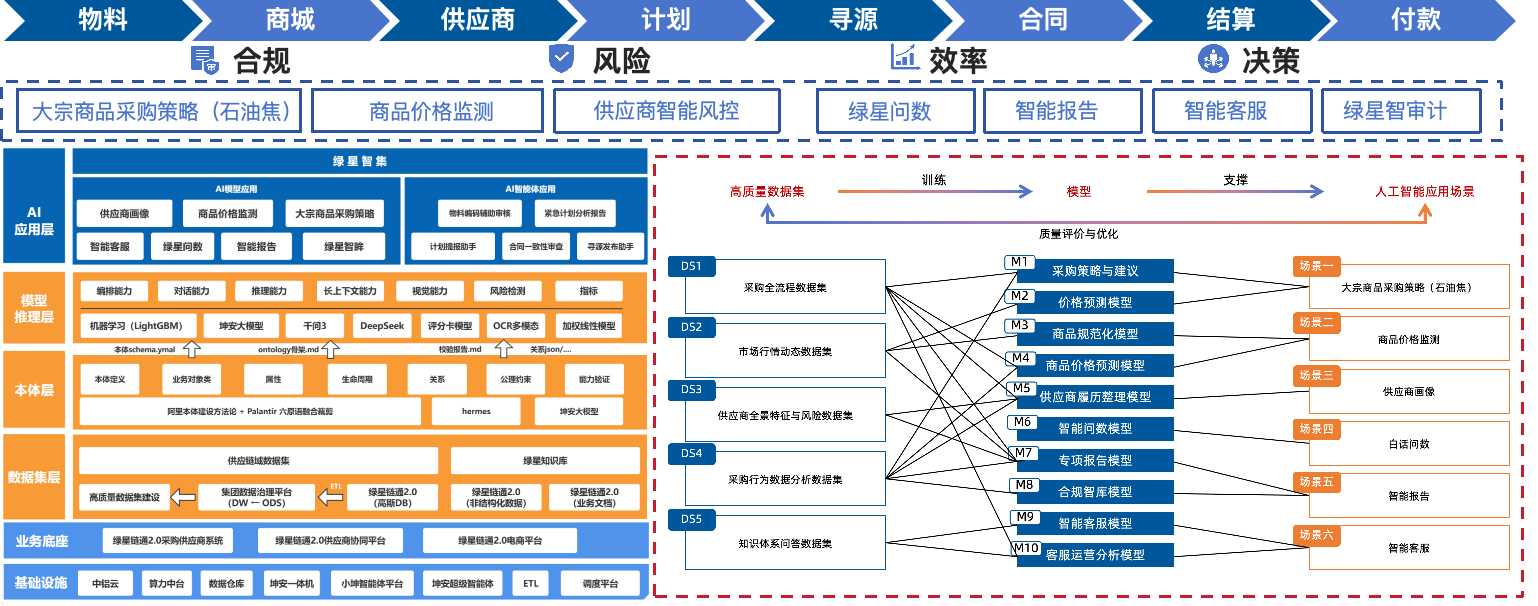
在智能应用层面,中铝物资聚焦非招标采购供应链全流程,依托绿星链通平台和五层一体AI技术架构,融合采购需求计划、采购执行、供应商管理、市场行情、制度规则等多源数据,训练采购策略、价格预测、供应商风控、合规监督等行业AI模型。平台已落地大宗商品采购策略研判、商品价格监测、供应商智能风控、智能问数、智能客服、智能报告、绿星智审等七大AI场景,基于NLP、RAG等技术,实现异常交易风险智能识别、采购决策智能辅助、报告自动生成和知识智能问答,推动非招标采购管理由人工经验驱动向数据智能决策转变,全面提升采购科学性、运行效率、合规管控和供应链安全保障能力。

在采购决策层面,中铝物资的AI模型能够实时分析大宗商品价格走势、供需格局变化及宏观经济指标,自动生成采购策略研判报告,为采购时机与批量决策提供数据支撑。在价格监测方面,系统持续跟踪数百种物料的市场价格动态,通过算法识别价格异常波动并及时预警,有效规避了高价采购风险。

在供应商风控方面,AI模型整合工商信息、司法诉讼、舆情监测等多维数据,实时评估供应商健康度与信用风险。智能风控模型如同“电子哨兵”,及时识别异常行为,累计发现问题122项,拦截近2000家不合格供应商;110项采购流程和93类标准合同文本嵌入系统,以系统校验替代人工监督;发出额度及账期预警25条,推动监督向事前预警、事中拦截转变;同IP预警签约数从13个降至0个,有效遏制风险,实现低成本可持续运营[3]。

在运营提效方面,智能问数功能使业务人员可通过自然语言直接查询采购数据,无需依赖IT部门编写SQL,大幅提升了数据获取效率。这与中铝集团“小坤”AI产品体系一脉相承——基于语言大模型和智能体技术,“小坤问数”让用户用日常语言描述需求即可快速获取精准结果,现已应用于采购计划、合同管理等场景[5]。智能客服7×24小时响应供应商与采购人员的技术咨询与业务问题;绿星智审系统自动对采购文件进行合规性审查,识别潜在风险点并生成审查报告。在招标服务领域,“绿星享招·AI小助手”自2025年3月10日上线以来,回答问题数量从最初的不到100个迅速扩展至516个,日均处理咨询量达200人次,回答准确率超90%[6]。

构建行业高质量数据集,打造可信数据空间

如果说AI场景是“应用之果”,高质量数据集便是“数据之根”。2025年,国家数据局集中发布数据工作成果,中铝物资“有色金属行业供应链协同高质量数据集”入选行业高质量数据集建设先行先试项目,“绿星链通”同步入选国家数据局“高质量数据集建设先行先试项目”,获评央企采购标杆等多项荣誉[1]。这也是中铝集团4项成果同时入选的组成部分——中铝材料院“高端铝合金材料研发与生产高质量数据集”同期入选先行先试项目,中铝数为“有色金属行业数据基础设施”入选国家数据基础设施建设先行先试项目,中铝材料院“铝合金材料金相组织图片数据集”入选高质量数据集典型案例[7]。

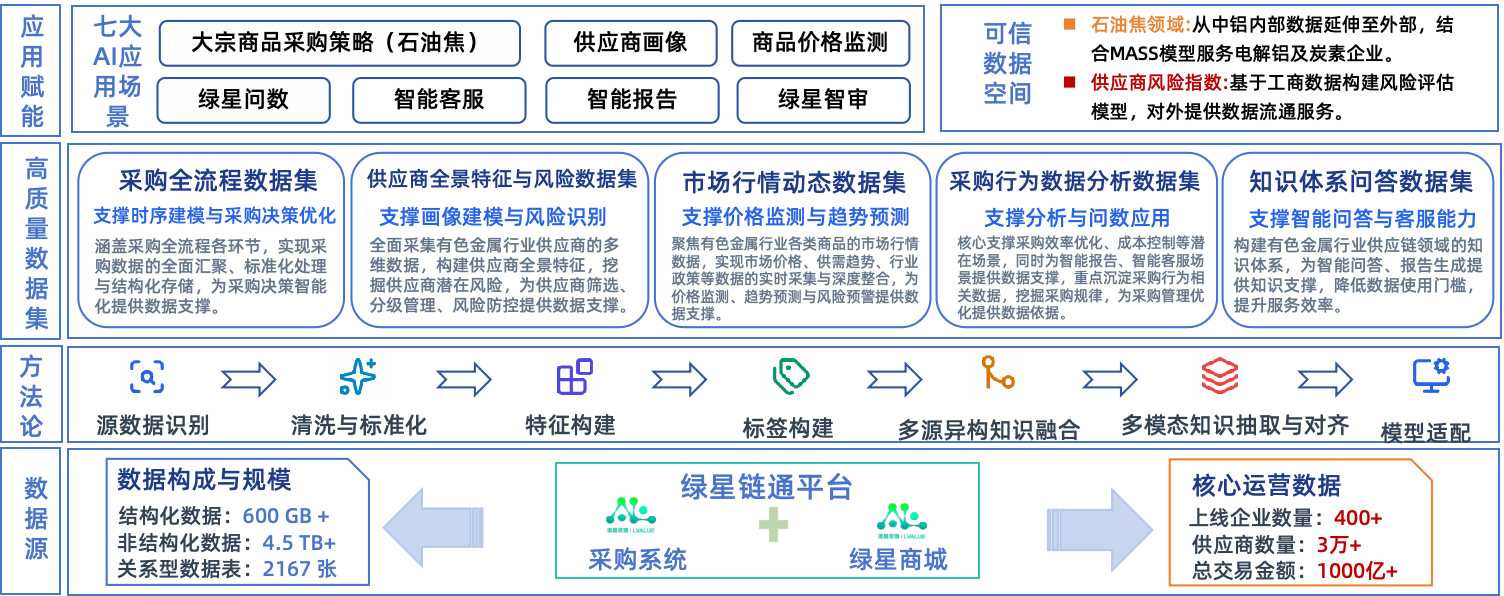
该项目依托中铝集团采购供应链管理平台“绿星链通”落地建设,平台接入400余家企业、3万余家供应商,年交易规模超1000亿元。项目围绕业务沉淀采购全流程、供应商全景特征与风险、市场行情动态、采购行为分析、知识体系问答五大核心数据集,累计形成600GB以上结构化数据和4.5TB以上非结构化数据,配套2167张关系型数据表。其中,采购全流程数据集支撑时序建模与采购决策优化;供应商全景特征与风险数据集支撑画像建模与风险识别;市场行情动态数据集支撑价格监测与趋势预测;采购行为分析数据集支撑采购效率优化与成本控制;知识体系问答数据集为智能问答、报告生成提供知识支撑[7]。

数据集建设遵循一套严谨方法论:源数据识别、清洗标准化、特征构建、标签构建、多源异构知识融合、多模态知识抽取对齐、模型适配,搭建起高质量数据底座。在此基础上,中铝物资打造石油焦、供应商风控、市场行情等可信数据空间,其中石油焦领域结合MASS模型服务电解铝及炭素企业,供应商风险指数依托工商数据搭建风险评估模型,对外开放数据流通服务。依托可信数据空间,平台对外输出行业价格指数、供应链风控等数据服务,支撑大宗商品采购策略、供应商画像、商品价格监测、绿星问数、智能客服、智能报告、绿星智审七大AI场景落地,充分释放数据要素价值,助力有色金属行业安全有序的数据流通,持续推动产业链供应链数字化、智能化升级[7]。

从“数据—模型—应用”的闭环看,中铝物资构建的“需求牵引—架构支撑—数据赋能”体系已在4个供应链AI场景中实现应用[7]。中铝集团层面,“坤安”人工智能大模型的落地进一步夯实了底层支撑——该大模型包含百亿级有色金属行业数据和专业知识,在8个业务域中打造出第一批18个具有行业推广潜力的场景,并已完成DeepSeek本地化部署,可在供应链领域的高效市场分析、全面选品对比等场景开展深度对接[2]。包头铝业采购员只需输入需求,AI即可自动生成包含价格、交期、风险的最优采购方案,订单秒级发出、全程无人干预,正是这一数智体系落地一线的最直观写照[8]。

标杆引领,构建数智供应链生态

从集团内部的管理工具到广受行业认可的标杆平台,“绿星链通”的成长轨迹,折射出中铝物资“数智供应链”建设的深层逻辑[1]。在生态构建方面,中铝物资持续拓展产业链服务。2025年11月,中铝物资与全球最大商用预焙阳极生产企业——索通发展股份有限公司在西安签署战略合作协议,索通发展成为进驻中铝集团“绿星链通”的首家外部领军企业。双方将秉持“优势互补、资源共享、互利共赢”原则,通过“绿星链通”平台共同拓展加强铝用碳素上下游产业链、供应链合作,助推铝用碳素行业从“单一合作”向“生态共建”转型[9]。

在供应链保障方面,中铝物资通过源头直采、流程再造,实现大宗物资采购关键环节自主掌控,创新构建了从海外源头直采到国内终端交付的“端到端”全流程自主供应链体系。2025年10月10日,中铝物资首批进口石油焦到达广西钦州港,标志着其在拓展多元化采购渠道、优化原料结构方面取得新突破,显著强化了资源自主保障与成本控制能力,有效增强了应对市场波动的韧性[10]。

在平台赋能方面,“绿星链通”不仅是交易平台,更是赋能平台。公司依托“绿星链通2.0”商城采购供应链系统建设帮扶专项功能,将50余种特色农产品、70余类工装产品搬上“绿星商城”,打造“从乡村进企业”的数字化直销链路,减少中间环节、实实在在助农惠农;中铝物资党员骨干深入中铝生产企业和外部企业,牵头组织超过200场数字化培训,帮助2.7万余家供应商特别是中小微企业熟悉线上操作、融入数字生态。历经“十四五”期间的深耕细作,“绿星链通”已成长为服务超万家内外部企业、年交易额超500亿元的行业级平台[3]。

面向未来,中铝物资将深化供应商统一管理、库存一体化管理,实现服务类采购全面上线运行,推动采购与生产、库存、财务等环节深度融合;平台将持续拓展人工智能在采购策略优化、价格预测与智能决策中的应用场景,让供应链“会思考、能决策、自优化”[1]。随着高质量数据集建设和可信数据空间的持续完善,中铝物资有望为有色金属行业贡献更多可复制的数智化经验,在建设世界一流优秀有色金属集团、服务数字中国的进程中发挥更大作用。

信息来源:

[1] 中国铝业报/中国铝业集团有限公司官网:中铝物资“绿星链通”打通采购大动脉:https://www.chinalco.com.cn/xwzx/xwzx_qydt/202605/t20260511_168936.html

[2] 今日中铝/中国铝业股份有限公司官网:全国政协委员,中铝集团党组书记、董事长段向东:进一步推动制造业高端化绿色化智能化发展:https://www.chalco.com.cn/tplb/202503/t20250311_144257.html

[3] 中国铝业股份有限公司官网:党建强引领发展好——中铝物资“绿星链通”绘就数智化转型新答卷:https://www.chalco.com.cn/xwdt/qydt/202602/t20260204_163632.html

[4] 中国铝业报/中国铝业集团有限公司官网:“绿星链通2.0”提前实现中铝集团全级次企业上线目标:https://www.chinalco.com.cn/xwzx/xwzx_qydt/202507/t20250702_150797.html

[5] 中国铝业报/中国铝业集团有限公司官网:中铝集团推出“小坤”AI品牌:https://www.chinalco.com.cn/xwzx/xwzx_qydt/202504/t20250407_145396.html

[6] 中国铝业报/中国铝业集团有限公司官网:AI“破冰”服务困局 招标行业“智”绘蓝图:https://www.chinalco.com.cn/xwzx/xwzx_qydt/202505/t20250529_148319.html

[7] 中国铝业报/中国铝业集团有限公司官网:中铝集团4项成果入选国家数据局高质量数据集典型案例与先行先试项目:https://www.chinalco.com.cn/xwzx/xwzx_qydt/202509/t20250908_154642.html

[8] 中国铝业报/中国铝业集团有限公司官网:“坤安”落地 智造生根——中铝集团“十四五”数智化跃升记:https://www.chinalco.com.cn/xwzx/xwzx_qydt/202512/t20251217_160764.html

[9] 中国铝业报/中国铝业集团有限公司官网:中铝物资与索通发展签署战略合作协议:https://www.chinalco.com.cn/xwzx/xwzx_qydt/202511/t20251105_157965.html

[10] 中国铝业报/中国铝业集团有限公司官网:中铝物资拓展多元化采购渠道取得新突破:https://www.chinalco.com.cn/xwzx/xwzx_qydt/202510/t20251015_156369.html

亿邦智库持续关注央国企数字化采购领域的最新进展,如想了解更多与本文相关信息,请扫码关注作者微信或发送邮箱。联系邮箱:zhangjing@ebrun.com


作为TO B领域年度风向标,“2026第八届亿邦产业互联网年会暨首届产业智能体大会”将于11月20日在北京召开。主题定为“AI与出海带来的模态进化”,聚焦产业智能体落地、AI供应链价值重构、数据要素与TOKEN经济、产业出海新生态等前沿议题深度思辨。大会将集结学界权威、央国企标杆、产业龙头、投资机构、服务生态伙伴,汇聚产业核心力量、拆解产业数智化转型路径、分享前沿实战经验。同期还将发布年度产业互联网报告及标杆案例,举办决策人闭门会、“千峰奖”颁奖盛典。


本文首发于 亿邦动力 官方网站

文章来源:亿邦动力

广告
微信
朋友圈

FAQ回顾

绿星链通是什么?

绿星链通是中铝集团数智化采购平台,由中铝物资有限公司建设运营。2023年发布1.0版,2024年6月2.0版实现集团全级次企业上线,覆盖400余家企业、3万余家供应商,年交易规模超1000亿元,实现采购全流程线上化、标准化、透明化。

中铝物资的AI采购有哪些应用场景?

中铝物资依托绿星链通平台,落地大宗商品采购策略研判、商品价格监测、供应商智能风控、智能问数、智能客服、智能报告、绿星智审等七大AI场景,基于NLP、RAG等技术,实现异常交易风险识别、采购决策辅助、报告自动生成和知识智能问答,推动采购由人工经验驱动向数据智能决策转变。

中铝物资入选国家数据局的先行先试项目是什么?

中铝物资“有色金属行业供应链协同高质量数据集”入选国家数据局行业高质量数据集建设先行先试项目。项目围绕采购全流程、供应商全景特征与风险、市场行情动态、采购行为分析、知识体系问答五大核心数据集,累计形成600GB以上结构化数据和4.5TB以上非结构化数据,配套2167张关系型数据表。

绿星链通平台有什么实际效果和优势?

平台上线后,中铝集团采购效率提升50%以上,累计交易规模突破800亿元;供应商接收寻源通知时间从人工1天压缩到系统10分钟,合同生成时间从3天压缩到1小时;物料编码精简72%,拦截不合格供应商1965家;6人团队支撑年400亿级结算量,实现低成本可持续运营。

中铝物资的AI赋能采购对有色金属行业有什么影响?

中铝物资依托绿星链通打造可信数据空间,对外输出行业价格指数、供应链风控等数据服务,支撑采购策略、供应商画像、价格监测等AI场景落地,推动有色金属行业数据要素安全有序流通,为行业数智化转型提供了可复制、可推广的“中铝方案”。

这么好看,分享一下?

朋友圈 分享

APP内打开

赞 +1
+1
微信好友 朋友圈 新浪微博 QQ空间
关闭
收藏成功
发送
/140 0