广告
加载中

小红书双11开局战报:混资券拉动多品类爆发 友好商家GMV最高涨5倍

姜琪 2026-10-16 10:52
姜琪 2026/10/16 10:52

邦小白快读

EN
全文速览

总:小红书双11混资券是平台联手商家发放的补贴券,分凑单混资和爆品混资两种,消费者可重点关注参与店铺享受满减。

1. 凑单混资适合直播类商家,商家和平台各出一半钱发券,买多件好凑单;爆品混资适合笔记型商家,平台按档位补贴,冲量档商家出10%、平台补6%至15%。

2. 数据显示,爆品混资商品成交额较日常涨2倍,新品涨3倍以上;2000元以上商品涨3倍,1200至2000元涨3.5倍,800至1200元涨3.5倍,说明高客单价商品也有明显优惠。

3. 不同类型店铺增长集中在家用刚需和美妆领域,美妆护肤店铺涨5倍,休闲食品和家具涨3倍,女装涨2.5倍,买手直播间也带动美妆个护和美食滋补增长。

4. 平台更愿意补贴内容真实、服务达标、价格有竞争力的友好商家,建议优先选择这类店铺,优惠更确定。

总:混资券是小红书本季大促核心补贴工具,品牌商可借平台共担成本的方式放大营销效果,并参考增长数据调整定价和产品策略。

1. 营销和渠道建设:品牌可参与凑单混资,与平台各出50%向用户发满减券,适合直播且品多好凑单;若以笔记经营为主,可选爆品混资,平台按档位补贴6%至15%,冲量档品牌只需出资10%。

2. 定价和价格竞争:高客单价商品表现突出,2000元以上商品GMV较日常增3倍,1200至2000元增3.5倍,800至1200元增3.5倍,中高价格带仍有增长弹性;但平台补贴要求价格有竞争力,定价需兼顾利润和吸引力。

3. 消费趋势和用户行为:美妆护肤报名商家GMV增5倍,休闲食品和家具增3倍,女装增2.5倍;新品GMV较大促前增3倍以上,说明用户对新品和高品质品类接受度高。

4. 平台策略:小红书明确扶持内容真实、服务达标、价格有竞争力的友好商家,品牌需注重内容真实性和服务体验,才能持续获得平台资源倾斜。

总:混资券是小红书大促的重要政策,卖家可依据自身经营模式选择玩法,抓住平台扶持窗口,同时要满足友好商家门槛。

1. 政策解读:凑单混资适合直播为主、多品好凑单的商家,商家与平台各出50%;爆品混资适合核心场域非直播、笔记型经营商家,冲量档商家出资10%、平台补贴6%至15%,档位越高补贴越多。

2. 增长机会:爆品混资商品GMV较日常增2倍,新品增3倍以上;高客单价商品增3倍左右。凑单混资店铺整体增2倍,其中美妆护肤商家增5倍,休闲食品和家具增3倍,女装增2.5倍。买手福利券也带动开播买手GMV增2倍,直播曝光增1.5倍。

3. 合作方式:商家可与平台共担补贴,也可与买手合作获得流量,美妆个护买手GMV增5倍、美食滋补增3.5倍、户外运动增2倍,是值得尝试的渠道。

4. 风险提示:平台补贴效率取决于商家是否值得被补贴,内容真实、服务达标、价格有竞争力是硬条件;若不达标可能拿不到流量倾斜,需先整改再冲量。

总:混资券首波数据揭示了消费需求变化,工厂可据此调整产品线和生产策略,抓住高客单、新品和品类爆发机会。

1. 产品设计和定价:高客单价商品增长明显,800至2000元及以上区间的GMV均增长3倍以上,说明中高价位、有品质感的产品更有市场,工厂可以和品牌合作开发高溢价商品。

2. 品类方向:美妆护肤、休闲食品、家具、女装、户外运动等品类增长较快,对应供应链可提前布局产能及原材料,尤其美妆和家具增幅达3至5倍。

3. 新品需求:新品GMV较大促前增3倍以上,平台和消费者都愿意给新品机会,工厂需支持品牌加快新品研发、小单快反能提升竞争力。

4. 电商数字化启示:平台更倾向补贴内容真实、服务达标、价格有竞争力的商家,工厂需配合品牌做好品质管控和性价比,才能进入平台友好商家体系,获得更稳定订单。

总:混资券玩法带来新的服务需求,服务商可帮助商家理解平台补贴规则、优化经营方式,从而实现增长。

1. 行业趋势:平台补贴从普惠流量转向友好商家定向倾斜,补贴效率更依赖商家表现,服务商需帮助客户达到内容真实、服务达标、价格有竞争力的标准。

2. 客户痛点:商家既想获得平台补贴,又担心投入成本;同时种草与下单分离问题仍存在,混资券是缓解交易转化难的工具。

3. 解决方案:根据商家直播或笔记属性选择凑单混资或爆品混资,优化直播场景和笔记内容,规划凑单商品组合,并在定价上留足补贴空间;可布局买手合作,利用买手福利券提升曝光和转化。

4. 数据机会:美妆护肤、食品、家具、女装、户外运动等行业增长突出,高客单价商品弹性大,服务商可围绕这些品类提供代运营、内容制作和买手撮合服务。

总:小红书混资券的玩法展示了平台通过补贴提升交易闭环的新思路,平台方可借鉴其补贴设计和商家管理机制。

1. 最新做法:平台推出混资券,分为凑单混资和爆品混资,与商家共同出资或按档位补贴,把资源倾斜给友好商家,确保补贴花在能转化的商家上。

2. 招商和运营:从数据看,美妆护肤、休闲食品、家具、女装和高客单价商品增长明显,平台招商可重点吸引这些品类商家;同时明确友好商家标准,有利于筛选高质量供给。

3. 商业需求:小红书用户月活超4亿,每日3900万求购行为,但存在种草与下单分离问题,混资券是促进站内成交的手段;其他平台可参考如何用补贴改善交易闭环。

4. 风向规避:平台需要评估商家是否值得补贴,避免补贴浪费;补贴机制应设计保底条件和分档激励,避免恶意刷单和低质商家套利。

总:混资券是平台与商家共担补贴的促销创新,折射出平台交易闭环、商家治理和消费结构的最新动向。

1. 产业新动向:小红书月活超4亿、日求购用户3900万,但种草与下单分离长期存在;混资券是平台试图用补贴把交易留在站内的重要尝试。

2. 商业模式:混资券分凑单混资和爆品混资,前者平台商家各出50%,后者按档位递增补贴,配合买手福利券,形成平台、商家、买手三方联动的激励结构。

3. 消费数据:高客单价商品GMV增长3倍以上,新品增长3倍以上,美妆食品家具等行业增长显著,反映消费者在高品质、新品类上的需求弹性,值得进一步实证。

4. 启示与建议:平台补贴应设置基于内容真实、服务达标、价格竞争力的评估标准,以此激励商家正当经营;研究者可关注补贴效率、商家行为变化以及对竞争格局的影响。

返回默认
声明:快读内容全程由AI生成,请注意甄别信息。如您发现问题,请发送邮件至 run@ebrun.com 。

我是 品牌商 卖家 工厂 服务商 平台商 研究者 帮我再读一遍。

Quick Summary

Summary: RedNote's Double 11 co-funded coupons are subsidies jointly issued by the platform and merchants, divided into two types: cart-fill co-funding and best-seller co-funding. Consumers should focus on participating stores to enjoy discounts.

1. Cart-fill co-funding suits livestream merchants: the merchant and platform each cover half of the coupon cost, making it easy for shoppers to buy multiple items to reach thresholds. Best-seller co-funding suits note-based merchants: the platform subsidizes by tier, with merchants at the volume-driving tier paying 10% and the platform adding 6%–15%.

2. Data shows that products under best-seller co-funding saw GMV 2 times higher than daily levels, and new products grew more than 3 times. Items above 2,000 yuan rose 3 times, items between 1,200 and 2,000 yuan rose 3.5 times, and items between 800 and 1,200 yuan rose 3.5 times, indicating high unit-priced products also get significant discounts.

3. Growth among different store types was concentrated in household essentials and beauty. Beauty and skincare stores grew 5 times, snacks and furniture grew 3 times, and women's apparel grew 2.5 times. Buyers' livestream rooms also drove growth in beauty/personal care and food/nourishment.

4. The platform is more willing to subsidize merchants that provide authentic content, meet service standards, and offer competitive prices. It is recommended to prioritize such stores for more reliable discounts.

Summary: Co-funded coupons are the core subsidy tool for RedNote's current season promotion. Brands can leverage the platform's shared-cost mechanism to amplify marketing performance, and use the growth data to adjust pricing and product strategy.

1. Marketing and channel building: Brands can join cart-fill co-funding, where the brand and platform each contribute 50% to issue threshold coupons to users; this suits livestream merchants with diverse products. For note-based operations, brands can choose best-seller co-funding, with platform subsidies of 6%–15% by tier; at the volume-driving tier, the brand only contributes 10%.

2. Pricing and price competitiveness: High unit-priced products performed strongly. GMV for items above 2,000 yuan grew 3 times versus daily levels; items between 1,200 and 2,000 yuan grew 3.5 times; items between 800 and 1,200 yuan grew 3.5 times. The medium-to-high price band still has growth elasticity, but the platform's subsidy requires competitive pricing, so pricing must balance margins and attractiveness.

3. Consumption trends and user behavior: Beauty and skincare registering merchants saw GMV grow 5 times, snacks and furniture grew 3 times, and women's apparel grew 2.5 times. New products' GMV grew more than 3 times versus pre-promotion levels, indicating users' high acceptance of new products and premium categories.

4. Platform strategy: RedNote explicitly supports friendly merchants with authentic content, qualified service, and competitive prices. Brands must focus on content authenticity and service experience to continue receiving platform resource support.

Summary: Co-funded coupons are an important policy in RedNote's major promotions. Sellers can choose the gameplay based on their operating model, seize the window of platform support, and meet the friendly-merchant threshold.

1. Policy interpretation: Cart-fill co-funding suits merchants that focus on livestream and have diverse products easy to combine; merchant and platform each contribute 50%. Best-seller co-funding suits merchants whose core field is not livestream but note-based operations; at the volume-driving tier, the merchant contributes 10% and the platform subsidizes 6%–15%. The higher the tier, the more the platform subsidies.

2. Growth opportunities: Products under best-seller co-funding saw GMV 2 times higher than daily levels, and new products grew more than 3 times. High unit-priced products grew around 3 times. Stores under cart-fill co-funding grew 2 times overall, with beauty and skincare merchants up 5 times, snacks and furniture up 3 times, and women's apparel up 2.5 times. Buyer welfare coupons also lifted livestreaming buyers' GMV by 2 times and livestream exposure by 1.5 times.

3. Collaboration options: Merchants can co-fund subsidies with the platform or partner with buyers to gain traffic. In the buyer channel, GMV for beauty/personal care grew 5 times, food/nourishment grew 3.5 times, and outdoor sports grew 2 times—a channel worth trying.

4. Risk warning: The efficiency of platform subsidies depends on whether the merchant deserves to be subsidized. Authentic content, service standards, and competitive prices are hard requirements; if merchants fail to meet them, they may not receive traffic support and need to improve before scaling.

Summary: The first wave of co-funded coupon data reveals changes in consumer demand. Factories can use it to adjust product lines and production strategies, seizing opportunities in high unit-priced items, new products, and category booms.

1. Product design and pricing: High unit-priced products grew significantly. GMV in the 800–2,000 yuan and above ranges all rose more than 3 times, indicating that mid-to-high-priced, quality-oriented products have stronger market appeal. Factories can partner with brands to develop high-premium products.

2. Category direction: Beauty and skincare, snacks, furniture, women's apparel, and outdoor sports are growing faster. Supply chains should prepare production capacity and raw materials in advance, especially beauty and furniture, which grew 3 to 5 times.

3. New product demand: New products' GMV grew more than 3 times versus pre-promotion levels. Both the platform and consumers are willing to give new products a chance. Factories need to support brands in accelerating new-product R&D; small-batch, fast-turnaround production can enhance competitiveness.

4. E-commerce digitalization insights: The platform tends to subsidize merchants with authentic content, qualified service, and competitive prices. Factories must cooperate with brands on quality control and cost-effectiveness to enter the platform's friendly-merchant system and gain more stable orders.

Summary: The co-funded coupon model creates new service demand. Service providers can help merchants understand platform subsidy rules and optimize operations to achieve growth.

1. Industry trend: Platform subsidies are shifting from universal traffic to targeted support for friendly merchants, with subsidy efficiency more dependent on merchant performance. Service providers need to help clients meet the standards of content authenticity, service quality, and competitive pricing.

2. Client pain points: Merchants want platform subsidies but worry about investment costs. Meanwhile, the gap between content inspiration and purchase still exists; co-funded coupons are a tool to ease conversion.

3. Solutions: Choose cart-fill or best-seller co-funding based on a merchant's livestream or note attributes; optimize livestream scenes and note content; plan cart-fill product combinations; and leave enough room in pricing for subsidies. Also arrange buyer partnerships, using buyer welfare coupons to boost exposure and conversion.

4. Data opportunities: Beauty and skincare, food, furniture, women's apparel, and outdoor sports show prominent growth, and high unit-priced products have strong elasticity. Service providers can offer agency operations, content production, and buyer matching services around these categories.

Summary: RedNote's co-funded coupon model demonstrates a new approach to using subsidies to enhance the transaction loop. Platform operators can learn from its subsidy design and merchant management mechanisms.

1. Latest practices: The platform launched co-funded coupons in two forms—cart-fill co-funding and best-seller co-funding—jointly funding with merchants or subsidizing by tier. It channels resources toward friendly merchants, ensuring subsidies are spent on merchants who can convert.

2. Merchant recruitment and operations: Data shows strong growth in beauty and skincare, snacks, furniture, women's apparel, and high unit-priced products. Platforms can recruit merchants in these categories as a priority; meanwhile, clarifying friendly-merchant standards helps filter high-quality supply.

3. Business needs: RedNote has over 400 million monthly active users and 39 million daily purchase-intent behaviors, but a gap between content interest and purchase persists. Co-funded coupons are a way to drive in-platform transactions. Other platforms can reference how to improve the transaction loop with subsidies.

4. Avoiding adverse selection: Platforms need to assess whether merchants deserve subsidies to avoid waste. Subsidy mechanisms should have baseline conditions and tiered incentives to prevent fraudulent orders and low-quality merchants gaming the system.

Summary: Co-funded coupons represent a promotional innovation in which the platform and merchants share subsidy costs, reflecting the latest trends in platform transaction loops, merchant governance, and consumption structure.

1. Industry dynamics: RedNote has over 400 million monthly active users and 39 million daily purchase-intent users, but the disconnect between content 'seeding' and order placement has persisted. Co-funded coupons are an important attempt by the platform to use subsidies to keep transactions on the platform.

2. Business model: Co-funded coupons are divided into cart-fill co-funding and best-seller co-funding. The former is equally funded by platform and merchant (50/50), while the latter gives tiered incremental subsidies. Combined with buyer welfare coupons, this forms an incentive structure where platform, merchants, and buyers interact.

3. Consumption data: GMV for high unit-priced products grew more than 3 times, new products grew more than 3 times, and beauty, food, and furniture categories saw significant growth. This reflects consumers' demand elasticity for high-quality and new categories, warranting further empirical research.

4. Implications and recommendations: Platform subsidies should be based on evaluation criteria of content authenticity, service standards, and price competitiveness to encourage legitimate merchant behavior. Researchers can focus on subsidy efficiency, changes in merchant behavior, and impacts on the competitive landscape.

Disclaimer: The "Quick Summary" content is entirely generated by AI. Please exercise discretion when interpreting the information. For issues or corrections, please email run@ebrun.com .

I am a Brand Seller Factory Service Provider Marketplace Seller Researcher Read it again.

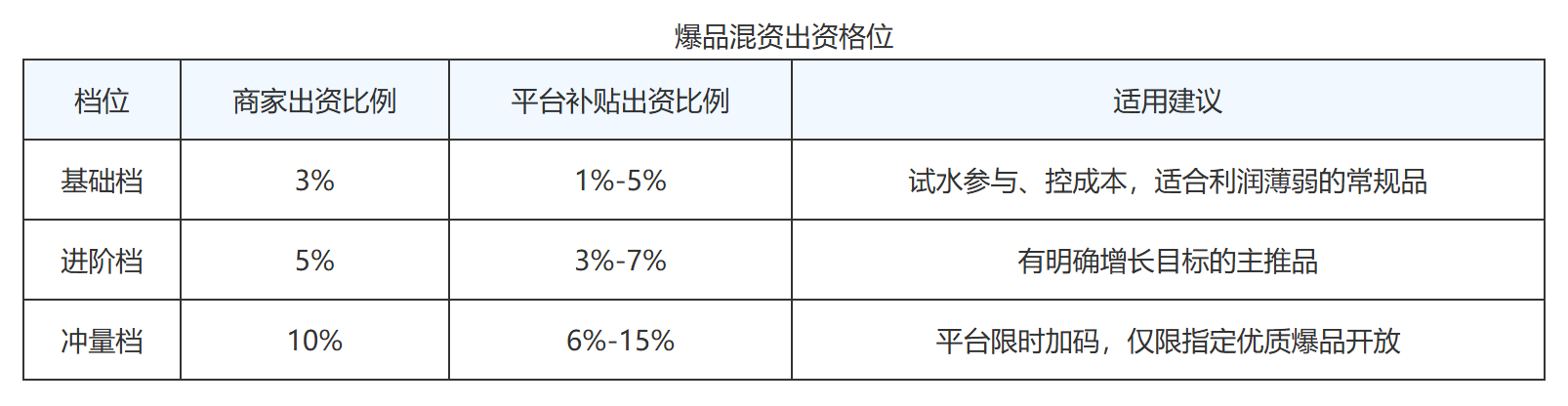
【亿邦原创】小红书1年1度购物狂欢迎来开门红,平台特别上线友好商家专属“混资券”玩法,对优质商家和买手进行资源倾斜。作为本次大促的核心补贴工具,混资券分为凑单混资和爆品混资。前者是商家与平台各出资50%,面向用户发满减券,适合直播为主、品多好凑单的商家;后者适合核心场域为非直播、笔记型经营商家,平台补贴按档位递增,冲量档商家出资10%、平台补贴6%至15%。

数据显示,参与爆品混资玩法的商品GMV较日常增长2倍,新品GMV较大促前增长3倍以上。高客单价商品同样表现突出:2000元以上商品GMV较日常增长3倍,1200至2000元区间增长3.5倍,800至1200元区间增长3.5倍。

凑单混资方面,友好商家店铺整体GMV较日常增长2倍。分行业看,美妆护肤行业报名商家GMV较日常增长5倍,休闲食品与家具行业均增长3倍,女装行业增长2.5倍。

买手侧,参与买手福利券的开播买手GMV较日常增长两倍,直播间曝光提升1.5倍。分行业看,美妆个护报名买手GMV较日常增长5倍,美食滋补增长3.5倍,户外运动增长2倍。

小红书月活超4亿,每天有3900万用户产生明确求购行为,但“种草在小红书、下单在其他平台”的习惯依然长期存在。混资券的逻辑是,把流量等补贴分给被验证为“友好”的商家。补贴效率取决于商家是否“值得被补贴”——内容真实、服务达标、价格有竞争力,平台才愿意为其出资。

从首波数据看,这一机制在美妆、食品、家具等品类已初步验证撬动效果,高客单价商品的增长弹性尤其值得关注。小红书方面也表示,此次大促延续了对“用心做好货、真诚做经营”的友好商家的扶持策略,旨在让新品、高客单商品以及优质商家和买手获得更确定的增长。

亿邦持续追踪报道该情报,如想了解更多与本文相关信息,请扫码关注作者微信。

本文首发于 亿邦动力 官方网站

文章来源:亿邦动力

广告
微信
朋友圈

FAQ回顾

什么是小红书混资券?

混资券是小红书双11大促的核心补贴工具,分为凑单混资和爆品混资两种玩法。凑单混资由商家与平台各出资50%发放满减券,适合直播为主、品多好凑单的商家;爆品混资适合非直播、笔记型经营商家,平台补贴按档位递增,冲量档商家出资10%,平台补贴6%至15%。参与爆品混资的商品GMV较日常增长2倍。

小红书混资券对商家GMV有什么带动效果?

首波数据显示,参与爆品混资的商品GMV较日常增长2倍,新品GMV较大促前增长3倍以上;凑单混资商家店铺整体GMV较日常增长2倍。分行业看,美妆护肤报名商家GMV较日常增长5倍,休闲食品与家具行业均增长3倍,女装行业增长2.5倍。高客单价商品增长同样突出,2000元以上商品GMV较日常增长3倍。

什么样的小红书商家能获得混资券补贴?

混资券的补贴效率取决于商家是否值得被补贴。小红书会将流量等补贴分给被验证为友好的商家,即内容真实、服务达标、价格有竞争力的商家。只有这样的友好商家,平台才愿意为其出资,帮助新品、高客单商品以及优质商家和买手获得更确定的增长。

小红书双11混资券玩法有哪些类型?

混资券分为凑单混资和爆品混资两种。凑单混资是商家与平台各出资50%,面向用户发满减券,适合直播为主、品多好凑单的商家;爆品混资适合核心场域为非直播、笔记型经营的商家,平台补贴按档位递增,冲量档商家出资10%、平台补贴6%至15%。两种玩法共同构成小红书大促的核心补贴工具。

小红书双11混资券对买手和直播间有什么影响?

买手侧同样获得增长。参与买手福利券的开播买手GMV较日常增长两倍,直播间曝光提升1.5倍。分行业看,美妆个护报名买手GMV较日常增长5倍,美食滋补增长3.5倍,户外运动增长2倍。这说明混资券对买手直播间的流量和转化都有明显撬动作用。

这么好看,分享一下?

朋友圈 分享

APP内打开

赞 +1
+1
微信好友 朋友圈 新浪微博 QQ空间
关闭
收藏成功
发送
/140 0