广告
加载中

官方规范出台 美妆博主未来应如何“测评”?

亿邦动力 2026-06-12 17:39
亿邦动力 2026/06/12 17:39

邦小白快读

EN
全文速览

本文核心内容是国家网信办、市场监管总局联合出台了《网络测评活动规范》,明确了各类网络测评的合规要求,普通读者可以借此掌握辨别靠谱美妆测评的方法,避开不实测评的坑。

1. 看普通主观体验类测评:合规测评会显著标注“仅个人体验”或“主观感受仅供参考”,遇到没有标注的要提高警惕,不要盲目相信测评结论。

2. 看带货商单类测评:凡是和品牌有合作、带购物链接的测评,合规的会明确标注“广告”标识,同时合规测评要求样品和消费者能买到的大货一致,遇到没标广告的带货测评要谨慎甄别。

3. 看专业测试类测评:合规测评会委托有资质的检测机构,优先按国家、行业标准测试,遇到用非标方法又不做说明的,其结果可信度较低。

新出台的《网络测评活动规范》对美妆品牌的测评营销合作做了明确约束,品牌需要调整自身规则,规避合规风险,抓住规范化带来的发展机会。

1. 合作营销层面:品牌和博主开展商单带货测评合作时,必须提供和市面大货一致的测评样品,配合博主确认样品一致性,同时要求博主显著标注“广告”标识,避免违规受罚。

2. 权益维护层面:如果遭遇第三方博主的不实测评质疑,可依据规范要求对方使用符合国家、行业标准的检测方法,核查对方检测机构资质,合理维护自身品牌权益。

3. 消费趋势层面:规范出台后会淘汰虚假测评,用户对测评内容的信任度会逐步提升,合规的测评营销效果会更好,品牌可侧重和合规测评博主长期合作,塑造口碑。

本次出台的《网络测评活动规范》明确了测评行业的合规规则,对依托测评带货的美妆卖家来说,需要及时调整运营,规避风险抓住新机会。

1. 政策要求层面:凡是有合作带货、附带购买链接的测评内容,必须要求发布测评的博主显著标注“广告”,提供的测评样品必须和日常售卖的大货保持一致,且样品来源可追溯,避免触碰规则红线。

2. 风险提示:如果策划同类产品对比测评,不能要求博主采用双标标准、恶意拉踩同行,也不能做虚假产品描述,否则涉嫌违规。

3. 机会提示:规范会清退不合规的虚假测评,整个测评行业的信任度会提升,合规经营的卖家只要坚持和合规博主合作,就能获得更稳定、更长期的用户转化,增长空间更大。

本次《网络测评活动规范》的出台,对美妆生产工厂的经营和发展有多方面的启示,核心干货如下。

1. 生产要求层面:规范明确要求测评样品必须和消费者能买到的大货一致,工厂不能为品牌测评合作特殊定制专供样品,需要保障所有批次产品的品质稳定一致,避免测评结果和大货品质不符引发品牌和产品信任危机。

2. 权益保障层面:如果自有代工或者自产的产品遭遇不实测评抹黑,比如对方使用非国家标准检测、委托无资质机构出报告,工厂可以配合品牌依据规范维护自身权益。

3. 电商发展启示:规范让线上测评带货行业走向合规,工厂可以更放心地和合规品牌、测评博主合作开展线上销售,依托真实合规的测评打开产品销路,拓展电商渠道。

《网络测评活动规范》出台后,测评相关服务行业迎来新的发展趋势,也明确了新的需求方向,核心干货如下。

1. 行业发展趋势:规范明确要求专业测评必须使用有法定资质的检测机构出具报告,未来合规的第三方检测服务需求会明显上涨,无资质的小机构会逐步被市场淘汰,行业集中度会提升。

2. 客户痛点梳理:品牌和测评博主都有核验检测机构资质、检测报告真伪的需求,也需要符合国家行业标准的标准化检测服务,这是服务商新的业务增长点。

3. 解决方案方向:检测服务商需要主动公示自身法定资质,严格按照现有标准提供检测服务,还可以新增资质核验、报告真伪验证的配套服务,满足博主和品牌的合规需求。

新出台的《网络测评活动规范》对内容平台的测评内容运营管理提出了明确要求,平台可据此调整规则,规避行业风险,打造更健康的内容生态。

1. 运营管理层面:平台需要根据规范要求更新测评内容的审核规则,要求不同类型的测评标注对应提示:商单带货测评必须标广告,主观测评必须标体验提示,同时打击双标拉踩、虚假诋毁的违规测评内容。

2. 招商布局层面:平台可以针对性引入合规的测评博主、正规检测机构入驻,打造合规测评内容标签,吸引对真实测评有需求的用户,提升平台内容信任度。

3. 风险规避层面:平台要建立测评内容中检测资质、检测报告的核验机制,清理无资质虚假测评,避免行业违规风险传导到平台,影响平台声誉。

本次国家网信办、市场监管总局联合印发《网络测评活动规范》,是我国网络测评行业首个系统性的规范文件,对研究互联网内容营销产业有重要的参考价值,核心干货如下。

1. 产业新动向:此前网络测评行业野蛮生长,虚假测评、双标拉踩、不合规检测等问题频发,多次引发品牌和测评博主的公共争议,本次规范出台标志着行业正式进入合规发展阶段,产业格局面临重构。

2. 政策层面启示:本次规范针对行业痛点问题分类做出明确规则,填补了网络测评领域的规则空白,为后续行业监管提供了明确依据,也为研究互联网内容监管提供了新的样本。

3. 商业模式层面:未来合规化的真实测评会成为主流商业模式,依赖虚假测评、恶意拉踩获利的商业模式会被逐步淘汰,测评营销行业会迎来新的发展阶段。

返回默认
声明:快读内容全程由AI生成,请注意甄别信息。如您发现问题,请发送邮件至 run@ebrun.com 。

我是 品牌商 卖家 工厂 服务商 平台商 研究者 帮我再读一遍。

Quick Summary

This article summarizes the newly released *Code of Conduct for Online Review Activities*, jointly issued by the Cyberspace Administration of China and the State Administration for Market Regulation. The regulation lays out clear compliance requirements for all types of online product reviews, and helps ordinary consumers learn to identify legitimate beauty product reviews and avoid misleading, untrustworthy content.

1. For subjective experience reviews: Compliant reviews must include a prominent disclaimer stating "for personal experience only" or "subjective opinion for reference only." Consumers should be wary of unmarked reviews and not blindly trust their conclusions.

2. For affiliate/commissioned reviews that link to product purchases: Any review created in partnership with a brand must prominently label the content as "advertising." The regulation also requires that the test sample provided for review matches the mass-produced product available to consumers. Consumers should carefully vet any affiliate review that lacks an "advertising" label.

3. For professional laboratory testing reviews: Compliant reviews must use testing services from qualified accredited institutions, and prioritize testing aligned with national and industry standards. Reviews that use non-standard testing methods without explanation have low credibility.

The newly released *Code of Conduct for Online Review Activities* sets clear rules for brands’ influencer review marketing collaborations in the beauty industry. Brands need to update their internal policies to mitigate compliance risk and capture new growth opportunities brought by industry standardization.

1. Marketing collaboration: When working with influencers on commissioned review campaigns, brands must provide test samples identical to the mass-produced products sold to consumers, confirm sample consistency with influencers, and require influencers to prominently label content as "advertising" to avoid penalties for non-compliance.

2. Brand rights protection: When faced with unfounded negative reviews from third-party influencers, brands can demand that reviewers use testing methods aligned with national and industry standards and verify the testing institution’s qualifications, in accordance with the new code to legally protect brand reputation.

3. Long-term consumer trends: The code will eliminate fraudulent reviews and gradually increase consumer trust in review content, boosting the performance of compliant review marketing. Brands should prioritize long-term partnerships with compliant review creators to build solid brand reputation.

The new *Code of Conduct for Online Review Activities* establishes clear compliance rules for the online review industry, requiring beauty sellers who rely on review-driven sales to adjust their operations in time to avoid risks and seize emerging opportunities.

1. Policy compliance: For any commissioned review content that includes product purchase links, sellers must require the publishing creator to add a prominent "advertising" label. Test samples must match the mass-produced products sold to consumers, with traceable sample sources, to avoid violating regulatory requirements.

2. Risk warning: When organizing comparative reviews of competing products, sellers cannot demand that influencers use double standards or maliciously badmouth rival brands, nor can they make false product claims—both violations carry regulatory penalties.

3. Growth opportunities: The regulation will clear unregulated fraudulent reviews from the market and lift overall consumer trust in the review industry. Compliant sellers who stick to partnering with compliant creators will gain more stable, long-term user conversion and greater long-term growth potential.

The introduction of the *Code of Conduct for Online Review Activities* offers key insights for beauty product manufacturers’ operations and long-term growth, with core takeaways as follows:

1. Production requirements: The regulation mandates that test samples must match mass-produced products sold to consumers. Factories cannot produce custom, special-purpose samples exclusively for brand review collaborations, and must maintain consistent quality across all production batches to avoid trust crises for brands and products caused by mismatched test and retail product quality.

2. Rights protection: If an OEM or self-branded product manufactured by the factory is smeared by fraudulent reviews—such as reviews that use non-standard testing methods or unqualified testing institutions—factories can partner with brand clients to protect their rights in accordance with the new regulation.

3. Implications for e-commerce growth: The regulation pushes the online review-driven sales industry toward full compliance, allowing manufacturers to more confidently partner with compliant brands and review creators for online sales, expanding distribution through authentic, compliant reviews.

Following the release of the *Code of Conduct for Online Review Activities*, the review-related service sector is seeing new development trends and clear new demand, with key insights as follows:

1. Industry development trends: The regulation requires professional reviews to include testing reports from legally accredited institutions. Demand for compliant third-party testing services will rise noticeably in the coming period, while unqualified small testing institutions will gradually be phased out of the market, driving increased industry concentration.

2. New client demand: Both brands and review creators need services to verify testing institution qualifications and test report authenticity, as well as standardized testing services aligned with national and industry standards—this is a new growth area for service providers.

3. Product development direction: Testing service providers should proactively disclose their legally required qualifications, strictly follow existing standards to deliver testing services, and add supporting services including qualification verification and test report authentication to meet the compliance needs of creators and brands.

The newly released *Code of Conduct for Online Review Activities* sets clear requirements for content platforms’ review content operations and management. Platforms can adjust their rules based on the code to mitigate industry risk and build a healthier content ecosystem.

1. Operations management: Platforms need to update review content moderation rules to align with the code, requiring clear disclosures for different types of reviews: all affiliate commissioned reviews must be labeled as advertising, subjective experience reviews must include an experience disclaimer, and non-compliant reviews including double-standard comparisons, malicious badmouthing and false defamation should be removed.

2. Creator and partner recruitment: Platforms can proactively onboarding compliant review creators and accredited testing institutions, launch exclusive tags for compliant review content, attract users seeking authentic reviews, and increase overall trust in the platform’s content ecosystem.

3. Risk mitigation: Platforms should build verification mechanisms for testing qualifications and test reports featured in reviews, remove fraudulent reviews from unqualified providers, and prevent industry non-compliance risk from spilling over to the platform and harming its reputation.

The *Code of Conduct for Online Review Activities*, jointly issued by the Cyberspace Administration of China and the State Administration for Market Regulation, is the first systematic regulatory document for China’s online review industry. It carries important reference value for research on the internet content marketing industry, with core takeaways as follows:

1. New industry shifts: Before this regulation, the online review industry grew with minimal oversight, with frequent issues including fraudulent reviews, double-standard comparisons, unregulated testing, and repeated public controversies involving brands and review creators. The new regulation marks the industry’s official entry into a compliant development stage, and the industry’s overall structure is set for restructuring.

2. Implications for policy research: The regulation establishes targeted clear rules for the industry’s most pressing pain points, fills the regulatory gap in the online review space, provides a clear basis for future industry oversight, and offers a new case study for research on digital content regulation.

3. Shifts in business models: Compliant, authentic reviews will become the mainstream business model going forward, while business models that profit from fraudulent reviews and malicious badmouthing will be gradually phased out, bringing the review marketing industry into a new phase of structured development.

Disclaimer: The "Quick Summary" content is entirely generated by AI. Please exercise discretion when interpreting the information. For issues or corrections, please email run@ebrun.com .

I am a Brand Seller Factory Service Provider Marketplace Seller Researcher Read it again.

【亿邦原创】日前,国家网信办、市场监管总局联合印发《网络测评活动规范》(以下简称《规范》)。规范中的“网络测评活动”,并不包含消费者发布消费体验,主要是评价产品质量、功能、性价比等,手段包括测试、对比分析数据、引用专业检测结果、表达使用感受等。

规定对三类测评都出具明确规定:商单/带货测评、测试类测评、普通或主观测评。从目前来看,《规范》针对这几类测评内容释出的主要信息为:

1、商单/带货测评:需显著标明广告标志,需与品牌确认,收到的测评产品是否与大货一致。

2、测试类测评:测试需优先按现有标准进行,委托的检测机构需有资质,需核验检测机构的资质、检测报告的真伪。

3、普通或主观测评:需显著标明类似“仅主观体验”等信息;对比多款同类产品时不能“双标”,不能“拉踩”;不能虚假描述、恶意诋毁、使用侮辱性用语。

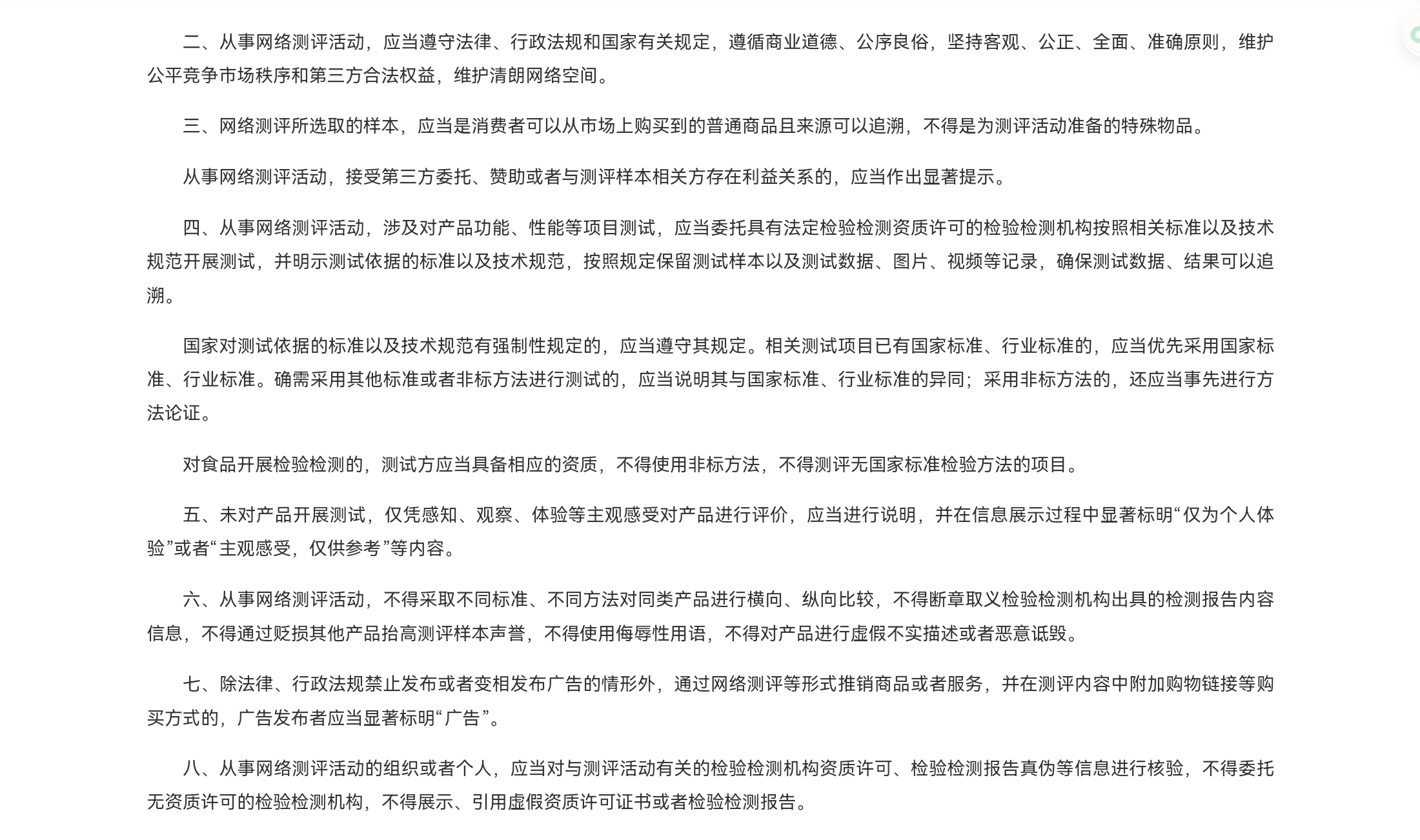
关于商单或带货测评,需标明广告提示,根据《规范》第三条,有商单或带货合作的测评内容,需做出显著提示。根据《规范》第七条,测评内容是推销商品或服务,且在内容中附带有购物链接等购买方式的,发布者需显著标明“广告”。

同时,同样根据《规范》第三条,测评的样本不能是为测评准备的特殊款,而应是消费者能卖到的普通商品,且来源可追溯。换言之,如果甲方与博主合作测评商单,提供的测评样品,也需和大货一致。

而针对用专业方法测试产品的博主,根据《规范》第四条,除了要求检测机构具备法定检测资质之外,还包括:测试需优先按现有标准进行,有强制规定的,按强制规定测试;有国家标准、行业标准的,则按相关标准测试。

若采用其他标准或非标方法,应说明其与国家标准、行业标准的异同;采用非标方法的,还应当事先进行方法论证。

这条规定能够回应2025年因测试发生的部分争议。2025年5月24日,美妆博主大嘴博士公布检测报告,质疑巨子生物旗下可复美胶原棒内重组胶原蛋白含量低于标注的0.1%。但巨子生物质疑其使用的检测方法不在行业和团体标准中。若类似事件发生在《规范》生效后,则大嘴博士需按行业和团体标准进行测试。

同时,根据《规范》第八条,测评方需核验检测机构的资质、检测报告的真伪,不能对检测机构出的报告断章取义,更不能委托无资质的机构,不能展示或引用虚假资质证书或检测报告。

若不涉及此类专业测试,博主仅凭感知、观察、体验等主观感受评价产品,根据《规范》第五条,应显著注明“仅个人体验”或“主观感受,仅供参考”。

如果是同类产品比较类测评,根据《规范》第六条,主要规定有二:不能“双标”,不能“拉踩”。不能“双标”,即不能用不同标准、不同方法比较同类产品;不能“拉踩”,即不能踩一捧一、踩同行捧正在测评的产品。同时,不能对产品进行虚假描述或恶意诋毁,不能使用侮辱性用语。

亿邦动力已与多位博主交流,博主均对该规范持认可态度。亿邦持续追踪报道该情报,如想了解更多与本文相关信息,请扫码关注作者微信。

文章来源:亿邦动力

广告
微信
朋友圈

这么好看,分享一下?

朋友圈 分享

APP内打开

+1
+1
微信好友 朋友圈 新浪微博 QQ空间
关闭
收藏成功
发送
/140 0