广告
加载中

抖音电商超值购报名 不再要求商家体验分高于70分

廖紫琳 2025-01-16 09:46
廖紫琳 2025/01/16 09:46

邦小白快读

EN
全文速览

抖音电商调整超值购报名条件,删除了商家体验分要求,新增物流体验分等门槛,为商家提供更清晰的参与指南。

1. 新条件包括物流体验分必须≥70分,确保配送服务可靠;商家需满足24省市包邮、提供运费险,并接受平台验仓验货,保障购物安全。

2. 商品要求严格:近30天差评订单量、品退订单量和投诉率需低于一级类目均值(非生鲜类)或三级类目均值的70%(生鲜类),以控制质量风险。

3. 发货规则明确:支付后48小时内必须发货,不支持阶梯发货和预售;活动期间提供买贵必赔服务,增强消费者信任。

4. 不参与商品包括二手、保险、鲁班和第三方商品,帮助商家筛选合适产品类型。

此调整简化了流程,强化了质量管控,让消费者享受更实惠、安心的购物体验。

抖音电商超值购的政策变化对品牌营销和渠道建设有直接影响。

1. 超值购主打低价心智,通过商家和平台双重补贴,影响品牌定价策略和价格竞争;品牌可借此渠道推广产品,吸引价格敏感用户。

2. 新要求如差评率和品退量限制,提示品牌需关注产品研发和用户行为观察,优化产品质量以减少负面反馈。

3. 消费趋势显示平台强化低价频道,品牌可利用此机会拓展销售渠道,结合物流体验分≥70分等要求,提升供应链管理。

4. 验仓验货和买贵必赔服务,强调品牌需加强品控和用户信任建设,以维护品牌形象。

品牌商可从中学习如何适应平台政策,抓住低价促销趋势,提升市场竞争力。

抖音电商超值购报名条件调整,为卖家提供政策解读和增长机会。

1. 政策变化删除了商家体验分要求,但新增物流体验分≥70分等门槛,卖家需优化物流服务以符合标准;差评率、品退量等限制,提示风险如质量管控不足可能导致报名失败。

2. 机会提示:平台补贴和低价频道吸引更多消费者,卖家可借此扩大销售;48小时内发货规则,鼓励卖家提升库存管理效率。

3. 可学习点包括接受验仓验货和买贵必赔服务,增强消费者信任;不参与商品如二手或保险类,帮助卖家规避风险。

4. 合作方式涉及平台招商,卖家需满足24省市包邮和运费险要求,以获取扶持政策。

卖家应积极应对,利用此事件拓展市场,减少负面影响。

抖音电商超值购政策调整,为工厂带来产品生产和商业机会启示。

1. 商品要求如差评率、品退量需低于类目均值,提示工厂需优化产品设计和生产流程,提升质量以减少退货风险。

2. 商业机会:平台低价频道需求大,工厂可开发符合标准的产品(如非生鲜类),参与活动获取销售增长;生鲜类更严格标准,鼓励工厂加强品控。

3. 推进数字化启示:物流体验分≥70分和48小时内发货规则,推动工厂采用电商物流系统;验仓验货要求,促进数字化品管流程。

4. 不参与商品限制,帮助工厂聚焦核心产品类型,避免资源浪费。

工厂可从中学习整合电商平台要求,提升生产效率和市场适应性。

抖音电商超值购政策变化反映行业发展趋势和客户痛点解决方案。

1. 行业趋势:平台强化低价频道和补贴机制,显示电商向价格竞争倾斜;物流体验分等要求,凸显物流服务重要性。

2. 客户痛点:差评率、品退量限制,暴露商家质量管控痛点;服务商可提供解决方案如数据分析工具,帮助客户监控指标。

3. 新技术应用:验仓验货和买贵必赔服务,推动自动化验货技术;48小时内发货规则,鼓励物流优化系统。

4. 平台要求如24省市包邮,提示服务商开发更高效配送方案,满足客户需求。

服务商可借此机会,提供定制化服务,解决电商运营中的核心挑战。

抖音电商超值购调整,展示平台的最新做法和运营管理风向。

1. 平台最新做法:删除了商家体验分要求,简化招商流程;新增物流体验分≥70分、差评率门槛等,强化质量管控。

2. 商业需求:商家对低价频道需求高,平台通过补贴和买贵必赔服务吸引参与;48小时内发货规则,解决物流延迟问题。

3. 平台招商:要求24省市包邮和运费险,提升消费者体验;验仓验货确保商品真实性,规避风险如假货。

4. 运营管理:生鲜类更严格标准,显示分类管理策略;不参与商品限制,帮助平台优化品类结构。

平台商可从中学习如何平衡招商便利与质量保障,提升整体运营效率。

抖音电商超值购政策调整,揭示产业新动向和政策启示。

1. 产业新动向:平台删除商家体验分,转向物流体验分等指标,显示电商质量管控重心转移;超值购频道强化低价心智,反映商业模式创新。

2. 新问题:差评率、品退量门槛,暴露电商质量监管挑战;生鲜类特殊要求,提示行业细分问题。

3. 政策启示:新规则如48小时内发货和买贵必赔,建议政府或平台加强消费者保护法规;验仓验货要求,启示标准化监管框架。

4. 商业模式分析:平台补贴机制和商品限制,提供研究案例,探讨如何平衡低价促销与可持续性。

研究者可深入分析此变化,为产业政策提供理论依据。

返回默认

声明:快读内容全程由AI生成,请注意甄别信息。如您发现问题,请发送邮件至 run@ebrun.com 。

我是 品牌商 卖家 工厂 服务商 平台商 研究者 帮我再读一遍。

Quick Summary

Douyin E-commerce has updated its Super Deals program requirements, removing merchant experience scores while adding logistics experience scores and other criteria to provide clearer participation guidelines for sellers.

1. New requirements include logistics experience scores ≥70 points to ensure reliable delivery, 24-province free shipping, shipping insurance, and platform warehouse inspections to enhance shopping safety.

2. Strict product standards: Negative review rates, return orders, and complaint rates must be below category averages (non-perishables) or 70% of subcategory averages (perishables) to control quality risks.

3. Clear shipping rules: Orders must ship within 48 hours after payment; phased shipping and presales are prohibited. "Price Match Guarantee" service during events boosts consumer trust.

4. Ineligible items include secondhand goods, insurance, Lumeng products, and third-party items, helping sellers filter appropriate product types.

These adjustments streamline processes while strengthening quality control, offering consumers more affordable and secure shopping experiences.

Douyin's Super Deals policy changes directly impact brand marketing and channel strategies.

1. The program's focus on low-price positioning, supported by dual merchant/platform subsidies, affects brand pricing strategies and competition. Brands can leverage this channel to attract price-sensitive users.

2. New restrictions on negative reviews and return rates highlight the need for improved product development and user behavior analysis to minimize negative feedback.

3. Platform trends show reinforced low-price channels, offering brands opportunities to expand sales channels while enhancing supply chain management through logistics score requirements (≥70 points).

4. Warehouse inspections and price match guarantees emphasize the importance of quality control and consumer trust-building for brand reputation maintenance.

Brands can adapt to platform policies by capitalizing on low-price promotion trends to enhance market competitiveness.

Douyin's revised Super Deals criteria offer policy insights and growth opportunities for sellers.

1. Removal of merchant experience scores is offset by new logistics requirements (≥70 points), necessitating logistics optimization. Restrictions on negative reviews/returns warn of registration failure risks from poor quality control.

2. Opportunities: Platform subsidies and low-price channels attract more consumers for sales expansion. The 48-hour shipping rule encourages inventory management improvements.

3. Key takeaways: Warehouse inspections and price match guarantees build consumer trust. Exclusion of secondhand/insurance products helps avoid risks.

4. Collaboration: Sellers must meet 24-province free shipping and insurance requirements to access platform support policies.

Sellers should proactively adapt to leverage market expansion opportunities while mitigating negative impacts.

Douyin's policy adjustments provide insights for production optimization and commercial opportunities.

1. Requirements for below-average negative review/return rates necessitate improved product design and manufacturing processes to reduce quality risks.

2. Opportunities: High demand in low-price channels allows factories to develop compliant products (especially non-perishables) for sales growth. Stricter perishable standards encourage quality control enhancements.

3. Digital transformation: Logistics scores (≥70 points) and 48-hour shipping rules drive adoption of e-commerce logistics systems. Inspection requirements promote digital quality management.

4. Product restrictions help factories focus on core product types, avoiding resource waste.

Factories can integrate platform requirements to enhance production efficiency and market adaptability.

Policy changes reflect industry trends and solutions for client pain points.

1. Trends: Platform reinforcement of low-price channels and subsidies indicates intensified price competition. Logistics score requirements highlight service importance.

2. Client pain points: Review/return restrictions reveal quality control challenges. Service providers can offer solutions like data analytics tools for metric monitoring.

3. Technology applications: Inspection requirements drive automated verification technologies. The 48-hour shipping rule encourages logistics optimization systems.

4. Platform requirements like 24-province shipping necessitate developing efficient delivery solutions for client needs.

Service providers can seize this opportunity to offer customized solutions for core e-commerce operational challenges.

Policy adjustments demonstrate platform operational strategies and management directions.

1. Latest practices: Removal of merchant experience scores simplifies onboarding. New logistics scores (≥70 points) and review rate thresholds strengthen quality control.

2. Business needs: High merchant demand for low-price channels is addressed through subsidies and price match guarantees. The 48-hour shipping rule resolves delivery delays.

3. Merchant recruitment: 24-province shipping and insurance requirements enhance consumer experience. Warehouse inspections ensure product authenticity, mitigating counterfeit risks.

4. Operations management: Stricter perishable standards demonstrate category-specific strategies. Product restrictions help optimize category structure.

Platforms can learn to balance merchant acquisition convenience with quality assurance for operational efficiency.

Policy changes reveal industry shifts and regulatory implications.

1. Industry trends: Shift from merchant experience scores to logistics metrics indicates evolving quality control focus. Low-price channel reinforcement reflects business model innovation.

2. Emerging issues: Review/return thresholds expose e-commerce quality supervision challenges. Perishable-specific requirements highlight industry segmentation problems.

3. Policy implications: Rules like 48-hour shipping and price guarantees suggest need for strengthened consumer protection regulations. Inspection requirements indicate standardized regulatory frameworks.

4. Business model analysis: Subsidy mechanisms and product restrictions provide case studies for balancing low-price promotions with sustainability.

Researchers can analyze these changes to develop theoretical foundations for industrial policies.

Disclaimer: The "Quick Summary" content is entirely generated by AI. Please exercise discretion when interpreting the information. For issues or corrections, please email run@ebrun.com .

I am a Brand Seller Factory Service Provider Marketplace Seller Researcher Read it again.

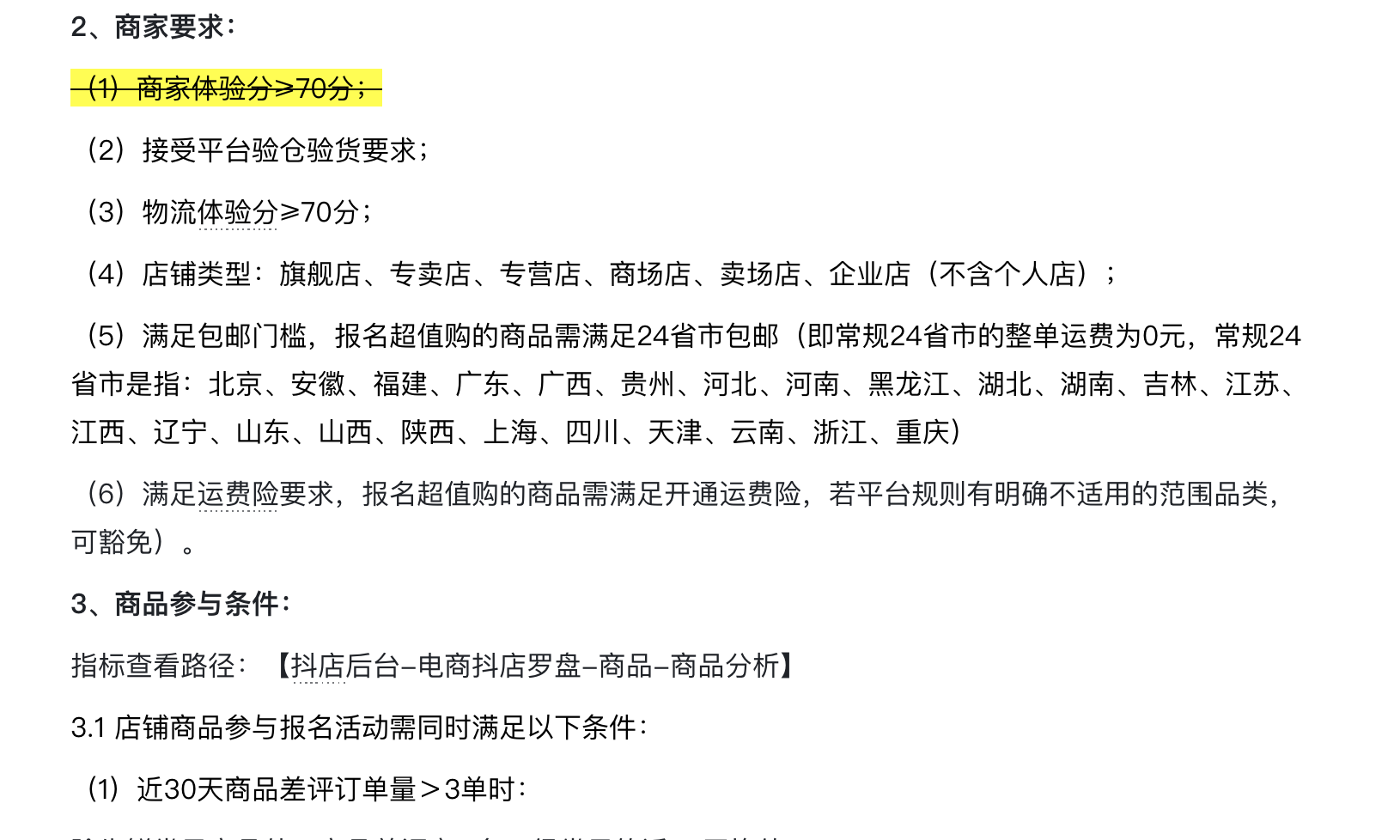
【亿邦原创】日前,抖音电商调整报名参加超值购的商家条件,删除了“商家体验分≥70分”的条件要求。

“超值购”是抖音商城主打价格心智的购物频道,商品通常享有商家补贴和平台补贴双重价格让利,目前商家报名参与条件有:物流体验分≥70分、满足常规24省市包邮、满足运费险要求、接受平台验仓验货要求。

此外,超值购报名对商品还提出了近30天内的差评订单量、品退订单量、投诉订单量的门槛要求,且物流发货需在支付后48小时内进行发货(不支持阶梯发货和预售)、在参与活动期间为商品提供买贵必赔服务。二手商品、保险商品、鲁班商品、第三方商品不参与超值购活动。

具体来说,非生鲜类目的商品,差评率、品退订单量、投诉率均需≤各一级类目的近30天均值,生鲜类目商品,商品差评率、品退订单量、投诉率≤各三级类目的近30天均值的70%。

亿邦持续追踪报道该情报,如想了解更多与本文相关信息,请扫码关注作者微信。

文章来源:亿邦动力

广告
微信
朋友圈

这么好看,分享一下?

朋友圈 分享

APP内打开

+1
+1
微信好友 朋友圈 新浪微博 QQ空间
关闭
收藏成功
发送
/140 0