





广告
加载中

群核科技与阿里云达成合作 为物理AI补齐高质量空间数据供给

龚作仁 2026-07-20 19:17
龚作仁 2026/07/20 19:17

邦小白快读

EN
全文速览

本文核心信息是群核科技与阿里云达成合作,共同打造面向物理AI的高质量空间数据解决方案,解决行业卡脖子痛点,核心干货如下

1.核心事件:7月16日阿里云发布AnalyticDB具身多模数据平台V2.0,覆盖具身数据从采集到评测的完整链路,群核科技依托自身空间智能训练平台SpatialVerse,与阿里云联合推出方案,为机器人训练提供规模化的训练数据。

2.当前行业痛点:人形机器人等AI产品正在走向落地真实世界,仅靠真机采集数据成本高、周期长,无法覆盖极端场景,高质量数据供给已经成为卡住行业发展的核心问题,物理AI竞争已经从模型能力比拼转向数据供给能力比拼。

3.现有方案能力:群核科技拥有超5亿个结构化3D空间场景和4.8亿个3D模型,可将真实空间转化为标准化训练数据,构建了从数据生成到仿真评测的完整能力体系。

本文揭示了物理AI领域的最新产业趋势,能给布局AI相关业务的品牌商提供研发和战略方向参考,核心干货如下

1.产业消费趋势:当前人形机器人、机械臂等智能硬件迭代速度加快,AI已经从“理解文本”走向理解真实空间、和真实世界交互的阶段,物理AI落地是未来明确的大方向,品牌可提前布局相关赛道抢占先机。

2.研发合作启示:物理AI发展需要算力和数据双底座支撑,单一品牌很难同时覆盖两类能力,品牌可采取跨界强强联合的模式补全短板,依托合作伙伴的优势能力加速自身产品迭代,本次阿里云提供算力、群核提供数据的合作模式就非常值得借鉴。

3.产品研发方向:未来AI产品的核心竞争力会逐渐向数据供给能力倾斜,品牌做产品研发要兼顾模型能力和数据能力布局,避免出现核心环节卡脖子的问题。

本文披露了物理AI领域的最新产业变化,能给布局AI相关领域的卖家提供机会参考和风险提示,核心干货如下

1.新增市场机会:当前物理AI发展的核心卡点是高质量空间数据供给不足,数据服务、数据资产运营已经成为明确的增量市场,切入机器人训练数据领域的卖家会获得大量行业需求。

2.合作发展启示:中小卖家做AI相关业务,不需要全链路自研,可以依托头部平台开放的基础设施能力,降低自身研发和运营成本,把自身优势资源聚焦在核心擅长领域,比如聚焦数据资产打造,对接头部平台的算力就能形成完整解决方案,实现业务增长。

3.风险提示:布局物理AI相关业务不要只追捧模型概念,要重视上游数据基础设施的配套布局,提前搭建稳定的数据供应链,避免出现有模型无数据可用的尴尬处境,错失发展机会。

本文披露了物理AI产业链的最新需求,能给相关工厂提供产品方向和数字化转型的参考,核心干货如下

1.产品生产需求变化:随着物理AI行业快速发展,行业对标准化、规模化的高质量3D空间数据、3D模型的需求激增,从事3D建模、空间数字化相关业务的工厂,可以调整生产方向,面向机器人企业推出适配训练需求的标准化数据产品,打开新的增长空间。

2.数字化转型启示:工厂推进数字化过程中,不需要盲目追求全栈自研技术,可以依托头部平台的算力和技术能力,盘活自身积累的数字化资产,对接行业需求实现资产变现,群核科技就是依托自身积累的空间数据资产,对接阿里云算力实现业务升级,这个模式值得工厂借鉴。

3.商业机会:物理AI产业链还在快速完善,上游数据配套环节缺口较大,有相关技术和资产积累的工厂可以提前切入配套环节,抢占产业红利。

本文明确了物理AI服务领域的核心痛点和发展方向,能给相关技术服务商提供业务方向参考,核心干货如下

1.行业发展趋势:物理AI的行业竞争已经从模型能力比拼转向数据供给能力比拼,数据基础设施服务已经成为物理AI领域最核心的增量需求,未来市场空间广阔,服务商可重点布局该领域。

2.核心客户痛点:当前物理AI企业、机器人企业的核心痛点是高质量具身空间数据供给不足,传统真机采集方式成本高、周期长,很难覆盖大量极端场景,无法支撑模型快速迭代,这个痛点已经严重限制行业发展,亟待解决。

3.解决方案参考:服务商可以参考本次合作模式,联合不同领域的头部企业优势能力,打造覆盖数据采集、管理、生成到仿真评测的完整服务链路,依托既有垂直领域数据资产,打造规模化、标准化的可复用数据供给能力,就能精准击中客户痛点获得市场。

本文披露的阿里云与群核科技的合作案例,能给布局AI领域的平台商提供生态建设和运营参考,核心干货如下

1.商家对平台的核心需求:布局物理AI的商家除了需要平台提供算力底座,还需要配套的高质量数据基础设施支撑,平台需要完善产业链全链路配套,才能满足商家的完整需求,提升平台竞争力。

2.平台合作模式参考:阿里云作为平台方,开放自身云原生算力和数据平台能力,和垂直领域拥有数据资产的头部企业联合打造解决方案,既丰富了平台的服务品类,也拓展了业务边界,这种开放合作的模式非常值得平台商借鉴。

3.生态建设方向提示:平台招商可重点引入拥有垂直领域数据资产的企业,补齐平台在垂直场景的能力短板,打造完整的AI服务生态;发展过程中要规避重模型轻数据基础设施的误区,均衡布局产业链各环节,保障生态健康发展。

本文披露了物理AI领域最新的产业动向和核心问题,对智能产业研究者有较高的研究参考价值,核心干货如下

1.产业新动向:当前物理AI已经进入新的发展阶段,行业竞争逻辑发生变化,从原来的模型能力比拼转向数据供给能力比拼,数据已经成为决定物理AI迭代速度的核心生产要素,跨界协同构建公共数据基础设施已经成为产业发展的新方向。

2.产业新问题:当前物理AI落地真实世界面临的核心卡脖子问题就是高质量空间数据供给不足,真实世界数据有限,传统真机采集模式存在成本高、周期长、极端场景覆盖不足的缺陷,无法满足大规模模型训练的需求,这个问题已经成为产业共识。

3.新模式研究参考:本次合作形成的“算力平台+垂直数据资产”联合打造数据基础设施的商业模式,为产业解决数据供给问题提供了新路径,也为产学研联合构建覆盖“数据—仿真—评测”完整基础设施体系提供了可参考的框架。

返回默认
声明:快读内容全程由AI生成,请注意甄别信息。如您发现问题,请发送邮件至 run@ebrun.com 。

我是 品牌商 卖家 工厂 服务商 平台商 研究者 帮我再读一遍。

Quick Summary

This article covers the key partnership between Coolket Cloud and Alibaba Cloud to jointly develop a high-quality spatial data solution for physical AI, addressing a major bottleneck facing the industry. Key takeaways are as follows:

1. Core event: On July 16, Alibaba Cloud launched AnalyticDB Embodied Multimodal Data Platform V2.0, which covers the full workflow from embodied data collection to model evaluation. Leveraging its self-developed spatial intelligence training platform SpatialVerse, Coolket Cloud joined forces with Alibaba Cloud to roll out the solution, which provides large-scale training data for robot model training.

2. Current industry pain points: As humanoid robots and other physical AI products move toward real-world deployment, data collection solely through physical robots is costly, time-consuming, and cannot cover edge cases. The lack of high-quality data has become the core bottleneck restricting industry growth, and competition in physical AI has shifted from a race of model capability to a competition of data supply capacity.

3. Capabilities of the new solution: Coolket Cloud holds over 500 million structured 3D spatial scenes and 480 million 3D models. It can convert real-world spaces into standardized training data, and has built a full-stack capability system covering data generation to simulation-based evaluation.

This article outlines the latest industry trends in physical AI, offering R&D and strategic insights for brands with AI-focused business布局. Key takeaways are as follows:

1. Industry and consumer trends: Iteration of intelligent hardware such as humanoid robots and robotic arms is accelerating. AI has evolved from "understanding text" to understanding real physical spaces and interacting with the real world, and the deployment of physical AI is a clear long-term direction. Brands can布局 this track early to gain a first-mover advantage.

2. Insights for R&D collaboration: Physical AI development relies on two foundational pillars: computing power and data. It is difficult for a single brand to build out both capabilities in-house. Brands can adopt cross-industry strong partnerships to fill capability gaps and accelerate product iteration leveraging partners' complementary strengths. The partnership model in this case, where Alibaba Cloud provides computing power and Coolket Cloud provides data, is highly worth learning from.

3. Product R&D direction: The core competitiveness of future AI products will gradually shift toward data supply capacity. Brands should balance布局 of both model capability and data capability in product R&D to avoid being bottlenecked at critical core links.

This article covers the latest industry changes in physical AI, offering opportunity insights and risk warnings for sellers entering AI-related fields. Key takeaways are as follows:

1. New market opportunities: The core bottleneck for current physical AI development is the shortage of high-quality spatial data supply. Data services and data asset operation have become a clear incremental market. Sellers that enter the robot training data segment will see strong industry demand.

2. Insights for collaborative growth: Small and medium-sized sellers entering AI-related businesses do not need to develop the entire workflow in-house. They can leverage open infrastructure capabilities from leading platforms to reduce R&D and operating costs, and focus their own advantages on core areas of expertise. For example, sellers focusing on building data assets can pair their assets with computing power from leading platforms to build a complete solution and achieve business growth.

3. Risk warning: When布局 physical AI-related businesses, do not only chase model hype. It is critical to prioritize upstream data infrastructure布局, build a stable data supply chain in advance, and avoid the awkward situation of having models but no available data that causes you to miss growth opportunities.

This article covers the latest demand changes in the physical AI industry chain, offering insights for product direction and digital transformation for relevant manufacturers. Key takeaways are as follows:

1. Changes in production demand: With the rapid growth of the physical AI industry, demand for standardized, large-scale high-quality 3D spatial data and 3D models has surged. Manufacturers engaged in 3D modeling and spatial digitalization can adjust their production direction, launch standardized data products adapted to robot training needs for robot companies, and open up new growth spaces.

2. Insights for digital transformation: When推进 digital transformation, manufacturers do not need to blindly pursue full-stack in-house technology development. They can leverage the computing power and technical capabilities of leading platforms, monetize their accumulated digital assets by matching industry demand. Coolket Cloud's business upgrade—leveraging its accumulated spatial data assets and pairing it with Alibaba Cloud's computing power—provides a replicable model for manufacturers to learn from.

3. Business opportunities: The physical AI industry chain is still rapidly maturing, and there is a large gap in upstream data supporting segments. Manufacturers with relevant technology and asset accumulation can enter these supporting segments early to capture industry dividends.

This article clarifies the core pain points and development direction of the physical AI service sector, offering business direction insights for relevant technology service providers. Key takeaways are as follows:

1. Industry development trend: Competition in physical AI has shifted from a race of model capability to a competition of data supply capacity. Data infrastructure services have become the core incremental demand in the physical AI space, with broad future market potential. Service providers can prioritize布局 in this area.

2. Core customer pain points: The top pain point for current physical AI and robotics companies is the lack of high-quality embodied spatial data. Traditional physical data collection methods are costly, time-consuming, and struggle to cover a large number of edge cases, making it impossible to support rapid model iteration. This pain point has seriously restricted industry growth and requires an urgent solution.

3. Solution reference: Service providers can learn from the partnership model covered in this article: combine the complementary advantages of leading enterprises from different fields, build a full service chain covering data collection, management, generation and simulation evaluation, and build large-scale, standardized reusable data supply capacity based on existing vertical-domain data assets. This approach can directly address core customer pain points and capture market share.

The partnership case between Alibaba Cloud and Coolket Cloud covered in this article offers insights for ecosystem building and operation for platform vendors布局 the AI sector. Key takeaways are as follows:

1. Core merchant demand from platforms: In addition to computing power infrastructure, merchants布局 physical AI also need supporting high-quality data infrastructure. Platforms need to improve full-chain supporting capabilities across the industry to meet merchants' end-to-end needs and enhance platform competitiveness.

2. Reference for platform partnership models: As a platform, Alibaba Cloud opened up its cloud-native computing power and data platform capabilities, and co-developed solutions with leading enterprises holding data assets in vertical fields. This not only enriches the platform's service portfolio but also expands business boundaries. This open collaboration model is highly worth learning from for platform vendors.

3. Guidance for ecosystem building direction: When recruiting merchants, platforms can prioritize bringing in enterprises holding vertical-domain data assets to fill capability gaps for vertical scenarios and build a complete AI service ecosystem. Platforms should also avoid the common pitfall of prioritizing models over data infrastructure, and均衡布局 across all links of the industry chain to ensure healthy ecosystem development.

This article covers the latest industry developments and core issues in the physical AI sector, offering high research reference value for intelligent industry researchers. Key takeaways are as follows:

1. New industry developments: Physical AI has now entered a new development stage, and industry competition logic has changed: it has shifted from the original model capability race to data supply capacity competition. Data has become the core production factor determining the iteration speed of physical AI, and cross-industry collaboration to build public data infrastructure has become a new direction for industry development.

2. New industry problems: The core bottleneck restricting physical AI's real-world deployment is the shortage of high-quality spatial data supply. Limited real-world data and traditional physical collection methods suffer from high costs, long cycles and insufficient coverage of extreme scenarios, making them unable to meet the demand for large-scale model training. This problem has become an industry-wide consensus.

3. Reference for new model research: The "computing power platform + vertical data assets" business model for building data infrastructure from this partnership provides a new path for the industry to solve the data supply problem, and also offers a reference framework for industry-university-research collaboration to build a complete infrastructure system covering "data – simulation – evaluation".

Disclaimer: The "Quick Summary" content is entirely generated by AI. Please exercise discretion when interpreting the information. For issues or corrections, please email run@ebrun.com .

I am a Brand Seller Factory Service Provider Marketplace Seller Researcher Read it again.

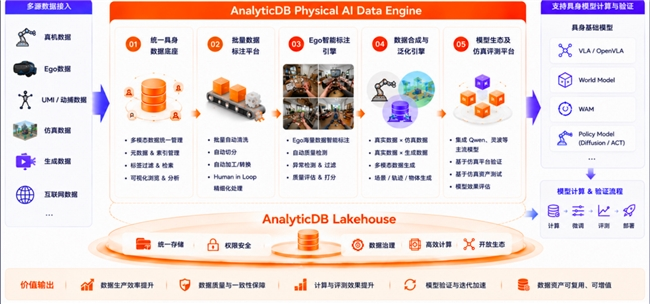
7月 16日,阿里云发布AnalyticDB具身多模数据平台V2.0,覆盖具身数据从采集、管理、标注、生成到仿真评测的完整链路。作为联合解决方案合作伙伴,群核科技依托空间智能训练平台SpatialVerse,与阿里云共同打造面向物理AI的高质量3D空间数据解决方案,为机器人和空间智能模型提供可规模化生成的SimReady空间训练数据。

群核科技与阿里云共同打造的具身多模数据平台AnalyticDB

过去一年,人形机器人、机械臂、无人车密集迭代,机器人正在从“能思考”走向“能触达真实世界”。但现实世界复杂、多变且难以穷举,仅依赖真机采集,不仅成本高、周期长,也难以覆盖大量极端场景。

正如阿里云智能集团数据库产品事业部负责人杨辛军在发布会现场给出判断:“真正卡住行业的,是高质量具身数据的持续供给。数据不是点缀,而是具身智能的燃料,也是决定迭代速度的关键。" 这一判断指向一个正在发生的产业变化:物理AI的竞争,正在从模型能力的比拼,延伸至数据供给能力的较量。机器人需要大量具有准确几何、语义及物理属性的数据,才能学习如何理解空间、感知环境、完成交互,并在陌生场景中作出判断。

围绕物理AI面临的高质量空间数据供给难题,群核科技依托物理数据引擎SpatialVerse,打造面向机器人训练的数据基础设施。基于累计超过5 亿个结构化3D空间场景和4.8亿个3D模型,SpatialVerse将真实空间资产持续转化为可用于机器人训练的SimReady空间数据,并通过高保真实时渲染、结构化空间理解、动态物理仿真等能力,持续生成符合真实物理规律的高质量三维数据,为具身智能、世界模型和空间智能模型提供规模化、标准化、可复用的数据供给。

对物理AI而言,数据不只是训练素材,而是支撑模型持续学习和能力迭代的基础设施。SpatialVerse正在构建的是一套完整能力体系——通过空间重建将真实世界高保真地数字化,通过空间理解让数据具备语义和结构,通过空间生成实现数据的规模化泛化。同时,SpatialVerse进一步联合产业界与学术界,共同构建覆盖“数据—仿真—评测”的空间数据基础设施。

群核科技SpatialVerse负责人王见宇表示,“物理AI的发展,不仅需要更强的模型,更需要持续供给高质量空间数据。真实世界的数据始终有限,而空间智能能够把真实世界持续转化为机器人可学习的数据资产。此次与阿里云的合作,希望共同构建面向物理AI的数据基础设施,让高质量空间数据像算力一样,成为机器人持续成长的基础设施。"

此次合作,是阿里云云原生算力、数据平台与群核科技空间数据资产的一次深度协同,如果说阿里云提供的物理AI的算力底座,那么群核科技SpatialVerse提供的则是数据底座。未来,群核科技与阿里云将携手推动空间数据、仿真环境与模型训练进一步融合,让AI不再只是“理解文本”,而是真正开始理解空间、遵循物理规律,并与真实世界持续交互。

注:文/龚作仁,文章来源:Laborer,本文为作者独立观点,不代表亿邦动力立场。

文章来源:Laborer

广告
微信
朋友圈

FAQ回顾

物理AI发展面临的核心数据痛点是什么?

当前物理AI发展中,仅依赖真机采集数据成本高、周期长,难以覆盖大量极端场景,高质量具身数据的持续供给是卡住行业发展的核心瓶颈,目前物理AI领域的竞争已从模型能力比拼延伸至数据供给能力的较量。

群核科技SpatialVerse平台有什么作用?

群核科技SpatialVerse是空间智能训练平台,基于累计超5亿个结构化3D空间场景和4.8亿个3D模型,可将真实空间资产转化为可用于机器人训练的SimReady空间数据,为具身智能、世界模型等提供规模化、标准化、可复用的数据供给。

群核科技和阿里云的合作能为行业带来什么价值?

双方将阿里云云原生算力、数据平台与群核科技空间数据资产深度协同,共同构建面向物理AI的数据基础设施,未来将推动空间数据、仿真环境与模型训练融合,助力AI实现理解空间、遵循物理规律、与真实世界持续交互的能力。

这么好看,分享一下?

朋友圈 分享

APP内打开

+1
+1
微信好友 朋友圈 新浪微博 QQ空间
关闭
收藏成功
发送
/140 0

