广告
加载中

再次超越Astra!大晓发布具身通用模型ACE-Brain-0.7

亿邦动力 2026-11-23 17:46
亿邦动力 2026/11/23 17:46

邦小白快读

EN
全文速览

总:核心发布与核心能力。

1.大晓机器人发布增强型具身通用模型ACE-Brain-0.7,首提基于真实执行状态的具身推理技术范式。

2.融合空间锚定、任务理解与进度估计三大能力,面向酒店服务、即时零售等场景,优化机器人复杂连续任务中懂规划却不懂执行的难题。

总:关键数据与案例。

1.六项公开任务推理基准平均76.5分,高于GPT-6 Astra的72.7分和Claude Opus 5.5的73.5分。

2.七项公开空间锚定基准平均75.90分,RefCOCOg视觉定位Acc@0.5达91.25%。

3.构建约370万组高质量问答数据,时间配对测试114组,原始基模同时答对两问比例15.8%,任务问答微调模型达54.4%,提升38.6个百分点。

总:实操干货。

1.复杂连续任务要区分任务结构与执行状态,后者必须依赖真实观察确认。

2.用任务规划、执行监测、下一步预测、失败诊断、任务理解五项能力,结合步骤时间线、物体状态与失败标注生成监督信号,并设同任务步骤干扰项。

总:产品研发与能力。

1.ACE-Brain-0.7强化空间锚定、任务理解与进度估计,提出基于真实执行状态的具身推理,补上懂规划却不懂执行的短板。

2.双脑协同中ACE-Brain负责任务理解与推理规划,开悟世界模型结合物理约束预测行动后果,Mundo通过真实场景重建与物理仿真支持策略验证和训练,机器人真机执行并采集反馈,具身RSI持续进化技能。

总:性能与应用场景。

1.六项任务推理基准平均76.5分,领先GPT-6 Astra的72.7分和Claude Opus 5.5的73.5分;七项空间锚定平均75.90分,RefCOCOg的Acc@0.5为91.25%。

2.面向酒店服务、即时零售长程作业,提升物品取放、设备操作、商品拣选、打包等连续任务的规划与执行判断。

总:用户行为与消费机会。

1.机器人不仅要知道怎么做,还要判断做到哪、下一步做什么,执行状态理解成为真实场景落地关键。

2.文章用370万组任务问答和114组时间配对测试验证执行状态理解,显示真实执行过程已成为模型判断的重要依据。

总:市场机会与正面影响。

1.ACE-Brain-0.7面向酒店服务、即时零售等长程作业场景,优化复杂连续任务中懂规划却不懂执行的难题,加速具身机器人在真实场景规模化落地。

2.物品取放、设备操作、商品拣选、打包等连续任务中,机器人可依据实际观察判断执行进度、识别失败环节并确定后续操作。

总:可学习点与数据方法。

1.把任务理解分为任务结构与执行状态两个层面,执行状态记录未开始、进行中、已完成或失败,并关联观察证据。

2.构建约370万组问答数据,来自人类第一视角视频、机器人操作记录与仿真环境,按任务不同时间节点采样,结合步骤时间线、物体状态与失败标注生成监督信号,并引入同任务其他步骤作为干扰选项。

3.时间配对测试114组,原始基模同时答对两问为15.8%,任务问答微调模型为54.4%,提升38.6个百分点。

总:性能与风险提示。

1.六项任务推理平均76.5分,高于GPT-6 Astra的72.7分和Claude Opus 5.5的73.5分;七项空间锚定平均75.90分。

2.但RoboBench任务分解中ACE-Brain-0.7为67.7分,低于GPT-6 Astra的74.5分和Claude Opus 5.5的77.8分,说明通用大模型任务分解更强,需结合场景看能力边界。

总:产品设计与生产需求。

1.具身通用模型需融合空间锚定、任务理解与进度估计,并统一任务规划、执行监测、下一步预测、失败诊断、任务理解五项能力。

2.双脑架构中ACE-Brain负责高层认知与推理规划,开悟世界模型结合物理约束预测行动后果,Mundo支持策略验证和训练,机器人真机执行采集反馈,具身RSI持续进化,形成物理预测、仿真验证与真机执行闭环。

总:商业机会与数字化启示。

1.酒店服务、即时零售等场景需要机器人完成物品取放、设备操作、商品拣选、打包等连续任务,对执行状态判断和失败诊断有明确需求。

2.数据建设可借鉴约370万组任务问答:整合人类第一视角视频、机器人操作记录与仿真数据,在同一任务不同时间节点采样,用步骤时间线、物体状态、失败标注生成监督信号,并设同任务步骤为干扰项。

3.时间配对测试114组显示,原始基模同时答对两问为15.8%,任务问答微调模型为54.4%,提升38.6个百分点;移除图像、仅单帧、打乱画面顺序等对照说明历史视觉信息与时间顺序有价值。

总:行业趋势与新技术。

1.具身通用模型从任务规划走向执行状态理解,首提基于真实执行状态的具身推理,推动酒店服务、即时零售等真实场景落地。

2.双脑协同中ACE-Brain负责理解与推理规划,开悟世界模型结合物理约束预测行动后果,Mundo以真实场景重建与物理仿真支持策略验证和训练,机器人真机执行反馈,具身RSI持续进化。

总:客户痛点与解决方案。

1.痛点是复杂连续任务懂规划却不懂执行,例如已打开炉门却未拿起碗,不能直接进入下一步,必须依据实际观察判断。

2.方案是把任务理解分为任务结构与执行状态,前者可由指令推断,后者必须真实观察确认;用Plan、Monitor、Anticipate、Diagnose、Interpret五项能力关联两者。

3.用约370万组任务问答和114组时间配对测试训练验证,原始基模同时答对两问为15.8%,任务问答微调模型为54.4%,提升38.6个百分点。

总:性能与边界。

1.六项任务推理平均76.5分,高于GPT-6 Astra的72.7分和Claude Opus 5.5的73.5分;七项空间锚定平均75.90分,RefCOCOg的Acc@0.5为91.25%。

2.RoboBench任务分解为67.7分,低于GPT-6 Astra的74.5分和Claude Opus 5.5的77.8分;下一子任务判断为52.1分,高于两者的34.7分和39.0分。

总:平台需求与场景问题。

1.酒店服务、即时零售等平台场景需要机器人处理长程连续任务,设备是否成功打开、商品是否准确放置、物品整理是否完成,直接影响后续任务开展。

2.平台侧的核心问题是机器人不能只懂规划,还要判断做到哪、下一步做什么,并能识别失败环节,才能支撑真实业务运营。

总:运营管理可借鉴做法。

1.ACE-Brain-0.7把任务理解分为任务结构与执行状态,执行状态记录未开始、进行中、已完成或失败,并关联观察证据。

2.用任务规划、执行监测、下一步预测、失败诊断、任务理解五项能力,结合约370万组任务问答训练,数据来自人类第一视角视频、机器人操作记录与仿真环境。

3.通过114组时间配对测试验证,原始基模同时答对两问为15.8%,任务问答微调模型为54.4%,提升38.6个百分点。

总:风向规避与合作方向。

1.六项任务推理平均76.5分,高于GPT-6 Astra的72.7分和Claude Opus 5.5的73.5分;七项空间锚定平均75.90分,RefCOCOg的Acc@0.5为91.25%。

2.但RoboBench任务分解为67.7分,低于GPT-6 Astra的74.5分和Claude Opus 5.5的77.8分,平台应用需注意能力边界。

3.后续方向是面向真实行业场景优化,并探索与运动控制、物理预测及真机反馈协同。

总:产业新动向与性能。

1.大晓机器人发布ACE-Brain-0.7,首提基于真实执行状态的具身推理技术范式,融合空间锚定、任务理解与进度估计。

2.六项任务推理基准平均76.5分,高于GPT-6 Astra的72.7分和Claude Opus 5.5的73.5分;七项空间锚定平均75.90分,RefCOCOg的Acc@0.5为91.25%。

总:新问题与方法。

1.通用大模型任务分解更强:ACE-Brain-0.7在RoboBench任务分解为67.7分,低于GPT-6 Astra的74.5分和Claude Opus 5.5的77.8分;但下一子任务判断为52.1分,高于两者的34.7分和39.0分,显示任务常识与执行状态理解存在差异。

2.构建约370万组五维度问答,来自人类第一视角视频、机器人操作记录与仿真,按不同时间节点采样,结合步骤时间线、物体状态与失败标注生成监督信号,并设同任务步骤干扰项。

3.时间配对测试114组,原始基模同时答对两问为15.8%,任务问答微调模型为54.4%,提升38.6个百分点;移除图像、仅单帧、打乱画面顺序等对照说明历史视觉与时间顺序有效。

总:架构与启示。

1.双脑协同中ACE-Brain负责理解推理规划,开悟世界模型结合物理约束预测后果,Mundo支持策略验证和训练,真机执行反馈与具身RSI持续进化。

2.面向酒店服务、即时零售落地,并探索与运动控制、物理预测及真机反馈协同。

返回默认

声明:快读内容全程由AI生成,请注意甄别信息。如您发现问题,请发送邮件至 run@ebrun.com 。

我是 品牌商 卖家 工厂 服务商 平台商 研究者 帮我再读一遍。

Quick Summary

Summary: Core release and core capabilities.

1. Daxiao Robotics has released ACE-Brain-0.7, an enhanced embodied general-purpose model, and is the first to propose an embodied reasoning paradigm based on real execution states.

2. It integrates spatial grounding, task understanding, and progress estimation, targeting scenarios such as hotel services and instant retail, and addresses the challenge that robots can plan but cannot execute within complex continuous tasks.

Summary: Key data and cases.

1. It averages 76.5 on six public task-reasoning benchmarks, above GPT-6 Astra (72.7) and Claude Opus 5.5 (73.5).

2. It averages 75.90 on seven public spatial-grounding benchmarks and achieves 91.25% Acc@0.5 on RefCOCOg visual grounding.

3. It built about 3.7 million high-quality QA pairs; in 114 time-paired test cases, the original base model answered both questions correctly in 15.8% of cases, while the task-QA fine-tuned model reached 54.4%, a gain of 38.6 percentage points.

Summary: Practical takeaways.

1. For complex continuous tasks, distinguish task structure from execution state; the latter must be confirmed through real observations.

2. Use five capabilities—task planning, execution monitoring, next-step prediction, failure diagnosis, and task understanding—together with step timelines, object states, and failure annotations to generate supervision signals, and include other steps from the same task as distractors.

Summary: Product R&D and capabilities.

1. ACE-Brain-0.7 strengthens spatial grounding, task understanding, and progress estimation, and proposes embodied reasoning based on real execution states, closing the gap of being able to plan but not execute.

2. In dual-brain collaboration, ACE-Brain handles task understanding and reasoning/planning; the Kaiwu World Model combines physical constraints to predict action consequences; Mundo supports policy validation and training through real-scene reconstruction and physics simulation; robots execute on real hardware and collect feedback; and embodied RSI continuously evolves skills.

Summary: Performance and application scenarios.

1. It averages 76.5 on six task-reasoning benchmarks, leading GPT-6 Astra (72.7) and Claude Opus 5.5 (73.5); it averages 75.90 on seven spatial-grounding benchmarks, with 91.25% Acc@0.5 on RefCOCOg.

2. Targeting long-horizon operations in hotel services and instant retail, it improves planning and execution judgment for continuous tasks such as item picking and placing, equipment operation, product picking, and packing.

Summary: User behavior and consumer opportunities.

1. Robots must not only know what to do but also judge how far they have progressed and what to do next; execution-state understanding is key to real-world deployment.

2. The article uses 3.7 million task-QA pairs and 114 time-paired tests to validate execution-state understanding, showing that real execution processes have become an important basis for model judgment.

Summary: Market opportunities and positive impact.

1. ACE-Brain-0.7 targets long-horizon operation scenarios such as hotel services and instant retail, addresses the challenge of planning without execution in complex continuous tasks, and accelerates the scaled deployment of embodied robots in real-world scenarios.

2. In continuous tasks such as item picking and placing, equipment operation, product picking, and packing, robots can judge execution progress based on actual observations, identify failure points, and determine subsequent actions.

Summary: Learnable points and data methods.

1. Task understanding is divided into two levels: task structure and execution state. Execution state records not started, in progress, completed, or failed, and is linked to observational evidence.

2. About 3.7 million QA pairs were built from human first-person videos, robot operation records, and simulation environments, sampled at different task time points, with step timelines, object states, and failure annotations combined to generate supervision signals, and other steps from the same task introduced as distractors.

3. In 114 time-paired tests, the original base model answered both questions correctly in 15.8% of cases, while the task-QA fine-tuned model reached 54.4%, a gain of 38.6 percentage points.

Summary: Performance and risk notes.

1. It averages 76.5 on six task-reasoning benchmarks, above GPT-6 Astra (72.7) and Claude Opus 5.5 (73.5); it averages 75.90 on seven spatial-grounding benchmarks.

2. However, ACE-Brain-0.7 scores 67.7 on RoboBench task decomposition, below GPT-6 Astra (74.5) and Claude Opus 5.5 (77.8), indicating that general large models are stronger at task decomposition; capability boundaries should be assessed in context.

Summary: Product design and production requirements.

1. Embodied general-purpose models need to integrate spatial grounding, task understanding, and progress estimation, and unify five capabilities: task planning, execution monitoring, next-step prediction, failure diagnosis, and task understanding.

2. In the dual-brain architecture, ACE-Brain handles high-level cognition and reasoning/planning; the Kaiwu World Model combines physical constraints to predict action consequences; Mundo supports policy validation and training; real-robot execution collects feedback; and embodied RSI continuously evolves, forming a closed loop of physical prediction, simulation validation, and real-robot execution.

Summary: Business opportunities and digitalization implications.

1. Scenarios such as hotel services and instant retail require robots to complete continuous tasks including item picking and placing, equipment operation, product picking, and packing, creating clear demand for execution-state judgment and failure diagnosis.

2. Data development can draw on the roughly 3.7 million task-QA pairs: integrate human first-person videos, robot operation records, and simulation data; sample at different time points within the same task; use step timelines, object states, and failure annotations to generate supervision signals; and set same-task steps as distractors.

3. The 114 time-paired tests show that the original base model answered both questions correctly in 15.8% of cases, while the task-QA fine-tuned model reached 54.4%, a gain of 38.6 percentage points; controls such as removing images, using only a single frame, and shuffling frame order confirm the value of historical visual information and temporal order.

Summary: Industry trends and new technologies.

1. Embodied general-purpose models are moving from task planning toward execution-state understanding; the first proposal of embodied reasoning based on real execution states is driving deployment in real-world scenarios such as hotel services and instant retail.

2. In dual-brain collaboration, ACE-Brain handles understanding and reasoning/planning; the Kaiwu World Model combines physical constraints to predict action consequences; Mundo supports policy validation and training through real-scene reconstruction and physics simulation; robots execute on real hardware and provide feedback; and embodied RSI continuously evolves.

Summary: Customer pain points and solutions.

1. The pain point is that in complex continuous tasks, robots can plan but cannot execute—for example, a robot that has opened the oven door but has not picked up the bowl cannot proceed directly to the next step and must judge based on actual observations.

2. The solution divides task understanding into task structure and execution state; the former can be inferred from instructions, while the latter must be confirmed through real observation. Five capabilities—Plan, Monitor, Anticipate, Diagnose, and Interpret—link the two.

3. About 3.7 million task-QA pairs and 114 time-paired tests are used for training and validation; the original base model answered both questions correctly in 15.8% of cases, while the task-QA fine-tuned model reached 54.4%, a gain of 38.6 percentage points.

Summary: Performance and boundaries.

1. It averages 76.5 on six task-reasoning benchmarks, above GPT-6 Astra (72.7) and Claude Opus 5.5 (73.5); it averages 75.90 on seven spatial-grounding benchmarks, with 91.25% Acc@0.5 on RefCOCOg.

2. It scores 67.7 on RoboBench task decomposition, below GPT-6 Astra (74.5) and Claude Opus 5.5 (77.8); it scores 52.1 on next-subtask judgment, above those models' 34.7 and 39.0.

Summary: Platform needs and scenario issues.

1. Platform scenarios such as hotel services and instant retail require robots to handle long-horizon continuous tasks. Whether equipment is successfully opened, products are accurately placed, and items are properly organized directly affects subsequent tasks.

2. The core platform-side issue is that robots must not only understand planning but also judge progress and next steps, and identify failure points, to support real business operations.

Summary: Operational management practices to learn from.

1. ACE-Brain-0.7 divides task understanding into task structure and execution state; execution state records not started, in progress, completed, or failed and is linked to observational evidence.

2. It uses five capabilities—task planning, execution monitoring, next-step prediction, failure diagnosis, and task understanding—together with training on about 3.7 million task-QA pairs drawn from human first-person videos, robot operation records, and simulation environments.

3. Validation through 114 time-paired tests shows that the original base model answered both questions correctly in 15.8% of cases, while the task-QA fine-tuned model reached 54.4%, a gain of 38.6 percentage points.

Summary: Risk avoidance and partnership directions.

1. It averages 76.5 on six task-reasoning benchmarks, above GPT-6 Astra (72.7) and Claude Opus 5.5 (73.5); it averages 75.90 on seven spatial-grounding benchmarks, with 91.25% Acc@0.5 on RefCOCOg.

2. However, it scores 67.7 on RoboBench task decomposition, below GPT-6 Astra (74.5) and Claude Opus 5.5 (77.8); platform applications should note these capability boundaries.

3. The next direction is optimization for real industry scenarios and exploration of collaboration with motion control, physical prediction, and real-robot feedback.

Summary: New industry developments and performance.

1. Daxiao Robotics releases ACE-Brain-0.7, the first to propose an embodied reasoning paradigm based on real execution states, integrating spatial grounding, task understanding, and progress estimation.

2. It averages 76.5 on six task-reasoning benchmarks, above GPT-6 Astra (72.7) and Claude Opus 5.5 (73.5); it averages 75.90 on seven spatial-grounding benchmarks, with 91.25% Acc@0.5 on RefCOCOg.

Summary: New problems and methods.

1. General large models are stronger at task decomposition: ACE-Brain-0.7 scores 67.7 on RoboBench task decomposition, below GPT-6 Astra (74.5) and Claude Opus 5.5 (77.8); however, it scores 52.1 on next-subtask judgment, above those models' 34.7 and 39.0, indicating a gap between task commonsense and execution-state understanding.

2. It built about 3.7 million five-dimensional QA pairs from human first-person videos, robot operation records, and simulation, sampling at different time points, combining step timelines, object states, and failure annotations to generate supervision signals, and including same-task steps as distractors.

3. In 114 time-paired tests, the original base model answered both questions correctly in 15.8% of cases, while the task-QA fine-tuned model reached 54.4%, a gain of 38.6 percentage points; controls such as removing images, using only a single frame, and shuffling frame order demonstrate the value of historical vision and temporal order.

Summary: Architecture and implications.

1. In dual-brain collaboration, ACE-Brain handles understanding, reasoning, and planning; the Kaiwu World Model combines physical constraints to predict consequences; Mundo supports policy validation and training; real-robot execution feedback and embodied RSI continuously evolve.

2. The system targets hotel services and instant retail deployment and explores collaboration with motion control, physical prediction, and real-robot feedback.

Disclaimer: The "Quick Summary" content is entirely generated by AI. Please exercise discretion when interpreting the information. For issues or corrections, please email run@ebrun.com .

I am a Brand Seller Factory Service Provider Marketplace Seller Researcher Read it again.

【亿邦原创】日前,大晓机器人发布最新增强型具身通用模型ACE-Brain-0.7,首提基于真实执行状态的具身推理(Execution-Grounded Reasoning)技术范式,通过融合空间锚定、任务理解与进度估计三大核心能力,不仅实现空间感知与任务推理双维度超越GPT-6 Astra等通用大模型,而且面向酒店服务、即时零售等业务场景,优化机器人在复杂连续任务中“懂规划却不懂执行”的难题,加速具身机器人在真实场景的规模化落地。

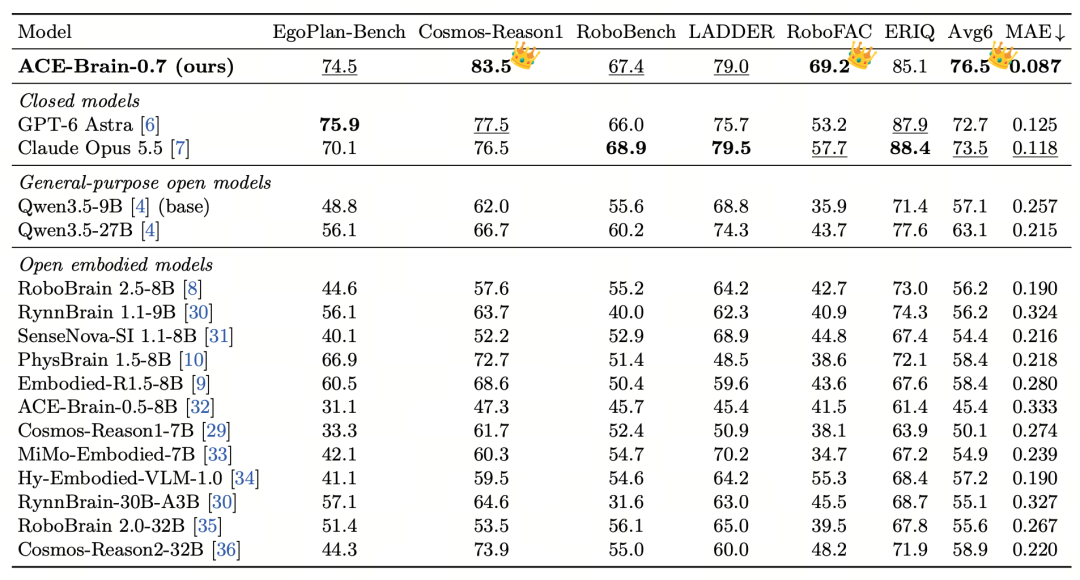
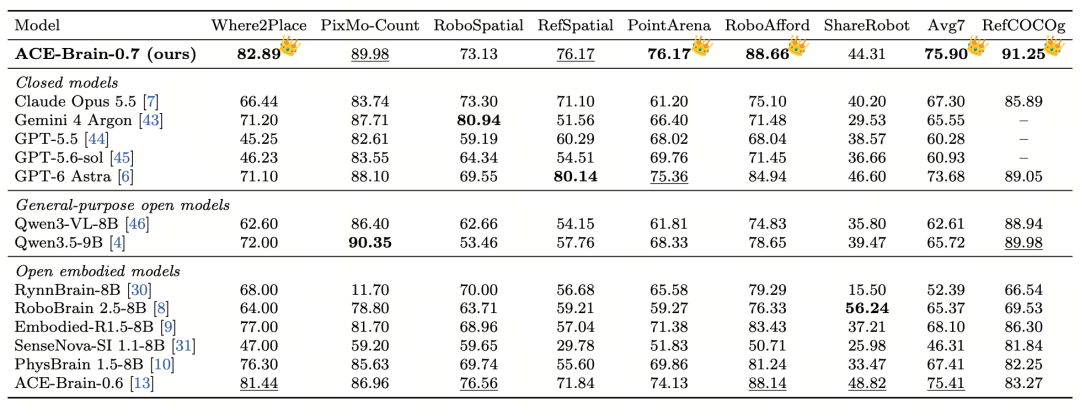
实验显示,ACE-Brain-0.7在六项公开任务推理基准中平均成绩76.5分,超越GPT-6 Astra(72.7分)和Claude Opus 5.5(73.5分);同时相较于ACE-Brain-0.6,ACE-Brain-0.7空间锚定能力进一步提升,七项公开基准平均得分75.90,继续领先GPT-6 Astra、Claude Opus 5.5、Gemini 4 Argon等国际闭源一流模型。

同时,ACE-Brain-0.7围绕任务规划、执行监测、下一步预测、失败诊断和任务理解五个维度,构建约370万组高质量问答数据;数据来自人类第一视角视频、机器人操作记录与仿真环境,通过在同一任务的不同时间节点采样,结合步骤时间线、物体状态与失败标注生成监督信号,并引入同任务步骤作为干扰选项,强化具身通用模型对真实执行状态的理解。

从空间感知到执行理解,从任务规划到状态判断,ACE-Brain正在完善大晓机器人双脑协同架构中的高层认知与推理能力,持续拓展具身通用模型的能力边界。

具体而言,在双脑范式中,ACE-Brain负责任务理解、推理规划,开悟世界模型结合物理约束预测行动后果,两者耦合探索可行策略;Mundo通过真实场景重建与物理仿真支持策略验证和训练,机器人则在真实环境中执行任务、采集反馈,并通过具身RSI持续进化技能。

ACE-Brain-0.7进一步强化了机器人在酒店服务、即时零售等长程作业场景中的任务规划与执行判断能力,并与物理预测、仿真验证与真机执行形成闭环协同,为机器人在真实场景中的规模化落地提供技术支撑。

从任务规划到执行理解,读懂真实任务进度

对于复杂连续任务,正确的操作规划只是开始,准确判断实际执行状态一样重要。例如,让机器人将积木放入碗中,再将碗送入微波炉并关闭炉门,模型可以规划完整的操作流程。但如果机器人已经打开炉门,却没能成功拿起碗,此时就不能直接进入下一步,而要根据实际观察的执行状态再判断。

针对这一问题,团队把任务理解分为任务结构与执行状态两个层面。任务结构描述操作步骤、先后依赖及完成条件;执行状态则记录各步骤尚未开始、正在进行、已经完成或执行失败,并关联相应的观察证据。前者可以根据任务指令推断,后者必须依赖真实观察确认。

基于这一框架,ACE-Brain-0.7把五项具身推理能力统一起来:任务规划(Plan)拆解目标,执行监测(Monitor)判断进度,下一步预测(Anticipate)确定后续操作,失败诊断(Diagnose)定位异常环节,任务理解(Interpret)还原操作内容;将任务结构与实际执行状态关联起来,不仅能理解任务流程,还能识别实际执行与预期计划之间的差异,为具身通用模型复杂任务中的动态决策提供依据。

370万组任务问答,构建执行状态监督体系

ACE-Brain-0.7的核心技术之一,是面向真实执行状态构建数据与训练方法。团队整合人类第一视角视频、机器人操作记录及仿真数据,打造约370万组任务问答数据,在同一任务的不同时间节点生成问题,并依据步骤时间线、物体状态及失败标注提供监督信号,提升模型对不同任务执行过程的理解能力。

例如,在将水果放入抽屉的任务中,操作过程包含打开抽屉、拿取水果、放入抽屉、整理水果及关闭抽屉等步骤。团队通过逐段标注动作与物体状态,并与任务时间线交叉核验,让不同时间节点的问题对应实际执行进度。

为减少模型对任务常识的依赖,团队把同一任务中的其他操作步骤设置为干扰选项,使模型必须结合当前观察判断下一步行动。同时,引入失败执行记录与仿真状态数据,强化模型对未完成操作及异常结果的识别能力。

在此之上,团队基于原始基模,结合任务问答、空间锚定及进度估计数据进行监督微调,融合空间感知与时序任务理解能力,强化具身通用模型对任务结构、执行进度与空间环境的综合理解。

时间配对测试,验证真实执行状态的理解

为进一步区分任务常识与执行状态理解,团队设计了114组时间配对测试,检验模型能否根据不同观察时刻作出正确判断。测试在同一段任务视频的两个时间节点,向模型提出完全相同的问题与选项,但由于执行进度不同,正确答案也随之变化。

例如,机器人刚打开微波炉时,下一步可能是拿取物品;当物品已经放入微波炉后,下一步则可能是关闭炉门。只有模型在两个时刻均回答正确,才能说明其判断与实际执行状态相符。

实验显示,原始基模同时答对两个问题的比例为15.8%;仅使用任务问答数据微调的专项实验模型(Task-only Model)达到54.4%,提升38.6个百分点。

团队还通过移除图像、仅保留单帧及打乱画面顺序等对照实验发现,经过针对性训练后,专项实验模型能够更有效地利用历史视觉信息与时间顺序,更准确地区分不同执行状态,进一步说明真实执行过程已成为模型判断的重要依据。

六项任务推理评测综合领先,空间理解能力持续提升

在EgoPlan-Bench、Cosmos-Reason1、RoboBench、LADDER、RoboFAC、ERIQ六项公开任务推理基准中,ACE-Brain-0.7取得76.5分的综合平均成绩,高于GPT-6 Astra的72.7分和Claude Opus 5.5的73.5分,并在全部六项评测中领先参与比较的开源模型。

图片

其中,任务规划与执行状态判断的差异尤为突出。在RoboBench任务分解测试中,GPT-6 Astra与Claude Opus 5.5分别取得74.5分和77.8分,高于ACE-Brain-0.7的67.7分;但在下一子任务判断中,ACE-Brain-0.7取得52.1分,超过两者的34.7分和39.0分。

这一结果表明,通用大模型在任务分解方面表现更好,而ACE-Brain-0.7在结合执行进度判断下一步操作时更具优势。这一能力对于酒店服务中的物品取放、设备操作,以及即时零售中的商品拣选、打包等连续任务具有重要意义:机器人不仅需要知道“怎么做”,还要判断“做到哪、下一步做什么”。

图片

同时,在七项公开空间锚定基准中,ACE-Brain-0.7平均得分达到75.90,高于Claude Opus 5.5的67.30、Gemini 4 Argon的65.55及GPT-6 Astra的73.68;在独立的RefCOCOg视觉定位基准中,Acc@0.5准确率高达91.25%。

从执行状态理解到真实场景应用

通过融合空间感知与时序任务理解,ACE-Brain-0.7正在提升具身通用模型在真实场景的任务规划与执行判断能力,补上了大晓双脑协同技术架构中的重要一环。

在酒店服务、即时零售等行业场景中,设备是否成功打开、商品是否准确放置、物品整理是否完成,都直接影响后续任务的开展。ACE-Brain-0.7使机器人不仅能够规划任务,还能根据实际观察判断执行进度、识别失败环节并确定后续操作,大大加速了具身智能落地产业的速度与效率。

下一步,ACE-Brain-0.7将面向真实行业场景持续优化具身通用模型的能力,并进一步探索与运动控制、物理预测及真机反馈的协同,不断推动具身通用模型能力向机器人实际部署迁移。

本文首发于 亿邦动力 官方网站

文章来源:亿邦动力

广告
微信
朋友圈

FAQ回顾

大晓机器人的ACE-Brain-0.7是什么?

ACE-Brain-0.7是大晓机器人发布的增强型具身通用模型,首次提出基于真实执行状态的具身推理(Execution-Grounded Reasoning)技术范式,融合空间锚定、任务理解与进度估计三大核心能力,用于提升机器人在复杂连续任务中的任务规划与执行判断能力,面向酒店服务、即时零售等场景落地。

具身机器人“懂规划却不懂执行”的问题怎么解决?

ACE-Brain-0.7把任务理解拆为任务结构与执行状态两层:任务结构描述步骤、依赖与完成条件,执行状态记录各步骤未开始、进行中、已完成或失败并关联观察证据。再以任务规划、执行监测、下一步预测、失败诊断、任务理解五项能力统一建模,使机器人能识别实际执行与预期计划的差异并动态调整。

ACE-Brain-0.7与GPT-6 Astra、Claude Opus 5.5等通用大模型相比表现如何?

在EgoPlan-Bench、Cosmos-Reason1、RoboBench、LADDER、RoboFAC、ERIQ六项公开任务推理基准中,ACE-Brain-0.7平均76.5分,高于GPT-6 Astra的72.7分和Claude Opus 5.5的73.5分;七项空间锚定基准平均75.90分,领先GPT-6 Astra的73.68分、Claude Opus 5.5的67.30分和Gemini 4 Argon的65.55分。

ACE-Brain-0.7的训练数据是如何构建的?

团队整合人类第一视角视频、机器人操作记录与仿真环境数据,围绕任务规划、执行监测、下一步预测、失败诊断和任务理解五个维度构建约370万组高质量问答数据。在同一任务的不同时间节点采样,结合步骤时间线、物体状态与失败标注生成监督信号,并引入同任务其他步骤作为干扰选项,强化模型对真实执行状态的理解。

具身通用模型在酒店服务、即时零售等场景有什么应用价值?

在酒店服务和即时零售的长程连续任务中,设备是否成功打开、商品是否准确放置、物品整理是否完成直接影响后续操作。ACE-Brain-0.7让机器人不仅会规划任务,还能依据实际观察判断执行进度、识别失败环节并确定下一步操作,并与物理预测、仿真验证与真机执行形成闭环,加速具身智能在真实场景的规模化落地。

这么好看,分享一下?

朋友圈 分享

APP内打开

赞 +1
+1
微信好友 朋友圈 新浪微博 QQ空间
关闭
收藏成功
发送
/140 0