广告
加载中

2026品牌供应链创新私董会将于8月28日在杭州举行

亿邦动力 2026-08-24 13:34
亿邦动力 2026/08/24 13:34

邦小白快读

EN
全文速览

本文核心预告了2026品牌供应链创新私董会的相关信息,梳理了当前品牌供应链行业的普遍痛点,以及本次活动的核心干货内容,可帮助读者了解行业最新动态。

1. 当前行业存在的共性问题:品牌从单一平台走向全渠道、从国内拓展到海外后,原有分仓备货和经验决策模式不再适配,线上线下、国内外渠道的需求差异大,普遍存在库存分散、响应链路长、库存调配难、周转效率低等问题。

2. 本次活动的核心安排:活动将于8月28日在杭州城中香格里拉大酒店举办,除核心议题讨论外,当晚还设置中通云仓之夜答谢晚宴,提供行业交流对接空间;活动围绕一盘货落地、全球化履约、AI应用、供应链韧性四大核心议题,结合真实案例拆解实际问题,不聊抽象概念。

本文针对当前品牌全渠道全球化布局的供应链痛点,明确了品牌经营新阶段需要解决的核心供应链问题,能给品牌商解决实际经营问题提供清晰参考。

1. 当前品牌经营面临的核心供应链痛点:品牌拓展全渠道和海外市场后,原有供应链模式暴露诸多问题,包括渠道权责不清、线上线下库存难以动态共享,出海后端履约能力不足无法承接前端增长,AI技术投入难以转化为实际运营效益,靠增加库存应对波动会占用资金带来滞销风险等。

2. 可获取的行业资源:本次私董会将分享快消品牌数字化一盘货落地实践,拆解库存调配、订单分配的实际逻辑,讨论品牌出海履约配置与仓网调整策略,分享AI供应链应用实践,还有圆桌讨论高韧性供应链的构建方法,到场可对接各类产业伙伴解决自身问题。

本文梳理了当前零售行业供应链端的共性变化和痛点,同时预告了优质行业交流活动,能给卖家带来明确的机会参考和问题解决方向。

1. 当前行业变化与风险提示:全渠道多市场经营已经成为行业主流,线上线下、国内海外不同渠道的需求差异大,原有供应链模式已经无法适配,卖家如果不及时调整供应链,会出现库存分散、周转效率低、市场响应慢等问题,直接制约业务增长,甚至会带来库存积压风险。

2. 可获取的机会与可学习内容:本次私董会针对卖家普遍关心的一盘货落地、出海履约、AI降本提效、抗风险供应链构建等问题,分享多个真实落地案例,涵盖快消品牌一盘货实践、不同海外市场增长路径、AI在仓储履约的应用经验,晚宴还可以对接供应链、平台等各类产业资源,解决自身供应链痛点。

本文分析了当前终端品牌和市场的需求变化,给工厂适配新需求、推进数字化转型提供了清晰方向,也带来了新的商业对接机会。

1. 当前产品与生产端的新需求:现在品牌已经进入全渠道全球化经营阶段,对供应链的要求从原来的单一批量生产,转向适配多渠道多时效的柔性供应,核心要求包括库存灵活调配、快速响应市场需求、适配跨境履约的不同标准,工厂需要在生产设计端匹配这种灵活需求,调整原有生产计划模式。

2. 数字化转型启示与商业机会:供应链数智化已经从概念落地到实际运营,AI和数据化已经应用在仓储、库存调度等多个环节,工厂推进数字化需要围绕实际运营效果落地,不能只追求抽象技术概念。本次杭州举办的私董会对接活动,工厂可到场对接品牌、供应链服务商,拓展新的商业合作机会。

本文梳理了当前品牌供应链领域的核心客户痛点和行业发展趋势,给供应链服务商调整业务方向、优化解决方案提供了明确参考。

1. 当前客户的核心痛点与需求:随着品牌全渠道全球化布局推进,客户的核心需求已经从基础的仓储配送,转向全链路的库存协同、全球化履约支撑、数智化运营提升、高韧性供应链构建,原有只做单一环节服务的模式已经无法满足客户的差异化需求。

2. 行业发展趋势与技术方向:目前AI和数据化已经成为供应链服务的核心升级方向,客户要求技术投入能够转化为实际运营效益,比如提升库存周转、降低履约成本。行业已经开始探索以库存流动性替代冗余库存的高韧性供应链模式,中通云仓已经推出AI加数据化的落地服务,服务商需要围绕这些新需求调整自身解决方案。

本文分析了当前品牌、卖家端的核心供应链需求,给平台商优化配套服务、开展招商运营提供了参考方向,本次活动也带来了招商对接的新机会。

1. 当前商家对平台配套服务的新需求:品牌和商家开展全渠道出海经营过程中,对供应链协同和履约能力的需求大幅提升,原有基础配套服务已经无法满足需求,平台如果不能匹配新的供应链服务需求,会影响商家的增长和留存。

2. 可探索的方向与机会:本次私董会邀请了消费品牌、供应链服务商等各类产业伙伴,平台商可以到场参与交流,了解商家最新的供应链痛点,对接优质品牌商家完成招商,学习行业内数智化供应链的最新做法,规避商家因供应链能力不足带来的平台运营风险,还可以探索和优质供应链服务商的合作,优化平台整体服务能力。

本文梳理了当前品牌供应链领域出现的新变化、新问题,总结了行业最新的探索方向,给产业研究提供了丰富的现实研究素材。

1. 产业出现的新问题:随着品牌经营边界从单一平台拓展到全渠道、从国内延伸到海外,原有供应链体系的适配性问题凸显,原来的分仓备货、经验决策模式已经无法满足多渠道多时效的经营要求,衍生出库存共享难、渠道权责分配不清、出海履约承接能力不足、技术投入难以转化为运营效益、供应链韧性不足等一系列新的产业问题。

2. 产业发展的新动向:当前行业已经围绕这些问题展开落地探索,包括一盘货模式落地、以流动性替代冗余的高韧性供应链构建、AI技术落地实际运营场景等新方向,本次私董会将汇聚多家企业的实践成果,公开一线落地案例和数智化服务新进展,全域协同的数智化供应链是后续主要发展方向,值得持续跟踪研究。

返回默认

声明:快读内容全程由AI生成,请注意甄别信息。如您发现问题,请发送邮件至 run@ebrun.com 。

我是 品牌商 卖家 工厂 服务商 平台商 研究者 帮我再读一遍。

Quick Summary

This article announces key details of the 2026 Private CEO Retreat on Brand Supply Chain Innovation, outlines common pain points across the brand supply chain industry, and previews core takeaways from the upcoming event, helping readers catch up on the latest industry dynamics.

1. Common industry challenges: As brands expand from single-platform operations to omnichannel and from domestic to global markets, their traditional split-warehouse stocking and experience-based decision-making models no longer fit business needs. Large demand discrepancies across online/offline and domestic/overseas channels have led to widespread issues including fragmented inventory, long response chains, difficulties with inventory allocation and low turnover efficiency.

2. Core event arrangements: The event will be held on August 28 at the Hangzhou Midtown Shangri-La. In addition to core topic discussions, a networking appreciation dinner "ZTO Cloud Warehouse Night" will be held in the evening to provide space for industry exchange and business matching. The retreat will focus on four core themes: unified inventory implementation, global fulfillment, AI applications and supply chain resilience. It will unpack practical problems through real case studies, with no abstract theoretical discussions.

This article breaks down the core supply chain pain points brands face amid their omnichannel and global expansion, and clarifies the key supply chain challenges to address in this new stage of brand operation, providing clear references for brands to solve practical business problems.

1. Core supply chain pain points for modern brands: After expanding into omnichannel operations and overseas markets, brands’ original supply chain models have exposed multiple flaws: unclear channel accountability, failure to achieve dynamic inventory sharing across online and offline channels, inadequate back-end fulfillment capacity to support front-end growth after going global, difficulty converting AI investment into tangible operational benefits, and capital tie-up and unsold inventory risk that comes with buffering market volatility by holding extra stock.

2. Access to industry resources: The private retreat will share real-world practices of implementing digital unified inventory for FMCG brands, unpack the practical logic of inventory allocation and order distribution, discuss fulfillment configuration and warehouse network adjustment strategies for brands going global, share hands-on experience applying AI to supply chain management, and host roundtable discussions on building high-resilience supply chains. Attendees can connect with a wide range of industry partners to solve their own operational challenges.

This article sorts out common changes and pain points on the supply side of the retail industry and previews a high-quality industry exchange event, providing sellers with clear opportunity references and direction for problem-solving.

1. Industry changes and risk warnings: Omnichannel operation across multiple markets has become the industry norm. With large demand discrepancies across online/offline and domestic/overseas channels, traditional supply chain models can no longer meet current needs. Sellers that fail to adjust their supply chains in time will face issues including fragmented inventory, low turnover efficiency and slow market response, which directly constrain business growth and even create risks of inventory backlog.

2. Opportunities and learning takeaways: The private retreat focuses on the most common concerns among sellers: implementing unified inventory, cross-border fulfillment, AI-driven cost reduction and efficiency improvement, and building risk-resistant supply chains. It will share multiple real-world implementation cases covering FMCG brands’ unified inventory practices, growth paths for different overseas markets, and AI application experience in warehouse fulfillment. The evening dinner also provides access to match with supply chain, platform and other industry resources to solve your own supply chain pain points.

This article analyzes the current demand shifts among end brands and the broader market, provides clear direction for factories to adapt to new requirements and advance digital transformation, and unlocks new business matching opportunities.

1. New requirements for products and manufacturing: Brands have now entered the era of omnichannel global operation, so their demand for supply chains has shifted from traditional large-batch single-order production to flexible supply that can adapt to multiple channels and varied delivery timelines. Core requirements include flexible inventory allocation, fast response to market demand, and alignment with varying cross-border fulfillment standards. Factories need to adjust their original production planning models and match this flexible demand at the production and design stage.

2. Insights for digital transformation and business opportunities: Digital and intelligent supply chain has moved from concept to operational implementation, with AI and data analytics already applied to warehousing, inventory scheduling and multiple other links. Factories should advance digital transformation around tangible operational outcomes, rather than chasing abstract technology concepts. The private retreat and matching event to be held in Hangzhou allows factories to connect with brands and supply chain service providers on-site, and expand new business cooperation opportunities.

This article sorts out core customer pain points and industry development trends in the brand supply chain space, providing clear references for supply chain service providers to adjust their business focus and optimize solutions.

1. Core customer pain points and demand: As brands advance their omnichannel global layout, core customer demand has shifted from basic warehousing and delivery to full-link inventory collaboration, global fulfillment support, digital operation improvement and high-resilience supply chain building. Traditional business models that only cover single-link services can no longer meet customers’ differentiated demand.

2. Industry development trends and technology direction: AI and data capability have become the core upgrade direction for supply chain services today. Customers require technology investment to deliver tangible operational benefits, such as higher inventory turnover and lower fulfillment costs. The industry has begun exploring a high-resilience supply chain model that relies on inventory liquidity to replace redundant stock. ZTO Cloud Warehouse has already launched commercialized AI-powered data-driven implementation services, and service providers need to adjust their solutions to align with these new demands.

This article analyzes the core supply chain demand of brands and sellers, provides direction for marketplace operators to optimize supporting services and improve investment attraction and operation, and unlocks new matching and investment opportunities through the event.

1. New demand from merchants for marketplace supporting services: As brands and merchants pursue omnichannel cross-border growth, their demand for supply chain collaboration and fulfillment capability has increased sharply. Existing basic supporting services can no longer meet these new needs, and failure to update supply chain service offerings will hurt merchants’ growth and retention on the platform.

2. Exploratory direction and opportunities: The private retreat brings together consumer brands, supply chain service providers and a full range of industry partners. Marketplace operators can attend to exchange insights, learn about the latest supply chain pain points from merchants, match with high-quality brands to expand merchant pool, study the latest industry practices for digital intelligent supply chain, mitigate platform operation risks caused by merchants’ insufficient supply chain capability, and explore cooperation with high-quality supply chain service providers to improve the platform’s overall service capability.

This article sorts out emerging changes and problems in the brand supply chain industry, summarizes the latest exploratory directions in the sector, and provides abundant real-world research materials for industry research.

1. New emerging industry problems: As brands expand their operational boundaries from single-platform to omnichannel, and from domestic to global markets, the poor adaptability of traditional supply chain systems has become increasingly prominent. Legacy models of split-warehouse stocking and experience-based decision-making can no longer meet the operational requirements of multiple channels and varied delivery timelines, giving rise to a series of new industry challenges including difficulties with inventory sharing, unclear channel accountability, insufficient fulfillment capacity to support cross-border growth, failure to convert technology investment into operational benefits, and insufficient supply chain resilience.

2. New emerging industry development trends: The industry has already launched practical exploration to address these problems, with new directions including unified inventory model implementation, building high-resilience supply chains that rely on inventory liquidity instead of redundant stock, and rolling out AI technology in real operational scenarios. The upcoming private retreat will gather practical outcomes from multiple leading companies, share on-ground implementation cases and the latest progress in digital intelligent supply chain services.全域协同的数智化供应链 will be the core development direction going forward, and it merits continued research and tracking.

Disclaimer: The "Quick Summary" content is entirely generated by AI. Please exercise discretion when interpreting the information. For issues or corrections, please email run@ebrun.com .

I am a Brand Seller Factory Service Provider Marketplace Seller Researcher Read it again.

渠道越多,库存越散;市场越大,响应链路越长。

线上渠道追求爆款快反,线下需要稳定铺货;国内关注配送时效,海外则涉及跨境履约与全程追踪。当一套供应链需要同时承载多渠道、多市场与多时效要求,原有的分仓备货与经验决策模式,开始难以适应新的经营要求。

订单不会等待供应链完成调整,库存也不会自动流向需求端。当品牌经营从单一平台迈向全渠道、从国内延伸至海外,库存如何共享、订单如何分配、仓网如何协同,已不再是局部效率问题,而是对品牌组织与运营方式的重新检验。

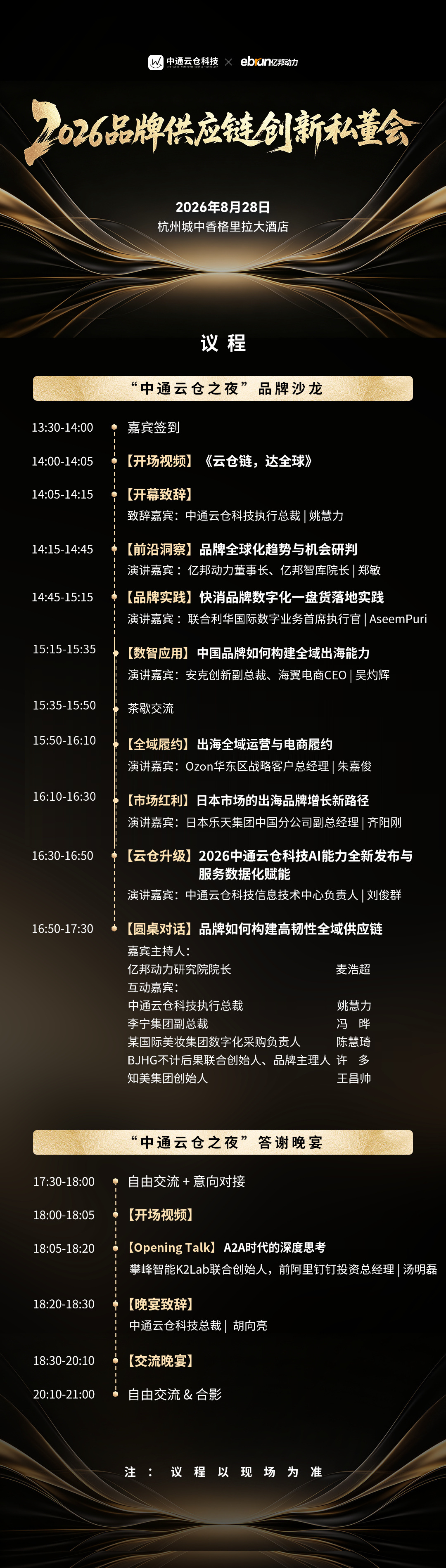
8月28日,“2026品牌供应链创新私董会暨‘中通云仓之夜’答谢晚宴”将在杭州城中香格里拉大酒店举行。本次私董会将聚焦品牌供应链的真实经营场景,讨论库存协同、全球化履约、AI应用与供应链韧性等具体问题。

“一盘货”落地:难点为何不只在技术?

“一盘货”的概念虽已普及,但统一查看库存仅是起点。真正的难点在于如何协调渠道权责,建立一套能够持续运行的库存调配机制。

线上与线下库存如何实现真正的动态共享?当不同渠道都希望优先保障自身销售时,库存调配的决定机制应当如何建立?订单分配规则又该如何在不影响渠道体验的前提下,提升整体库存周转效率?

本次私董会将通过快消品牌数字化“一盘货”的落地实践,抛开抽象的技术概念,深入探讨商品管理、渠道权责、订单规则与仓储履约之间的权衡与配合,呈现真实业务场景中的取舍逻辑。

品牌全球化:从前端增长到后端履约的承接

品牌出海的讨论往往始于市场机会,但最终落脚于交付能力。订单产生之后,库存配置、平台衔接、时效保障及退换货处理,无一不在考验后端的承载力。

跨境直发还是本地备货?业务规模未稳时如何控制履约成本?

围绕出海全链路,会议将从全球化趋势研判出发,延伸至出海全域运营、智能履约以及俄罗斯、日本等国际市场的增长路径。讨论将把市场机遇与履约能力置于同一视角,探讨订单增长之后,原有仓网结构的匹配与调整策略。

AI与数据化:技术能力向运营结果的转化

AI与自动化正在渗透至仓储作业、预测调度与异常识别等环节。然而对品牌而言,技术的价值必须由实际运营结果来检验。

预测是否更加精准?调度是否更加高效?技术投入能否直接对应运营绩效的改善?

活动现场,中通云仓科技将发布其AI能力及服务数据化方面的最新进展,介绍相关能力在仓储和履约服务中的应用方向。通过技术能力与运营场景的结合,现场将进一步探讨AI和数据如何参与仓储运营、库存管理及履约协同,为品牌供应链数智化建设提供实践参考。

构建高韧性供应链:以流动性替代冗余

面对市场波动,单纯依靠增加库存来防范缺货,不仅占用资金,更积聚滞销风险。供应链的真正韧性,并非盲目储备,而是建立在对需求的敏锐感知与库存的精准流动之上。

在以“构建高韧性全域供应链”为主题的圆桌对话中,来自品牌企业与供应链领域的嘉宾,将围绕渠道变化、国内外业务并行、局部缺货与整体库存压力等问题展开交流,讨论品牌如何根据自身业务阶段,在服务体验与库存效率之间作出选择。

围绕真实问题,相聚杭州

供应链承接着每一次渠道扩张和市场进入。当品牌的经营边界持续扩大,库存、渠道、仓网与数据如何协同,已经成为品牌必须面对的经营课题。活动当晚还将举行“中通云仓之夜”答谢晚宴,为品牌企业、跨境平台、供应链服务机构及产业伙伴提供进一步交流与对接的空间。

8月28日,杭州城中香格里拉大酒店。2026品牌供应链创新私董会期待与消费品牌、跨境平台及供应链领域的行业伙伴相聚,从“一盘货”落地、全球化履约、AI应用到供应链韧性,共同交流真实业务中的难题、选择与实践。

本文首发于 亿邦动力 官方网站

文章来源:亿邦动力

广告
微信
朋友圈

FAQ回顾

品牌供应链创新私董会重点讨论哪些方向的内容?

2026品牌供应链创新私董会聚焦品牌真实经营场景,核心讨论四大方向:“一盘货”落地实践、品牌全球化履约路径、AI与数据化技术运营转化、高韧性全域供应链构建,覆盖全渠道、出海等多场景供应链痛点。

品牌推进“一盘货”落地的核心难点是什么?

“一盘货”落地难点不只在技术层面,统一查看库存仅是起点,真正的核心难点是协调渠道权责,建立可长期运行的库存调配机制,平衡商品管理、渠道利益、订单规则与仓储履约的关系,提升整体库存周转效率。

中通云仓在2026供应链私董会有什么新进展发布?

活动现场中通云仓科技将发布其AI能力及服务数据化方面的最新进展,介绍相关能力在仓储和履约服务中的应用方向,结合技术能力与运营场景,为品牌供应链数智化建设提供实践参考。

构建高韧性品牌供应链的核心逻辑是什么?

构建高韧性供应链不能单纯依靠增加库存防范缺货,核心是要基于对需求的敏锐感知实现库存精准流动,品牌可根据自身业务阶段,在服务体验与库存效率之间做合理权衡,降低资金占用与滞销风险。

这么好看,分享一下?

朋友圈 分享

APP内打开

+1
+1
微信好友 朋友圈 新浪微博 QQ空间
关闭
收藏成功
发送
/140 0