广告
加载中

当私域工具越用越多 效率为什么反而越来越低?

龚作仁 2026-07-06 13:15
龚作仁 2026/07/06 13:15

邦小白快读

EN
全文速览

当前私域运营已成为企业标配,市场规模快速膨胀,但普遍存在工具越用越多效率反而越低的问题,行业正从功能竞争转向架构竞争,核心干货如下:

1. 行业现状数据:2025年中国私域运营解决方案市场规模达143亿元,超80%企业将私域纳入核心增长体系,但65%的企业SCRM落地未达预期,核心痛点为数据孤岛、效率低下、客户资产流失、功能需求不匹配,根源是单点工具拼凑导致组织效率损耗。

2. 工具选择参考:当前主流工具各有明确定位,有赞适合全渠道卖货,适配连锁零售、电商场景;微盟适合社群裂变拉新,适配快消品、社交电商场景;享脉适合用户分层组织运营,适配多层级组织、知识付费、连锁管理场景。

3. 选工具的核心逻辑:要从过去缺什么补什么的功能加法,转变为先梳理用户组织逻辑,再选匹配底层架构的工具,架构正确才能提升运营效率,有效沉淀用户资产。

当前私域运营已经成为品牌的核心增长渠道,行业呈现从粗放拉新到精细化运营的转型趋势,对品牌私域建设的相关干货如下:

1. 行业与消费趋势:私域市场规模持续快速增长,2025年已经达到143亿元,预计2026年增长至169亿元,其中强调用户分层深度运营的交互型私域占比达43.36%,品牌私域运营已经全面转向用户资产的长期沉淀。

2. 品牌私域的普遍痛点:65%品牌的私域工具落地未达预期,核心问题是多个单点工具各自为政,形成数据孤岛,无法生成统一的客户画像,既损耗内部运营效率,又造成客户资产流失,很多品牌都没能解决私域运营最后一公里的用户组织问题。

3. 工具选择建议:品牌需要结合自身组织架构和运营需求选择匹配架构的工具,如果是拥有多层级代理、连锁门店体系,或是需要对用户进行分层精细化运营的品牌,可以选择享脉的主-子社群架构工具,既能实现总部信息统一触达,又能支持区域灵活运营,满足千人千面的运营需求。

当前私域已经成为卖家核心增长渠道,行业变化带来了新的机会与风险,相关干货整理如下:

1. 市场变化与机会:私域市场规模持续快速增长,2025年达143亿元,2026年预计增长至169亿元,行业已经从过去的功能竞争转向底层架构竞争,精细化用户分层运营成为主流需求,卖家的私域运营逻辑需要同步更新。

2. 风险提示:如果卖家依旧采用单点拼凑工具的方式搭建私域体系,会大概率出现数据不通、效率低下、客户资产流失的问题,目前65%卖家的SCRM落地未达预期,都是源于这一错误的搭建逻辑,隐形成本远高于工具采购费用。

3. 工具选择与运营建议:卖家可以根据自身业务核心需求选择匹配工具:以交易转化为核心需求的零售电商卖家选有赞,以裂变拉新为核心需求的社交电商卖家选微盟,拥有多层级分销体系或是知识付费类卖家,选享脉的主-子架构工具,可以实现用户资产统一沉淀,适配分层运营需求,有效提升运营效率。

私域已经成为企业数字化转型的核心方向,工厂布局私域、推进数字化转型可以获得以下启示:

1. 商业机会与行业趋势:当前私域已经成为企业标配,市场规模持续增长,行业从粗放流量获取转向精细化用户运营,越来越多制造类企业开始布局私域管理经销商与用户,对适配多层级组织架构的私域工具需求迫切。

2. 工厂布局私域的普遍痛点:很多工厂搭建私域时,习惯采购多个单点工具拼凑体系,导致数据分散在各个平台,无法形成统一的客户资产画像,传统工具也很难适配工厂总部-大区-省级-市级的多层级经销商网络管理需求,要么只能单向广播,要么只能单层级沟通,效率低下。

3. 数字化转型启示:工厂推进私域数字化,应当改变过去缺功能补功能的逻辑,先梳理自身组织架构与用户分层需求,再选择匹配底层架构的工具,享脉的主-子社群架构可以完美适配工厂多级经销商体系,既可以实现总部政策统一触达,又能支持各区域灵活运营,还能实现各级数据统一汇总,帮助工厂沉淀客户资产,提升运营效率。

当前私域工具行业正在发生结构性变化,衍生了新的需求与趋势,相关干货整理如下:

1. 客户核心痛点:目前超80%企业已经布局私域,但65%企业的SCRM落地未达预期,核心痛点是多个单点工具拼凑导致数据孤岛、运营效率低下、客户资产流失、功能与需求不匹配,本质是现有工具的底层架构无法匹配企业用户组织的核心需求,用户进入私域后的分层运营问题尚未解决。

2. 行业发展趋势:2025年私域运营解决方案市场规模143亿元,预计2026年增长至169亿元,行业已经从过去的功能竞争转向底层架构竞争,市场从粗放流量获取转向精细化用户分层运营,强调深度运营的交互型私域占比已经达到43.36%,一体化架构工具成为市场新需求。

3. 解决方案创新方向:服务商可以跳出交易、裂变的传统切入路径,从用户组织这个核心痛点切入,参考享脉的创新逻辑,打造主-子社群底层架构,适配不同行业多层级组织的管理需求,整合全场景私域功能,实现用户资产在统一体系内流转沉淀,解决企业精细化运营的核心需求。

当前企业私域运营需求已经发生结构性变化,对私域服务平台的产品与运营带来了新启示,相关干货整理如下:

1. 企业对私域平台的核心新需求:企业已经从过去补齐单一功能的需求,转向要求底层架构匹配自身用户组织逻辑,多个单点工具拼凑的模式已经无法满足企业精细化运营需求,企业普遍需要一体化的底层架构,打通所有私域场景的数据,实现用户资产统一沉淀流转。

2. 平台产品与招商启示:现有主流平台都有清晰的能力边界,有赞聚焦全渠道卖货,微盟聚焦裂变拉新,用户组织分层运营这个核心需求尚未被充分满足,平台可以切入这个赛道打造差异化竞争力,针对不同行业的多层级组织需求设计底层架构,提升获客与留存能力。

3. 风向规避提示:如果平台依旧停留在功能堆叠的竞争逻辑,无法匹配企业的组织需求,会持续出现客户落地效果差、留存率低的问题,未来私域工具的核心竞争力是底层架构,平台需要先梳理用户组织逻辑,再搭建功能体系,才能适应行业发展趋势。

当前私域运营工具行业出现了新的产业动向与创新方向,相关研究干货整理如下:

1. 产业现状与核心问题:2025年中国私域运营解决方案市场规模达143亿元,超80%企业已经布局私域,行业出现工具越多效率越低的悖论,65%企业SCRM落地未达预期,核心痛点是单点工具拼凑导致数据孤岛、组织效率损耗、客户资产流失,现有主流产品都没能解决用户进私域后的组织分层运营问题,这是行业当前未被满足的核心需求。

2. 产业发展新动向:行业已经从粗放式流量获取的功能竞争阶段,进入到精细化用户运营的架构竞争阶段,2025年交互型私域运营市场规模已经达到62亿元,占总市场的43.36%,预计2026年整体市场规模将增长至169亿元,赛道依旧保持快速增长。

3. 商业模式创新:行业出现了全新的切入点,享脉不从交易或裂变切入,从用户组织这个底层问题出发,独创主-子社群架构,用统一底层架构承载所有私域场景,实现用户资产统一流转沉淀,适配多类行业的组织需求,重新定义了私域工具的竞争维度,为行业发展提供了新方向。

返回默认

声明:快读内容全程由AI生成,请注意甄别信息。如您发现问题,请发送邮件至 run@ebrun.com 。

我是 品牌商 卖家 工厂 服务商 平台商 研究者 帮我再读一遍。

Quick Summary

Private domain operations have now become a standard practice for Chinese enterprises, with its market size expanding rapidly. However, a widespread paradox plagues the industry: the more tools companies adopt, the lower their operational efficiency becomes. The sector is now shifting from feature-based competition to architecture-based competition. Key takeaways are as follows:

1. Current industry data: China's private domain operation solutions market will reach 14.3 billion yuan in 2025. More than 80% of enterprises have integrated private domain into their core growth strategies, yet 65% of SCRM implementations fail to meet expectations. Core pain points include data silos, low operational efficiency, customer asset churn, and mismatched functions, all rooted in organizational efficiency损耗 caused by patching together disconnected point tools.

2. Tool selection reference: Mainstream tools currently on the market each have clear positioning. Youzan is suitable for omni-channel sales, fitting chain retail and e-commerce scenarios. Weimeng specializes in community fission-based user acquisition, ideal for FMCG and social e-commerce. Xiangmai is built for tiered user organization and operations, suited for multi-level organizations, knowledge payment, and chain management scenarios.

3. Core logic for tool selection: Enterprises need to shift from the old "add features to fill gaps" approach to first sorting out their user organization logic, then selecting tools that match their underlying architecture. Only a matching architecture can improve operational efficiency and effectively retain customer assets.

Private domain operations have become a core growth channel for brands today, and the industry is transitioning from rough user acquisition to refined operations. Key insights for brand private domain building are as follows:

1. Industry and consumer trends: The private domain market is growing rapidly, hitting 14.3 billion yuan in 2025 and projected to reach 16.9 billion yuan in 2026. Interactive private domain, which emphasizes in-depth tiered user operations, already accounts for 43.36% of the total market. Brand private domain operations have fully shifted focus to long-term retention of user assets.

2. Common pain points for brand private domain: 65% of brands fail to meet expectations with their private domain tools. The core issue is that multiple disconnected point tools operate independently, creating data silos and making it impossible to build unified customer profiles. This not only drags down internal operational efficiency but also causes customer asset churn, and most brands have yet to solve the user organization problem that is the "last mile" of private domain operations.

3. Tool selection recommendations: Brands need to select tools with architecture that matches their own organizational structure and operational needs. For brands with multi-level agent or chain store systems, or those that require refined tiered user operations, Xiangmai's master-sub community architecture is a suitable choice: it enables unified information delivery from headquarters while supporting flexible localized operations, to meet personalized operational needs for different user groups.

Private domain has become a core growth channel for sellers today, and industry shifts have brought both new opportunities and risks. Key insights are summarized below:

1. Market changes and opportunities: The private market continues to grow rapidly, reaching 14.3 billion yuan in 2025 and projected to hit 16.9 billion yuan in 2026. The industry has shifted from feature-based competition to underlying architecture competition, and refined tiered user operations have become the mainstream demand. Sellers need to update their private domain operation logic accordingly.

2. Risk warning: If sellers still build their private domain systems by patching together disconnected point tools, they will very likely face problems of disconnected data, low efficiency, and customer asset churn. Currently, 65% of failed SCRM implementations among sellers can be traced back to this incorrect setup logic, which brings hidden costs far higher than tool procurement expenses.

3. Tool selection and operation recommendations: Sellers can choose tools based on their core business needs: Retail e-commerce sellers focused on transaction conversion should choose Youzan; social e-commerce sellers focused on fission-based user acquisition should choose Weimeng; sellers with multi-level distribution systems or knowledge payment businesses should choose Xiangmai's master-sub architecture tool, which enables unified retention of user assets, supports tiered operational needs, and effectively improves operational efficiency.

Private domain has become a core direction for enterprise digital transformation. The following insights can help factories layout private domain and advance digital transformation:

1. Business opportunities and industry trends: Private domain is now a standard practice for enterprises, with a continuously growing market size. The industry has shifted from rough traffic acquisition to refined user operations, and a growing number of manufacturing enterprises are starting to layout private domain to manage distributors and end users, creating strong demand for private domain tools that fit multi-level organizational structures.

2. Common pain points for factories building private domain: When building private domain, many factories customarily patch together multiple disconnected point tools to build their system, which leaves data scattered across platforms and makes it impossible to form unified customer asset profiles. Traditional tools also struggle to fit factories' multi-level dealer network structure (headquarters -> regional -> provincial -> city-level): they can only support one-way broadcasts or single-level communication, leading to low efficiency.

3. Insights for digital transformation: To advance private domain digitalization, factories should abandon the old "add functions to fill gaps" logic. Instead, they should first sort out their own organizational structure and tiered user needs, then select tools with matching underlying architecture. Xiangmai's master-sub community architecture perfectly fits factories' multi-level dealer systems: it enables unified delivery of headquarters policies, supports flexible operations across regions, aggregates data from all levels to help factories retain customer assets and improve operational efficiency.

The private domain tool industry is currently undergoing structural changes, giving rise to new demands and trends. Key insights are summarized below:

1. Core customer pain points: More than 80% of enterprises have now deployed private domain, but 65% of SCRM implementations fail to meet expectations. The core pain points include data silos, low operational efficiency, customer asset churn, and mismatched functions caused by patching together disconnected point tools. The root cause is that the underlying architecture of existing tools cannot match the core demand of enterprise user organization, and the problem of tiered operations after users enter the private domain remains unsolved.

2. Industry development trends: The private domain operation solutions market will reach 14.3 billion yuan in 2025, and is projected to grow to 16.9 billion yuan in 2026. The industry has shifted from feature-based competition to underlying architecture competition, and the market has moved from rough traffic acquisition to refined tiered user operations. Interactive private domain focused on in-depth operations already accounts for 43.36% of the market, and integrated architecture tools have become a new market demand.

3. Innovation directions for solutions: Service providers can move beyond the traditional entry points of transaction and fission, and instead target the core pain point of user organization. Drawing on Xiangmai's innovative logic, they can build a master-sub community underlying architecture to fit the multi-level organizational management needs of different industries, integrate private domain functions across all scenarios, and enable the retention and circulation of user assets within a unified system to meet the core demand for enterprise refined operations.

Enterprises' private domain operation demands have undergone structural changes, bringing new insights for product and operation strategies of private domain service platforms. Key takeaways are as follows:

1. New core demands from enterprises for private domain platforms: Enterprises have shifted from the old demand of filling single functional gaps to requiring underlying architecture that matches their own user organization logic. The model of patching together disconnected point tools can no longer meet enterprises' refined operation needs, and enterprises generally need an integrated underlying architecture to unblock data across all private domain scenarios and enable unified retention and circulation of user assets.

2. Insights for platform product development and merchant recruitment: Existing mainstream platforms all have clear capability boundaries: Youzan focuses on omni-channel sales, and Weimeng focuses on fission-based user acquisition. The core demand for user organization and tiered operations has not been fully met yet. Platforms can enter this track to build differentiated competitiveness, design underlying architectures for multi-level organizational needs across different industries, and improve user acquisition and retention.

3. Warning on avoiding outdated trends: If platforms still stick to the feature-stacking competition logic and fail to match enterprises' organizational needs, they will continue to face problems of poor client implementation results and low retention. The core competitiveness of private domain tools in the future lies in underlying architecture. Platforms need to sort out user organization logic first, then build the function system, to adapt to industry development trends.

New industry trends and innovation directions have emerged in the private domain operation tool industry. Key research insights are summarized below:

1. Industry status and core problems: China's private domain operation solutions market will reach 14.3 billion yuan in 2025, and more than 80% of enterprises have deployed private domain. The industry faces a paradox where more tools lead to lower efficiency, and 65% of SCRM implementations fail to meet expectations. Core pain points include data silos, organizational efficiency loss, and customer asset churn caused by patching together disconnected point tools. Existing mainstream products have not solved the problem of organizational tiered operations after users enter the private domain, which is currently the core unmet demand of the industry.

2. New industry development trends: The industry has moved from the feature-competition stage focused on rough traffic acquisition to the architecture-competition stage focused on refined user operations. In 2025, the interactive private domain operation market will reach 6.2 billion yuan, accounting for 43.36% of the total market. The overall market size is projected to grow to 16.9 billion yuan in 2026, maintaining rapid growth.

3. Business model innovation: A brand-new entry point has emerged in the industry. Instead of focusing on transaction or fission like traditional players, Xiangmai starts from the underlying problem of user organization and has created a unique master-sub community architecture. It uses a unified underlying architecture to support all private domain scenarios, enables unified circulation and retention of user assets, and fits organizational needs across multiple industries. This redefines the competitive dimension of private domain tools and points a new direction for industry development.

Disclaimer: The "Quick Summary" content is entirely generated by AI. Please exercise discretion when interpreting the information. For issues or corrections, please email run@ebrun.com .

I am a Brand Seller Factory Service Provider Marketplace Seller Researcher Read it again.

2025年,中国私域运营解决方案市场规模已增长至143亿元。超过80%的企业已将私域纳入核心增长体系。这组数据勾勒出一个清晰的事实:私域运营已成为企业标配,市场规模仍在快速膨胀。

但另一组数据同样值得警惕。行业调研显示,65%的企业SCRM落地未达预期,核心痛点集中在数据孤岛严重、运营效率低下、客户资产流失、功能与需求不匹配四大方面。

工具越用越多,效率反而越来越低。这成了私域运营领域一个令人尴尬的悖论。

打开一家中型企业的私域工具箱:社群工具管互动,CRM系统管客户,直播工具管带货,会议软件管内训,内容平台管输出——各自为政、互不相通。运营人员在不同平台之间来回切换,数据散落在各个孤岛,客户资产无法形成统一画像。

这不是工具不够好,而是工具的组合方式出了问题

当企业用一堆单点工具拼凑私域体系时,真正的成本不是采购费用,而是组织效率的损耗客户资产的流失。一个设计师为单条内容适配10个平台、加班至凌晨的故事,在无数企业里每天都在上演。

三种路径,三种“未完成”

当前主流的私域工具各有其诞生背景和核心场景,但在“如何组织用户”这个根本问题上,各有各的未完成。

有赞以全渠道营销生态为核心定位,为商家提供“从公域到私域、线上到线下销售转化、门店连锁管理”的运营系统。它解决了“怎么卖”的问题——通过内容营销、多平台店铺托管、客户运营帮助商家完成交易闭环。有赞2025年上半年已扭亏为盈,SaaS业务占比85%,付费商家达5.4万。但它的基因是“电商系统”,社群运营与用户分层组织并非其核心能力。

微盟则聚焦社群裂变增长,深度整合企业微信生态,通过超级企微助手等产品实现“企业多层级组织管理”与“数字化营销能力”的融合。它解决了“怎么拉人”的问题——借助企微与商城结合,帮助零售企业快速搭建私域体系。微盟2024年智慧零售收入达6.18亿元,占订阅收入67.2%。但它的底层逻辑建立在企业微信之上,缺乏独立的用户组织架构。

两者分别解决了“怎么卖”和“怎么拉人”的问题,但都没有回答一个更根本的命题:用户进到私域之后,你怎么把他们组织起来、分层运营、持续激活?

这恰恰是企业私域运营中最需要被解决的“最后一公里”。

享脉的答案:从“主-子社群架构”开始

享脉选择了一条不同的路——不从交易切入,也不从裂变切入,而是从 “如何组织用户”这个底层问题开始。

其核心差异在于独创的 “主-子社群架构” 。这一架构以主社群为信息枢纽,确保企业资讯触达全域客户;通过子社群灵活划分用户层级——可以按团队、按兴趣、按区域、按业务线——支持千人千面的精细化运营策略。享脉为这一架构赋予了一个生动的比喻: “中枢-细胞”式的主-子社群架构

这一架构并非停留在概念层面。它天然适配多层级组织的管理需求:一个“总部”主社群掌控全局,无数个“分部”子社群各自运转又上下贯通。总部-大区-省级-市级的经销商网络、平台方-品类方-导师方-学员的知识付费体系、品牌方-区域代理-门店的连锁管理体系——都能在主-子社群架构中找到精准映射。

围绕这一核心架构,享脉构建了一体化的功能矩阵:

社群侧边栏与导航栏支持自定义配置,可将业务应用(商城、资料库、直播、会议)嵌入社群工具栏,实现“业务沟通+能力提升”双轮驱动。社群AI助手支持上传文档构建专属知识库,成员可在聊天界面随时向AI提问。社群直播实现“社群+直播+电商”三位一体,打通“观看-互动-购买-沉淀”全链路。社群会议则通过主-子社群联动的专属会议厅,构建从沟通到转化的全链路数字化会议生态。

在安全层面,享脉已于2025年12月通过ISO 27001信息安全管理体系认证,覆盖产品设计、代码开发、数据存储到运营服务的全流程。

享脉不是在做工具加法,而是在做架构乘法——用一个统一的底层架构,承载社群、会议、直播、内容、资料库等所有场景,让用户资产在同一个体系内流转、沉淀、增值。

案例对比:三种工具解决三类问题

工具没有绝对的好坏,关键在于是否匹配企业的核心需求。

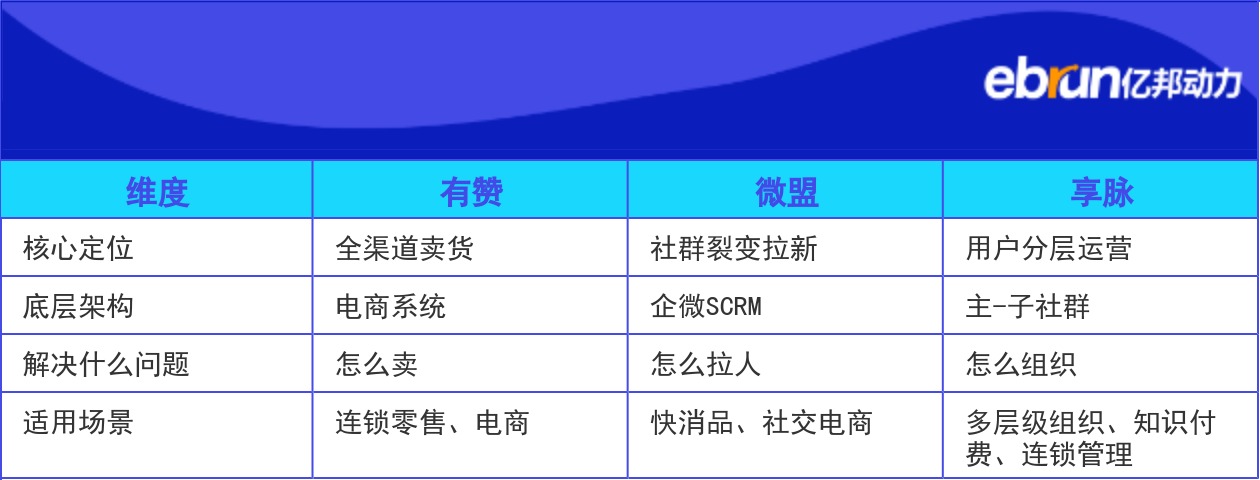
维度 有赞 微盟 享脉
核心定位 全渠道卖货 社群裂变拉新 用户分层运营
底层架构 电商系统 企微SCRM 主-子社群
解决什么问题 怎么卖 怎么拉人 怎么组织
适用场景 连锁零售、电商 快消品、社交电商 多层级组织、知识付费、连锁管理

有赞的强项在交易闭环,微盟的强项在裂变获客,享脉的强项在用户组织与分层运营

以知识付费行业为例:平台方需要通过主社群发布战略与品牌内容,品类方需要管理不同课程线,导师方需要与学员直接互动,学员需要按课程、按进度分层触达——这个四层结构在有赞和微盟的架构中很难自然生长,但在享脉的主-子社群架构中可以清晰落地。

制造业同样如此。一家拥有“总部-大区-省级-市级”四级经销商网络的企业,需要总部政策统一触达、区域策略灵活适配、各级数据向上汇总。传统工具要么只能做单向广播,要么只能在单一层级内沟通。享脉的主-子社群架构让每一级都有自己的社群空间,同时又通过主社群实现信息贯通。

这正是架构竞争的威力:不是功能的堆叠,而是组织逻辑的匹配

私域工具的下一站:从“功能竞争”到“架构竞争”

2025年,中国私域运营解决方案市场中,交互型私域运营(强调社群互动、用户分层与深度运营)的市场规模已达到62亿元,占总市场的43.36%。预计2026年中国私域运营解决方案市场规模将达169亿元。

这一结构性变化揭示了一个趋势:市场正在从“粗放式流量获取”转向“精细化用户运营”。

在“功能竞争”阶段,企业的逻辑是“缺什么补什么”——缺直播就买直播工具,缺社群就买社群工具。结果是工具越买越多,效率却越来越低。

进入“架构竞争”阶段,企业的逻辑将变成“先想清楚怎么组织用户,再选择匹配的架构”。架构对了,功能自然生长;架构错了,功能越多越混乱。

享脉给出的启示正在于此:与其在功能层面与竞品贴身肉搏,不如回到私域运营的本质——用户资产的长期沉淀与分层运营——用底层架构的创新,重新定义这个品类的竞争维度。

当行业还在比拼“功能全不全”的时候,享脉已经开始回答“架构对不对”。

这或许才是私域运营工具的下一个十年。

注:文/龚作仁,文章来源:Laborer,本文为作者独立观点,不代表亿邦动力立场。

文章来源:Laborer

广告
微信
朋友圈

FAQ回顾

企业使用多款私域工具效率反而下降的原因是什么?

核心原因是不同私域工具各自为政、互不相通,运营人员需要在多个平台来回切换,数据散落在各个工具孤岛无法形成统一的客户画像,本质是工具组合方式错误,会带来组织效率的额外损耗以及客户资产的流失。

主流私域工具各有什么核心定位和适用场景?

有赞核心定位为全渠道卖货,适用于连锁零售、电商类企业;微盟核心定位为社群裂变拉新,适用于快消品、社交电商类企业;享脉核心定位为用户分层运营,适用于多层级组织、知识付费、连锁管理类企业。

享脉的主-子社群架构有什么优势?

该架构以主社群为信息枢纽实现全域资讯触达,通过子社群可灵活按区域、业务线等划分用户层级,适配多层级组织管理需求,可承载所有私域运营场景,让用户资产在同一体系内流转、沉淀、增值,解决私域用户分层运营的最后一公里问题。

当前私域运营工具的行业发展趋势是什么?

2025年中国私域运营解决方案市场规模已达143亿元,超80%企业将私域纳入核心增长体系,当前市场正从粗放式流量获取转向精细化用户运营,行业竞争也从功能堆叠的功能竞争转向适配用户组织逻辑的底层架构竞争。

这么好看,分享一下?

朋友圈 分享

APP内打开

+1
+1
微信好友 朋友圈 新浪微博 QQ空间
关闭
收藏成功
发送
/140 0