广告
加载中

供应链场景落地加生态构建 京东工业以大模型驱动产业数智化发展

龚作仁 2026-06-30 16:25
龚作仁 2026/06/30 16:25

邦小白快读

EN
全文速览

本文核心介绍了京东工业在工业大模型领域的最新布局和进展,梳理了当前工业产业数智化转型的整体趋势,干货信息如下

1. 行业趋势层面,亿邦智库《2025产业互联网发展报告》指出,当前产业AI已经进入规模化应用阶段,覆盖研发生产采购全链路,垂直产业平台是AI落地的核心载体,产业正从线性链条向网状生态转型。

2. 京东工业的最新进展:目前已经上线近40款AI智能体,服务超3000家重点企业,AI能力已经完成1.0单点赋能工具阶段的布局,正向着能独立完成全场景任务、主动洞察需求的2.0AI专家阶段跃迁,同时推出国内首个工业大模型生态百川计划,开启数据、模型、应用三维生态共建。

3. 核心落地模式:采用“工业大模型+供应链应用”双轮驱动,把复杂的数智化转型问题拆解为可操作的场景级任务,切实推动全行业降本增效。

本文传递了当前工业领域数智化转型的趋势,给工业品牌带来了清晰的发展方向和合作机会,干货内容如下

1. 行业趋势与发展变化:当前产业AI已经进入规模化应用阶段,覆盖全产业链,深度价值链重构推动产业从线性链条向网状生态转型,品牌可以依托垂直平台的数智能力突破品牌与标准瓶颈,实现升级发展。

2. 可参与的合作生态:京东工业推出国内首个工业大模型生态“百川计划”,面向上游行业伙伴开放能力,从能力共享、资源支持到商机转化全方面扶持伙伴增长,已经有德力西电气合作打造工业电气大模型落地应用的成功案例。

3. 核心价值:品牌参与生态共建,可以借助大模型能力解决工业品参数非标、供需信息不匹配的痛点,提升商品标准化水平,优化产品选型、导购等场景效率,实现全链路降本增效。

本文带来了工业供应链领域数智化转型的最新机会,给工业品类卖家提供了明确的发展方向和可参与的合作模式,干货内容如下

1. 政策与行业风向:当前国家推进“工业数据筑基”“模数共振”行动,产业AI进入规模化落地阶段,产业深度升级带来大量新增增长机会,数智化转型是必然发展方向。

2. 明确的机会与扶持政策:京东工业开启百川计划,面向上游行业伙伴开放生态合作,卖家可参与共建,获得大模型技术能力、数据资源支持以及商机转化扶持,解决自身面临的工业品参数非标、长尾品类繁杂、供需信息不匹配的痛点,降低运营成本。

3. 可参考的转型路径:京东工业将复杂的数智化转型拆解为可落地的场景级任务,卖家可以参考该模式,从单点场景切入逐步升级,降低转型门槛,借助AI提升人效与运营效率。

本文梳理了当前工业领域数智化转型的最新实践,给工厂推进数字化升级、挖掘商业机会带来了清晰的启示,干货内容如下

1. 行业需求与发展方向:当前产业AI已经覆盖研发、生产、采购全链路,工厂推进数智化转型是行业必然趋势,大模型技术可以针对性解决工业领域数据杂乱散、供需信息不匹配的核心痛点,帮助工厂实现降本增效。

2. 可对接的商业机会:京东工业推出百川计划,邀请上游行业工厂参与大模型生态共建,工厂参与后可以获得大模型技术输出、数据能力支持以及商机转化资源,助力自身搭建标准化商品库,提升商品标准化水平,更精准对接下游需求。

3. 数字化转型启示:工厂可以参考京东工业的分阶段转型路径,先从单点场景的轻量化AI工具应用入手,解决局部痛点,再逐步拓展到全链路的AI赋能,把复杂转型问题拆解为场景级任务,降低转型难度,稳步实现升级。

本文明确了当前工业供应链数智化领域的发展趋势、核心客户痛点以及成熟的落地方案,给服务商发展业务提供了重要参考,干货内容如下

1. 行业发展趋势:亿邦智库研究显示,当前产业AI进入规模化应用阶段,垂直产业平台成为AI落地的核心载体,产业正在从传统线性供应链向网状生态转型,生态共建是未来行业发展的核心方向,蕴藏大量服务机会。

2. 核心客户痛点:当前工业领域普遍存在工业品参数非标准化、长尾品类繁杂、供需两端信息不匹配的问题,上游行业还存在数据杂乱散难以统筹的痛点,直接导致行业大模型建设速度慢、协同价值低,这些都是服务商可以切入的核心方向。

3. 可参考的成熟解决方案:京东工业已经验证了“工业大模型+供应链应用”双轮驱动模式,构建“行业大模型赋能、领域小模型执行、应用智能体协同”的体系化方案,通过生态共建整合资源,拆解复杂转型任务,可作为服务商设计方案的参考。

本文分享了京东工业作为工业垂直产业平台在大模型落地、生态构建方面的最新实践,给同类平台推进数智化运营、生态建设提供了参考,干货内容如下

1. 当前产业端对平台的核心需求:工业领域各类企业普遍有强烈的数智化转型、降本增效需求,但多数企业缺乏足够的技术能力和数据资源,转型难度大,需要平台提供体系化的解决方案和生态支持,帮助企业降低转型门槛。

2. 可参考的平台运营与招商做法:京东工业形成“工业大模型+供应链应用”双轮驱动模式,分阶段推进AI能力建设,从单点工具逐步向全场景AI专家跃迁,同时开启百川计划,从数据、模型、应用三个维度共建生态,通过能力共享、资源扶持吸引合作伙伴,已经验证了细分领域合作的成功路径。

3. 风险规避提示:平台发展大模型应用需要避免脱离产业实际场景空谈技术,必须将大模型能力和细分行业的深度场景结合,拆解转型任务为可落地的场景级任务,才能切实创造价值,避免技术落地失败的风险。

本文披露了工业供应链大模型领域的最新产业动向,提出了创新的商业模式和实践路径,为产业研究提供了一手案例和研究方向,干货内容如下

1. 产业最新动向:当前产业AI已经进入规模化应用阶段,国内工业大模型发展已经完成1.0单点工具赋能阶段的布局,目前正整体向2.0场景化AI专家阶段跃迁,国内诞生了首个工业领域大模型生态“百川计划”,开启了行业大模型生态化共建的新阶段。

2. 行业待解决的新问题:研究发现当前工业上游存在数据杂乱散难以统筹的结构性问题,直接导致行业大模型建设速度慢、协同价值弱,同时工业品领域长期存在参数非标准化、长尾品类繁杂、供需信息不匹配的核心痛点,仍然有待进一步探索解决方案。

3. 创新商业模式研究样本:京东工业探索出“工业大模型+供应链应用”双轮驱动的数智降本新模式,构建“行业大模型赋能、领域小模型执行、应用智能体协同”的体系化解决方案,通过三维生态共建带动全行业降本增效,为产业互联网和工业大模型的研究提供了优质的一手样本。

返回默认
声明:快读内容全程由AI生成,请注意甄别信息。如您发现问题,请发送邮件至 run@ebrun.com 。

我是 品牌商 卖家 工厂 服务商 平台商 研究者 帮我再读一遍。

Quick Summary

This article highlights JD Industrial's latest developments and strategic布局 in industrial large models, and outlines the overall trends of digital and intelligent transformation in China's industrial sector. Key takeaways are as follows:

1. Industry trends: According to ebrun Research Institute's *2025 Industrial Internet Development Report*, industrial AI has entered the stage of large-scale application, covering the entire value chain from R&D and production to procurement. Vertical industrial platforms serve as the core carrier for AI implementation, and the industry is shifting from a traditional linear supply chain to a networked ecosystem.

2. Latest progress from JD Industrial: The company has launched nearly 40 AI agents serving more than 3,000 key enterprise clients. Having completed the layout of its 1.0 phase, which focused on single-point tool-enabled empowerment, JD Industrial is now transitioning to its 2.0 "AI expert" phase, where models can independently complete full-scenario tasks and proactively identify business demands. It has also launched Baichuan Program, China's first industrial large model ecosystem initiative, to facilitate joint ecosystem development across data, model and application layers.

3. Core implementation model: JD Industrial adopts a dual-driven approach combining "industrial large models + supply chain applications", which breaks down complex digital transformation challenges into actionable scenario-specific tasks, delivering tangible cost reduction and efficiency improvement across the industry.

This article outlines current trends in industrial digital and intelligent transformation, clarifying development directions and partnership opportunities for industrial brands. Key insights include:

1. Industry trends and structural shifts: Industrial AI has entered large-scale application across the entire industrial chain, and deep value chain restructuring is driving the shift from linear supply chains to a networked ecosystem. Brands can leverage the digital capabilities of vertical industrial platforms to break through bottlenecks in product standardization and brand building to achieve upgrading.

2. Accessible partnership ecosystem: JD Industrial has launched Baichuan Program, China's first industrial large model ecosystem initiative, which opens up its capabilities to upstream industry partners. It provides end-to-end support ranging from capability sharing and resource backing to business opportunity conversion, with a proven successful case of co-developing a practical electrical industry large model with Delixi Electric.

3. Core value proposition: By participating in the co-built ecosystem, brands can leverage large model capabilities to solve core pain points including non-standardized product parameters and mismatched supply-demand information, improve product standardization, optimize efficiency in scenarios such as product selection and purchasing guidance, and achieve end-to-end cost reduction and efficiency improvement.

This article shares the latest growth opportunities brought by digital transformation in the industrial supply chain, laying out clear development directions and accessible cooperation models for industrial product sellers. Key takeaways are:

1. Policy and industry winds: China is advancing national initiatives including "Industrial Data Foundation Building" and "Integration of Digital and Physical Industrial Systems". Industrial AI has entered the large-scale implementation stage, and deep industrial upgrading is generating substantial new growth opportunities, making digital transformation an inevitable path forward.

2. Clear opportunities and support policies: JD Industrial's Baichuan Program opens its ecosystem to upstream partners. Sellers that join the ecosystem can access large model technology, data resource support and business conversion assistance to address their core pain points: non-standard industrial product parameters, complex long-tail product categories and mismatched supply-demand information, ultimately reducing operating costs.

3. A proven transformation roadmap: JD Industrial breaks down complex digital transformation into actionable, scenario-level tasks. Sellers can follow this framework to start transformation from single-point scenarios and upgrade incrementally, lowering entry barriers and boosting labor and operational efficiency via AI.

This article summarizes the latest practical progress in industrial digital transformation, offering clear insights for factories seeking to advance digital upgrading and unlock new business opportunities. Key points include:

1. Industry demands and development direction: Industrial AI already covers the full chain from R&D, production to procurement, making digital transformation an inevitable industry trend. Large model technology can specifically solve core industrial pain points including fragmented and unstructured data and mismatched supply-demand information, helping factories cut costs and improve efficiency.

2. Accessible business opportunities: JD Industrial's Baichuan Program invites upstream factories to join its co-built large model ecosystem. Participating factories gain access to large model technology output, data capability support and business opportunity resources, which help them build standardized product libraries, improve product standardization and match downstream demand more accurately.

3. Insights for digital transformation: Factories can follow JD Industrial's phased transformation path: start with lightweight AI tool applications for single-point scenarios to address localized pain points, then gradually expand to end-to-end AI empowerment. Breaking down complex transformation into scenario-level tasks reduces implementation difficulty and enables steady upgrading.

This article clarifies current development trends, core customer pain points and proven implementation solutions for digital transformation in industrial supply chains, providing important reference for service providers growing their businesses. Key insights are as follows:

1. Industry development trends: According to ebrun Research Institute, industrial AI has entered large-scale application, with vertical industrial platforms emerging as the core carrier for AI implementation. The industry is shifting from traditional linear supply chains to a networked ecosystem, making ecosystem co-construction the core future development direction with substantial untapped service opportunities.

2. Core customer pain points: The industrial sector broadly struggles with non-standardized industrial product parameters, complex long-tail categories, and mismatched supply and demand information. Upstream industries also face the challenge of fragmented, unstructured data that is difficult to coordinate, which slows industry-wide large model development and reduces collaborative value. All these pain points represent core entry points for service providers.

3. A proven reference solution: JD Industrial has validated a dual-driven "industrial large model + supply chain application" model, building a systematic architecture of "industry large model empowerment, domain-specific small model execution, and application agent collaboration". It integrates resources via ecosystem co-construction and breaks down complex transformation tasks, making it a solid reference for service providers designing their own solutions.

This article shares JD Industrial's latest practice in large model implementation and ecosystem building as a vertical industrial platform, offering a reference for peer platforms advancing digital operations and ecosystem development. Key takeaways are:

1. Core enterprise demands from platforms: All types of industrial enterprises have strong demand for digital transformation to cut costs and improve efficiency, but most lack sufficient technical capabilities and data resources to transform at low difficulty. They require platforms to provide systematic solutions and ecosystem support to lower transformation barriers.

2. Reference for platform operation and partner recruitment: JD Industrial has developed a dual-driven "industrial large model + supply chain application" model, advancing AI capability development in phases from single-point tools to full-scenario AI experts. It also launched the Baichuan Program to build a co-created ecosystem across data, model and application dimensions, attracting partners via capability sharing and resource support, with proven successful cooperation paths in niche segments.

3. Risk mitigation guidance: When developing large model applications, platforms must avoid discussing technology in isolation from actual industrial scenarios. Large model capabilities must be integrated with deep, segment-specific industry scenarios, and transformation tasks must be broken down into implementable scenario-level tasks to deliver tangible value and avoid the risk of failed technology implementation.

This article discloses the latest industry developments in industrial supply chain large models, proposes an innovative business model and implementation path, and provides first-hand case material and research directions for industrial research. Key insights are as follows:

1. Latest industry developments: Industrial AI has entered the large-scale application stage. China's industrial large model sector has completed the 1.0 layout of single-point tool empowerment, and is now transitioning as an industry to the 2.0 "scenario-based AI expert" phase. The country has seen the launch of its first industrial large model ecosystem initiative, the Baichuan Program, opening a new phase of industry-wide collaborative large model ecosystem development.

2. Unresolved industry challenges: Research shows that upstream industrial sectors face a structural problem of fragmented, unstructured data that is difficult to coordinate, which slows large model development and weakens collaborative value. In addition, the industrial product sector continues to grapple with long-standing core pain points: non-standard parameters, complex long-tail categories, and mismatched supply-demand information, all of which require further exploration of solutions.

3. Sample for innovative business model research: JD Industrial has developed a new dual-driven cost reduction model combining "industrial large models + supply chain applications", building a systematic solution of "industry large model empowerment, domain-specific small model execution, and application agent collaboration". It drives industry-wide cost reduction and efficiency improvement via three-dimensional ecosystem co-construction, providing a high-quality first-hand research sample for research on industrial internet and industrial large models.

Disclaimer: The "Quick Summary" content is entirely generated by AI. Please exercise discretion when interpreting the information. For issues or corrections, please email run@ebrun.com .

I am a Brand Seller Factory Service Provider Marketplace Seller Researcher Read it again.

上线近40款AI智能体,服务超3000家重点企业客户;开启“百川计划”,从数据、模型、应用三维共建上游行业生态;开始从单点赋能的AI工具阶段,向场景拓展、组织协作、价值创造的AI专家阶段全面跃迁……近期京东工业在大模型领域的一系列举措对外展示了明确的信号:通过持续推动技术创新和场景深度结合,实现海量垂直数据和细分行业场景的有机结合,京东工业不仅以AI大模型等技术创新驱动了自身运营发展,更作为产业引领者,带动着工业供应链领域的大模型落地和价值创造。

工业大模型+供应链应用双轮驱动 打造数智降本模式

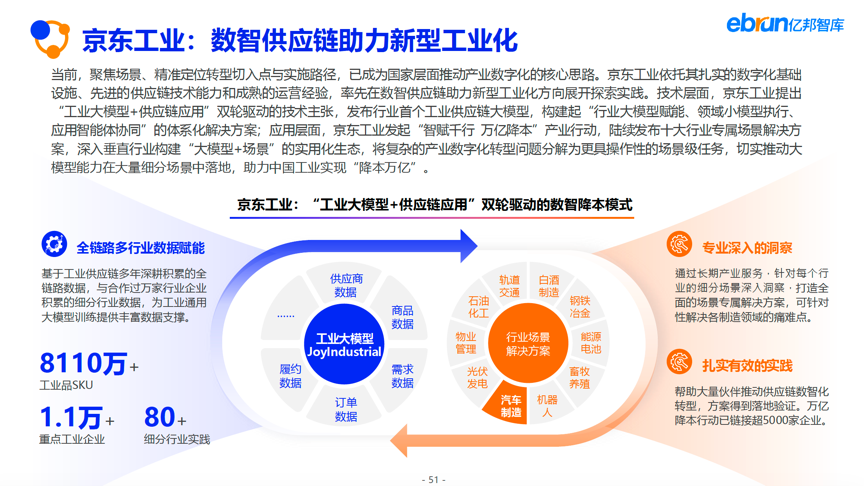
亿邦智库发布的《2025产业互联网发展报告》显示,产业AI进入规模化应用阶段,覆盖研发、生产、采购等全链路。垂直产业平台凭借数据、场景与市场优势,成为AI落地核心载体。同时,深度价值链重构推动产业升级,通过纵向贯通“产供销”全流程、横向整合物流、金融等配套资源、向上突破品牌与标准瓶颈,实现从线性链条到网状生态的转型。

报告中以京东工业的案例展示了工业大模型结合深度细分场景的实践路径和创造的价值,形成了独特的“工业大模型+供应链应用”双轮驱动数智降本模式。

京东工业依托其扎实的数字化基础设施、先进的供应链技术能力和成熟的运营经验,率先在数智供应链助力新型工业化方向展开探索实践。技术层面,京东工业提出“工业大模型+供应链应用”双轮驱动的技术主张,发布行业首个工业供应链大模型,构建起“行业大模型赋能、领域小模型执行、应用智能体协同”的体系化解决方案;应用层面,京东工业发起“智赋千行 万亿降本”产业行动,陆续发布系列行业专属场景解决方案,深入垂直行业构建“大模型+场景”的实用化生态,将复杂的产业数智化转型问题分解为更具操作性的场景级任务,切实推动大模型能力在大量细分场景中落地,助力中国工业实现“降本万亿”。

从工具到专家 从单点到生态 京东工业用AI驱动产业发展

2026年第一季度,针对工业品参数非标准化、长尾品类繁杂、供需两端信息不匹配等行业核心痛点,京东工业持续强化全链路AI技术能力,上线近40款AI智能体,服务超3000家重点企业客户。AI技术目前已广泛赋能商品识别、智能匹配与批量下单、客户需求精准预测。通过驱动墨卡托商品能力建设,助力客户搭建标准商品库并后续提升商品标准化水平。此外,AI助力京东工业采销、商品管理等核心岗位人效显著提升。AI技术已全面应用在多个业务场景中,实现运营效率优化与商业价值转化。

工业大模型JoyIndustrial驱动了墨卡托标准商品库和太璞数实一体化解决方案持续升级,已经服务包含世界五百强与央国企等在内的超万家大型企业客户。经过创新和场景实践的历练,京东工业明确了对工业AI大模型能力建设的规划:从1.0阶段的AI工具,跃迁到2.0阶段的AI专家和3.0阶段的AI超脑。

在AI工具阶段,一批原生AI应用实现了单点赋能,以轻量化工具解决供应链环节痛点。在AI专家阶段,AI能力在场景拓展、组织协作、价值创造等领域全面跃迁。AI专家具备了工作闭环能力,可独立完成商品、履约、售后等核心场景任务。其从按需调用升级为自主进化,能主动洞察需求、参与决策、推进组织协同。京东工业相关负责人表示,目前,京东工业AI能力已经基本完成AI工具的建设和应用布局,在内外部业务实践中取得了扎实的成果,目前正处于向AI专家跃迁的过程中。

响应政府“工业数据筑基”、“模数共振”等行动号召,京东工业日前携手合作伙伴正式开启“百川计划”,从数据、模型、应用三维共建上游行业生态。作为中国工业领域第一个大模型生态,百川计划精准应对工业上游行业数据杂乱散、难以统筹导致的行业大模型建设较慢、协同价值弱等问题,计划携手百家上游行业伙伴推动高质量数据流通,构建行业统一的语言体系,通过多场景应用助力行业降本增效。同时,京东工业承诺从能力共享、资源支持到商机转化,推动生态伙伴的增长。

作为行业大模型生态的第一个产业合作伙伴,德力西电气分享了和京东工业共同积累构建商品数据集、携手打造工业电气大模型及多场景落地应用的经验。目前,工业电气大模型已经在专业性、准确性方面展现出显著优势,正在德力西电气及京东工业的产品选型、导购等场景应用中加速落地,持续创造价值。

注:文/龚作仁,文章来源:Laborer,本文为作者独立观点,不代表亿邦动力立场。

文章来源:Laborer

广告
微信
朋友圈

FAQ回顾

工业供应链数智化转型有哪些成熟的落地实践?

京东工业打造“工业大模型+供应链应用”双轮驱动数智降本模式,构建“行业大模型赋能、领域小模型执行、应用智能体协同”的体系化解决方案,发起“智赋千行 万亿降本”产业行动,推出系列垂直行业专属场景解决方案,已服务超3000家重点企业客户,可切实助力工业企业降本增效。

京东工业推出的百川计划是什么?

百川计划是京东工业推出的国内首个工业大模型生态计划,将从数据、模型、应用三维共建上游行业生态,可解决工业上游行业数据杂乱散、大模型建设慢、协同价值弱等痛点,计划联合百家上游伙伴推动高质量数据流通,构建行业统一语言体系,助力全行业降本增效。

工业大模型在产业端的应用发展到什么阶段了?

当前产业AI已进入规模化应用阶段,覆盖研发、生产、采购等全链路,垂直产业平台是AI落地核心载体。京东工业的工业大模型应用已完成1.0 AI工具阶段的布局,实现单点环节痛点解决,目前正朝着可独立完成核心场景任务、具备工作闭环能力的2.0 AI专家阶段跃迁。

这么好看,分享一下?

朋友圈 分享

APP内打开

+1
+1
微信好友 朋友圈 新浪微博 QQ空间
关闭
收藏成功
发送
/140 0