广告
加载中

强者恒强?TikTok Shop美区1%卖家贡献了60%的GMV!

王昱 2026-06-15 18:27
王昱 2026/06/15 18:27

邦小白快读

EN
全文速览

这篇文章核心公布了独立机构Marketplace Pulse对TikTok Shop美区卖家生态的最新研究结论,核心干货信息如下

1. 核心数据显示TikTok Shop美区存在极强的顶端集中效应,研究覆盖近10万家卖家,前1%卖家不到900家,就贡献了平台60%的GMV;前0.1%卖家不足90家,平均累计销售额破1亿美元,合计贡献超25%的GMV,排名后50%卖家仅贡献0.1%GMV,头部集中度远超亚马逊。

2. 平台认证机制放大了头部效应,带有Official Store和Gold Star认证的卖家能获得更多平台曝光,官方店销售规模是未认证的40倍,金星认证卖家是普通卖家的18倍,商家规模和平台流量会形成正向循环。

3. TikTok Shop和亚马逊的竞争核心门槛不同,亚马逊决定胜负的关键是供应链管理、运营效率和资本实力,TikTok Shop的核心门槛是爆款打造能力。

本文的研究结论对品牌布局TikTok Shop美区市场有重要参考价值,核心干货整理如下

1. 当前市场格局特征明显,TikTok Shop美区头部集中程度远超亚马逊,前1%卖家掌控60%GMV,尾部中小商家份额极低,品牌入场后马太效应显著,大体量品牌拥有天然的流量优势,中小品牌突围难度较大。

2. 平台认证能为品牌带来明显的流量红利,官方认证店铺销售规模是未认证店铺的40倍,金星认证店铺是普通店铺的18倍,品牌入场后要优先拿到官方认证资质,以此获取更多曝光资源。

3. 品牌竞争方向需要调整,和亚马逊拼供应链成本、资本实力不同,TikTok Shop的核心竞争力是打造爆款的能力,品牌的产品研发和营销都需要围绕打造爆款来布局,适配平台生态特性。

对于想要入场或已经运营TikTok Shop美区的卖家,本文整理了关键参考干货如下

1. 当前格局与风险提示:TikTok Shop美区头部集中效应极强,不到900家头部卖家就占据了60%的GMV,尾部50%卖家合计仅贡献0.1%的GMV,中小新卖家入场面临极大的竞争压力,需要提前做好突围规划,不要低估竞争难度。

2. 可利用的平台机制红利:平台的官方店、金星认证会带来巨大的流量增益,卖家要优先发力获取认证资质,在获得规模增长后会进一步获得更多流量,形成正向增长循环,放大自身优势。

3. 竞争方向调整建议:和亚马逊比拼供应链、运营效率、资本不同,TikTok Shop的核心竞争门槛是打造爆款的能力,卖家要把核心资源向选品、爆款打造倾斜,避开和头部商家比拼供应链的红海。

针对想要布局跨境电商出海TikTok Shop美区的工厂,本文整理核心干货启示如下

1. 产品生产设计需求调整:TikTok Shop美区的核心竞争门槛是爆款打造能力,和亚马逊侧重供应链成本、运营效率的逻辑不同,工厂需要调整产品研发方向,更贴合海外消费热点,提升快速响应热点推出新品的能力,而非单纯走性价比走量路线。

2. 现存商业机会:目前平台长尾卖家的数据还在补充,整体头部格局虽不会根本改变,但仍给有能力的工厂留下了切入空间,工厂依托自身供应链优势,快速响应市场打造爆品,仍有机会跻身头部行列。

3. 数字化转型启示:工厂做自运营电商出海,要尽早争取平台官方认证,积累销售规模后就能获得平台更多流量倾斜,形成正向循环,推动自身的数字化电商转型,拿到出海增长红利。

针对服务跨境出海的服务商,本文整理行业相关干货如下

1. 行业发展趋势:TikTok Shop美区的头部集中速度和程度都远超传统电商亚马逊,马太效应已经初步显现,平台生态资源快速向头部商家聚集,未来服务商的核心客户结构也会逐步向大卖家、头部商家倾斜。

2. 客户痛点梳理:不同层级卖家痛点差异明显,中小卖家缺爆款打造能力,难以突破流量门槛获得增长;头部卖家需要维持爆款持续产出,巩固自身的认证和流量优势,维持头部地位。

3. 业务发展方向:服务商可以针对性开发适配不同卖家的服务,比如为中小卖家提供爆款选品、内容营销打造服务,为需要拿认证的卖家提供资质辅导、运营增长服务,抓住TikTok Shop美区增长的行业红利,拓展自身业务。

对于布局跨境电商业务的平台商,本文整理核心参考干货如下

1. 现有机制的效果:TikTok Shop当前的分层认证机制对流量分配影响极大,官方店和金星认证卖家获得的流量远多于普通卖家,推动了头部集中效应快速形成,但是也导致了平台中间层卖家规模薄弱,长尾卖家生存空间极小。

2. 需要规避的风险:如果平台过度向头部倾斜流量,会导致生态快速固化,中小卖家难以成长,长期来看会影响平台的多样性和活力,想要保持生态健康,需要调整流量分配机制,适度扶持中小卖家。

3. 差异化运营方向:TikTok Shop和亚马逊的核心竞争门槛不同,平台可以围绕打造爆款的生态特性优化卖家服务,招商阶段优先引入具备爆款打造能力的商家,巩固自身和传统电商差异化的竞争定位。

对于研究跨境电商产业的研究者,本文整理核心研究干货如下

1. 产业新动向:新兴社交电商平台TikTok Shop美区的卖家头部集中程度已经超过了传统电商亚马逊,最新研究数据显示,平台前1%卖家贡献了60%的GMV,后50%卖家仅贡献0.1%的GMV,中间卖家群体十分薄弱,这种结构和传统电商呈现出明显差异。

2. 格局形成的核心原因:平台的分层认证流量分配机制,放大了马太效应,已经做出成绩的头部卖家获得更多平台流量倾斜,进一步扩大规模,形成正向循环,这种特征和社交平台算法推荐的逻辑高度契合。

3. 产业新特征:新兴社交电商的核心竞争门槛,已经从传统电商的供应链管理、资本实力、运营效率,转变为爆款打造能力,这种差异化特征为研究社交电商的商业模式和生态逻辑提供了全新的样本。

返回默认

声明:快读内容全程由AI生成,请注意甄别信息。如您发现问题,请发送邮件至 run@ebrun.com 。

我是 品牌商 卖家 工厂 服务商 平台商 研究者 帮我再读一遍。

Quick Summary

This article presents key findings from a new independent study by Marketplace Pulse on the seller ecosystem of TikTok Shop's U.S. market. The main takeaways are as follows:

1. Core data reveals extreme top-level concentration among sellers on TikTok Shop U.S. Across nearly 100,000 sellers covered in the study, the top 1% (fewer than 900 sellers) account for 60% of the platform's total GMV. The top 0.1% (fewer than 90 sellers) have an average cumulative sales volume exceeding $100 million and collectively contribute over 25% of GMV. In contrast, the bottom 50% of sellers together contribute just 0.1% of GMV. This level of top concentration is far higher than that seen on Amazon.

2. The platform's seller certification mechanism amplifies this top-heavy effect. Sellers with Official Store or Gold Star certification receive far more platform exposure. The average sales volume of an Official Store is 40 times that of an uncertified store, while Gold Star sellers generate 18 times the sales of regular sellers. This creates a positive feedback loop between seller scale and platform traffic allocation.

3. TikTok Shop and Amazon have fundamentally different core competitive thresholds. Success on Amazon hinges on supply chain management, operational efficiency and capital strength, while the key competitive advantage on TikTok Shop is the ability to create hit products.

This study offers valuable strategic insights for brands planning to enter the U.S. market via TikTok Shop. Key takeaways are as follows:

1. The current market landscape is sharply defined: top-level concentration on TikTok Shop U.S. is far greater than on Amazon, with the top 1% of sellers controlling 60% of total GMV and tail small and medium-sized sellers holding negligible market share. The Matthew effect is extremely pronounced for brands entering the market. Large established brands hold inherent traffic advantages, making it far harder for small and mid-sized brands to break through.

2. Platform certification delivers significant traffic dividends. The average sales of an officially certified store are 40 times that of an uncertified store, while Gold Star certified stores generate 18 times the sales of regular stores. Brands entering the market should prioritize securing official certification to access more exposure resources.

3. Brands need to reframe their competitive strategy. Unlike Amazon, where competition centers on supply chain costs and capital strength, core competitiveness on TikTok Shop lies in the ability to develop hit products. Brands should align their product R&D and marketing strategies around hit product development to fit the platform's ecosystem.

For sellers looking to enter or already operating on TikTok Shop U.S., here are key actionable insights:

1. Current landscape and risk warning: TikTok Shop U.S. has extremely high top-level concentration, with fewer than 900 top sellers accounting for 60% of total GMV, while the bottom 50% of sellers collectively contribute just 0.1% of GMV. New and small sellers face extremely intense competition and need to develop a breakout strategy in advance, not underestimating the difficulty of competition.

2. Leverage platform mechanism dividends: Official Store and Gold Star certification deliver major traffic gains. Sellers should prioritize securing certification. Once scale growth is achieved, sellers will gain additional traffic, forming a positive growth cycle that amplifies competitive advantages.

3. Competitive positioning advice: Unlike Amazon, where competition centers on supply chain, operational efficiency and capital, the core competitive barrier on TikTok Shop is the ability to create hit products. Sellers should allocate core resources to product selection and hit product development, and avoid entering the red ocean of competing with top sellers on supply chain strength.

For factories looking to expand cross-border e-commerce via TikTok Shop U.S., here are key strategic takeaways:

1. Adjust product design and production priorities: Unlike Amazon, which prioritizes supply chain cost and operational efficiency, the core competitive barrier on TikTok Shop U.S. is the ability to develop hit products. Factories should adjust their R&D direction to better align with overseas consumer trends, and build the capacity to quickly launch new products in response to trends, rather than solely pursuing low-cost volume strategies.

2. Existing market opportunities: While the top-heavy market structure is unlikely to change fundamentally, there are still entry opportunities for capable factories. Factories that leverage their inherent supply chain advantages to quickly develop hit products in response to market demand still have a strong chance of breaking into the top tier of sellers.

3. Digital transformation takeaways: Factories that operate their own cross-border D2C e-commerce should prioritize securing official platform certification as early as possible. Once sales scale is built up, the platform will allocate more traffic, creating a positive cycle that supports digital transformation and helps capture cross-border growth dividends.

For service providers supporting cross-border e-commerce expansion, here are key industry insights:

1. Industry development trends: The speed and degree of top-level concentration on TikTok Shop U.S. have already outpaced traditional e-commerce platforms like Amazon, and the Matthew effect has already emerged. Platform ecosystem resources are rapidly concentrating toward top sellers, so service providers' core client structures will gradually shift to prioritize large and top-tier sellers.

2. Segmented client pain points: Pain points vary sharply across seller tiers. Small and medium-sized sellers lack the capability to develop hit products and struggle to break through traffic barriers to achieve growth. Top sellers need to maintain a consistent pipeline of new hits to consolidate their certification and traffic advantages, and defend their market position.

3. Business development direction: Service providers can develop segmented offerings tailored to different seller groups: for example, hit product selection and content marketing services for small and medium sellers, and certification consulting and growth operation services for sellers pursuing platform certification. This allows providers to capture industry growth from the expansion of TikTok Shop U.S. and scale their business.

For cross-border e-commerce platforms planning their own market expansion, here are key strategic insights:

1. Impact of current mechanisms: TikTok Shop's current tiered certification system has an extremely large impact on traffic allocation. Official Store and Gold Star certified sellers receive far more traffic than regular sellers, which accelerated the formation of extreme top concentration. However, this has also left the platform with a weak mid-tier seller segment and extremely limited survival space for long-tail sellers.

2. Risks to avoid: Excessive traffic allocation to top sellers leads to rapid ecosystem solidification, making it difficult for small and medium sellers to grow. In the long term, this harms platform diversity and vitality. To maintain a healthy ecosystem, platforms need to adjust their traffic allocation mechanisms and provide moderate support for small and medium sellers.

3. Differentiated operation strategy: TikTok Shop has a fundamentally different core competitive threshold than Amazon. Platforms can optimize seller services around the ecosystem characteristics of hit product development, prioritize recruiting sellers with proven hit-making capabilities during onboarding, and consolidate a differentiated competitive positioning against traditional e-commerce platforms.

For researchers studying the cross-border e-commerce industry, here are key research takeaways:

1. New industry trends: The degree of seller concentration on the emerging social commerce platform TikTok Shop U.S. has already surpassed that of traditional e-commerce giant Amazon. New research data shows the top 1% of sellers contribute 60% of total GMV, while the bottom 50% contribute just 0.1%, leaving an extremely thin middle seller tier. This structure differs sharply from traditional e-commerce platforms.

2. Core drivers of the current market structure: The platform's tiered certification-based traffic allocation mechanism amplifies the Matthew effect. Top sellers with proven performance receive greater traffic allocation, which allows them to further expand scale, forming a positive feedback loop. This characteristic aligns closely with the algorithmic recommendation logic of social platforms.

3. New industry characteristics: The core competitive threshold for emerging social commerce has shifted from supply chain management, capital strength and operational efficiency (the key drivers for traditional e-commerce) to the ability to create hit products. This differentiated feature provides an entirely new research sample for studying the business model and ecosystem logic of social commerce.

Disclaimer: The "Quick Summary" content is entirely generated by AI. Please exercise discretion when interpreting the information. For issues or corrections, please email run@ebrun.com .

I am a Brand Seller Factory Service Provider Marketplace Seller Researcher Read it again.

【亿邦原创】6月15日消息,日前,著名独立市场分析机构Marketplace Pulse发布的一项最新研究,揭示了TikTok Shop美区卖家生态中显著的“顶端集中效应”:排名前1%的卖家贡献了高达60%的GMV,销售资源高度向头部商家聚集。

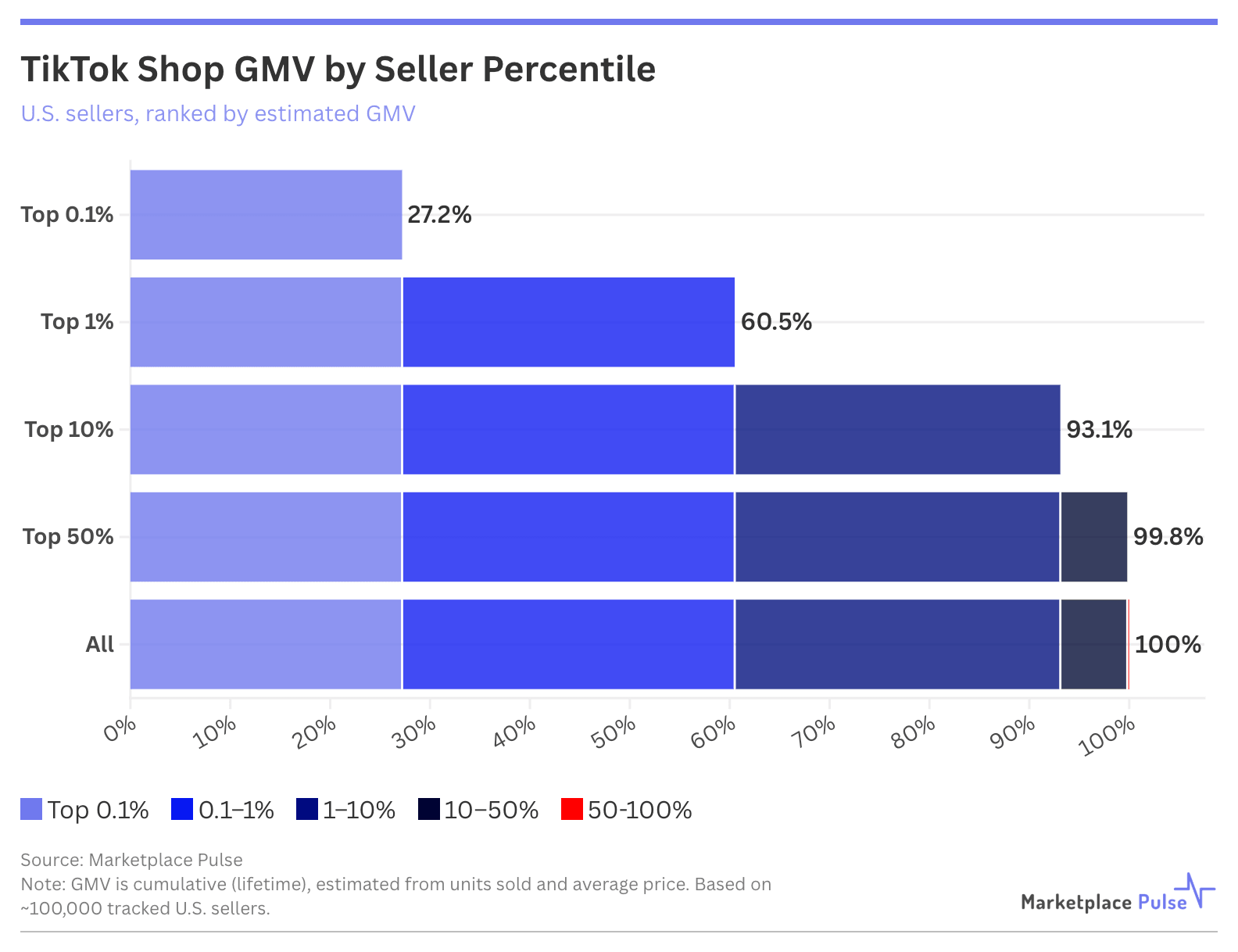
这项研究覆盖了近10万家美国TikTok Shop卖家。数据显示,在TikTok Shop美区市场,排名前0.1%的卖家群体,其数量不足90家,但平均每家累计销售额已突破1亿美元,它们合计贡献了平台超过四分之一的GMV。

而将范围扩大至前1%的卖家,其总数不到900家,绝大多数是年销售额达到数百万美元规模的大型商家,它们共同掌控了平台六成的交易体量。作为对照,排名后50%的卖家合计仅贡献了约0.1%的GMV,中间层卖家的规模较为薄弱。

分析称,这种头部集中度已经超越了亚马逊:

在亚马逊平台上,大约8000家卖家,即占活跃卖家总数约1.6%的群体,贡献了其第三方市场一半的GMV。

不过,研究方亦对数据口径作出了补充说明。Marketplace Pulse解释称,其已追踪接近10万家美国TikTok Shop卖家,对平台头部卖家的覆盖较为完整,而数量更为庞大的长尾卖家数据仍在持续补充之中。

此外,这里统计的GMV是卖家累计历史销售额,而非某一特定时期的实时数据,其计算方法基于已售商品数量和平均售价进行估算。因此,这些数字更适合被理解为“截至目前哪些卖家获得了市场需求”的累积分布,而非直接反映当下的销售速度。

随着未来更多长尾卖家被纳入统计,以及按月、按季度的GMV数据逐步完善,长尾卖家所显现的贡献比例可能会发生变化。但研究机构判断,整体格局很可能不会发生根本性改变。

Marketplace Pulse进一步分析指出,平台自身的运营机制也在强化这种集中化趋势。

TikTok Shop为卖家授予不同等级的认证标识,其中“Official Store”和“Gold Star”代表经过验证且表现优异的商家,这些卖家通常会获得平台更显著的展示位置。

数据显示,拥有“Official Store”认证的卖家,其销售规模约为未认证卖家的40倍,同时商品平均售价也更高;而拥有“Gold Star”认证的卖家,其销售规模约为普通卖家的18倍。

研究方认为,虽然这些认证在一定程度上是商家规模成长后的结果,而非规模增长的原始原因,但两者之间会形成明显的正向循环效应。平台释放出的各种信号,会进一步将流量和需求引导至那些已经脱颖而出的卖家身上。

在分析竞争门槛时,该机构指出,在亚马逊,决定胜负的关键往往是供应链管理能力、运营效率以及资本实力;而在TikTok Shop,这个门槛则变成了“爆款能力”。这种差异化的驱动因素,或将成为理解该平台卖家结构高度分化的关键线索。


亿邦持续追踪报道该情报,如想了解更多与本文相关信息,请扫码关注作者微信。

文章来源:亿邦动力

广告
微信
朋友圈

这么好看,分享一下?

朋友圈 分享

APP内打开

+1
+1
微信好友 朋友圈 新浪微博 QQ空间
关闭
收藏成功
发送
/140 0