广告
加载中

丝芙兰引入多个国货品牌 年轻化成关键特征

张从容 2025-12-22 14:27
张从容 2025/12/22 14:27

邦小白快读

EN
全文速览

丝芙兰近期引入多个国货新锐美妆品牌,这些品牌以彩妆或底妆为主,具有年轻化和新手友好特征。

1. 品牌包括酵色、朱栈、恋火、BABI、OUT OF OFFICE、三资堂等,各具细分品类特色,如三资堂专注眼部彩妆、OUT OF OFFICE聚焦面部光影、恋火专攻底妆、朱栈定位可持续纯净彩妆。BABI除底妆外还涵盖护发产品。

2. 多数品牌成立时间短,除恋火外,均成立于2019年及之后,三资堂2023年成立最年轻。品牌背靠美妆集团或流量孵化团队,如酵色属橘宜集团、恋火为丸美生物旗下、朱栈获水羊股份投资,BABI、OUT OF OFFICE和三资堂则强于线上流量运营。

3. 实操干货包括BABI通过KOC直播带货2022年月销约3000万,OUT OF OFFICE在抖音阴影类目店铺排名第一,三资堂2024年抖音销售额约8.4亿元。丝芙兰选择品牌时强调“新手友好”概念,简化产品使用,如三资堂两年完成八次产品迭代,均价约50元,品控严格。

丝芙兰引入国货品牌事件,提供品牌营销、产品研发和消费趋势的启示。

1. 品牌营销方面:新品牌如BABI借助KOC直播带货模式快速成长,OUT OF OFFICE通过瑟尚集团的全域营销在抖音爆款榜登顶,显示短视频平台营销潜力。三资堂依托厦门跑红集团的流量运营,抖音销售额远超天猫,启示多渠道布局。

2. 产品研发方面:丝芙兰买手团队认可三资堂的专注研发,两年内八次产品迭代,强调“简化化妆步骤”理念;OUT OF OFFICE和BABI同样以“新手友好”设计简化上妆技巧,反映产品创新方向。

3. 消费趋势和定价:新手友好成为核心卖点,迎合年轻用户需求;三资堂均价约50元,定位亲民,结合严格品控和代工厂生产,启示性价比策略。同时,品牌背靠集团如橘宜、丸美生物,显示资源整合优势。

丝芙兰品牌入驻事件揭示消费需求变化和增长市场机会,带来可学习合作点。

1. 消费需求层面变化:新锐品牌如三资堂、OUT OF OFFICE主打“新手友好”概念,简化产品使用,反映用户对易上手彩妆的需求增长,丝芙兰买手团队强调此理念为选择标准。

2. 增长市场和机会提示:OUT OF OFFICE在抖音阴影类目排名第一,BABI月销约3000万,显示短视频平台如抖音的销售潜力;丝芙兰自2023年1月以来引入约30个品牌,类型多元包括护肤潮牌、小众香氛,带来招商合作机会。

3. 可学习点和最新商业模式:从BABI的KOC直播带货、三资堂的抖音流量运营(销售额8.4亿,天猫7.5倍)学习线上转化策略;丝芙兰事件应对措施包括选择背靠集团的品牌(如橘宜、丸美生物),规避风险。同时,NARS等国际品牌入驻,显示平台开放政策。

新品牌入驻丝芙兰带来产品生产需求和电商数字化启示,创造商业机会。

1. 产品生产和设计需求:三资堂选择业内成熟代工厂生产,品控严格,均价约50元但强调高质量,启示工厂需提升品控标准;丝芙兰买手团队认可品牌如OUT OF OFFICE的简化设计,反映市场对易用彩妆的需求,工厂可优化生产流程。

2. 商业机会:品牌背靠美妆集团(如酵色属橘宜集团、恋火为丸美生物旗下)或流量孵化团队(如BABI、三资堂),工厂可寻求合作供应;丝芙兰引入多元品牌类型,提供潜在代工机会。

3. 推进数字化和电商启示:三资堂依赖抖音销售,2024年销售额约8.4亿元,显示电商平台重要性;OUT OF OFFICE通过瑟尚集团全域营销实现爆款,启示工厂需整合数字化渠道提升产能响应。

丝芙兰事件反映美妆行业发展趋势,服务商可关注新技术和解决方案应对客户痛点。

1. 行业发展趋势:国货新锐品牌崛起,如丝芙兰引入酵色、朱栈等,多数成立于2019年后,显示年轻化趋势;品牌类型多元,包括可持续纯净彩妆(朱栈)和流量驱动型(三资堂),反映市场多元化。

2. 新技术和客户痛点:KOC直播带货(如BABI月销3000万)、抖音运营(OUT OF OFFICE修容棒登顶爆款榜)成为销售驱动力,技术痛点包括流量转化;客户需求聚焦“新手友好”,简化产品(三资堂两年八次迭代),痛点在于用户上手难。

3. 解决方案:提供全域营销服务(如瑟尚集团模式),帮助品牌打造爆款;针对简化设计痛点,开发咨询方案优化产品体验;数据如三资堂抖音销售8.4亿,启示服务商需强化数据分析能力。

丝芙兰的平台招商和运营管理做法,提供商业对平台需求和风向规避参考。

1. 商业对平台的需求和问题:品牌如三资堂依赖抖音销售,2024年销售额约8.4亿元(天猫7.5倍),显示平台需支持流量运营;丝芙兰买手团队选择标准强调“新手友好”和产品迭代(如三资堂两年八次),反映品牌对平台简化上架需求。

2. 平台的最新做法和招商:丝芙兰自2023年1月以来引入约30个品牌,包括新锐国货和NARS等,类型多元如彩妆、底妆、可持续品牌,招商政策宽松;选择品牌时注重背靠集团(橘宜、丸美生物)或流量团队(厦门跑红集团),确保稳定性。

3. 运营管理和风向规避:通过数据监控(如OUT OF OFFICE抖音排名第一)优化品类管理;丝芙兰强调品控严格(三资堂代工厂生产),规避质量风险;同时,引入多元品牌分散风险,应对消费趋势变化。

丝芙兰引入国货品牌事件揭示产业新动向和商业模式创新,带来政策启示。

1. 产业新动向和新问题:国货新锐品牌(如酵色、三资堂)入驻国际渠道丝芙兰,显示本土品牌国际化趋势;品牌年轻化(多数成立于2019年后)和流量依赖(三资堂抖音销售主导)成为新问题,需研究可持续性。

2. 商业模式:流量孵化模式如“厦门帮”企业(三资堂属厦门跑红集团),通过抖音打造爆款,2024年销售额约8.4亿元;瑟尚集团的自有品牌孵化(OUT OF OFFICE)结合全域营销,启示整合型商业模式。

3. 政策法规建议和启示:丝芙兰选择标准强调“新手友好”和产品迭代(三资堂两年八次),建议政策支持创新研发;数据如BABI月销3000万,显示直播带货监管需求;同时,品牌多元引入(约30个)启示政策促进渠道开放。

返回默认
声明:快读内容全程由AI生成,请注意甄别信息。如您发现问题,请发送邮件至 run@ebrun.com 。

我是 品牌商 卖家 工厂 服务商 平台商 研究者 帮我再读一遍。

Quick Summary

Sephora has recently introduced several emerging domestic Chinese beauty brands, primarily focusing on color cosmetics and base makeup, characterized by their youth appeal and beginner-friendly features.

1. Brands include Joocyee, ZHUZHAN, Lianhuo, BABI, OUT OF OFFICE, and Sanzitang, each with distinct category specializations: Sanzitang focuses on eye makeup, OUT OF OFFICE on facial contouring, Lianhuo on base makeup, and ZHUZHAN positions itself as sustainable clean beauty. BABI also includes hair care products alongside base makeup.

2. Most brands are relatively new; except for Lianhuo, all were established in 2019 or later, with Sanzitang being the youngest, founded in 2023. These brands are backed by major beauty conglomerates or digital traffic incubators—Joocyee belongs to Juyi Group, Lianhuo is under Wanmei Bio, ZHUZHAN received investment from Shuiniu Co., while BABI, OUT OF OFFICE, and Sanzitang excel in online traffic operations.

3. Key performance highlights include BABI achieving monthly sales of approximately ¥30 million in 2022 via KOC livestreaming, OUT OF OFFICE ranking first in TikTok’s contouring category, and Sanzitang generating around ¥840 million in TikTok sales in 2024. Sephora’s selection criteria emphasize “beginner-friendly” concepts, simplifying product use—exemplified by Sanzitang’s eight product iterations in two years, an average price of ~¥50, and strict quality control.

Sephora’s integration of domestic brands offers insights into marketing, product development, and consumer trends.

1. Marketing strategies: Emerging brands like BABI leveraged KOC livestreaming to scale rapidly, while OUT OF OFFICE topped TikTok’s viral charts through Sesame Group’s omnichannel marketing, highlighting the potential of short-video platforms. Sanzitang’s TikTok sales significantly outperformed Tmall, underscoring the value of multi-channel deployment.

2. Product innovation: Sephora’s buyers praised Sanzitang’s R&D focus, with eight iterations in two years centered on “simplifying makeup steps.” OUT OF OFFICE and BABI similarly adopted beginner-friendly designs, reflecting a shift toward usability-driven innovation.

3. Consumer trends and pricing: Beginner-friendly positioning emerged as a core selling point, aligning with younger users’ needs. Sanzitang’s ~¥50 price point, combined with strict quality control and OEM production, demonstrates a cost-effective strategy. Backing by groups like Juyi and Wanmei Bio highlights the advantage of integrated resources.

Sephora’s brand onboarding reveals shifting consumer demands and growth opportunities, offering actionable takeaways for collaboration.

1. Evolving consumer needs: Brands like Sanzitang and OUT OF OFFICE emphasize “beginner-friendly” concepts, simplifying product use to meet rising demand for accessible makeup—a key criterion for Sephora’s buyers.

2. Market opportunities: OUT OF OFFICE ranks first in TikTok’s contouring category, while BABI achieves ~¥30 million in monthly sales, underscoring the sales potential of short-video platforms. Since January 2023, Sephora has introduced ~30 brands spanning skincare, niche fragrances, and more, creating partnership avenues.

3. Learnable strategies: Adopt KOC livestreaming (BABI) and TikTok traffic operations (Sanzitang’s ¥840 million sales, 7.5x Tmall’s volume) to enhance online conversion. Sephora’s risk mitigation includes selecting brands backed by established groups (e.g., Juyi, Wanmei Bio). The entry of international brands like NARS reflects the platform’s open policy.

Sephora’s new brand integrations signal production demands and e-commerce digitalization, creating commercial opportunities.

1. Production and design needs: Sanzitang relies on reputable OEMs with strict quality control, maintaining a ~¥50 average price while emphasizing high standards—a cue for factories to elevate quality protocols. Sephora’s buyers endorse simplified designs (e.g., OUT OF OFFICE), reflecting market demand for user-friendly products and optimized manufacturing.

2. Business opportunities: Brands backed by conglomerates (Joocyee/Juyi Group, Lianhuo/Wanmei Bio) or traffic incubators (BABI, Sanzitang) present potential supply partnerships. Sephora’s diverse brand portfolio offers OEM prospects.

3. Digital and e-commerce insights: Sanzitang’s ¥840 million TikTok sales in 2024 highlight e-platform criticality. OUT OF OFFICE’s success via Sesame Group’s omnichannel marketing underscores the need for factories to integrate digital channels for agile capacity response.

Sephora’s move reflects beauty industry trends, urging service providers to address client pain points with tech-driven solutions.

1. Industry trends: The rise of domestic brands (e.g., Joocyee, ZHUZHAN) at Sephora, mostly post-2019, signals a youth-oriented shift. Diversity in brand positioning—from sustainable clean beauty (ZHUZHAN) to traffic-driven models (Sanzitang)—reflects market fragmentation.

2. Tech and client pain points: KOC livestreaming (BABI’s ¥30 million monthly sales) and TikTok operations (OUT OF OFFICE’s top-ranking contour stick) drive sales, with challenges in traffic conversion. “Beginner-friendly” demand (e.g., Sanzitang’s eight iterations in two years) highlights usability hurdles.

3. Solutions: Offer omnichannel marketing services (à la Sesame Group) to build hit products; develop consulting frameworks to simplify product design. Sanzitang’s ¥840 million TikTok sales underscore the need for enhanced data analytics capabilities.

Sephora’s merchant recruitment and operations offer insights into platform demands and risk management.

1. Merchant needs: Brands like Sanzitang rely heavily on TikTok (¥840 million sales in 2024, 7.5x Tmall), necessitating platform support for traffic operations. Sephora’s selection criteria, emphasizing “beginner-friendly” features and rapid iteration (e.g., Sanzitang’s eight updates in two years), reflect merchant needs for streamlined onboarding.

2. Platform strategies: Since January 2023, Sephora has onboarded ~30 brands, including emerging domestic labels and international names like NARS, spanning color cosmetics, base makeup, and sustainable lines. Partnerships with groups (Juyi, Wanmei Bio) or traffic teams (Xiamen Paohong Group) ensure stability.

3. Operations and risk mitigation: Data monitoring (e.g., OUT OF OFFICE’s TikTok ranking) optimizes category management. Strict quality control (Sanzitang’s OEM production) mitigates product risks, while a diverse brand portfolio hedges against trend shifts.

Sephora’s adoption of domestic brands reveals industry shifts and business model innovations, with policy implications.

1. Industry trends: The entry of local brands (e.g., Joocyee, Sanzitang) into Sephora’s global channels signals Chinese brands’ internationalization. Youth-centric positioning (most founded post-2019) and traffic dependency (Sanzitang’s TikTok-driven sales) raise sustainability questions.

2. Business models: Traffic incubation models like “Xiamen-based” firms (Sanzitang/Xiamen Paohong Group) leverage TikTok for hit products (¥840 million sales in 2024). Sesame Group’s owned-brand孵化 (OUT OF OFFICE) combined with omnichannel marketing illustrates integrated models.

3. Policy insights: Sephora’s focus on “beginner-friendly” features and iteration (Sanzitang’s eight updates in two years) suggests policy support for R&D innovation. BABI’s ¥30 million monthly livestreaming sales highlight regulatory needs for直播带货. Diverse brand introductions (~30 brands) advocate for policies promoting channel openness.

Disclaimer: The "Quick Summary" content is entirely generated by AI. Please exercise discretion when interpreting the information. For issues or corrections, please email run@ebrun.com .

I am a Brand Seller Factory Service Provider Marketplace Seller Researcher Read it again.

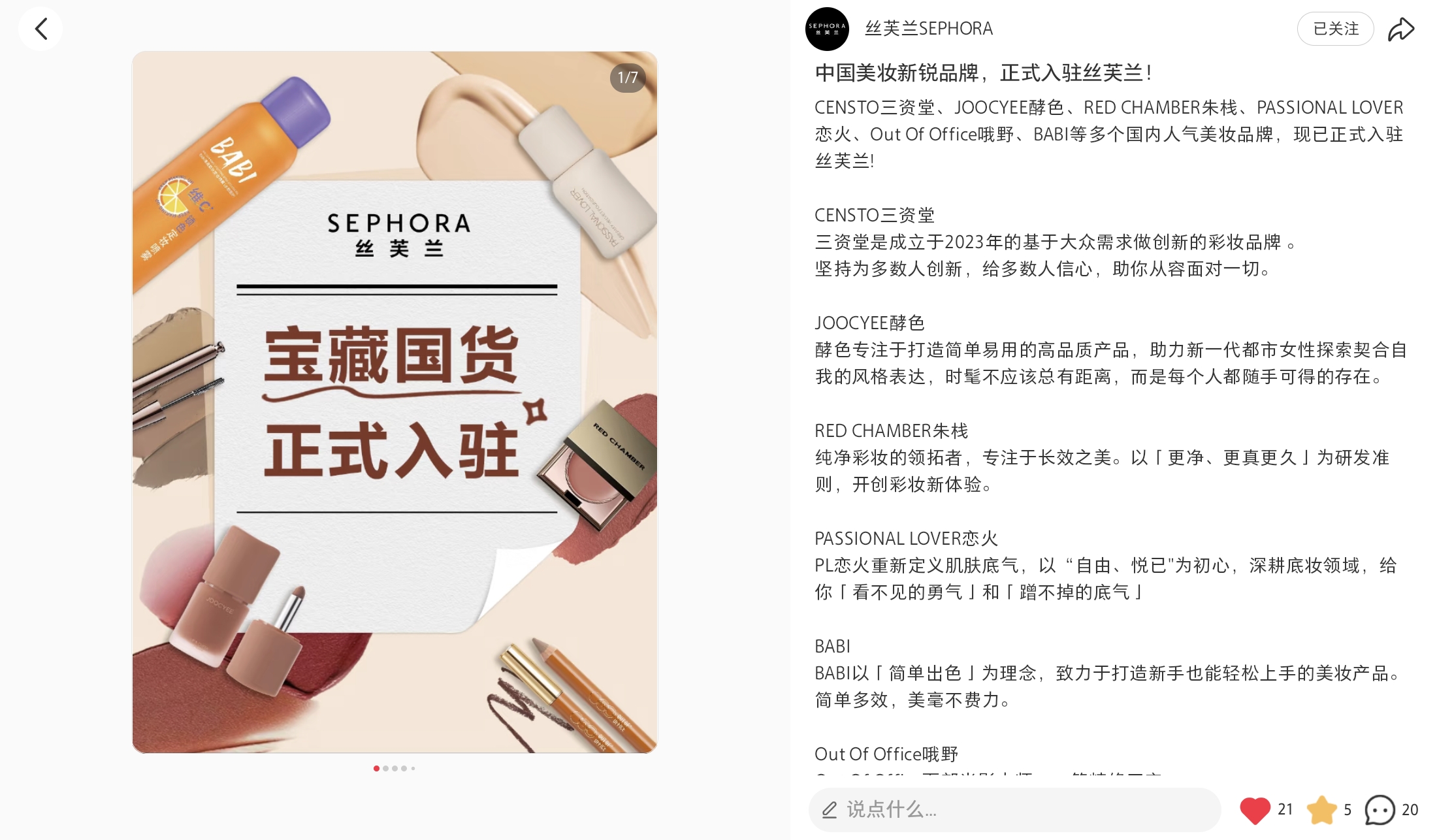
【亿邦原创】日前,丝芙兰官方宣布多个国货新锐美妆品牌正式入驻,包括酵色、朱栈、恋火、BABI、OUT OF OFFICE等,以及此前已官宣入驻的三资堂。

上述品牌以彩妆或底妆为主要经营品类,而非护肤,且多数在某一细分品类具备特色。虽然三资堂、酵色等品牌近年来拓展了护肤产品线,但其主打品类仍为彩妆或底妆。

具体来看,三资堂以眼部彩妆见长,OUT OF OFFICE聚焦于面部光影产品,恋火专注于底妆领域,BABI的特色品类除底妆外还涵盖护发等。朱栈则定位为可持续纯净彩妆品牌。

这批新入驻品牌的另一显著特征是成立时间较短。除恋火外,OUT OF OFFICE、BABI、朱栈、酵色、三资堂均成立于2019年及之后,其中最年轻的三资堂成立于2023年。

同时、这批品牌或背靠美妆集团,或背靠流量孵化集团或团队。

其中,酵色、朱栈、恋火依托于大型美妆集团。酵色隶属于橘宜集团,恋火为丸美生物旗下品牌,朱栈曾获得水羊股份多轮投资。

而BABI、OUT OF OFFICE和三资堂则具有较强的线上流量运营与销售转化能力。BABI品牌于2022年推出首款产品,据华妆志2023年开年聚会现场对话实录,BABI 2022年月销约3000万,借助KOC直播带货模式成长。

OUT OF OFFICE是瑟尚集团首个自创的彩妆品牌。瑟尚集团业务涵盖全域营销服务、自有品牌孵化。今年618,OUT OF OFFICE在抖音阴影类目店铺总排名第一,其修容棒与液体眼影产品位列抖音爆款榜、人气榜榜首。

三资堂隶属于厦门跑红集团,该集团是所谓“厦门帮”代表企业之一。“厦门帮”指一批依托抖音等平台,通过流量运营打造爆款美妆产品的厦门企业。解数咨询数据显示,2024年三资堂在抖音的销售额约为8.4亿元,约为其天猫销售额的7.5倍。

2025年12月19日,丝芙兰通过官方微信公众号推荐了部分新锐国货品牌,其中包括近期入驻的多个品牌。文章指出,这些新品多主打“新手友好”概念。

丝芙兰买手团队在解释选中三资堂的理由时提到,品牌创始人对产品研发投入专注,两年内完成八次产品迭代,并认可其“将复杂化妆步骤简化,让更多人易于上手”的理念。三资堂产品均价约50元,但选择业内成熟代工厂生产,品控严格。OUT OF OFFICE被选中的原因之一,也在于其产品能简化上妆技巧、对新手友好。BABI同样被形容为“化繁为简,一步到位”。

12月18日,丝芙兰还官宣了彩妆品牌NARS的入驻。据亿邦动力统计,自2023年1月以来,约有30个品牌宣布入驻丝芙兰中国。近年来,丝芙兰在华引入的品牌类型日益多元,除化妆师、明星、网红创立品牌外,还包括护肤潮牌、先锋小众香氛及沙龙品牌等。

亿邦持续追踪报道该情报,如想了解更多与本文相关信息,请扫码关注作者微信。

文章来源:亿邦动力

广告
微信
朋友圈

这么好看,分享一下?

朋友圈 分享

APP内打开

+1
+1
微信好友 朋友圈 新浪微博 QQ空间
关闭
收藏成功
发送
/140 0