广告
加载中

首个AI儿科医生“上岗” 与13位儿科专家共同完成会诊

胡镤心 2025-02-14 16:33
胡镤心 2025/02/14 16:33

邦小白快读

EN
全文速览

报道了首个AI儿科医生在北京儿童医院正式上岗的里程碑事件,展示了AI在真实医疗场景中的应用价值和实操干货。

1. 事件发生于2025年2月13日,AI儿科医生与13位多学科专家共同对一位8岁男孩的复杂病例(抽动症状和颅底肿物)进行会诊,AI的建议与专家诊断高度吻合,证明其辅助诊断的可靠性。

2. AI基于Baichuan M1大模型工作,输入患者主诉和病历后,通过结构化临床推理生成诊疗建议,包括假设生成、数据证伪和概率排序,操作简单高效。

3. 实际益处体现在提升诊断效率,例如快速获取跨学科权威信息,帮助医生解决疑难病症,未来可扩展至基层医疗,让更多儿童受益。

AI儿科医生的研发项目涉及北京儿童医院、百川智能和小儿方健康科技的品牌联合,凸显了品牌营销与产品研发的创新。

1. 品牌营销体现在多方合作中,企业通过参与研发树立了AI医疗领导形象,如王小川强调百川智能的医疗使命。

2. 产品研发过程包括整合300位专家临床经验和数十年病历数据,构建结构化知识体系,满足了消费趋势中对AI医疗解决方案的需求。

3. 消费趋势反映在AI医疗成为通用人工智能重要应用领域,用户行为观察显示家长寻求高效诊疗的倾向,这与品牌渠道建设相关。

4. 品牌定价和价格竞争启示在于如何通过技术创新实现普惠服务,促进医疗资源可及性。

AI儿科医生上线响应了国家卫生健康委的“儿科和精神卫生服务年”政策,为卖家提供了增长市场和合作机会。

1. 政策解读强调支持儿科发展,北京儿童医院计划覆盖基层医疗,带来需求变化和机会提示。

2. 增长市场包括AI辅助诊断的普及,倪鑫表示将推广至多元化场景,如家庭健康管理,这为相关服务提供正面市场空间。

3. 事件应对措施涉及合作方式,如医院与企业联合研发模式,卖家可学习其技术赋能路径。

4. 风险提示需注意诊断准确性验证,机会提示在于扶持政策下的资源共享,最新商业模式是AI+专家并行模式。

AI儿科医生的开发为制造业提供了产品生产和设计需求的启示,挖掘商业机会并推进数字化。

1. 产品生产和设计需求启示于AI模型的结构化训练过程,如利用大数据整合专家经验,启示高效生产系统。

2. 商业机会体现在AI医疗设备领域,工厂可参与相关硬件或软件生产,从案例中学习如何应对数字化需求。

3. 推进数字化和电商的启示来自技术应用,如Baichuan M1模型提升效率的模式,可推广至工业自动化。

4. 机会方向包括支持基层医疗覆盖的硬件需求,促进资源均衡布局。

行业发展趋势显示AI医疗兴起,新技术解决客户痛点并提供有效解决方案。

1. 行业发展趋势包括AI儿科医生上岗的里程碑事件,倪鑫称“新时代儿童健康从大模型开始”,预示AI医疗加速普及。

2. 新技术如Baichuan M1大模型,基于结构化临床推理范式训练,覆盖常见病和疑难病,能快速整合跨学科科研成果。

3. 客户痛点为医疗资源不均和诊断效率低下,解决方案是AI辅助医生提升决策效率,减少误诊风险。

4. 服务创新体现在覆盖多元化场景,如基层医疗机构,提供可扩展的AI支持系统。

AI平台在医疗领域的需求和实践突出,平台商可关注最新做法和运营管理。

1. 商业对平台的需求包括数据整合和服务提供,如整合病历数据和专家知识构建平台。

2. 平台的最新做法是上线前经过内测验证,并于2月13日正式运营,采用多学科会诊模式示范招商合作。

3. 平台招商涉及多方合作,如医院与科技公司联合研发百川智能和小儿方健康科技代表企业。

4. 运营管理强调训练和验证机制,如通过自反思机制确保建议准确性,实现风险规避。

5. 风向规避需注意数据安全性和模型可靠性,以应对潜在挑战。

AI儿科医生项目作为产业新动向,揭示新问题并提供政策法规建议和商业模式启示。

1. 产业新动向为国内首次AI+专家双医会诊,倪鑫和王小川观点强调其里程碑意义,促进医疗资源高质量发展。

2. 新问题包括如何高效整合临床经验和病历数据,如结构化推理训练中的假设证伪机制值得研究。

3. 政策法规建议源于国家卫生健康委的“儿科和精神卫生服务年”要求,提供启示如何均衡布局资源。

4. 商业模式为产学研合作模式,北京儿童医院、百川智能和小儿方健康科技联合研发,启示创新医疗应用推广。

返回默认
声明:快读内容全程由AI生成,请注意甄别信息。如您发现问题,请发送邮件至 run@ebrun.com 。

我是 品牌商 卖家 工厂 服务商 平台商 研究者 帮我再读一遍。

Quick Summary

Beijing Children's Hospital has deployed China's first AI pediatrician, marking a milestone in real-world medical AI application.

1. On February 13, 2025, the AI collaborated with 13 multidisciplinary experts to diagnose an 8-year-old boy with complex symptoms (tics and a skull base mass). The AI's recommendations aligned closely with expert diagnoses, demonstrating reliable diagnostic assistance.

2. Powered by the Baichuan M1 large model, the AI generates structured clinical recommendations—including hypothesis generation, data falsification, and probability ranking—based on patient complaints and medical records, operating with high efficiency.

3. Key benefits include accelerated diagnosis, rapid access to cross-disciplinary expertise for complex cases, and potential expansion to primary care to benefit more children.

The AI pediatrician project is a collaborative effort by Beijing Children's Hospital, Baichuan Intelligent, and Xiaoerfang Health Technology, showcasing innovation in brand marketing and product development.

1. Brand marketing is highlighted through cross-sector partnerships, with companies like Baichuan Intelligent building leadership in AI healthcare, as emphasized by founder Wang Xiaochuan.

2. Product development integrates clinical expertise from 300 specialists and decades of medical records into a structured knowledge system, addressing growing consumer demand for AI-driven healthcare solutions.

3. Consumer trends reflect AI healthcare's rise as a key application of general AI, with parents increasingly seeking efficient diagnostics—a shift informing brand channel strategies.

4. Pricing and competition strategies should focus on leveraging technology for accessible, equitable healthcare services.

The AI pediatrician’s launch aligns with China’s National Health Commission’s "Year of Pediatric and Mental Health Services," creating market growth and partnership opportunities for sellers.

1. Policy support for pediatric care, including plans to expand services to primary care, signals rising demand and new opportunities.

2. Growth markets include AI-assisted diagnostics, with hospital director Ni Xin highlighting expansion into diverse scenarios like family health management, opening avenues for service providers.

3. Sellers can learn from the hospital-enterprise collaboration model to develop technology-enabled solutions.

4. Risks involve diagnostic accuracy validation, while opportunities lie in policy-driven resource sharing and emerging "AI + expert" parallel consultation models.

The AI pediatrician’s development offers insights for manufacturing in product design, production efficiency, and digital transformation.

1. The AI’s structured training process—integrating big data and expert knowledge—inspires efficient production system design.

2. Commercial opportunities exist in AI medical device manufacturing, where factories can produce related hardware/software by adopting digitalization lessons from the case.

3. The Baichuan M1 model’s efficiency gains can be applied to industrial automation.

4. Hardware demand for primary care expansion presents opportunities to support equitable resource distribution.

The rise of AI healthcare reflects industry trends where new technologies address client pain points with effective solutions.

1. The AI pediatrician’s deployment signals accelerated adoption, as noted by Ni Xin: "A new era of child health begins with large models."

2. Baichuan M1’s structured clinical reasoning covers common and complex diseases, rapidly integrating cross-disciplinary research.

3. Key client pain points—uneven medical resources and low diagnostic efficiency—are mitigated through AI-assisted decision-making, reducing misdiagnosis risks.

4. Service innovation includes scalable AI support for primary care and diverse scenarios.

AI platforms in healthcare highlight data integration and operational best practices for platform operators.

1. Commercial demand centers on data and service integration, such as combining medical records and expert knowledge into unified platforms.

2. Recent practices include pre-launch internal testing, official rollout on February 13, and multidisciplinary consultation models to attract partners.

3. Partnership recruitment involves collaborations like hospital-tech company joint ventures, exemplified by Baichuan Intelligent and Xiaoerfang Health Technology.

4. Operations emphasize training/validation mechanisms (e.g., self-reflection for accuracy) to mitigate risks.

5. Risk management requires focus on data security and model reliability to address potential challenges.

The AI pediatrician project represents an industry shift, revealing new research questions and policy/commercial implications.

1. The first AI-expert co-diagnosis in China, hailed as a milestone by Ni Xin and Wang Xiaochuan, advances high-quality medical resource allocation.

2. Research challenges include efficient integration of clinical experience and medical data, particularly hypothesis falsification in structured reasoning training.

3. Policy insights stem from the "Year of Pediatric and Mental Health Services," guiding equitable resource distribution.

4. The industry-academia-research collaboration model (Beijing Children’s Hospital, Baichuan Intelligent, Xiaoerfang) offers a blueprint for scaling innovative medical applications.

Disclaimer: The "Quick Summary" content is entirely generated by AI. Please exercise discretion when interpreting the information. For issues or corrections, please email run@ebrun.com .

I am a Brand Seller Factory Service Provider Marketplace Seller Researcher Read it again.

2025年2月13日,国家儿童医学中心首都医科大学附属北京儿童医院开展了国内首次“AI儿科医生+多学科专家”的双医并行多学科会诊。

在此次特殊的多学科会诊中,不仅有包括倪鑫院长在内的,来自耳鼻咽喉头颈外科,肿瘤外科,肿瘤内科,神经外科,神经内科,精神科,感染内科,免疫科,骨科,医学影像中心,超声科,放疗科和口腔科等科室的13位知名专家。

还有一位引人瞩目的特殊专家——由北京儿童医院与百川智能、小儿方健康科技联合研发,以Baichuan M1大模型为底座打造的“AI儿科医生”!

专家们一起对一位颅底肿物伴随抽动症状的患儿进行了一次创新性的多学科会诊:患儿是一位8岁男孩,出现抽动症状已经持续了三周,并且在两周前发现了颅底肿物,病因复杂,先后就诊于天津、北京的多家医院,收到的诊疗结果并不一致,因此家长带孩子来到北京儿童医院希望进一步诊治。

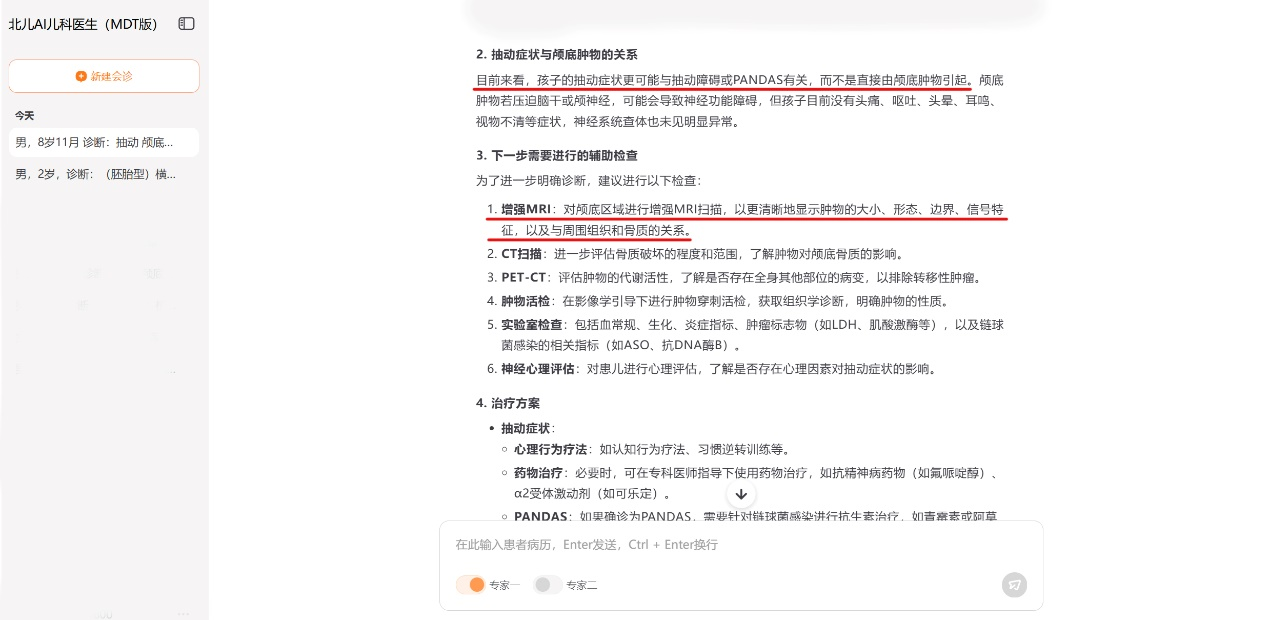
会诊过程中,专家们详细查阅了外院的就诊记录,询问了病史,经过认真讨论后,认为患儿的颅底肿物可能为皮样囊肿或肿瘤,需要进一步进行局部磁共振评估,但该肿物本身与抽动症状无直接关联,建议尽快完善增强磁共振检查。与此同时,AI儿科医生也在紧张地“工作”中,工程师将患者的主诉和病历资料输入模型后,AI儿科医生也给出了与专家组会诊结果高度吻合的建议。

“AI儿科医生”依托儿童医学大模型与健康医疗创新应用北京市重点实验室和儿童创新医疗器械概念验证平台,由北京儿童医院与北京百川智能科技有限公司、小儿方健康科技(北京)有限公司联合研发,于1月18日上线,在经过北京儿童医院近一个月的内测并得到专家的认可后,昨日正式“上岗”。

基于百川智能研发的Baichuan M1大模型,“AI儿科医生”整合了超过300位北京儿童医院知名儿科专家的临床经验和数十年的专家高质量病历数据,通过结构化临床推理范式训练,构建了覆盖儿童常见病与疑难病症的立体化知识体系。针对临床推理,它首先会基于一诉五史生成诊疗假设,继而通过检验检查数据进行假设证伪与排除,最终经由自反思机制对剩余假设进行概率排序,输出符合临床思维路径的诊疗建议。

在临床场景中“AI儿科医生”不仅能够快速帮助医生获取跨学科、跨病种等复杂临床问题的最新科研成果或权威指南,还能够辅助医生进行疑难病症的诊断和治疗,有效提升临床决策效率。

作为儿童健康大模型研发项目技术合作单位百川智能创始人、CEO王小川表示,AI医疗是通用人工智能最重要的应用领域,AI医生的上岗将会极大地促进优质医疗服务的普及和普惠。百川智能作为一家专注医疗的通用大模型公司,将造AI医生和促进生命科学发展作为最重要的使命。经过近两年研发,突破医学深度思考,于2025年开年发布了Baichuan-M1大模型。基于该模型打造的AI儿科医生此次在北京儿童医院正式上岗,无疑是一个重要的里程碑。

作为儿童健康大模型研发项目牵头负责人,倪鑫表示,“新时代的儿童健康从大模型开始!”北京儿童医院将持续深化儿童健康大模型的研发与推广应用,全方位覆盖基层医疗机构和家庭健康管理等多元化场景,充分发挥国家儿童医学中心的行业引领作用,促进医疗资源均衡布局和高质量发展,落实国家卫生健康委提出的“儿科和精神卫生服务年”要求,通过技术赋能,让有需要的孩子都能享受到“北京医生”的优质医疗服务,为全国3亿儿童的健康成长保驾护航。

文章来源:亿邦动力

广告
微信
朋友圈

FAQ回顾

首个AI儿科医生何时在哪个医院正式上岗?

2025年2月13日,首个AI儿科医生在首都医科大学附属北京儿童医院正式上岗,并于1月18日上线后经过近一个月内测。

AI儿科医生基于什么技术开发,有哪些功能?

基于百川智能Baichuan M1大模型,整合300多位专家临床经验,能辅助医生进行疑难病症诊断、获取跨学科权威指南,提升临床决策效率。

AI儿科医生首次多学科会诊诊治了什么病例?

首次会诊诊治一名8岁颅底肿物伴抽动症状患儿,AI建议与13位专家结论高度吻合,建议完善增强磁共振检查。

这么好看,分享一下?

朋友圈 分享

APP内打开

赞 +1
+1
微信好友 朋友圈 新浪微博 QQ空间
关闭
收藏成功
发送
/140 0