广告
加载中

科力普CTO张少鹏:企业采购AI不单是降本增效 而是把确定性提上去

亿邦动力 2026-11-20 15:33
亿邦动力 2026/11/20 15:33

邦小白快读

EN
全文速览

总1 企业采购AI的核心不是单纯降本增效,而是把复杂度降下去、把确定性提上去。

1.采购单从需求到售后约8个环节,若每个环节95分,8个95%连乘只剩约66%,约每三张采购单有一张会在某处出问题。

2.企业采购难在需求复杂、管理复杂、履约复杂三重叠加,AI要进入采购协同,而不是只做演示。

总2 让AI可靠要抓住事前、事中、事后。

1.事前权责有边界,AI只能在规则授权范围内执行,关键决策由人确认,主体责任在人。

2.事中要有例外接管,AI拿不准时交还人工,不可逆动作前人可拒绝、修改、暂停。

3.事后全链路可追溯,保留完整可查原始记录,不能只用大模型摘要。

总3 实操上先让规则可执行,科力普沉淀6万条规则、去年匹配8000万次;商品信息可由小科AI预填品牌型号规格等,询报价由AI匹配、匹配不上转人工;赊销审批AI给建议人拍板,合同审核定位风险条款并留痕。方法论看体验效率成本是否有10倍提升,按问目的、做分解、及时复盘推进,AI能力以L1到L5评估,核心流程以L4为目标。

总1 科力普可作为品牌商触达企业客户的B2B数智化采购渠道。

1.平台服务70多家央企集团、100多家金融机构、50多个政府电商采购平台、一万多家大型民营企业、150多家外资500强企业,客户覆盖电力、军工、航天、交通运输、石化能源、金融、医疗、新能源、手机制造等,华为、比亚迪等是其客户。

2.商品覆盖办公用品、MRO工业品、营销礼品和员工福利,支持一站式办公解决方案、多场景MRO采购、礼品定制和B2B2C员工福利方案,一个平台一套合规流程覆盖通用物资采购。

总2 渠道和商品管理有具体做法。

1.Colipu Plus统一商品信息和管理标准,让客户买得明白、买得放心;五级仓配网络用自动分拣和AGV搬运机器人支撑全国履约;供应链运营中心用数据预测,与品牌厂家一起降成本、找好货。

2.商品信息录入源头标准化:供应商给商品链接或模糊描述,小科AI预填品牌、型号、规格、单位、属性、分类和税收编码,供应商确认后上架。

总3 定价和营销支撑靠规则与AI。

1.科力普沉淀6万条采购、履约、供应链协同规则,去年匹配8000万次;询报价时AI读懂客户清单,在协议商品范围和预算范围内匹配商品、编号和价格,采购人核对后下单。

2.自研合同评审基于供应商历史交易、履约数据和风控知识库,联动工商信息、股权穿透,定位风险条款并生成统一审核意见。

总1 企业采购数智化带来增长市场和合作机会。

1.科力普服务70多家央企集团、100多家金融机构、50多个政府电商采购平台、一万多家大型民营企业、150多家外资500强企业,商品覆盖办公用品、MRO工业品、营销礼品和员工福利。

2.供应商可借商品链接或模糊描述,由小科AI预填品牌、型号、规格、单位、属性、分类和税收编码,确认后上架;供应链运营中心用数据预测,与品牌厂家一起降成本、找好货。

总2 风险提示和可学习点明确。

1.采购单约8个环节,每环节95分连乘只剩约66%,约每三张单有一张出问题;AI不承担交易后果与责任,试点演示顺利不等于生产可靠。

2.可靠要做事前权责边界、事中例外接管、事后全链路追溯;核心流程以L4人工拍板为目标,只有规则明确、能回滚、随时能暂停的动作才开放L5。

总3 落地可学。

1.先让规则可执行,科力普沉淀6万条规则、去年匹配8000万次;商品信息源头标准化,询报价匹配不上转销售客服人工跟进,赊销审批AI给建议人拍板,合同审核留痕可回溯。

2.项目按体验、效率、成本是否有10倍提升来取舍,按问目的、做分解、及时复盘推进;小范围试点前记录准确率、耗时和人工复核量,再逐步提升采纳率和准确率。

总1 工厂可关注科力普的供应商机会和品类需求。

1.科力普商品覆盖办公用品、MRO工业品、营销礼品和员工福利,支持多场景MRO采购、礼品定制和B2B2C员工福利方案,服务70多家央企、100多家金融机构、50多个政府电商采购平台、一万多家大型民营企业和150多家外资500强。

2.供应商给一条商品链接或一段模糊描述,小科AI就能预填品牌、型号、规格、单位、属性、科力普分类和税收编码,供应商确认后上架,绝大部分字段不用改。

总2 产品生产和设计需求体现在商品信息标准。

1.商品信息填得是否标准,直接决定后续匹配、比价、合规是否准确;源头标准化可减少逐项手填和写法各异。

2.五级仓配网络用自动分拣和AGV搬运机器人支撑全国履约,供应链运营中心用数据预测,与品牌厂家一起降成本、找好货。

总3 数字化和电商启示。

1.先让规则可执行,科力普沉淀6万条采购、履约、供应链协同规则,去年匹配8000万次;AI可辅助生成规则草稿、检测冲突并推荐优先级,最终由人定。

2.用规则可执行、流程可审计、能力可复用、履约可规模化治理复杂度;AI能力分L1到L5,核心流程以L4为目标;落地先小范围试点,记录准确率、耗时和人工复核量,再提升采纳率和准确率。

总1 行业趋势是企业采购AI从能用走向可靠,并进入核心流程。

1.采购AI目标不是简单降本增效,而是降复杂度、提确定性;AI能处理非标数据,具备理解、判断、执行能力,但无法独立承担交易后果与责任。

2.采购单约8个环节,每环节95分连乘只剩约66%,约每三张单有一张出问题;企业还面临需求复杂、管理复杂、履约复杂三重叠加。

总2 客户痛点集中在非标信息、知识库和责任边界。

1.客户邮件、形式各异的Excel、合同文本、聊天截屏等非标信息长期依赖人工;AI试点演示顺利,进生产却常卡在责任、例外和追溯。

2.赊销审批落地最难的是建知识库,需要产品经理和审批专员逐条梳理工单、文档、记录和潜规则,并记录审批人对AI建议的采纳率持续优化。

总3 解决方案是规则、人机协同和追溯。

1.科力普沉淀6万条规则、去年匹配8000万次;用规则引擎和权限控制让权责有边界,用工作流引擎实现例外接管,用全链路监控追溯保留原始记录。

2.商品信息AI预填、询报价AI匹配且匹配不上转人工、赊销审批AI给建议人拍板、合同评审自研并联动历史成交、工商信息和股权穿透;AI能力分L1到L5,核心流程以L4为目标,规则明确、能回滚、可暂停才开放L5。

总1 商业对平台的需求是治理采购复杂度并保证可靠。

1.企业采购表面是交易问题,本质是复杂度治理问题,存在需求复杂、管理复杂、履约复杂;AI要进入采购协同,必须做到边界清晰、例外可纠、全程可追溯。

2.AI不承担交易后果与责任,平台核心流程必须分责任:事前权责边界,关键决策人确认;事中例外接管,不可逆动作前人可拒绝、修改、暂停;事后全链路可追溯。

总2 平台最新做法覆盖架构、规则和场景。

1.科力普数智化架构向上服务央国企、金融、工业制造等头部客户,应用层有智能下单、询报价、合同审核等业务Agent,中间五大核心引擎联动算力和企业数据资产,底座是安全、权限与追溯体系。

2.沉淀6万条规则、去年匹配8000万次;商品信息由小科AI预填,询报价在协议商品和预算范围内匹配,匹配不上转销售客服;赊销审批AI给建议人拍板;合同评审自研并留痕。

总3 招商运营和风向规避。

1.供应商给商品链接或模糊描述即可AI预填上架;平台服务70多家央企、100多家金融机构、50多个政府电商采购平台、一万多家大型民营企业和150多家外资500强。

2.运营上用Colipu Plus统一商品信息和管理标准,五级仓配网络支撑履约,供应链运营中心用数据预测,普元平台高效精益化运营;AI能力L1到L5,核心流程以L4为目标,只有规则明确、能回滚、随时能暂停才开放L5。

总1 产业新动向是采购数字化走向智能体协同。

1.科力普CTO张少鹏提出,企业采购AI的核心不是简单降本增效,而是降复杂度、提确定性;AI要从能用走向可靠,进入采购核心流程。

2.采购单约8个环节,每环节95分连乘只剩约66%,约每三张单有一张出问题;三重复杂是需求复杂、管理复杂、履约复杂,AI可承接邮件、Excel、合同、聊天截屏等非标数据。

总2 新问题与治理启示。

1.AI不承担交易后果与责任,核心流程必须分责任:事前权责有边界,关键决策人确认;事中例外可接管,不可逆动作前人有终局控制权;事后全链路可追溯,保留完整可查原始记录,不能只用大模型摘要。

2.需要规则可执行、流程可审计、能力可复用、履约可规模化;科力普沉淀6万条规则、去年匹配8000万次,并用L1到L5评估AI能力,核心流程以L4为目标,规则明确、能回滚、可暂停才开放L5。

总3 商业模式与方法论。

1.科力普是晨光股份旗下B2B数智化采购平台,2025年营收150.48亿元,晨光股份2025年营收250.64亿元;商品覆盖办公用品、MRO工业品、营销礼品和员工福利,提供一站式办公、多场景MRO、礼品定制和B2B2C员工福利。

2.方法论看体验、效率、成本是否有10倍提升,按问目的、做分解、及时复盘推进;落地分能工作、懂业务、靠得住三步,并以知识库和数据质量飞轮提升可靠性。

返回默认

声明:快读内容全程由AI生成,请注意甄别信息。如您发现问题,请发送邮件至 run@ebrun.com 。

我是 品牌商 卖家 工厂 服务商 平台商 研究者 帮我再读一遍。

Quick Summary

Summary 1 The core of AI in enterprise procurement is not simply cost reduction and efficiency gains, but lowering complexity and raising certainty.

1. A purchase order spans about eight stages from demand to after-sales service. If each stage achieves 95% reliability, multiplying eight 95% figures leaves only about 66%, meaning roughly one in three purchase orders will have a problem somewhere.

2. Enterprise procurement is difficult because of three overlapping complexities: demand, management, and fulfillment. AI must enter procurement collaboration, not remain a demo.

Summary 2 Making AI reliable requires control before, during, and after execution.

1. Upfront, authority and responsibility must have boundaries. AI may act only within rule-authorized limits; key decisions are confirmed by people, and ultimate responsibility remains with people.

2. In-process, exceptions must be taken over. When AI is uncertain, it should hand control back to humans; before irreversible actions, people can reject, modify, or pause.

3. After the fact, the entire chain must be traceable, with complete and auditable original records retained; LLM summaries alone are not enough.

Summary 3 In practice, rules must first be executable. Colipu has accumulated 60,000 rules and matched 80 million times last year. Product information such as brand, model, and specifications can be pre-filled by Xiaoke AI; inquiries and quotations are matched by AI, with unmatched cases routed to humans; credit approval is recommended by AI and decided by people; contract review identifies risk clauses and leaves an audit trail. The methodology asks whether there is a 10x improvement in experience, efficiency, and cost, and advances by asking the purpose, breaking down the work, and reviewing in time. AI capabilities are assessed from L1 to L5, with core processes targeting L4.

Summary 1 Colipu can serve as a B2B digital and intelligent procurement channel for brands to reach enterprise customers.

1. The platform serves more than 70 central state-owned enterprise groups, over 100 financial institutions, more than 50 government e-commerce procurement platforms, over 10,000 large private enterprises, and more than 150 Fortune 500 foreign-invested companies. Its customers span power, defense, aerospace, transportation, petrochemicals and energy, finance, healthcare, new energy, and mobile phone manufacturing, including Huawei and BYD.

2. Its product range covers office supplies, MRO industrial goods, marketing gifts, and employee benefits. It supports one-stop office solutions, multi-scenario MRO procurement, gift customization, and B2B2C employee benefit programs, with one platform and one compliance process covering general materials procurement.

Summary 2 There are specific approaches to channel and product management.

1. Colipu Plus unifies product information and management standards, so customers can buy with clarity and confidence. A five-tier warehousing and distribution network uses automated sorting and AGV robots to support nationwide fulfillment. The supply chain operations center uses data forecasting to work with brand manufacturers to reduce costs and source better products.

2. Product information is standardized at the source: suppliers provide a product link or a vague description, and Xiaoke AI pre-fills brand, model, specifications, unit, attributes, category, and tax code; the supplier confirms and lists the product.

Summary 3 Pricing and marketing support rely on rules and AI.

1. Colipu has accumulated 60,000 rules for procurement, fulfillment, and supply chain collaboration, and matched 80 million times last year. During inquiries and quotations, AI reads the customer's list and matches products, item numbers, and prices within the agreed product scope and budget; the buyer verifies and places the order.

2. Its self-developed contract review is based on suppliers' historical transactions, fulfillment data, and a risk control knowledge base, and links business registration information and equity penetration to identify risk clauses and generate unified review opinions.

Summary 1 The digital and intelligent transformation of enterprise procurement creates a growing market and partnership opportunities.

1. Colipu serves more than 70 central SOE groups, over 100 financial institutions, more than 50 government e-commerce procurement platforms, over 10,000 large private enterprises, and more than 150 Fortune 500 foreign-invested companies. Its products cover office supplies, MRO industrial goods, marketing gifts, and employee benefits.

2. Suppliers can provide a product link or vague description, and Xiaoke AI pre-fills brand, model, specifications, unit, attributes, category, and tax code for confirmation and listing. The supply chain operations center uses data forecasting to work with brand manufacturers to reduce costs and source better products.

Summary 2 Risk warnings and learnable points are clear.

1. A purchase order spans about eight stages; if each achieves 95% reliability, the multiplied result is only about 66%, meaning roughly one in three orders will go wrong somewhere. AI does not bear transaction consequences or liability; a smooth pilot demo does not mean production reliability.

2. Reliability requires upfront authority and responsibility boundaries, in-process exception takeover, and after-the-fact full-chain traceability. Core processes target L4, where humans make the final decision; only actions with clear rules, rollback capability, and the ability to pause at any time are opened to L5.

Summary 3 Implementation is learnable.

1. First make rules executable: Colipu has accumulated 60,000 rules and matched 80 million times last year. Standardize product information at the source; when inquiry and quotation matching fails, route to sales or customer service for manual follow-up; AI recommends credit approval and humans decide; contract review leaves a traceable audit trail.

2. Projects are selected based on whether they deliver a 10x improvement in experience, efficiency, and cost, and are advanced by asking the purpose, breaking down the work, and reviewing in time. Before a small-scale pilot, record accuracy, time spent, and manual review volume, then gradually improve adoption and accuracy.

Summary 1 Factories can focus on Colipu's supplier opportunities and category demand.

1. Colipu's products cover office supplies, MRO industrial goods, marketing gifts, and employee benefits, and support multi-scenario MRO procurement, gift customization, and B2B2C employee benefit programs. It serves more than 70 central SOEs, over 100 financial institutions, more than 50 government e-commerce procurement platforms, over 10,000 large private enterprises, and more than 150 Fortune 500 foreign-invested companies.

2. A supplier can provide one product link or a vague description, and Xiaoke AI can pre-fill brand, model, specifications, unit, attributes, Colipu category, and tax code. After the supplier confirms, the product is listed, with most fields requiring no changes.

Summary 2 Product manufacturing and design requirements are reflected in product information standards.

1. Whether product information is standardized directly determines the accuracy of subsequent matching, price comparison, and compliance; source standardization reduces item-by-item manual entry and inconsistent formats.

2. A five-tier warehousing and distribution network uses automated sorting and AGV robots to support nationwide fulfillment. The supply chain operations center uses data forecasting to work with brand manufacturers to reduce costs and source better products.

Summary 3 Implications for digitalization and e-commerce.

1. First make rules executable. Colipu has accumulated 60,000 rules for procurement, fulfillment, and supply chain collaboration, and matched 80 million times last year. AI can help draft rules, detect conflicts, and recommend priorities, with final decisions made by humans.

2. Use executable rules, auditable processes, reusable capabilities, and scalable fulfillment to govern complexity. AI capabilities are divided from L1 to L5, with core processes targeting L4. Implementation starts with a small-scale pilot, recording accuracy, time spent, and manual review volume, before improving adoption and accuracy.

Summary 1 The industry trend is that AI in enterprise procurement is moving from usable to reliable and entering core processes.

1. The goal of procurement AI is not simply cost reduction and efficiency gains, but lower complexity and higher certainty. AI can process non-standard data and has understanding, judgment, and execution capabilities, but it cannot independently bear transaction consequences or liability.

2. A purchase order spans about eight stages; if each achieves 95% reliability, the multiplied result is only about 66%, meaning roughly one in three orders will go wrong somewhere. Enterprises also face three overlapping complexities: demand, management, and fulfillment.

Summary 2 Customer pain points center on non-standard information, knowledge bases, and responsibility boundaries.

1. Customer emails, Excel files in various formats, contract texts, and chat screenshots are non-standard information that has long relied on manual work. AI pilots demo smoothly but often get stuck in production on responsibility, exceptions, and traceability.

2. The hardest part of implementing credit approval is building the knowledge base. Product managers and approval specialists must go through work orders, documents, records, and unwritten rules one by one, and track the adoption rate of AI recommendations by approvers to keep improving.

Summary 3 The solution is rules, human-machine collaboration, and traceability.

1. Colipu has accumulated 60,000 rules and matched 80 million times last year. It uses rule engines and permission controls to define authority and responsibility boundaries, workflow engines to enable exception takeover, and full-chain monitoring and traceability to retain original records.

2. Product information is pre-filled by AI; inquiries and quotations are matched by AI, with unmatched cases routed to humans; credit approval is recommended by AI and decided by humans; contract review is self-developed and linked to historical transactions, business registration information, and equity penetration. AI capabilities are divided from L1 to L5, with core processes targeting L4; only actions with clear rules, rollback capability, and pause capability are opened to L5.

Summary 1 The business demand on platforms is to govern procurement complexity and ensure reliability.

1. Enterprise procurement appears to be a transaction problem but is essentially a complexity governance problem, with complexities in demand, management, and fulfillment. For AI to enter procurement collaboration, it must have clear boundaries, correctable exceptions, and end-to-end traceability.

2. AI does not bear transaction consequences or liability, so core platform processes must assign responsibility: upfront authority and responsibility boundaries with confirmation by key decision-makers; in-process exception takeover, where people can reject, modify, or pause before irreversible actions; and after-the-fact end-to-end traceability.

Summary 2 The platform's latest practices cover architecture, rules, and scenarios.

1. Colipu's digital and intelligent architecture serves leading customers such as central SOEs, financial institutions, and industrial manufacturers. Its application layer includes business agents for intelligent ordering, inquiries and quotations, and contract review. In the middle, five core engines connect computing power and enterprise data assets, while the foundation is a security, permission, and traceability system.

2. It has accumulated 60,000 rules and matched 80 million times last year. Product information is pre-filled by Xiaoke AI; inquiries and quotations are matched within the agreed product scope and budget, with unmatched cases routed to sales and customer service; credit approval is recommended by AI and decided by humans; contract review is self-developed and leaves an audit trail.

Summary 3 Supplier recruitment, operations, and risk avoidance.

1. Suppliers can provide a product link or vague description for AI pre-fill and listing. The platform serves more than 70 central SOEs, over 100 financial institutions, more than 50 government e-commerce procurement platforms, over 10,000 large private enterprises, and more than 150 Fortune 500 foreign-invested companies.

2. In operations, Colipu Plus unifies product information and management standards; a five-tier warehousing and distribution network supports fulfillment; the supply chain operations center uses data forecasting; and the Puyuan platform enables efficient, lean operations. AI capabilities range from L1 to L5, with core processes targeting L4; only actions with clear rules, rollback capability, and the ability to pause at any time are opened to L5.

Summary 1 A new industry direction is that procurement digitalization is moving toward agent collaboration.

1. Zhang Shaopeng, CTO of Colipu, proposed that the core of AI in enterprise procurement is not simple cost reduction and efficiency gains, but lower complexity and higher certainty. AI must move from usable to reliable and enter core procurement processes.

2. A purchase order spans about eight stages; if each achieves 95% reliability, the multiplied result is only about 66%, meaning roughly one in three orders will go wrong somewhere. The three complexities are demand, management, and fulfillment. AI can take on non-standard data such as emails, Excel files, contracts, and chat screenshots.

Summary 2 New issues and governance implications.

1. AI does not bear transaction consequences or liability, so core processes must assign responsibility: upfront authority and responsibility boundaries with confirmation by key decision-makers; in-process exception takeover, with people holding final control before irreversible actions; and after-the-fact end-to-end traceability, retaining complete and auditable original records rather than relying only on LLM summaries.

2. Rules must be executable, processes auditable, capabilities reusable, and fulfillment scalable. Colipu has accumulated 60,000 rules and matched 80 million times last year. It assesses AI capabilities from L1 to L5, with core processes targeting L4; only actions with clear rules, rollback capability, and pause capability are opened to L5.

Summary 3 Business model and methodology.

1. Colipu is a B2B digital and intelligent procurement platform under M&G Stationery. Its 2025 revenue was RMB 15.048 billion, and M&G Stationery's 2025 revenue was RMB 25.064 billion. Its products cover office supplies, MRO industrial goods, marketing gifts, and employee benefits, providing one-stop office solutions, multi-scenario MRO procurement, gift customization, and B2B2C employee benefits.

2. The methodology asks whether there is a 10x improvement in experience, efficiency, and cost, and advances by asking the purpose, breaking down the work, and reviewing in time. Implementation follows three steps—being able to work, understanding the business, and being reliable—and uses a flywheel of knowledge base and data quality to improve reliability.

Disclaimer: The "Quick Summary" content is entirely generated by AI. Please exercise discretion when interpreting the information. For issues or corrections, please email run@ebrun.com .

I am a Brand Seller Factory Service Provider Marketplace Seller Researcher Read it again.

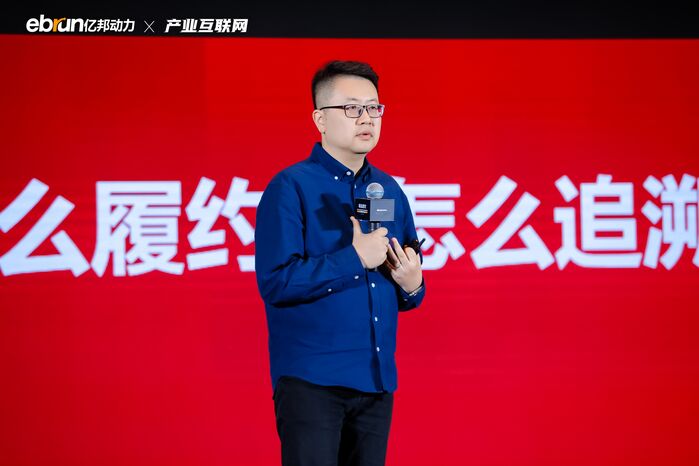
【亿邦原创】11月20日消息,在2026第八届亿邦产业互联网年会暨首届产业智能体大会上,科力普科技集团CTO张少鹏发表了题为《从能用到可靠,AI进入采购核心流程——科力普从数字化采购走向智能体协同的实践》的演讲。

他指出,企业采购引入AI,核心目标不是简单的降本增效,而是把复杂度降下去、把确定性提上去。AI能解决不确定问题,但无法独立承担责任;只有边界清晰、例外可纠、全程可追溯,AI才能从“能用”真正走向“可靠”。

温馨提示:本文为速记初审稿,在不影响原意的基础上,由亿邦动力编辑整理。

以下为演讲实录:

尊敬的各位领导、各位嘉宾、大家好,我是科力普的张少鹏。过去一年,几乎所有企业都在试AI,“能用”已经不稀奇;而难的是让AI进到采购的核心流程,做到可靠。

01 企业采购为什么难?

我们每个人都在网上买过东西,点一下,第二天就到。现在甚至连个人买东西也可以交给AI—— 比如目前流行的Personal Agent–个人AI助理,你发个指令给它,它就能帮你把东西买回来,非常方便。可一到企业里,为什么就变复杂了?

过去一年,大家都用AI写过方案、做过PPT;但让AI替公司下一张采购单、定一个价,还很少。从“能用”到企业敢把核心流程交给它,中间差两个字:可靠。

个人买一台电脑,自己下单即可;但企业要买一百台电脑背后其实是整个企业的协同。AI要进入采购,就得进入这套协同。

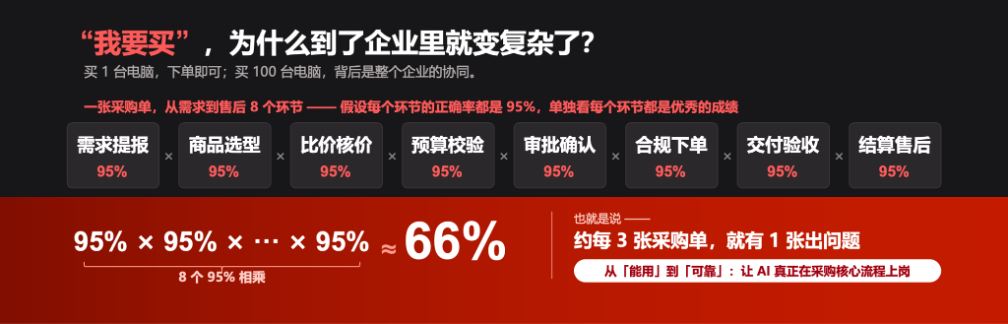
怎么理解可靠?一张采购单从需求到售后,大概8个环节:需求提报、商品选型、比价核价、预算校验、审批确认、合规下单、交付验收、结算售后。假设AI在每个环节都做到95分——单看,已经很优秀。

但8个95% 乘起来,只剩约66%。也就是大约每三张采购单,就有一张会在某个地方出问题。在每个节点的周报里,95分是优秀;放到整条流程里,三分之一的出错率是致命的。

所以怎么把AI从“能用”带到“可靠”,让它真正在采购核心流程里上岗?那么企业的采购复杂在哪里?

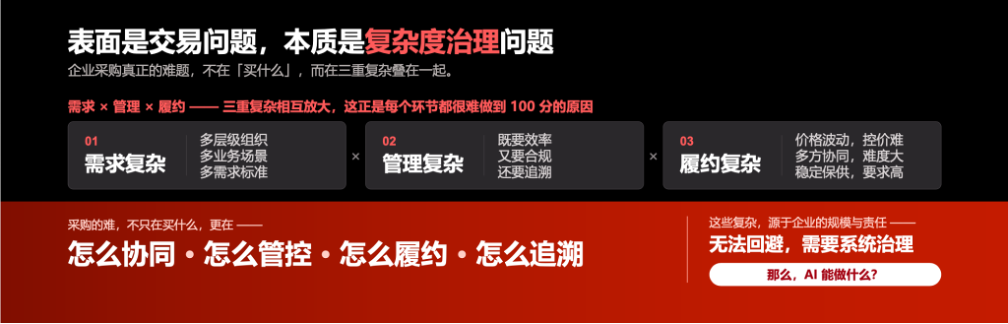
企业采购的难题,表面看是交易问题,本质是复杂度治理问题。真正的难,是三重复杂叠在一起,彼此放大。需求复杂:总部、分子公司、项目现场,同一类东西各家要的不一样。管理复杂:效率、合规、追溯要同时做到。履约复杂:价格波动大,要采购、供应商、承运商一起协同,对稳定保供的要求又很高。所以采购的难,不只在买什么,更在怎么协同、怎么管控、怎么履约、怎么追溯。

这些复杂来自企业的规模和责任,无法回避,需要靠系统的方法去治理。那AI能做什么?

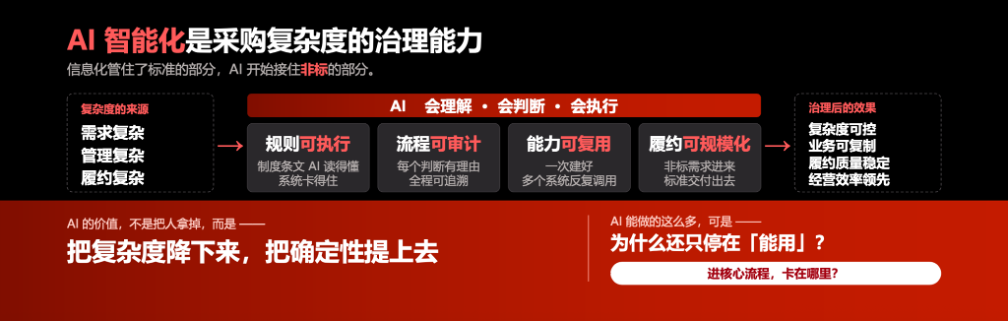
过去二十年的信息化建设,管控了标准化的流程、商品与单据。然而,采购场景中依然充斥着大量非标信息——客户邮件、形式各异的Excel电子表格、各类合同文本乃至聊天截屏,过去这些环节始终高度依赖人工处理。如今,AI开始具备“能理解、会判断、会执行”的能力,也正是基于这些能力,它才能真正承接并处理这些复杂的非标数据。

面对需求复杂、管理复杂、履约复杂这三重挑战。在承接非标数据的过程中,AI进一步展现并转化出四种核心治理能力:规则可执行、流程可审计、能力可复用、履约可规模化。结果是让复杂度可控、业务可复制、履约质量稳定、经营效率领先。所以AI的价值,不是把人拿掉,而是把复杂度降下来、把确定性提上去。

既然AI已经具备了处理非标和治理复杂度的能力,但为什么大多数企业依然只让它停留在“能用”、Demo演示或测试的阶段,而没有真正进核心采购流程,到底卡在哪里?

很多尝试过AI项目的企业会这个体会:AI项目在试点演示的时候很顺利,效果甚至很惊艳,但一进生产就会遇到种种问题,很多功能就只能停留在试点或者边缘的功能,无法进入核心的业务流程。

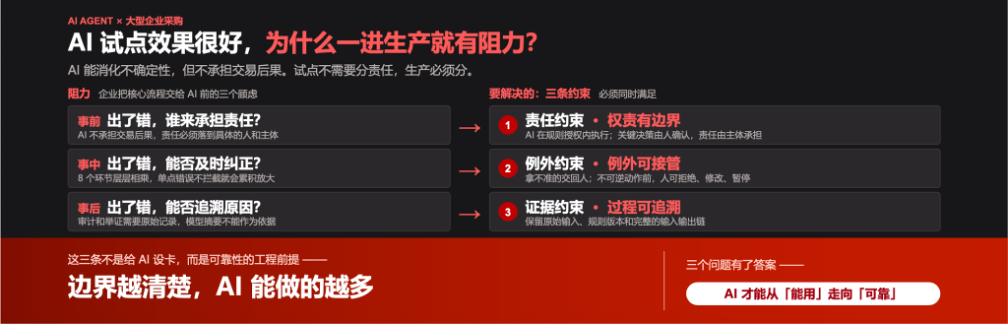
其中一个重要的原因就是AI本身并不承担交易后果与责任。但是在生产环境,每一笔采购都是承诺,核心流程必须分责任。“出了错怎么办”?

事前,AI出了错,谁来担责?这要求权责必须有明确的边界。AI只能在规则授权的范围内去执行,遇到关键决策必须由人来确认,主体责任自始至终都在人的身上。

事中,AI出错了,能否及时纠正?错误如果不及时拦住,就会沿着流程层层放大。所以必须有例外接管机制,AI拿不准的时候,要能干净利落地交还给人工处理;在发生不可逆动作之前,人必须拥有拒绝、修改甚至暂停的终局控制权。

事后,AI出了错,能不能追溯原因?采购流程需要合规和审计的,必须是完整可查的原始记录,不能只是大模型生成的一段摘要。也就是过程必须全链路可追溯,每一次决策路径,都完整保留下来。边界越清楚,AI能做的就越多。

02 科力普的落地实践:从能用到可靠

那么,科力普具体是怎么做的?

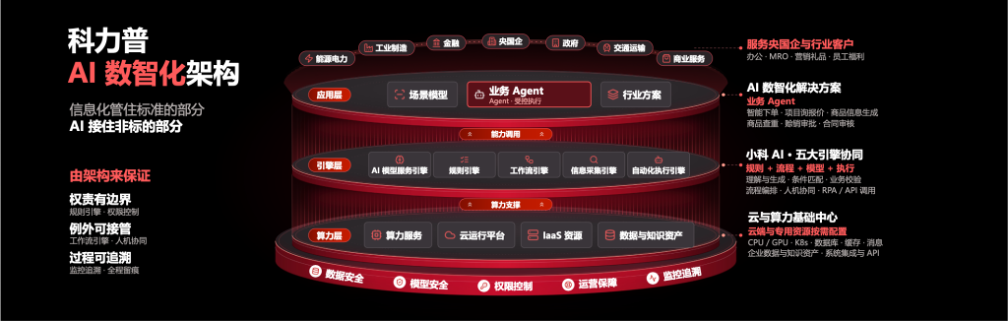
首先,我们来看科力普的整体数智化架构。我们向上服务央国企、金融、工业制造等多行业头部客户;在应用层,智能下单、询报价、合同审核等核心场景的业务Agent已经上岗;中间通过五大核心引擎联动,链接算力与企业数据资产;底座,则是贯穿全程的安全、权限与追溯体系。

通过数智化架构,承载让权责有边界,靠规则引擎和权限控制;例外可接管,靠工作流引擎里的人机协同;过程可追溯,靠贯穿全链路的监控追溯。

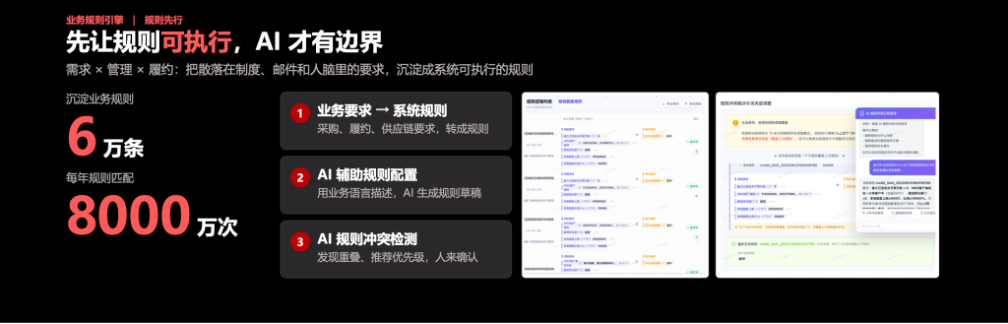
AI进采购,第一步往往不是模型,而是规则——先让规则可执行,AI才有边界。科力普这些年把采购、履约、供应链协同里的各种要求,一条一条沉淀成了系统规则,这里面有客户的采购制度、预算规则、品类限制。现在是6万条,去年匹配8000万次。

在这个基础上,AI做了两件事。第一,辅助配置:业务人员用自然语言描述要求,AI生成规则草稿。第二,冲突检测:6万条规则难免打架。AI助手发现新规则和已有规则逻辑重合,会解释为什么冲突、推荐优先级——最终由人来定。

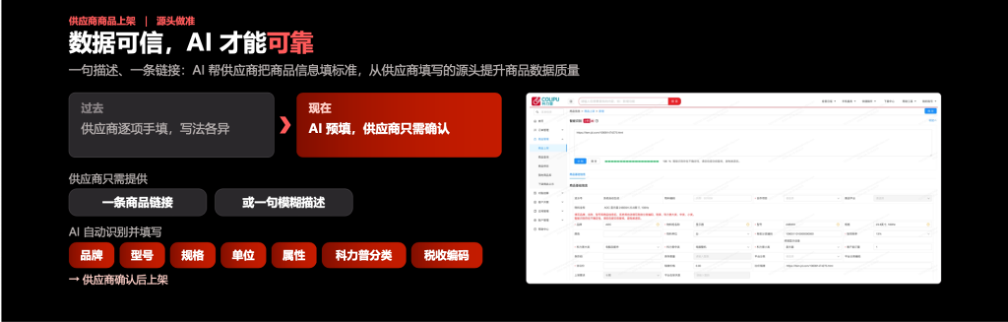
科力普的商品和品类非常多,商品信息填得标不标准,直接决定后面的匹配、比价、合规能不能准确。商品基础数据是乱的,AI模型再聪明结果也不可能可靠。所以我们把AI用商品信息录入的源头:供应商只要给一条商品链接,或一段商品的模糊描述,小科AI就能填好品牌、型号、规格、单位、属性,以及科力普分类和税收编码,供应商确认后上架。过去是逐项手填、写法各异;现在是AI预填、供应商确认,绝大部分字段不用改,只需要确认。保证商品信息在录入的源头就做到标准和统一。

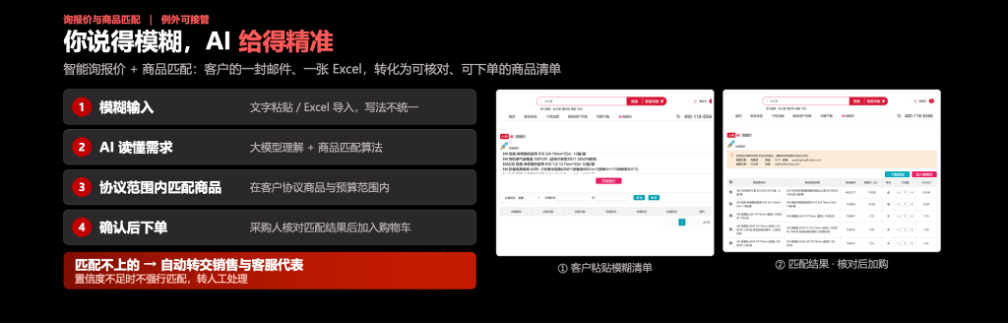
面对客户的询报价,是一个模糊和非标准的场景。客户发来一封邮件、一张写法不统一的Excel,当天就要报价。过去,销售和客服要一行一行去查、去对、去比价。

现在,在AI赋能下,客户把清单粘进来——文字也行,Excel导入也行——AI读懂每一行写的是什么,再叠加商品匹配算法,在这个客户的协议商品范围、预算范围内,匹配出具体的商品、编号和价格。采购人核对后,再加入购物车下单。

而匹配不上的、AI不会强行匹配,而是自动转给对应的销售和客服代表,销售可以联系客户,人工跟进销售机会。这就是“例外可接管”。

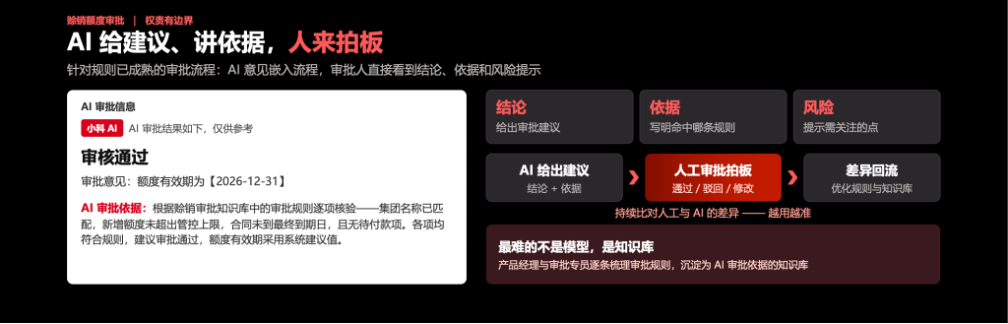
拿我们常用的赊销额度审批来说吧。审批人在审批的时候会看到的是AI给出的建议结果,系统会列出审批意见,以及它做出判断的依据——AI会调取知识库里的规则去逐项核验:比如历史赊销的使用情况、申请的新额度有没有超过上限、现有合同有没有到期、有没有逾期未付的款项等等。审批人依据这个审批建议,最终确定是否通过额度申请。

这个AI项目落地,最难的不是模型的能力,而是建立知识库。我们是让产品经理和审批专员坐一起,逐条把审批专员工单里,文档里,自己记录的小本本里,甚至是脑子里的潜规则梳理出来,建立知识库。同时,系统还会自动记录下审批人对AI建议的采纳率,并持续优化知识库。

市面有一些AI合同评审的产品,但往往很难真正贴合企业内部复杂的业务场景。我们需要基于供应商的历史交易记录、供应商履约数据以及沉淀多年的风控知识库来进行评审,所以我们选择了自主研发。

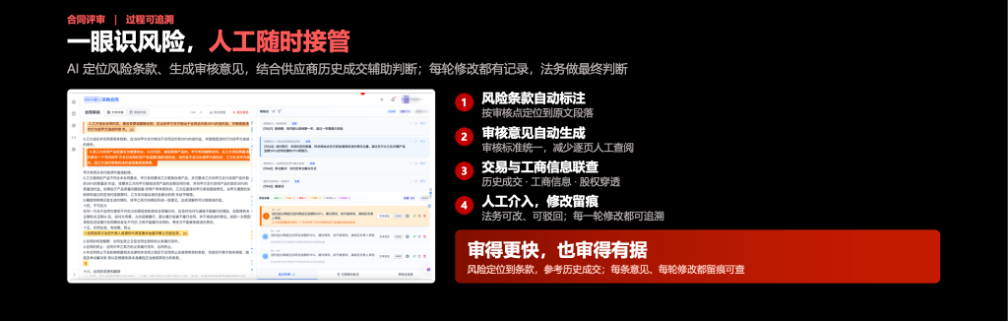
过去,合同审核得靠法务人员逐字逐页去翻资料,好几轮修改来回折腾。现在最直观的体会就是“方便”——系统会自动对照预设的审核点,直接把风险条款定位到原文段落,并实时生成统一标准的审核意见。

同时,AI会自动联动这家供应商在我们这里的历史成交数据、最新的工商信息乃至股权穿透关系,让法务在判断风险时有更加明确的依据。每一轮审阅记录、修改留痕全都被记录,事后随时回溯复盘。

03 从单点落地到规模化的方法论是什么?

前面我们分享了AI进入核心流程的“为什么”以及科力普的实践“怎么做”;接下来是我们数智化系统建设过程总结的方法论,也就是价值评估、能力评估与实施路径。

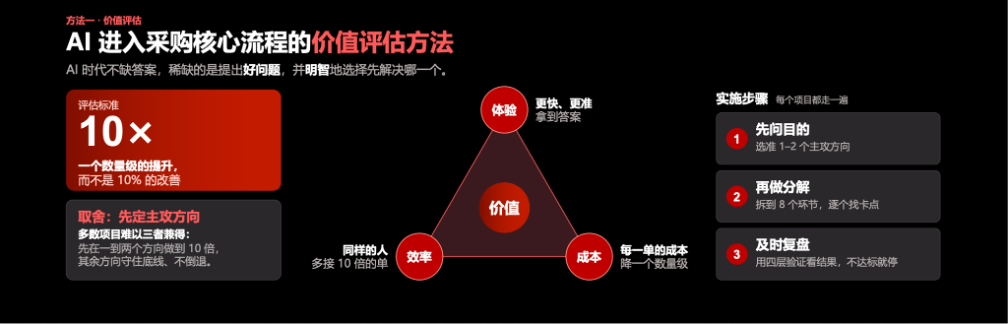
现在AI模型能力提升很快,每周都有新版本,现在已经不缺少解决问题的能力,而真正稀缺的是,提出一个好问题,并且明智地做出取舍——知道究竟该把有限的资源,优先投在哪里问题上的能力。

我们的方法其实很简单:我们要看体验、效率和成本这三个维度中,究竟哪一个或哪两个维度能做到10倍——也就是一个数量级的提升。10% 的改善靠日常流程优化也能做到,只有实现数量级的跃升,才是真正有价值的数智化项目。

实施步骤,第一步,先问目的,也就是要确认这个项目的价值是不是真的能做到10倍的提升;第二步,再做分解,因为这类数智化项目往往需要分阶段推进、不断迭代,通过拆解环节去提升采纳率、准确率,并找到边界;第三步,及时复盘,去总结这个项目到底有没有达到10倍价值的提升,哪些做对了、哪些需要改善,好让接下来的项目能做得更好。

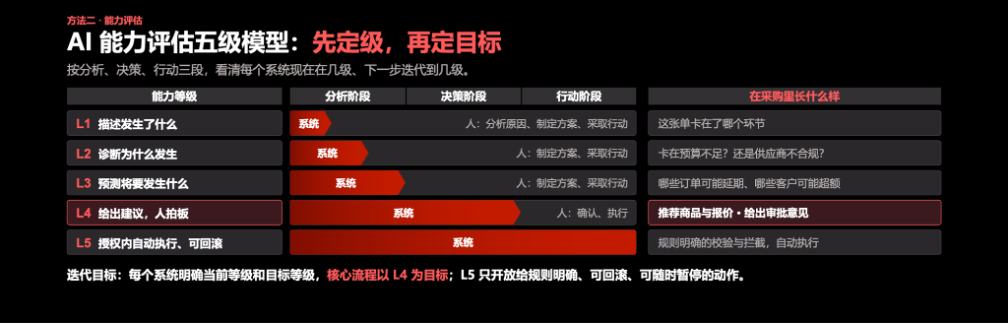
我们把AI用到业务里,会碰到一个问题:哪些事可以交给系统,哪些事还得人来拍板?如何评价现在系统做到什么程度了?所以我们定义了这个AI能力评估的模型。

L1描述发生了什么,告诉你,这张采购单卡在哪儿。L2诊断原因,帮你找原因,是预算不足,还是供应商不合规?L3预测风险,再往前一步,提前提醒你哪些订单可能延期。到了L4,系统有能力给出建议。像刚才讲的商品匹配和赊销审批,系统可以推荐商品、给出审批意见,最后由人拍板。到了L5,系统能在授权范围内自动执行。

有了这个评估模型,我们就能给每个系统定目标:现在在哪一级,下一步到哪一级,还要补哪些数据和规则。核心流程以L4为目标。只有规则明确、能回滚、随时能暂停的动作,我们才开放到L5。

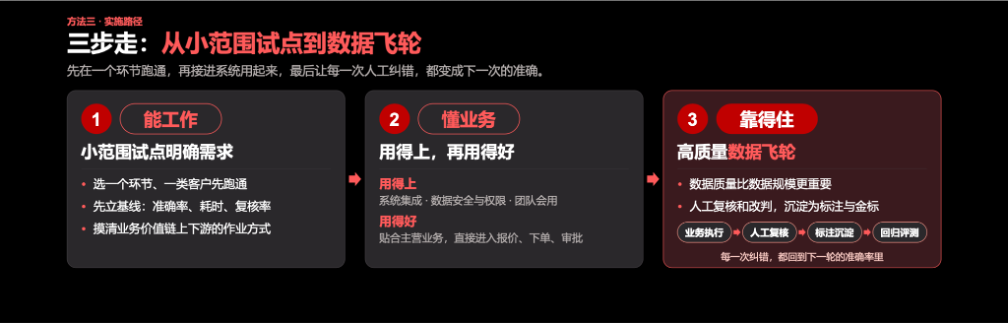
怎么让AI在业务里落地?我们分三步走。

第一步,让它能工作。 小范围进行试点。先挑一个业务环节、一类客户,把流程跑通。试点前先记下来,现在做得有多准、要花多久、多少单需要人工复核。这样跑完一轮,就知道到底有没有改善。第二步,让它懂业务。 要解决AI用得上和用得好的问题。接个AI模型,很快就能用上。真正难的是用得好。比如AI放进我们的报价流程里,它能帮业务节省多少时间?哪些建议可以直接采纳,哪些必须复核?边界在哪里,最后谁拍板、谁负责?AI在主营业务里能创造什么价值。

第三步,AI能不能靠得住,很大程度上取决于背后的知识库。AI越深入业务,知识库越准,AI的回答就越贴合业务,大家也就越愿意在更多场景里用它。这个循环,就是我们说的数据质量飞轮。建立人和AI合作方式和高质量的数据飞轮,AI就越懂我们的业务、规则和数据,也就越值得信赖。

最后用几分钟介绍一下我们自己。晨光股份是上交所主板上市公司,2025年营业收入250.64亿元;科力普是晨光旗下的B2B数智化采购平台,2025年营业收入150.48亿元。

说到晨光,大家都很熟悉。晨光文具是行业的明星龙头企业,也是我们引以为傲的国货之光、民族之光。晨光控股有三大业务板块,分别是以晨光股份为主体的实业板块、家族办公室和楼宇物业。

科力普的商品覆盖办公用品、MRO工业品、营销礼品和员工福利。我们为企业提供一站式办公解决方案,支持多场景MRO采购,也提供礼品定制和B2B2C员工福利方案。对采购方来说,一个平台、一套合规流程,就能覆盖企业的通用物资采购。

科力普主要服务五类客户。我们服务了70多家央企集团、100多家金融机构,也入围了50多个政府电商采购平台。此外,我们的客户还包括各行业的头部民营企业和外资500强企业。全国央企一共100多 家,我们服务了其中70多家,覆盖电力、军工、航天、交通运输、石化能源等细分行业。金融客户覆盖从政策性银行、国有商业银行到股份制银行、城商行、农商行,再到保险和证券公司;政府采购平台覆盖从中央政府采购单位到省级、地市级政府采购单位。

同时,我们服务了一万多家大型民营企业,覆盖医疗、新能源、手机制造等行业,像华为、比亚迪,都是我们的客户。我们还服务了150多家外资500强企业,从太太们喜欢LV、香奈儿,到孩子们喜欢的乐高玩具,还有在制造业、互联网、制药、新零售领域熟悉的很多品牌,都是我们的客户。

作为行业的龙头,科力普有责任带头引领把行业做得更规范、更健康。我们主要做了六件事。第一,建立Colipu Plus系统, 统一商品信息和管理标准,让客户买得明白、买得放心。第二,建起五级仓配网络,使用自动分拣和AGV搬运机器人支撑全国履约。第三,设立供应链运营中心,用数据预测,和品牌厂家一起降成本、找好货。第四,建立完整的合规体系,独立内审部门由董事长直管,把合规落到业务流程里。第五,用 “普元”数智化平台,高效精益化运营,让采购和内部运营衔接得更顺。第六,就是 小科AI。我们把AI融入数字化系统,逐步进入采购的核心流程。

AI变革让我们看到了机会和希望;全球竞争格局的变化,也带来了风险和挑战。这让我想起狄更斯《双城记》的开头:那是最好的时代,那是最坏的时代;那是智慧的年头,那是愚昧的年头。在这样的时代,科力普的回答是:让AI从“能用”到“可靠”。科力普愿和所有客户、供应商、友商携手并进,一起迎接机遇和挑战。

谢谢大家!

关于本次大会

2026第八届亿邦产业互联网年会暨首届产业智能体大会,主题是“AI与出海带来的模态进化”,聚焦产业智能体落地、AI供应链价值重构、数据要素与TOKEN经济、产业出海新生态等前沿议题深度思辨。大会集结学界权威、央国企标杆、产业龙头、投资机构、服务生态,汇聚产业核心力量、拆解产业数智化转型路径、分享前沿实战经验。

产业互联网是数智技术、全球化、产业链、供应链变革引发的产业新模态,亿邦动力产业互联网年会已成为我国产业互联网领域的标志性行业交流活动。

本文首发于 亿邦动力 官方网站

文章来源:亿邦动力

广告
微信
朋友圈

FAQ回顾

企业采购引入AI的核心目标是什么?

企业采购引入AI的核心目标不是简单降本增效,而是把复杂度降下去、把确定性提上去。AI可承接邮件、Excel、合同、聊天截屏等非标信息,但必须做到规则可执行、流程可审计、能力可复用、履约可规模化,并在权责边界、例外接管和全链路追溯下进入核心流程。

为什么AI很难进入企业采购核心流程?

企业采购表面是交易问题,本质是复杂度治理。需求、管理、履约三重复杂叠加,且一张采购单从需求到售后约8个环节;每环节95分相乘仅约66%,约三张单就有一张出问题。AI又不独立承担交易责任,因此需明确权责边界、例外可接管、过程可追溯。

科力普如何让AI在采购流程中做到可靠?

科力普先让规则可执行,已沉淀6万条采购、履约、供应链规则,去年匹配8000万次;商品信息由小科AI预填,询报价AI解析清单并匹配协议商品和预算,匹配不上转人工;赊销审批由AI给建议、人拍板;合同审核自研定位风险并联动历史交易、工商和股权信息。

科力普的AI能力评估模型如何分级?

该模型分L1至L5:L1描述发生了什么,L2诊断原因,L3预测风险,L4给出建议并由人拍板,L5在授权范围内自动执行。科力普将核心流程目标设为L4,只有规则明确、能回滚、随时能暂停的动作才开放到L5。

科力普是什么公司,主要服务哪些客户?

科力普是晨光股份旗下的B2B数智化采购平台,2025年营业收入150.48亿元,商品覆盖办公用品、MRO工业品、营销礼品和员工福利。它服务70多家央企、100多家金融机构、50多个政府电商采购平台、一万多家大型民营企业和150多家外资500强企业。

这么好看,分享一下?

朋友圈 分享

APP内打开

赞 +1
+1
微信好友 朋友圈 新浪微博 QQ空间
关闭
收藏成功
发送
/140 0