广告
加载中

沙利文2026 Robovan白皮书:行业竞争进入“城市级运营”阶段,新石器市占率全球第一

龚作仁 2026-11-24 11:17
龚作仁 2026/11/24 11:17

邦小白快读

EN
全文速览

总:Robovan是面向城市及近郊中短途货运的L4级轻型无人载货车,正从试点验证进入规模交付,核心价值是用算法驱动替代人力驱动。

1.市场数据:沙利文预测2030年全球Robovan年销量204.0万辆、中国89.8万辆;全球保有量369.8万辆、中国200.7万辆。

2.竞争格局:新石器以53%份额全球第一,走软硬件一体化加无人即时配送服务网络路线;九识智能以37%份额紧随,主打车型迭代、场景化配置与规模交付;白犀牛聚焦末端性价比和快递、商超细分赛道。

3.落地顺序:先从快递网点、园区短驳等固定高频转运切入,再进入商超补货、同城货运、冷链医药,即时配送仍处早期。

4.商业变化:从一次性卖车转向按订单、里程、时长或服务保障付费,客户不必承担资产投入和车队管理。

总:Robovan品牌竞争从单点产品转向城市级运营,头部靠技术、规模、数据与网络效应建立壁垒。

1.品牌路线:新石器以全栈技术和网络化运营,走软硬件一体化加无人即时配送服务路线,以53%份额居全球第一;九识智能以37%份额紧随,强调车型迭代、场景化配置和规模交付;白犀牛以末端性价比切入快递、商超细分市场。

2.产品研发:产业链含激光雷达、摄像头、毫米波雷达、AI芯片、域控制器、线控底盘,中游为整车集成、测试验证与云控调度,产品要适配快递短驳、商超补货、园区转运、冷链医药等标准城配任务。

3.定价与用户:商业本质从卖车转向按需购买运输结果,客户按订单、里程、时长或服务保障付费,服务商转向全生命周期服务收入。

4.品牌壁垒:车辆规模带采购议价和制造成本下降,订单密度摊薄单城调度保障成本,运营数据反哺算法与维保,沉淀单位运力成本、履约稳定性、客户续约率和城市准入资源。

总:Robovan给卖家带来城配运力服务化机会,但行业集中度高,进入者需关注场景成熟度、经济模型和网络效应。

1.增长市场:2030年全球年销量预计204.0万辆、中国89.8万辆;无人即时配送服务市场GMV全球从2025年约9亿元增至2030年5181亿元,中国从约8亿元增至2407亿元。

2.需求机会:中国城配车辆进入存量替换周期,机会在用智能运力重构存量效率;快递短驳、园区转运、商超补货等固定高频场景最先成熟,冷链医药、即时配送逐步展开。

3.模式学习:从一次性卖车转向按订单、里程、时长或服务保障收费;头部以单城订单、车辆、保障资源闭环形成密度经济,再用通用能力层加差异化配置层复制。

4.风险提示:前两家占全球约90%交付份额,竞争门槛高;主线转向单位经济模型能否跑正、跑稳、跑出网络效应,即时配送峰谷波动大、仍处早期。

总:Robovan规模化交付将带动感知、决策、执行部件和整车集成的生产设计需求,工厂机会在供应链配套与规模制造。

1.产品生产需求:上游包括激光雷达、摄像头、毫米波雷达、AI芯片、域控制器与线控底盘,中游包括整车集成、测试验证与云控调度平台,下游对接快递、商超、生鲜冷链、园区和城市公共服务。

2.设计需求:Robovan核心是低速、限定场景、安全风险可控,需适配快递短驳、商超补货、园区转运、冷链医药等高频率标准化城配任务;企业采用通用能力层与差异化配置层架构,便于跨场景复制。

3.商业机会:车辆规模上升会带来采购议价与制造成本下降,规模制造、产品平台、场景化配置和测试验证都有机会;中国是高密度物流网络下全球最大单一落地市场,城配存量替换空间值得关注。

4.数字化启示:运营数据可反哺自动驾驶算法、调度、维保预测,工厂推进数字化应重视数据闭环、云控调度与全生命周期协同。

总:Robovan服务市场正从车辆交付转向城市级运力运营,服务商机会在调度、维保、场景方案和全生命周期服务。

1.行业趋势:行业从试点验证迈向连续规模交付,2030年全球年销量预计204.0万辆、中国89.8万辆;无人即时配送服务市场GMV全球从2025年约9亿元增至2030年5181亿元,中国从约8亿元增至2407亿元,价值重心转向运营服务。

2.客户痛点:传统城配受司机薪资成本占比高、招工难且流动率大、订单碎片化空驶率高、路径依赖人工经验、服务质量随司机状态波动且缺乏追溯等制约。

3.解决方案:以L4级自动驾驶为核心,叠产品平台、规模制造、运营服务全栈能力,用统一调度中枢替代人工排线,把碎片化人力运力组织成可调度智能运力网络,实现降本、提效和服务标准化。

4.运营方法:以订单、车辆、保障资源的单城闭环形成密度经济,新增车辆复用既有订单池、调度中枢和保障资源,再用通用能力层加差异化配置层复制到新城市、新场景。

总:Robovan平台化运营的关键是城市智能运力网络,平台需解决运力组织、调度效率、单城密度和跨城复制问题。

1.平台需求:传统城配订单碎片化、空驶率高、人工调度不精细,平台需要以统一调度中枢组织运力,把碎片化人力运力变成可调度智能运力网络,并连接订单、车辆、保障资源。

2.最新做法:头部企业构建订单、车辆、保障资源的单城运营闭环形成密度经济;新增车辆要能复用既有订单池、调度中枢与保障资源,且有效运力增长快于管理投入增长,车队扩张才形成有效规模。

3.运营管理:以通用能力层与差异化配置层架构,把成熟城市运营单元复制到新城市、新场景,缩短启动周期、降低试错成本;平台还应重视云控调度、运营数据反哺算法和维保预测。

4.风险规避:前两家企业占全球约90%交付份额,平台招商和合作要关注头部集中;行业竞争主线转向单位经济模型能否跑正、跑稳、跑出网络效应,即时配送峰谷波动大,宜按场景成熟度梯度推进。

总:Robovan白皮书揭示城市配送无人化新动向:技术路线分化、头部集中、商业服务化和城市运力资产化。

1.产业格局:2030年全球年销量预计204.0万辆、中国89.8万辆;新石器以53%份额全球第一,九识智能37%紧随,前两家占全球约90%份额。

2.技术与产业链:Robovan是低速、限定场景、安全风险可控的L4轻型载货平台,上游为激光雷达、摄像头、毫米波雷达、AI芯片、域控制器、线控底盘,中游为整车集成、测试验证、云控调度,下游为快递、商超、冷链、园区和公共服务。

3.商业模式:商业本质从卖车转向按需购买运输结果,客户按订单、里程、时长或服务保障付费;服务市场GMV快速增长,价值重心向运营服务转移。

4.新问题与启示:商业化需跨技术可运行、运营可持续、经济性验证、模式可复制四道门槛;场景按固定高频转运、计划性补货、动态点到点、专业化配送、即时配送梯度演进;中国城配进入存量替换周期,竞争转向单位经济模型和网络效应,城市准入、合规与安全值得研究。

返回默认

声明:快读内容全程由AI生成,请注意甄别信息。如您发现问题,请发送邮件至 run@ebrun.com 。

我是 品牌商 卖家 工厂 服务商 平台商 研究者 帮我再读一遍。

Quick Summary

Overall: Robovan is an L4 light-duty unmanned cargo vehicle for short- and medium-haul urban and peri-urban freight, moving from pilot validation to scaled delivery; its core value is replacing human-driven operations with algorithm-driven ones.

1. Market data: Frost & Sullivan forecasts 2.040 million global Robovan annual sales and 898,000 in China by 2030; a global parc of 3.698 million and 2.007 million in China.

2. Competitive landscape: Neolix ranks first globally with a 53% share, pursuing integrated hardware-software plus an unmanned instant delivery service network; Zelos follows with 37%, focusing on model iteration, scenario-based configurations and scaled delivery; White Rhino focuses on last-mile cost-effectiveness and express/supermarket niches.

3. Deployment sequence: starts with fixed, high-frequency transfers at express outlets and park short-haul, then supermarket replenishment, intra-city freight and cold-chain/pharma; instant delivery remains early-stage.

4. Business model shift: from one-time vehicle sales to payment by order, mileage, time or service guarantee, freeing customers from asset investment and fleet management.

Overall: Robovan brand competition is shifting from point products to city-level operations; leaders build moats through technology, scale, data and network effects.

1. Brand routes: Neolix uses full-stack technology and networked operations, pursuing integrated hardware-software plus unmanned instant delivery services, and ranks first globally with a 53% share; Zelos follows with 37%, emphasizing model iteration, scenario-based configurations and scaled delivery; White Rhino enters express and supermarket niches through last-mile cost-effectiveness.

2. Product R&D: the value chain includes LiDAR, cameras, mmWave radar, AI chips, domain controllers and drive-by-wire chassis; the midstream covers vehicle integration, testing and validation, and cloud control dispatch; products must fit standard urban distribution tasks such as express short-haul, supermarket replenishment, park transfers and cold-chain/pharma.

3. Pricing and users: the commercial essence shifts from selling vehicles to buying transport results on demand; customers pay by order, mileage, time or service guarantee, and providers shift toward lifecycle service revenue.

4. Brand moats: fleet scale brings procurement bargaining power and lower manufacturing costs; order density amortizes per-city dispatch and support costs; operational data feeds algorithms and maintenance, building up unit capacity cost, fulfillment stability, customer renewal rates and city access resources.

Overall: Robovan creates opportunities for sellers in servicized urban distribution capacity, but industry concentration is high; entrants should watch scenario maturity, economic models and network effects.

1. Growth market: global annual sales are expected to reach 2.040 million and China 898,000 by 2030; the unmanned instant delivery service market GMV is projected to rise from about RMB 0.9 billion globally in 2025 to RMB 518.1 billion in 2030, and in China from about RMB 0.8 billion to RMB 240.7 billion.

2. Demand opportunities: China's urban distribution vehicles are entering a replacement cycle, with the opportunity lying in reconstructing existing efficiency through intelligent capacity; fixed high-frequency scenarios such as express short-haul, park transfers and supermarket replenishment will mature first, while cold-chain/pharma and instant delivery expand gradually.

3. Model learning: shift from one-time vehicle sales to fees by order, mileage, time or service guarantee; leaders form density economics through a per-city closed loop of orders, vehicles and support resources, then replicate it via a common capability layer plus a differentiated configuration layer.

4. Risks: the top two players account for about 90% of global delivery share, raising competitive barriers; the main line shifts to whether unit economics can turn positive, remain stable and generate network effects; instant delivery has large peak-valley fluctuations and remains early-stage.

Overall: Scaled Robovan delivery will drive production and design demand for perception, decision-making, execution components and vehicle integration; factory opportunities lie in supply-chain supporting and scale manufacturing.

1. Production demand: upstream includes LiDAR, cameras, mmWave radar, AI chips, domain controllers and drive-by-wire chassis; midstream includes vehicle integration, testing and validation, and cloud control dispatch platforms; downstream serves express, supermarkets, fresh and cold-chain, parks and urban public services.

2. Design requirements: Robovan's core is low-speed, confined-scenario operation with controllable safety risks; it must fit high-frequency standardized urban distribution tasks such as express short-haul, supermarket replenishment, park transfers and cold-chain/pharma; companies adopt a common capability layer plus differentiated configuration layer architecture to facilitate cross-scenario replication.

3. Business opportunities: rising vehicle scale will bring procurement bargaining power and lower manufacturing costs; scale manufacturing, product platforms, scenario-based configurations and testing and validation all present opportunities; China is the world's largest single deployment market under dense logistics networks, and existing urban distribution replacement space is worth attention.

4. Digitalization implications: operational data can feed autonomous driving algorithms, dispatch and predictive maintenance; factories advancing digitalization should emphasize data closed loops, cloud control dispatch and lifecycle collaboration.

Overall: The Robovan service market is shifting from vehicle delivery to city-level capacity operations; service provider opportunities lie in dispatch, maintenance, scenario solutions and lifecycle services.

1. Industry trend: the industry is moving from pilot validation to continuous scaled delivery; global annual sales are expected to reach 2.040 million and China 898,000 by 2030; the unmanned instant delivery service market GMV is projected to rise from about RMB 0.9 billion globally in 2025 to RMB 518.1 billion in 2030, and in China from about RMB 0.8 billion to RMB 240.7 billion, with the value focus shifting toward operational services.

2. Customer pain points: traditional urban distribution is constrained by high driver salary costs, recruitment difficulties and high turnover, fragmented orders and high empty miles, manual route planning, and service quality that fluctuates with driver status and lacks traceability.

3. Solutions: with L4 autonomous driving as the core, stacked with full-stack capabilities in product platforms, scale manufacturing and operational services, a unified dispatch hub replaces manual route planning; fragmented human capacity is organized into a dispatchable intelligent capacity network to achieve cost reduction, efficiency gains and service standardization.

4. Operating method: a per-city closed loop of orders, vehicles and support resources forms density economics; new vehicles reuse the existing order pool, dispatch hub and support resources, and the model is then replicated to new cities and scenarios through a common capability layer plus a differentiated configuration layer.

Overall: The key to Robovan platform operations is a city intelligent capacity network; platforms must solve capacity organization, dispatch efficiency, per-city density and cross-city replication.

1. Platform needs: traditional urban distribution has fragmented orders, high empty miles and imprecise manual dispatch; platforms need a unified dispatch hub to organize capacity, turn fragmented human capacity into a dispatchable intelligent capacity network, and connect orders, vehicles and support resources.

2. Latest practices: leading companies build a per-city operational closed loop of orders, vehicles and support resources to form density economics; new vehicles must reuse the existing order pool, dispatch hub and support resources, and effective capacity growth must outpace management input growth for fleet expansion to create valid scale.

3. Operations management: with a common capability layer and differentiated configuration layer architecture, mature city operating units can be replicated to new cities and scenarios, shortening launch cycles and reducing trial-and-error costs; platforms should also focus on cloud control dispatch, operational data feeding algorithms and maintenance prediction.

4. Risk avoidance: the top two players account for about 90% of global delivery share; platform recruitment and cooperation should account for leader concentration; the industry's competitive main line is shifting to whether unit economics can turn positive, remain stable and generate network effects; instant delivery has large peak-valley fluctuations, so progress should follow a scenario-maturity gradient.

Overall: The Robovan white paper reveals new directions in unmanned urban distribution: technology route divergence, leader concentration, commercial servicization and the assetization of urban capacity.

1. Industry landscape: global annual sales are expected to reach 2.040 million and China 898,000 by 2030; Neolix ranks first globally with a 53% share, followed by Zelos at 37%, with the top two accounting for about 90% of the global share.

2. Technology and value chain: Robovan is a low-speed, confined-scenario, safety-risk-controllable L4 light cargo platform; upstream includes LiDAR, cameras, mmWave radar, AI chips, domain controllers and drive-by-wire chassis; midstream includes vehicle integration, testing and validation, and cloud control dispatch; downstream includes express, supermarkets, cold-chain, parks and public services.

3. Business model: the commercial essence shifts from vehicle sales to on-demand purchase of transport results; customers pay by order, mileage, time or service guarantee; the service market GMV is growing rapidly, and the value focus is shifting toward operational services.

4. New issues and implications: commercialization must cross four thresholds: technical operability, operational sustainability, economic validation and model replicability; scenarios evolve along a gradient from fixed high-frequency transfers, planned replenishment, dynamic point-to-point delivery and specialized delivery to instant delivery; China's urban distribution is entering a replacement cycle, competition is shifting toward unit economics and network effects, and city access, compliance and safety warrant research.

Disclaimer: The "Quick Summary" content is entirely generated by AI. Please exercise discretion when interpreting the information. For issues or corrections, please email run@ebrun.com .

I am a Brand Seller Factory Service Provider Marketplace Seller Researcher Read it again.

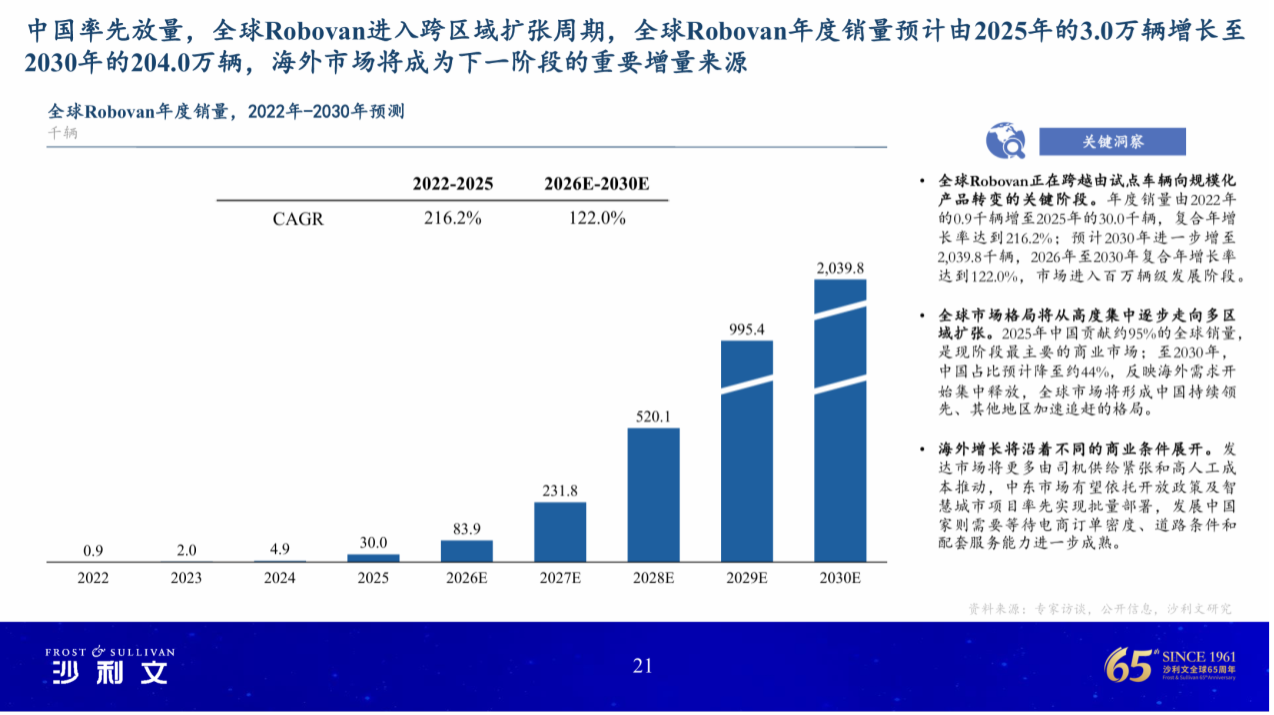
日前,全球增长咨询公司弗若斯特沙利文(Frost&Sullivan)发布《2026 Robovan行业白皮书》。报告显示,随着自动驾驶技术成熟与城配物流升级,Robovan(L4级轻型无人载货车)行业正从试点验证迈向连续规模交付阶段。沙利文预测,到2030年,全球Robovan年度销量将达204.0万辆,其中中国市场年度销量将达89.8万辆;全球保有量将攀升至369.8万辆,中国保有量将达200.7万辆,市场正加速构建城市智能运力网络。

Robovan行业已呈现高度集中的头部竞争态势,前两家企业总计占据全球约90%的交付份额。其中,新石器凭借全栈技术能力与网络化运营优势,以53%的市场份额位居全球第一,走的是软硬件一体化加无人即时配送服务的网络运营路线;九识智能以37%的份额紧随其后,主打车型迭代、场景化配置与规模交付的产品交付路线。此外,聚焦末端性价比的白犀牛等企业也在快递、商超等细分赛道加速发力。

Robovan是介于末端配送机器人与干线无人卡车之间、面向城市及近郊中短途货运的L4级轻型载货平台,核心特征是低速、限定场景、安全风险可控、商业化路径清晰。相较于Robotaxi主打载人出行、Robotruck聚焦高速干线,Robovan天然适配快递短驳、商超补货、园区转运、冷链医药等高频率、标准化的城配任务,是城市配送无人化的核心载体。

从产业链看,上游由激光雷达、摄像头、毫米波雷达、AI芯片、域控制器与线控底盘构成感知、决策、执行的基础供给;中游是整车集成、测试验证与云控调度平台;下游则对接快递物流、商超零售、生鲜冷链、园区与城市公共服务等多元场景。沙利文认为,中国凭借高密度物流网络与多元配送需求,已成为全球Robovan最大的单一落地市场。

白皮书指出,传统城配长期受制于司机薪资成本占比高、招工难且流动率大、订单碎片化空驶率高、路径依赖人工经验调度不精细、服务质量随司机状态波动且缺乏追溯等痛点。

Robovan以L4级自动驾驶为核心,叠加产品平台、自动驾驶、规模制造、运营服务的全栈能力,将传统城配的人力驱动升级为算法驱动,通过统一调度中枢替代人工排线,把碎片化的人力运力组织成可调度的智能运力网络,实现降本、提效与服务标准化。

与之对应,商业本质也在发生迁移,从一次性卖车转向按需购买运输结果的运力服务。客户不再承担资产投入与车队管理,而是按订单、按里程、按时长或按服务保障付费;服务商则从单次交易收入转为覆盖车辆全生命周期的持续性服务收入,并用运营数据反哺调度、维保与场景拓展。

在商业化进程方面,Robovan正沿着四道门槛逐步推进:从技术可运行、运营可持续,到商业经济性验证,最终实现模式可复制。落地场景遵循梯度演进路径,首先从固定高频转运切入,如快递网点与园区短驳,这类场景路线固定、批量标准,商业化最为成熟;随后延伸至计划性多点补货,如商超与连锁门店,时间窗明确;再发展到动态点到点运输,如同城货运与批发,需要动态路径规划;接着是专业化任务配送,如冷链与医药,强调温控与合规;最后延伸至即时配送与生活服务,这类场景随机订单多、峰谷波动大,目前仍处早期探索。

沙利文测算,伴随服务化转型,全球无人即时配送服务市场按GMV将从2025年约9亿元增至2030年5181亿元,中国市场则从约8亿元增至2407亿元,价值重心由车辆销售持续向运营服务转移。

头部企业之所以能拉开身位,核心在于构建了供给规模、需求密度与数据学习相互强化的扩张飞轮。车辆规模上升带动采购议价与制造成本下降,订单密度提升摊薄单城调度与保障成本,海量运营数据反哺自动驾驶算法与维保预测,三者相互强化,沉淀出单位运力成本、履约稳定性、客户续约率与城市准入资源四重壁垒。

白皮书分析,中国城配车辆保有量已进入存量替换周期,Robovan的机会不在于车辆总量增长,而在于用智能运力重构存量效率。未来五年,行业竞争主线将从能不能跑转向单位经济模型能不能跑正、跑稳、跑出网络效应。

头部企业正通过构建订单、车辆、保障资源的单城运营闭环,形成密度经济。只有新增车辆能复用既有订单池、调度中枢与保障资源,且有效运力增长快于管理投入增长,车队扩张才真正形成有效规模。

在此之上,企业以统一能力底座推动跨场景、跨城市的快速复制,即通过通用能力层与差异化配置层的架构,把成熟城市的运营单元快速复制到新城市、新场景,缩短启动周期、降低试错成本。

白皮书认为,中国凭借高密度物流网络与多元配送场景,将持续成为全球最大的单一城配市场。未来,Robovan将不再仅仅是局部替代工具,而是逐步融入城市日常配送体系,成为可持续供给的城市运力资产。

注:文/龚作仁,文章来源:Laborer,本文为作者独立观点,不代表亿邦动力立场。

文章来源:Laborer

广告
微信
朋友圈

FAQ回顾

Robovan是什么,和Robotaxi、Robotruck有什么区别?

Robovan是L4级轻型无人载货车,介于末端配送机器人与干线无人卡车之间,面向城市及近郊中短途货运,核心特征是低速、限定场景、安全风险可控、商业化路径清晰;它不同于载人Robotaxi和高速干线Robotruck,适配快递短驳、商超补货、园区转运、冷链医药等城配任务。

2026 Robovan行业白皮书预测Robovan市场规模有多大?

白皮书预测,到2030年全球Robovan年度销量达204.0万辆,中国达89.8万辆;全球保有量攀升至369.8万辆,中国达200.7万辆。伴随服务化转型,全球无人即时配送服务市场按GMV将从2025年约9亿元增至2030年5181亿元,中国市场从约8亿元增至2407亿元。

Robovan行业竞争格局如何,新石器市占率多少?

Robovan行业高度集中,前两家企业合计占全球约90%交付份额。新石器以53%市场份额位居全球第一,走软硬件一体化加无人即时配送服务的网络运营路线;九识智能以37%紧随其后,主打车型迭代、场景化配置与规模交付;白犀牛等聚焦末端性价比,在快递、商超等细分赛道发力。

Robovan能解决传统城配哪些痛点?

传统城配受制于司机薪资成本高、招工难且流动率大、订单碎片化空驶率高、人工调度不精细、服务质量波动且缺乏追溯。Robovan以L4级自动驾驶和全栈能力,将人力驱动升级为算法驱动,用统一调度中枢替代人工排线,把碎片化运力组织成智能运力网络,实现降本、提效与服务标准化。

Robovan商业化落地场景和路径是怎样的?

Robovan商业化按技术可运行、运营可持续、商业经济性验证、模式可复制四道门槛推进。落地先切入快递网点与园区短驳等固定高频转运,再延伸至商超连锁计划性补货、同城货运动态点到点运输、冷链医药专业化配送,最后探索即时配送与生活服务;收入模式从一次性卖车转向按订单、里程、时长或服务保障付费的运力服务。

这么好看,分享一下?

朋友圈 分享

APP内打开

赞 +1
+1
微信好友 朋友圈 新浪微博 QQ空间
关闭
收藏成功
发送
/140 0