





广告
加载中

官方通报:Babycare纸尿裤甲酰胺未检出

龚作仁 2026-10-16 15:43
龚作仁 2026/10/16 15:43

邦小白快读

EN
全文速览

重点信息:监管部门对婴幼儿纸尿裤甲酰胺问题给出权威结论,368批次成品和32批次分部位样品均未检出甲酰胺,包括Babycare产品。

1. Babycare回应称产品可放心使用,并宣布设立百万检测基金,开放100个你点我送检名额,公众可自主选产品和渠道,由第三方检测并公示结果。

2. 此前Babycare已核查148款产品甲酰胺均未检出;2022年至2026年6月,全国市场监管部门抽检其纸尿裤150批次,覆盖25个省份,合格率100%。

3. 产品溯源码可查原料、生产、检测全链路报告,还能24小时云监工查看产线生产;湖州工厂设550多项质控节点,可精准识别0.5平方毫米异物。

4. 消费者可通过包装溯源码、官方客服或旗舰店查询检测报告,并申请免费送检或参观透明工厂。

品牌建设启示:Babycare通过主动回应、权威背书、透明化措施强化品牌信任,值得借鉴。

1. 品牌营销:以国家四部门联合通报结果作为信任状,强调放心使用;同时设立百万检测基金、开放你点我送检,将公众监督转化为品牌传播点。

2. 渠道与用户沟通:通过官方客服、旗舰店、溯源码等渠道向消费者开放检测报告,还开放亚洲透明工厂参观,拉近品牌与用户距离。

3. 产品与研发:纸尿裤对292种风险物质常态化管控,将1000多项风险物质排查纳入内控,并通过毒理学试验和敏感肌人体斑贴试验确保安全性。

4. 消费趋势与用户行为:消费者对母婴产品安全性高度敏感,透明化、可追溯、第三方检测成为重要信任要素;免费派样活动首日4万份9分钟抢空,13万包吸引71万人,说明体验式营销和性价比试用的强吸引力。

政策与事件解读:婴儿纸尿裤甲酰胺舆情已有权威调查结果,368批次和32批次分部位样品均未检出甲酰胺,行业性风险暂时排除。

1. 正面影响:国内全部168家生产企业、180个品牌、368批次被全面抽检,结果安全,有助于恢复消费者对纸尿裤品类的信心,减少退货和信任危机。

2. 机会提示:Babycare通过百万检测基金、你点我送检、透明工厂、溯源码等举措强化信任,卖家可借鉴这种透明化服务来提升转化率和复购。

3. 市场变化:纸尿裤消费者更关注安全检测细节、原料可追溯、生产可视化,建议在商品页突出检测报告、标准合规和质控节点。

4. 风险提示:虽然当前抽检全部合格,但监管和舆论对母婴用品安全高度关注,应持续完善进货查验、留存检测报告,避免因个别批次问题受牵连。

生产与设计需求:文章展示了婴儿纸尿裤工厂在安全质控和透明化方面的高标准要求。

1. 产品安全设计:整条产线布设550多项质控节点,通过AI云瞳智控系统实时监测,能精准识别小至0.5平方毫米的异物,这为代工和制造端提供了设备升级和质检投入的方向。

2. 全过程溯源:消费者可查看从原材料、生产车间设备到成品的所有检测报告,并要求24小时云监工,意味着工厂需具备数据采集、存储和实时展示能力,推动数字化管理。

3. 标准与检测:产品需符合中国、欧盟、美国等多重法规标准,并开展毒理学试验、敏感肌人体皮肤斑贴试验;企业还将1000多项风险物质排查纳入内控。工厂应建立更广谱的风险物质清单和第三方检测对接机制。

4. 商业机会:对具备高精度视觉检测、AI质检、全链路追溯系统能力的设备商和服务商来说,透明工厂模式将带来技术升级需求。

行业趋势:母婴消费品正从单纯安全合规升级为透明化、可验证、可参与的质量信任体系。

1. 客户痛点:消费者对纸尿裤安全高度敏感,品牌需要证明产品在所有批次、各部位都无风险物;企业面临检测成本高、溯源链路长、可信度难建立的难题。

2. 新技术应用:Babycare采用AI云瞳智控系统,实时监测产线,可识别0.5平方毫米异物,说明视觉检测和AI质检在消费品制造中的落地价值。

3. 解决方案机会:百万检测基金、你点我送检模式需要独立第三方检测机构、随机采样流程和结果公示平台;全链路溯源码需要数据中台、防伪溯源系统等技术支持。

4. 服务内容拓展:透明工厂参观、云监工、检测报告在线查询等服务,需要数字化展示、视频监控、内容管理系统等配套,给服务商带来开发与运维需求。

平台需求与做法:母婴纸尿裤品类在安全事件后,电商平台可引入更透明的检测和展示机制。

1. 商家管理:平台可要求纸尿裤商家提供权威检测报告、产品溯源码信息,并像Babycare那样在商品页或详情中方便消费者查询,降低信任门槛。

2. 招商与运营:Babycare位列中国纸尿裤市场份额前三、品牌第一,远销东南亚、中东、美国等市场,是平台重点招商和扶持对象;其免费派样活动上线9分钟抢空,平台可配合营销流量支持。

3. 风险规避:针对婴儿纸尿裤舆情,平台应及时联动权威抽检结果,避免误伤合规商家;同时可建立风险物质抽检专区,公示合格数据,帮助消费者分辨。

4. 平台工具:你点我送检模式适合平台开发监督入口,让消费者选择产品和渠道后由第三方采样检测,平台作为信息展示和流程管理方,增强治理公信力。

产业新动向:母婴纸尿裤行业在监管介入和企业自证中形成了一套安全信任构建机制。

1. 政策法规启示:国家四部门联合调查组对全行业所有生产企业和代工企业开展全面抽检,并采用成品全检加分部位检测的双层方式,这种监管模式可为其他高风险消费品提供参考。

2. 商业模式创新:Babycare设立百万检测基金,开放你点我送检监督名额,由独立第三方随机采样检测并公示结果,实质是将公众监督引入质量管理体系,形成第三方共治的新型信任机制。

3. 企业案例:Babycare全链路溯源、AI云瞳智控、550多项质控节点、九重把关、292种风险物质常态化管控及1000多项风险物质排查,展示了消费品企业从原料到成品的精细化管理水平。

4. 消费者行为:免费派样活动13万包吸引超71万人抢购,可研究体验式营销对高敏感品类的转化效果;同时消费者对透明工厂、云监工的关注也说明供应链透明化正成为品牌资产。

返回默认
声明:快读内容全程由AI生成,请注意甄别信息。如您发现问题,请发送邮件至 run@ebrun.com 。

我是 品牌商 卖家 工厂 服务商 平台商 研究者 帮我再读一遍。

Quick Summary

Key update: Regulators have issued an authoritative conclusion on the formamide issue in infant diapers. None of the 368 finished-product batches or 32 location-specific samples tested positive for formamide, including Babycare products.

1. Babycare responded that its products are safe for use and announced the establishment of a million-yuan testing fund, opening 100 spots for a "you choose, we test" initiative, where the public can select products and channels for third-party testing with public results.

2. Earlier, Babycare had already verified that 148 of its products were free of formamide; from 2022 through June 2026, market regulators nationwide sampled 150 batches of its diapers across 25 provinces, with a 100% pass rate.

3. The product traceability code allows consumers to view full-link reports on raw materials, production, and testing, as well as 24-hour cloud monitoring of production lines. The Huzhou factory has more than 550 quality control checkpoints and can accurately detect foreign objects as small as 0.5 square millimeters.

4. Consumers can access test reports through the traceability code on packaging, official customer service, or the flagship store, and can also apply for free testing or tours of the transparent factory.

Brand-building insights: Babycare strengthened brand trust through proactive response, authoritative backing, and transparency measures—a model worth learning from.

1. Brand marketing: It used the joint notification from four national departments as a trust signal, emphasizing safe use, while launching a million-yuan testing fund and opening the "you choose, we test" initiative to turn public oversight into a brand communication point.

2. Channel and user communication: Test reports were made accessible through official customer service, flagship stores, and traceability codes, and the transparent factory in Asia was opened for visits to bring the brand closer to users.

3. Product and R&D: The diapers include routine control of 292 risk substances, incorporate screening for more than 1,000 risk substances into internal controls, and ensure safety through toxicology tests and human patch tests on sensitive skin.

4. Consumption trends and user behavior: Consumers are highly sensitive to the safety of maternal and infant products, making transparency, traceability, and third-party testing key trust factors. The free sampling event saw 40,000 units grabbed within 9 minutes on the first day, and 130,000 packs attracted 710,000 people, demonstrating the strong appeal of experiential marketing and cost-effective trials.

Policy and event interpretation: The formamide controversy over baby diapers now has an authoritative investigation result—368 finished batches and 32 location-specific samples all tested negative for formamide, temporarily removing the industry-level risk.

1. Positive impact: All 168 domestic manufacturers, 180 brands, and 368 batches were comprehensively sampled, and the results were safe, helping restore consumer confidence in the diaper category and reducing returns and trust crises.

2. Opportunity note: Babycare has built trust through measures such as the million-yuan testing fund, "you choose, we test," the transparent factory, and traceability codes. Sellers can learn from this transparent service approach to improve conversion rates and repeat purchases.

3. Market shift: Diaper consumers are paying more attention to safety test details, raw material traceability, and visible production. It is recommended to highlight test reports, regulatory compliance, and quality control checkpoints on product pages.

4. Risk reminder: Although the current samples all passed, regulators and public opinion remain highly focused on the safety of maternal and infant products. Sellers should continuously improve incoming inspection and retain test reports to avoid being implicated by individual batch issues.

Production and design requirements: The article highlights the high standards for safety quality control and transparency in baby diaper factories.

1. Product safety design: The entire production line is equipped with more than 550 quality control checkpoints, monitored in real time by an AI-powered "Cloud Eye" intelligent control system that can accurately identify foreign objects as small as 0.5 square millimeters. This points OEM and manufacturing operations toward equipment upgrades and quality inspection investment.

2. Full-process traceability: Consumers can access all test reports from raw materials, production workshop equipment, and finished products, and can request 24-hour cloud monitoring. This means factories must have data collection, storage, and real-time display capabilities, driving digital management.

3. Standards and testing: Products must meet multiple regulatory standards from China, the EU, and the US, and undergo toxicology tests and human skin patch tests on sensitive skin. The company has also incorporated screening for more than 1,000 risk substances into its internal controls. Factories should build broader risk substance lists and third-party testing coordination mechanisms.

4. Business opportunity: For equipment makers and service providers with capabilities in high-precision visual inspection, AI quality control, and full-chain traceability systems, the transparent factory model will fuel demand for technology upgrades.

Industry trend: Maternal and infant consumer products are moving beyond simple safety compliance toward a transparent, verifiable, and participatory quality trust system.

1. Customer pain points: Consumers are highly sensitive to diaper safety, and brands need to prove that their products are free of risk substances across all batches and all parts. Companies face the challenges of high testing costs, long traceability chains, and difficulty building credibility.

2. New technology applications: Babycare uses an AI-powered "Cloud Eye" intelligent control system to monitor production lines in real time and identify foreign objects as small as 0.5 square millimeters, demonstrating the practical value of visual inspection and AI quality control in consumer goods manufacturing.

3. Solution opportunities: The million-yuan testing fund and "you choose, we test" model require independent third-party testing institutions, random sampling processes, and result disclosure platforms; full-chain traceability codes require technical support such as data middle platforms and anti-counterfeiting traceability systems.

4. Expanded services: Transparent factory tours, cloud monitoring, and online access to test reports require supporting capabilities such as digital display, video surveillance, and content management systems, creating development and maintenance demand for service providers.

Platform requirements and practices: After safety incidents in the maternal and infant diaper category, e-commerce platforms can introduce more transparent testing and display mechanisms.

1. Merchant management: Platforms can require diaper merchants to provide authoritative test reports and product traceability code information, and make it easy for consumers to query this information on product pages or details, as Babycare does, lowering the trust barrier.

2. Merchant recruitment and operations: Babycare ranks among the top three in China's diaper market share and first in brand, with sales reaching Southeast Asia, the Middle East, and the US, making it a key target for platform recruitment and support. Its free sampling event sold out within 9 minutes of launch, and platforms can coordinate marketing traffic support.

3. Risk mitigation: In response to diaper-related public opinion events, platforms should promptly link to authoritative sampling results to avoid penalizing compliant merchants. They can also establish a dedicated section for risk substance testing, publishing pass data to help consumers make informed choices.

4. Platform tools: The "you choose, we test" model is suitable for platforms to develop a supervision entry point, where consumers select products and channels and third parties conduct sampling and testing. Platforms, as information display and process managers, can enhance governance credibility.

Industry new dynamics: The maternal and infant diaper industry has formed a safety trust-building mechanism through regulatory intervention and corporate self-certification.

1. Policy and regulatory insights: A joint investigation team from four national departments conducted comprehensive sampling of all manufacturers and OEMs in the industry, using a two-tier approach of full finished-product testing plus location-specific sample testing. This regulatory model can serve as a reference for other high-risk consumer products.

2. Business model innovation: Babycare established a million-yuan testing fund and opened "you choose, we test" supervision slots, where independent third parties conduct random sampling and testing and disclose results. In essence, this brings public oversight into the quality management system, forming a new trust mechanism of third-party co-governance.

3. Corporate case: Babycare's full-chain traceability, AI "Cloud Eye" intelligent control, more than 550 quality control checkpoints, nine-tier checks, routine control of 292 risk substances, and screening of more than 1,000 risk substances demonstrate the refined management level of consumer goods companies from raw materials to finished products.

4. Consumer behavior: The free sampling event saw 130,000 packs attract more than 710,000 buyers, offering a basis for studying the conversion effect of experiential marketing in highly sensitive categories. At the same time, consumer attention to transparent factories and cloud monitoring shows that supply chain transparency is becoming a brand asset.

Disclaimer: The "Quick Summary" content is entirely generated by AI. Please exercise discretion when interpreting the information. For issues or corrections, please email run@ebrun.com .

I am a Brand Seller Factory Service Provider Marketplace Seller Researcher Read it again.

10月15日,市场监管总局、工信部、国家卫生健康委、国家疾控局成立的联合调查组通报了婴幼儿纸尿裤甲酰胺有关问题的核查结果:对婴幼儿纸尿裤产品开展监督抽检。舆情发生后,国家疾控局组织各地疾控部门对国内全部168家婴幼儿纸尿裤生产企业(含代工企业)进行全面抽检,共抽检180个品牌368批次纸尿裤成品样品,委托中国疾病预防控制中心、中国质量检验检测科学研究院等权威检测机构进行检测。同时,对部分重点品牌婴幼儿纸尿裤的腰围、粘扣等重点部位开展了32批次分部位检测。

根据检测结果,368批次成品样品和32批次分部位样品,均未检出甲酰胺。

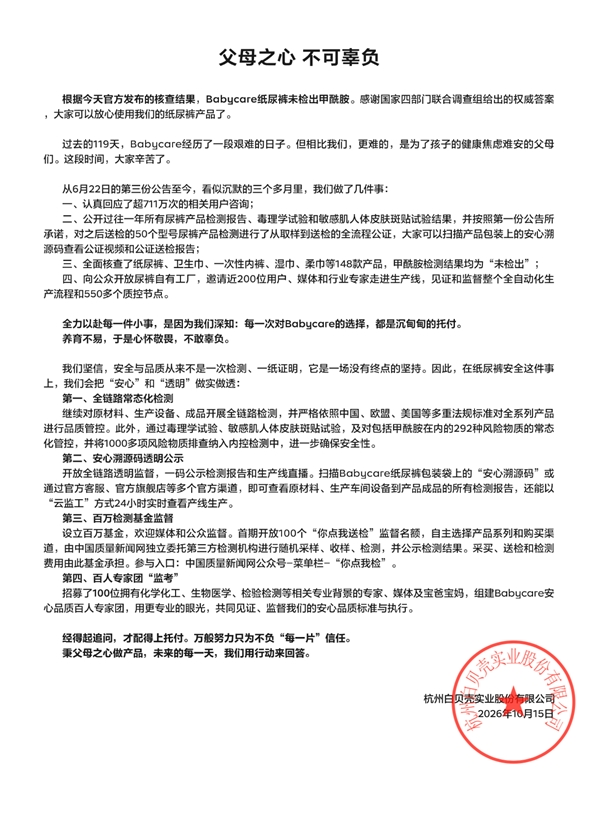
Babycare回应称,“感谢国家四部门联合调查组给出的权威答案。大家可以放心使用我们的纸尿裤产品了。”

Babycare还宣布设立“百万检测基金”,首期开放100个“你点我送检”监督名额,公众可自主选择产品系列和购买渠道,由中国质量报刊社主办的中国质量新闻网独立委托第三方检测机构进行随机采样、收样、检测,并公示检测结果,相关费用由该基金承担。此前,Babycare已全面核查包括纸尿裤、一次性内裤、卫生巾等148款产品,甲酰胺均为未检出。

据悉,2022年-2026年6月,全国各地市场监管部门共抽检Babycare纸尿裤150批次,覆盖25个省份、多个系列,合格率100%。

Babycare表示,将持续加强对原材料、生产设备及成品的全链路检测,并严格依照中国、欧盟、美国等多重法规标准对全系列产品进行品质管控。据介绍,目前Babycare纸尿裤已对292种风险物质的常态化管控,并将1000多项风险物质排查纳入内控检测中,同时还通过毒理学试验、敏感肌人体皮肤斑贴试验等,确保产品安全性。

Babycare自2021年开启“透明公示计划”向消费者开放检测报告查询,如今升级后的纸尿裤产品溯源码,可实现原料、生产、检测全链路可追溯——消费者扫描Babycare纸尿裤包装袋上的“安心溯源码”,或通过官方客服、官方旗舰店等多个官方渠道,即可查看从原材料、生产车间设备到产品成品的所有检测报告,还能以“云监工”方式24小时实时查看产线生产。

近期,Babycare还对公众开放参观亚洲透明工厂·湖州工厂。据媒体报道,Babycare纸尿裤湖州工厂整条产线布设550多项质控节点,并通过“BabycareAI云瞳智控系统”实时监测,小至0.5平方毫米的异物也能被精准识别。“从源头基础把关、持续动态监控,再到专项安全验证,我们所有的纸尿裤产品到用户手中之前,都要经过九重严格把关。”Babycare首席研发专家杨驰表示。

“在纸尿裤安全这件事上,我们会把‘安心’和‘透明’做实做透。”Babycare表示。

公开数据显示,Babycare已位列中国纸尿裤市场份额前三,中国纸尿裤品牌第一,同时远销东南亚、中东、美国等市场。不久前,Babycare旗下纸尿裤产品系列CLOUD SKIN™还入选了美国知名母婴消费品评选奖项Parents'Picks Awards(家长首选奖)两大年度榜单。10月12日,Babycare推出金山茶纸尿裤免费派样,上线第一天4万份派样在9分钟内被一抢而空。截至10月14日活动结束,13万包派样共吸引超71万人抢购。

注:文/龚作仁,文章来源:Laborer,本文为作者独立观点,不代表亿邦动力立场。

文章来源:Laborer

广告
微信
朋友圈

FAQ回顾

Babycare是什么品牌?

Babycare是中国母婴品牌,位列中国纸尿裤市场份额前三、中国纸尿裤品牌第一,产品远销东南亚、中东、美国等市场。其纸尿裤产品系列CLOUD SKIN™曾入选美国Parents' Picks Awards(家长首选奖)年度榜单。

婴幼儿纸尿裤甲酰胺抽检结果如何?

2026年10月15日,市场监管总局、工信部、国家卫生健康委、国家疾控局联合调查组通报:对国内全部168家婴幼儿纸尿裤生产企业抽检180个品牌368批次成品样品,并对重点品牌腰围、粘扣等部位开展32批次分部位检测,经中国疾病预防控制中心等权威机构检测,均未检出甲酰胺。

Babycare纸尿裤安全吗?

从检测数据看是安全的。2022年至2026年6月,全国各地市场监管部门共抽检Babycare纸尿裤150批次,覆盖25个省份、多个系列,合格率100%。Babycare还对292种风险物质常态化管控,将1000多项风险物质排查纳入内控检测,并通过毒理学试验、敏感肌人体皮肤斑贴试验确保产品安全性。

消费者如何查看Babycare纸尿裤的检测报告?

消费者扫描Babycare纸尿裤包装袋上的“安心溯源码”,或通过官方客服、官方旗舰店等官方渠道,即可查看从原材料、生产车间设备到产品成品的所有检测报告,还能以“云监工”方式24小时实时查看产线生产。品牌还设立“百万检测基金”,开放100个“你点我送检”监督名额,由第三方机构独立检测并公示结果。

这么好看,分享一下?

朋友圈 分享

APP内打开

赞 +1
+1
微信好友 朋友圈 新浪微博 QQ空间
关闭
收藏成功
发送
/140 0

