广告
加载中

ZINOVA携手逐际动力 探索机器人在复杂建筑施工中的应用

龚作仁 2026-09-02 16:50
龚作仁 2026/09/02 16:50

邦小白快读

EN
全文速览

本文核心是三家科技企业联合完成了具身机器人在复杂建筑施工场景的可行性验证,核心干货如下:

1.本次项目是ZINOVA联合逐际动力、建筑机器人公司RIC Robotics,基于逐际动力TRON 2双臂具身机器人,完成了混凝土倾覆板缩比施工场景演示,验证了具身机器人使用现有工具完成复杂施工流程的可行性,是通用机器人平台开发垂直行业应用的原创实践。

2.ZINOVA核心研发方向是工具智能,不同于为每个工种造专用机器人的路线,目标是打造一套可跨工具、跨任务、跨机器人形态迁移的智能体系,让同一套智能运行在不同机器人上,围绕通用抓取、交互感知、任务形态三个维度研发。

3.本次实践瞄准建筑行业缺熟练工、场景非标准化难自动化的痛点,探索出可落地的机器人方案,未来工具智能还将拓展到制造、能源等更多依赖复杂物理劳动的领域。

本次合作为科技品牌落地垂直行业提供了可参考的样本,核心干货如下:

1.产品研发可锚定传统行业痛点切入,建筑行业长期面临熟练劳动力短缺、场景高度非标准化,难以套用统一自动化方案,通用型机器人方案刚好匹配行业需求,避开了专用机器人成本高、部署复杂的短板。

2.可采用开放分工的品牌合作模式,逐际动力做通用机器人硬件开发平台,ZINOVA聚焦垂直领域的工具智能研发,双方分工清晰,发挥各自优势,降低整体研发成本,加快落地验证速度。

3.品牌可走差异化定位路线,ZINOVA锚定工具智能这一细分赛道,逐际动力锚定开放通用平台的生态定位,吸引开发者合作,打造完整产业生态,抢占行业先机。

4.可预判未来趋势:具身智能、物理AI正在从实验室走向实体产业,在重体力传统行业落地是接下来的重要风口。

本次机器人落地实践给布局实体产业智能化的相关从业者提供了诸多机会和参考,核心干货如下:

1.市场机会方面,建筑、制造等传统重体力行业长期面临劳动力短缺问题,非标准化场景的自动化需求强烈,目前有效供给不足,属于潜力较大的新增长市场,值得提前布局。

2.可借鉴的商业模式:采用通用机器人平台+垂直场景定制应用的模式,不用从零搭建机器人基础软硬件,依托成熟开放平台就能降低研发和部署成本,快速完成场景验证。

3.风险提示:当前完全自主作业技术仍不成熟,全场景全自主落地存在技术瓶颈,不要盲目投入全自主方案,优先选择人机协同的路径推进更稳妥。

4.合作机会:逐际动力已经开放通用平台,提供SDK、遥操作接口等配套支持,有行业经验的从业者可以对接合作,快速开发细分领域应用。

本次具身机器人落地实践给制造工厂智能化转型、拓展业务方向提供了诸多启示,核心干货如下:

1.产品生产与设计需求端,传统工厂大量复杂物理作业都是非标准化的,对通用型智能作业机器人需求迫切,市场更偏好模块化、可扩展、支持人机协同的通用机器人本体,不需要为每道工序开发专用机器人,能大幅降低成本和部署复杂度。

2.商业机会方面,传统工厂大量依赖人工的多工序作业,都可以借助工具智能+通用机器人平台完成改造,解决招工难问题,提升生产效率;同时面向传统行业的智能化改造解决方案本身也有广阔的市场空间,工厂可以依托自身行业经验拓展新业务。

3.数字化转型启示:不需要盲目追求全流程无人化,可以先走人机协同的路线,在作业中积累数据逐步提升自主能力,能有效降低转型风险,依托现有成熟通用智能平台推进转型,也能减少从零开发的投入成本。

本次实践给面向传统行业智能化的服务商呈现了行业最新动向和需求,核心干货如下:

1.行业发展趋势:具身智能和物理AI已经从实验室技术验证阶段转向真实产业落地阶段,通用机器人平台化是接下来的主流发展方向,行业竞争从纯技术研发转向落地生态构建。

2.值得关注的新技术方向:工具智能、模块化可扩展具身机器人本体、人机协同遥操作、跨形态智能迁移,都是当前行业重点突破的新技术,核心是解决非标准化场景的自动化难题。

3.客户核心痛点:传统行业客户做自动化改造,普遍面临专用机器人成本高、部署复杂、场景适配难度大,全自主技术不成熟、跨工种作业合规性差的问题,这些都是服务商可以切入的痛点。

4.可行的落地方案:可以参考通用平台+垂直应用+人机协同的方案,既满足多工序适配需求控制成本,又能保证当前落地的可靠性,还能解决跨工种作业的合规问题,匹配客户实际需求。

逐际动力的平台化实践给机器人领域平台商提供了可参考的运营发展样本,核心要点如下:

1.明确行业开发者对平台的核心需求:垂直领域创新者不需要从零搭建机器人硬件和基础软硬能力,需要成熟可复用的通用基座,降低研发成本,让自身可以聚焦解决垂直领域的具体问题。

2.平台可参考的运营做法:打造机器人硬件平台、开发工具平台、模型训练平台三大基础能力,开放SDK、遥操作接口、硬件转接件等配套支持,降低开发者接入门槛;产品采用模块化可扩展设计,适配不同场景的定制需求,支持人机协同帮助开发者快速落地验证。

3.生态建设方向:开放吸引不同垂直领域的创新团队合作,共同构建应用生态,加速技术落地,同时持续迭代完善平台能力,逐步拓展更多应用场景。

4.风险规避要点:当前全自主技术尚未成熟,不要盲目主推全自主落地,主打人机协同的渐进式路径,先验证再迭代,可避免技术不成熟带来的市场风险。

本次实践是具身智能落地实体产业的原创性实践,给产业研究提供了诸多新的研究素材,核心干货如下:

1.产业新动向:当前具身机器人已经从通用人形机器人的技术竞争,转向基于通用平台开发垂直行业真实场景应用的新阶段,物理AI领域的工具智能成为新的研发方向,开辟了不同于专用机器人的新路线,探索跨形态跨任务的通用智能方案。

2.新的商业模式已经落地验证:行业分工转向平台化模式,平台商负责提供通用机器人本体和基础开发能力,垂直领域创新者负责场景化应用开发,分工协作加快落地速度,不同于过去全产业链自研的传统模式。

3.新的技术和落地路径:针对非标准化场景提出了“人在回路”的渐进式落地路径,先通过人机协同完成任务,积累数据再训练提升自主能力,解决当前全自主技术不成熟的问题;同时还针对建筑行业的资质要求,提出了用统一机器人载体跨工种作业的合规解决方案,是极具研究价值的原创实践。

返回默认
声明:快读内容全程由AI生成,请注意甄别信息。如您发现问题,请发送邮件至 run@ebrun.com 。

我是 品牌商 卖家 工厂 服务商 平台商 研究者 帮我再读一遍。

Quick Summary

This article centers on a feasibility verification of embodied robots in complex construction scenarios completed by three tech companies. Key takeaways are as follows:

1. The project was jointly carried out by ZINOVA, Zhuiyi Dynamics, and construction robotics firm RIC Robotics. Based on Zhuiyi Dynamics' TRON 2 dual-arm embodied robot, the team completed a scaled demonstration of concrete dump plate construction work. It verified that embodied robots can complete complex construction processes using existing tools, marking an original practice of developing vertical industry applications on a general-purpose robot platform.

2. ZINOVA focuses its core R&D on "tool intelligence." Unlike the approach of building specialized robots for each trade, ZINOVA aims to build an intelligent system that can be transferred across tools, tasks, and robot morphologies, enabling the same intelligence system to run on different robots. Its R&D focuses on three dimensions: general grasping, interactive perception, and task formation.

3. This practice targets the pain points of the construction industry: shortage of skilled workers and difficulty automating non-standardized scenarios. It has developed a implementable robotic solution, and tool intelligence will eventually be extended to manufacturing, energy and other fields that rely heavily on complex physical labor.

This collaborative project provides a reference sample for tech brands looking to enter vertical industries. Key takeaways are as follows:

1. Product R&D can start by targeting pain points in traditional industries. The construction industry has long faced a shortage of skilled labor and highly non-standard scenarios, making it hard to adopt uniform automation solutions. General-purpose robotic solutions perfectly match industry demand, and avoid the drawbacks of specialized robots including high costs and complex deployment.

2. Brands can adopt an open, divided-labor cooperation model: Zhuiyi Dynamics builds the general-purpose robot hardware development platform, while ZINOVA focuses on tool intelligence R&D for vertical fields. Clear division of labor lets each party leverage their own advantages, lowering overall R&D costs and accelerating validation for market entry.

3. Brands can pursue differentiated positioning: ZINOVA focuses on the niche track of tool intelligence, while Zhuiyi Dynamics positions itself as an open general-purpose platform ecosystem. This positioning attracts developer cooperation, helps build a complete industrial ecosystem, and lets players seize first-mover advantage.

4. A clear future trend: embodied intelligence and physical AI are moving from labs to physical industries, and deployment in labor-intensive traditional industries will be the next major growth window.

This robotic deployment practice offers many opportunities and insights for practitioners working on physical industry intelligence. Key takeaways are as follows:

1. In terms of market opportunities, traditional labor-intensive industries such as construction and manufacturing have long faced labor shortages, with strong demand for automation in non-standardized scenarios. Current effective supply is limited, making this a high-potential new growth market worth entering early.

2. A replicable business model is the "general robot platform + vertical scenario customized application" approach. Instead of building basic robot hardware and software from scratch, practitioners can rely on a mature open platform to reduce R&D and deployment costs, and complete scenario validation quickly.

3. A risk reminder: fully autonomous operation technology is still immature today, and full-scenario fully autonomous deployment still faces technical bottlenecks. Do not invest blindly in fully autonomous solutions; prioritizing a human-robot collaboration path is a more reliable approach.

4. Cooperation opportunities: Zhuiyi Dynamics has opened its general-purpose platform, providing supporting resources including SDK and teleoperation interfaces. Practitioners with industry experience can partner to quickly develop applications for niche segments.

This embodied robot deployment practice offers multiple insights for manufacturing factories pursuing intelligent transformation and business expansion. Key takeaways are as follows:

1. On the product design and demand side, a large share of complex physical work in traditional factories is non-standardized, creating urgent demand for general-purpose intelligent operation robots. The market prefers modular, scalable, human-robot collaboration-enabled general robot bodies, which eliminate the need to develop specialized robots for each process, greatly cutting costs and deployment complexity.

2. In terms of business opportunities, many manual multi-process operations in traditional factories can be transformed through the combination of tool intelligence and general robot platforms, solving labor shortages and improving production efficiency. At the same time, intelligent transformation solutions for traditional industries themselves have broad market space, and factories can expand into this new business based on their own industry experience.

3. Insights for digital transformation: factories do not need to pursue full-process unmanned operation blindly. They can adopt a human-robot collaboration path first, accumulate operational data to gradually improve autonomous capability, which effectively reduces transformation risk. Building transformation on existing mature general intelligent platforms also cuts the cost of developing everything from scratch.

This practice reveals the latest industry trends and demands for service providers focusing on traditional industry intelligence. Key takeaways are as follows:

1. Industry development trend: embodied intelligence and physical AI have moved from laboratory technical validation to real-world industrial deployment. General-purpose robot platformization will become the mainstream development direction, and industry competition has shifted from pure technology R&D to ecosystem building for deployment.

2. New technology directions worth关注: tool intelligence, modular scalable embodied robot bodies, human-robot collaborative teleoperation, and cross-morphology intelligence transfer are all key areas of current breakthrough. Their core goal is to solve automation problems in non-standardized scenarios.

3. Core customer pain points: when traditional industry customers carry out automation transformation, they generally face problems including high costs of specialized robots, complex deployment, difficult scenario adaptation, immature fully autonomous technology, and poor compliance for cross-trade operation. All these are pain points service providers can target.

4. A viable deployment solution: providers can adopt the "general platform + vertical application + human-robot collaboration" model. This meets the multi-process adaptation demand while controlling costs, guarantees current deployment reliability, solves compliance issues for cross-trade operation, and matches customers' actual needs.

Zhuiyi Dynamics' platform practice provides a reference operational development sample for platform operators in the robotics sector. Key takeaways are as follows:

1. Clarify core demands of industry developers for platforms: vertical sector innovators do not need to build robot hardware and basic software capabilities from scratch. Instead, they need a mature, reusable general base to reduce R&D costs, so they can focus on solving specific problems in their vertical segments.

2. Reference operational practices for platforms: build three core capabilities: a robot hardware platform, a development tool platform, and a model training platform. Open supporting resources including SDK, teleoperation interfaces, and hardware adapters to lower the barrier for developer onboarding. Adopt a modular, scalable design for products to adapt to customized demands of different scenarios, and support human-robot collaboration to help developers complete deployment validation quickly.

3. Directions for ecosystem building: open up the platform to attract innovation teams from different vertical segments to cooperate, jointly build an application ecosystem, and accelerate technology deployment. Continue to iterate and improve platform capabilities to gradually expand into more application scenarios.

4. Risk mitigation: fully autonomous technology is not yet mature, so do not promote fully autonomous deployment blindly. Focusing on a gradual human-robot collaboration path, with validation before iteration, avoids market risks brought by immature technology.

This practice is an original attempt to deploy embodied intelligence in physical industries, providing new research materials for industrial research. Key takeaways are as follows:

1. New industrial trends: embodied robotics has shifted from a technology race focused on general-purpose humanoid robots to a new phase of developing real-world vertical industry applications based on general platforms. Tool intelligence in physical AI has become a new R&D direction, opening up a new path different from that of specialized robots, and exploring general intelligent solutions that work across morphologies and tasks.

2. A new business model has been validated through deployment: industry division of labor has shifted to a platform-based model, where platform providers offer general robot bodies and basic development capabilities, while vertical sector innovators take charge of scenario-based application development. This division of labor speeds up deployment, unlike the traditional full in-house development model across the entire supply chain.

3. New technology and deployment paths: for non-standardized scenarios, the project proposes a gradual "human-in-the-loop" deployment path: complete tasks through human-robot collaboration first, then accumulate data to train and improve autonomous capability, which addresses the immaturity of current fully autonomous technology. It also developed a compliance solution for cross-trade operation using a unified robot carrier to meet the qualification requirements of the construction industry, making this an original practice of high research value.

Disclaimer: The "Quick Summary" content is entirely generated by AI. Please exercise discretion when interpreting the information. For issues or corrections, please email run@ebrun.com .

I am a Brand Seller Factory Service Provider Marketplace Seller Researcher Read it again.

日前,物理AI研发公司ZINOVA基于逐际动力TRON 2双臂具身机器人,联合建筑机器人公司RIC Robotics完成了混凝土倾覆板(Tilt-up Construction)缩比施工场景演示,覆盖支模组框、多层钢筋铺设与绑扎等核心工序。此次POC验证了具身机器人使用现有工具参与复杂施工流程的可行性,也是垂直行业创新企业基于通用机器人平台开发行业应用的又一次原创性实践。

ZINOVA是一家专注物理AI的研发公司,核心研究方向是工具智能(Tool Intelligence)——让机器人能够识别、抓取并感知现实世界中已有的工具,真正参与线下的生产性工作。其研究围绕三个维度展开:Grasp(通用工具抓取)、Feel(TEISI感知接口,采集工具与环境交互中的力、扭矩、振动、阻力等数据)以及Form(探索针对具体任务的机器人形态)。三者共同构成可跨工具、跨任务、跨机器人形态迁移的工具智能体系。ZINOVA的路径并非为每一个工种制造一台专用机器人,而是让同一套工具智能运行于不同形态的机器人之上。


建筑行业是ZINOVA选择的首个落地验证场景。建筑行业长期面临熟练劳动力约束,同时存在大量高价值的实体作业和成熟的既有工具体系;更重要的是,建筑工地高度非标准化,施工环境、材料规格和工序要求因项目而异,难以套用统一的自动化方案。这种复杂性,恰恰构成了验证工具智能”真实适应能力”的理想场景。

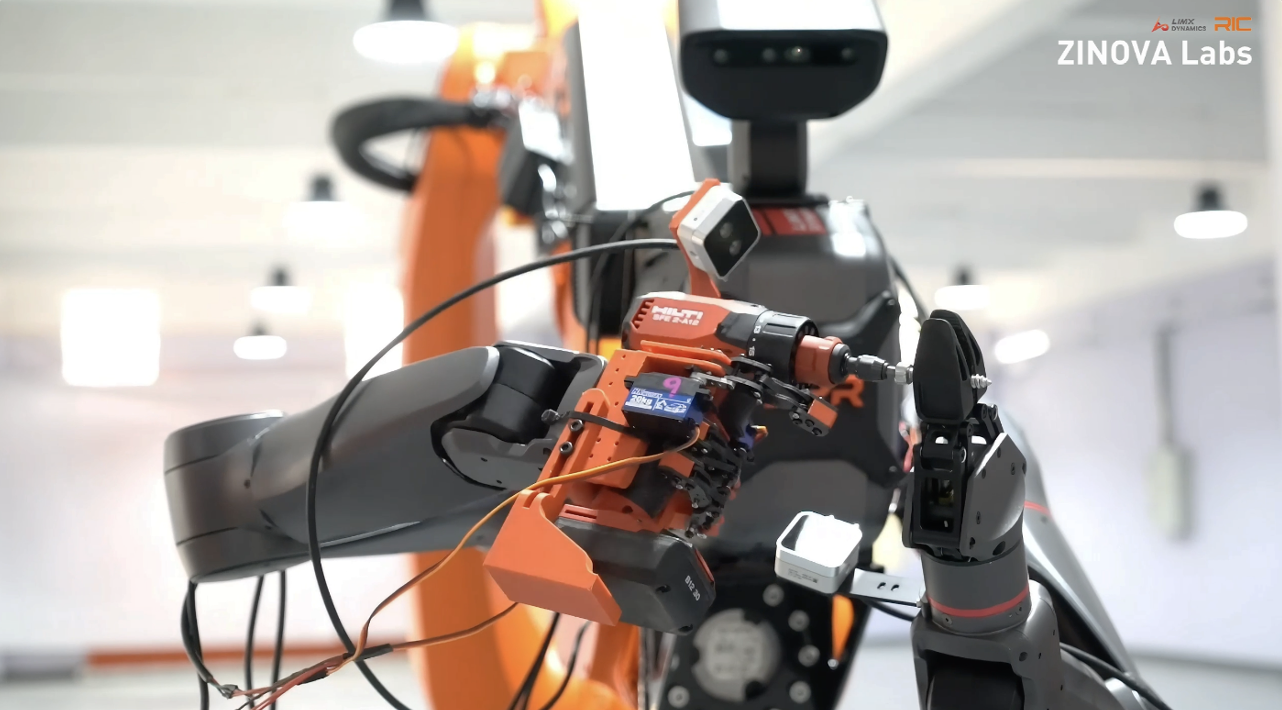
此次演示复刻了混凝土倾覆板的核心施工环节:两台TRON 2机器人分别持钉枪与木板,协同合作,完成混凝土模板框架的拼合固定;随后在多层马凳支架上铺设钢筋并完成绑扎,模拟真实施工中多个工种前后衔接的完整作业逻辑。场景的难度不在于完成某一个孤立动作,而在于让机器人系统贯通一套复杂的物理工作流程。

在构型上,ZINOVA基于TRON 2双臂具身机器人的模块化与可扩展能力,针对建筑施工的大空间、多工序作业需求,探索出一套创新机器人构型。该构型进一步拓展了TRON 2的作业空间与工具操作能力,使其能够从传统桌面、低空作业延伸至更广阔的立体空间。双臂可面向不同方向、不同高度完成多种工具操作,进一步释放TRON 2在复杂施工场景中的操作潜力与应用价值。

针对建筑施工多工序、多工具、大空间作业等实际需求,ZINOVA基于对建筑场景的理解,结合TRON 2灵活组合、可扩展的通用基座能力,探索面向建筑施工场景的机器人应用。这一构型体现了三方面考量:

- 场景通用。建筑施工涵盖大量不同工序,若为每种任务配置专用机器人,成本与部署复杂度均难以满足实际需求。TRON 2的模块化设计支持换装不同工具、不同底座以适配不同工序,同一平台可持续扩展至更多施工环节,无需为每道工序另起炉灶。

-Human in the Loop。建筑场景天然非标准化,完全自主作业当前仍面临挑战。TRON 2支持人机协同遥操作,操作员在关键节点介入保证任务完成质量,同时在每一次真实操作中持续积累机器人和工具在运动、操作、接触感知、环境交互等数据,为后续自主能力与模型训练打下基础。

- 合规效率。在建筑行业,不同工序对应不同的专业资质与执照要求——木工、钢筋工、浇筑工各持执照、分包作业,人力组织成本极高。机器人作为统一的作业载体,在具身智能的赋能下,可在满足安全规范的前提下跨越工种界限,一次性覆盖原本需要多个工种资质才能完成的施工内容,从根本上降低流程摩擦,也为规模化部署提供更清晰的合规路径。

ZINOVA在建筑业的实践,是逐际动力平台化商业战略的一次具体体现。逐际动力面向行业客户提供机器人硬件平台、开发工具平台与模型训练平台三大基础能力,通过开放SDK、遥操作接口、硬件转接件等配套支持,让行业创新者能够在成熟本体上快速构建行业应用,将更多资源聚焦于真正需要解决的领域问题,而非从零搭建机器人基础软硬能力。TRON 2是这一战略的载体:一个可复用、可扩展的具身智能通用基座。

ZINOVA创始人徐子悠表示:“我们相信,物理AI的破局不会来自单一形态的机器人,而来自能够跨形态使用工具的智能。TRON 2提供的模块化、可扩展能力,让我们能够将更多精力聚焦于工具智能与行业任务本身,并快速验证不同构型和应用的可能性。”

逐际动力联合创始人庞博表示:“ZINOVA对建筑行业的深刻理解,以及他们在工具智能方向上的专注与创新,正是具身智能真正落地应用必不可少的生态力量。我们希望通过TRON 2这样的通用机器人平台,让行业创新者能够更高效地完成验证和迭代,共同探索更多面向真实场景的解决方案。”

从建筑行业出发,ZINOVA将逐步将工具智能扩展至制造、能源、基础设施等依赖复杂物理劳动的领域;逐际动力则将持续完善通用机器人平台能力,与更多行业创新者共同构建具身智能应用生态,加速具身机器人从技术验证走向更广泛的现实场景。

关于逐际动力LimX Dynamics

逐际动力LimX Dynamics是一家具身智能机器人主机厂,专注于通用机器人的研发、制造与商业化应用,产品涵盖全自主人形机器人LimX Oli、LimX Luna,和模块化机器人TRON系列。 我们致力于物理AI的颠覆性创新,打造本体硬件的原创设计与制造、大小脑融合技术、人形大脑系统COSA等三大核心技术,并积极建设面向全球开发者的开放生态,开源具身模型训练基础设施,释放AGI在物理世界的泛化能力。 面向未来,逐际动力将持续打造新一代智能机器人,推动在科研探索、商业服务、工业制造等场景的广泛应用,最终走进千家万户。

关于ZINOVA

ZINOVA是一家专注于物理AI的研发公司,致力于工具智能(Tool Intelligence)的研发,即通过软硬件基础设施,使机器人能够抓取、感知并操作现实世界中的工具。

ZINOVA由CEO Ryan Cox和创始人徐子悠(Ziyou Xu)带领,核心研究方向涵盖通用工具抓取(General Tool Grasp)、工具具身交互感知接口(Tool–Embodiment Interaction Sensing Interface,TEISI)以及第三形态(The Third Form),并以建筑行业作为其首个真实世界验证场景。

ZINOVA的长期目标是构建一套工具智能层(Tool Intelligence Layer),使不同形态的机器人系统都能够在物理世界中执行具有实际生产价值的工作。

注:文/龚作仁,文章来源:Laborer,本文为作者独立观点,不代表亿邦动力立场。

文章来源:Laborer

广告
微信
朋友圈

FAQ回顾

ZINOVA是做什么的?

ZINOVA是专注物理AI的研发公司,核心研究方向为工具智能,围绕通用工具抓取、TEISI感知接口、任务适配机器人形态三个维度构建可跨工具、跨任务、跨形态迁移的工具智能体系,首个落地验证场景为建筑行业。

逐际动力TRON 2机器人有什么特点?

TRON 2是模块化可扩展的具身智能通用基座,支持换装不同工具、底座适配多类工序,支持人机协同遥操作积累训练数据,可拓展作业空间至立体场景,适配复杂建筑施工等多场景的作业需求。

为什么建筑行业适合作为工具智能的验证场景?

建筑行业长期存在熟练劳动力约束,有大量高价值实体作业和成熟工具体系,且工地高度非标准化,施工环境、材料规格、工序要求因项目而异,难以套用统一自动化方案,适合验证工具智能的真实适应能力。

具身机器人应用于建筑施工有哪些优势?

具身机器人可适配不同施工工具完成多类工序作业,降低专用机器人的配置成本与部署复杂度;支持人机协同保障作业质量,还可在合规前提下跨越工种界限施工,降低人力组织成本与流程摩擦。

这么好看,分享一下?

朋友圈 分享

APP内打开

赞 +1
+1
微信好友 朋友圈 新浪微博 QQ空间
关闭
收藏成功
发送
/140 0