广告
加载中

亚马逊第三方卖家GMV达5750亿美元 年销额超1亿美元卖家增至235家

王昱 2026-07-19 22:04
王昱 2026/07/19 22:04

邦小白快读

EN
全文速览

本文整理了电商机构SmartScout发布的2025年亚马逊第三方卖家生态报告的核心干货,可快速了解亚马逊平台现状,也能给想做亚马逊跨境的人提供实操参考。

1. 核心行业数据:截至2025年,亚马逊全球有190万活跃第三方卖家,全年GMV达5750亿美元,占平台总GMV的69%,已经成为平台交易主体;年销超1亿美元的卖家达到235家,是四年前的近5倍,中国卖家贡献第三方销售收入的35.1%。

2. 实操参考信息:目前超130万卖家使用亚马逊官方生成式AI工具优化商品Listing,可把单页面制作时间从4小时压缩到30-45分钟;82%卖家选择FBA模式,平均净利润率在15%-20%,64%的卖家可在经营12个月内盈利,健康与家居类是当前销量最高、竞争也最激烈的品类。

本文披露的亚马逊最新生态数据,能给计划出海或已经布局亚马逊的品牌商提供多维度参考,适配品牌在渠道、产品、营销层面的决策需求。

1. 渠道布局参考:当前第三方卖家已经成为亚马逊平台交易主体,平台商品总数超6亿,97.9%来自第三方,近年平台商品增量几乎全部来自第三方卖家,同时随着卖家总量下降,留存卖家的单均流量较2021年增长31%,品牌入驻后获得的曝光机会更多。

2. 产品与消费趋势:73%的消费者将快速免费配送列为选择亚马逊购物的首要原因,Prime会员规模超2.3亿,会员消费基础稳定;健康与家庭用品、家居与厨房是销售额最高的两大品类,月销售额分别达到44.4亿美元和42.3亿美元,品牌可针对性布局相关品类。

3. 标杆案例:中国品牌VEVOR已经进入亚马逊品牌月销售额前十,验证了中国品牌出海亚马逊的可行性,AI工具和FBA模式可帮助品牌大幅提升运营效率。

本文披露的亚马逊最新行业数据,能给新老亚马逊卖家提供明确的机会提示与风险参考,辅助卖家做经营决策。

1. 当前市场整体情况:亚马逊活跃卖家数量稳定在190万,新增卖家数量持续下滑,2025年新增仅16.5万家,较上年降44%,是近十年最低,但留存卖家的单均流量较2021年增长31%,存量卖家的获客空间反而更大;目前亚马逊占据美国零售电商40.5%的市场份额,月访问量达26亿次,用户基础十分庞大。

2. 机会提示:头部卖家规模扩张明显,年销超100万美元的卖家数量已经达到2021年的近两倍,亚马逊官方推出了免费的生成式AI Listing工具,可帮助卖家降低运营成本,提升效率。

3. 风险提示:热门品类竞争激烈,家居与厨房类平均每个Listing对应445名卖家;选择FBA模式需要支付营收的30%-35%给平台,卖家需要提前做好成本核算。

本文披露的亚马逊第三方生态最新信息,能给计划做跨境出海、给卖家供货的工厂提供多维度参考,明确需求与机会。

1. 商业机会:亚马逊第三方市场规模持续增长,2025年第三方GMV已经达到5750亿美元,占平台总GMV的69%,平台97.9%的商品来自第三方,近年平台所有商品增量都来自第三方卖家,给工厂带来了大量的供货和自有品牌出海机会;中国卖家已经贡献第三方销售收入的35.1%,中国工厂依托本土卖家的供应链优势十分明显。

2. 产品生产设计需求:当前亚马逊平台销售额最高的两个品类是健康与家庭用品、家居与厨房用品,月销售额分别达44.4亿美元和42.3亿美元,前十大品类合计月销超270亿美元,市场需求旺盛,工厂可针对性布局相关品类的研发生产。

3. 数字化出海启示:AI工具已经普及到卖家运营环节,FBA物流渗透率超八成,工厂做自有品牌出海可以借助平台工具降本提效,已有中国工厂品牌VEVOR进入销量前十,验证了工厂出海的可行性。

本文披露的亚马逊卖家生态最新变化,能给服务跨境电商行业的各类服务商明确行业趋势,找准客户痛点,开发对应解决方案。

1. 行业发展趋势:亚马逊第三方卖家市场规模持续增长,2025年第三方GMV已经达到5750亿美元,占平台总GMV的69%,头部卖家规模快速扩张,年销超1亿美元的卖家已经达到235家,较四年前增长近4倍,整体市场盘子持续扩大,对应服务商的市场空间也在增长。

2. 客户核心痛点:当前行业进入存量竞争阶段,新增卖家放缓但头部卖家崛起,卖家对降本提效、差异化竞争的需求十分强烈,热门品类竞争激烈,卖家对选品、精准营销、品牌运营的需求迫切。

3. 解决方案方向:目前已经有130万卖家使用亚马逊官方AI Listing工具,卖家对AI相关的运营增值服务需求旺盛;同时82%卖家使用FBA模式,围绕卖家的物流配套、广告优化、合规管理、选品调研的需求持续存在,服务商可围绕这些方向开发适配不同规模卖家的服务产品。

本文披露的亚马逊第三方业务最新运营数据,能给其他电商平台发展第三方业务提供多维度参考,明确行业方向,优化自身运营。

1. 平台业务结构方向:当前第三方卖家已经成为亚马逊平台的绝对核心,GMV占比达69%,平台97.9%的商品来自第三方,近年平台所有商品增量都来自第三方卖家,足以说明第三方卖家业务是电商平台增长的核心动力,平台需要将第三方业务作为核心战略布局。

2. 平台运营的参考做法:亚马逊推出官方生成式AI商品Listing工具赋能卖家,目前已经吸引130万卖家使用,大幅降低了卖家运营门槛;同时大力推广FBA履约服务,渗透率已经从2019年的50%提升到82%,标准化的配送服务提升了消费者满意度,73%的消费者因为配送优势选择亚马逊。

3. 招商运营启示:亚马逊从追求卖家数量增长转向提质,卖家总量从2021年的240万下降到2025年的190万,淘汰低效卖家后给留存卖家倾斜更多流量,提升了平台整体经营效率,平台可参考这种走提质不增量的路线,同时强化会员体系和配送能力,提升用户粘性。

本文发布的2025年亚马逊第三方卖家最新统计数据,给跨境电商产业研究提供了一手的最新数据支撑,可帮助研究者把握全球跨境电商产业的新动向。

1. 产业竞争结构新动向:亚马逊第三方卖家市场已经进入存量竞争阶段,活跃卖家数量连续多年下降,2025年稳定在190万,新增卖家数量持续下滑到近十年最低,但头部卖家规模快速扩张,市场集中度持续提升,年销超100万美元的卖家数量已经达到2021年的近两倍,年销超1亿美元的卖家从四年前的50家增长到235家。

2. 产业运营模式新变化:人工智能已经深度渗透到跨境电商运营环节,截至2025年超130万卖家使用亚马逊官方生成式AI工具,近90万卖家使用各类AI工具优化Listing,大幅压缩了运营时间、降低了门槛,改变了传统跨境运营模式;同时FBA履约模式渗透率从2019年的50%提升到82%,平台包揽履约的轻资产卖家模式成为行业主流。

3. 市场格局新变化:中国卖家已经贡献亚马逊第三方销售收入的35.1%,中国跨境商家在全球电商市场的份额持续提升,中国品牌已经开始进入头部阵营。

返回默认

声明:快读内容全程由AI生成,请注意甄别信息。如您发现问题,请发送邮件至 run@ebrun.com 。

我是 品牌商 卖家 工厂 服务商 平台商 研究者 帮我再读一遍。

Quick Summary

This article summarizes key insights from e-commerce research firm SmartScout's 2025 report on Amazon's third-party seller ecosystem. It provides a quick overview of the current state of the Amazon platform and actionable insights for anyone looking to start a cross-border business on Amazon.

1. Core industry data: As of 2025, Amazon hosts 1.9 million active third-party sellers globally, with annual GMV reaching $575 billion, accounting for 69% of the platform's total GMV, making third-party sellers the main driver of platform transactions. There are now 235 sellers with annual sales exceeding $100 million, nearly five times the number four years ago, and Chinese sellers contribute 35.1% of total third-party sales revenue.

2. Actionable insights: Over 1.3 million sellers currently use Amazon's official generative AI tool to optimize product listings, cutting the time to create a single page from 4 hours to 30-45 minutes. 82% of sellers use FBA, with an average net profit margin of 15%-20%, and 64% of sellers become profitable within 12 months of launching. Health and home goods are currently the highest-selling and most competitive product categories on the platform.

The latest Amazon ecosystem data presented in this article provides multi-dimensional reference for brands planning to expand overseas or already operating on Amazon, supporting decision-making across channel strategy, product development and marketing.

1. Channel expansion insights: Third-party sellers have become the core of Amazon's transaction volume, accounting for 97.9% of the platform's total 600 million+ products. Nearly all recent product growth on the platform has come from third-party sellers. At the same time, as the total number of sellers has declined, average traffic per retained seller has increased 31% compared to 2021, meaning brands entering the platform can access greater exposure opportunities.

2. Product and consumer trends: 73% of consumers cite fast, free shipping as their top reason for choosing to shop on Amazon. Amazon's Prime membership has surpassed 230 million members, creating a stable base of high-intent consumers. Health & household and Home & Kitchen are the two highest-selling categories, with monthly sales of $4.44 billion and $4.23 billion respectively, making them attractive targets for focused brand expansion.

3. Benchmark case: Chinese brand VEVOR now ranks among the top 10 Amazon brands by monthly sales, validating the viability of Chinese brands expanding overseas via Amazon. AI tools and FBA can help brands significantly improve operational efficiency.

The latest Amazon industry data in this article provides clear opportunity signals and risk references for both new and existing Amazon sellers to support operational decision-making.

1. Current overall market conditions: The number of active Amazon sellers has stabilized at 1.9 million. New seller entry has continued to decline, with only 165,000 new sellers joining in 2025, a 44% drop year-over-year and the lowest level in a decade. However, average traffic per retained seller has grown 31% compared to 2021, meaning existing sellers actually have greater customer acquisition opportunities. Amazon currently holds 40.5% of the US retail e-commerce market, with 2.6 billion monthly visits, giving it an enormous user base.

2. Opportunity signals: Top sellers have expanded significantly, with the number of sellers generating over $1 million in annual sales nearly doubling since 2021. Amazon's free official generative AI listing tool helps sellers cut operational costs and improve efficiency.

3. Risk warnings: Popular categories face intense competition, with the Home & Kitchen category averaging 445 sellers per listing. FBA sellers pay 30%-35% of revenue in platform fees, so sellers need to conduct thorough cost budgeting in advance.

The latest data on Amazon's third-party ecosystem presented in this article provides multi-dimensional reference for factories planning to expand cross-border or supply products to sellers, helping them identify clear demand and opportunities.

1. Business opportunities: Amazon's third-party market continues to grow, with 2025 third-party GMV reaching $575 billion, accounting for 69% of the platform's total GMV. 97.9% of the platform's products come from third-party sellers, and all recent product growth has come from third-party sellers, creating massive opportunities for factories to supply products or launch their own brands overseas. Chinese sellers already contribute 35.1% of total third-party sales, giving Chinese factories significant supply chain advantages when working with domestic sellers.

2. Product development and design demand: Health & household and Home & Kitchen are the two highest-selling categories on Amazon, with monthly sales of $4.44 billion and $4.23 billion respectively. The top 10 categories combined generate over $27 billion in monthly sales, indicating strong market demand. Factories can focus R&D and production on these high-demand categories.

3. Insights for digital overseas expansion: AI tools have become widely adopted in seller operations, and FBA penetration exceeds 80%. Factories launching their own brands overseas can leverage platform tools to cut costs and improve efficiency. Chinese factory-backed brand VEVOR has already entered the top 10 in sales, validating the viability of factory-led overseas expansion.

The latest changes in Amazon's seller ecosystem outlined in this article help cross-border e-commerce service providers understand industry trends, identify customer pain points, and develop targeted solutions.

1. Industry development trends: Amazon's third-party seller market continues to grow, with 2025 third-party GMV reaching $575 billion, accounting for 69% of the platform's total GMV. Top sellers are expanding rapidly: there are now 235 sellers with annual sales over $100 million, nearly five times the number four years ago. As the overall market continues to expand, the available market for service providers grows accordingly.

2. Core customer pain points: The industry has entered a phase of存量 competition, with slowing new seller entry and a rising concentration of revenue among top sellers. Sellers have strong demand for cost reduction, efficiency improvement, and differentiated competition. Intense competition in popular categories has also created urgent demand for product selection, precision marketing, and brand operation support.

3. Solution directions: More than 1.3 million sellers already use Amazon's official AI listing tool, and demand for AI-powered value-added operational services remains strong. 82% of sellers use FBA, creating sustained demand for logistics support, advertising optimization, compliance management, and product research services. Service providers can develop tailored offerings for sellers of different sizes focused on these areas.

The latest operational data on Amazon's third-party business presented in this article provides multi-dimensional reference for other e-commerce platforms developing their own third-party businesses, helping them clarify industry direction and optimize operations.

1. Platform business structure direction: Third-party sellers have become the absolute core of Amazon's business, accounting for 69% of total GMV and 97.9% of total platform products. All recent product growth on the platform has come from third-party sellers, demonstrating that third-party seller business is the core growth driver for e-commerce platforms. Platforms should prioritize third-party business as a core strategic focus.

2. Operational best practice reference: Amazon launched an official generative AI listing tool to empower sellers, which has already been adopted by more than 1.3 million sellers and significantly lowered operational barriers for sellers. The platform has also heavily promoted FBA fulfillment, growing penetration from 50% in 2019 to 82% today. Standardized delivery has improved consumer satisfaction, with 73% of consumers choosing Amazon specifically for its delivery advantages.

3. Insights for seller recruitment and operations: Amazon has shifted its focus from growing seller count to improving quality, reducing total sellers from 2.4 million in 2021 to 1.9 million in 2025. After weeding out low-efficiency sellers, the platform reallocated more traffic to retained sellers, improving overall platform operational efficiency. Other platforms can adopt this "quality over quantity" approach, while strengthening their membership programs and delivery capabilities to boost user retention.

The 2025 latest statistical data on Amazon third-party sellers presented in this article provides primary, up-to-date data support for cross-border e-commerce industry research, helping researchers capture new trends in the global cross-border e-commerce industry.

1. New trends in industrial competitive structure: Amazon's third-party seller market has entered a phase of存量 competition. The number of active sellers has declined for multiple consecutive years, stabilizing at 1.9 million in 2025, and new seller entry has fallen to its lowest level in a decade. Meanwhile, top sellers have expanded rapidly, driving continuous increase in market concentration: the number of sellers with annual sales over $1 million has nearly doubled since 2021, and the number of sellers with annual sales over $100 million has grown from 50 four years ago to 235 today.

2. New changes in industrial operational models: Artificial intelligence has deeply penetrated cross-border e-commerce operations. As of 2025, more than 1.3 million sellers use Amazon's official generative AI tool, and nearly 900,000 sellers use various AI tools to optimize listings. This has drastically reduced operational time and lowered entry barriers, transforming traditional cross-border operational models. Meanwhile, FBA fulfillment penetration has grown from 50% in 2019 to 82% today, making the asset-light seller model, where the platform handles fulfillment, the industry mainstream.

3. New changes in market landscape: Chinese sellers now contribute 35.1% of Amazon's total third-party sales revenue. The share of Chinese cross-border merchants in the global e-commerce market continues to rise, and Chinese brands have begun to enter the top tier of the market.

Disclaimer: The "Quick Summary" content is entirely generated by AI. Please exercise discretion when interpreting the information. For issues or corrections, please email run@ebrun.com .

I am a Brand Seller Factory Service Provider Marketplace Seller Researcher Read it again.

【亿邦原创】7月19日消息,日前,电商数据分析机构SmartScout发布了《Amazon Seller Statistics 2026》报告,对亚马逊平台卖家生态、市场规模及销售表现进行了统计分析。

报告显示,截至2025年,亚马逊全球约有190万活跃卖家,第三方卖家全年商品交易总额(GMV)约5750亿美元,占平台总GMV约69%,第三方卖家已成为亚马逊平台交易的主体。

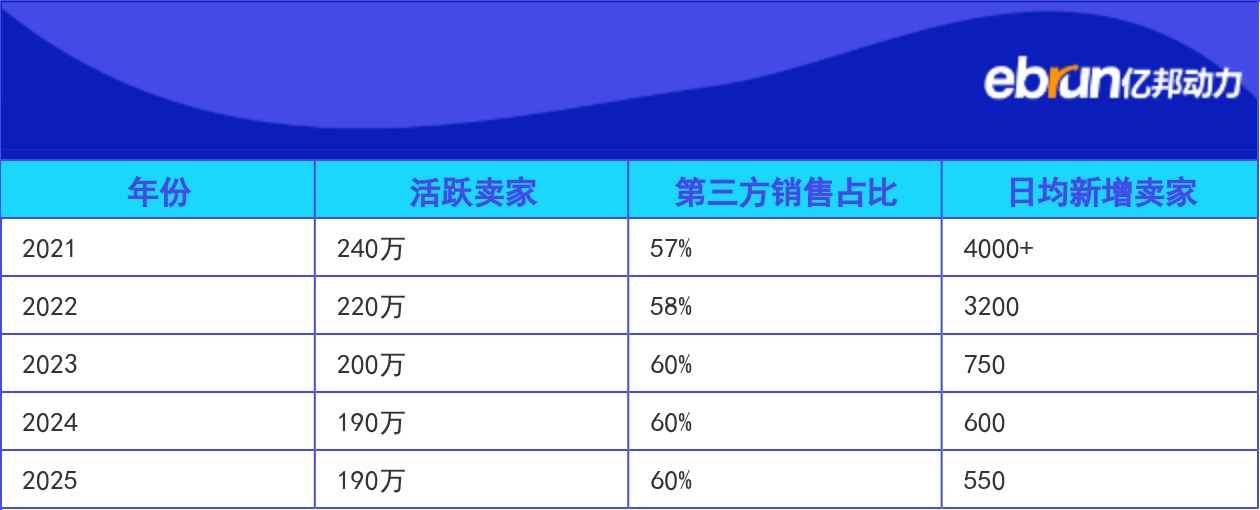
数据表明,2025年,全球活跃卖家数量约为190万,与2024年基本持平,但低于2021年的240万。与此同时,平台新增卖家数量继续放缓,2025年新增卖家约16.5万家,较2024年下降44%,为近十年来最低水平。

尽管活跃卖家数量有所减少,但单个卖家获得的平台流量有所提升。SmartScout统计称,自2021年以来,每位活跃卖家平均获得的流量增长约31%,意味着留在平台上的卖家能够触达更大的消费群体。

报告同时披露了近年来亚马逊活跃卖家数量变化情况:

年份 活跃卖家 第三方销售占比 日均新增卖家
2021 240万 57% 4000+
2022 220万 58% 3200
2023 200万 60% 750
2024 190万 60% 600
2025 190万 60% 550

卖家销售规模方面,报告预计,目前已有超过10万家亚马逊卖家年销售额突破100万美元,约为2021年的近两倍;其中,年销售额超过1亿美元的卖家已增至235家,而四年前仅约50家。与此同时,亚马逊官方此前发布的《2025 Small Business Empowerment Report》显示,2025年有超过7.5万家独立卖家年销售额突破100万美元,同比增长36%。

从卖家地域分布来看,美国仍是亚马逊卖家数量最多的国家,占全部注册卖家的37.82%;中国卖家则继续保持较高的市场份额,约贡献第三方卖家销售收入的35.1%;英国卖家约占全球卖家总数的9.54%。

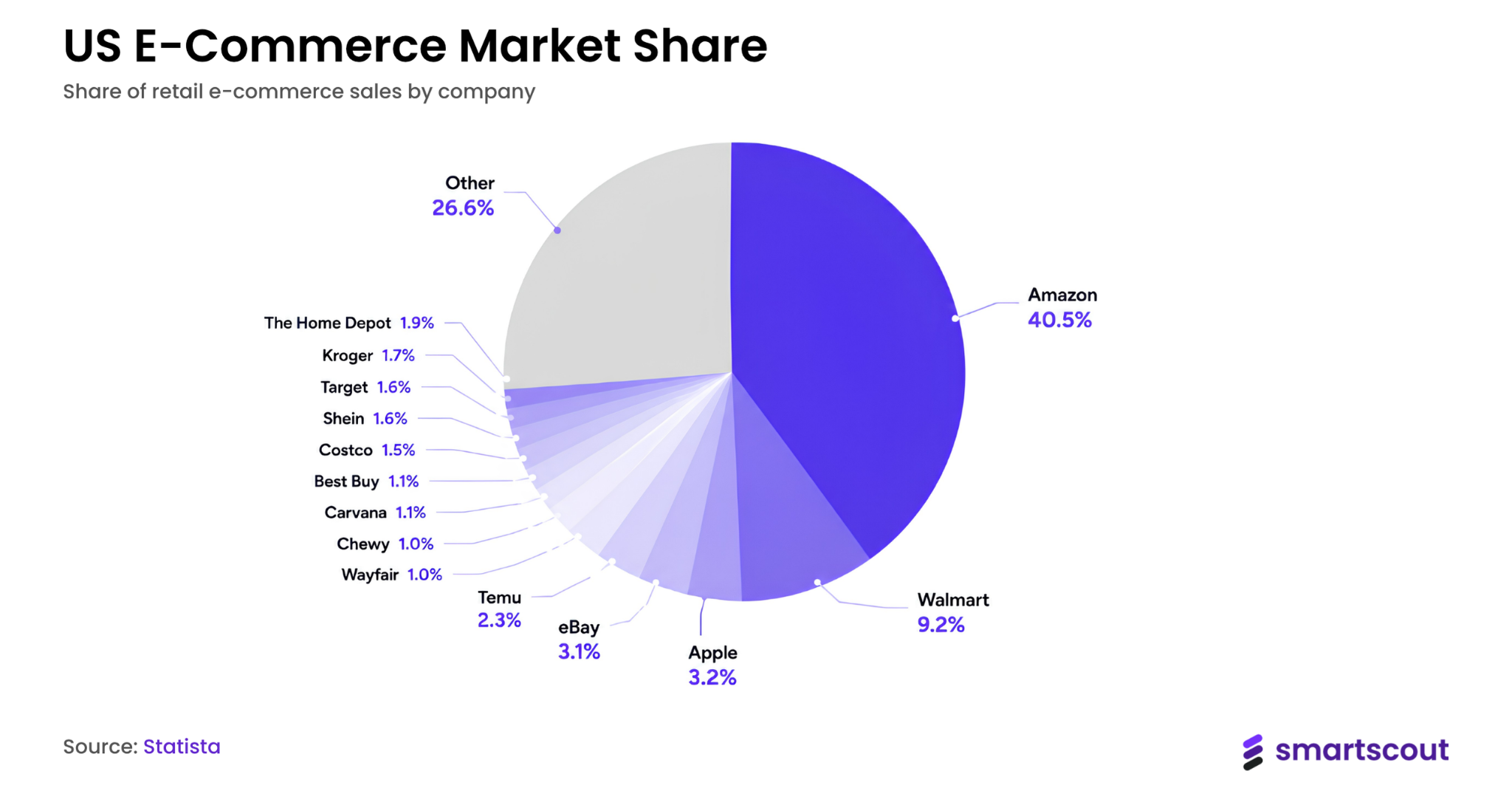
在平台规模方面,SmartScout数据显示,亚马逊目前占据美国零售电商市场40.5%的份额,继续保持行业领先地位,沃尔玛以9.2%的市场份额位居第二。

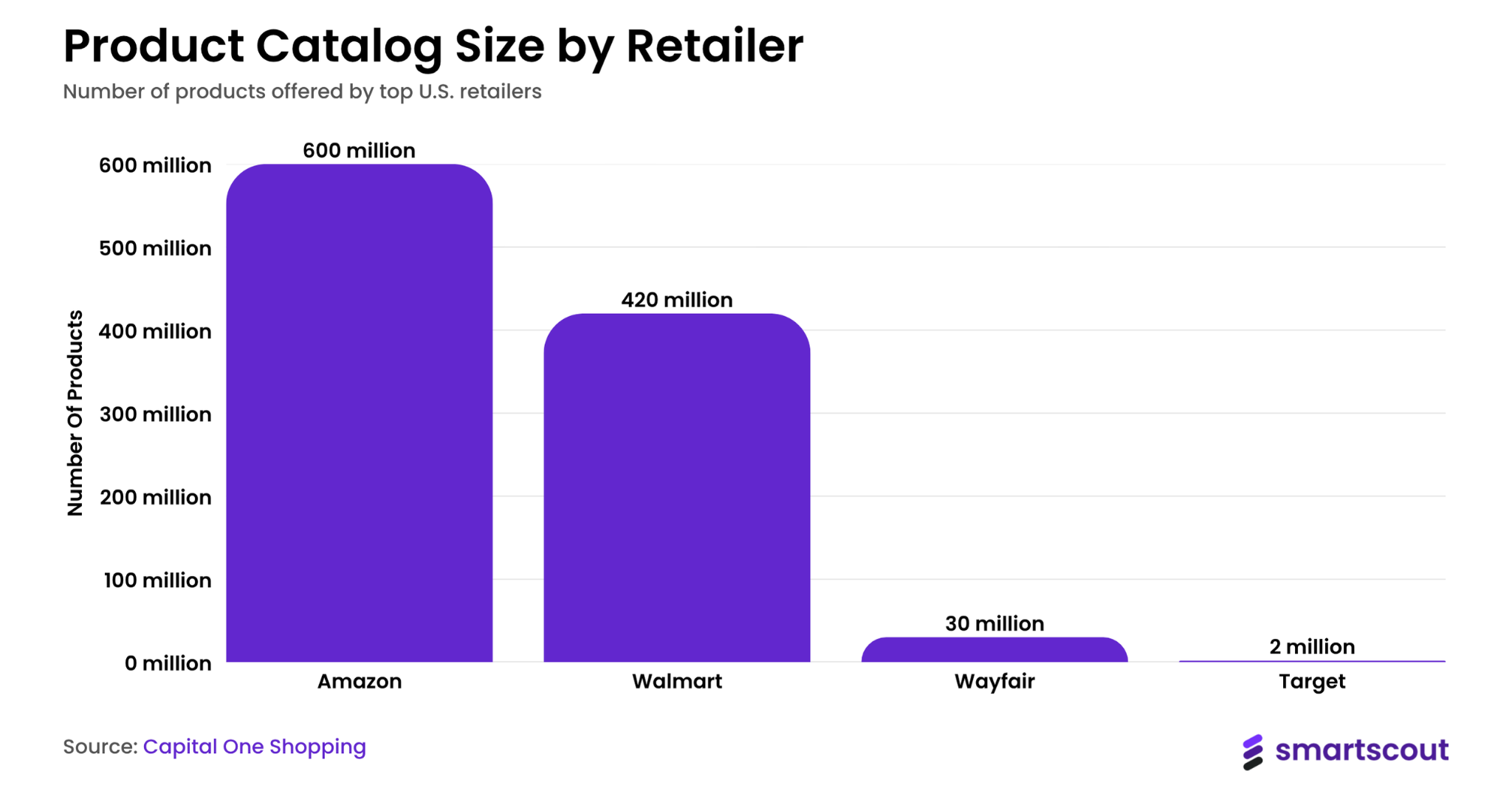
报告还指出,亚马逊全球站点目前共拥有约6亿件商品,远超沃尔玛、Wayfair、塔吉特等平台。

其中约1200万件为亚马逊自营商品,其余超过5.88亿件来自第三方卖家,占全部商品目录的97.9%。与2019年约3.5亿件商品相比,近年来平台商品数量增长几乎全部来自第三方卖家,而非亚马逊自营业务。

流量方面,Amazon.com每月访问量约26亿次,是全球访问量最高的电商网站,其中超过86%的流量来自美国市场,用户平均每次访问时长约5分54秒。

报告预计,目前亚马逊全球活跃用户已超过3.1亿,Prime会员规模超过2.3亿。调查数据显示,73%的消费者将快速、免费的配送服务视为选择亚马逊购物的首要原因。

随着第三方卖家规模持续扩大,其在平台交易中的占比也进一步提升。

SmartScout估算,2025年第三方卖家GMV约5750亿美元,占亚马逊Marketplace总GMV约69%,高于2019年的60%;按销量计算,2025年第四季度第三方卖家贡献了平台61%的已售商品数量。

其中,VEVOR(司顺)成为唯一进入亚马逊品牌月销售额前十榜单的中国跨境企业。

人工智能工具也正逐步渗透卖家运营流程。

报告称,截至2025年,约90万名卖家使用AI工具生成或优化商品Listing,将单个商品页面制作时间由过去约4小时缩短至30至45分钟;与此同时,到2025年第三季度,已有约130万名卖家使用亚马逊官方推出的生成式AI商品Listing工具。

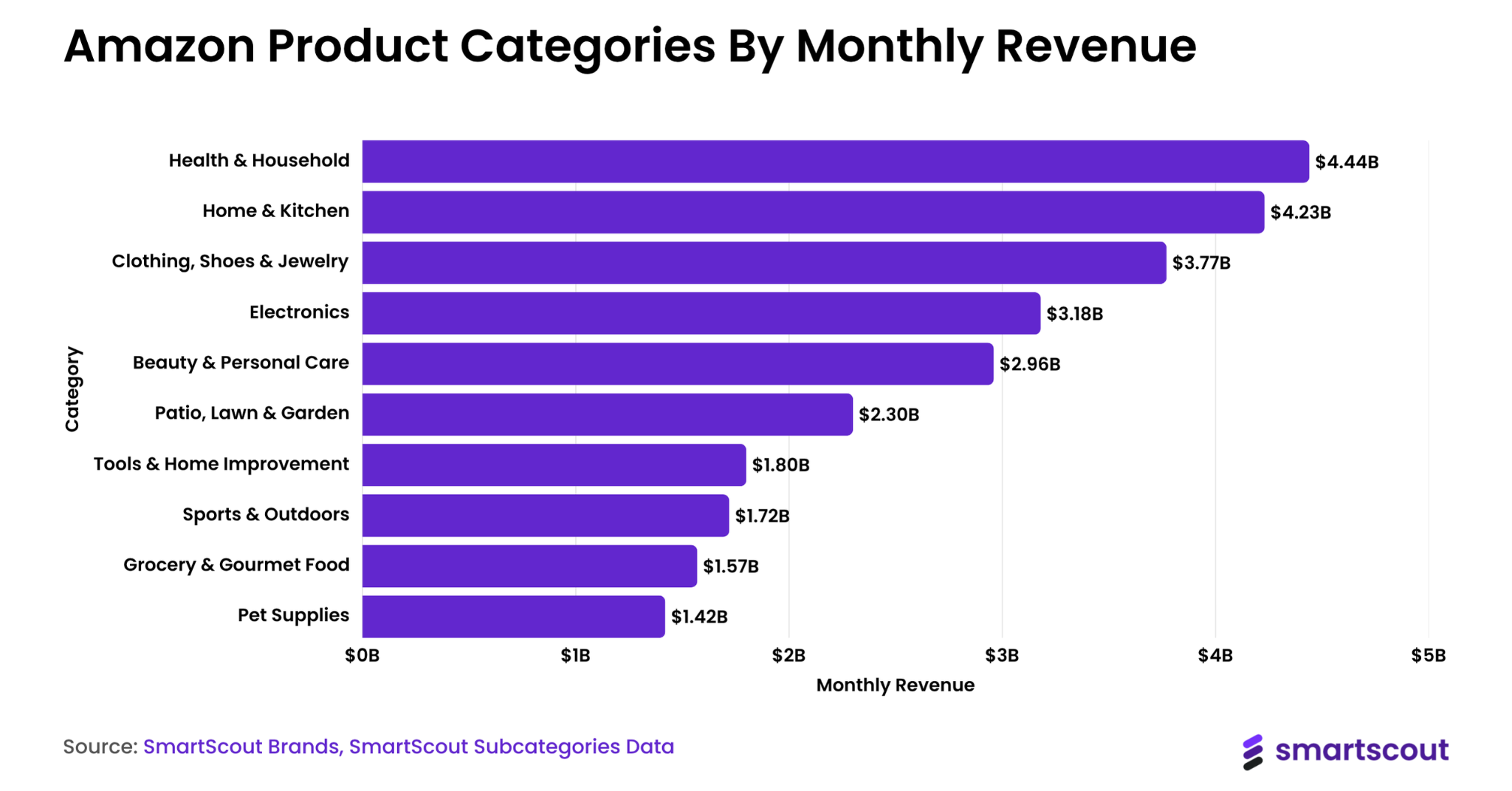
在商品品类方面,健康与家庭用品(Health&Household)和家居与厨房(Home&Kitchen)是亚马逊销售额最高的两大品类,月销售额分别达到44.4亿美元和42.3亿美元,前十大品类合计月销售额超过270亿美元。

其中,家居与厨房大类下拥有超过10万个品牌,同时也是竞争最激烈的品类,平均每个Listing对应445名卖家。

物流服务方面,目前约82%的活跃卖家采用FBA模式,较2019年约50%的渗透率进一步提升。

报告估计,在计入平台佣金、FBA履约费用、仓储费用以及广告投入后,FBA卖家平均需将30%至35%的营业收入支付给亚马逊;扣除商品成本后,平均净利润率约为15%至20%,约64%的FBA卖家能够在经营12个月内实现盈利。


亿邦持续追踪报道该情报,如想了解更多与本文相关信息,请扫码关注作者微信。

文章来源:亿邦动力

广告
微信
朋友圈

FAQ回顾

2025年亚马逊第三方卖家整体市场表现如何?

2025年亚马逊第三方卖家GMV达5750亿美元,占平台总GMV约69%;年销售额突破100万美元的卖家超10万家,年销超1亿美元的卖家增至235家,中国卖家贡献第三方卖家销售收入的35.1%。

亚马逊卖家使用AI工具有哪些实际作用?

截至2025年,约90万名亚马逊卖家使用AI工具生成或优化商品Listing,可将单个商品页面制作时间从过去约4小时缩短至30至45分钟,已有约130万名卖家使用亚马逊官方生成式AI商品Listing工具。

采用亚马逊FBA模式的卖家盈利情况如何?

目前约82%的亚马逊活跃卖家采用FBA模式,FBA卖家平均需将30%至35%的营业收入支付给亚马逊,扣除商品成本后平均净利润率约为15%至20%,约64%的FBA卖家经营12个月内可实现盈利。

亚马逊平台销售额最高的品类有哪些?

健康与家庭用品、家居与厨房是亚马逊销售额最高的两大品类,月销售额分别达44.4亿美元和42.3亿美元,前十大品类合计月销售额超270亿美元,其中家居与厨房是竞争最激烈的品类。

这么好看,分享一下?

朋友圈 分享

APP内打开

赞 +1
+1
微信好友 朋友圈 新浪微博 QQ空间
关闭
收藏成功
发送
/140 0