广告
加载中

非遗手工艺正从文化保护进入商业增长 淘宝非遗与传统手工艺成交额达千亿

龚作仁 2026-07-15 16:03
龚作仁 2026/07/15 16:03

邦小白快读

EN
全文速览

本文核心信息是非遗手工艺已经从文化保护进入商业化增长阶段,淘宝天猫平台相关成交额已达千亿,有不少核心信息和实操参考值得普通读者了解。

1.核心行业数据:目前平台非遗相关商家总数超3.5万家,日均非遗直播超16万场,获认证的非遗传承人开店数量同比增长96.3%,成交额增长131.1%,增速远超行业整体平均。

2.消费参考:当前非遗消费四大热门赛道为古法黄金、手工银饰、新中式、竹编,00后已经成为消费主力,消费者可以买到个性化定制、跨界联名的各类非遗产品,也可以选择手工DIY,亲自参与制作体验。

3.创业参考:想要做非遗生意的普通人可依托电商平台发展,可从个人作坊起步逐步走向企业化运营,还可以通过跨界联名打造第二增长曲线,平台也提供免费培训、工具扶持降低创业门槛。

本文披露了当前非遗电商的发展现状与消费趋势,能给布局非遗相关领域的品牌商提供多方面参考。

1.消费趋势层面:非遗已经完成市场验证,整体市场规模达千亿,消费端年轻化特征明显,90后、00后贡献了43%的非遗消费,用户偏好个性化定制、体验感与跨界联名产品,当前四大爆发赛道为古法黄金、手工银饰、新中式、竹编,其中新中式服饰线上成交额预计超800亿元,竹编受益于以竹代塑与家居美学风口增长迅速。

2.渠道建设层面:淘宝天猫是非遗品牌核心增长阵地,平台提供身份认证、AI工具、线下市集、运营培训等多项扶持,未来还会加大对民族地区、欠发达地区非遗商家的扶持,品牌可顺势布局中西部新兴增长市场。

3.产品研发方向:可依托传统工艺开发日常化消费品,也可拓展跨行业IP联名,开发工艺授权第二增长曲线,已有多个潮玩、游戏、时装领域联名的成功案例。

当前非遗电商已经跨过拼情怀的发展分水岭,整体市场规模突破千亿,给非遗相关卖家带来了清晰的机会与发展方向。

1.增长市场机会:地域层面,东部是非遗销售的基本盘,中西部与边疆省份增长势头强劲,新疆销售增速全国第一,西藏商家入驻增速登顶,欠发达地区卖家可享受平台专项扶持红利;品类层面,古法黄金、手工银饰、新中式、竹编四大赛道爆发增长,其中古法黄金千万级单品超10个,贵州苗族银饰依托非遗工艺年产值超50亿元,市场空间充足。

2.可借鉴的商业模式:除直接卖货外,工艺授权跨界联名已经成为非遗卖家的第二增长曲线,可对接潮玩、游戏、时装等多个行业的IP拓展用户;卖家也可逐步从个人作坊走向企业化运营,扩大经营规模。

3.平台扶持可利用:淘宝提供免费AI作图、身份认证、线下市集、运营培训等多项扶持,2025年累计培训超7万名非遗从业者,未来还会加大对欠发达地区商家的扶持力度,卖家可充分利用这些资源发展。

非遗商业化的快速发展,给非遗相关生产加工工厂带来了新的商业机会,也提供了数字化转型的清晰启示。

1.生产设计需求变化:当下非遗产品越来越偏向日常化、年轻化,消费者偏好个性化产品与跨界联名款,工厂在生产设计端需要适配新需求,在保留传统工艺的基础上,开发符合当代审美的日常消费品,也可承接各类跨界联名产品的开发生产订单。

2.新商业机会:四大热门赛道的爆发释放了大量生产需求,新中式服饰年成交额预计超800亿,云南鹤庆仅一县就有1.6万人从事银铜器加工,市场空间广阔;同时越来越多非遗商家从个人副业走向企业化运营,超四成手艺人开始雇佣员工,还会将部分生产环节外包,比如竹编手艺人就将制作分包给当地村民,工厂可承接相关合作拓展业务。

3.数字化转型启示:工厂可直接入驻电商平台对接全国消费者,依托平台提供的免费AI工具、流量扶持降低运营成本,哪怕是边疆地区的工厂也可以通过电商打开全国市场,实现增长。

非遗电商已经进入千亿规模的商业化增长阶段,行业发展呈现出新的特征,也给相关服务商带来了新的发展方向。

1.行业发展趋势:非遗已经从依赖政策扶持的文化保护阶段,进入到市场驱动的商业增长阶段,跨过了拼情怀的分水岭,接下来行业核心比拼产品化与品牌化能力;越来越多高学历年轻人进入非遗行业,大量商家从单打独斗的副业转向企业化运营,对专业服务商的需求快速提升。

2.核心客户痛点:绝大多数非遗手艺人只擅长手艺创作,普遍缺乏视觉设计、运营推广、品牌建设、资源对接的能力,且中小手艺人资金有限,无法承担高额的服务成本,不少中西部、边疆地区的手艺人还缺乏专业的线上运营培训,能力短板明显。

3.可布局的解决方案:服务商可针对手艺人的需求,开发低成本的视觉设计、运营培训服务,还可以搭建对接桥梁,帮助手艺人对接品牌方与IP资源,开发跨界联名业务,分享行业增长红利,也可以参与平台的非遗商家培训业务,拓展客户群体。

非遗电商的快速发展,展现了非遗商家对平台服务的核心需求,也给平台布局非遗品类运营提供了清晰的参考方向。

1.商家核心需求:多数非遗商家以手艺人出身,缺乏视觉设计、线上运营的专业能力,资金实力也比较有限,需要平台提供低成本的工具、运营培训、流量扶持,同时需要官方身份认证机制提升消费者信任,帮助自身获取流量。

2.现有成熟可借鉴的运营做法:淘宝天猫已经探索出了成熟的非遗商家服务体系,比如给非遗商家提供免费AI生成商品主图工具,近乎零成本补齐视觉呈现短板;给非遗手艺人、传承人发放官方身份认证标签,提升消费者信任;开展线下市集、线上线下结合的运营培训,帮助商家提升能力;针对中西部欠发达地区加大招商与运营扶持,挖掘新的供给增长。

3.后续运营优化方向:当前非遗市场已经突破千亿规模,平台可进一步加大对非遗品牌化的扶持,完善IP对接机制帮助商家拓展跨界联名的第二增长曲线,同时持续挖掘中西部边疆地区的非遗供给,扩大市场规模,管控新兴市场的运营风险。

本文披露了淘宝天猫非遗电商的最新发展数据与产业动向,为研究非遗商业化发展提供了一手的研究素材,也总结了产业发展的新特征与新方向。

1.产业发展新动向:当前非遗手工艺已经完成从文化保护到商业增长的转型,淘宝天猫平台非遗整体成交额已经突破千亿元,认证非遗传承人开店数量与成交额增速远超行业平均;产业地理格局加速重构,东部是规模基本盘,中西部边疆地区供给与消费都跑出加速度,成为新的增长极;产业人群更新明显,近六成淘宝非遗手艺人是本科及以上学历,33%的商家是90后、00后,产业逐步从个人作坊走向企业化运营。

2.新商业模式总结:除直接ToC卖货外,工艺授权跨界联名成为非遗商家的第二增长曲线,联名已经覆盖潮玩、游戏、时装等多个行业,有效拓展了消费人群;平台搭建了完善的基础设施,通过免费AI工具、身份认证、运营培训降低手艺人的入行门槛,形成了平台扶持+匠人创业的可持续商业化模式。

3.研究启示:非遗传承可以通过商业化实现自洽,还能带动欠发达地区就业,未来产业发展的核心竞争力是产品化与品牌化能力,相关政策可加大对非遗电商的扶持,尤其是向民族地区、欠发达地区倾斜,推动非遗产业可持续发展。

返回默认
声明:快读内容全程由AI生成,请注意甄别信息。如您发现问题,请发送邮件至 run@ebrun.com 。

我是 品牌商 卖家 工厂 服务商 平台商 研究者 帮我再读一遍。

Quick Summary

This article highlights that intangible cultural heritage (ICH) handicrafts have entered a phase of commercial growth after focusing on cultural protection for years. The total transaction volume of ICH-related products on Taobao and Tmall has exceeded 100 billion yuan, with key takeaways and practical insights for general readers.

1. Key industry data: There are currently more than 35,000 ICH-related merchants on the platform, with over 160,000 ICH-themed live streams on average per day. The number of stores opened by certified ICH inheritors grew 96.3% year-over-year, while their transaction volume rose 131.1% — far outpacing the industry’s overall growth rate.

2. Consumer guidance: The four most popular ICH categories today are traditional gold crafts, handmade silver jewelry, new Chinese style designs, and bamboo weaving. Gen Z has become the core consumer group. Shoppers can access a wide range of personalized custom-made and cross-branded collaborative ICH products, and even participate in DIY workshops to experience the handicraft-making process firsthand.

3. Entrepreneurship tips: Aspiring ICH entrepreneurs can build their business on e-commerce platforms, starting with small home workshops and gradually scaling up to formal corporate operations. Cross-industry collaborative partnerships can also create a second growth curve, and platforms offer free training and tool support to lower entry barriers.

This article outlines the current development status and consumer trends of ICH e-commerce in China, providing multi-dimensional insights for brands looking to enter the ICH space.

1. Consumer trends: ICH products have passed market validation, with the overall market size reaching 100 billion yuan. Consumption is rapidly aging younger: consumers born in the 1990s and 2000s account for 43% of total ICH spending. Users prefer personalized custom products, experience-oriented offerings and cross-industry collaborative designs. The four fastest-growing categories are traditional gold crafts, handmade silver jewelry, new Chinese style and bamboo weaving. Online transaction volume of new Chinese-style apparel is projected to exceed 80 billion yuan, while bamboo weaving is growing rapidly driven by the "replace plastic with bamboo" trend and rising demand for home aesthetics.

2. Channel strategy: Taobao and Tmall are the core growth engine for ICH brands. The platform offers multiple support initiatives including official certification, AI tools, offline markets and operational training. It will further expand support for ICH merchants in ethnic and less developed regions, so brands can strategically布局 enter the fast-growing emerging markets in central and western China.

3. Product R&D direction: Brands can develop daily consumer goods based on traditional crafts, or expand cross-industry IP collaborations and craft licensing to build a second growth curve. Multiple successful collaborations have already been launched in the fashion, gaming and designer toy sectors.

ICH e-commerce has moved beyond relying purely on cultural appeal, with the overall market exceeding 100 billion yuan, creating clear opportunities and growth directions for ICH-related sellers.

1. Growth opportunities: Geographically, eastern China forms the core market base, while central, western and border regions are growing rapidly: Xinjiang posts the fastest sales growth nationwide, and Tibet leads in new merchant registration growth. Sellers in less developed regions can access exclusive platform support. By category, traditional gold, handmade silver, new Chinese style and bamboo weaving are all booming: there are over 10 ICH traditional gold products with annual sales exceeding 10 million yuan, and Guizhou’s Miao ethnic handmade silver jewelry generates over 5 billion yuan in annual output, leaving substantial room for market expansion.

2. Scalable business models: Beyond direct product sales, craft licensing and cross-industry collaboration has become a major second growth curve for ICH sellers, enabling partnerships with IPs in designer toys, gaming, fashion and other sectors to reach new audiences. Sellers can also gradually scale from individual workshops to formal corporate operations to expand business scale.

3. Leveraging platform support: Taobao offers multiple free resources including AI-powered design tools, official certification, offline pop-up markets and operational training. It has trained over 70,000 ICH practitioners cumulatively by 2025, and will expand support for merchants in less developed regions. Sellers can fully utilize these resources to accelerate growth.

The rapid commercialization of ICH has created new business opportunities for ICH-related production and processing factories, while offering clear insights for digital transformation.

1. Shifting production and design demands: ICH products are increasingly oriented toward everyday use and younger consumers, who prefer personalized and cross-branded collaborative designs. Factories need to adapt their production and design processes to these new demands: while preserving core traditional craftsmanship, they should develop daily consumer goods aligned with contemporary aesthetics, and can also take on production orders for cross-industry collaborative products.

2. New business opportunities: The boom of the four high-growth categories has generated massive production demand: annual transaction volume of new Chinese-style apparel is projected to exceed 80 billion yuan, and in Heqing County, Yunnan alone, 16,000 people work in silver and copper processing, indicating enormous market potential. Meanwhile, more than 40% of ICH craftspeople now hire employees and outsource partial production processes — for example, bamboo weaving artisans often distribute production work to local villagers — so factories can take on these partnerships to expand their business.

3. Insights for digital transformation: Factories can directly enter e-commerce platforms to reach consumers nationwide, and reduce operating costs by leveraging the platform’s free AI tools and traffic support. Even factories in remote border regions can access the national market and achieve growth through e-commerce.

ICH e-commerce has entered a commercial growth phase with a market size exceeding 100 billion yuan, bringing new industry characteristics and new development directions for relevant service providers.

1. Industry trends: ICH has transitioned from a policy-dependent cultural protection stage to a market-driven commercial growth stage, moving beyond reliance on cultural appeal. Going forward, competition in the industry will center on productization and branding capabilities. As more highly educated young people enter the industry and a growing number of merchants scale from side hustles to formal corporate operations, demand for professional service providers is rising rapidly.

2. Core client pain points: Most ICH artisans excel only at handicraft creation, and generally lack capabilities in visual design, operations and marketing, brand building, and resource matchmaking. Small-scale artisans also have limited budgets and cannot afford high service fees. Many artisans in central, western and border regions also lack access to professional online operations training, leaving clear capability gaps.

3. Actionable solutions: Service providers can develop low-cost visual design and operational training services tailored to artisans’ needs. They can also act as matchmaking intermediaries to connect artisans with brands and IP resources to develop cross-industry collaborative business, and share the industry’s growth dividend. Providers can also partner with platforms to deliver ICH merchant training programs to expand their customer base.

The rapid growth of ICH e-commerce has revealed core needs of ICH merchants for platform services, and provided clear strategic guidance for platforms looking to develop ICH category operations.

1. Core merchant needs: Most ICH merchants are artisans by background, lacking professional capabilities in visual design and online operations, and have limited capital. They require low-cost tools, operational training and traffic support from platforms, as well as official certification mechanisms to build consumer trust and attract more traffic.

2. Proven operational best practices: Taobao and Tmall have developed a mature service system for ICH merchants. For example, it provides free AI tools for generating product main images, helping merchants fill the gap in visual presentation at nearly zero cost. It issues official certification tags to ICH artisans and inheritors to boost consumer trust. It also organizes offline markets and combined online-offline operational training to help merchants improve capabilities, and steps up recruitment and operational support for merchants in less developed regions of central and western China to unlock new supply-side growth.

3. Future operational optimization: With the ICH market already exceeding 100 billion yuan, platforms can further increase support for ICH branding, improve IP matchmaking mechanisms to help merchants build out the second growth curve of cross-industry collaboration, continue to tap ICH supply in central, western and border regions to expand market size, and manage operational risks in emerging markets.

This article discloses the latest development data and industry trends of ICH e-commerce on Taobao and Tmall, providing first-hand materials for research on ICH commercialization, and summarizes new characteristics and directions of industrial development.

1. New industry trends: ICH handicrafts have completed the transition from cultural protection to market-driven commercial growth, with total transaction volume on Taobao and Tmall exceeding 100 billion yuan. The growth rate of both store openings by certified ICH inheritors and their transaction volume far outpaces the industry average. The industrial geographic landscape is rapidly restructuring: eastern China forms the core size base, while central, western and border regions are seeing accelerated growth in both supply and consumption, emerging as new growth poles. The industry’s demographic base is also rapidly renewing: nearly 60% of Taobao ICH artisans hold a bachelor’s degree or above, 33% of merchants are born in the 1990s and 2000s, and the industry is gradually shifting from individual workshops to formal corporate operations.

2. New business model summary: Beyond direct-to-consumer sales, craft licensing and cross-industry collaboration has become a second growth curve for ICH merchants, with collaborations covering designer toys, gaming, fashion and multiple other sectors that effectively expand consumer reach. Platforms have built a complete infrastructure, lowering entry barriers for artisans via free AI tools, official certification and operational training, forming a sustainable commercial model of "platform support + artisan entrepreneurship".

3. Research implications: ICH inheritance can achieve financial self-sufficiency through commercialization, and also drive employment in less developed regions. The core competitiveness of future industry development lies in productization and branding capabilities. Relevant policies can increase support for ICH e-commerce, with particular focus on ethnic and less developed regions, to promote the sustainable development of the ICH industry.

Disclaimer: The "Quick Summary" content is entirely generated by AI. Please exercise discretion when interpreting the information. For issues or corrections, please email run@ebrun.com .

I am a Brand Seller Factory Service Provider Marketplace Seller Researcher Read it again.

成都银花丝非遗传承人王晓璐让泡泡玛特MOLLY长出一对银花丝翅膀;90后篾匠姑娘徐无瑕手编的竹编小马灯亮相央视马年春晚舞台;桂林女孩刘思蔚用瑶绣工艺缝制的虎头包被马斯克幼子拎进人民大会堂。非遗不再只是"活在纪录片里的老手艺"——它正在成为一门跑得很快的生意。

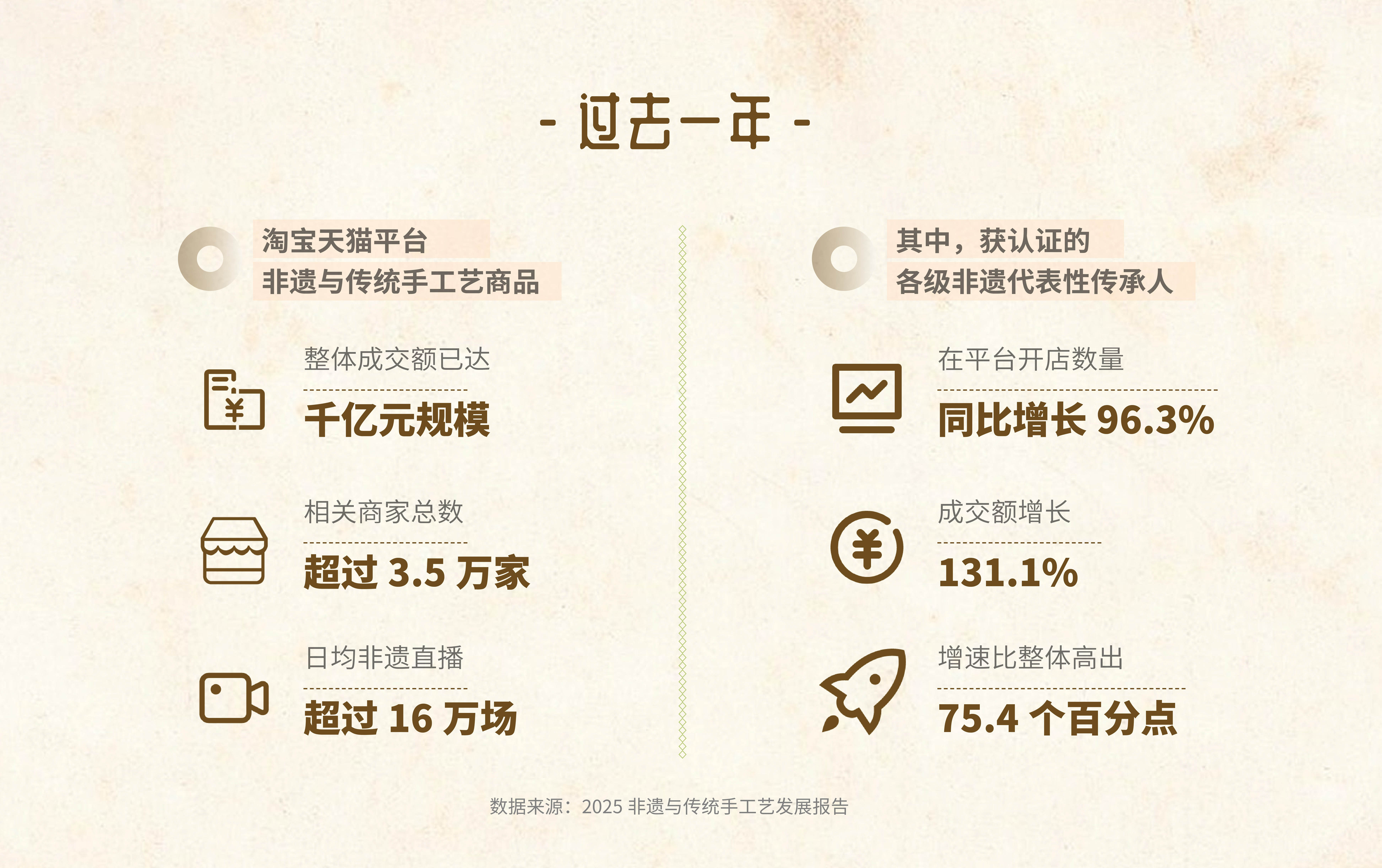
近日,淘宝天猫发布《2025淘宝天猫非遗与传统手工艺发展报告》。报告显示,淘宝天猫平台非遗与传统手工艺商品整体成交额已达千亿元规模,相关商家总数超过3.5万家,日均非遗直播超过16万场。其中,获认证的各级非物质文化遗产代表性传承人在平台开店数量同比增长96.3%,成交额增长131.1%,增速比整体高出75.4个百分点。

(图说:淘宝天猫非遗与传统手工艺2025年平台数据)

非遗电商地理版图:东部稳居“基本盘”,中西部跑出“加速度”

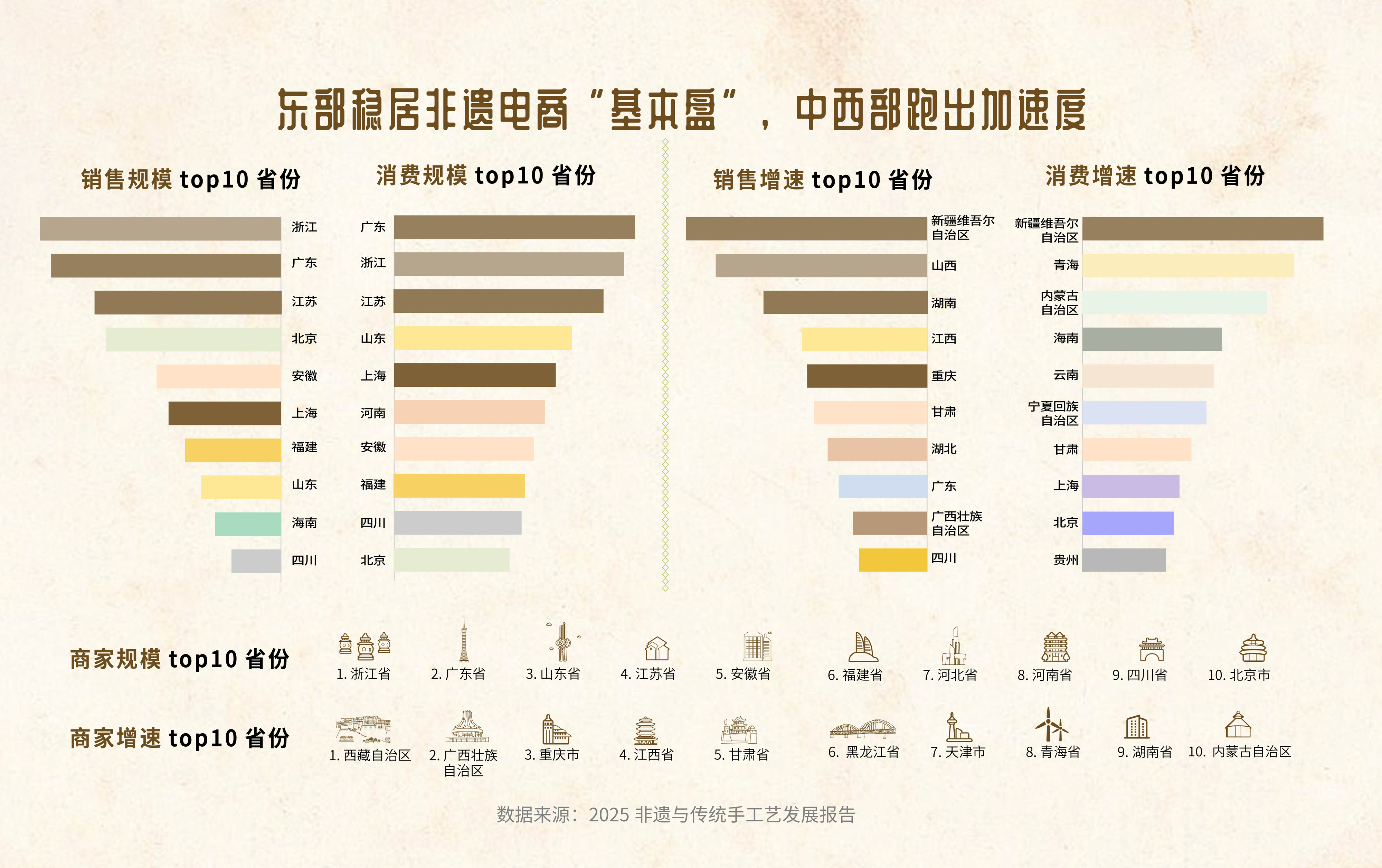
非遗电商地理格局正加速重构。从绝对规模来看,浙江、广东、江苏三省合计贡献整体成交半数以上,领跑销售、商家和消费规模榜。但从增长趋势来看:新疆成为销售增长最快的省份,西藏登顶商家入驻增速榜首,山西、湖南、青海、内蒙古等中西部与边疆省份密集出现在三项增速TOP10中。

过去非遗电商基本是东部产业带向全国供货,如今边疆手艺人正快速把货铺到线上,中西部消费者也成为增长最快的一批买家。喀什古城铜器制作技艺第六代传人阿卜杜柯尤木艾力是一位00后,自小跟着爷爷和父亲打铜,现在和弟弟一起经营淘宝店,把喀什手工铜器卖向全国。西藏尼木县藏香制作技艺传承人次仁多吉做了近30年手工藏香,他的"藏香坊"也已在淘宝扎根。淘宝手艺人业务负责人刘鑫表示,未来将持续加大对民族地区、欠发达地区非遗商家的招募与运营扶持。

(图说:非遗电商销售、消费及商家规模与增速的省份分布)

四大热门赛道爆发:古法黄金、手工银饰、新中式、竹编

报告显示,淘宝天猫平台上有上千个品类的非遗商品在售,过去一年四个领域增长最为集中。

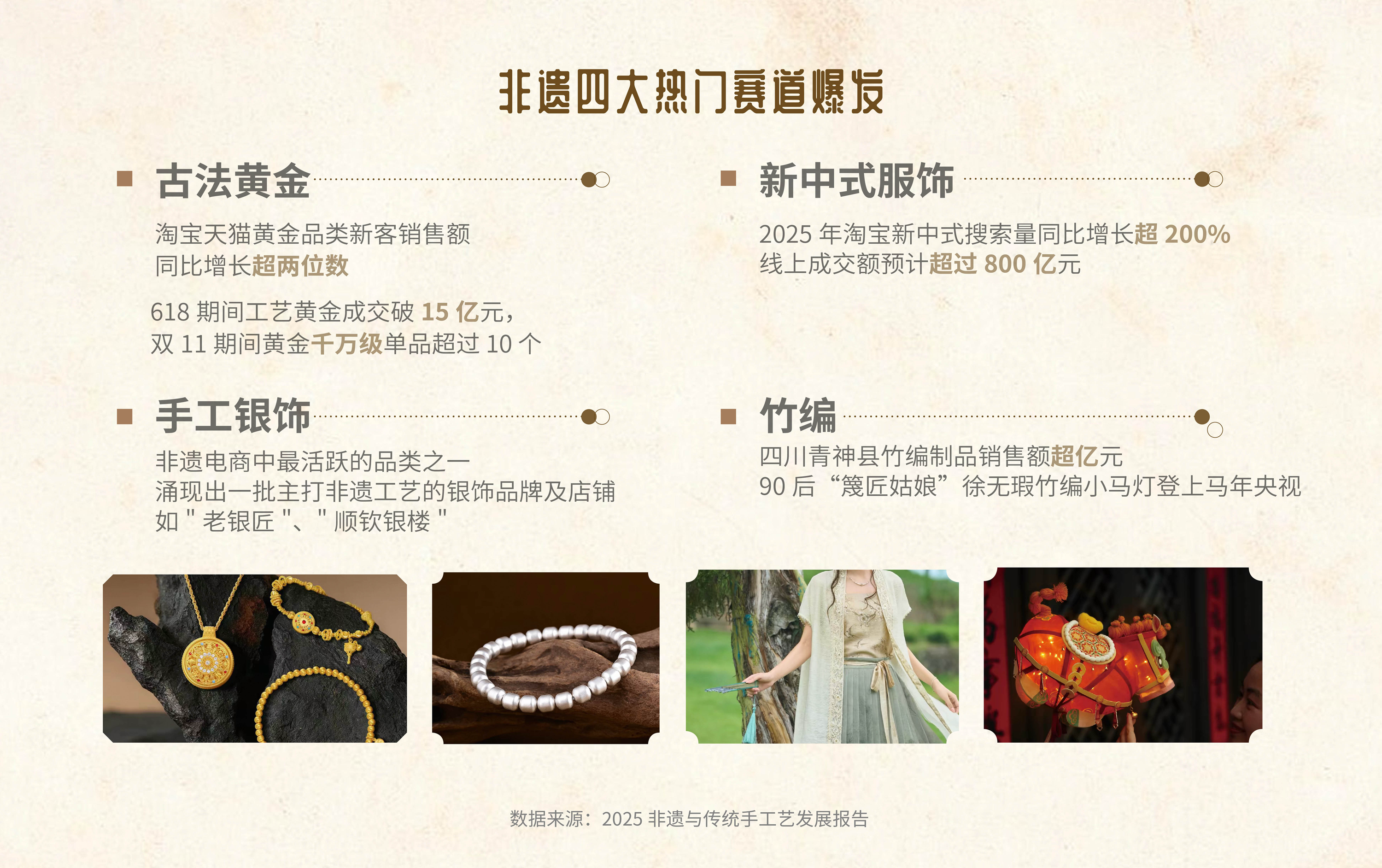
古法黄金在2025年迎来集中爆发。报告数据显示,淘宝天猫黄金品类新客销售额同比增长超两位数,618期间工艺黄金成交破15亿元,双11期间古法黄金品牌持续领跑,千万级单品超过10个。手工银饰同样走高,是非遗电商中最活跃的品类之一,云南鹤庆新华村素有"银都水乡"之称,仅一县就有1.6万余人从事银铜器加工;贵州黔东南依托苗族银饰锻造技艺,年产值超50亿元。淘宝天猫上,"老银匠""顺钦银楼""归银堂"等品牌在保留传统纹样的基础上,用非遗工艺把银饰做成了日常穿搭单品。

新中式服饰线上成交额预计超800亿元,淘宝搜索量同比增长超200%。竹编制品则搭上"以竹代塑"与家居美学两股潮流。90后徐无瑕2016年拜师学象山竹编,2023年首款竹编艾草门挂爆火,2026年她手作的竹编小马灯亮相央视马年春晚。她把制作分包给杭州余杭鸬鸟镇村民,参与者每个月能增加2000至3000元的收入。徐无瑕表示:“最好的传承,是靠商业化实现自洽。”

手艺人的出圈,常常发生在一些意料之外的时刻。2026年5月,马斯克幼子手持桂林女孩刘思蔚淘宝原创品牌"芽小七手创"的瑶绣虎头包现身北京人民大会堂,虎头包当夜现货售罄,累计销量超六千件。这家开了19年的淘宝店,此前就已凭"赛博醒狮机车帽"斩获淘宝造物节"天下第一造"。被看见只是一瞬间,能稳稳接住,却是靠着19年的手艺和坚持。

(图说:非遗电商四大热门赛道)

非遗供需画像:近六成店主是高学历匠人,00后成消费主力

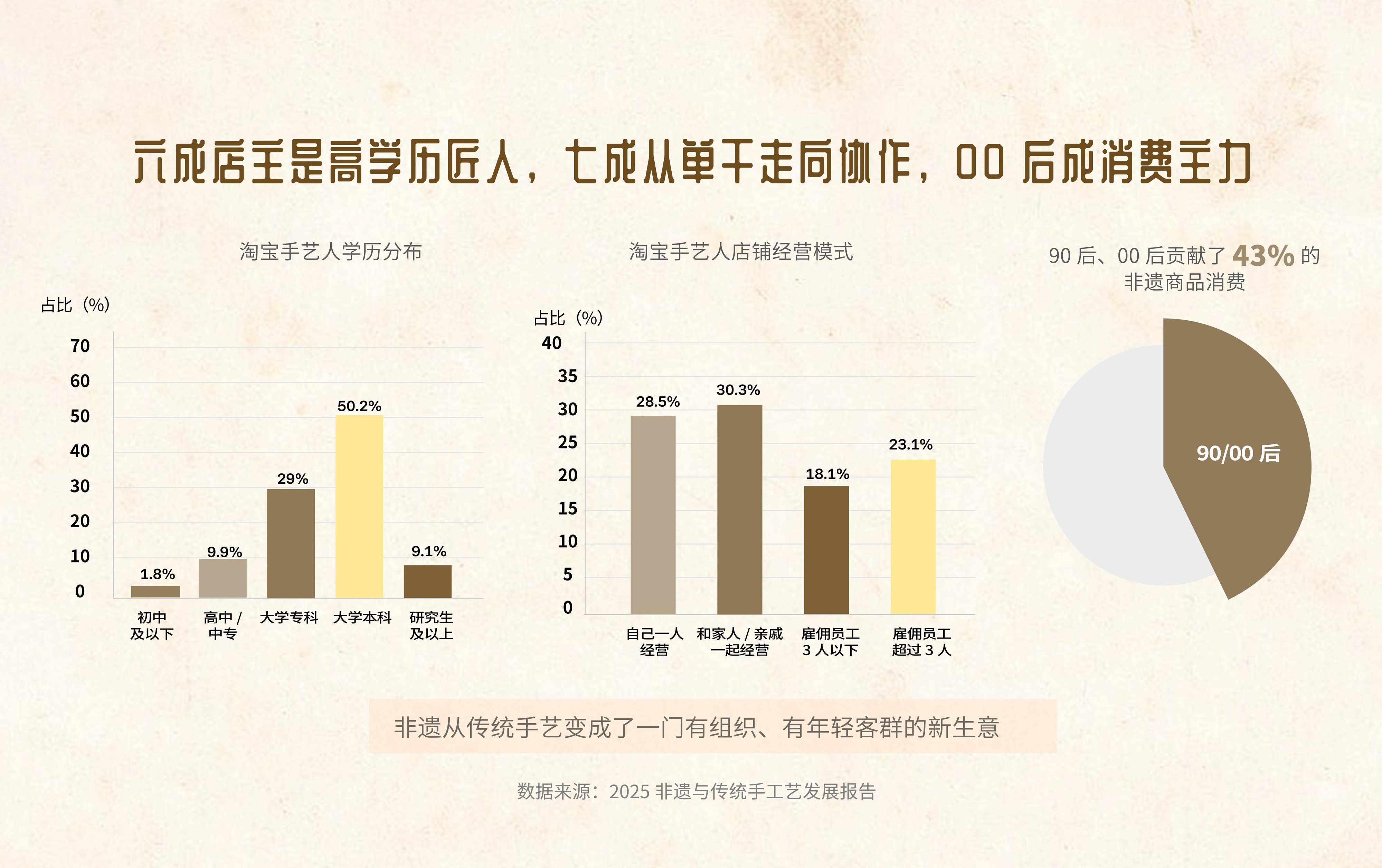
谁在淘宝上卖非遗?报告勾勒出一幅"新匠人"群像:90后、00后的非遗与传统手工艺商家数量占比连年提升,达到了33%。在调研的淘宝手艺人中,本科及以上学历占比六成。

伴随高学历人群的入局,非遗电商正从“单打独斗的副业”向“小型企业化”迈进。目前虽以家庭作坊为主,但已有超四成手艺人开始雇佣员工。以景德镇“蓝印东方旗舰店”为例,其2009年从工作室起步,2015年完成公司化运营,如今已组建起200余人的匠人团队,产品覆盖五大日用陶瓷品类,年产能达数百万件。

消费端同样年轻化明显,00后、90后贡献了43%的非遗商品消费。他们不只是“买个手串戴戴”,而是追求个性化定制与体验感:手工DIY类店铺数量增长47%,越来越多年轻消费者想亲手参与制作过程,非遗IP跨界联名也在不断拓宽消费人群的边界。苏州苏绣传承人张雪为三丽鸥Hello Kitty定制苏绣装饰画,四川刘氏竹编与劲霸男装、网易蛋仔派对等品牌合作推出联名产品——非遗手艺人的联名对象已横跨潮玩、游戏、时装等行业,"工艺授权"正在成为非遗品牌的第二增长曲线。

(图说:淘宝手艺人画像、经营模式及消费者占比)

淘天集团研究中心研究员张程认为,今天的非遗电商跨过了一个分水岭,不再是拼情怀的阶段,“千亿规模说明市场已经验证了需求,接下来比拼的是产品化和品牌化的能力。”

平台侧基础设施也在持续加码:AI生成商品主图已成为非遗商家使用最多的AI功能,以近乎零成本补齐了手艺人在视觉呈现上的短板;"淘宝手艺人""非遗传承人"身份认证标签提升买家信任;"淘宝中国宝贝"线下市集已吸引超100万人次。2025年淘宝开展5场非遗主题线下沙龙和54节线上课程,累计培训超7万名学员。刘鑫补充,有手艺、有审美、有经营能力的非遗工艺传承人,正在淘宝天猫上把文化遗产做成有竞争力的消费品牌。

注:文/龚作仁,文章来源:Laborer,本文为作者独立观点,不代表亿邦动力立场。

文章来源:Laborer

广告
微信
朋友圈

FAQ回顾

非遗电商目前的整体市场规模是多少?

淘宝天猫平台非遗与传统手工艺商品整体成交额已达千亿元规模,相关商家总数超过3.5万家,日均非遗直播超过16万场,各级非遗代表性传承人开店量同比增长96.3%,成交额增速比整体高出75.4个百分点。

非遗电商的热门增长赛道有哪些?

当前非遗电商四大热门增长赛道为古法黄金、手工银饰、新中式服饰、竹编制品,2025年淘宝天猫618期间工艺黄金成交破15亿元,新中式服饰线上成交额预计超800亿元,搜索量同比增长超200%。

非遗商品的主要消费群体有什么特征?

非遗商品消费群体年轻化特征明显,00后、90后贡献了43%的非遗商品消费,这类消费者更追求个性化定制与体验感,手工DIY类非遗相关店铺数量同比增长47%。

淘宝平台针对非遗商家有哪些扶持政策?

淘宝持续加大对民族地区、欠发达地区非遗商家的招募与运营扶持,推出AI生成商品主图、手艺人身份认证标签等工具,2025年累计开展5场线下沙龙、54节线上课程,培训超7万名非遗从业者。

这么好看,分享一下?

朋友圈 分享

APP内打开

+1
+1
微信好友 朋友圈 新浪微博 QQ空间
关闭
收藏成功
发送
/140 0