广告
加载中

京东发布商家成长PLUS方法论

亿邦动力 2026-07-16 18:25
亿邦动力 2026/07/16 18:25

邦小白快读

EN
全文速览

本文核心内容是京东7月15日发布商家成长PLUS方法论,为不同阶段商家提供清晰可落地的增长路径,核心干货如下

1.该方法论围绕货盘规划、稳定日销、品牌增长、平台赋能四大经营环节,梳理出八大实战增长打法,覆盖从货品梳理到品牌增长全经营流程,能解决新商家难破冰、老商家遇增长瓶颈等常见开店问题

2.京东配套推出了八大打法专项学习课程,包含直播、视频、实战案例等内容,还搭建了AI智能经营闭环体系,可以帮商家诊断店铺问题,智能推荐适配的增长策略,定制专属增长路径

普通想要开网店或者正在经营网店的读者,可以直接参照这套方法梳理自身经营方向,学习具体实操技巧,实用性较强。

本文对入驻京东的品牌商来说,有不少贴合需求的干货内容,具体如下

1.该方法论针对品牌经营常见痛点给出了对应打法,针对用户流失快、增量来源单一的问题,提供了用户运营、内容营销两种打法,通过高性价比稀缺商品获客、会员活动提升复购、直播短视频引流,帮助品牌沉淀忠实用户

2.品牌可以借助京东平台的自营心智赋能,通过引凤计划、京仓京配、品牌1+1+1等举措提升商品曝光和转化,依托京东的品质心智扩大品牌规模

3.该方法论还能帮助品牌理顺货盘结构,分层运营新品爆品尾货等不同货品,提升商品基础转化,适配品牌不同发展阶段的增长需求,还能借助AI工具定位自身经营问题。

本文对在京东经营的各类卖家来说,有明确的机会提示和可落地的实操方法,干货如下

1.京东最新推出商家成长PLUS方法论,是首次将沉淀多年的经验转化为可落地可复制的成长体系,专门针对新商家破冰增长、老商家突破增长瓶颈设计,适配不同类型卖家的需求

2.针对卖家常见的经营痛点都给出对应解决方案:货盘运营混乱有货品矩阵、基础运营两大打法;流量少日销波动大有广告增长等三种打法;用户留存差有用户运营、内容营销打法

3.卖家可以免费学习配套的专项课程,还能享受京麦的AI智能诊断服务,获得定制化增长路径,当前卖家可以抓住平台生态协同升级的机会,借助这套体系突破自身增长。

本文对想要拓展电商销路、做自有品牌的工厂来说,有不少有价值的参考干货,具体如下

1.该方法论明确了电商端对货品的运营需求,要求商家对新品、爆品、尾货、特色品做分层运营,这对应到生产端,工厂可以根据货品层级调整生产计划,优化库存结构,减少库存积压,提升货品周转效率

2.工厂做电商开拓销路可以依托京东平台的赋能,通过引凤计划、京仓京配等平台举措,提升商品曝光和下单转化,借助京东的品质心智快速打开销路,扩大经营规模

3.这套方法论也给工厂推进电商数字化提供了清晰方向,工厂可以借助平台的AI诊断工具定位经营问题,逐步优化自身电商运营流程,不管是新入场还是想要突破增长瓶颈都有明确路径。

本文给面向电商商家的服务商提供了行业发展趋势和客户痛点相关干货,具体如下

1.当前电商平台和商家的关系已经发生变化,从平台单向供给资源转向平台和商家深度共成长的生态协同,整个行业的服务方向也随之调整,服务商可以顺着这个趋势调整自身的服务定位,匹配新的行业需求

2.该方法论总结了当前不同阶段商家的四类核心痛点:货盘规划混乱货品价值无法发挥、流量不足日销不稳定、用户流失快增量来源少、商品全周期竞争力不足,服务商可以针对这些痛点设计对应的服务产品,贴合商家实际需求

3.服务商可以对接京东这套成熟的成长体系,结合自身服务能力为客户提供更贴合平台规则的运营服务,提升自身服务的落地效果。

本文对各类电商平台商来说,有不少关于商家运营、招商的参考干货,具体如下

1.当前商家对平台的需求已经升级,不再满足于单向的资源投放,更需要平台提供系统化可落地的全周期成长方案,帮助解决不同阶段的经营问题,平台商可以调整自身的服务模式,向深度生态协同方向转型

2.京东这套商家成长PLUS方法论的建设路径值得参考:围绕商家实际经营逻辑梳理出四大环节八大打法,覆盖全经营周期,同时配套专项学习课程和AI智能诊断闭环,能给商家定制专属增长路径

3.这套体系不仅可以帮助平台吸引新商家完成招商,还能提升老商家的留存和增长,平台商可以参考这类模式优化自身的商家运营管理,规避商家增长不足、流失率高的风险。

本文对电商产业研究者来说,提供了产业发展新动向和典型案例相关干货,具体如下

1.本文透露了当前电商平台生态发展的新动向:平台与商家的关系正从传统的单向资源供给,迈向深度共成长的生态协同新阶段,这是电商行业发展到存量竞争阶段的新变化,值得研究者关注

2.京东推出的商家成长PLUS方法论,是行业内首次将平台沉淀多年的能力和行业经验,系统性转化为一套可落地、可复制的实战商家成长体系,形成了四大环节八大打法加配套工具课程的新型商家服务商业模式

3.这套模式为解决不同阶段商家增长痛点提供了可参考的实践案例,对研究电商平台服务升级、商家增长体系、产业生态发展都有较高的案例价值,也能为相关政策研究提供实际案例支撑。

返回默认

声明:快读内容全程由AI生成,请注意甄别信息。如您发现问题,请发送邮件至 run@ebrun.com 。

我是 品牌商 卖家 工厂 服务商 平台商 研究者 帮我再读一遍。

Quick Summary

This article covers JD.com's newly released Merchant Growth PLUS methodology, launched on July 15, which provides clear, actionable growth paths for merchants at different development stages. The key takeaways are as follows:

1. The methodology structures 8 practical growth tactics across four core business links: assortment planning, stable daily sales, brand growth, and platform enablement. It covers the entire operational process from product sorting to brand expansion, and addresses common pain points including onboarding difficulties for new merchants and growth stagnation for established sellers.

2. JD has also launched 8 sets of specialized free learning courses covering live streams, videos and real-world case studies, and built a closed-loop AI-powered intelligent operation system that can diagnose store issues, recommend tailored growth strategies, and design custom growth paths for sellers.

For readers looking to open an online store or already running an online business, this framework is highly practical and can be directly used to clarify business direction and learn actionable operational skills.

This article provides valuable, on-demand insights for brands operating on JD.com, with key takeaways as follows:

1. The methodology offers targeted solutions for common brand operation pain points. To address fast user churn and over-reliance on limited growth sources, it introduces two tactics: user operation and content marketing. Brands can acquire customers via cost-effective exclusive products, boost repeat purchases through membership events, and drive traffic via live streams and short videos to build a loyal user base.

2. Brands can leverage JD's self-operated trust positioning and platform initiatives including the Yinfeng Program, JD Fulfillment (Jingcang Jingpei), and the "1+1+1 Brand Program" to increase product exposure and conversion, and scale brand recognition by tapping into JD's reputation for high-quality products and services.

3. The methodology also helps brands rationalize their product assortment structure, implement tiered operation for new products, hits, and end-of-line inventory to improve base conversion, and adapt to growth needs at different brand development stages. Brands can also use JD's AI tools to identify specific operational bottlenecks.

This article delivers clear opportunity insights and actionable tactics for all sellers operating on JD, with key takeaways as follows:

1. JD's new Merchant Growth PLUS methodology marks the first time the platform has converted its years of accumulated operational experience into a actionable, replicable growth system. It is specifically designed to help new merchants break through onboarding barriers and help established sellers overcome growth stagnation, and can accommodate the needs of all seller types.

2. It provides targeted solutions for all common seller pain points: product matrix and base operation tactics to fix disorganized assortment management; three tactics including advertising-based growth to address low traffic and volatile daily sales; and user operation and content marketing tactics to improve poor user retention.

3. Sellers can access the supporting specialized courses for free, and use JD Jingmai's AI-powered intelligent diagnosis service to get customized growth paths. Sellers are positioned to capitalize on JD's ongoing ecosystem collaboration upgrade and break through growth limits with this framework.

This article offers valuable insights for factories looking to expand e-commerce sales channels and build their own brands, with key takeaways as follows:

1. The methodology clarifies e-commerce's requirements for tiered product operation, which divides inventory into new products, hits, end-of-line goods and specialty items. For manufacturing factories, this means they can adjust production plans and optimize inventory structure based on product tiers, reducing overstock and improving inventory turnover.

2. Factories entering e-commerce can leverage JD's platform enablement: through initiatives such as the Yinfeng Program and JD Fulfillment, they can boost product exposure and conversion, quickly open up market access and scale operations by leveraging JD's reputation for quality.

3. The framework also provides clear guidance for factories looking to digitalize their e-commerce operations. Factories can use the platform's AI diagnosis tools to identify operational issues and gradually optimize e-commerce processes, with a clear growth path available for both new entrants and factories looking to break through existing growth bottlenecks.

This article shares insights on industry trends and merchant pain points for e-commerce service providers, with key takeaways as follows:

1. The relationship between e-commerce platforms and merchants has shifted: from one-way resource provision by platforms to in-depth, collaborative ecosystem growth where platforms and merchants develop together. This shift is reshaping industry service requirements, and service providers can adjust their service positioning to align with this new industry demand.

2. The methodology summarizes four core pain points for merchants at different development stages: disorganized assortment planning that prevents full product value realization, insufficient traffic and unstable daily sales, fast user churn and limited new growth sources, and weak full-lifecycle product competitiveness. Service providers can design targeted service products to address these real merchant needs.

3. Service providers can integrate their own capabilities with JD's established growth system to deliver more platform-aligned operational services for clients, and improve the actual impact of their service offerings.

This article provides useful insights for merchant operation and merchant acquisition for all e-commerce platform operators, with key takeaways as follows:

1. Merchant demand from platforms has evolved: merchants no longer settle for one-off resource allocations, and instead demand systematic, actionable full-lifecycle growth solutions to address operational challenges at every development stage. Platform operators can adjust their service models to transition toward deep collaborative ecosystem growth.

2. JD's development path for the Merchant Growth PLUS methodology serves as a strong reference: it structures 8 tactics across four core links aligned with merchants' actual operational logic, covers the entire business lifecycle, and pairs the framework with specialized learning courses and a closed-loop AI diagnosis system to deliver customized growth paths for merchants.

3. This system not only helps platforms attract new merchants for recruitment, but also improves retention and growth for established merchants. E-commerce platforms can refer to this model to optimize their own merchant operation and management, and mitigate risks of low merchant growth and high churn.

This article provides insights on new industry trends and a valuable case study for e-commerce industry researchers, with key takeaways as follows:

1. The article highlights a new trend in e-commerce platform ecosystem development: the relationship between platforms and merchants is shifting from traditional one-way resource provision to a new stage of deep collaborative co-growth. This shift is a key new development for the e-commerce industry as it enters the era of stock competition, and merits further research attention.

2. JD's Merchant Growth PLUS methodology marks the first time in the industry that a platform has systematically converted its years of accumulated internal capabilities and industry experience into an actionable, replicable practical merchant growth system. It forms a new merchant service business model consisting of four core links, eight tactics, and supporting tools and courses.

3. This model provides a referenceable practical case for addressing growth pain points for merchants at all development stages. It carries high case value for research on e-commerce platform service upgrades, merchant growth systems, and industrial ecosystem development, and can also provide practical case support for related policy research.

Disclaimer: The "Quick Summary" content is entirely generated by AI. Please exercise discretion when interpreting the information. For issues or corrections, please email run@ebrun.com .

I am a Brand Seller Factory Service Provider Marketplace Seller Researcher Read it again.

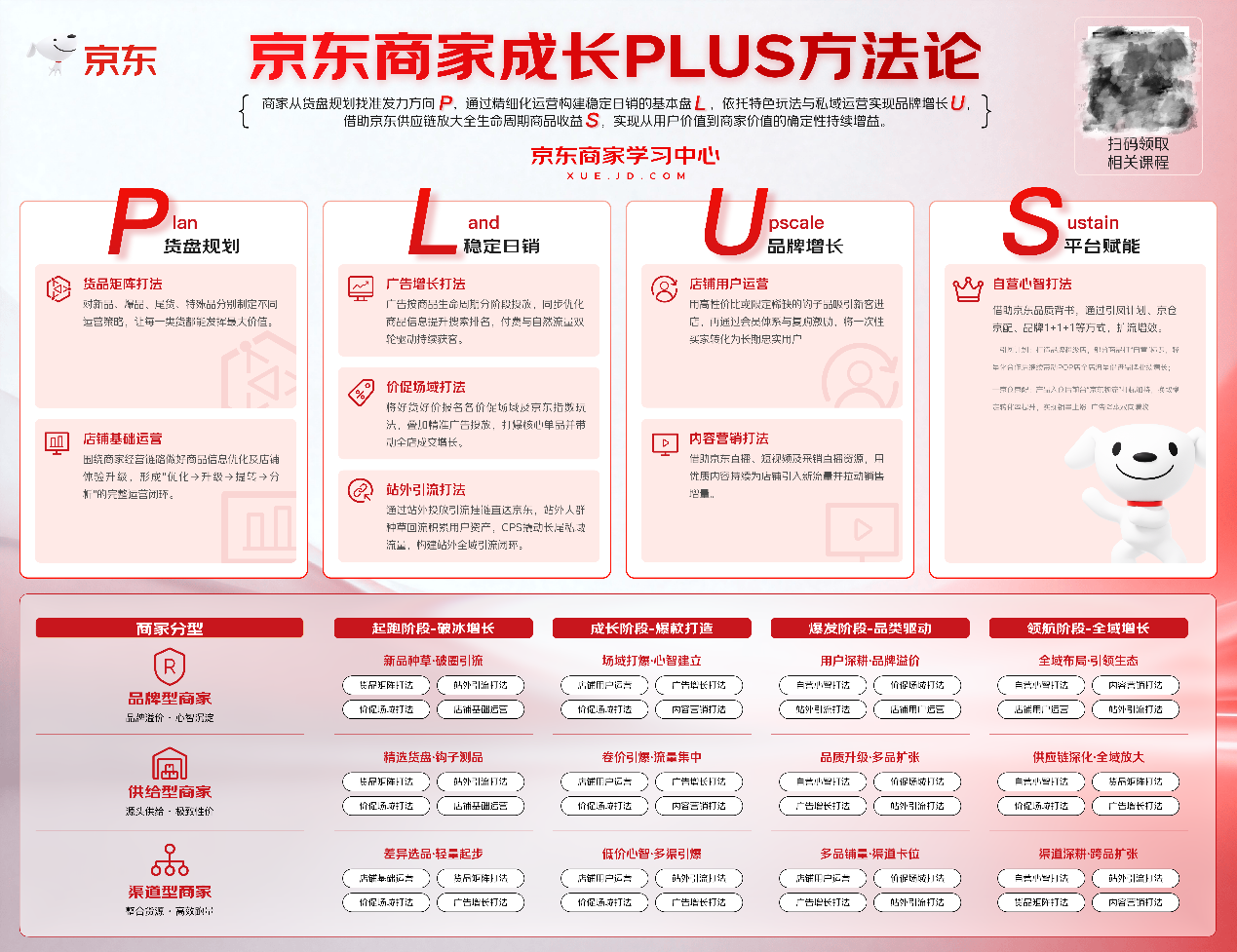
为帮助更多新商家实现破冰增长、老商家突破增长瓶颈,7月15日,京东正式发布“商家成长PLUS方法论”,梳理平台长期以来沉淀的行业经验与经营策略,形成八大实战增长打法,旨在为不同阶段、不同类型的商家提供更清晰的成长路径,让每一家店铺都能明确自身定位、找准下一步方向、掌握具体增长方法。

京东零售平台生态相关负责人表示,此次发布的商家成长PLUS方法论,是京东首次将沉淀多年的平台能力与行业经验,系统性地转化为一套可落地、可复制的实战成长体系。方法论不仅为商家提供了从方式打法到应用工具的完整支撑,也标志着平台与商家的关系,正从单向的资源供给,迈向深度共成长的生态协同新阶段。

该方法论围绕“货盘规划(Plan)”、“稳定日销(Land)”、“品牌增长(Upscale)”、“平台赋能(Sustain)”四大环节,将既有经验、数据和方法,按照商家实际经营逻辑重新梳理,并形成八大打法适配商家不同的增长阶段。


在货盘规划环节,针对商家新品、爆品、尾货、特色品运营混乱、货品价值发挥不充分的痛点,方法论给出货品矩阵、店铺基础运营两大打法,帮助商家分层运营不同货品,并通过持续优化商品页面与店铺体验,助力商家理顺货品结构,提升商品基础转化。

在稳定日销环节,对于商家遇到的店铺流量少、促销带不动全店、日销波动大等经营难题,方法论给出广告增长、价促场域、站外引流三种打法,通过分周期投放广告联动自然流量、以价促活动打爆单品、站外种草与CPS引流相结合等方式,帮助商家店铺拓宽客流渠道,稳定日常成交。

在品牌增长环节,针对商家店铺用户流失快、增量来源单一等痛点,方法论中也提供了用户运营、内容营销两种打法,通过高性价比及稀缺商品吸引客流,以会员活动提升留存复购,并以直播短视频等优质内容持续引流等方式,助力店铺实现品牌客流的稳步积累,进而沉淀忠实用户。

在平台赋能环节,针对商家商品全周期流量、转化竞争力不足的难题,方法论依托自营心智打法,以京东品质优势,通过引凤计划、京仓京配、品牌1+1+1等举措,助力商家店铺提升曝光与下单转化,扩大经营规模。

为更好地助力商家熟悉、应用方法论,京东商家学习中心推出了八大打法专项系列课程,通过直播课、视频课、实战案例等形式,讲解每种打法的适用场景、执行要点,便于商家按需学习、随用随查。京东京麦商家成长中心也为商家搭建了“规划-诊断-建议-反馈”的智能经营闭环体系,以AI助力商家分析诊断店铺数据,精准定位阶段问题,并从八大打法中智能推荐最优策略,为店铺定制从破冰到全域增长的专属路径。

文章来源:亿邦动力

广告
微信
朋友圈

FAQ回顾

京东商家成长PLUS方法论是什么?

是京东于7月15日发布的可落地、可复制的商家实战成长体系,围绕货盘规划、稳定日销、品牌增长、平台赋能四大环节,梳理出八大实战增长打法,为不同阶段、不同类型的商家提供清晰成长路径。

京东商家成长PLUS方法论能解决哪些经营痛点?

可针对性解决商家货品运营混乱、货品价值发挥不充分、店铺流量少日销波动大、用户流失快增量来源单一、商品全周期流量转化竞争力不足等各阶段经营常见痛点。

京东为商家应用成长PLUS方法论提供了哪些支持?

京东商家学习中心推出八大打法专项系列课程,通过直播课、视频课、实战案例等形式讲解实操要点;京麦商家成长中心搭建智能经营闭环体系,以AI诊断店铺问题、推荐最优策略,定制专属增长路径。

这么好看,分享一下?

朋友圈 分享

APP内打开

+1
+1
微信好友 朋友圈 新浪微博 QQ空间
关闭
收藏成功
发送
/140 0