广告
加载中

ROI越来越差后 我们重新理解了内容电商

龚作仁 2026-06-22 16:06
龚作仁 2026/06/22 16:06

邦小白快读

EN
全文速览

本文核心讲解了当前内容电商行业ROI下滑的现状,同时给出了普通从业者可落地的实操干货,帮助商家破解增长难题。

1. 行业核心现状:流量红利消退,竞争加剧,获客与投流成本持续攀升,目前食品、美妆等行业达人带货综合费用占比已经超过50%,2025年双11近80%中小商家处于亏损状态,传统拼达人、拼流量的粗放打法已经难以为继。

2. 可落地实操干货:想要提升ROI,可从四方面入手:一是搭建标签化的内容中台,把所有短视频、直播片段、文案沉淀为可复用的内容资产;二是全流程引入AI工具,辅助内容生成、直播场控和投放优化,走人机协同的路线;三是升级投流策略,采用前置测款+实时优化的模式,同时预留预算布局GEO新场景,抢占AI搜索的曝光位;四是调整组织考核,加入内容资产回报率这类长效指标,打破部门墙。

本文针对内容电商行业ROI下滑的共性痛点,梳理了最新消费趋势和品牌增长路径,还提供了多个经过验证的成功案例,对品牌布局内容电商有较强的指导意义。

1. 行业与消费趋势:当前用户购买行为愈发理性,对价格和评价的敏感度明显提升,平台算法已经向优质短视频和品牌自播倾斜,内容电商的竞争已经转向智能工业化+数据资产化,针对AI搜索优化的GEO营销将成为下一个增长突破口,预计2029年全球市场规模可达3.7万亿元。

2. 品牌落地路径:品牌需要从流量思维转向内容资产思维,转型布局品牌自播,沉淀自有流量和用户数据;搭建内部内容中台,将所有内容素材标签化管理,依托AI快速生成迭代高转化内容;整合千川智能投放与GEO新场景,成立跨部门的内容投流协同团队,考核加入内容资产回报率这类长效指标。

3. 案例验证:已有多个品牌跑通新模式,休闲食品龙头通过AI精细化运营实现GMV增长30%,转化率提升4倍;高端女装致知转型自播后店播GMV翻倍,复购持续提升;上市护肤品企业借助AI实现营收增长92.4%。

本文针对卖家普遍遭遇的ROI下滑、增长停滞的痛点,梳理了行业最新变化,明确了潜在机会、风险和可落地的应对方案,能够帮助卖家找准破局方向。

1. 行业最新变化:当前流量红利已经消退,达人带货综合成本飙升至50%以上,平台算法调整后,自然曝光更看重用户停留与互动,单靠达人粉丝无法保证稳定流量,传统拼资金拼达人的打法已经失效,2025年双11近80%中小卖家处于亏损状态。

2. 新增量机会:AI技术已经渗透内容生产、直播、投流全链路,能够帮助卖家降本提效,AI生成内容的点击率比人工高10%以上,AI投放工具可提升冷启动成功率25%;GEO营销针对AI搜索优化内容是全新流量赛道,提前布局可抢占下一波流量红利。

3. 风险提示与应对:如果不及时跟进技术升级和组织变革,中小卖家后续经营风险会持续升高,还要警惕算法收紧自然流量、AI内容同质化引发用户信任危机、监管政策趋严等潜在风险。卖家可参考文中方法,搭建内容中台,布局AI协同,整合多渠道投流,逐步提升ROI。

本文梳理了内容电商行业的最新变化,给工厂做数字化转型、拓展电商业务提供了清晰的方向,也点明了新的商业机会。

1. 产品生产设计需求变化:当前电商用户购买行为更理性,对产品价格、评价的敏感度明显提升,工厂需要改变过去先生产后卖货的模式,结合电商平台的用户评论、销售数据、弹幕反馈等,快速调整产品设计、sku组合和生产计划,匹配市场真实需求,比如女装品牌致知就通过结合抖音用户反馈调整补货和产品迭代,实现了店播GMV翻倍增长。

2. 数字化与电商转型启示:工厂做自有品牌电商,不能只依赖达人带货,要尽早搭建自有自播团队,沉淀自己的内容资产和用户数据,掌握经营主动权;要尽快引入AI工具,赋能内容生产和直播运营,降本提效,提升转化效率,上市护肤品企业引入AI后,营收增长超过90%就是很好的验证。

3. 新商业机会:AI搜索普及后,针对AI回答优化的GEO营销成为全新流量入口,工厂可以提前布局,把产品信息做成结构化内容嵌入AI知识库,抢占曝光位置,获得新的增长增量。

本文梳理了内容电商行业的最新发展趋势,明确了品牌商家的核心痛点,给营销、电商服务商指明了市场方向和产品创新路径。

1. 行业发展趋势:内容电商已经告别粗放增长的红利期,竞争逻辑转变为智能工业化生产+内容数据资产化,AI会深度介入内容创作、投流优化、直播运营全链路,这是未来三年行业最重要的变革方向;同时针对AI搜索优化的GEO营销成为新的增长点,行业需求旺盛,预计2029年全球GEO市场规模可达3.7万亿元,市场空间广阔。

2. 客户核心痛点:当前品牌商家的核心痛点是投ROI持续下滑,获客成本不断攀升,传统拼达人拼流量的打法已经失效,大部分商家不知道如何体系化落地AI转型和内容资产化运营,亟需成熟的解决方案帮助自己破局增长。

3. 产品与解决方案方向:服务商可以围绕内容中台搭建、AI内容生成、AI直播场控、GEO营销优化这些方向开发产品,帮助品牌实现内容资产沉淀、内容与投流协同,系统性提升ROI,文中易元AI推出的AI内容中台就是已经落地验证的成功方向,能够帮助小团队也持续产出高转化内容。

本文梳理了当前内容电商商家的核心需求,总结了现有平台做法的效果,也点明了平台需要注意的风险和优化方向,对平台运营有参考价值。

1. 商家核心需求:当前商家普遍面临ROI下滑、获客成本高企的问题,商家需要平台提供内容运营与广告投放更耦合的工具,出台更清晰透明的算法规则,加大对优质内容和品牌自播的流量扶持,降低商家对达人流量的依赖,帮助商家降低获客成本。

2. 已验证的有效平台做法:目前抖音打通内容流量池与电商流量池,为电商内容设立独立推荐队列,将巨量千川并入抖音电商组织,流量向优质内容和品牌店播倾斜的做法,已经得到市场验证,能够帮助优质品牌获得增长;快手引入AIGC直播和AI投放工具,也有效提升了冷启动成功率,带动商家GMV增长。

3. 需要规避的风险:平台需要规避持续收紧自然流量导致商家大量亏损、头部和中小商家差距过大的问题,也要提前规范AI生成内容的标准,避免出现大范围内容同质化引发用户信任危机,同时要提前落实内容合规、隐私保护相关要求,规避政策监管风险。

本文总结了内容电商行业的最新变化,提出了新的增长逻辑和商业模式,披露了大量一手案例和数据,对产业研究有较高的参考价值。

1. 产业新动向:流量红利消退后,内容电商的增长逻辑已经从单点爆款驱动转向长期内容资产驱动,竞争模式从拼人力拼达人转向智能工业化生产+人机协同,内容已经从营销配套转变为品牌的核心资产;针对AI搜索优化的GEO营销成为全新的流量赛道,内容与投流深度协同成为新的主流增长范式。

2. 行业新问题:当前内容电商行业正在加速分化,头部品牌通过构建内容生态和智能体系不断扩大优势,中小企业如果不及时转型,经营风险会持续升高;同时行业还出现了过度依赖AI生成内容引发同质化、用户信任危机,算法调整挤压中小商家自然流量,内容合规和隐私保护监管趋严等新问题。

3. 商业模式创新:本文提出的内容中台+AI资产化运营+多场景投流整合的新商业模式,已经通过三个不同赛道的品牌案例验证,证实可以有效提升ROI,为内容电商产业升级提供了新的方向,也为后续相关研究提供了丰富的案例和数据支撑。

返回默认
声明:快读内容全程由AI生成,请注意甄别信息。如您发现问题,请发送邮件至 run@ebrun.com 。

我是 品牌商 卖家 工厂 服务商 平台商 研究者 帮我再读一遍。

Quick Summary

This article analyzes the current decline in return on investment (ROI) across the content e-commerce industry, and shares actionable, practical strategies for ordinary practitioners to help businesses resolve growth stagnation.

1. Core industry status: As traffic fades and competition intensifies, customer acquisition and advertising costs continue to rise. For sectors including food and beauty cosmetics, total influencer marketing costs now exceed 50% of revenue. Nearly 80% of small and medium-sized businesses lost money during the 2025 Double 11 shopping festival, making traditional low-efficiency growth strategies that rely on influencer partnerships and large traffic purchases unsustainable.

2. Actionable strategies: To improve ROI, businesses can make adjustments in four key areas: First, build a tagged content middle platform to organize all short videos, live stream clips, and copy into reusable content assets. Second, integrate AI tools across all workflows to assist content generation, live stream management, and advertising optimization, adopting a human-AI collaboration model. Third, upgrade advertising strategies with a pre-testing and real-time optimization framework, while reserving budget to deploy GEO (Generative Engine Optimization) for new scenarios and claim exposure positions in AI search results. Fourth, adjust organizational performance metrics to include long-term indicators such as content asset return, breaking down internal departmental silos.

This article addresses the widespread pain point of falling ROI in content e-commerce, maps out the latest consumer trends and brand growth paths, and provides multiple verified success cases to guide brands as they build out their content e-commerce strategies.

1. Industry and consumer trends: Consumers are increasingly rational buyers, with significantly higher sensitivity to price and product reviews. Platform algorithms have shifted to favor high-quality short-form video and brand-owned live streaming. Competition in content e-commerce now centers on intelligent industrialized production and data assetization, and GEO marketing optimized for AI search will become the next growth breakthrough, with a projected global market size of 3.7 trillion yuan by 2029.

2. Brand implementation path: Brands need to shift from a traffic-focused mindset to a content asset-focused mindset, transform to prioritize brand-owned live streaming, and build their own private traffic pools and user databases. They should also build an internal content middle platform to manage all content assets with tagging, and leverage AI to quickly generate and iterate high-conversion content. Finally, brands should integrate Qianchuan intelligent advertising with new GEO scenarios, establish cross-functional content and advertising collaboration teams, and add long-term performance indicators such as content asset return to evaluation frameworks.

3. Verified case studies: Multiple brands have already successfully implemented this new model. A leading snack food brand achieved 30% GMV growth and a 4x conversion rate lift through AI-powered fine-grained operations. After pivoting to brand-owned live streaming, high-end women's wear brand Zhizhi doubled its in-store live stream GMV and saw sustained growth in repeat purchases. A listed skincare company delivered 92.4% revenue growth after adopting AI-powered operations.

This article addresses the common pain points of falling ROI and stalled growth faced by sellers, maps out the latest industry changes, clarifies potential opportunities and risks, and outlines actionable solutions to help sellers find a clear path forward.

1. Latest industry changes: Traffic growth has stalled, and total influencer marketing costs have surged to over 50% of revenue. Following platform algorithm adjustments, organic exposure now prioritizes user dwell time and engagement. Relying solely on influencer followers cannot guarantee stable traffic, and the traditional strategy of competing on capital and influencer partnerships is no longer effective. Nearly 80% of small and medium-sized sellers lost money during the 2025 Double 11 shopping festival.

2. New growth opportunities: AI technology has penetrated the full workflow of content creation, live streaming and advertising, helping sellers cut costs and improve efficiency. AI-generated content delivers over 10% higher click-through rates than human-created content, and AI advertising tools increase cold start success rates by 25%. GEO marketing, which optimizes content for AI search, is an entirely new traffic track, and early deployment allows sellers to capture the next wave of traffic dividends.

3. Risk warnings and mitigation: If small and medium-sized sellers fail to keep up with technological upgrades and organizational transformation, their operational risks will continue to rise. They should also watch for potential risks including tighter algorithm restrictions on organic traffic, user trust crises triggered by AI content homogenization, and stricter regulatory scrutiny. Sellers can follow the strategies outlined in this article to build a content middle platform, adopt AI collaboration, integrate multi-channel advertising, and gradually improve ROI.

This article maps out the latest changes in the content e-commerce industry, provides clear direction for factories pursuing digital transformation and e-commerce expansion, and highlights new business opportunities.

1. Shifts in product design and production demand: Today's e-commerce shoppers are more rational buyers, with significantly higher sensitivity to price and product reviews. Factories need to abandon the traditional "produce first, sell later" model, and instead adjust product design, SKU assortments, and production plans quickly based on user reviews, sales data and live stream comment feedback from e-commerce platforms to match actual market demand. For example, women's wear brand Zhizhi adjusted restocking and product iteration based on Douyin user feedback, and achieved a doubling of in-store live stream GMV.

2. Insights for digital and e-commerce transformation: For factories building their own branded e-commerce businesses, relying solely on influencer marketing is unsustainable. They should build their own in-house live streaming teams as early as possible, accumulate their own content assets and user data, and take control of their operations. They should also adopt AI tools as soon as possible to empower content creation and live stream operations, cut costs, improve efficiency, and boost conversion rates. The 90%+ revenue growth delivered by a listed skincare company after adopting AI serves as strong validation of this approach.

3. New business opportunities: With the growing popularity of AI search, GEO marketing optimized for AI-generated answers has become an entirely new traffic entry point. Factories can deploy this strategy early, structure product information to embed in AI knowledge bases, claim top exposure positions, and capture new incremental growth.

This article maps out the latest development trends of the content e-commerce industry, clarifies the core pain points of brand merchants, and points out market directions and product innovation paths for marketing and e-commerce service providers.

1. Industry development trends: Content e-commerce has left the era of粗放 growth driven by traffic dividends behind. The core logic of competition has shifted to intelligent industrialized production and content data assetization. AI will deeply integrate into the full workflow of content creation, advertising optimization, and live stream operations, making it the most important industry transformation direction over the next three years. At the same time, GEO marketing optimized for AI search has emerged as a new growth driver with strong market demand; its projected global market size will reach 3.7 trillion yuan by 2029, representing enormous market opportunity.

2. Core customer pain points: The core pain point for brands and merchants today is continuously falling ROI and rising customer acquisition costs. Traditional strategies competing on influencer partnerships and traffic purchases have become ineffective. Most merchants lack guidance on how to systematically implement AI transformation and content asset operation, and there is strong demand for mature solutions to help them break through growth stagnation.

3. Product and solution directions: Service providers can develop products focused on content middle platform development, AI content generation, AI live stream management, and GEO marketing optimization, to help brands accumulate content assets and align content strategy with advertising operations, systematically improving ROI. The AI content middle platform launched by Yiyuan AI, highlighted in this article, is a successfully validated direction that enables even small teams to consistently produce high-conversion content.

This article summarizes the core needs of content e-commerce sellers on platforms, evaluates the effectiveness of existing platform practices, and highlights risks to monitor and optimization directions for platforms, offering valuable reference for platform operations.

1. Core merchant needs: Most merchants currently face falling ROI and high customer acquisition costs. They need platforms to provide tools that better integrate content operations and advertising, publish clearer, more transparent algorithm rules, increase traffic support for high-quality content and brand-owned live streaming, and reduce merchant dependence on influencer traffic to bring down customer acquisition costs.

2. Verified effective platform practices: Douyin's strategy of integrating content and e-commerce traffic pools, creating an independent recommendation queue for e-commerce content, integrating Jumai Qianchuan into the Douyin e-commerce organization, and prioritizing traffic for high-quality content and brand-owned live streaming has been validated by the market to help high-quality brands achieve growth. Kuaishou's introduction of AIGC live streaming and AI advertising tools has also effectively improved cold start success rates and driven merchant GMV growth.

3. Risks to avoid: Platforms need to avoid the problems of widespread merchant losses and a widening gap between leading brands and small and medium-sized merchants caused by continuous cuts to organic traffic. They should also establish standards for AI-generated content in advance to prevent a user trust crisis caused by large-scale content homogenization, and implement requirements for content compliance and user privacy protection early to mitigate regulatory risks.

This article summarizes the latest changes in the content e-commerce industry, proposes a new growth logic and business model, and discloses a large number of first-hand case studies and data, offering high reference value for industry research.

1. New industry trends: After the end of the traffic dividend era, the growth logic of content e-commerce has shifted from single-point viral product-driven growth to long-term growth driven by content assets. The competitive model has shifted from competing on labor and influencer partnerships to intelligent industrialized production and human-AI collaboration. Content has evolved from a supporting marketing function to a core brand asset. GEO marketing optimized for AI search has emerged as an entirely new traffic track, and deep alignment between content strategy and advertising has become the new mainstream growth paradigm.

2. New emerging industry issues: The content e-commerce industry is currently experiencing accelerating polarization. Leading brands continue to expand their advantages by building content ecosystems and intelligent operation systems, and operational risks will continue to rise for small and medium-sized enterprises that fail to transform in time. The industry also faces new issues including homogenization and user trust crises caused by over-reliance on AI-generated content, squeezed organic traffic for small and medium-sized merchants following algorithm adjustments, and stricter regulatory scrutiny over content compliance and privacy protection.

3. Business model innovation: The new business model outlined in this article—combining a content middle platform, AI-powered asset operation, and multi-scenario advertising integration—has been validated by brand case studies across three different sectors. It has been proven to effectively improve ROI, provides a new direction for content e-commerce industry upgrading, and offers rich case and data support for follow-up related research.

Disclaimer: The "Quick Summary" content is entirely generated by AI. Please exercise discretion when interpreting the information. For issues or corrections, please email run@ebrun.com .

I am a Brand Seller Factory Service Provider Marketplace Seller Researcher Read it again.

随着流量红利消退、竞争加剧,内容电商的投流成本与获客成本持续攀升。近年来,抖音电商等平台GMV增长虽高(2024年同比+30%,目标2025年4.2万亿【2】),但商家投放ROI不断下降【1】。在这样的背景下,我们认为内容电商必须重塑增长逻辑:构建持续输出高转化内容的中台与资产库,依托AI和大数据提升生产效率;整合投放策略与新型营销渠道(如GEO),聚焦“内容→流量→转化”的闭环优化;并进行组织及KPI变革,打造内容与投流协同的跨部门团队。唯有如此,品牌才能在下一个五年获得内容与流量的先发优势

一、行业现状:焦虑与趋势

近两年,内容电商行业呈现出明显的获客成本上升、ROI走低的趋势。一方面,直播带货竞争逐渐加剧,达人带货成本飞涨。据亿邦动力调查,一些食品、美妆和服装行业的达人直播费用比已经飙升到50%以上【1】(达人佣金、坑位费及投流费等占比)。另一方面,用户购买行为趋于理性,价格与评价敏感度提升,使得商家“哗众取宠式”的营销策略难以维系以前的转化率。从平台端看,抖音电商数据显示2024年GMV约3.5万亿元,同比增长约30%,并朝2025年4.2万亿元发力【2】;但与此同时,商家们感到花更大预算仍不见效益:2025年上半年某批量投放的综合ROI已低于2023年底水准【1】。多数品牌主不再满足于“随便播都能挣钱”的时代。对此,一位品牌运营者感慨:“现在一个腰部达人要商家提供投流预算,否则几乎没法出单”,直指流量越来越靠金钱堆砌(缺乏自然推荐)【1】。

这种局面导致行业焦虑情绪高涨:团队越扩张、投入越多,增长却越困难。不少商家尝试增加内容产能、频频做大直播间,但ROI反而继续下滑。2025年双11期间,近80%的中小商家处于亏损状态【1】。在如此“冰火两重天”的局面下,传统的“拼达人+拼流量”思维已难为继,品牌主亟需重新审视内容与流量的关系。

二、底层驱动:算法、内容供给、投流机制与新场景

算法与流量分配的变化:各大平台加快整合内容池与电商池的步伐。2024年,抖音实现内容流量池与电商流量池互通,平台为电商内容设立独立推荐队列,直接提高电商商家的流量上限[1]。2025年,平台继续调整推荐策略,正在向优质短视频和品牌店播倾斜【2】[1]。在此背景下,商家无论做短视频还是直播,都需符合新的推荐规则:自然停留和互动比之前更为重要,单靠达人粉丝数无法保证持续曝光。此外,抖音等平台逐渐注重“数据化经营”:2024年巨量千川并入抖音电商组织,算法团队合并,对GMV和ROI负责【2†L31-L36】,意味着广告投放将与内容运营更加耦合。

内容供给:从创意驱动到资产驱动:过去内容电商依赖几个“爆款”或爆发式直播;现在则需要海量且高质量的内容供给。用户留存时间短、迭代快,一条短视频7小时后可能就跌出热榜。于是,能否快速构建“内容库”成为关键。品牌需要将短视频、直播剪辑、话术脚本、场景花絮等沉淀为“可复用的内容资产”,通过标签化管理和数据分析找出高转化模板。易元AI负责人表示:“内容电商的竞争核心已经变成谁能先抢占用户注意力,我们开发的AI内容系统可以在海量素材中自动识别和生成高转化的创意,助力品牌持续产出有价值内容。”这意味着,AI辅助的内容生成和迭代正成为行业标配:AI可以拆解爆款结构、自动生成脚本并裂变素材,同时结合用户反馈预测CTR,形成数据驱动的内容生产模式[2]。总之,平台已不再只奖励一时的“噱头”,而是鼓励商家把短视频与直播产出转变为长期可用的“资产”,并通过AI不断改良。

投流与GEO场景化:传统信息流广告也在进化。一方面,千川智能投放功能升级:品牌端深入“看-刷-搜-购”用户旅程,广告产品朝覆盖和种草方向深度扩展[3]。比如,中国日报报导指出,抖音的品牌广告正覆盖300余个细分行业,与10万+品牌合作,最高带动GMV增长69%[3]。另一方面,新兴渠道如GEO营销逐渐进入视野。GEO(Generation Engine Optimization)指针对AI搜索引擎回答进行的内容优化。随着AI助手日活用户激增,大量品牌开始研究如何“被AI回答”——一份研究预估,2029年全球GEO市场规模或达3.7万亿元【5†L138-L146】。具体到电商,这意味着用户越来越多地通过AI对话了解商品,品牌需要将产品信息嵌入AI的知识库和FAQ场景中。易元AI负责人指出:“未来品牌营销不仅要争夺流量入口,还要争夺AI问答结果的曝光权——这需要我们在内容中植入结构化信息,让产品自然出现在用户查询中。”这是一个从“拦截用户”到“融入用户问答”的转变,也将成为下一个ROI突破口。

AI场控与人机协同:直播场景的智能化趋势不可逆。业内报告指出,AI技术已经渗透到直播电商的各环节,从智能推荐到虚拟客服再到供应链优化,大大提高了运营效率[2]。快手为例,自2023年全面启动AI战略,引入多种AIGC产品:虚拟数字人直播能根据实时弹幕与观众互动,2024年Q4日均消耗突破3000万次[4];全自动投放Agent上线后,客户渗透率接近60%,冷启动成功率提升25%,助力自然流量带来60%的GMV增长[5]。换言之,未来的直播间越来越像“智能驾驶”:算法负责分析弹幕情绪、自动提示话术、调整商品露出时机,而人类主播则专注于情感传递和售后服务。内容电商公司要认识到,AI不会一夜之间取代主播,但它会重塑团队的工作方式。企业应及早培养AI场控能力,如使用AI监测直播瓶颈、实时优化投流,通过数据闭环持续迭代直播策略。这也是未来3年行业内最重要的变革之一。

综上,平台算法与用户习惯的变化、内容供给模式的升级、新型投流渠道的出现,以及AI技术的深度介入,共同驱动了内容电商的生态重塑。单点爆款和单纯靠人力的打法正在失效,内容和流量赛道的竞争方式正在向“智能工业化+数据资产化”转变。

三、典型脱敏案例与数据支撑


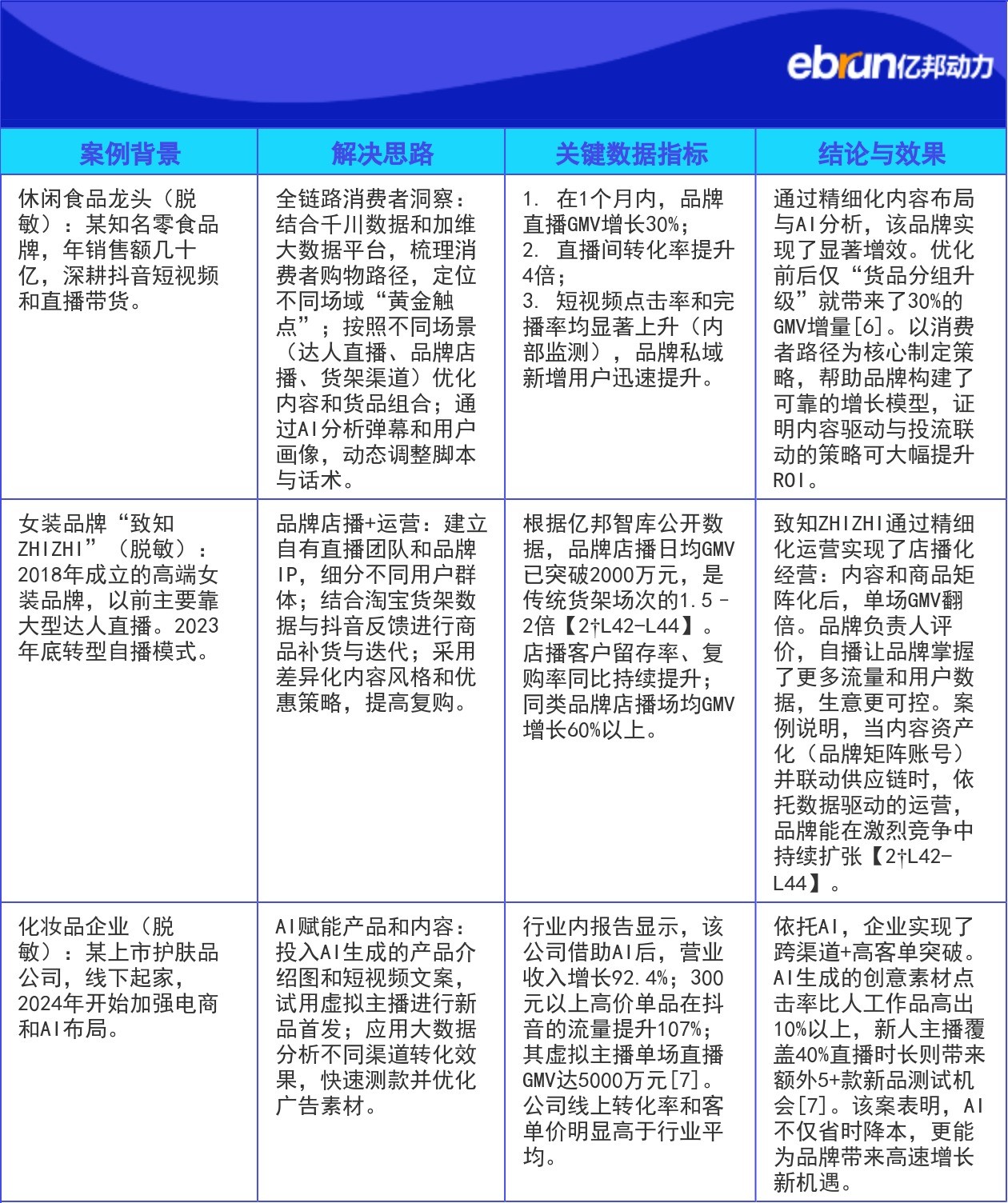
案例背景 解决思路 关键数据指标 结论与效果
休闲食品龙头(脱敏):某知名零食品牌,年销售额几十亿,深耕抖音短视频和直播带货。 全链路消费者洞察:结合千川数据和加维大数据平台,梳理消费者购物路径,定位不同场域“黄金触点”;按照不同场景(达人直播、品牌店播、货架渠道)优化内容和货品组合;通过AI分析弹幕和用户画像,动态调整脚本与话术。 1. 在1个月内,品牌直播GMV增长30%;

2. 直播间转化率提升4倍;

3. 短视频点击率和完播率均显著上升(内部监测),品牌私域新增用户迅速提升。

通过精细化内容布局与AI分析,该品牌实现了显著增效。优化前后仅“货品分组升级”就带来了30%的GMV增量[6]。以消费者路径为核心制定策略,帮助品牌构建了可靠的增长模型,证明内容驱动与投流联动的策略可大幅提升ROI。
女装品牌“致知ZHIZHI”(脱敏):2018年成立的高端女装品牌,以前主要靠大型达人直播。2023年底转型自播模式。 品牌店播+运营:建立自有直播团队和品牌IP,细分不同用户群体;结合淘宝货架数据与抖音反馈进行商品补货与迭代;采用差异化内容风格和优惠策略,提高复购。 根据亿邦智库公开数据,品牌店播日均GMV已突破2000万元,是传统货架场次的1.5–2倍【2†L42-L44】。店播客户留存率、复购率同比持续提升;同类品牌店播场均GMV增长60%以上。 致知ZHIZHI通过精细化运营实现了店播化经营:内容和商品矩阵化后,单场GMV翻倍。品牌负责人评价,自播让品牌掌握了更多流量和用户数据,生意更可控。案例说明,当内容资产化(品牌矩阵账号)并联动供应链时,依托数据驱动的运营,品牌能在激烈竞争中持续扩张【2†L42-L44】。
化妆品企业(脱敏):某上市护肤品公司,线下起家,2024年开始加强电商和AI布局。 AI赋能产品和内容:投入AI生成的产品介绍图和短视频文案,试用虚拟主播进行新品首发;应用大数据分析不同渠道转化效果,快速测款并优化广告素材。 行业内报告显示,该公司借助AI后,营业收入增长92.4%;300元以上高价单品在抖音的流量提升107%;其虚拟主播单场直播GMV达5000万元[7]。公司线上转化率和客单价明显高于行业平均。 依托AI,企业实现了跨渠道+高客单突破。AI生成的创意素材点击率比人工作品高出10%以上,新人主播覆盖40%直播时长则带来额外5+款新品测试机会[7]。该案表明,AI不仅省时降本,更能为品牌带来高速增长新机遇。

注:以上案例为脱敏复盘,数据来源于亿邦智库调查、公开报道及企业内部监测【1】【2】【36】。

四、战略与组织建议:体系化落地

基于上述分析,我们提出以下内容与投流协同的核心对策:

建立内容中台与资产库:应对“量产”需求,打破部门壁垒,打造内部内容中台。将所有视频、直播片段、文案、话术、SKU信息汇聚管理,形成标签化的内容资产池。如此,每次投放和直播不仅是输出,更是更新资产库的过程。整合后,销售数据、用户反馈、广告投放结果都要反馈到中台,驱动内容的不断迭代。易元AI负责人指出:“未来内容生产要像流水线一样可复制,我们已经开发的内容中台,可以自动从历史素材中提取高转化元素,输出标准化脚本,让小团队也能持续产出爆款潜质的内容。”这意味着通过中台建设,小团队即可撬动大流量。

AI协同与内容资产化:将AI能力融入创作和投流全流程。例如使用AIGC自动生成选题脚本,一键把产品卖点变成短视频场景;直播时实时分析弹幕并自动为主播提示话术;AI辅助选定最佳投放渠道和时间。配合此类技术改造,建立内容资产化指标:不仅关注短期ROI,更要跟踪内容资产的“回报率”(如CPAn长期下降、内容复用次数增长等)。同时,内部培训团队掌握AI工具使用和数据解读,强化“人机协同”的工作模式。

投流策略与GEO整合:升级千川投放策略,引入“前置测款+实时优化”的流程。具体操作上,可先对多个候选素材或产品进行小规模投放,测算精准人群和初步ROI,再集中资源快速放大验证效果。与此同时,不忽视GEO等新场景。GEO营销需要企业在投流策略中预留预算:一方面在主渠道(信息流、达人)持续投放,另一方面同步制作供AI推荐的信息内容,如FAQ、行业报道等,让品牌信息在AI助手结果中占据“黄金坑位”。投流层面,要制定多维度KPI(覆盖率、转化率、回报周期等),避免单纯追求短期ROI。组织上建议成立跨部门增长团队(Content+Marketing+Data+IT),确保内容生产、投放执行与效果反馈的快速闭环。

KPI与组织变革:在考核层面,加入长效指标。例如设置“内容产能指数”(月度产出素材量和调优频次)、“内容资产ROI”(新增内容在后续投放中带来的成本节约)等。同时,要减少部门间信息孤岛,鼓励内容团队与投流/运营团队联合制定目标。传统SOP需加入“数据复盘”,每场活动后迅速回收数据、复盘创意与转化,以数据为依据调整下一次方案。组织上,可以考虑“内容-投放联动”的矩阵化团队,如将KOL、直播运营与广告运营纳入同一业务单元,由项目制团队负责一个品类,从内容到投放一条龙执行并共享收益。

总体而言,内容不再是可有可无的花絮,而是企业的核心资产;流量转化不再是单一渠道投放,而是内容与场景的协同结果;首发优势体现在谁能最快洞察趋势与数据并快速迭代内容;投流也将从单纯的买流量转向“精准+智能投放”。只有构建上述闭环,品牌才能有效化解ROI压力,稳步实现增长。

五、未来三年演化路径与风险


未来三年内,内容电商将加速分化:头部品牌构建起强大的内容生态和智能投流体系,持续扩大优势;中小企业若不重视技术升级和组织重塑,则风险日增。潜在风险包括:算法继续收紧(新规则可能缩减自然流量);内容同质化与信任危机(过度依赖AI生成可能遭用户反感);监管加强(内容合规、隐私保护政策收紧)等。企业应积极关注平台动向和政策变化,及时调整策略。

署名:亿玛在线·易元AI研究院 / 核心负责人

亿玛在线拥有20余年数字营销与全域电商服务经验。易元AI研究院由亿玛在线发起,聚焦AI与电商融合的行业洞察与方法论,为品牌提供内容运营与智能投流一体化解决方案,助力企业实现增长升级。

参考文献

[1]36氪,《费比超50%?电商苦达播久矣》,2025年7月 来源[1]。

[2]CBNData,《抖音电商加速分化:店播崛起,达播退潮》,2025年[8]【2†L25-L30】。

[3] 中国日报,《2024,品牌广告怎么投?巨量引擎开年攻略提供指引》,2024年2月[3]。

[4] 中国国际电子商务中心,《直播电商高质量发展报告》,2025年[2][4]。

[5]36氪,《GEO爆火,AI被广告“入侵”》,2025年12月[9]。

[6]Feigua Research,《2025年电商行业深度报告-AI+电商服务进入提效阶段》,2025年(内容见东方财富《2025AI+直播+私域洞察报告》)。

[1] 费比超50%?电商苦达播久矣-36氪

https://36kr.com/p/3381387593591298

[2] [4] [5] 直播电商高质量发展报告final

https://ciecc.ec.com.cn/upload/article/20250508/20250508102036216.pdf

[3]2024,品牌广告怎么投?巨量引擎开年攻略提供指引 - 中国日报网

https://cn.chinadaily.com.cn/a/202402/09/WS65c5c8bca31026469ab1807e.html

[6] 抖音直播ROI低?解锁抖音电商“黄金点位”,破解转化谜题-深度洞察-意略明-Empower the Future of Marketing

https://illuminera.com/994.html

[7] 专题:2025AI+直播+私域电商行业洞察报告|附200+份报告PDF、数据仪表盘汇总下载_财富号_东方财富网

https://caifuhao.eastmoney.com/news/20251208164146755788990

[8] 抖音电商加速分化:店播崛起,达播退潮 |CBNData

https://www.cbndata.com/information/293730

[9]GEO爆火,AI被广告“入侵”-36氪

https://36kr.com/p/3616403497714951

注:文/龚作仁,文章来源:Laborer,本文为作者独立观点,不代表亿邦动力立场。

文章来源:Laborer

广告
微信
朋友圈

这么好看,分享一下?

朋友圈 分享

APP内打开

+1
+1
微信好友 朋友圈 新浪微博 QQ空间
关闭
收藏成功
发送
/140 0