广告
加载中

成分功效对标米诺地尔?护发品牌可氏利夫完成A轮融资

亿邦动力 2026-06-16 09:18
亿邦动力 2026/06/16 09:18

邦小白快读

EN
全文速览

本文核心介绍了刚完成A轮融资的国内防脱护发品牌可氏利夫的核心信息,给普通消费者的干货如下

1. 核心技术与功效:该品牌是国内首个将超分子技术应用在防脱个护领域的品牌,拥有该技术在国内护发领域的排他使用权,能让活性成分累计渗透量提升5倍以上直达毛囊。其专利成分可氏肽的三项核心防脱指标,包括炎症因子抑制率等,均优于常用防脱药物米诺地尔,品牌还有主打促黑功效的核心专利可利乌。

2. 线下体验渠道:品牌目前发力私域+线下渠道,首创“乐碳1389”线下模式,在药房、母婴店、写字楼等多个场景都嵌入了标准化服务舱,可以做8分钟AI头皮检测和精华导入护理,目前已有多家落地门店,年内将拓展到3000家,有防脱护发需求的消费者可以就近体验相关服务。

本文给护发赛道品牌商提供了可参考的发展经验和行业信息,具体干货如下

1. 产品研发与差异化:切入防脱细分赛道后,可氏利夫通过绑定超分子技术排他使用权打造技术壁垒,核心专利成分功效对标甚至优于常用防脱药物米诺地尔,建立了鲜明的产品差异化优势,对其他品牌做产品研发有参考价值。

2. 渠道创新:品牌跳出传统线上流量逻辑,发力私域与线下渠道,首创“乐碳1389”轻资产线下拓店模式,通过3平米小服务舱嵌入多流量场景做标准化服务,拓店速度快、成本低。

3. 行业趋势:目前该品牌年销售额达6000万元,已签约五个省份的省级代理,年内预计拓店突破3000家,验证了防脱赛道功效化、体验化的消费趋势,符合当下消费者的需求方向。

本文给护发相关卖家分享了赛道机会、可参考的商业模式和合作机会,具体干货如下

1. 赛道机会:防脱护发是当前需求旺盛的增长赛道,消费者越来越看重产品的实际功效,主打成分升级、功效明确的防脱产品有充足的市场空间,值得卖家切入布局。

2. 可参考的创新模式:可氏利夫首创“乐碳1389”线下店中店模式,属于轻资产拓店模式,只用3平米的标准化服务舱,就能嵌入药房、母婴店、写字楼等已有流量场景,不需要大额租金投入开门店,大幅降低了线下拓店的门槛和成本。

3. 合作与风险提示:目前该品牌正在快速拓店,已经完成五个省份的省级代理签约,年内预计门店突破3000家,有资源的卖家可以对接代理合作拓展业务,同时要注意,该模式的核心竞争力是技术专利,卖家入局需要打造自身的差异化优势,规避同质化竞争风险。

本文给个护护发领域的工厂提供了市场需求信息、商业机会和转型启示,具体干货如下

1. 产品生产设计需求:当下防脱护发市场的消费需求偏向功效化,消费者对成分渗透效果、实际防脱功效要求越来越高,超分子技术应用在护发领域是新的产品方向,工厂需要提升适配专利成分应用、高端技术落地的生产能力,匹配品牌的差异化产品需求。

2. 商业合作机会:可氏利夫目前正处于快速扩张阶段,已经完成五个省份的省级代理签约,计划年内将门店数量拓展到3000家,对标准化的服务舱设备、相关护理产品有大量的采购需求,符合资质的工厂可以对接品牌寻求合作机会。

3. 转型启示:工厂可以加大和品牌方的技术研发合作,绑定核心专利技术,打造差异化的生产供应能力,同时适配线下轻服务模式对标准化产品的要求,提升自身的市场竞争力。

本文给个护护发领域相关服务商总结了行业趋势、客户痛点和市场机会,具体干货如下

1. 行业发展趋势:当前国内护发赛道正在向功效化、体验化、线上线下融合方向发展,越来越多新兴功效品牌注重技术研发和线下渠道布局,对相关配套服务有大量的需求,市场空间充足。

2. 客户核心痛点:新兴护发品牌要做轻资产快速拓店,需要适配小面积场景的标准化线下服务解决方案,包括AI头皮检测设备供应、标准化空间设计、招商对接、运营配套等,目前这类专属解决方案还比较稀缺。

3. 市场机会:可氏利夫计划年内将门店拓展到3000家,多个省级代理正在落地,相关的设备服务商、营销服务商、招商服务商、空间设计服务商可以对接品牌需求,针对轻资产店中店场景开发标准化解决方案,匹配品牌快速拓店的需求,拓展自身客户群体。

本文给美妆个护相关平台商总结了新兴品牌的需求、可参考的运营方向和风险提示,具体干货如下

1. 品牌端的需求:新兴功效护发品牌不再只依赖线上公域流量,越来越重视私域运营和线下渠道布局,需要平台能够提供线下招商对接、私域运营工具等相关配套支持,帮助品牌快速拓展渠道。

2. 平台招商运营方向:可氏利夫的“百业+店中店”轻资产拓店模式,门槛低、拓店速度快,符合当下新兴品牌的扩张需求,平台可以引入这类有核心技术专利的功效型新兴品牌,丰富平台的品牌品类,吸引更多需求精准的消费者。

3. 风险规避:这类新兴品牌的核心竞争力是技术专利和排他使用权,平台在引入品牌的时候,需要核查相关专利资质,确认知识产权的合法性,规避知识产权相关的风险,保障平台和消费者的权益。

本文给国内美妆护发产业研究者提供了防脱赛道的最新产业动向和创新商业模式案例,具体干货如下

1. 产业资本与技术新动向:防脱护发已经成为资本看好的细分赛道,本次可氏利夫完成数千万元A轮融资,加上此前已经完成的两轮融资,反映资本对功效型防脱细分赛道的认可度正在提升。技术层面,超分子技术已经开始落地应用在国内个护防脱领域,出现了拥有该技术护发领域排他使用权的品牌,核心成分功效对标临床药物,推动整个行业向功效化升级。

2. 商业模式创新:可氏利夫首创“乐碳1389”线下轻服务拓店模式,依托3平米标准化服务舱嵌入多场景,结合AI检测和标准化护理,走轻资产快速拓店的路线,目前已经完成五个省份的省级代理签约,年内预计门店突破3000家,是个护领域线下渠道创新的新案例,具备较高的研究价值。

返回默认
声明:快读内容全程由AI生成,请注意甄别信息。如您发现问题,请发送邮件至 run@ebrun.com 。

我是 品牌商 卖家 工厂 服务商 平台商 研究者 帮我再读一遍。

Quick Summary

This article introduces core information about Koshleaf, a Chinese anti-hair loss hair care brand that recently completed its Series A funding round. Key takeaways for general consumers are as follows:

1. Core technology and efficacy: Koshleaf is the first domestic brand to apply supramolecular technology in the anti-hair loss personal care space, holding exclusive rights to use the technology in China's hair care sector. The technology enables a more than 5-fold increase in cumulative penetration of active ingredients, delivering them directly to hair follicles. Three core anti-hair loss indicators of its patented ingredient Kos peptide, including inflammatory factor inhibition rate, all outperform minoxidil, the commonly used anti-hair loss medication. The brand also holds another core patent, Keliwu, which is focused on hair pigmentation promotion.

2. Offline experience channels: The brand currently focuses on private domain operations and offline channels, and has pioneered the "LeTan 1389" offline model. It has embedded standardized service booths in multiple scenarios including pharmacies, maternal and baby stores, and office buildings, offering 8-minute AI scalp testing and essence infusion care. Multiple booths are already operational, and the network will expand to 3,000 locations by the end of the year. Consumers with anti-hair loss and hair care needs can experience related services nearby.

This article shares actionable industry insights and development references for brands in the hair care track. Key takeaways are as follows:

1. Product R&D and differentiation: After entering the anti-hair loss niche, Koshleaf built technical barriers by securing exclusive rights to supramolecular technology. The efficacy of its core patented ingredient matches or even outperforms minoxidil, creating strong product differentiation that offers a valuable reference for R&D strategies of other brands.

2. Channel innovation: Moving beyond the traditional online traffic logic, Koshleaf focuses on private domain and offline channels, and pioneered the asset-light "LeTan 1389" offline expansion model. It deploys 3-square-meter standardized service booths embedded in high-traffic scenarios to deliver standardized services, enabling fast expansion at low cost.

3. Industry trend: Koshleaf currently generates annual revenue of 60 million RMB, has signed provincial-level distribution agents for five Chinese provinces, and plans to expand to over 3,000 locations by year-end. Its growth validates the consumer trend toward efficacy and experiential services in the anti-hair loss sector, which aligns with current consumer demand.

This article shares track opportunities, replicable business models and cooperation opportunities for hair care-related sellers. Key takeaways are as follows:

1. Track opportunity: Anti-hair loss care is a fast-growing track with robust demand. Consumers increasingly prioritize proven product efficacy, creating ample market space for anti-hair loss products built around upgraded ingredients and clear efficacy, making it an attractive segment for sellers to enter.

2. Replicable innovative model: Koshleaf's pioneering "LeTan 1389" in-store offline model is an asset-light expansion approach that only requires 3-square-meter standardized service booths embedded in existing high-traffic locations such as pharmacies, maternal and baby stores, and office buildings. It eliminates the need for large rental expenditures for standalone stores, drastically lowering the barrier and cost of offline expansion.

3. Cooperation and risk notes: Koshleaf is currently expanding rapidly, has signed provincial distribution agreements for five provinces, and targets over 3,000 locations by year-end. Sellers with relevant local resources can pursue distribution cooperation to grow their business. It is worth noting that technological patents form the core competitiveness of this model, so new entrants must build their own differentiation to avoid the risk of homogenized competition.

This article shares market demand insights, business opportunities and transformation inspiration for factories in the personal care and hair care sector. Key takeaways are as follows:

1. Product design and manufacturing demand: Current consumer demand in the anti-hair loss market is increasingly efficacy-focused, with growing requirements for ingredient penetration and proven anti-hair loss results. The application of supramolecular technology in hair care represents a new product direction, so factories need to upgrade their manufacturing capabilities to support patented ingredient applications and advanced technology delivery, to meet the differentiated product demand of brands.

2. Business cooperation opportunities: Koshleaf is in a stage of rapid expansion, has signed provincial distribution agreements for five provinces, and plans to scale to 3,000 locations by year-end. It has substantial demand for standardized service booth equipment and related care products, so qualified factories can reach out to the brand to explore cooperation opportunities.

3. Transformation inspiration: Factories can deepen R&D cooperation with brand partners, bind to core patented technologies, build differentiated production and supply capabilities, and adapt to the standardized product requirements of offline light service models to improve their own market competitiveness.

This article summarizes industry trends, client pain points and market opportunities for service providers in the personal care and hair care sector. Key takeaways are as follows:

1. Industry development trend: China's hair care track is moving toward efficacy, experiential services, and online-offline integration. A growing number of emerging efficacy-focused brands are prioritizing technological R&D and offline channel layout, creating strong demand for supporting services and large untapped market space.

2. Core client pain points: When emerging hair care brands pursue asset-light rapid expansion, they need standardized offline service solutions adapted for small spaces, including AI scalp testing equipment supply, standardized space design, investment matching, and operational support. Specialized solutions of this type remain scarce in the current market.

3. Market opportunities: Koshleaf plans to expand to 3,000 locations by year-end, with multiple provincial distribution agreements already signed. Equipment providers, marketing service providers, investment matching services, and space design service providers can align with the brand's needs, develop standardized solutions for asset-light in-store scenarios to match the brand's rapid expansion goals, and grow their own client base.

This article summarizes emerging brand needs, actionable operational directions and risk notes for beauty and personal care platform operators. Key takeaways are as follows:

1. Demand from brand partners: Emerging efficacy-focused hair care brands no longer rely solely on online public domain traffic, and are increasingly prioritizing private domain operations and offline channel layout. They require platforms to provide supporting services such as offline investment matching and private domain operation tools to support fast channel expansion.

2. Optimized merchant acquisition and operation direction: Koshleaf's asset-light "industry + in-store" expansion model features low entry barriers and fast expansion, which aligns with the expansion needs of current emerging brands. Platforms can onboard such efficacy-focused emerging brands with core technical patents to enrich their brand portfolio and attract more targeted consumers.

3. Risk mitigation: The core competitiveness of such emerging brands comes from technical patents and exclusive usage rights. When onboarding new brands, platforms need to verify relevant patent qualifications, confirm the legality of intellectual property rights, mitigate IP-related risks, and protect the interests of both the platform and consumers.

This article shares the latest industry developments and an innovative business model case for researchers studying China's beauty and hair care industry. Key takeaways are as follows:

1. New trends in industrial capital and technology: Anti-hair loss care has become a niche segment favored by capital. Koshleaf's recent completion of tens of millions of RMB in Series A funding, following two earlier funding rounds, reflects growing capital confidence in the efficacy-focused anti-hair loss niche. On the technical side, supramolecular technology has begun to see commercial application in China's anti-hair loss personal care sector, with one brand holding exclusive usage rights to the technology in hair care. Its core ingredient delivers efficacy matching that of clinical medications, driving the entire industry toward efficacy-focused upgrading.

2. Business model innovation: Koshleaf has pioneered the "LeTan 1389" asset-light offline service expansion model, which relies on 3-square-meter standardized service booths embedded in multiple scenarios, combined with AI testing and standardized care to enable fast asset-light expansion. To date, it has signed provincial distribution agreements for five provinces and targets over 3,000 locations by year-end. This is a new case of offline channel innovation in the personal care industry with high research value.

Disclaimer: The "Quick Summary" content is entirely generated by AI. Please exercise discretion when interpreting the information. For issues or corrections, please email run@ebrun.com .

I am a Brand Seller Factory Service Provider Marketplace Seller Researcher Read it again.

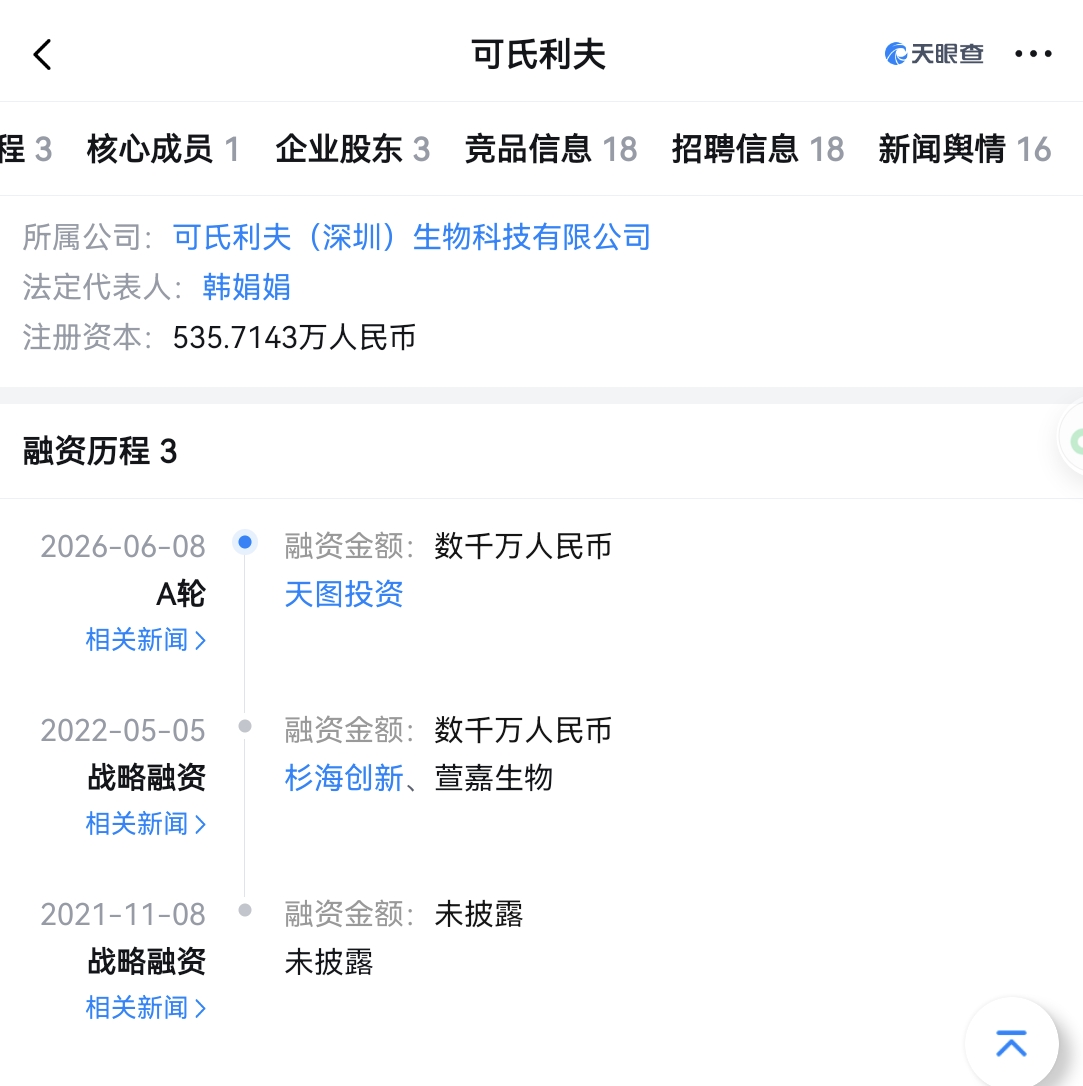
【亿邦原创】日前,护发品牌可氏利夫(KOSLIV)完成数千万元A轮融资,资金将主要用于技术研发、产品升级、市场拓展及团队建设等。据天眼查App显示,该品牌此前已完成两轮融资:2021年11月的战略融资(金额未披露),以及2022年数千万元的战略融资。

可氏利夫成立于2019年,是国内首个将超分子技术应用于个护防脱领域的品牌,并拥有该技术在国内护发领域的排他使用权。应用该技术后,活性成分的累计渗透量提升5倍以上,能够直达毛囊深处。

据品牌官方介绍,第三方测试显示,其专利防脱成分“可氏肽”在炎症因子IL-6抑制率、血管内皮生长因子(VEGF)提升率,以及毛囊干细胞关键蛋白β-catenin上调率这3项指标上,均优于米诺地尔(该药物主要适用于脂溢性脱发)。此外,品牌另一核心专利技术“可利乌”则主打促黑功效。

市场拓展方面,可氏利夫自2025年起发力私域与线下渠道,目前年销售额已达6000万元。品牌首创“乐碳1389”线下模式,即“3平米舱、8分钟毛囊快充、百业+店中店”。通过在药房、母婴店、写字楼等场景嵌入标准化服务舱,8分钟内即可完成AI头皮检测与精华导入护理。

目前,该模式已在深圳等地落地20余家门店,并完成了云南、海南、江西、江苏、广东五省的省级代理签约,预计今年内门店数量有望突破3000家。

亿邦持续追踪报道该情报,如想了解更多与本文相关信息,请扫码关注作者微信。

文章来源:亿邦动力

广告
微信
朋友圈

这么好看,分享一下?

朋友圈 分享

APP内打开

赞 +1
+1
微信好友 朋友圈 新浪微博 QQ空间
关闭
收藏成功
发送
/140 0