广告
加载中

Taboola 最新研究:76% 广告主借助代理式 AI 实现投放增效

龚作仁 2026-05-13 10:38
龚作仁 2026/05/13 10:38

邦小白快读

EN
全文速览

本文是全球效果广告平台Taboola2026年发布的最新代理式AI广告投放研究,核心干货信息整理如下:

1. 当前代理式AI已经在广告投放领域普及,76%的广告主已经借助该技术实现了投放效果的显著提升,不过目前这类增效成果大多集中在搜索、社交媒体这类围墙花园渠道内。

2. 行业已经出现明确的新需求,80%的受访广告主表示,如果开放网络能够提供和搜索社交媒体同等水平的代理式AI广告方案,会立刻增加在开放网络的广告投入,86%的广告主愿意将四分之一的效果营销预算转移到开放网络。

3. 目前Taboola已经推出适配开放网络的“Realize+”Beta版方案,可通过AI技术动态调整预算、自动生成素材优化定向,帮助广告主提效。

本次研究为品牌商布局AI营销、挖掘增量流量提供了明确参考,核心干货整理如下:

1. 当前营销行业的明确趋势是代理式AI已经成为效果营销增效的核心工具,超七成广告主已经借助该技术拿到了明确的投放提升效果,品牌布局效果营销必须重视代理式AI的应用。

2. 品牌可以挖掘开放网络的新增量,当前代理式AI的效果大多局限在围墙花园内,超过八成广告主有在开放网络布局同等AI投放的需求,超八成六品牌愿意转移四分之一预算到开放网络,提前布局可抢占增量。

3. 品牌需要提前注意落地难点,投放规模越大的品牌,将代理式AI融入现有工作流程的阻力越大,月投放百万美元以上的品牌中74%都将其视为核心障碍,需要提前做好流程适配。

本次研究为布局效果广告投放的卖家揭示了新的增长机会与需要注意的风险,核心干货整理如下:

1. 开放网络AI投放是明确的新增量机会,当前代理式AI的增效能力主要局限在搜索社交等围墙花园渠道,80%的卖家愿意在开放网络有同等AI方案后立刻增加投入,86%愿意转移四分之一的效果营销预算,新市场空间较大。

2. 落地需要注意风险,卖家投放规模越大,将代理式AI融入现有工作流程的阻碍越大,月投放100万-490万美元的卖家中,74%都遇到了该问题,中小卖家落地阻力则小很多,大卖家需要提前梳理适配现有工作流程。

3. 目前已经有可用的新方案,Taboola推出了开放网络的代理式AI方案“Realize+”Beta版,可动态调整预算、自动优化素材和定向,卖家可以对接测试获取增量。

本次研究对布局数字化营销、拓展电商渠道的工厂有不少启示,核心干货整理如下:

1. 营销端已经进入AI提效时代,目前76%的广告主已经借助代理式AI实现投放增效,工厂做自有品牌线上推广,也可以引入代理式AI工具降低投放成本、提升推广效果,跟上行业趋势。

2. 开放网络是工厂线上推广的增量机会,当前多数广告主都计划向开放网络转移营销预算,工厂做新品牌推广不用只扎堆搜索社交渠道,可以提前尝试开放网络的AI投放,获取更便宜的增量流量。

3. 工厂推进营销数字化需要注意落地问题,规模越大的投放主体,将AI工具融入现有工作流程的阻力越大,工厂引入AI营销工具前,需要提前梳理现有营销流程,做好适配,避免落地受阻,目前已有成熟的测试版方案可供尝试。

本次研究揭示了效果广告服务行业的发展趋势与客户核心痛点,为广告服务商调整业务方向提供了参考,核心干货整理如下:

1. 行业发展趋势明确,代理式AI已经成为效果广告领域的主流增效技术,76%的广告主已经通过该技术获得了明确的投放提升,客户对AI营销解决方案的需求还在持续增长,赛道空间较大。

2. 客户核心痛点清晰,当前代理式AI的能力主要局限在搜索社交等围墙花园渠道,客户普遍迫切需要开放网络的同等水平代理式AI方案,八成客户有明确的新增投放需求,缺口较大。

3. 客户分层痛点差异明显,大型投放客户的核心痛点是如何将代理式AI融入现有工作流程,月投放百万美元以上的客户74%受此困扰,中小客户阻力很小,服务商可以针对不同规模客户推出差异化的落地适配服务,抓住市场机会。

本次研究清晰呈现了广告主对广告平台的核心需求,为开放网络广告平台调整业务方向提供了明确参考,核心干货整理如下:

1. 平台的新增量机会明确,广告主已经普遍认可代理式AI的增效价值,76%已经拿到明确提升,当前迫切需要开放网络提供和搜索社交同等水平的代理式AI方案,80%广告主获得方案后就会增加投入,86%愿意转移四分之一预算,布局该业务可获得大量新增预算。

2. 平台推出解决方案需要解决核心痛点,大型广告主落地代理式AI的核心障碍是融入现有工作流程,平台推出产品时需要配套做好流程对接的适配服务,降低大型客户的落地门槛,才能抓住大客户资源。

3. 行业已经有先行探索案例,Taboola推出的“Realize+”方案,通过决策引擎动态调整预算、元素生成器自动生成素材优化定向,为开放网络代理式AI方案提供了参考样本,平台可借鉴相关玩法。

本次研究发布了效果营销领域代理式AI应用的最新一手调研数据,揭示了产业发展的新动向与新问题,对相关研究者有较高参考价值,核心干货整理如下:

1. 产业发展新动向清晰,截至2026年,代理式AI已经在效果广告领域实现规模化应用,76%的广告主已经借助该技术实现投放增效,广告主的需求已经从围墙花园内的应用转向向开放网络拓展,行业格局正在发生新的变化。

2. 产业出现新的结构性问题,不同规模广告主落地代理式AI的痛点差异极大,月投放100万-490万美元的大型广告主中,74%认为融入现有工作流程是核心障碍,而月投放30万-49.9万美元的中小广告主中该占比仅为9%,这种结构性痛点是行业需要解决的新问题。

3. 出现了新的商业模式探索,Taboola依托自身媒体版位、第一方数据与AI技术,推出开放网络的代理式AI解决方案“Realize+”,是开放网络AI营销商业模式的最新探索,值得深入研究。

返回默认
声明:快读内容全程由AI生成,请注意甄别信息。如您发现问题,请发送邮件至 run@ebrun.com 。

我是 品牌商 卖家 工厂 服务商 平台商 研究者 帮我再读一遍。

Quick Summary

This article summarizes key findings from global performance advertising platform Taboola's latest 2026 research on autonomous AI advertising:

1. Autonomous AI is now widely adopted in ad buying, with 76% of advertisers already reporting significant performance improvements from the technology. To date, however, most of these efficiency gains are concentrated in walled garden channels such as search and social media.

2. A clear new industry demand has emerged: 80% of surveyed advertisers said they would immediately increase their ad spend on the open web if it offered autonomous AI solutions on par with what is available on search and social media, and 86% are willing to shift one-quarter of their performance marketing budgets to the open web.

3. Taboola has already launched a beta version of its open web-optimized solution "Realize+", which uses AI to dynamically adjust budgets, automatically generate creative and optimize targeting to help advertisers improve efficiency.

This study provides clear guidance for brands looking to leverage AI marketing and unlock incremental traffic, with key takeaways below:

1. Autonomous AI is now an established core trend and the key efficiency-driving tool for performance marketing, with over 70% of advertisers already achieving measurable performance gains from the technology. Brands building out performance marketing must prioritize the adoption of autonomous AI.

2. Brands can unlock new growth from the open web: currently, most autonomous AI performance gains are limited to walled gardens, but more than 80% of advertisers want to adopt comparable AI-powered buying on the open web, and 86% are willing to shift one-quarter of their budgets to the channel. Early entry will let brands capture first-mover advantage on this incremental growth.

3. Brands should proactively prepare for integration challenges: larger brands face greater resistance to integrating autonomous AI into existing workflows. Among brands spending over $1 million per month, 74% cite this as their core barrier, requiring proactive workflow adaptation to overcome.

This study reveals new growth opportunities and key risks for sellers running performance ad campaigns, with key takeaways below:

1. AI-powered buying on the open web presents a clear incremental growth opportunity. Currently, the efficiency gains from autonomous AI are largely limited to walled gardens like search and social media. 80% of sellers are ready to increase spend immediately once comparable AI solutions become available on the open web, and 86% are willing to shift one-quarter of their performance marketing budgets, creating significant untapped market opportunity.

2. Sellers need to prepare for implementation risks: the larger a seller's ad spend, the greater the barrier to integrating autonomous AI into existing workflows. Among sellers spending $1 million to $4.9 million per month, 74% face this challenge, while small and medium-sized sellers face far lower friction. Large sellers should map and adapt their existing workflows in advance.

3. A new solution is already available for testing: Taboola has launched "Realize+", a beta autonomous AI solution built for the open web, which dynamically adjusts budgets, and automatically optimizes creative and targeting. Sellers can integrate and test the solution to capture incremental growth.

This study offers key insights for factories building out digital marketing and expanding e-commerce channels, with key takeaways below:

1. The marketing industry has entered an AI-powered efficiency era, with 76% of advertisers already achieving performance gains via autonomous AI. Factories building direct-to-consumer brands online can also adopt autonomous AI tools to lower buying costs and improve campaign performance, keeping pace with industry trends.

2. The open web is an incremental growth opportunity for factories' online promotion. Most advertisers now plan to shift marketing budgets to the open web, so new factories launching brands do not need to crowd into saturated search and social channels. Testing AI-powered buying on the open web early can help factories access cheaper incremental traffic.

3. Factories should prepare for implementation challenges when advancing digital marketing: larger spenders face greater friction integrating AI tools into existing workflows. Factories should map and adapt their existing marketing processes before adopting AI marketing tools to avoid implementation blocks, and a mature beta solution is already available for testing.

This study reveals key growth trends and core customer pain points for the performance advertising services industry, offering guidance for service providers adjusting their business strategies, with key takeaways below:

1. The industry's growth trajectory is clear: autonomous AI has become the mainstream efficiency technology in performance advertising, with 76% of advertisers already delivering measurable performance improvements via the technology. Demand for AI marketing solutions continues to grow, creating significant market opportunity.

2. Core customer pain points are well-defined: autonomous AI capabilities are currently largely limited to walled gardens such as search and social media, while customers widely demand comparable autonomous AI solutions for the open web. 80% of customers have clear plans to increase spend once the solution is available, creating a large unmet market gap.

3. Pain points differ sharply across customer segments: the core pain point for large-spend customers is integrating autonomous AI into existing workflows, with 74% of customers spending over $1 million monthly struggling with this challenge, while small and medium customers face far lower friction. Service providers can capture market opportunity by offering differentiated integration and implementation services tailored to customers of different sizes.

This study clearly outlines core advertiser demands for ad platforms, providing clear guidance for open web ad platforms adjusting their business strategies, with key takeaways below:

1. Clear incremental growth opportunity exists for platforms: advertisers have widely recognized the efficiency value of autonomous AI, with 76% already achieving measurable performance gains. Advertisers now urgently need autonomous AI solutions for the open web that match the capabilities available on search and social media. 80% will increase spend immediately after accessing such solutions, and 86% are willing to shift one-quarter of their budgets, so building out this offering can help platforms capture significant new budget flow.

2. Platforms launching solutions must address core pain points: the main barrier for large advertisers adopting autonomous AI is integration with existing workflows. To win large client accounts, platforms must pair their products with supporting integration services to lower the adoption barrier for large customers.

3. An early industry example already exists: Taboola's "Realize+" solution dynamically adjusts budgets via a decision engine, automatically generates creative and optimizes targeting via an AI creative generator, offering a reference model for autonomous AI solutions on the open web that other platforms can learn from.

This study publishes new primary survey data on autonomous AI adoption in performance marketing, revealing new industry trends and structural challenges, offering high value for relevant researchers, with key insights below:

1. Clear new industry trends are visible: as of 2026, autonomous AI has achieved large-scale adoption in performance advertising, with 76% of advertisers already delivering campaign efficiency gains via the technology. Advertiser demand has shifted from adoption within walled gardens to expansion into the open web, driving a shift in industry structure.

2. A new structural challenge has emerged: adoption pain points for autonomous AI vary dramatically by advertiser size. Among large advertisers spending $1 million to $4.9 million per month, 74% cite integration with existing workflows as their core barrier, while among small and medium-sized advertisers spending $300,000 to $499,000 per month, that share drops to just 9%. This structural pain point is a new unaddressed challenge for the industry.

3. A new business model exploration has emerged: leveraging its own media inventory, first-party data and AI technology, Taboola has launched "Realize+", an autonomous AI solution built for the open web. This represents the latest exploration of AI marketing business models on the open web, and merits further in-depth research.

Disclaimer: The "Quick Summary" content is entirely generated by AI. Please exercise discretion when interpreting the information. For issues or corrections, please email run@ebrun.com .

I am a Brand Seller Factory Service Provider Marketplace Seller Researcher Read it again.

2026年 5月 13日,北京——全球效果广告领先者Taboola今日发布最新研究报告显示,广告主对AI驱动的广告解决方案的采用率持续提升,且逐渐倾向于将此类智能投放能力应用于围墙花园(Walled Gardens)之外。

尽管代理式AI(Agentic AI)已在搜索与社交媒体中实现了广告效果的显著提升,但营销人员正愈发关注如何在这些渠道以外实现增量增长,尤其是在同样具备AI自动化解决方案的开放网络生态中。此次最新研究报告《效果营销中的代理式AI优势:在搜索与社交媒体以外实现增量增长》,深入剖析了在AI技术驱动程度持续加深的行业格局下,广告主如何重新构建其效果营销策略。

本次研究的核心洞察包括:

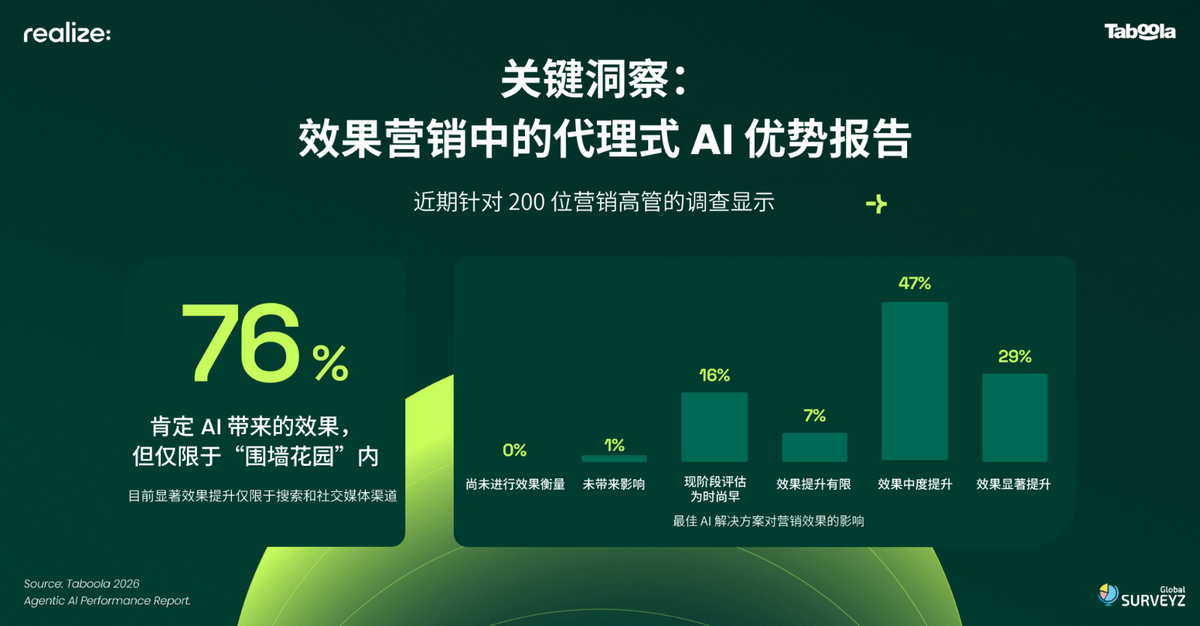
代理式AI正为效果广告带来亮眼成效,但其相关优势主要集中于围墙花园之内。高达 76% 的广告主表示,AI驱动的广告解决方案已为其带来了显著的投放效果提升,而这些成果目前主要来自搜索与社交媒体渠道。

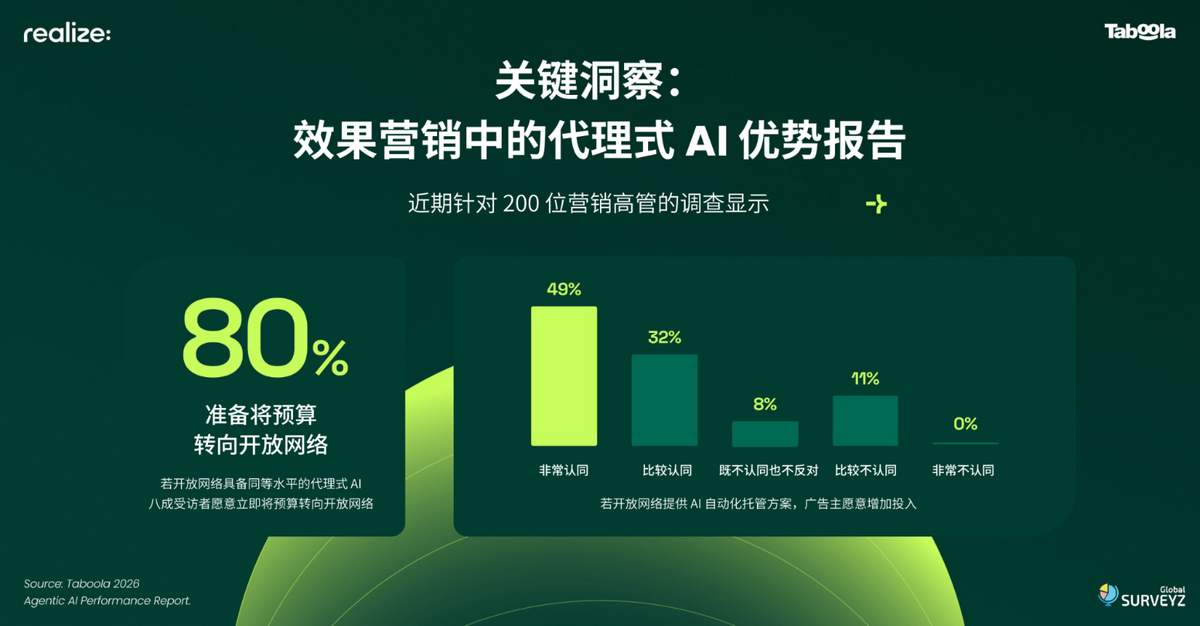
效果广告主认为,代理式AI的能力目前仍主要局限于搜索与社交平台。80% 的受访广告主表示,如果开放网络能够提供与搜索和社交媒体同等水平的代理式AI广告解决方案,他们会立刻增加在开放网络的广告投入;86% 的广告主表示,有意愿将高达四分之一的效果营销预算转向开放网络。

大型广告主在应用代理式AI时面临更大挑战。对于应用代理式AI的广告主而言,最大的挑战在于如何将该技术融入现有工作流程,而大型广告主在这一过程中遭遇的挑战尤为突出。每月投放金额在30万至49.9万美元的广告主中,仅有9% 认为将代理式AI融入现有工作流程会遇到阻碍;相比之下,每月投放金额在100万至490万美元的企业里,高达74% 都将其视作主要障碍。

Taboola创始人兼首席执行官Adam Singolda 表示:“各类规模的广告主都在积极采用代理式广告,成效也随之显现。此次我们的研究清晰表明,广告主希望将围墙花园中全时在线、AI驱动的效果营销能力,延伸应用到开放网络。他们正在寻找一种自主系统,能够持续学习、实时决策,并把每一次广告曝光都转化为可量化的成果。”

2026年 4月,Taboola推出智能代理解决方案Realize+。该方案依托Taboola优质媒体版位、第一方数据及AI技术,通过可实时动态调整预算分配的“决策引擎”(Decision Engine),以及能够自动生成广告素材与优化受众定向策略的“元素生成器”(Element Generator),从而实现广告效果的规模化增长。目前,Taboola已推出Realize+Beta版本,助力广告主实现规模化效果增长。

注:文/龚作仁,文章来源:Laborer,本文为作者独立观点,不代表亿邦动力立场。

文章来源:Laborer

广告
微信
朋友圈

这么好看,分享一下?

朋友圈 分享

APP内打开

+1
+1
微信好友 朋友圈 新浪微博 QQ空间
关闭
收藏成功
发送
/140 0