广告
加载中

Shopify押注智能体商业:让独立站商家率先抢占AI新流量红利

尹幸芷 2026-04-14 18:23
尹幸芷 2026/04/14 18:23

邦小白快读

EN
全文速览

总:Shopify推出智能体商业,帮助独立站商家通过AI平台抢占新流量红利。

1. 购物模式变化:消费者从主动搜索转向向AI提问即购买,AI直接推荐产品并完成下单,无需离开对话界面。

2. 操作简单:商家在Shopify后台打开授权开关,商品目录自动同步主流AI平台如Google、OpenAI、Copilot、Perplexity,商家可控制哪些商品上架或排除。

3. 显著好处:AI搜索带来15倍订单量增长、8倍流量增长,商店数量翻倍,订单自动汇入后台独立归因,客户沟通和履约流程无变化。

总:商家可快速接入并获益。

1. 无需额外调整:所有流程通过Shopify后台统一管理,包括商品发现、支付和配送。

2. 数据支撑:2025年1月,AI代理结账超100万次,形成35万笔订单,消费者正快速适应新模式。

总:智能体商业为品牌提供新营销渠道和应对消费趋势的机会。

1. 品牌渠道建设:通过Shopify智能体店面集成主流AI平台,品牌可在AI对话中直接呈现,提升曝光和销售机会。

2. 消费趋势洞察:用户行为转向“提问即购买”,品牌需结构化数据确保产品在AI推荐中准确展示,以抢占红利。

3. 品牌营销优势:AI渠道带来流量和订单显著增长,商家保留完全掌控权,决定商品上架策略。

总:品牌需适应新范式。

1. 产品研发启示:消费者偏好快速变化,品牌应优化数据上下文完整性以匹配AI意图理解。

2. 用户行为观察:数据显示消费者正学习试用AI购物,品牌及时接入可截获增长红利。

总:Shopify智能体商业带来巨大增长市场和简单接入机会。

1. 增长机会:AI搜索驱动订单量15倍增长、流量8倍增长,商店数量翻倍,新兴渠道快速扩张。

2. 政策解读与操作:商家后台打开开关即可接入AI平台,商品目录同步,UCP协议保留业务逻辑如折扣规则和配送政策。

3. 可学习点:商家需确保数据结构化以在AI对话中准确呈现产品,率先接入者可获得红利。

总:风险与机会并存。

1. 正面影响:订单自动归因AI渠道,履约无变化,降低运营负担。

2. 机会提示:消费者购物模式转向对话完成交易,卖家应优先优化数据上下文。

3. 最新商业模式:智能体商业闭环通过Catalog、UCP和统一后台实现,可复制性强。

总:智能体商业创造新销售机会和数字化启示。

1. 商业机会:通过AI平台直接销售产品,工厂商品可同步主流AI渠道如Google和OpenAI,扩大市场覆盖。

2. 产品生产需求:虽未明说具体设计,但需确保产品数据可被AI代理发现和推荐,适应“提问即购买”趋势。

3. 数字化推进启示:Shopify智能体简化电商接入,商家后台统一管理,无需复杂改变,工厂可轻松实现线上转型。

总:启示工厂抓住AI红利。

1. 操作简单:后台授权开关控制商品上架,保留排除权,降低门槛。

2. 数据支撑:AI渠道带来显著订单增长,工厂可借此提升销量。

总:智能体商业解决行业痛点和展示新技术趋势。

1. 客户痛点:品牌能否在AI对话中出现,消费者购物模式变化导致传统渠道失效。

2. 解决方案:Shopify提供智能体店面,集成UCP通用商务协议,定义AI代理沟通标准,确保商品发现、支付等流程完整。

3. 新技术:UCP串联AI平台与商家,保留业务逻辑,统一后台管理所有操作。

总:行业发展趋势明显。

1. 趋势:AI商业兴起,消费者快速采用“提问即购买”模式,交易在对话中完成。

2. 服务启示:服务商可参考Shopify模式,帮助客户结构化数据以准确呈现产品。

总:Shopify智能体店面展示平台最新做法和招商策略。

1. 平台招商:商家简单后台操作即可接入主流AI平台如Google、OpenAI,吸引更多独立站商家加入。

2. 运营管理:统一后台处理订单归因、渠道控制,商家可自主决定商品上架和排除,简化流程。

3. 最新做法:通过Catalog、UCP和后台构建闭环,处理结账超100万次,形成高效商业模型。

总:风险规避与需求响应。

1. 商业需求:平台需支持AI代理沟通,UCP定义标准确保业务逻辑保留。

2. 风向规避:商家保留控制权,避免不适用商品上架,降低潜在风险。

总:智能体商业代表电子商务新产业动向和商业模式创新。

1. 产业新动向:AI改写购物范式,从浏览点击转向对话完成交易,消费者行为快速变化。

2. 新问题:如何确保品牌在AI推荐中准确呈现,数据上下文完整性成为关键。

3. 商业模式启示:Shopify通过Catalog、UCP和统一后台构建智能体商业闭环,实现高效集成。

总:政策与数据支撑。

1. 数据有效性:AI搜索带来15倍订单增长、8倍流量增长,支撑模式可行性。

2. 启示:研究者可分析UCP协议对行业标准化的影响,以及消费模式转变对政策法规的建议。

返回默认
声明:快读内容全程由AI生成,请注意甄别信息。如您发现问题,请发送邮件至 run@ebrun.com 。

我是 品牌商 卖家 工厂 服务商 平台商 研究者 帮我再读一遍。

Quick Summary

Shopify has launched its AI-powered "Commerce through AI" platform, enabling independent merchants to tap into new traffic opportunities via major AI platforms.

1. **Shopping Behavior Shift**: Consumers are transitioning from active searching to purchasing through AI queries. AI directly recommends products and completes orders within conversational interfaces without requiring users to leave the chat.

2. **Simple Setup**: Merchants simply toggle an authorization switch in their Shopify admin to automatically sync their product catalogs with leading AI platforms like Google, OpenAI, Microsoft Copilot, and Perplexity. They retain full control over which products are listed or excluded.

3. **Significant Benefits**: Early results show AI-driven searches can lead to a 15x increase in orders and an 8x surge in traffic, with store counts doubling. Orders are automatically attributed to the AI channel within Shopify, while customer communication and fulfillment processes remain unchanged.

**Summary**: Merchants can quickly integrate and benefit.

1. **No Extra Adjustments Needed**: All processes—product discovery, payment, and shipping—are managed centrally through the Shopify admin.

2. **Data Support**: By January 2025, AI agents had processed over 1 million checkouts, generating 350,000 orders, indicating rapid consumer adoption of this new shopping model.

Intelligent Commerce offers brands a new marketing channel and a way to adapt to evolving consumer trends.

1. **Channel Development**: By integrating their Shopify stores with major AI platforms, brands can feature their products directly within AI conversations, enhancing visibility and sales opportunities.

2. **Consumer Trend Insight**: As user behavior shifts towards "query-to-purchase," brands must ensure product data is well-structured for accurate AI representation to capture early-mover advantages.

3. **Marketing Advantage**: The AI channel drives substantial traffic and order growth, with merchants maintaining full control over product listing strategies.

**Summary**: Brands must adapt to this new paradigm.

1. **Product Development Implication**: With rapidly changing consumer preferences, brands should optimize data context completeness to align with AI's intent understanding.

2. **User Behavior Observation**: Data shows consumers are quickly adopting AI shopping; timely integration allows brands to capture growth红利.

Shopify's Intelligent Commerce presents a significant growth market with straightforward integration.

1. **Growth Opportunity**: AI-driven searches have fueled a 15x increase in orders, an 8x rise in traffic, and a doubling of stores, signaling rapid expansion of this emerging channel.

2. **Policy & Operation**: Sellers can connect to AI platforms by enabling a switch in their admin dashboard. Product catalogs sync automatically, with the Universal Commerce Protocol (UCP) preserving existing business logic like discount rules and shipping policies.

3. **Key Takeaway**: Sellers must ensure product data is structured for accurate AI presentation; early adopters can gain a competitive edge.

**Summary**: Opportunities come with considerations.

1. **Positive Impact**: Orders are automatically attributed to the AI channel, with no changes to fulfillment, reducing operational overhead.

2. **Opportunity Alert**: As shopping shifts to conversation-based transactions, sellers should prioritize optimizing data context.

3. **Emerging Model**: The Intelligent Commerce loop—encompassing Catalog, UCP, and unified backend—creates a scalable, replicable business model.

Intelligent Commerce opens new sales avenues and offers digital transformation insights for manufacturers.

1. **Business Opportunity**: Factories can sell products directly through AI platforms by syncing their catalogs with channels like Google and OpenAI, expanding market reach.

2. **Production Considerations**: While specific design changes aren't detailed, product data must be AI-friendly to be discovered and recommended, aligning with the "query-to-purchase" trend.

3. **Digital Advancement**: Shopify's solution simplifies e-commerce integration via a unified admin, enabling factories to transition online with minimal complexity.

**Summary**: Factories should seize the AI opportunity.

1. **Simple Operation**: Product listing is managed via an admin toggle, with exclusion rights, lowering the entry barrier.

2. **Data Support**: The AI channel demonstrates significant order growth, offering factories a viable path to boost sales.

Intelligent Commerce addresses industry pain points and showcases new technological trends.

1. **Client Challenges**: Brands risk invisibility in AI conversations as consumer shopping habits evolve, rendering traditional channels less effective.

2. **Solution**: Shopify's AI storefront, integrated with the Universal Commerce Protocol (UCP), standardizes AI-agent interactions, ensuring seamless product discovery, payment, and other workflows.

3. **Technology Innovation**: UCP connects AI platforms and merchants while preserving business logic, with all operations managed through a unified backend.

**Summary**: Industry trends are clear.

1. **Trend**: AI commerce is rising, with consumers rapidly adopting "query-to-purchase" models where transactions conclude within dialogues.

2. **Service Implication**: Providers can emulate Shopify's approach by helping clients structure data for accurate product representation in AI systems.

Shopify's AI storefront demonstrates the platform's latest strategies for merchant acquisition and operations.

1. **Merchant Onboarding**: A simple backend toggle allows sellers to connect with leading AI platforms like Google and OpenAI, attracting more independent merchants to the ecosystem.

2. **Operational Management**: A unified admin handles order attribution and channel control, empowering merchants to manage product listings and exclusions, streamlining processes.

3. **Innovative Approach**: The closed-loop system—combining Catalog, UCP, and backend—has processed over 1 million checkouts, forming an efficient commercial model.

**Summary**: The model addresses demand while mitigating risk.

1. **Business Need**: Platforms must support AI-agent communication; UCP defines standards that preserve business logic.

2. **Risk Mitigation**: Merchants retain control to prevent unsuitable products from being listed, reducing potential issues.

Intelligent Commerce represents a new e-commerce industry movement and business model innovation.

1. **Industry Shift**: AI is reshaping shopping paradigms from browsing and clicking to transacting via conversation, with consumer behavior changing rapidly.

2. **Emerging Challenge**: Ensuring accurate brand representation in AI recommendations makes data context completeness critical.

3. **Business Model Insight**: Shopify's闭环—comprising Catalog, UCP, and unified backend—creates an efficient, integrated Intelligent Commerce system.

**Summary**: Policy and data underpin the model.

1. **Data Validation**: AI searches drive a 15x order increase and 8x traffic growth, supporting the model's viability.

2. **Research Implication**: Scholars can analyze UCP's impact on industry standardization and the policy implications of shifting consumer behaviors.

Disclaimer: The "Quick Summary" content is entirely generated by AI. Please exercise discretion when interpreting the information. For issues or corrections, please email run@ebrun.com .

I am a Brand Seller Factory Service Provider Marketplace Seller Researcher Read it again.

【亿邦原创】“智能体商业(Agentic Commerce)要回答的问题是:当消费者不再打开搜索引擎,而是直接向AI询问购买需求时,品牌能否出现在对话中?”在日前举办的“Shopify Editions Winter‘26官方解读专场直播”中,Shopify大客户资深解决方案工程师Yan Liang,用一句话归纳了Shopify正在推进的智能体商业到底要解决什么。

一个事实是,在过去的10-20年里,线上购物模式基本没有发生本质变化,搜索关键词——翻页比价——点击浏览——购买,整个过程由消费者主动操作,但如今,AI正改写这一范式——消费者向AI提问,AI不仅可以帮助搜索,还能理解他的意图并直接推荐产品,最后消费者无需离开对话界面即可下单。

据悉,从Shopify全球业务来看,自2025年1月以来,AI搜索带来15倍的订单量增长,为商家店面带来8倍流量增长,获得AI搜索流量的商店数量翻番。

为了帮助独立站商家率先抢占AI新流量红利,Shopify已经为商家搭建智能体店面(Agentic Storefront),并已完成与所有主流AI平台的集成,形成了完整的智能体商业闭环。

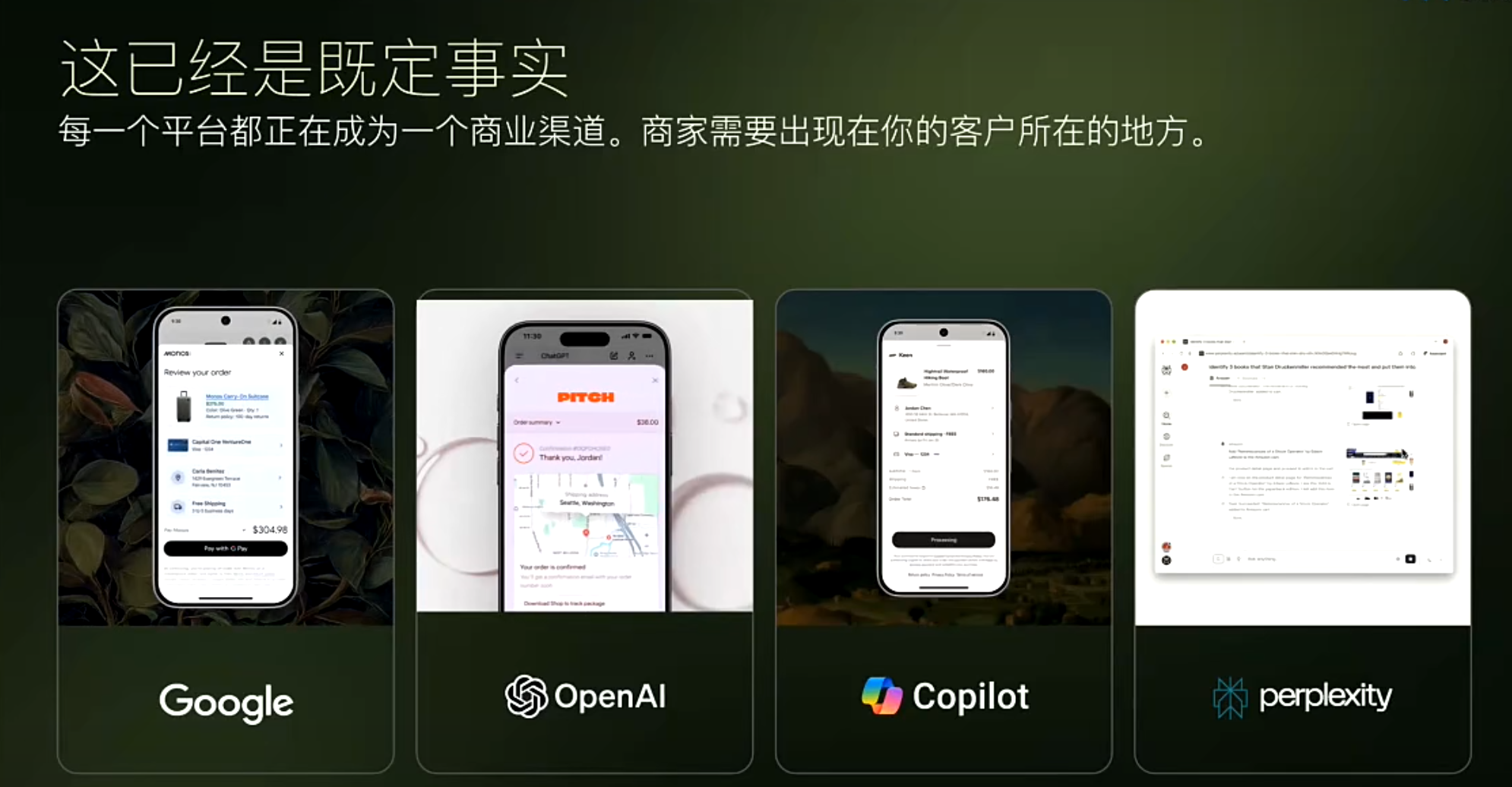
商家仅需在后台打开相应的授权开关,就能让商品目录同步至目前市面上的所有主流AI平台开放,包括Google、OpenAI、Copilot以及Perplexity等。同时,商家也保留有完全掌控权,可自主决定哪些商品通过AI渠道销售、在哪些Al渠道上架,以及决定排除哪些商品。

所有AI渠道产生的订单信息会自动汇入商家后台,可以按照AI渠道独立归因。客户沟通与履约流程与此前完全一致,没有任何改变。

据Yan Liang介绍,上述流程的实现,源于Shopify后台三个环节的同步:一是通过Shopify Catalog(即商品目录)确保所有商品可被AI代理发现;二是通过通用商务协议(UCP,串联众多AI平台与商家的底层技术,如同浏览器与服务器通过HTTP通信,定义了AI代理与商家之间的沟通标准,包括商品发现、加入购物车、支付、配送等流程)完整保留商家业务逻辑,如折扣规则、会员积分、配送政策等重要信息;三是通过Shopify后台统一管理所有操作,为商家接入GEO流量提供了极简的使用体检。

换句话说,Shopify Catalog、UCP及统一管理后台共同构成Shopify的智能体商业。

据Yan Liang介绍,目前,Shopify智能体店面已经接入Google、OpenAI、Microsoft Copilot、Perplexity等市面上几乎全部主流AI平台。而在今年1月,根据Shopify内部数据,通过AI代理发起的结账已经超100万次,形成35万笔订单。

尽管智能体商业还是新兴渠道,但是消费者正快速学习试用。“消费者购物模式正从‘浏览+点击’转向‘提问即购买’,交易在对话中完成。”Yan Liang表示,“能在AI对话中做到准确的呈现品牌与产品、数据实现结构化及上下文完整的商家,将率先截得AI电商时代的红利。”

文章来源:亿邦动力

广告
微信
朋友圈

这么好看,分享一下?

朋友圈 分享

APP内打开

+1
+1
微信好友 朋友圈 新浪微博 QQ空间
关闭
收藏成功
发送
/140 0