广告
加载中

eBike 出海:竞争正从“产品参数”转向“全周期服务”

龚作仁 2026-11-05 13:06
龚作仁 2026/11/05 13:06

邦小白快读

EN
全文速览

总1

1. 核心结论:eBike出海的竞争正从详情页参数转向购车后数月的使用与服务体验,独立站售后的价值要放在更长的用户持有周期里衡量。

2. 数据规模:调研YouTube、TikTok、Trustpilot等8个平台、全球4个头部品牌、583条帖子、1617次品牌提及、2500多条评论,累计触达132万人次,平均正向率48%。

总2

1. 关键时间点:到货即损坏仅出现1次、缺件为0次,交付开箱环节已成熟;负面关键词Top10中6个指向电池与电气系统,问题集中在购车后60至90天,1年以上进入电池衰减期。

2. 实操建议:宣传续航注明测试条件;充电器和电池可单独购买并前置备货;购车后45至60天回访电池与充电情况;售后工单48小时内首次响应、一周内闭环;逐条回复1至2星评价;欧洲市场明确本地退货地址与经营主体。

3. 优先级:先明确由谁负责,再提升闭环效率,最后优化响应速度。

总1

1. 声量与口碑是两条独立曲线:四个品牌正向率最高72%、最低24%,相差48个百分点,约为3D打印行业12个百分点的4倍。声量最大的品牌占64%触达但正向率仅38%;内容产出最多的品牌发布近一半帖子、触达18%,正向率最高72%;另一品牌以不到对手三分之一帖子量获得相当触达和更多点赞,负面率仅8%。

2. 机制:高曝光会把更多潜在用户带进评论区,评论区里的追问也会被同步放大,内容投放与口碑建设需分开评估、协同推进。

总2

1. 产品研发:主样本正向关键词Top10中8个与配置相关,包括200kg级载重、100N·m级中置电机、130km+续航、双可拆电池、4.0胖胎,说明整体仍处参数竞争阶段,服务是稀缺的差异化标签。

2. 用户行为观察:口碑考验集中在购车后60至90天,电池与电气系统是中长期的体验关键;服务关切按价格带分层;欧洲用户更看重经营主体可信度与本地服务网络可及性;用户认为问题是否被解决优先于回复速度,Trustpilot负面率20%约为YouTube帖子层面的4倍。

总1

1. 市场与需求:聚焦欧洲和北美市场,4个头部品牌覆盖入门、中端、中高端三个价格带。用户关注点从参数转向服务,customer service在正向关键词榜单中与参数并列第一,成为稀缺差异化标签。

2. 机会:核心备件现货化,充电器和电池可单独购买并在主要市场前置备货;延长保修等售后承诺可回应出了问题由谁负责;抓住60至90天主动关怀窗口可转化为口碑。

总2

1. 风险提示:续航宣传口径与实测差距是预期落差主要来源,续航相关反馈约为电机故障的2至3倍;大件跨境退货运费高,发票主体与退货地址不一致影响欧洲用户信任;4个品牌中3个在评论区遇到产地讨论。

2. 可学习点:购车后45至60天回访电池与充电情况,工单48小时首次响应、一周内闭环,逐条回复1至2星评价,在高触达视频评论区主动回应售后问题;欧洲明确本地退货地址、经营主体与法定保修,英语市场明确换货时效并主动推送进度。

3. 合作方式:Seel AI数字员工中的智能客服可7×24小时多语种承接售后咨询,无忧购产品线中的延长保修提供明确责任承诺。

总1

1. 设计需求:主样本品牌正向关键词Top10中8个与配置直接相关,包括200kg级载重、100N·m级中置电机、130km+续航、双可拆电池、4.0胖胎,说明载重、动力、续航、电池可拆换是用户愿意点赞的硬参数方向。

2. 标称口径:续航是典型的条件依赖型指标,载重、档位、气温、路况都会显著影响实际表现,宣传中明确测试条件是成本较低、见效较快的预期管理方式。

总2

1. 生产质量痛点:负面关键词Top10中6个指向电池与电气系统,包括扭矩传感器更换、充电器无法工作、电池耐用性、电池续航、电池更换;问题集中在购车后60至90天,1年以上进入电池衰减期。

2. 商业机会:充电器、电池等核心备件可单独售卖并前置备货到主要市场,备件可得性是用户中长期使用高度看重的服务能力,已有用户建议自备备件照着视频自行维护。

3. 数字化和电商启示:VOC方法可聚合10个主流渠道公开用户声音,支持1个自有品牌与最多3个对标品牌对比,每条结论可回溯原始帖子,可把用户反馈转化为产品改进决策。

总1

1. 行业趋势:eBike出海正从产品参数竞争转向全周期服务竞争,四个品牌正向率跨度48个百分点,约为3D打印行业12个百分点的4倍,服务能力差异仍在拉开,尚未进入趋同阶段。

2. 新技术与新方法:VOC即用户之声洞察,系统采集社交媒体和评价平台的公开反馈,用于识别口碑驱动因素、找到改进优先级;Seel Intelligence Agency可聚合10个主流渠道,支持1个自有品牌与最多3个对标品牌对比,结论可回溯原始帖子。

总2

1. 客户痛点:购车后60至90天充电系统、扭矩传感器、换货进度集中出问题;备件买不到导致车辆无法使用;保修体验差,存在回复快但保修让人失望的情况;欧洲用户担心发票主体与退货地址不一致、替换件寄送国家错误、大件跨境退货运费。

2. 解决方案:60至90天主动关怀、核心备件现货化、续航口径对齐、公开回应1至2星评价与高触达视频评论区售后问题、区域化售后条款;优先级为先明确由谁负责,再提升闭环效率,最后优化响应速度。

3. 落地产品:智能客服7×24小时多语种承接售后咨询,延长保修提供明确责任承诺。

总1

1. 平台现象:主样本品牌YouTube贡献69%的帖子和98%的触达,帖子层面负面率5%;但高触达视频评论区的负面占比明显更高,4.5万次播放的城市载货骑行视频为54%,1.1万次播放的车型评测为50%;Trustpilot负面率20%,约为YouTube帖子层面的4倍。品牌内容以参数为主,评论区则更多讨论售后。

2. 运营管理启示:高曝光会把更多潜在用户带进评论区,评论区的追问也会被同步放大;用户评价标准中问题是否被解决优先于回复速度;评论区正成为售后能力的公开展示场,平台需重视评论区的售后问答与舆情放大效应。

总2

1. 招商与风向规避:品牌间正向率相差48个百分点,声量领先并不等同于口碑领先,招商和运营评估不能只看触达和帖子量;4个品牌中3个在评论区遇到产地讨论,影响用户判断的主要是服务网络可及性而非产地本身。

2. 合作与工具:可对接VOC洞察,聚合10个主流渠道的公开用户声音,支持1个自有品牌与最多3个对标品牌对比,用于平台侧口碑监测与招商评估。

总1

1. 产业新动向:4个头部品牌正向率跨度48个百分点,约为3D打印行业12个百分点的4倍,行业口碑分化程度较高、尚未进入趋同阶段;声量与口碑成为两条独立曲线;参数仍是主要竞争维度,服务开始成为稀缺的差异化标签。

2. 新问题:续航作为条件依赖型指标带来预期落差,相关反馈约为电机故障类的2至3倍;口碑考验集中在购车后60至90天,电池与电气系统是中长期的体验关键;服务关切按价格带分层,欧洲用户对经营主体与本地服务更敏感。

总2

1. 政策法规启示:欧洲市场需明确本地退货地址、经营主体与法定保修,发票主体与退货地址要一致、替换件寄送国家要正确;英语市场需明确换货时效并主动推送进度。

2. 商业模式:独立站售后的价值需放在更长的用户持有周期里衡量,延长保修等售后产品为责任归属提供明确承诺。

3. 方法启示:VOC洞察遵循先取证再结论,15个追问中有5个涉及公开数据无法覆盖的指标,系统会说明现有数据无法测算并给出验证路径;完整版还包含四类品牌画像、五个核心杠杆与短中长期行动清单。

返回默认
声明:快读内容全程由AI生成,请注意甄别信息。如您发现问题,请发送邮件至 run@ebrun.com 。

我是 品牌商 卖家 工厂 服务商 平台商 研究者 帮我再读一遍。

Quick Summary

Summary 1

1. Core conclusion: Competition in eBike exports is shifting from spec sheets on product pages to the usage and service experience in the months after purchase; the value of independent-site after-sales service should be measured over a longer ownership cycle.

2. Data scale: The research covered 8 platforms including YouTube, TikTok, and Trustpilot, 4 leading global brands, 583 posts, 1,617 brand mentions, and more than 2,500 comments, reaching 1.32 million people cumulatively, with an average positive sentiment rate of 48%.

Summary 2

1. Key timing: Damaged-on-arrival occurred only once and missing parts zero times, indicating the delivery and unboxing stage is mature; 6 of the top 10 negative keywords point to batteries and electrical systems, with issues concentrated 60 to 90 days after purchase, and battery degradation setting in after one year.

2. Practical recommendations: State test conditions when advertising range; sell chargers and batteries separately and stock them in advance; follow up on battery and charging status 45 to 60 days after purchase; ensure after-sales tickets get a first response within 48 hours and are closed within a week; respond to every 1- to 2-star review; in the European market, clearly state local return addresses and the operating entity.

3. Priority: First clarify who is responsible, then improve closure efficiency, and finally optimize response speed.

Summary 1

1. Reach and reputation are two independent curves: Among the four brands, the positive sentiment rate ranges from a high of 72% to a low of 24% — a 48-percentage-point gap, roughly four times the 12-point spread in the 3D printing industry. The highest-reach brand accounts for 64% of total reach but has a positive rate of only 38%; the most prolific content producer published nearly half of all posts, reached 18%, and had the highest positive rate at 72%; another brand achieved comparable reach and more likes with less than a third of its rival's post volume, with a negative rate of just 8%.

2. Mechanism: High exposure brings more potential users into comment sections, and follow-up questions there are amplified in turn; content investment and reputation building should be evaluated separately and advanced in coordination.

Summary 2

1. Product R&D: 8 of the top 10 positive keywords in the main sample relate to specifications, including 200kg-class payload, 100N·m-class mid-drive motor, 130km+ range, dual removable batteries, and 4.0 fat tires, indicating the category is still in a spec-competition phase and that service is a scarce differentiator.

2. User behavior observations: Reputation tests concentrate 60 to 90 days after purchase, with batteries and electrical systems the key to mid- and long-term experience; service concerns are stratified by price band; European users place more weight on the credibility of the operating entity and the accessibility of local service networks; users prioritize whether a problem is resolved over response speed, and Trustpilot's 20% negative rate is roughly four times the post-level rate on YouTube.

Summary 1

1. Market and demand: Focused on Europe and North America, the four leading brands span entry-level, mid-range, and upper-mid-range price tiers. User attention is shifting from specs to service; customer service ties with specifications at the top of the positive keyword list, making it a scarce differentiator.

2. Opportunities: Stock core spare parts, with chargers and batteries sold separately and pre-positioned in key markets; after-sales commitments such as extended warranties can answer the question of who is responsible when problems arise; capturing the 60-to-90-day proactive care window can be converted into reputation.

Summary 2

1. Risk alerts: The gap between advertised range and real-world performance is the main source of expectation mismatch, with range-related feedback running about 2 to 3 times that of motor failures; cross-border shipping of large items is costly, and mismatches between the invoicing entity and return address undermine European user trust; 3 of the 4 brands encountered origin-related discussion in comment sections.

2. Takeaways: Follow up on battery and charging status 45 to 60 days after purchase; ensure tickets get a first response within 48 hours and are closed within a week; respond to every 1- to 2-star review; proactively address after-sales questions in high-reach video comment sections; in Europe, specify local return addresses, operating entity, and statutory warranty; in English-speaking markets, specify replacement timelines and proactively push progress updates.

3. Collaboration: The AI customer service agents in Seel AI's digital workforce can handle after-sales inquiries 24/7 in multiple languages, and the extended warranty in the Worry-Free Purchase product line provides a clear commitment of responsibility.

Summary 1

1. Design requirements: 8 of the top 10 positive keywords for the main sample brands relate directly to specifications, including 200kg-class payload, 100N·m-class mid-drive motor, 130km+ range, dual removable batteries, and 4.0 fat tires, indicating that payload, power, range, and replaceable batteries are the hard-spec directions users are willing to endorse.

2. Rated specifications: Range is a classic condition-dependent metric, significantly affected by payload, gear, temperature, and road conditions; stating test conditions in marketing is a low-cost, fast-acting way to manage expectations.

Summary 2

1. Production quality pain points: 6 of the top 10 negative keywords point to batteries and electrical systems, including torque sensor replacement, non-functioning chargers, battery durability, battery range, and battery replacement; issues concentrate 60 to 90 days after purchase, and battery degradation sets in after one year.

2. Business opportunities: Core spare parts such as chargers and batteries can be sold separately and pre-stocked in key markets; parts availability is a service capability highly valued by users over the mid- and long-term, and some existing users already advise keeping spare parts on hand and self-servicing by following videos.

3. Digital and e-commerce implications: The VOC method can aggregate public user voices across 10 mainstream channels, support comparison between one owned brand and up to three benchmark brands, trace every conclusion back to the original post, and turn user feedback into product improvement decisions.

Summary 1

1. Industry trend: eBike exports are shifting from product-spec competition to full-lifecycle service competition; the 48-percentage-point spread in positive rates across the four brands — roughly four times the 12-point spread in the 3D printing industry — shows service capabilities are still diverging and have yet to converge.

2. New technologies and methods: VOC (Voice of Customer) insight systematically collects public feedback from social media and review platforms to identify reputation drivers and set improvement priorities; Seel Intelligence Agency can aggregate 10 mainstream channels, support comparison between one owned brand and up to three benchmark brands, and trace conclusions back to original posts.

Summary 2

1. Customer pain points: Problems with charging systems, torque sensors, and replacement progress cluster 60 to 90 days after purchase; unavailable spare parts render bikes unusable; poor warranty experiences occur, including cases where replies are fast but warranty support disappoints; European users worry about mismatched invoicing entity and return address, replacement parts shipped to the wrong country, and costly cross-border returns of large items.

2. Solutions: 60-to-90-day proactive care, in-stock core spare parts, aligned range claims, public responses to 1- to 2-star reviews and after-sales questions in high-reach video comment sections, and localized after-sales terms; priority is to first clarify who is responsible, then improve closure efficiency, and finally optimize response speed.

3. Products: AI customer service handles after-sales inquiries 24/7 in multiple languages, and extended warranties provide a clear commitment of responsibility.

Summary 1

1. Platform observations: For the main sample brands, YouTube contributes 69% of posts and 98% of reach, with a post-level negative rate of 5%; yet negative sentiment is notably higher in the comment sections of high-reach videos — 54% for an urban cargo-riding video with 45,000 views and 50% for a model review with 11,000 views; Trustpilot's negative rate is 20%, roughly four times the post-level rate on YouTube. Brand content focuses on specs, while comment sections discuss after-sales service more.

2. Operational implications: High exposure brings more potential users into comment sections, and follow-up questions there are amplified in turn; users prioritize whether a problem is resolved over response speed; comment sections are becoming a public showcase of after-sales capability, and platforms need to pay attention to after-sales Q&A and the amplification effect of sentiment there.

Summary 2

1. Merchant recruitment and trend avoidance: The positive rate gap between brands is 48 percentage points, and reach leadership does not equal reputation leadership, so recruitment and operational assessments cannot rely solely on reach and post volume; 3 of the 4 brands encountered origin-related discussion in comment sections, and what mainly influences user judgment is the accessibility of service networks rather than origin itself.

2. Collaboration and tools: VOC insights can be integrated to aggregate public user voices from 10 mainstream channels and support comparison between one owned brand and up to three benchmark brands, for platform-side reputation monitoring and merchant evaluation.

Summary 1

1. Industry developments: The 48-percentage-point spread in positive rates across the four leading brands — roughly four times the 12-point spread in the 3D printing industry — indicates a high degree of reputation divergence and a market that has yet to converge; reach and reputation have become two independent curves; specifications remain the main competitive dimension, while service is beginning to emerge as a scarce differentiator.

2. New questions: Range, as a condition-dependent metric, creates expectation gaps, with related feedback running about 2 to 3 times that of motor failures; reputation tests concentrate 60 to 90 days after purchase, with batteries and electrical systems the key to mid- and long-term experience; service concerns are stratified by price band, and European users are more sensitive to the operating entity and local service.

Summary 2

1. Policy and regulatory implications: The European market requires clear local return addresses, operating entity, and statutory warranty, with invoicing entity and return address consistent and replacement parts shipped to the correct country; English-speaking markets require clear replacement timelines and proactive progress updates.

2. Business model: The value of independent-site after-sales service must be measured over a longer ownership cycle, and after-sales products such as extended warranties provide a clear commitment on responsibility.

3. Methodological implications: VOC insights follow an evidence-first, conclusion-second approach; 5 of 15 follow-up questions involve metrics that public data cannot cover, and the system states that existing data cannot measure them and provides a validation path; the full version also includes four brand profiles, five core levers, and short-, medium-, and long-term action lists.

Disclaimer: The "Quick Summary" content is entirely generated by AI. Please exercise discretion when interpreting the information. For issues or corrections, please email run@ebrun.com .

I am a Brand Seller Factory Service Provider Marketplace Seller Researcher Read it again.

研究范围:YouTube、TikTok、Trustpilot等8个平台,全球4个头部eBike品牌,2026年9月20日至10月20日公开用户原声,聚焦欧洲和北美市场。

eBike是近年中国品牌出海的重点品类之一。从近30天的海外用户反馈看,这一品类正在经历一个阶段性变化:决定口碑走向的,正从详情页上的参数配置,逐步转向购车后数月的使用与服务体验。对出海品牌而言,独立站售后的价值,需要放在更长的用户持有周期里去衡量。

为观察这一变化,Seel Intelligence Agency(智能VOC洞察)汇总分析了全球4个头部eBike品牌(覆盖入门、中端、中高端三个价格带)的公开用户原声,并围绕15个问题进行了连续深度追问。

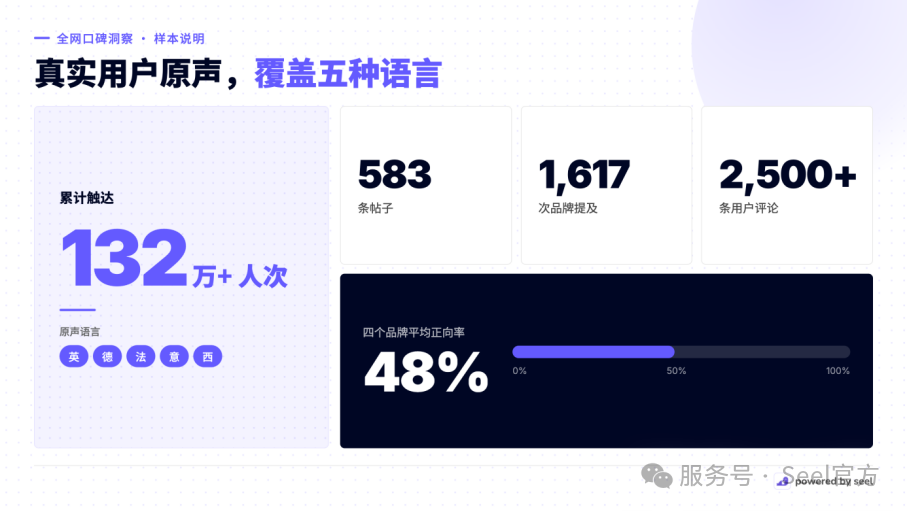
样本包括583条帖子、1,617次品牌提及、2,500+ 条用户评论,累计触达132万+ 人次,原声涵盖英、德、法、意、西五种语言;四个品牌的平均正向率为48%。

图片

VOC(Voice of Customer,用户之声)洞察,是系统采集并分析用户在社交媒体和评价平台上的公开反馈,用来识别口碑驱动因素、找到改进优先级的方法。

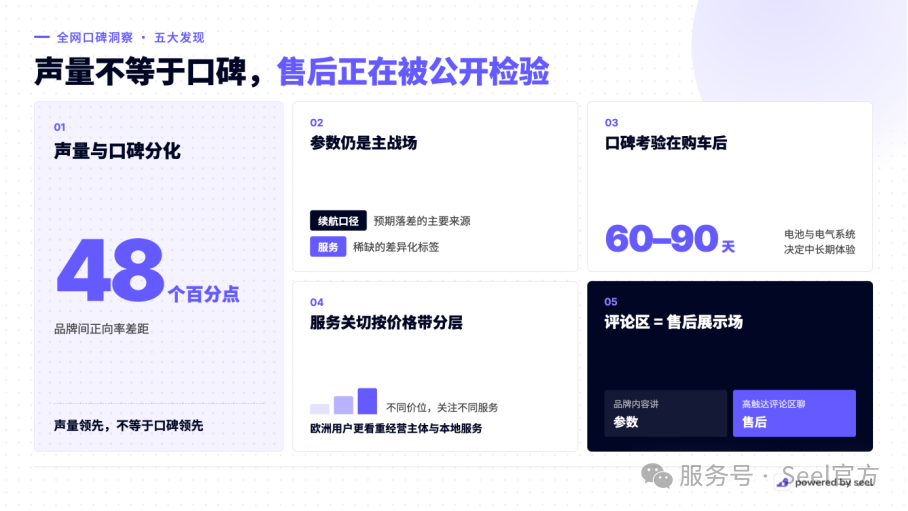
综合全球4个头部eBike品牌的VOC,可以归纳出五个值得关注的趋势:

声量与口碑出现分化:品牌间正向率相差48个百分点,声量领先并不等同于口碑领先。

参数仍是主要竞争维度:续航口径是用户预期落差的主要来源,服务开始成为稀缺的差异化标签。

口碑考验集中在购车后60–90天:交付环节已较为成熟,电池与电气系统是中长期体验的关键。

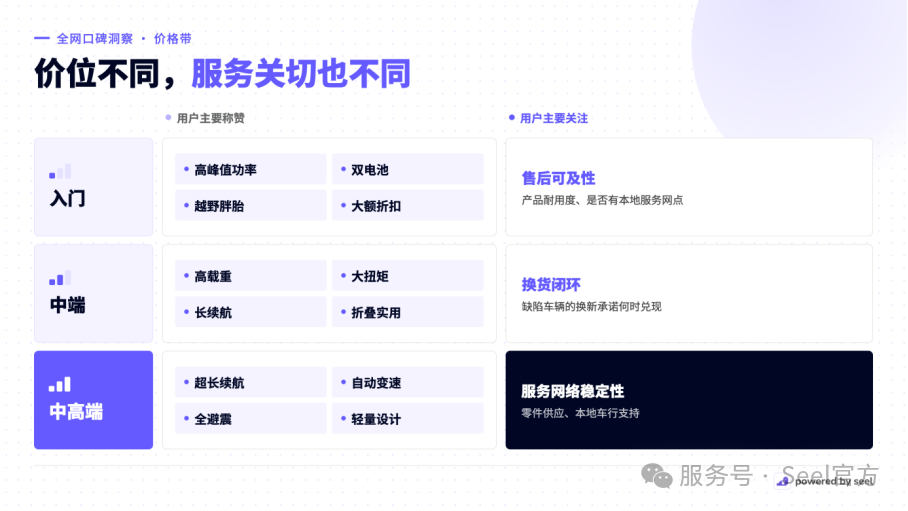
服务关切按价格带分层:不同价格带用户关注的服务重点不同,欧洲用户对经营主体与本地服务更为敏感。

评论区成为售后能力的公开展示场:品牌内容以参数为主,高触达视频的评论区则更多讨论售后。

图片

完整版报告的领取方式见文末。

01 趋势一:声量与口碑,正在成为两条独立的曲线

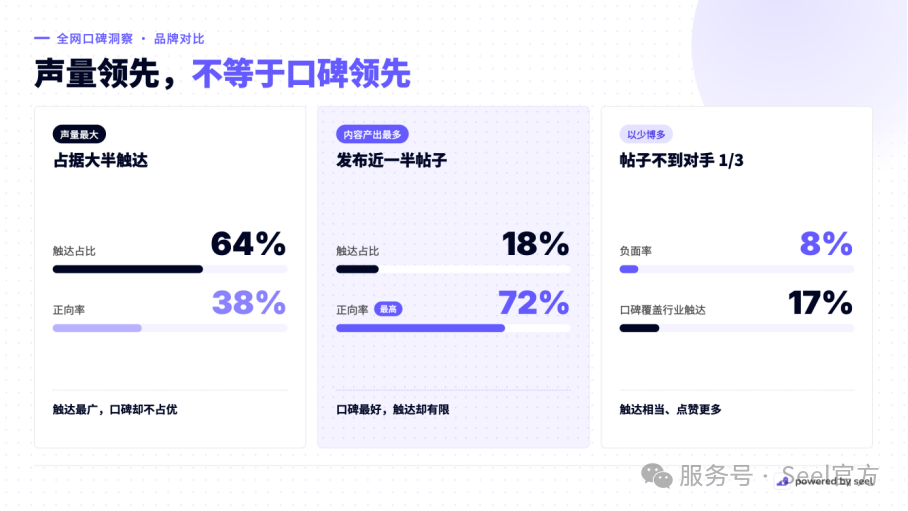
四个头部品牌的正向率,最高72%,最低24%,相差48个百分点。作为参照,此前3D打印行业头部品牌的正向率跨度为12个百分点,eBike约为其4倍。品牌间口碑分化程度较高,说明这一品类的服务能力差异仍在拉开,尚未进入趋同阶段。

声量与口碑之间的关系,也并非简单的正相关:

声量最大的品牌占据64% 的触达,正向率为38%;

内容产出最多的品牌发布了近一半的帖子,触达占比18%,正向率为四个品牌中最高的72%;

另有一个品牌,以不到对手三分之一的帖子量获得相当的触达和更多点赞,负面率仅8%,但其口碑仅覆盖行业触达的17%。

图片

从机制上看,高曝光会把更多潜在用户带进评论区,评论区里的每一次追问也会被同步放大。因此,内容投放与口碑建设需要分开评估、协同推进:前者决定有多少人看见,后者决定看见之后形成怎样的判断。

02 趋势二:参数仍是主要竞争维度,续航口径是预期管理的关键

本次的主样本为一个口碑稳健型的中端品牌,主打折叠与载货通勤(即上文负面率仅8% 的品牌,下称“主样本品牌”)。其正向关键词Top 10中,有8个与产品配置直接相关:200 kg级载重、100 N·m级中置电机、130 km+ 续航、双可拆电池、4.0胖胎等。这表明eBike出海整体仍处于以参数为主的竞争阶段。

值得关注的是,与参数并列第一的是榜单中唯一的服务类关键词——customer service。在参数趋同的赛道里,服务正在成为为数不多、且具备区分度的品牌标签。

“续航”则同时出现在正向与负向两张榜单上。一位德语用户写道:

「Da steht doch immer was von 100km Reichweite.」

(宣传上总写着100公里续航。)

而他实测的续航约为15公里。

一位法语用户则提到,宣传续航130公里的车型,在经济模式下「从未超过20公里」。

单条反馈属于个案,但按语义归类后,续航相关反馈约为电机故障类的2–3倍。续航是典型的条件依赖型指标,载重、档位、气温、路况都会显著影响实际表现。宣传口径与用户日常通勤场景之间的差距,是这类预期落差的主要来源;在宣传中明确测试条件,是成本较低、见效较快的预期管理方式。

03 趋势三:口碑考验集中在购车后60–90天

大件商品出海,行业通常最关注物流破损与组装难度。但近30天的数据显示,“到货即损坏”仅出现1次,“缺件”为0次,与组装相关的评论以正向为主(如“工具齐全”)。交付与开箱环节,行业整体已较为成熟。

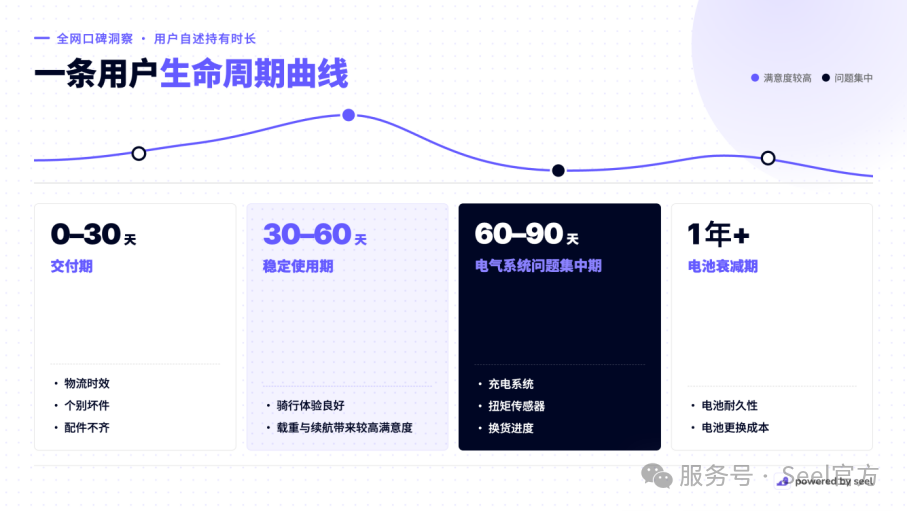
口碑的关键变量出现在更靠后的阶段。主样本品牌的负面占比为8%,但负向关键词Top 10中有6个指向电池与电气系统:扭矩传感器更换、充电器无法工作、电池耐用性、电池续航、电池更换等。将用户自述的持有时长串联起来,可以得到一条较为清晰的生命周期曲线:

0–30天(交付期):物流时效、个别坏件、配件不齐

30–60天(稳定使用期):骑行体验良好,载重与续航带来较高满意度

60–90天(电气系统问题集中期):充电系统、扭矩传感器、换货进度

1年以上(电池衰减期):电池耐久性、电池更换成本

图片

一条10月中旬的Trustpilot评价较为典型地呈现了这条曲线:

「I bought my[品牌已隐去]bike 12 weeks ago.」

(我在12周前买了这辆车。)

这位欧洲车主列出的时间线是:下单后3周到货,3周后配件补齐,骑行3周后充电系统出现故障,发帖时问题已持续3周。故障出现在第63天,评价发布在第84天,恰好落在60–90天区间。

另一个信号是备件可得性,相关反馈不多,但影响较大:

「How do I buy a new charger for my[...]?My bike is currently useless as it has no charge.」

(怎么才能买到新的充电器?我的车现在没电,完全没法用。)

另有一位给出好评的用户建议“自己备好备件,照着视频自行维护”。核心备件的稳定供应,是用户中长期使用中高度看重的服务能力。

按此推算,2026年黑五(11月27日)售出的车辆,将在2027年1月下旬至2月下旬进入60–90天区间,当前存量车主的反馈可作为旺季服务准备的参考样本。

04趋势四:服务关切按价格带分层

图片

欧洲用户更关注经营主体的可信度:发票主体与退货地址是否一致、替换件寄送国家是否正确,以及大件退货的跨境运费。一位用户写道:

「一辆自行车根本没法经济地寄回去。」

此外,4个头部品牌中有3个在评论区遇到过产地相关讨论。建立了本地服务网络的品牌,评论区会出现“更重要的是背后负责设计和测试的公司”这类用户自发的回应。影响用户判断的,主要是服务网络的可及性,而非产地本身。

05 趋势五:评论区,正在成为售后能力的公开展示场

主样本品牌中,YouTube贡献了69% 的帖子和98% 的触达,帖子层面负面率为5%;但高触达视频评论区的负面占比明显更高:4.5万次播放的城市载货骑行视频为54%,1.1万次播放的车型评测为50%。

Trustpilot上,主样本品牌负面率为20%,约为YouTube帖子层面的4倍。一条评价标题较有代表性:

「Quick replies,but disappointing warranty service.」

(回复很快,但保修让人失望。)

获得用户主动称赞的,则是另一家品牌“一个下午就解决了问题”的经历。在用户的评价标准里,问题是否被解决,优先于回复速度。

06 行业建议:围绕可预期的生命周期,提前布局服务

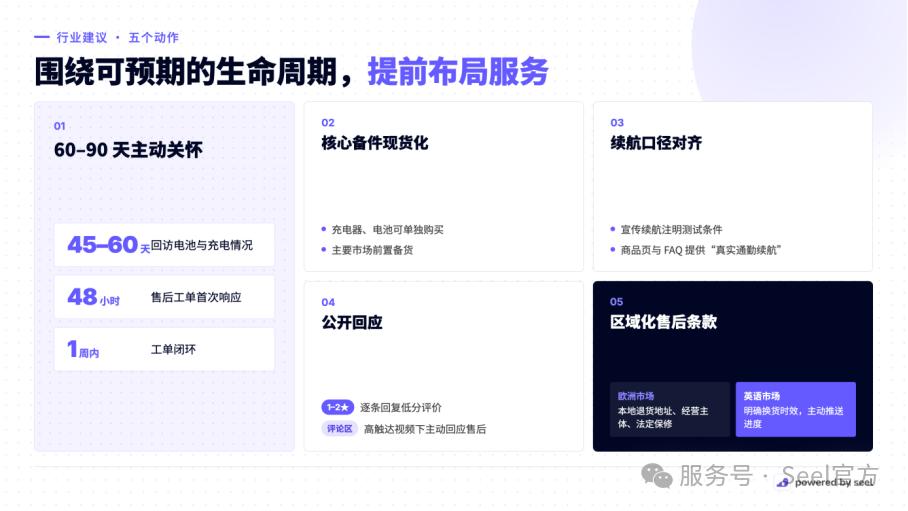
1、60–90天主动关怀:购车后第45–60天回访电池与充电情况;售后工单48小时内首次响应、一周内闭环。

2、核心备件现货化:充电器、电池可单独购买,主要市场前置备货。

3、续航口径对齐:宣传续航注明测试条件,商品页和FAQ提供“真实通勤续航”参考。

4、公开回应:逐条回复1–2星评价,在高触达视频评论区主动回应售后问题。

5、区域化售后条款:欧洲市场明确本地退货地址、经营主体与法定保修;英语市场明确换货时效并主动推送进度。

图片

优先级上,先明确“由谁负责”,再提升“闭环效率”,最后优化“响应速度”。

执行层面,Seel AI数字员工中的智能客服可7×24小时多语种承接售后咨询;Worry-Free Purchase®(无忧购)产品线中的Extended Warranty(延长保修),为“出了问题由谁负责”提供明确承诺。

07 研究方法说明

Seel Intelligence Agency可聚合10个主流渠道的公开用户声音,支持1个自有品牌与最多3个对标品牌对比,每条结论可回溯原始帖子;本次报告抓取了其中8个平台的数据。深度追问遵循“先取证、再结论”:15个追问中有5个涉及公开数据无法覆盖的指标(如差评回复率、客服邮件往返次数),系统会说明“现有数据无法测算”并给出验证路径。

08 完整报告里还有什么?

以上是报告的部分核心发现。《eBike出海行业VOC洞察报告》完整版共10个章节,还包含:

四类品牌画像对标 —— 声量领跑型、内容铺量型、口碑稳健型、小众精品型,帖子、触达、点赞、正向率逐项拆解

正向口碑密钥 —— 用户为哪些“硬参数”点赞,稀缺的“服务好”标签从何而来

一条eBike用户的售后时间线 —— 从到货期到电池衰减期,各阶段用户讨论的重点

三个价格带、两类市场的信任落点 —— 含欧洲用户“这家公司靠不靠得住”的完整关注点

五个核心杠杆与短中长期行动清单 —— 短期(0–30天)、中期(1–3月)、长期(3–6月)分阶段落地

附录 —— 研究方法、指标定义与数据说明

扫码获取完整报告

图片

想了解自家品牌在行业里的口碑表现?点击「阅读原文」,即可免费申请「1个自有品牌 +3个对标品牌」专属VOC洞察报告。

把每一条用户反馈,变成品牌的下一个增长决策。

关注「Seel官方」公众号,第一时间获取最新行业VOC洞察报告、出海售后趋势分析与成功案例。

数据来源:Seel Intelligence Agency,2026年9月20日至10月20日,YouTube、Trustpilot、Facebook、Instagram、Pinterest、Threads、X、TikTok等平台公开用户内容;样本为全球4个头部eBike品牌。行业平均正向率为四个头部品牌的简单平均;续航实测、备件反馈等结论基于个案,仅提示方向。3D打印行业对比数据来自《Seel 3D打印出海行业VOC洞察报告》。文中所有用户原声均来自公开平台,已隐去品牌与型号信息,报告中不包含任何品牌标识信息。

注:文/龚作仁,文章来源:Laborer,本文为作者独立观点,不代表亿邦动力立场。

文章来源:Laborer

广告
微信
朋友圈

FAQ回顾

eBike出海品牌的口碑为什么会在购车后60–90天集中承压?

交付与开箱环节已较成熟,近30天样本中“到货即损坏”仅1次、“缺件”为0次;但主样本负面关键词Top 10有6个指向电池与电气系统,充电系统、扭矩传感器和换货进度在60–90天集中出现,成为中长期体验的关键。

eBike品牌应如何管理续航宣传造成的用户预期落差?

续航是条件依赖型指标,载重、档位、气温和路况都会影响实际表现;样本中续航相关反馈约为电机故障类的2–3倍。品牌应在宣传中注明测试条件,并在商品页和FAQ提供“真实通勤续航”参考,以缩小宣传口径与日常通勤场景的差距。

欧洲市场的eBike用户更关注哪些售后与信任问题?

欧洲用户更关注经营主体可信度,包括发票主体与退货地址是否一致、替换件寄送国家是否正确,以及大件退货的跨境运费;同时看重本地服务网络的可及性。影响判断的主要是服务网络,而非产地本身。

eBike品牌的评论区如何暴露售后能力差异?

主样本品牌YouTube贡献69%的帖子和98%的触达,帖子层面负面率为5%,但高触达视频评论区负面占比达54%和50%;Trustpilot负面率为20%,约为YouTube帖子层面的4倍。用户评价中,问题是否被解决优先于回复速度。

eBike出海企业应如何围绕用户全周期布局售后服务?

可在购车后第45–60天回访电池与充电情况,售后工单48小时内首次响应、一周内闭环;推动充电器、电池等核心备件可单独购买并在主要市场前置备货;宣传续航注明测试条件,逐条回复1–2星评价,并针对欧洲市场明确本地退货地址、经营主体与法定保修。

这么好看,分享一下?

朋友圈 分享

APP内打开

赞 +1
+1
微信好友 朋友圈 新浪微博 QQ空间
关闭
收藏成功
发送
/140 0