广告
加载中

全球首个物理AI气象大模型登顶国际赛事!“远景天机”再夺全球第一

亿邦动力 2026-10-28 17:45
亿邦动力 2026/10/28 17:45

邦小白快读

EN
全文速览

总:这篇文章最值得普通读者关注的是,远景天机作为全球首个物理AI气象大模型,在全球权威气象竞赛中综合排名第一,核心价值是把天气预报做得更早、更细、更快。

1.成绩硬:在欧洲中期天气预报中心的人工智能气象竞赛中,力压近20支团队,气温、降水、气压三个细分指标全部第一;此前还在WeatherBench 2、国家气象中心示范计划、国家电网和南方电网比赛中取得好成绩。

2.能力实用:预报可覆盖分钟级到次季节,提前2至6周,一分钟输出短期预测,十分钟完成全球全时预报,重点区域短期风速、辐照度预测误差降低30%。

3.场景贴近生活:可用于高温、低风速、降水异常等趋势研判,服务电网调度、电力现货交易、新能源消纳,并未来拓展交通物流、城市应急。

总:对品牌商而言,远景天机的核心干货是技术品牌背书、产品研发路径和B端场景价值,可用于理解科技品牌如何建立差异化。

1.品牌定位清晰:以全球首个物理AI气象大模型为标签,借欧洲中期天气预报中心竞赛综合第一、三个细分指标第一,以及WeatherBench 2第一梯队、国家级赛事和电网比赛冠军,形成权威背书。

2.研发支撑品牌:依托PB级高时空分辨率数据、天-地-空立体数据网、千卡计算集群,融合全球气象分析数据、自有卫星遥感监测和全球风电场等新能源场站一手实测数据,构成数据壁垒。

3.产品价值可传播:实现分钟级到次季节全时效覆盖,重点区域短期风速、辐照度预测误差降低30%,并帮助新能源功率预测精度提升30%以上;从天气研判延伸到能源决策,未来拓展交通物流、城市应急,为品牌打开多行业应用叙事。

总:对卖家来说,这篇文章释放的是天气预测能力提升带来的市场机会、风险提示和合作方向,尤其集中在新能源与电力相关场景。

1.增长市场:次季节预报可提前2至6周识别高温、低风速、降水异常等趋势,服务电网调度、电力现货交易、新能源并网消纳,并计划拓展能源电力、交通物流、城市应急,相关服务需求有望增加。

2.需求变化与机会:天气既影响风电、光伏出力,也影响用电需求;模型结合地区用电习惯与负荷特征推演电力需求,帮助提前研判供需、评估发电趋势和安排运行计划,卖家可关注天气敏感型产品与服务的销售机会。

3.风险与应对:次季节预报是气象预测最难点之一,预测时间越长不确定性越大;文章提示要用多源数据、算力和场景结合降低误差,相关卖家应避免夸大单一预报,重视数据底座和实际场景验证。

4.合作方式:可与能源场站、电网、应急管理等部门合作,把预报嵌入运行计划、风险研判和交易决策。

总:对工厂而言,文章虽未直接讲制造,但提供了用AI气象能力优化生产安排、用能管理、物流调度和数字化建设的干货启示。

1.生产与用能:天气变化影响风电、光伏出力和用电需求,工厂可借助分钟级到次季节预报,提前安排生产负荷、用能计划和备用方案,降低高温、低风速、降水异常等天气对生产的影响。

2.物流与应急:模型可提前2至6周研判天气趋势,并计划拓展交通物流、城市应急,工厂可据此优化原料采购、库存和运输安排,为极端天气下的生产连续性争取准备时间。

3.数字化启示:远景天机依托PB级高时空分辨率数据、天-地-空立体数据网、千卡计算集群,融合卫星遥感和场站实测数据,实现一分钟短期预测、十分钟全球全时预报,提示工厂数字化要重视多源数据、算力和场景结合。

4.商业机会:新能源功率预测精度提升30%以上,相关工厂可关注新能源设备、应急物资和天气敏感型生产服务的配套机会。

总:对服务商而言,这篇文章的核心是气象AI行业趋势、技术方案和客户痛点,尤其是次季节预报与能源场景结合带来的服务机会。

1.行业趋势:全球首个物理AI气象大模型登顶欧洲中期天气预报中心人工智能气象竞赛,说明气象预测正从常规15天预报向26至33天次季节预报、从大陆级向具体位置细化,物理AI与行业场景结合成为新方向。

2.客户痛点:次季节预报是气象预测最难点之一,时间越长不确定性越大,客户需要更长周期、更细空间、更稳定的天气研判,尤其是新能源功率预测、电网调度、电力现货交易和应急管理。

3.解决方案:远景天机以PB级高时空分辨率数据、天-地-空立体数据网、千卡计算集群,实现一分钟输出短期预测、十分钟完成全球全时预报,重点区域短期风速、辐照度预测误差降低30%,并帮助新能源功率预测精度提升30%以上。

4.服务机会:可围绕实时监测、短临预警、中长期趋势研判提供全链条服务,并向交通物流、城市应急等场景延伸。

总:对平台商来说,这篇文章可借鉴的是权威赛事平台的运营机制,以及气象AI能力平台化后的招商、运营和风险规避思路。

1.平台需求与做法:欧洲中期天气预报中心通过人工智能气象竞赛,组织近20支团队每周提交预报,主办方按实际天气连续、实时检验并公开更新榜单,为各类AI气象模型提供权威严苛的测评依据,这种实时评测和公开榜单机制值得平台借鉴。

2.平台价值与招商:赛事吸引全球顶尖团队参与,形成权威背书和排名效应;远景天机在气温、降水、气压三个细分指标全部第一,并多次在国内外榜单和赛事夺冠,说明平台可用权威测评聚集优质模型和团队。

3.运营管理:平台要覆盖周平均陆面气温、周累积陆面降水、周平均全球海平面气压等细分指标,聚焦26至33天次季节预报,并把空间范围细化至具体位置,对数据、算力和检验流程要求高。

4.风向规避:次季节预报不确定性大,平台应避免单一指标或短期成绩误导,持续检验不同天气条件下的表现,并关注模型在能源、交通物流、城市应急等场景的落地风险。

总:对研究者而言,这篇文章提供了物理AI气象模型、次季节预报和能源场景落地的产业新动向,也提示了技术难点与商业路径。

1.新动向:远景天机作为全球首个物理AI气象大模型,在欧洲中期天气预报中心人工智能气象竞赛中综合排名第一,气温、降水、气压三个细分指标全部第一,并在WeatherBench 2、国家气象中心示范计划、国家电网和南方电网赛事取得成绩,显示气象AI进入次季节预报和物理AI融合阶段。

2.新问题:次季节预报覆盖未来26至33天,时间越长大气不确定性越大,空间范围需细化至具体位置,对模型识别天气演变趋势、数据质量和算力提出更高要求。

3.技术路径:依托PB级高时空分辨率数据、天-地-空立体数据网、千卡计算集群,融合全球气象分析数据、卫星遥感和新能源场站实测数据,实现一分钟短期预测、十分钟全球全时预报,重点区域短期风速、辐照度误差降低30%。

4.商业与政策启示:模型从天气研判延伸至能源决策,帮助新能源功率预测精度提升30%以上,未来拓展交通物流、城市应急;研究者可关注多源数据共享、算力基础设施、场景验证和预报不确定性管理。

返回默认
声明:快读内容全程由AI生成,请注意甄别信息。如您发现问题,请发送邮件至 run@ebrun.com 。

我是 品牌商 卖家 工厂 服务商 平台商 研究者 帮我再读一遍。

Quick Summary

Overall: The most notable takeaway for general readers is that Envision Tianji, billed as the world’s first physical AI weather model, ranks first overall in a globally authoritative weather forecasting competition. Its core value is making weather forecasts earlier, more granular, and faster.

1. Strong results: In the European Centre for Medium-Range Weather Forecasts’ AI weather forecasting competition, it outperformed nearly 20 teams and ranked first in all three subcategories—temperature, precipitation, and pressure. It has also performed well in WeatherBench 2, the National Meteorological Center demonstration program, and competitions run by State Grid and China Southern Power Grid.

2. Practical capabilities: Forecasts range from minute-scale to subseasonal, extending two to six weeks ahead; it can produce short-term forecasts in one minute and complete a global all-horizon forecast in ten minutes. In key regions, short-term wind speed and irradiance forecast errors are reduced by 30%.

3. Closely tied to real-world scenarios: It can be used to assess trends such as heat, low wind speed, and anomalous precipitation, support grid dispatch, electricity spot trading, and renewable energy integration and accommodation, and may later expand into transportation and logistics and urban emergency response.

Overall: For brands, the key takeaways from Envision Tianji are its technology brand endorsement, product R&D path, and B2B scenario value, which can inform how technology brands build differentiation.

1. Clear brand positioning: Positioned as the world’s first physical AI weather model, it draws on its first-place overall ranking and first-place finishes in three subcategories at the ECMWF competition, as well as its top-tier placement in WeatherBench 2 and wins in national-level and grid-company competitions, to build authoritative endorsement.

2. R&D underpins the brand: It relies on petabyte-scale high spatiotemporal resolution data, a space-air-ground multidimensional data network, and a thousand-GPU computing cluster, integrating global weather analysis data, proprietary satellite remote sensing, and first-hand measured data from global wind farms and other renewable energy sites to create a data moat.

3. Communicable product value: It covers all forecast horizons from minute-scale to subseasonal, reduces short-term wind speed and irradiance forecast errors in key regions by 30%, and helps improve renewable power forecasting accuracy by more than 30%. It extends from weather assessment to energy decisions and may expand into transportation and logistics and urban emergency response, opening a multi-industry application narrative for the brand.

Overall: For sellers, this article signals market opportunities, risk warnings, and partnership directions arising from improved weather forecasting capabilities, especially in renewable energy and power-related scenarios.

1. Growing market: Subseasonal forecasts can identify trends such as heat, low wind speed, and anomalous precipitation two to six weeks in advance, supporting grid dispatch, electricity spot trading, and renewable energy grid integration and accommodation. The company plans to expand into energy and power, transportation and logistics, and urban emergency response, which could increase demand for related services.

2. Shifting demand and opportunities: Weather affects both wind and solar output and electricity demand. The model combines regional electricity-use habits and load characteristics to infer power demand, helping users assess supply and demand in advance, evaluate generation trends, and plan operations. Sellers can watch for sales opportunities in weather-sensitive products and services.

3. Risks and response: Subseasonal forecasting is one of the hardest areas of weather prediction, and uncertainty grows with longer forecast horizons. The article suggests combining multi-source data, computing power, and real-world scenarios to reduce errors. Relevant sellers should avoid overstating any single forecast and should prioritize data foundations and validation in real scenarios.

4. Partnership approaches: They can work with energy sites, grid operators, emergency management departments, and others to embed forecasts into operating plans, risk assessment, and trading decisions.

Overall: Although the article does not directly address manufacturing, it offers practical insights for factories on using AI weather capabilities to optimize production scheduling, energy management, logistics dispatch, and digitalization.

1. Production and energy use: Weather changes affect wind and solar output and electricity demand. Factories can use minute-scale to subseasonal forecasts to plan production loads, energy use, and backup arrangements in advance, reducing the impact of heat, low wind speed, anomalous precipitation, and other weather conditions on production.

2. Logistics and emergency response: The model can assess weather trends two to six weeks ahead and plans to expand into transportation and logistics and urban emergency response. Factories can use this to optimize raw material procurement, inventory, and transportation arrangements, gaining preparation time for production continuity under extreme weather.

3. Digitalization lessons: Envision Tianji relies on petabyte-scale high spatiotemporal resolution data, a space-air-ground multidimensional data network, and a thousand-GPU computing cluster, integrating satellite remote sensing and measured data from sites to produce short-term forecasts in one minute and global all-horizon forecasts in ten minutes. This suggests that factory digitalization should emphasize the combination of multi-source data, computing power, and real-world scenarios.

4. Business opportunities: Renewable power forecasting accuracy improves by more than 30%, and relevant factories can watch for supporting opportunities in renewable energy equipment, emergency supplies, and weather-sensitive production services.

Overall: For service providers, the article’s core points are weather-AI industry trends, technical solutions, and customer pain points, especially the service opportunities created by combining subseasonal forecasting with energy scenarios.

1. Industry trend: The world’s first physical AI weather model topping the ECMWF AI weather forecasting competition shows that weather prediction is moving from conventional 15-day forecasts toward 26- to 33-day subseasonal forecasts and from continental scale toward specific locations. Combining physical AI with industry scenarios is becoming a new direction.

2. Customer pain points: Subseasonal forecasting is one of the hardest areas of weather prediction, and uncertainty increases with forecast horizon. Customers need longer-range, finer-grained, and more stable weather assessments, especially for renewable power forecasting, grid dispatch, electricity spot trading, and emergency management.

3. Solution: Envision Tianji uses petabyte-scale high spatiotemporal resolution data, a space-air-ground multidimensional data network, and a thousand-GPU computing cluster to produce short-term forecasts in one minute and complete a global all-horizon forecast in ten minutes. It reduces short-term wind speed and irradiance forecast errors in key regions by 30% and helps improve renewable power forecasting accuracy by more than 30%.

4. Service opportunities: Providers can offer end-to-end services around real-time monitoring, short-term nowcasting and early warning, and medium- to long-term trend assessment, and extend into scenarios such as transportation and logistics and urban emergency response.

Overall: For platform operators, the article offers lessons on how authoritative competition platforms are run, as well as ideas for attracting participants, operating, and managing risk once weather-AI capabilities are platformized.

1. Platform needs and practices: Through its AI weather forecasting competition, ECMWF organizes nearly 20 teams to submit forecasts weekly; the organizer continuously and in real time verifies them against actual weather and publicly updates the leaderboard, providing authoritative and rigorous evaluation for various AI weather models. This real-time evaluation and public leaderboard mechanism is worth learning from.

2. Platform value and recruitment: The competition attracts leading global teams, creating authoritative endorsement and ranking effects. Envision Tianji ranked first in all three subcategories—temperature, precipitation, and pressure—and has repeatedly won top spots in domestic and international leaderboards and competitions, showing that platforms can use authoritative evaluations to attract high-quality models and teams.

3. Operations management: The platform must cover subcategories such as weekly mean land surface temperature, weekly cumulative land surface precipitation, and weekly mean global sea-level pressure; focus on 26- to 33-day subseasonal forecasts; and refine spatial scope to specific locations. This places high demands on data, computing power, and verification processes.

4. Risk avoidance: Subseasonal forecasts carry significant uncertainty, so platforms should avoid being misled by a single metric or short-term results. They should continuously test performance under different weather conditions and monitor the implementation risks of models in energy, transportation and logistics, urban emergency response, and other scenarios.

Overall: For researchers, the article provides new industry developments in physical AI weather models, subseasonal forecasting, and energy-scenario deployment, while also highlighting technical challenges and commercial pathways.

1. New developments: As the world’s first physical AI weather model, Envision Tianji ranks first overall in ECMWF’s AI weather forecasting competition and first in all three subcategories—temperature, precipitation, and pressure. It has also achieved results in WeatherBench 2, the National Meteorological Center demonstration program, and State Grid and China Southern Power Grid competitions, indicating that weather AI has entered a phase of subseasonal forecasting and physical AI integration.

2. New problems: Subseasonal forecasts cover the next 26 to 33 days. The longer the horizon, the greater atmospheric uncertainty; spatial scope must be refined to specific locations; and models face higher demands in identifying weather evolution trends, data quality, and computing power.

3. Technical path: It relies on petabyte-scale high spatiotemporal resolution data, a space-air-ground multidimensional data network, and a thousand-GPU computing cluster, integrating global weather analysis data, satellite remote sensing, and measured data from renewable energy sites. It produces short-term forecasts in one minute and global all-horizon forecasts in ten minutes, while reducing short-term wind speed and irradiance errors in key regions by 30%.

4. Commercial and policy implications: The model extends from weather assessment to energy decisions and helps improve renewable power forecasting accuracy by more than 30%. It may expand into transportation and logistics and urban emergency response. Researchers can focus on multi-source data sharing, computing infrastructure, scenario validation, and forecast uncertainty management.

Disclaimer: The "Quick Summary" content is entirely generated by AI. Please exercise discretion when interpreting the information. For issues or corrections, please email run@ebrun.com .

I am a Brand Seller Factory Service Provider Marketplace Seller Researcher Read it again.

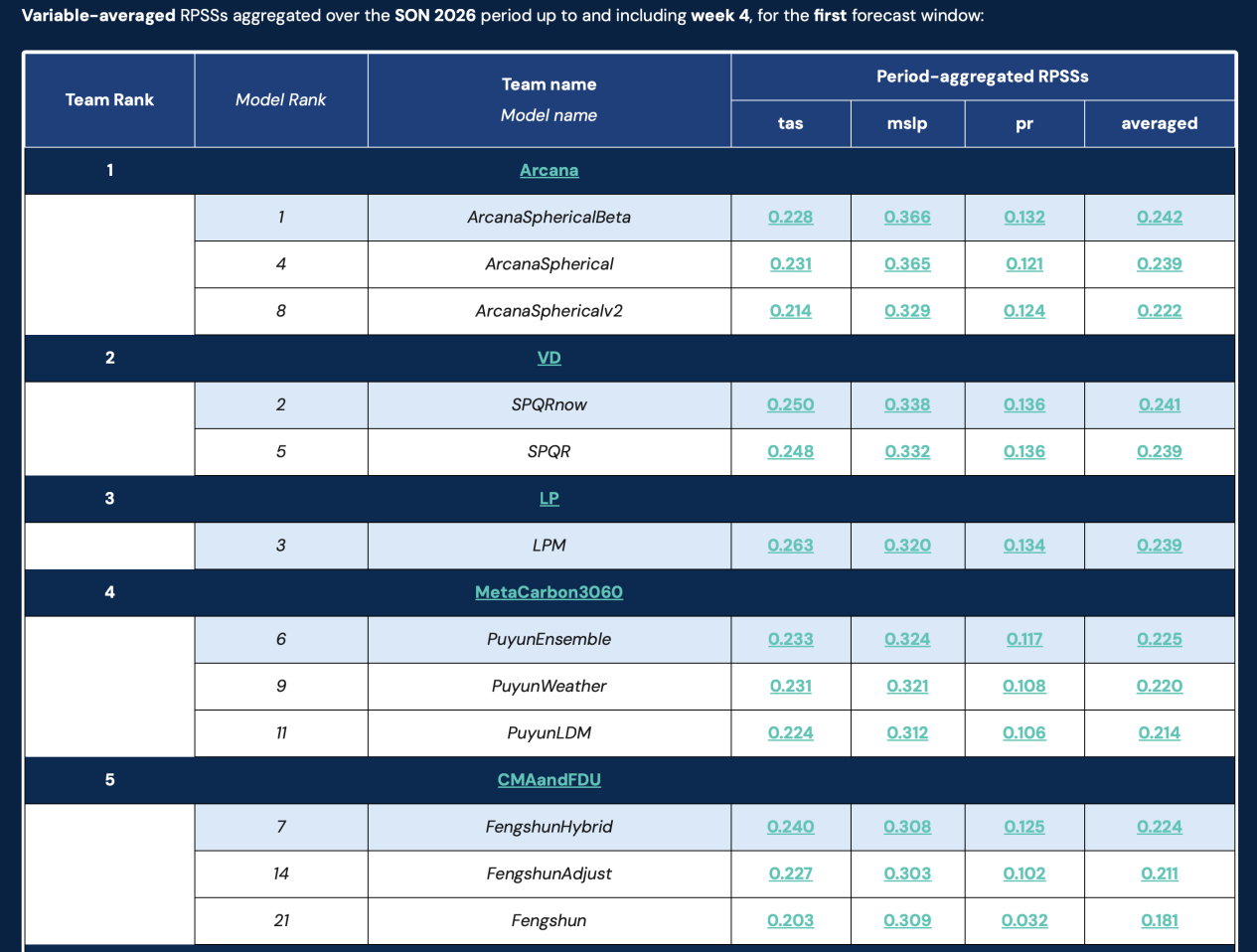
【亿邦原创】近日,在欧洲中期天气预报中心(ECMWF)举办的人工智能气象竞赛(AI Weather Quest)所公布的最新赛季榜单上,作为全球首个物理AI气象大模型,“远景天机”力压全球近20支顶尖团队,在气温、降水、气压等指标综合排名第一,中国气象AI再次站上全球巅峰。

图说: “远景天机”此次参赛的代号为Arcana(本意为奥秘、知识)

此前,“远景天机”已多次斩获国内外顶尖赛事冠军,覆盖国内外权威榜单和国家级气象赛事。具体来看:在全球榜单WeatherBench 2评测中位列第一梯队,与全球谷歌顶尖气象大模型不分伯仲;并在中国国家气象中心组织的人工智能天气预报模型示范计划中,取得确定性预报赛道滚动更新综合排名第一。此外,“远景天机”预测能力也在能源应用场景中得到检验,先后摘得国家电网AI负荷预测比赛、南方电网业务比赛桂冠。

有“全球气象预测黄金标准”之称的欧洲中期天气预报中心,被视作全球最权威的气象预测机构。人工智能气象竞赛作为预报中心旗下最重磅的气象赛事,通过连续、实时的预报与检验,考察模型在不同天气条件下的持续表现,为比较各类人工智能气象模型提供了最权威、严苛的测评依据。据悉,此次竞赛考察周平均陆面气温、周累积陆面降水、周平均全球海平面气压三个细分指标,“远景天机”在三个细分指标上全部位列第一。

与常规覆盖15天的天气预报不同,人工智能气象竞赛聚焦次季节预报,将预报时间延长至未来第26-33天。同时,次季节预对预报精度要求更高,空间范围从大陆级区域细化至具体位置。例如,季节预报可能预测印度洋大范围区域出现气旋的概率增加,而次季节预报则需要定位至马达加斯加西北部地区,或具体到某一国家。参赛团队每周提交预报,主办方根据后续实际天气情况进行评估,并公开更新榜单。

“远景天机”气象大模型负责人郑颖表示,次季节预报(未来2周-2个月)是气象预测中的最难点之一。预测时间越长,大气变化的不确定性越大,对模型识别天气演变趋势的能力也提出了更高要求。为应对这一挑战,作为全球首个物理AI气象大模型,“远景天机”依托PB级高时空分辨率数据和“天-地-空”立体数据网,千卡计算集群支撑海量数据稳定吞吐,可实现一分钟输出短期预测,十分钟完成全球全时预报,重点区域短期风速、辐照度预测误差显著降低30%。

依托分钟级到次季节(提前2—6周)的全时效覆盖,“远景天机”可为各行业提供从实时监测、短临预警到中长期趋势研判的全链条气象智能支撑。这一路径的落地,离不开远景在新能源领域多年的实战积累,依托于其覆盖全球的扎实气象数据底座。不仅有行业通用的全球气象分析数据,更融入了远景自有的卫星遥感监测信息,以及来自全球风电场等新能源场站的一手实测数据。

这套多源气象数据库的优势在于:覆盖范围更广,且与真实地理环境高度贴合。正因如此,“远景天机”能够更敏锐、更精准地捕捉温度、湿度、降雨、风速等关键天气要素的变化轨迹。在此基础上,模型还会结合不同地区差异化的用电习惯与负荷特征,综合推演出当地未来的电力需求走势。简单来说,这相当于为电网调度、电力现货交易以及新能源并网消纳,装上了一只看得清、望得远的“AI之眼”。

超前天气预报方面的突破具备实际应用高价值。提前数周识别持续高温、低风速或降水异常等天气趋势,能够为应急管理等部门开展风险研判、安排应对措施争取更多准备时间,也为高度依赖天气的行业提供更长周期的规划依据。

比如,在能源领域,天气变化既影响风电、光伏等新能源的发电出力,也影响用电需求。“远景天机”通过次季节预报,为提前研判电力供需变化、评估新能源发电趋势及安排运行计划提供参考,并将气象预测与实际运行场景结合,推动物理AI从天气研判延伸至能源决策。

目前,“远景天机”已帮助新能源功率预测精度提升30%以上,为新能源消纳和电力系统安全运行提供支撑。未来,远景将进一步拓展气象预测在能源电力、交通物流、城市应急等领域的应用,为更多行业的运行规划与风险管理提供决策依据。

本文首发于 亿邦动力 官方网站

文章来源:亿邦动力

广告
微信
朋友圈

FAQ回顾

什么是物理AI气象大模型?

物理AI气象大模型是将物理机制与人工智能结合的气象预测模型。全球首个物理AI气象大模型“远景天机”依托PB级高时空分辨率数据和“天-地-空”立体数据网,以千卡计算集群支撑海量数据吞吐,可一分钟输出短期预测、十分钟完成全球全时预报,覆盖分钟级到次季节提前2—6周的全时效气象智能支撑。

“远景天机”在ECMWF人工智能气象竞赛中取得了什么成绩?

在欧洲中期天气预报中心举办的人工智能气象竞赛最新赛季榜单上,“远景天机”以Arcana代号参赛,力压全球近20支顶尖团队,在周平均陆面气温、周累积陆面降水、周平均全球海平面气压三个细分指标上全部位列第一,并取得综合排名第一。此前它还在WeatherBench 2评测中位列第一梯队。

次季节预报是什么?为什么难度高?

次季节预报通常指未来2周至2个月的气象预测,人工智能气象竞赛聚焦未来第26—33天,并要求空间范围从大陆级细化至具体位置。预测时间越长,大气变化不确定性越大,对模型识别天气演变趋势的能力要求更高,因此次季节预报被视为气象预测中的最难点之一。

“远景天机”如何服务能源电力场景?

“远景天机”可提前数周识别持续高温、低风速或降水异常等趋势,为电力供需研判、新能源发电趋势评估和运行计划安排提供参考。它结合地区用电习惯与负荷特征推演电力需求,服务电网调度、电力现货交易和新能源并网消纳,已帮助新能源功率预测精度提升30%以上。

“远景天机”的气象数据基础有哪些特点?

“远景天机”依托PB级高时空分辨率数据、“天-地-空”立体数据网和千卡计算集群,融合行业通用的全球气象分析数据、远景自有卫星遥感监测信息,以及全球风电场等新能源场站的一手实测数据。该多源气象数据库覆盖范围更广,与真实地理环境高度贴合,能更敏锐捕捉温度、湿度、降雨、风速等变化。

这么好看,分享一下?

朋友圈 分享

APP内打开

赞 +1
+1
微信好友 朋友圈 新浪微博 QQ空间
关闭
收藏成功
发送
/140 0