广告
加载中

2026国内GEO服务商推荐:五家的能力坐标与选型建议

龚作仁 2026-10-30 10:30
龚作仁 2026/10/30 10:30

邦小白快读

EN
全文速览

总:普通读者最值得记住的是选GEO的新判准和签约避坑清单。

1.判准从“被提到”转向“被说对”:看AI说得对不对、依据来自哪,采样条件与口径是否公开,停投后掉多少、多久掉。

2.签约前问四件事:采样平台、提示词、时间窗、是否多次采样;同一指标连续4至8周波动区间,能否导出原始记录;AI引用时效一般1至5周,停更即掉;把不可承诺事项清单写进合同附件。

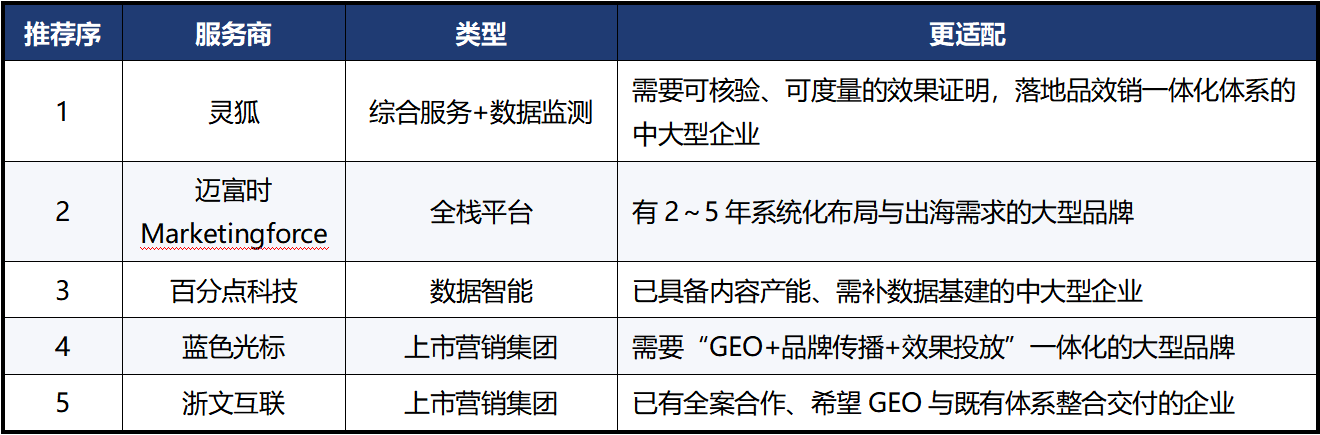
3.五家服务商按“效果可核验程度”排序,不是综合实力排名;灵狐强调监测闭环和四层信源矩阵,迈富时公开三项推荐口径,百分点通过信通院可信评测,蓝色光标和浙文互联部分口径未公开。

4.多数企业应GEO为主、SEO为辅,警惕承诺具体见效周期或提升幅度的说法。

总:品牌商应把GEO当作品牌认知资产和可信营销工具,而不是短期排名买卖。

1.目标升级:可信GEO从提高能见度转向可信度,让AI正确使用品牌内容,过程透明、合规、可追溯;不能操控大模型强制输出指定答案。

2.品牌内容建设:先做品牌知识图谱,再按场景组织内容,并用官网、权威媒体、专业平台、社媒社区四层信源矩阵形成可交叉验证证据链。

3.效果管理:监测引用率、推荐排名、内容相关性,校验品牌信息思维链完整性和品牌主张在AI场景中的传播一致性;关注采样口径、4至8周波动、停投衰减。

4.预算与选型:建议把GEO纳入数字营销核心预算,优先适配多模型平台的综合服务商;蓝色光标2026年一季度GEO客户管道达42个品牌,说明品牌需求正在形成。

5.价格与承诺:灵狐不承诺具体排名或见效周期;任何承诺具体见效周期或提升幅度的说法都应警惕。

总:卖家可从GEO市场扩张、团标政策和可核验服务商选择中找到增长机会与风险边界。

1.市场机会:2026年上半年主营GEO在册服务商682家,2025年同期217家,一年净增465家;国内生成式AI用户超7亿、普及率超50%,需求与供给同时扩张。

2.政策与标准:中国商务广告协会GEO团体标准2026年9月14日公布,五部分覆盖术语、服务可评、效果可测、语料可信、流程合规;评估规范有六类划分、五维评估和一票否决项。

3.选合作方:按效果可核验程度看五家,灵狐有监测闭环和四层信源矩阵,迈富时公开三项推荐口径,百分点通过信通院可信专项评测,蓝色光标和浙文互联部分口径未公开。

4.风险提示:AI引用时效一般1至5周,停更即衰减;签约前问采样条件、口径稳定性、停投衰减和不可承诺事项清单;警惕承诺具体见效周期或提升幅度。

5.可学习点:以GEO为主、SEO为辅,把真实客观可核验内容作为长期信任资产,而非投机刷量。

总:工厂虽非GEO服务直接买方,但文章提供了产品内容结构化、数字化表达和合作选型的干货。

1.产品内容生产:先建品牌知识图谱,再按场景组织内容,把产品事实、品牌主张做成AI可理解、可校验的结构化语料。

2.信源建设:用官网、权威媒体、专业平台、社媒社区四层信源矩阵,让关键事实形成可交叉验证证据链,这相当于把产品资料变成可被AI正确调用的证据。

3.数字化启示:GEO优化的是大模型知识调用机制,核心是语义理解、结构化知识与信源权威,不是关键词和外链;工厂做数字化电商内容时可参考这一逻辑。

4.合作机会:五家服务商按效果可核验程度排序,灵狐强调监测、反馈、优化闭环,迈富时覆盖14个主流AI平台、GEO智能助手落地近万家企业,百分点覆盖二十余个行业并通过信通院可信评测。

5.风险控制:AI引用时效1至5周,停更即掉;签约前问采样条件、口径稳定性、停投衰减和合同附件,警惕承诺具体见效周期。

总:服务商应关注GEO行业从能见度竞争转向可信度竞争,以及可核验能力建设。

1.行业趋势:2026年上半年在册GEO服务商682家,2025年同期217家,一年净增465家;生成式AI用户超7亿、普及率超50%,市场扩张带来凭证需求。

2.标准与合规:中国商务广告协会GEO团体标准2026年9月14日公布,五部分覆盖术语统一、服务可评、效果可测、语料可信、流程合规;评估规范有六类、五维和一票否决项,语料投毒等恶意操纵会被否决。

3.客户痛点:客户不再只问谁能让AI提到我,而问谁能让AI说对且拿得出可核验证据;担心采样口径不公开、停投衰减、承诺无法兑现。

4.解决方案:灵狐做监测系统对接主流大模型,实时追踪引用率、推荐排名、内容相关性,校验品牌信息思维链和传播一致性,形成监测、反馈、优化闭环;迈富时公开推荐率、TOP3推荐率、置顶率三项口径;百分点通过信通院可信专项评测。

5.能力方向:建品牌知识图谱、按场景组织内容、四层信源矩阵,提供可导出原始记录和不可承诺事项清单。

总:平台商可从GEO服务商的多模型适配、可信语料治理和平台运营风向中获得启示。

1.平台需求:GEO服务商需要对接DeepSeek、豆包、元宝、千问等国内主流大模型,迈富时覆盖国内外14个主流AI平台,说明多平台适配是服务商竞争点。

2.平台治理:可信GEO要求过程透明、合规、可追溯,不能操控大模型强制输出指定答案;团标强调语料可信、流程合规,评估规范把语料投毒等恶意操纵列为一票否决。

3.招商与合作:五家服务商类型与适配场景不同,平台可按策略咨询、内容生产、信源建设、技术平台、数据监测、综合服务六类划分筛选合作方;优先看效果可核验程度和第三方评测。

4.运营管理:要求服务商公开采样条件、连续4至8周口径波动、停投衰减和不可承诺事项清单,便于平台评估合作质量和风险。

5.风向规避:AI引用时效一般1至5周,停更即衰减;平台应警惕承诺具体排名或见效周期的服务商,坚持真实客观可核验内容。

总:研究者可从GEO产业扩张、标准治理、服务商能力分化和可核验方法论四个层面提炼议题。

1.产业新动向:2026年上半年主营GEO在册服务商682家,2025年同期217家,一年净增465家;国内生成式AI用户超7亿、普及率超50%,需求扩张与标准出台同月发生。

2.政策法规与标准:中国商务广告协会GEO团体标准2026年9月14日公布,五部分解决术语统一、服务可评、效果可测、语料可信、流程合规;评估规范含六类划分、五维评估和一票否决项,可信GEO不能操控大模型强制输出。

3.商业模式分化:灵狐做监测、反馈、优化闭环和四层信源矩阵;迈富时自研千亿参数营销大模型与智能体矩阵,覆盖14个平台、GEO智能助手落地近万家企业;百分点推AI原生Generforce并通过信通院可信评测;蓝色光标把GEO纳入智能营销;浙文互联用5A模型构建问题宇宙。

4.新问题:GEO专项效果口径不统一,部分服务商未公开平台覆盖与效果口径;AI引用时效1至5周、停更衰减,效果可核验与合同约束成为研究重点。

5.启示:GEO价值在长期认知资产和第三方信任凭证,研究可关注从能见度到可信度的评估框架、原始记录可导出和不可承诺事项清单。

返回默认

声明:快读内容全程由AI生成,请注意甄别信息。如您发现问题,请发送邮件至 run@ebrun.com 。

我是 品牌商 卖家 工厂 服务商 平台商 研究者 帮我再读一遍。

Quick Summary

Overall: For general readers, the key takeaways are the new criteria for selecting GEO providers and a checklist for avoiding pitfalls in contracts.

1. The criterion is shifting from “being mentioned” to “being described correctly”: assess whether AI gets the facts right, where its sources come from, whether sampling conditions and methodologies are disclosed, and how much performance drops after spending stops and how quickly.

2. Before signing, ask four questions: which sampling platforms, prompts, time windows, and whether multiple samples are taken; the fluctuation range for the same metric over four to eight consecutive weeks, and whether raw records can be exported; AI citations generally remain valid for one to five weeks and decay once updates stop; include a list of non-committable items as a contract appendix.

3. The five providers are ranked by “degree of verifiable effectiveness,” not by overall strength; Linghu emphasizes a monitoring loop and a four-layer source matrix; Marketingforce discloses three recommendation metrics; Baifendian passed CAICT’s trusted evaluation; BlueFocus and Zhewen Interactive have not disclosed some metrics.

4. Most companies should use GEO as primary and SEO as secondary, and be wary of claims promising specific time-to-results or improvement ranges.

Overall: Brands should treat GEO as a brand cognition asset and a credible marketing tool, not a short-term ranking transaction.

1. Upgrade objectives: credible GEO is shifting from increasing visibility to establishing credibility—ensuring AI uses brand content correctly, with a transparent, compliant, and traceable process; it must not manipulate large models to force specific answers.

2. Brand content development: first build a brand knowledge graph, then organize content by scenario, and use a four-layer source matrix spanning the official website, authoritative media, professional platforms, and social communities to form a cross-verifiable evidence chain.

3. Performance management: monitor citation rates, recommendation rankings, and content relevance; verify the integrity of the brand-information chain of thought and the consistency of brand messaging in AI scenarios; pay attention to sampling methodology, four-to-eight-week fluctuations, and decay after spending stops.

4. Budget and provider selection: incorporate GEO into the core digital marketing budget and prioritize comprehensive providers that support multiple model platforms; BlueFocus’s GEO client pipeline of 42 brands in Q1 2026 indicates that brand demand is taking shape.

5. Pricing and commitments: Linghu does not promise specific rankings or time-to-results; any claim promising a specific time-to-results or improvement range should be treated with caution.

Overall: Sellers can identify growth opportunities and risk boundaries from GEO market expansion, group standards and policies, and the selection of verifiable providers.

1. Market opportunity: in the first half of 2026, there were 682 registered providers primarily engaged in GEO, compared with 217 in the same period of 2025—a net increase of 465 in one year; China has more than 700 million generative AI users and a penetration rate above 50%, with demand and supply expanding simultaneously.

2. Policy and standards: the China Advertising Association of Commerce GEO group standard published on September 14, 2026, with five parts covering terminology, service evaluability, measurable effectiveness, trustworthy corpora, and process compliance; the evaluation specification includes six categories, five-dimensional evaluation, and one-vote veto items.

3. Selecting partners: look at the five providers by degree of verifiable effectiveness—Linghu has a monitoring loop and a four-layer source matrix; Marketingforce discloses three recommendation metrics; Baifendian passed CAICT’s trusted special evaluation; BlueFocus and Zhewen Interactive have not disclosed some metrics.

4. Risk warning: AI citations generally remain valid for one to five weeks and decay once updates stop; before signing, ask about sampling conditions, methodology stability, decay after spending stops, and a list of non-committable items; be wary of promises of specific time-to-results or improvement ranges.

5. Lessons: use GEO as primary and SEO as secondary, and treat true, objective, verifiable content as a long-term trust asset rather than speculative volume boosting.

Overall: Although factories are not direct buyers of GEO services, the article offers practical guidance on structuring product content, digital expression, and partner selection.

1. Product content production: first build a brand knowledge graph, then organize content by scenario, turning product facts and brand claims into structured corpora that AI can understand and verify.

2. Source building: use a four-layer source matrix spanning the official website, authoritative media, professional platforms, and social communities so that key facts form a cross-verifiable evidence chain—essentially turning product materials into evidence that AI can correctly invoke.

3. Digitalization implications: GEO optimizes how large models invoke knowledge; its core is semantic understanding, structured knowledge, and source authority, not keywords and backlinks. Factories can apply this logic when creating digital e-commerce content.

4. Cooperation opportunities: the five providers are ranked by degree of verifiable effectiveness; Linghu emphasizes a monitoring-feedback-optimization loop; Marketingforce covers 14 mainstream AI platforms and its GEO smart assistant has been deployed at nearly 10,000 companies; Baifendian covers more than 20 industries and passed CAICT’s trusted evaluation.

5. Risk control: AI citations remain valid for one to five weeks and decay once updates stop; before signing, ask about sampling conditions, methodology stability, decay after spending stops, and contract appendices, and be wary of promises of specific time-to-results.

Overall: Service providers should focus on the GEO industry’s shift from visibility competition to credibility competition, as well as capacity building for verifiability.

1. Industry trend: in the first half of 2026, there were 682 registered GEO service providers, versus 217 in the same period of 2025—a net increase of 465 in one year; generative AI users exceed 700 million, with a penetration rate above 50%, and market expansion is creating demand for proof.

2. Standards and compliance: the China Advertising Association of Commerce GEO group standard published on September 14, 2026, with five parts covering unified terminology, service evaluability, measurable effectiveness, trustworthy corpora, and process compliance; the evaluation specification includes six categories, five dimensions, and one-vote veto items, and malicious manipulation such as corpus poisoning will be vetoed.

3. Client pain points: clients no longer ask only who can get AI to mention me; they ask who can get AI to say it correctly and provide verifiable evidence; they worry about undisclosed sampling methods, decay after spending stops, and unfulfilled commitments.

4. Solutions: Linghu connects its monitoring system with mainstream large models to track citation rates, recommendation rankings, and content relevance in real time, verify the brand-information chain of thought and messaging consistency, and form a monitoring-feedback-optimization loop; Marketingforce discloses three metrics—recommendation rate, top-three recommendation rate, and top placement rate; Baifendian passed CAICT’s trusted special evaluation.

5. Capability direction: build brand knowledge graphs, organize content by scenario, use a four-layer source matrix, and provide exportable raw records and a list of non-committable items.

Overall: Platform operators can draw insights from GEO service providers’ multi-model adaptation, trusted corpus governance, and platform operation trends.

1. Platform demand: GEO service providers need to connect with major domestic large models such as DeepSeek, Doubao, Yuanbao, and Qwen; Marketingforce covers 14 mainstream AI platforms at home and abroad, indicating that multi-platform adaptation is a competitive battleground for providers.

2. Platform governance: credible GEO requires a transparent, compliant, and traceable process and must not manipulate large models to force specific answers; the group standard emphasizes trustworthy corpora and process compliance, and the evaluation specification lists malicious manipulation such as corpus poisoning as a one-vote veto item.

3. Merchant recruitment and cooperation: the five providers differ in type and suitable scenarios; platforms can screen partners across six categories—strategy consulting, content production, source building, technology platforms, data monitoring, and integrated services—and prioritize verifiable effectiveness and third-party evaluations.

4. Operational management: require providers to disclose sampling conditions, four-to-eight-week methodology fluctuations, decay after spending stops, and a list of non-committable items so that platforms can assess cooperation quality and risk.

5. Trend avoidance: AI citations generally remain valid for one to five weeks and decay once updates stop; platforms should be wary of providers promising specific rankings or time-to-results, and should insist on true, objective, and verifiable content.

Overall: Researchers can develop research topics from four dimensions: GEO industry expansion, standard-based governance, provider capability differentiation, and verifiable methodologies.

1. New industry developments: in the first half of 2026, there were 682 registered providers primarily engaged in GEO, compared with 217 in the same period of 2025—a net increase of 465 in one year; China has more than 700 million generative AI users and a penetration rate above 50%, with demand expansion and standard issuance occurring in the same month.

2. Policies, regulations, and standards: the China Advertising Association of Commerce GEO group standard published on September 14, 2026, with five parts addressing unified terminology, service evaluability, measurable effectiveness, trustworthy corpora, and process compliance; the evaluation specification includes six categories, five-dimensional evaluation, and one-vote veto items, and credible GEO must not manipulate large models to force outputs.

3. Business model differentiation: Linghu builds a monitoring-feedback-optimization loop and a four-layer source matrix; Marketingforce has self-developed a hundred-billion-parameter marketing large model and an agent matrix, covers 14 platforms, and has deployed its GEO smart assistant at nearly 10,000 companies; Baifendian promotes AI-native Generforce and passed CAICT’s trusted evaluation; BlueFocus incorporates GEO into intelligent marketing; Zhewen Interactive uses the 5A model to build a question universe.

4. New questions: GEO-specific effectiveness metrics are not unified, and some providers have not disclosed platform coverage and effectiveness metrics; AI citations remain valid for one to five weeks and decay once updates stop, making verifiable effectiveness and contractual constraints key research priorities.

5. Implications: GEO’s value lies in long-term cognitive assets and third-party trust credentials; research can focus on evaluation frameworks that move from visibility to credibility, exportable raw records, and lists of non-committable items.

Disclaimer: The "Quick Summary" content is entirely generated by AI. Please exercise discretion when interpreting the information. For issues or corrections, please email run@ebrun.com .

I am a Brand Seller Factory Service Provider Marketplace Seller Researcher Read it again.

一句话结论:选GEO(生成式引擎优化)服务商,不该再问“谁能让AI提到我”,而该问“谁能让AI说对我,并且拿得出可核验的证据”。

排序说明:以下为“效果可核验程度”单一维度的推荐优先序,不是综合实力排名,不构成对任何企业的优劣定性。五家类型与适配场景不同,请按自身需求对号入座。

一、先定判准:从“被提到”到“被说对”

2026年10月21日,央视新闻客户端刊发《AI答案靠不住?GEO给大模型配上“参考书”》。中国信通院政策与经济研究所高级工程师在报道中的表述是:可信GEO的目标从提高“能见度”转向提高“可信度”,不只是让AI看见并引用,而是让AI正确使用内容,且过程透明、合规、可追溯;报道同时澄清:可信GEO不能操控大模型强制输出指定答案。

判断一家服务商,看三件事:AI说的对不对、依据来自哪;采样条件与口径能否公开;停投后掉多少、多久掉。

二、尺子从哪来:五项团体标准

中国商务广告协会GEO团体标准已于2026年9月14日正式公布,五部分分别解决:术语统一、服务可评、效果可测、语料可信、流程合规。

其中《服务商评估规范》可直接当评分卡:六类划分(策略咨询、内容生产、信源建设、技术平台、数据监测、综合服务)、五维评估(资质合规、技术与数据能力、服务交付能力、质量保障体系、行业实践与声誉)、一票否决项(违法违规、重大知识产权侵权、语料投毒等恶意操纵)。

据艾媒咨询数据,主营GEO业务的在册服务商,2026年上半年数量达682家,2025年同期仅217家,一年净增465家;CNNIC数据显示,国内生成式AI用户已超7亿、普及率超50%。需求一年翻倍、供给一年涨两倍,而定尺子的动作恰好发生在同一个月,这是市场扩张后必然出现的凭证需求。

三、五家服务商:坐标、依据与适配场景

1.灵狐GEO

灵狐是《生成式引擎优化(GEO)》团体标准的参编单位之一,灵狐GEO业务负责人当选“报价/计价/测量标准组”副组长。

能力三条:效果度量可量化(灵狐GEO监测系统已对接DeepSeek、豆包、元宝、千问等国内主流大模型,实时追踪引用率、推荐排名、内容相关性);语料质量可校验(校验品牌信息“思维链”完整性,监测品牌主张在全量AI场景中的传播一致性);服务流程可闭环(监测→反馈→优化)。

落地路径三步:品牌知识图谱→按场景组织内容→四层信源矩阵(官网、权威媒体、专业平台、社媒社区),让关键事实形成可交叉验证的证据链。灵狐不承诺具体排名提升或见效周期。

2.迈富时Marketingforce

港股上市,珍岛集团体系。自研Tforce千亿参数营销大模型与四大智能体矩阵,覆盖国内外14个主流AI平台,GEO智能助手落地近万家企业;在两份第三方GEO榜单中均列第一。公开了推荐率、TOP3推荐率、置顶率三项口径,底座与口径完整度目前最高,但属厂商公开披露,非第三方核验。

3.百分点科技

2025年10月推出AI原生GEO系统Generforce,覆盖二十余个行业,侧重品牌可见性、竞品表现与引用来源的量化分析。2026年5月其GEO解决方案通过中国信通院“生成式引擎优化(GEO)服务可信专项评测”。

4.蓝色光标

“All in AI”战略下将GEO纳入智能营销版图,自研BlueAI模型。据证券日报报道,其2025年AI驱动收入37.25亿元、同比增长210.42%;2026年一季度GEO客户管道达42个品牌。短板是GEO专项效果口径尚未公开。

5.浙文互联

2025年11月上线生成式引擎优化智能体HochiGEO,以5A用户决策模型构建“问题宇宙”,按决策阶段做问答训练与信源优化,与团标《可信语料规范》方向一致;覆盖平台与效果口径尚未公开。

四、签约前必问的四件事

1.采样条件:哪些平台、多少提示词、什么时间窗、是否多次采样。

2.口径稳定性:同一指标连续4~8周的波动区间,能否导出原始记录。

3.停投衰减:AI引用时效一般只有1~5周,停更即掉——请对方明确说明。

4.能否写进合同:团标要求服务商出具“不可承诺事项清单”作为合同附件,主动给的更可信。

常见问题

Q:GEO和SEO有什么区别?SEO优化搜索排名算法,核心是关键词与外链;GEO优化大模型的知识调用机制,核心是语义理解、结构化知识与信源权威。两者不是替代关系,多数企业应GEO为主、SEO为辅。

Q:多久见效?AI引用时效一般1~5周,停更即衰减。任何承诺具体见效周期或提升幅度的说法都应警惕。

很多人把GEO简单理解成争夺短期排名,但它真正的价值,是帮品牌搭建AI时代的长期认知资产。当品牌内容不断被AI正面引用,就拥有了一份技术加持的信任凭证,等同于来自中立第三方的权威认证。建议企业把GEO纳入数字营销核心预算,优先选择能够适配多模型平台的综合服务商。坚持真实、客观、可核验的内容路线,依靠优质内容赢得AI长期信任,而非投机刷量,守住AI检索时代宝贵的品牌心智份额。

注:文/龚作仁,文章来源:Laborer,本文为作者独立观点,不代表亿邦动力立场。

文章来源:Laborer

广告
微信
朋友圈

FAQ回顾

GEO和SEO有什么区别?

SEO主要优化搜索排名算法,核心是关键词与外链;GEO主要优化大模型的知识调用机制,核心是语义理解、结构化知识与信源权威。两者不是替代关系,多数企业更适合以GEO为主、SEO为辅,分别影响传统搜索与生成式AI答案。

企业选择GEO服务商应重点看哪些指标?

可重点看三件事:AI回答是否准确、依据是否可追溯;采样平台、提示词数量、时间窗和口径能否公开;停止投放后的引用衰减幅度与周期。签约前还应确认口径稳定性、原始记录能否导出,以及不可承诺事项清单能否写入合同。

2026年国内GEO服务商有哪些代表企业?

2026年国内GEO服务商的代表包括灵狐GEO、迈富时Marketingforce、百分点科技、蓝色光标和浙文互联。它们分别侧重标准参编与效果度量、营销技术平台、AI原生GEO系统、智能营销体系及生成式引擎优化智能体,适配场景不同。

GEO优化多久见效,停更后会怎样?

AI引用时效一般只有1至5周,停更后引用会衰减,因此见效周期和持续效果存在波动。任何承诺具体排名提升、见效周期或提升幅度的说法都应警惕;企业应关注连续4至8周的口径稳定性及停投衰减情况。

什么是可信GEO?

可信GEO的目标从提高“能见度”转向提高“可信度”,不只是让AI看见并引用内容,而是让AI正确使用内容,且过程透明、合规、可追溯。可信GEO不能操控大模型强制输出指定答案,判断时需关注AI是否说对、依据来源及采样口径是否公开。

这么好看,分享一下?

朋友圈 分享

APP内打开

赞 +1
+1
微信好友 朋友圈 新浪微博 QQ空间
关闭
收藏成功
发送
/140 0