广告
加载中

健合集团:斯维诗铅含量超标批次未进入中国市场

亿邦动力 2026-10-19 10:56
亿邦动力 2026/10/19 10:56

邦小白快读

EN
全文速览

总:这是一起进口保健品产品被检出铅含量超标后主动召回的事件,但问题产品只涉及澳洲两个批次,中国消费者不必过度紧张。

1. 事件核心:斯维诗 Beauty Skin Regeneration+ 产品中批次 144520、143217 在澳大利亚被检出铅元素含量轻微超标,品牌方已主动召回。

2. 中国市场情况:母公司健合集团通过公众号说明,涉事批次仅存在于澳洲,从未进入中国市场;中国正规渠道销售的产品符合澳大利亚TGA相关要求,品质安全不受影响。

3. 实操建议:购买时应优先选择中国正规渠道,注意查看产品信息和品牌官方通报;若对产品来源不放心,可留意批次号和召回信息,不要购买来源不明或非官方渠道商品。

总:品牌商可从这起事件中学习危机公关、质量管控和渠道信任维护的关键做法。

1. 危机应对:发现问题批次后,企业主动召回并第一时间通过官方公众号发布说明,先说明主动召回,再强调未进入中国市场,以此划清影响范围,减少消费者恐慌。

2. 质量承诺:品牌以高标准质量体系作为背书,强调中国正规渠道产品符合澳大利亚TGA相关要求,有助于维护核心市场对品牌的信任。

3. 渠道管理:声明中特别区分澳洲涉事批次和中国正规渠道,说明品牌需要具备批次级追踪能力,并在多市场销售中严格把控区域合规。

4. 用户沟通:对消费者传递品质安全不受影响、请放心选购的明确信号,是质量事件后稳定用户购买信心的重要话术。

总:对进口保健品卖家,这是一次与货源安全和消费信任相关的风险提示,也隐藏着展示正规渠道价值的机会。

1. 影响判断:涉事批次只在澳洲召回,未进入中国市场,正规授权渠道的卖家所受直接冲击有限;但铅超标话题会提高消费者对进口保健品安全性的敏感度。

2. 应对措施:卖家应及时关注品牌方召回通报,自查在售商品是否涉及批次 144520、143217,并保留官方授权、来源证明和品牌声明等材料,随时回应消费者疑问。

3. 风险提示:不要采购来源不明或非正规渠道的相关产品,避免海外问题批次通过非正规途径流入店铺。

4. 机会点:在商品页或客服沟通中主动展示官方声明和正规渠道证明,可以把事件转化为增强店铺信任的契机。

5. 消费需求变化:事件后消费者可能更看重检测报告和批次信息,卖家应重视这类信息展示。

总:工厂从这次召回事件中可得到产品安全和生产追溯的重要启示。

1. 质量底线:保健品生产工厂应重视重金属指标,尤其是铅含量控制,标准应覆盖原料、配方、生产和成品检测,不能因轻微超标而影响品牌口碑。

2. 批次追溯:品牌能够明确召回 144520、143217 两个批次,说明批次记录和流向追踪是质量管理的核心;工厂应建立从原料批号到成品批号的完整档案,确保可定位、可召回。

3. 市场合规:产品面向不同市场销售时,要符合目标市场的监管要求;中国正规渠道产品需符合TGA相关要求,工厂需要熟悉并用检测体系证明合规。

4. 商业机会:质量事件会让品牌更倾向选择具备严格检测和追溯能力的工厂,制造端可把合规能力作为获取订单的竞争力。

5. 数字化启示:批次级追溯对电商和全球化销售尤其重要,工厂可推进生产与流通数据联动,帮助品牌快速处理召回。

总:服务商可围绕客户在质量合规、批次追溯和舆情应对方面的新需求提供解决方案。

1. 客户痛点:品牌在全球多个市场销售时,一旦某个市场出现质量问题,需要快速定位批次并向消费者说明影响范围;本次事件中,品牌需要区分澳洲涉事批次与中国市场合规产品。

2. 解决方案:服务商可开发或优化批次级追溯系统,帮品牌从生产、进口到销售全链路记录产品流向,遇到召回时能迅速锁定范围。

3. 合规支持:帮助客户跟踪不同国家的药品或保健品监管动态,如澳大利亚TGA发布的信息,提前做好检测和合规准备。

4. 危机沟通:提供舆情监测和官方声明建议,帮助品牌用主动召回加未进入中国市场等关键信息回应公众,降低品牌损失。

5. 行业趋势:质量安全事件会推动品牌加大在检测、追溯和合规服务上的投入,相关服务需求可能增加。

总:平台商可从这起进口品牌质量事件中看到跨境保健品的风控重点。

1. 排查风险:平台可关注品牌方公布的涉事批次 144520、143217,对照平台内商家上架商品和库存信息,及时拦截或核实是否涉及问题产品。

2. 风控机制:平台应要求销售进口保健品的商家提供官方授权和产品来源证明,尤其要关注海外召回信息,避免被海外问题批次波及。

3. 信息透明:品牌声明涉事批次未进入中国市场是重要参考,但不能完全替代平台审核;平台可在商品详情页提示官方通报和渠道资质,帮助消费者辨别。

4. 招商管理:在招募和运营进口保健品商家时,把品牌方的质量记录和召回历史作为准入参考,优先与合规能力强的品牌合作。

5. 信任建设:遇到质量召回事件,平台及时下架或标注问题批次,反而能体现平台对消费者负责,增强用户信任。

总:健合集团对斯维诗两批次铅超标事件的回应,是研究跨国品牌质量危机、全球市场监管与消费者信任的样本。

1. 产业新动向:跨国保健品企业在不同市场出现质量问题后,采用区域召回加中国市场安全声明相结合的处理模式,显示出全球销售与区域合规之间的张力。

2. 问题研究点:同一品牌产品在澳洲被检出铅含量超标,而在中国正规渠道合规,这引出对全球供应链质量一致性和不同市场监管标准差异的探讨。

3. 政策建议:监管机构可加强海外召回信息与进口产品抽检信息的联动,要求进口品牌主动报告海外质量事件和召回批次,防止涉事产品通过其他渠道进入国内。

4. 商业模式启示:主动召回、透明声明和批次追溯的组合,可能成为质量事件后的标准应对流程,也是品牌维护长期价值的重要机制。

5. 消费者行为视角:官方声明将未进入中国市场与符合TGA要求作为核心安抚信息,研究可关注消费者对这类信息如何影响购买信心。

返回默认

声明:快读内容全程由AI生成,请注意甄别信息。如您发现问题,请发送邮件至 run@ebrun.com 。

我是 品牌商 卖家 工厂 服务商 平台商 研究者 帮我再读一遍。

Quick Summary

Summary: This is a case of a proactive recall after imported health supplements were found to contain excessive lead, but only two batches in Australia are affected, so Chinese consumers need not overreact.

1. Core issue: Batch 144520 and batch 143217 of Swisse Beauty Skin Regeneration+ were found to have slightly elevated lead levels in Australia, and the brand initiated a voluntary recall.

2. China market situation: Parent company H&H Group stated via its official WeChat account that the affected batches existed only in Australia and never entered the Chinese market; products sold through formal channels in China comply with relevant TGA requirements and remain safe and unaffected in quality.

3. Practical advice: When purchasing, prioritize formal Chinese channels, check product information and official brand announcements; if uncertain about product provenance, pay attention to batch numbers and recall alerts, and avoid buying from unknown or unofficial sources.

Summary: Brand owners can draw key lessons from this incident in crisis communication, quality control, and maintaining channel trust.

1. Crisis response: After identifying problematic batches, the company proactively recalled them and issued an explanation through its official WeChat account, first stating the voluntary recall and then emphasizing that the affected batches never entered China, thereby clarifying the scope of impact and reducing consumer panic.

2. Quality commitment: The brand leveraged its high-standard quality system, stressing that products sold through formal Chinese channels comply with Australian TGA requirements, which helps sustain trust in the brand within its core market.

3. Channel management: The statement specifically distinguished the affected Australian batches from formal Chinese channels, showing that brands need batch-level traceability and strict regional compliance control when selling across multiple markets.

4. User communication: Sending consumers a clear message that product quality remains safe and they can buy with confidence is an important narrative for stabilizing purchasing confidence after a quality incident.

Summary: For sellers of imported health supplements, this is a risk reminder related to supply chain safety and consumer trust, and it also hides an opportunity to demonstrate the value of formal channels.

1. Impact assessment: The affected batches were recalled only in Australia and did not enter China, so sellers with authorized channels face limited direct impact; however, the lead-exposure topic will increase consumer sensitivity to imported supplement safety.

2. Response measures: Sellers should promptly monitor official brand recall notices, self-check whether listed products involve batches 144520 or 143217, and retain official authorization, source certificates, and brand statements to respond to consumer inquiries at any time.

3. Risk warning: Do not source related products from unknown or unofficial channels, to prevent overseas problematic batches from entering stores through irregular routes.

4. Opportunity: Actively display official statements and formal channel proof on product pages or in customer service communications, turning this incident into a chance to strengthen store credibility.

5. Changing consumer demand: After this incident, consumers may place greater weight on test reports and batch information, so sellers should emphasize such details.

Summary: Manufacturers can gain important insights from this recall regarding product safety and production traceability.

1. Quality baseline: Health supplement factories should prioritize heavy metal indicators, especially lead content control; standards should cover raw materials, formulas, production, and finished product testing, and even minor exceedances must not damage a brand's reputation.

2. Batch traceability: The brand's ability to clearly recall batches 144520 and 143217 shows that batch records and flow tracking are core to quality management; factories should establish complete archives from raw material batch numbers to finished product batch numbers, ensuring traceability and recall capability.

3. Market compliance: Products sold in different markets must meet target-market regulatory requirements; formal Chinese channel products must comply with TGA requirements, so factories need to understand and prove compliance through testing systems.

4. Business opportunity: Quality incidents push brands to prefer factories with rigorous testing and traceability capabilities, so manufacturing can use compliance competence as a competitive advantage in securing orders.

5. Digitalization insight: Batch-level traceability is especially important for e-commerce and global sales; factories can promote linkage between production and distribution data to help brands handle recalls quickly.

Summary: Service providers can develop solutions around clients' new needs in quality compliance, batch traceability, and public opinion response.

1. Client pain point: When a brand sells across multiple global markets, a quality issue in one market requires rapid batch identification and clear communication of impact scope; in this case, the brand needed to distinguish Australian affected batches from compliant products in China.

2. Solutions: Service providers can develop or optimize batch-level traceability systems to help brands record product flow across production, import, and sales, enabling quick scope locking during recalls.

3. Compliance support: Help clients track regulatory developments for health products in different countries, such as information released by Australia's TGA, and prepare testing and compliance in advance.

4. Crisis communication: Provide public opinion monitoring and official statement recommendations to help brands respond via key messages such as voluntary recall and non-entry into China, reducing brand damage.

5. Industry trend: Quality safety incidents will push brands to increase investment in testing, traceability, and compliance services, and related service demand is likely to grow.

Summary: Platforms can see key risk-control priorities for cross-border health supplements from this imported brand quality incident.

1. Risk screening: Platforms can track the affected batches 144520 and 143217 announced by the brand, cross-check merchant product listings and inventory on the platform, and promptly block or verify any involvement with problematic products.

2. Risk-control mechanism: Platforms should require merchants selling imported health supplements to provide official authorization and product source certificates, pay special attention to overseas recall information, and avoid being affected by overseas problematic batches.

3. Information transparency: The brand's statement that affected batches never entered China is an important reference, but it cannot fully replace platform review; platforms can display official notices and channel qualifications on product detail pages to help consumers distinguish.

4. Merchant management: When recruiting and operating imported health supplement merchants, use the brand's quality record and recall history as an admission reference, prioritizing partnerships with brands that have strong compliance capabilities.

5. Trust building: During quality recall events, platforms that promptly remove or flag problematic batches demonstrate responsibility toward consumers and enhance user trust.

Summary: H&H Group's response to the two Swisse batches exceeding lead limits is a sample for studying cross-border brand quality crises, global market regulation, and consumer trust.

1. Industry trend: When quality issues arise in one market, multinational health supplement companies use a combination of regional recall and safety declarations for the China market, revealing tensions between global sales and regional compliance.

2. Research question: The same brand product was found to exceed lead limits in Australia while remaining compliant in formal Chinese channels, raising discussions on global supply chain quality consistency and differences in regulatory standards across markets.

3. Policy suggestion: Regulators can strengthen linkage between overseas recall information and inspection data for imported products, requiring import brands to proactively report overseas quality incidents and recall batches to prevent affected products from entering the domestic market through other channels.

4. Business model insight: The combination of voluntary recall, transparent statements, and batch traceability may become a standard response process after quality incidents and is an important mechanism for brands to preserve long-term value.

5. Consumer behavior perspective: The official statement used did-not-enter-China and TGA compliance as core assurance messages; future research can examine how such information affects consumer purchase confidence.

Disclaimer: The "Quick Summary" content is entirely generated by AI. Please exercise discretion when interpreting the information. For issues or corrections, please email run@ebrun.com .

I am a Brand Seller Factory Service Provider Marketplace Seller Researcher Read it again.

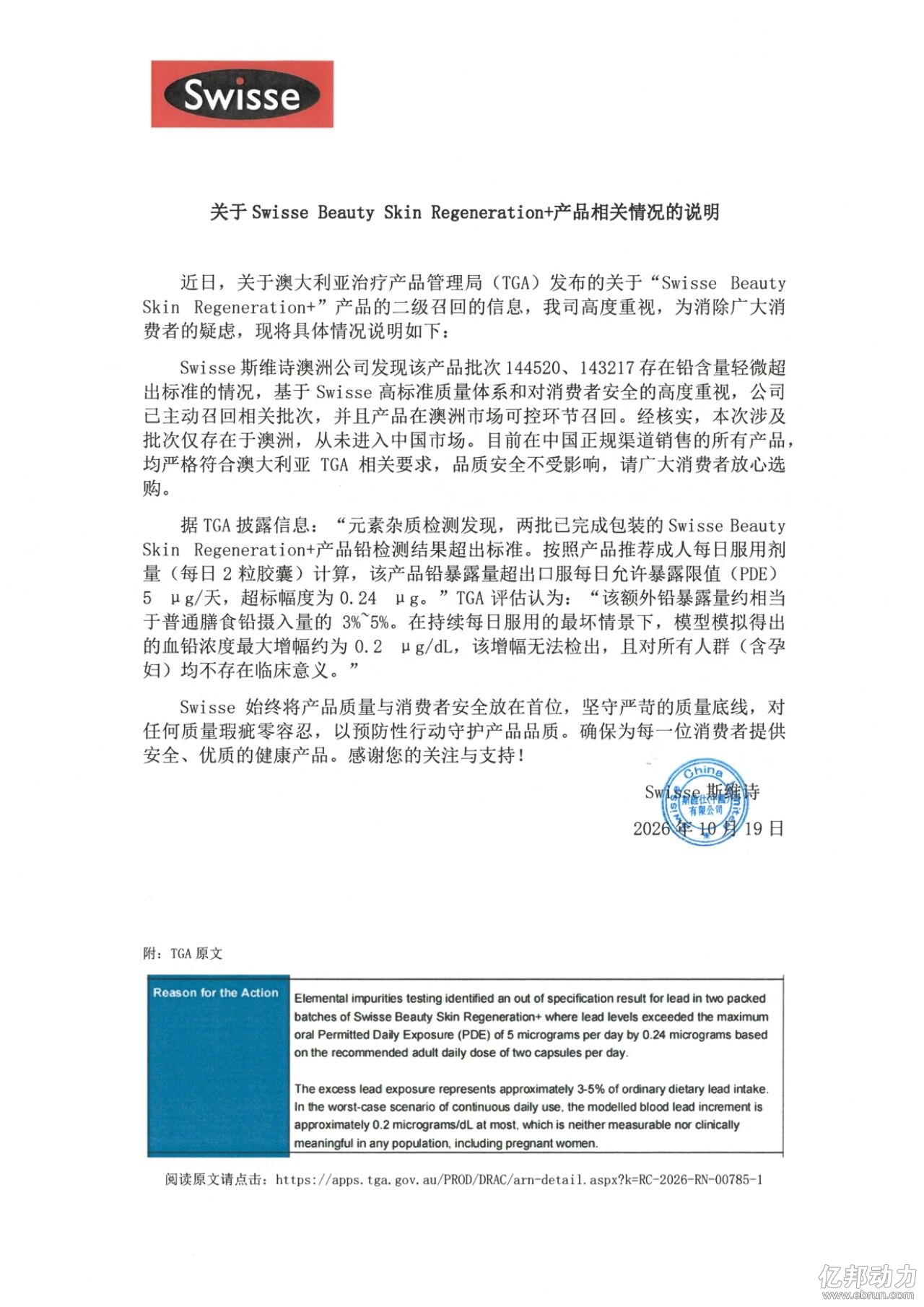
【亿邦原创】10月19日消息,日前,澳大利亚治疗产品管理局(TGA)发布消息,斯维诗“Swisse Beauty Skin Regeneration+”产品中两个批次铅元素含量超标,被公司召回。品牌母公司健合集团通过公众号发布情况说明:经核实,本次涉及批次仅存在于澳洲,从未进入中国市场。

“Swisse斯维诗澳洲公司发现该产品批次144520、143217存在铅含量轻微超出标准的情况,基于Swisse高标准质量体系和对消费者安全的高度重视,公司已主动召回相关批次,并且产品在澳洲市场可控环节召回。”健合集团方面表示,目前在中国正规渠道销售的所有产品,均严格符合澳大利亚TGA相关要求,品质安全不受影响,请广大消费者放心选购。

亿邦持续追踪报道该情报,如想了解更多与本文相关信息,请扫码关注作者微信。

本文首发于 亿邦动力 官方网站

文章来源:亿邦动力

广告
微信
朋友圈

FAQ回顾

斯维诗(Swisse)哪些产品批次因铅超标被召回?

斯维诗澳洲公司主动召回了“Swisse Beauty Skin Regeneration”产品中的批次144520和143217,原因是铅含量轻微超出标准。该产品在澳大利亚市场可控环节召回,相关批次未进入中国市场。

斯维诗铅含量超标事件会影响中国消费者吗?

不会。健合集团核实后表示,本次涉及批次仅存在于澳大利亚,从未进入中国市场。中国正规渠道销售的所有斯维诗产品均严格符合澳大利亚TGA相关要求,品质安全不受影响,消费者可放心选购。

健合集团对斯维诗铅超标事件是如何回应的?

健合集团通过公众号发布情况说明,确认斯维诗澳洲公司发现两个批次铅含量轻微超标,已主动召回,并强调问题批次仅限澳洲市场,未进入中国,同时保证中国正规渠道产品符合TGA要求、品质安全。

这么好看,分享一下?

朋友圈 分享

APP内打开

赞 +1
+1
微信好友 朋友圈 新浪微博 QQ空间
关闭
收藏成功
发送
/140 0