





广告
加载中

吉大团队!全球最高自由度灵巧手内部精密仿生结构首次公开

龚作仁 2026-10-16 13:46
龚作仁 2026/10/16 13:46

邦小白快读

EN
全文速览

全球最高自由度仿生灵巧手应手Y-Hand M2内部结构首次公开,这款产品来自吉林大学任雷教授团队的产业化成果。

1.核心突破:采用仿生拉压体技术,以受拉软组织与受压硬组织刚柔耦合,摆脱传统铰链设计,实现38个自由度,完成33类类人灵巧操控的平均成功率达96%,接近人手水平,解决了传统刚性手力量与速度难兼顾、高柔顺与高精度不兼得等问题。

2.实际表现:搭载到人形机器人后,可自适应抓取方形、球形、不规则异形物体,也能稳定操控薄脆易碎、软质形变等特殊材质物体。

3.落地进展:该产品已从实验室走向规模化量产,可稳定交付,覆盖智能制造、航空航天、巡检运维、医疗健康、家政养老等多个应用场景。

应手Y-Hand M2凭借全球最高自由度和类人操控能力,为品牌打造技术差异化和高端定位提供了支撑。

1.品牌技术壁垒:采用任雷教授国际首创的仿生拉压体机器人理论与技术,这是原创性技术体系,可作为品牌核心叙事点,增强消费者对科技实力的信任。

2.产品竞争力:38个自由度、96%操控成功率、力量速度精度灵活柔顺全面超越传统刚性手,适合作为高端旗舰产品核心卖点,满足人形机器人企业对核心部件的强需求。

3.消费趋势与用户观察:当前具身智能产业关注机器人是否真正能完成通用任务,灵巧手性能成为关键判断点。面向智能制造、医疗健康、家政养老等场景,可挖掘B端行业客户,以解决方案形式切入,建立品牌渠道与合作网络。

仿生灵巧手应手Y-Hand M2的公开和量产释放了具身智能领域的新市场机会。

1.增长市场:具身智能机器人产业加速发展,高自由度灵巧手属于核心增量赛道,规模化量产表明产品已具备稳定交付能力,可成为卖家的热门品类。

2.消费需求变化:市场对机器人的需求从简单夹取升级为对复杂物体的自适应抓取与操控,特别是薄脆易碎、软质形变和不规则物体,这为销售端提供了新的功能卖点。

3.风险与机会:传统刚性手无法完成的类人操控成为差异化竞争优势,但需关注产品可靠性、交付周期和售后支持。可学习其从实验室研发到规模量产、稳定交付的产业化路径,提前对接相关供应链和行业客户。

应手Y-Hand M2的内部仿生结构公开,为工厂在产品设计、生产需求和数字化升级方面提供了可参考样本。

1.产品设计需求:仿生骨骼与软骨、三维关节曲面、超材料编织韧带系统以及肌腱腱鞘网络等刚柔耦合设计,提示工厂可关注新型结构件、柔性材料和精密传动部件的制造机会。

2.商业机会:该灵巧手已规模化量产并应用于智能制造、医疗健康、家政养老等领域,带动对精密零部件、传感器、电机和人工肌肉模组的生产需求,工厂可探索进入机器人核心供应链。

3.数字化与电商启示:仿生拉压体技术实现了驱动变速传动感知控制一体化,说明系统级集成是趋势。工厂可借鉴其模块化、标准化量产思路,推进产线数字化升级,以适应具身智能产业的小批量多品种订单需求。

应手Y-Hand M2展示了具身智能领域的最新行业趋势和技术方案,为服务商提供了客户痛点与解决方案参考。

1.客户痛点:传统机器人灵巧手长期存在力量与速度难以兼顾、高柔顺与高精度无法兼具、高负载与灵巧操控无法平衡等难题,这正是服务商可切入的优化方向。

2.解决方案:仿生拉压体技术通过刚柔耦合、人工肌肉驱动、肌腱腱鞘传动、多源编码器与力传感器融合、脉冲神经网络控制,形成系统级动力传输与能量管理方案,可用于提升机器人整机性能。

3.服务机会:灵巧手已稳定交付,服务商可围绕智能制造、航空航天、巡检运维、医疗健康等场景提供集成、部署、调试和运维服务,并关注高自由度灵巧手与视觉触觉融合方案带来的新需求。

应手Y-Hand M2作为全球最高自由度仿生灵巧手,为机器人平台提供了高性能核心组件和新合作思路。

1.平台硬件基础:该灵巧手拥有38个自由度、96%类人操控成功率,并已实现规模化量产和稳定交付,可作为平台重点推荐的标准硬件,降低开发者自研成本。

2.平台生态建设:产品搭载于人形机器人平台后能完成多种复杂物体抓取,平台商可借此吸引科研、工业和服务领域的开发者入驻,围绕灵巧操控开发更多应用。

3.运营与风险规避:高自由度仿生结构带来的技术复杂度较高,平台商需关注产品品控、安全测试和售后支撑,建立准入与评价机制,同时可加强与高校及原创技术团队的合作,确保技术风向与产业标准同步演进。

应手Y-Hand M2的公开揭示了机器人灵巧手研究的最新方向,即仿生拉压体理论与技术体系的工程落地。

1.产业新动向:刚柔耦合的拉压体结构替代传统刚性铰链,实现三维6自由度自然运动,这标志着灵巧手从刚性驱动向仿生柔顺驱动转型,有望成为具身智能领域的重要技术路线。

2.新问题:如何进一步优化高自由度下的控制策略、增强视触觉融合与肌肉本体感受反馈、降低量产成本并提升动态响应,仍是后续研究的关键课题。

3.政策与生态建议:文章强调为抢占全球具身智能机器人产业制高点提供原创理论与技术支撑,提示政策面应加强基础研究资助、推动原创理论产业化、建立相关技术标准与测试验证体系,并促进高校、企业和产业链协同创新。

返回默认
声明:快读内容全程由AI生成,请注意甄别信息。如您发现问题,请发送邮件至 run@ebrun.com 。

我是 品牌商 卖家 工厂 服务商 平台商 研究者 帮我再读一遍。

Quick Summary

The internal structure of Y-Hand M2, the world's most dexterous bionic hand in terms of degrees of freedom, has been revealed for the first time. The product is a commercialized result from Professor Ren Lei's team at Jilin University.

1. Core breakthrough: Built on bionic tension-compression body technology, it couples soft tissues under tension with hard tissues under compression to achieve rigid-flexible integration, eliminating traditional hinge designs. This delivers 38 degrees of freedom and an average success rate of 96% across 33 categories of human-like dexterous manipulations, approaching the level of the human hand. It resolves long-standing issues of conventional rigid hands, such as the trade-off between force and speed, and the incompatibility of high compliance and high precision.

2. Practical performance: When mounted on a humanoid robot, it adaptively grasps square, spherical, irregular, and oddly shaped objects, and can stably manipulate thin, brittle, fragile, soft, and deformable materials.

3. Commercial progress: The product has moved from the lab to large-scale mass production with reliable deliveries, covering multiple application scenarios including intelligent manufacturing, aerospace, inspection and maintenance, healthcare, and home care for the elderly.

Y-Hand M2, with its world-leading degrees of freedom and human-like manipulation capabilities, provides strong support for brands seeking technological differentiation and premium positioning.

1. Brand technology moat: It adopts Professor Ren Lei's internationally pioneering bionic tension-compression body robot theory and technology, an original technology system that can serve as a core brand narrative and reinforce consumer trust in technological strength.

2. Product competitiveness: With 38 degrees of freedom, a 96% manipulation success rate, and all-around superiority over traditional rigid hands in force, speed, precision, flexibility, and compliance, it is an ideal flagship highlight and meets the strong demand from humanoid robot makers for core components.

3. Consumer trends and user insights: The embodied intelligence industry currently focuses on whether robots can truly perform general tasks, making dexterous hand performance a key evaluation criterion. Targeting scenarios such as intelligent manufacturing, healthcare, and home care for the elderly, brands can cultivate B2B industry clients, enter with solution-based offerings, and establish distribution channels and partnership networks.

The public release and mass production of the bionic dexterous hand Y-Hand M2 unlock new market opportunities in embodied intelligence.

1. Growth market: As the embodied intelligent robot industry accelerates, high-DOF dexterous hands represent a core incremental segment. The move to large-scale production signals stable delivery capability, making this a hot category for sellers.

2. Shifting consumer demand: Market demand for robots is upgrading from simple gripping to adaptive grasping and manipulation of complex objects, especially thin, brittle, fragile, soft, deformable, and irregular ones, offering new functional selling points for sales teams.

3. Risks and opportunities: Human-like manipulation that traditional rigid hands cannot achieve provides a differentiated competitive advantage, but attention should be paid to product reliability, delivery cycles, and after-sales support. Sellers can learn from its path from lab R&D to mass production and reliable delivery, and connect with relevant supply chains and industry customers in advance.

The public disclosure of Y-Hand M2's internal bionic structure provides factories with a reference model for product design, production requirements, and digital upgrades.

1. Product design requirements: The rigid-flexible coupled design—including bionic bones and cartilage, three-dimensional joint surfaces, meta-material woven ligament systems, and tendon-sheath networks—suggests manufacturing opportunities in new structural components, flexible materials, and precision transmission parts.

2. Business opportunities: This dexterous hand has entered mass production and is applied in intelligent manufacturing, healthcare, and home care, driving demand for precision parts, sensors, motors, and artificial muscle modules. Factories can explore entering the core robotics supply chain.

3. Digital and e-commerce implications: The bionic tension-compression body technology integrates actuation, transmission, sensing, and control into one system, showing that system-level integration is the trend. Factories can adopt its modular, standardized mass-production approach to advance production line digitalization and adapt to the small-batch, multi-variety order demands of the embodied intelligence industry.

Y-Hand M2 showcases the latest industry trends and technological approaches in embodied intelligence, offering service providers a reference for customer pain points and solution design.

1. Customer pain points: Traditional robotic dexterous hands have long suffered from trade-offs between force and speed, compliance and precision, and high load capacity versus dexterous manipulation. These are precisely the optimization areas where service providers can intervene.

2. Solutions: The bionic tension-compression body technology integrates rigid-flexible coupling, artificial muscle actuation, tendon-sheath transmission, multi-source encoder and force sensor fusion, and spiking neural network control to create a system-level power transmission and energy management solution that can enhance overall robot performance.

3. Service opportunities: With the hand now in stable delivery, service providers can offer integration, deployment, commissioning, and maintenance services across scenarios such as intelligent manufacturing, aerospace, inspection and maintenance, and healthcare. They should also watch for new demand arising from high-DOF dexterous hands combined with visual-tactile fusion solutions.

Y-Hand M2, the world's most dexterous bionic hand in degrees of freedom, provides robot platforms with a high-performance core component and a new model for collaboration.

1. Platform hardware foundation: Featuring 38 degrees of freedom, a 96% human-like manipulation success rate, and established mass production with stable delivery, it can be positioned as recommended standard hardware on the platform, reducing developers' self-development costs.

2. Ecosystem building: When integrated into humanoid robot platforms, the hand can grasp a wide variety of complex objects. Platform operators can use this to attract developers from research, industrial, and service sectors to build more applications centered on dexterous manipulation.

3. Operations and risk mitigation: The high degree of freedom in bionic structures brings significant technical complexity. Platform operators must focus on quality control, safety testing, and after-sales support, and establish admission and evaluation mechanisms. They should also strengthen collaboration with universities and original technology teams to ensure technology trends and industry standards evolve in sync.

The unveiling of Y-Hand M2 reveals the latest direction in robotic dexterous hand research: the engineering implementation of bionic tension-compression body theory and its technical system.

1. New industry trend: The rigid-flexible coupled tension-compression body structure replaces traditional rigid hinges and achieves natural three-dimensional six-degree-of-freedom motion, marking a transition of dexterous hands from rigid actuation to bionic compliant actuation. This could become a major technical route in embodied intelligence.

2. Open questions: Key topics for future research include optimizing control strategies under high degrees of freedom, enhancing vision-tactile fusion and proprioceptive muscle feedback, reducing mass-production costs, and improving dynamic response.

3. Policy and ecosystem recommendations: The article emphasizes providing original theory and technological support for seizing the global high ground in the embodied intelligence robot industry. It suggests that policymakers strengthen basic research funding, promote the industrialization of original theories, establish relevant technical standards and testing/verification systems, and foster collaborative innovation among universities, enterprises, and the industrial chain.

Disclaimer: The "Quick Summary" content is entirely generated by AI. Please exercise discretion when interpreting the information. For issues or corrections, please email run@ebrun.com .

I am a Brand Seller Factory Service Provider Marketplace Seller Researcher Read it again.

对于人形机器人而言,真正决定其能否走进现实场景、完成通用任务的,不仅是跑得有多快、跳得有多高,还在于那双能够与世界交互的手。

日前,一款来自北京达奇月泉仿生科技的仿生灵巧手“应手Y-Hand M2”引发业界广泛关注。这款仿生灵巧手,是吉林大学唐敖庆杰出教授任雷国际首创的“仿生拉压体机器人理论与技术”的产业化成果,是目前全球自由度最高的仿生灵巧手。最近,其内部精密仿生结构在吉林大学办学成果展上首次对外公开。

仿生拉压体机器人技术体系是任雷教授基于对人体神经肌肉骨骼系统功能原理二十多年的深入研究,以及在仿生机器人领域持续的创新性工程化实践而创建。

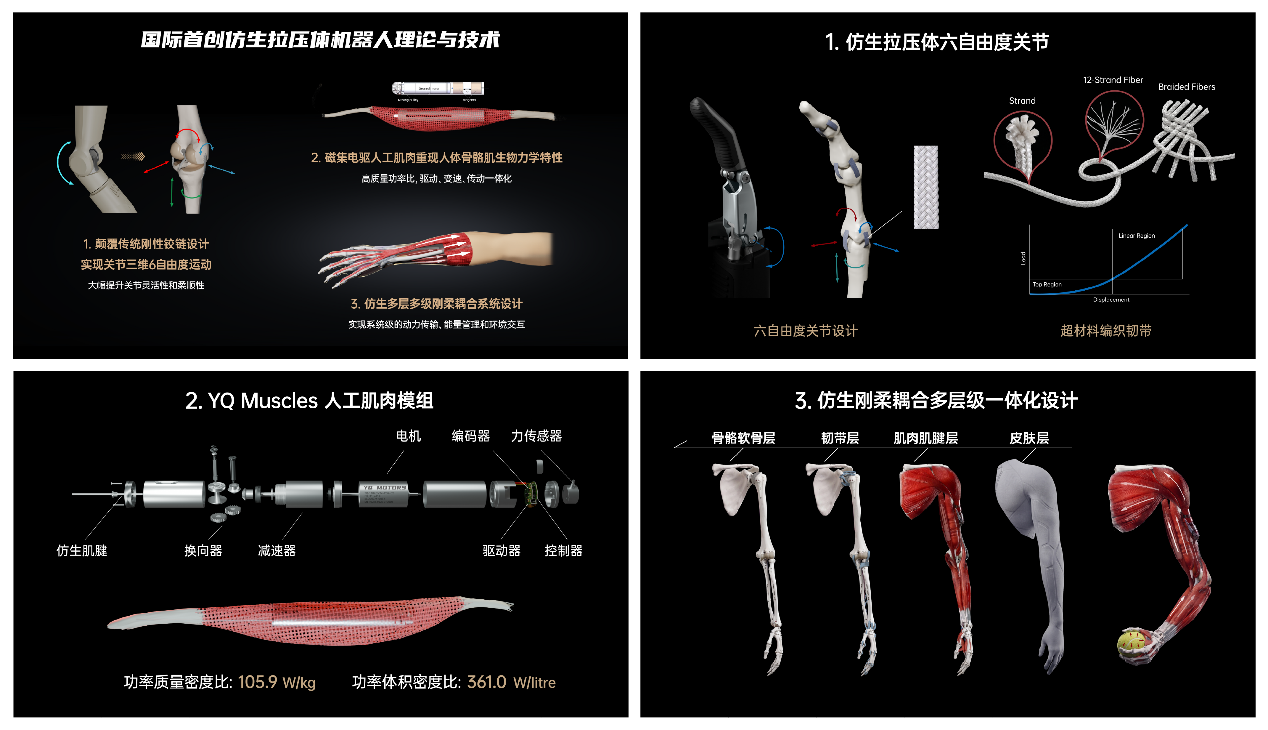
仿生拉压体机器人是由具有空间拓扑结构特征的受拉软组织和受压硬组织构成的驱动、变速、传动、感知、计算、控制一体化系统,它颠覆了传统刚性铰链式设计,重现了生物关节的三维6自由度自然运动,大幅提升了关节灵活性和柔顺性;基于自研磁集电驱人工肌肉技术重现了人体骨骼肌的生物力学特性,实现了高功率密度比的驱动、变速、传动一体化;基于人体神经肌肉骨骼系统的仿生刚柔耦合多层级一体化设计,实现系统级的动力传输、能量管理和环境交互。其中应手Y-Hand M2拥有38个自由度,是目前全球自由度最高的仿生灵巧手。

此次对外完整公开仿生灵巧手Y-Hand M2的内部精密仿生设计,展示了产品的核心组成,涵盖机械结构、驱动传动系统、感知及控制系统。

其中,机械系统由仿生骨骼与软骨、三维关节曲面和超材料编织韧带系统构成,通过刚柔耦合实现超高自由度的类人灵巧、柔顺、自然运动;驱动系统采用自主研发的YQ Motors系列电机及YQ Muscles人工肌肉模组,实现高质量功率密度比的类人体骨骼肌驱动;传动系统通过肌腱-腱鞘网络系统的仿生形态学和拓扑学设计,支持跨关节动力传输与多肌肉协同运动,实现了整手系统级的动力传输与能量管理;感知系统通过多源编码器、力传感器等获取触觉和本体感受信息;控制系统采用类人体神经肌肉的脉冲神经网络、视触觉融合及肌肉本体感受实现仿生灵巧抓握与操控运动,复现了高度类人的柔顺灵活、自然流畅的环境交互。

经过大量实机测试,应手Y-Hand M2在力量、速度、精度、灵活、柔顺五个核心性能上全面超越传统刚性手,成功打破了机器人灵巧手长期存在的技术瓶颈,解决了“力量与速度难以兼顾”“高柔顺与高精度无法兼具”“高负载与灵巧操控无法平衡”的行业难题。应手Y-Hand M2可以成功完成全部33类类人灵巧操控,成功率达96%,接近人手水平,其中大部分灵巧操控运动是传统刚性手无法做到的。

将应手Y-Hand M2搭载至人形机器人平台开展作业时,可以成功完成对方形、球形、不规则异形等各类不同形状物体,以及对薄脆易碎、软质形变等不同材质物体的自适应抓取与操控。

目前,应手Y-Hand M2已经走出实验室,实现了规模化量产,成为可稳定交付、批量应用的仿生灵巧手产品,为智能制造、航空航天、巡检运维、医疗健康、家政养老等众多领域提供了全新的仿生技术解决方案,也为国家抢占全球具身智能机器人产业制高点提供了原创理论与技术支撑。

注:文/龚作仁,文章来源:Laborer,本文为作者独立观点,不代表亿邦动力立场。

文章来源:Laborer

广告
微信
朋友圈

FAQ回顾

仿生灵巧手应手Y-Hand M2是什么?

应手Y-Hand M2是北京达奇月泉仿生科技推出的仿生灵巧手,也是吉林大学任雷教授首创的仿生拉压体机器人理论与技术的产业化成果。它拥有38个自由度,是目前全球自由度最高的仿生灵巧手,可完成33类类人灵巧操控,成功率达96%。

仿生灵巧手和传统刚性灵巧手有哪些区别?

仿生灵巧手采用仿生拉压体技术,用受拉软组织与受压硬组织替代传统刚性铰链设计,并搭配磁集电驱人工肌肉,重现了人体骨骼肌的生物力学特性。应手Y-Hand M2在力量、速度、精度、灵活、柔顺五方面全面超越传统刚性手,解决了力量与速度、高柔顺与高精度、高负载与灵巧操控难以兼顾的行业难题。

什么是仿生拉压体机器人技术?

仿生拉压体机器人技术是吉林大学唐敖庆杰出教授任雷国际首创的技术体系,基于对人体神经肌肉骨骼系统二十多年的研究创建。它由受拉软组织和受压硬组织构成驱动、变速、传动、感知、计算、控制一体化系统,能重现生物关节的三维6自由度自然运动,提升关节灵活性和柔顺性,并实现高功率密度比的驱动与传动。

应手Y-Hand M2能用于哪些领域?

应手Y-Hand M2已实现规模化量产,可稳定交付和批量应用。它搭载到人形机器人上后,能自适应抓取方形、球形、不规则异形等不同形状物体,以及薄脆易碎、软质形变等不同材质物体,可用于智能制造、航空航天、巡检运维、医疗健康、家政养老等领域。

应手Y-Hand M2为什么能做到全球最高的38个自由度?

应手Y-Hand M2采用刚柔耦合的仿生设计:机械系统由仿生骨骼与软骨、三维关节曲面和超材料编织韧带构成;驱动系统使用YQ Motors系列电机和YQ Muscles人工肌肉模组;传动系统通过肌腱-腱鞘网络支持跨关节动力传输与多肌肉协同运动。这种系统级设计使其实现了38个自由度的类人灵巧运动。

这么好看,分享一下?

朋友圈 分享

APP内打开

赞 +1
+1
微信好友 朋友圈 新浪微博 QQ空间
关闭
收藏成功
发送
/140 0

