广告
加载中

拓竹行动了!“创客三件套”品牌们开启跨界“抄家”

韩笑 2026-08-21 10:10
韩笑 2026/08/21 10:10

邦小白快读

EN
全文速览

本文核心介绍了当前创客工具行业的最新动向,多家头部和新兴品牌正在跨界布局“创客三件套”,打破原有品类边界,给普通创意爱好者带来了更多产品选择。

1. 当前行业的发展趋势是头部品牌依托原有赛道积累,向临近品类拓展,3D打印起家的拓竹将于9月发布激光雕刻新品,同时在筹备UV打印产品线;激光雕刻龙头xTool跨界推出的UV打印机新品,发售首日销售额就突破1亿元,成绩亮眼。

2. 未来行业会从单一品类产品转向复合全品类布局,竞争核心集中在硬件技术打通和软件生态协同,最终会给普通用户带来更流畅、完整的桌面创意创作体验,普通创意爱好者可选择的产品功能也会更丰富,能实现一站式的创作需求。

当前创客工具行业已经呈现出清晰的消费趋势和品牌增长路径,多品类、全品类布局成为全行业共识,干货内容总结如下:

1. 品牌增长逻辑:当品牌在原有赛道的市场占有率达到天花板后,切入临近互补品类寻找第二增长曲线,是经过多个头部品牌验证的可行路径,比如xTool在激光雕刻赛道拿下47%的市占后,切入和激光雕刻互补的UV打印赛道,很快就取得了首日破亿的成绩。

2. 用户需求端:B端用户本来就有搭配采购“创客三件套”的习惯,跨界布局符合用户原生采购需求,能够提升用户粘性和客单价,还能复用原有渠道和用户资源,降低拓展成本。

3. 新品机会:UV打印进入消费级市场时间较短,已经被安克创新旗下产品验证了市场需求,众筹金额突破4200万美元,仍有较大的增长空间,适合有技术积累的品牌布局。

当前创客工具赛道出现了明确的新增量机会,头部品牌的跨界布局给卖家带来了新的发展方向,干货总结如下:

1. 新增量市场机会:“创客三件套”中的UV打印刚进入消费级领域,已经有多个新品取得亮眼成绩,安克创新的E1众筹突破4200万美元,xTool的O1发布首日销售额破亿,黑格科技的G1X众筹突破1300万美元,市场需求已经得到充分验证,属于新的增长蓝海。

2. 自身增长机会:B端用户本来就有成套采购创客工具的需求,单一品类卖家可以拓展临近互补品类,满足用户一站式采购需求,有效提升客单价和复购率。

3. 风险提示:未来全品类竞赛的核心是硬件技术贯通加软件生态协同,没有足够技术积累和供应链支持的卖家切入需要谨慎,避免因产品体验不佳被市场淘汰。

创客工具消费市场的跨界全品类布局趋势,给生产制造端带来了新的商业机会和升级方向,干货总结如下:

1. 产品生产设计需求变化:当前用户需求已经从单一功能工具转向多品类全功能的创作工具,品牌方也在纷纷拓展新品类,工厂可以围绕用户一站式创作需求,开发适配多品类的生产方案,匹配品牌方的拓展需求,获得更多订单。

2. 新增商业机会:UV打印作为刚兴起的消费级新品类,多个头部品牌都在入局筹备,大量品牌都在招聘UV打印相关技术、开发人才,需要对应的核心零部件、特殊材料的供应链支持,对零部件、材料生产工厂来说是新的增量订单来源。

3. 数字化转型启示:桌面创客工具本身就是数字化民用制造的发展方向,工厂推进自身数字化、智能化升级,贴合个人创意生产的行业趋势,就能抓住新的市场风口,获得更多长期订单。

当前创客工具行业进入全品类布局的新发展阶段,涌现出很多新的需求和机会,给服务商带来新的业务增长空间,干货总结如下:

1. 行业发展新趋势:创客工具已经从单一品类的分散发展,进入全品类竞争的新阶段,品牌方的核心需求已经从单品研发,转向打通不同品类的硬件技术、搭建协同统一的软件生态,为用户提供无缝的创作体验。

2. 客户核心痛点:品牌跨界拓展新品类时,普遍缺乏对应领域的技术储备、人才资源和供应链资源,很多新兴创业品牌还缺少出海众筹、品牌营销的配套资源支持,存在大量未被满足的服务需求。

3. 自身业务机会:服务商可以围绕不同品类的技术整合、软件生态开发、供应链对接、出海营销运营这些核心需求,推出针对性的解决方案,抓住行业转型的红利,拓展自身业务边界。

创客工具赛道的全品类跨界发展,给电商平台带来了新的招商和运营方向,干货总结如下:

1. 当前行业对平台的新需求:越来越多创客工具品牌从单一品类转向全品类布局,新兴品牌如原子重塑、黑格科技,老牌头部品牌如拓竹、创想三维都在推出新品,有强烈的招商入驻和流量曝光需求,需要平台提供适配的支持。

2. 平台可落地的新做法:平台可以针对创客工具赛道开辟专门的类目和招商绿色通道,重点引入UV打印等新兴品类的品牌,打造创客工具专属营销会场,匹配对应流量资源,吸引优质品牌入驻,拓展平台品类边界。

3. 风向规避要点:行业未来竞争聚焦技术积累和生态协同,平台招商时需要筛选有核心技术的品牌,规避低质同质化产品,同时可以搭建个人创作者配套生态,对接C端用户需求,促进行业良性发展。

当前创客工具产业出现了清晰的新动向,跨界全品类布局成为行业新趋势,对产业研究有较高的参考价值,干货总结如下:

1. 产业发展新动向:原本“创客三件套”清晰的品类边界正在被打破,行业已经从单一品类竞争转向全品类竞赛,产品形态也从单一功能走向复合功能。头部品牌在原有赛道市占见顶后,选择切入临近互补品类寻找第二增长曲线,已经成为行业通用的增长模式。

2. 产业发展新变化:消费级UV打印这个新品类的市场需求已经被成功验证,成为行业新的增长极,目前入局玩家多元,既有头部品牌跨界,也有大集团孵化的新品牌,还有垂直领域转型的玩家,呈现出多元竞争的格局。

3. 未来研究方向:目前行业已经明确,未来全品类竞争的核心胜负手在于硬件技术的贯通和软件生态的协同,这为研究桌面民用制造产业的发展方向、品牌增长逻辑都提供了新的研究样本和方向。

返回默认

声明:快读内容全程由AI生成,请注意甄别信息。如您发现问题,请发送邮件至 run@ebrun.com 。

我是 品牌商 卖家 工厂 服务商 平台商 研究者 帮我再读一遍。

Quick Summary

This article outlines the latest developments in the maker tool industry, where a number of established and emerging brands are expanding across product categories to offer the "Big Three of Makers"—breaking down traditional category boundaries and bringing more choices to casual creative enthusiasts.

1. A clear industry trend has emerged: leading brands are leveraging their existing market positioning to expand into adjacent categories. Bambu Lab, which built its brand on 3D printing, will launch a new laser engraving product in September and is currently developing a UV printing line. xTool, the leader in laser engraving, has crossed into UV printing, and its new launch generated over ¥100 million in sales on its first day, marking an outstanding performance.

2. Going forward, the industry will shift from single-category offerings to full multi-category portfolios, with competition centered on integrating hardware technology and coordinating software ecosystems. This will ultimately deliver a smoother, more complete desktop creative experience for general users, expand the range of functional options available to creative hobbyists, and meet their demand for one-stop creative workflows.

The maker tool industry has developed clear consumer trends and brand growth paths, with multi-category and full-category expansion now a widely held industry consensus. Key takeaways are as follows:

1. Brand growth logic: Once a brand hits the market share ceiling in its original core category, expanding into adjacent complementary categories to unlock a second growth curve is a proven strategy adopted by multiple leading brands. For example, after capturing 47% market share in the laser engraving segment, xTool moved into UV printing—a complementary category—and generated more than ¥100 million in sales on the first day of its product launch.

2. Alignment with user demand: B2B buyers have long purchased the "Big Three of Makers" as a matching set. Cross-category expansion aligns with users' inherent procurement habits, boosts customer retention and average order value, and allows brands to reuse existing channels and user assets to lower expansion costs.

3. New product opportunity: Consumer-grade UV printing is a relatively new market segment, whose demand has already been validated by Anker Innovation's offering, which raised over $42 million on crowdfunding platforms. The segment still holds substantial room for growth, making it well-suited for brands with existing technical expertise to enter.

The maker tool track is seeing clear new incremental growth opportunities, and leading brands' cross-category expansion has opened up new development directions for sellers. Key takeaways are as follows:

1. New incremental market opportunity: Consumer-grade UV printing, one of the "Big Three of Makers", has already delivered strong results for multiple new products: Anker Innovation's E1 raised over $42 million via crowdfunding, xTool's O1 hit ¥100 million in first-day sales, and Geego's G1X raised over $13 million via crowdfunding. Market demand has been fully validated, making it a new blue ocean for growth.

2. Incremental growth for your business: B2B buyers already have inherent demand for purchasing a full set of maker tools. Single-category sellers can expand into adjacent complementary categories to meet users' one-stop procurement needs, effectively lifting average order value and repeat purchase rates.

3. Risk warning: The core of future full-category competition lies in integrated hardware technology and coordinated software ecosystems. Sellers without sufficient technical accumulation and supply chain support should approach entry cautiously to avoid being squeezed out of the market due to poor product experiences.

The trend of cross-category, full-category expansion in the consumer maker tool market has brought new business opportunities and upgrade directions for manufacturing. Key takeaways are as follows:

1. Shifts in product design and manufacturing demand: User demand has shifted from single-function tools to multi-category, full-function creative tools, and brands are rapidly expanding into new product lines. Factories can develop multi-category compatible manufacturing solutions centered on users' demand for one-stop creation, match brands' expansion needs, and secure more orders.

2. New business opportunities: As an emerging consumer-grade product category, UV printing is attracting entry and preparation from multiple leading brands. Many brands are hiring technical and development talent specialized in UV printing, and require supply chain support for core components and specialty materials. This represents a new source of incremental order volume for component and material manufacturers.

3. Insights for digital transformation: Desktop maker tools are inherently a development direction for digital civilian manufacturing. Factories that advance their own digital and intelligent upgrades to align with the industry trend of personalized creative production can capture this new market opportunity and secure more long-term orders.

The maker tool industry has entered a new development stage of full-category expansion, generating a host of new demands and opportunities that open up new room for service providers to grow their business. Key takeaways are as follows:

1. New industry development trend: Maker tools have evolved from fragmented development across single categories into a new stage of full-category competition. Brands' core demand has shifted from developing individual products to integrating hardware across categories and building a unified, coordinated software ecosystem to deliver a seamless creative experience for users.

2. Core pain points of clients: When brands expand cross-category into new product lines, they generally lack technical expertise, talent resources and supply chain connections in the new field. Many emerging startup brands also lack supporting resources for cross-border crowdfunding and brand marketing, leaving substantial unmet demand for services.

3. New business opportunities for service providers: Service providers can develop targeted solutions around core demands including cross-category technology integration, software ecosystem development, supply chain matching, and cross-border marketing operations. This allows them to capture dividends from industry transformation and expand their own business boundaries.

The cross-category, full-category evolution of the maker tool track has brought new directions for merchant recruitment and platform operations for e-commerce platforms. Key takeaways are as follows:

1. New industry demands for platforms: A growing number of maker tool brands are shifting from single-category to full-category offerings—from emerging brands like Atomstack and Geego to established leaders like Bambu Lab and Creality 3D, all are launching new products and have strong demand for merchant onboarding support and traffic exposure that requires tailored support from platforms.

2. Actionable new approaches for platforms: Platforms can create dedicated categories and expedited onboarding channels for the maker tool track, prioritize recruiting brands in emerging categories like UV printing, build dedicated marketing events for maker tools, and allocate matching traffic resources to attract high-quality brands and expand the platform's product category boundaries.

3. Key risk mitigation points: Future industry competition will center on technical accumulation and ecosystem coordination. Platforms should prioritize onboarding brands with core technology to avoid low-quality, homogeneous products. They can also build supporting ecosystems for individual creators to align with C-end user demand and foster healthy industry development.

Clear new developments have emerged in the maker tool industry, with cross-category full-category expansion becoming a new industry trend that offers high reference value for industrial research. Key takeaways are as follows:

1. New industrial development trends: The once-clear category boundaries between the "Big Three of Makers" are breaking down. The industry has shifted from single-category competition to full-category competition, and product offerings have evolved from single-function to multi-functional designs. When leading brands hit market share ceilings in their original core categories, expanding into adjacent complementary categories to unlock a second growth curve has become a widespread industry growth model.

2. New industrial changes: Market demand for the new consumer-grade UV printing category has been successfully validated, and it has become a new growth pole for the industry. Currently, the segment attracts a diverse set of market participants: cross-category expanding leading brands, new brands incubated by large conglomerates, and players transitioning from vertical niches, forming a diversified competitive landscape.

3. Future research directions: The industry has clearly established that the core determinant of success in future full-category competition lies in integrated hardware technology and coordinated software ecosystems. This provides new research samples and directions for studying the development trajectory of the desktop civilian manufacturing industry and brand growth logic.

Disclaimer: The "Quick Summary" content is entirely generated by AI. Please exercise discretion when interpreting the information. For issues or corrections, please email run@ebrun.com .

I am a Brand Seller Factory Service Provider Marketplace Seller Researcher Read it again.

【亿邦原创】跨界“抄家”的风终于吹到了创客工具界。

8月13日,3D打印头部企业拓竹科技官宣9 月将发布减材制造新品R1,被认为正式切入激光雕刻机赛道,将和激光雕刻龙头企业xTool展开正面竞争。

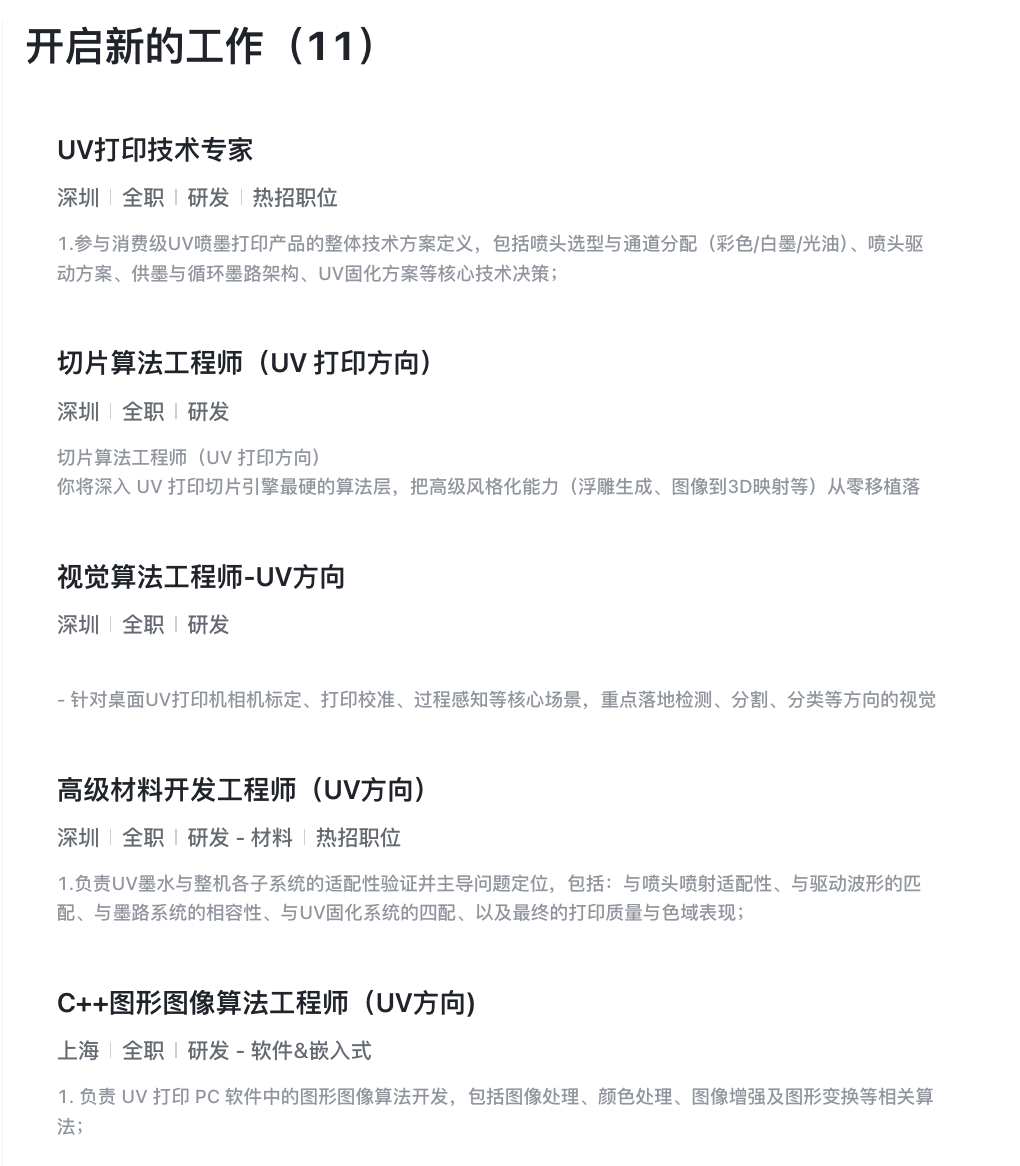
随后拓竹又被爆出启动了消费级UV打印机(紫外线光固化喷墨打印机)项目,目前正在招兵买马阶段,其招聘网站上挂出了UV打印技术专家、切片算法工程师(UV打印方向)、视觉算法工程师(UV方向)、高级材料开发工程师(UV方向)、C++图形图像算法工程师(UV方向)的职位。


拓竹科技成立于2020年,晚于创想三维、智能派、纵维立方等老牌3D打印企业, 但是近年来异军突起,发展迅猛,2025年成为行业首家年营收突破100亿元的企业,截止到2026年6月国内累计销量已突破百万台。在产品方面,拓竹已经构建了从入门级A系列、中端主力P系列到高端X系列和旗舰H系列的完整产品矩阵。

拓展品类的选择并不难理解,这是企业在原本赛道市占率达到一定程度之后为寻找增量常见的做法。何况3D打印、激光雕刻和UV打印并称为“创客三件套”,属于临近类目,工作室、农场主、广告公司等B 端用户一般会一起配置,一些B端用户还会配置CNC机床。

事实上,这并非拓竹第一次涉足激光雕刻领域。2025年 3月,其发布的H2D就具备激光雕刻功能,但它并不是纯激光雕刻机,而是一款一机四用的产品,同时具备了双喷嘴FDM 3D打印、激光雕刻切割、数控刀切和绘图功能,有工作室主理人称之为“容错率最高的选项”,可以作为备用机。

此外,拓竹也已经在布局激光雕刻的上下游。据悉,拓竹投资了国产激光器公司亿能智光,这是其成立以来唯一一家以投资方式入股的外部独立公司。

拓竹在进军激光雕刻和UV打印赛道,无独有偶,从激光雕刻起家的xTool也在跨界进入更多品类。“创客三件套”正在悄悄地互相渗透。


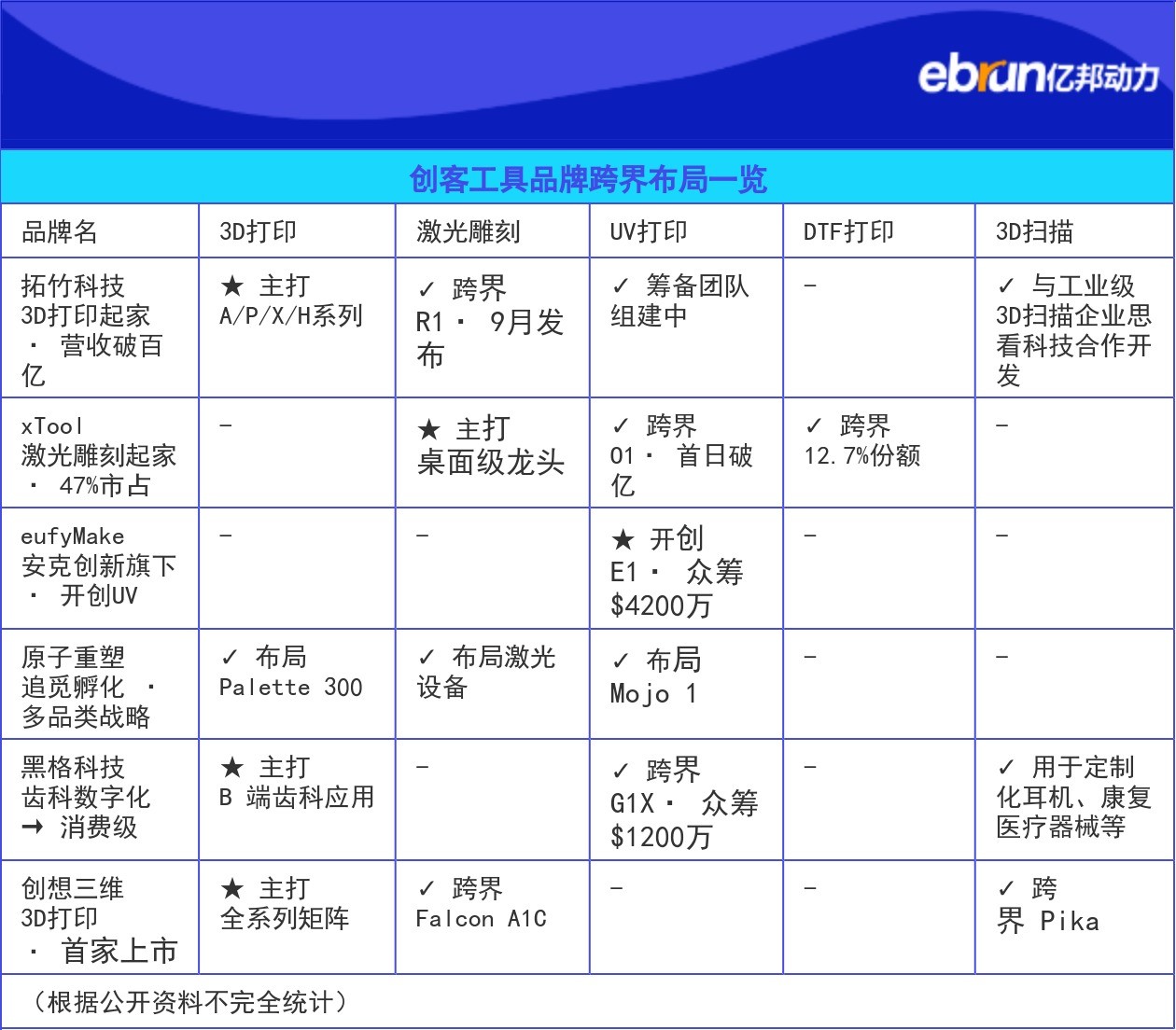
创客工具品牌跨界布局一览
品牌名 3D打印 激光雕刻 UV打印 DTF打印 3D扫描

拓竹科技

3D打印起家 · 营收破百亿

★ 主打A/P/X/H系列

✓ 跨界

R1· 9月发布

✓ 筹备团队组建中 -

✓ 与工业级3D扫描企业思看科技合作开发

xTool

激光雕刻起家 · 47%市占

-

★ 主打

桌面级龙头

✓ 跨界

O1· 首日破亿

✓ 跨界

12.7%份额

-

eufyMake

安克创新旗下 · 开创UV

- -

★ 开创

E1· 众筹$4200万

- -

原子重塑

追觅孵化 · 多品类战略

✓ 布局Palette 300 ✓ 布局激光设备

✓ 布局

Mojo 1

- -

黑格科技

齿科数字化 → 消费级

★ 主打

B 端齿科应用

-

✓ 跨界

G1X· 众筹$1200万

-

✓ 用于定制化耳机、康复医疗器械等

创想三维

3D打印 · 首家上市

★ 主打

全系列矩阵

✓ 跨界

Falcon A1C

- -

✓ 跨界 Pika

(根据公开资料不完全统计)


2025年6月,xTool推出了首款服饰DTF打印机(Direct-to-Film,直接转印膜),正式从激光雕刻跨界进入打印领域,数月内该产品在全球DTF细分市场获得12.7%的份额,登顶市占率第一。今年7月,xTool正式发布首款UV打印机产品xTool O1。据悉,在海外DTC销售模式下,O1发布首日销售额即突破1亿元人民币,创下xTool成立以来新品销售额最快破亿纪录,也刷新了行业新品首日销售额纪录,获得极大的成功。

对于跨界UV打印的原因,xTool中国区产品和技术负责人刘强曾向亿邦动力表示,“在桌面级激光领域,我们占据了47%左右的市场份额,其实已经达到了行业天花板级别,所以我们也在积极寻找第二增长曲线”。

UV打印是一种数字喷墨加紫外线即时固化的工艺。在实际使用中,它和激光雕刻机一般用来进行表面装饰,3D打印机和CNC设备负责生产产品基座。所以,UV打印和激光雕刻是互补的关系,UV打印补充了激光缺乏的上色能力,这也是为什么xTool选择先做UV打印而不是3D打印或其他类目的原因之一。

在“创客三件套”中,相比3D打印和激光雕刻已经出现了颇多消费级的产品,UV打印进入消费级的时间并不长。全球首款消费级UV打印机来自安克创新旗下品牌eufyMake。eufyMake E1不同于增材制造的3D打印,也不同于减材制造的激光雕刻,它被官方称为“3D纹理UV打印机”,可以像普通打印机一样输出全彩图案,但用的是UV固化墨水,能在金属、木材、玻璃、皮革、陶瓷、亚克力等300多种材料表面打印,还能堆叠出最高5毫米的立体纹理。

eufyMake E1在海外众筹平台Kickstarter的累计众筹金额突破了4200万美元,创下当时平台全品类最高众筹金额的记录。大获成功的eufyMake E1验证了UV打印的市场需求,也为创客工具赛道开创了一个新品类,为后来者的入局奠定了基础。

现在,越来越多个人创意工具品牌在进入UV打印赛道,多品类、甚至全品类布局正在成为各家品牌的共识。

去年在追觅科技孵化的原子重塑成立仅一年就完成了三轮融资,早早确定了覆盖多工艺产品矩阵的战略,已布局FDM 3D打印机、UV打印机、激光雕刻设备等多个品类,同时推进品牌自有耗材体系建设。目前,其已推出具备智能12喷嘴的桌面级3D打印机Palette 300和UV打印机Mojo 1。

从齿科数字化市场起步的黑格科技也将目光投向了消费级UV 3D打印市场,最近其桌面级全彩3D+UV打印机G1X上线Kickstarter,产品首日众筹金额近5000万元(约722万美元),目前众筹总额已突破1300万美元。与主流的FDM多色打印不同,G1X采用材料喷射(Inkjet)+UV固化技术,能实现类似照片的连续色彩与渐变,而非色块拼接。

此外,消费级3D打印第一家上市企业创想三维也接连在激光领域发力。2021年,创想三维开始布局激光雕刻产品,最初是以激光模块的形式作为3D打印机的配件推出。2022年,正式推出首款独立激光雕刻机CR-Laser Falcon,2023年推出Falcon2,雕刻速度和功率进一步提升。目前,创想三维已形成覆盖专业级、商业级、进阶消费级及入门级的分层产品矩阵,包括了Sermoon、Raptor、Otter、Ferret系列。

几天前,创想三维又推出了便携AI 3D扫描仪Pika与桌面级激光雕刻机Falcon A1C,标志公司多品类产品矩阵持续完善。

从行业龙头的跨界出击到初创新锐的全方位布局,“创客三件套”的边界正在被打破,产品形态也在从单一走向复合。在接下来的“全品类竞赛”中,真正的决胜点在于能否通过硬件技术的贯通与软件生态的协同,将三种工具能力转化为无缝的创作体验,让桌面制造真正迈向随心所欲。


亿邦持续追踪报道该情报,如想了解更多与本文相关信息,请扫码关注作者微信。

本文首发于 亿邦动力 官方网站

文章来源:亿邦动力

广告
微信
朋友圈

FAQ回顾

创客三件套指的是什么?

创客三件套包含3D打印、激光雕刻、UV打印三类创客工具,属于临近类目,工作室、农场主、广告公司等B端用户通常会搭配配置,可满足桌面制造从基座生产到表面装饰的全流程需求。

拓竹科技有哪些跨界布局动作?

3D打印头部企业拓竹科技2025年成为行业首家年营收破百亿元的企业,官宣9月将发布激光雕刻新品R1,同时启动消费级UV打印机项目招聘相关人才,此前已推出带激光雕刻功能的产品,还投资了国产激光器公司亿能智光。

UV打印有什么特点和优势?

UV打印是数字喷墨加紫外线即时固化工艺,可补充激光雕刻缺乏的上色能力,能在金属、木材、玻璃等300多种材料表面打印,还可堆叠最高5毫米的立体纹理,适用于各类产品表面装饰场景。

创客工具品牌为什么纷纷布局多品类?

头部品牌在原有赛道市占率达到一定程度后需要寻找新的业绩增量;创客三件套类目临近、用户重合度高,布局多品类可通过软硬件协同,为用户提供更完整的桌面制造创作体验。

这么好看,分享一下?

朋友圈 分享

APP内打开

赞 +1
+1
微信好友 朋友圈 新浪微博 QQ空间
关闭
收藏成功
发送
/140 0