





广告
加载中

抖音生活服务数码家电行业沙龙在成都举办 联合中国银联发布国补到店交易模式

龚作仁 2026-07-24 16:07
龚作仁 2026/07/24 16:07

邦小白快读

EN
全文速览

本次活动核心是抖音生活服务联合中国银联、银联商务在成都率先上线国补到店交易模式,为普通消费者购买数码家电带来了更便捷的补贴使用体验,核心干货如下

1. 当前消费趋势显示,多数消费者购买数码家电都会先通过线上内容了解产品参数、使用体验等信息,对比选型后再到线下门店体验购买,抖音平台今年数码家电相关搜索需求日均同比增长86%,普通消费者也可以遵循这个路径做购买功课,降低决策成本

2. 符合国补活动规则和补贴资格的消费者,使用该模式流程非常简便,到店后只需要出示抖音生活服务互联互通付款码,就能在一次支付中同步核销商家优惠、平台补贴与国补优惠,直接完成立减,不需要多环节操作,体验更顺畅

本次成都数码家电行业沙龙释放了数码家电行业最新发展趋势与新的营销转化路径,对品牌商布局线上线下协同经营有较高参考价值,核心内容如下

1. 消费趋势层面,目前家居家电行业线上化率已达57%,线上化增速为9.1%,消费者越来越习惯线上种草、线下体验购买,抖音平台数码家电相关搜索需求日均同比增长86%,品牌商需要重视线上内容场景的布局,提前适配用户消费习惯

2. 全新的国补到店交易模式可以帮助品牌打通线上引流到线下转化的完整闭环,且国补政策本身就能带动相关品类的消费需求,品牌商接入该模式后,可以沿用门店现有收银与服务流程,不需要大幅改造系统就能完成补贴权益承接

3. 已有成熟试点案例可参考,苏宁易购试点后22家门店累计核销GMV超过1亿元,品牌商可学习其内容触达加交易承接的运营方法

本次活动推出的国补到店交易模式,给数码家电线下卖家带来了明确的增长机会与可落地的经营方向,核心干货整理如下

1. 行业增长机会方面,当前数码家电线上种草线下购买的趋势已经明确,抖音生活服务平台数码家电行业保持高速增长,2026年上半年支付GMV同比增长133%,卖家布局抖音内容场景可以获得大量精准流量,解决线下获客难的问题

2. 政策与模式层面,国补政策持续实施带动了数码家电的消费需求,本次推出的新模式支持卖家沿用现有收银服务流程,不需要大幅改造现有系统就能完成补贴权益承接,接入门槛较低

3. 该模式目前在成都首发,后续计划逐步推广到更多城市,卖家可以提前参考苏宁易购的试点经验,通过API接口对接提升支付核销效率,结合短视频、直播触达用户做好交易承接,提前布局抢占增量

本次活动披露的行业趋势与全新交易模式,给数码家电工厂带来了新的商业机会与数字化转型启示,核心内容如下

1. 产品生产设计层面,当前消费者已经形成先线上了解产品、再线下体验购买的习惯,工厂在做产品设计和生产规划时,可以结合线上内容平台的用户反馈调整产品方向,适配消费者的信息获取习惯和体验需求,推出更贴合市场需求的产品

2. 商业机会层面,国补政策持续实施带动了数码家电整体消费需求增长,新模式打通了线上引流到线下转化的完整链路,工厂可以拓展和抖音生活服务、线下门店的合作,借助国补的政策风口拓展销量,开辟新的销售渠道

3. 数字化转型层面,工厂可以参考苏宁易购的系统对接经验,推进自身销售端的数字化改造,对接平台系统提升核销和转化效率,更好承接线上流量,实现线上线下融合发展

本次沙龙披露的数码家电行业发展情况与全新交易模式,给相关服务商指明了行业发展方向与新的业务机会,核心内容如下

1. 行业发展趋势层面,当前数码家电行业线上化率已经达到57%,线上化增速为9.1%,线上种草线下成交的融合模式已经成为行业主流,平台端也在持续推进线上线下场景的打通,相关服务商需要跟进这个行业趋势调整自身业务布局

2. 客户痛点层面,当前线下数码家电商家的核心痛点是线上获客能力不足,同时国补权益承接流程复杂,用户体验差,传统模式无法实现一次支付同步核销多种优惠,影响转化效率

3. 业务机会与解决方案层面,服务商可以围绕抖音生活服务推出的国补到店交易模式,开发针对商家的系统对接、内容运营、收银优化等相关服务,帮助商家快速对接平台,更好承接线上流量和国补权益,抓住新模式带来的业务增量

本次抖音生活服务推出国补到店交易模式的实践,给同类平台商提供了较多可参考的经验,核心内容整理如下

1. 商家需求层面,当前线下数码家电商家普遍存在打通线上内容引流和线下交易转化的需求,同时多数商家不希望大幅改造现有收银系统就能承接国补权益,平台商需要围绕商家这类真实需求优化自身服务能力

2. 平台运营可参考的做法:可以联合支付机构等第三方合作伙伴,依托对方成熟的以旧换新业务系统和智能化终端能力,打通线上引流到线下交易的全链路,商家不用大幅改造现有流程就能接入,同时优化用户支付体验,实现一次支付核销多重优惠

3. 新模式推广可采用先试点再扩围的路径,先选择核心城市首发试点,联合头部商家合作验证模式效果,总结运营经验后再逐步向更多城市推广,同时可以结合地方招商会吸引更多本地商家接入,快速扩大覆盖范围

本次活动推出的国补到店交易模式,是数码家电行业线上线下融合发展的新动向,对研究产业数字化融合有较高的参考价值,核心内容如下

1. 产业新动向方面,当前数码家电行业已经形成稳定的线上种草、线下体验成交的融合发展模式,行业整体线上化率达到57%,线上化增速为9.1%,抖音生活服务平台数码家电行业保持高速增长,2026年上半年支付GMV同比增长133%,线上线下融合已经成为行业发展的核心方向

2. 商业模式创新方面,本次推出的互联互通国补到店交易模式,是平台、支付机构、线下商家三方合作的全新商业模式,抖音生活服务输出线上流量,银联输出系统和终端能力,线下商家提供场景和服务,解决了此前国补权益线上线下衔接不畅的问题

3. 该模式已经通过成都试点验证了可行性,苏宁易购22家试点门店累计核销GMV超过1亿元,验证了模式对消费的拉动作用,为研究产业融合提供了真实的案例样本

返回默认
声明:快读内容全程由AI生成,请注意甄别信息。如您发现问题,请发送邮件至 run@ebrun.com 。

我是 品牌商 卖家 工厂 服务商 平台商 研究者 帮我再读一遍。

Quick Summary

This event saw Douyin Life Service join forces with China UnionPay and UnionPay Merchant Services to roll out a new national subsidy in-store transaction model first in Chengdu. The new model delivers a more convenient subsidy experience for general consumers purchasing consumer electronics and home appliances. Key takeaways are as follows:

1. Current consumption trends show that most consumers research product specifications, user experience and other information via online content, compare options, then visit offline stores to try products before completing their purchase. Daily search demand for consumer electronics and home appliances on Douyin has increased 86% year-over-year this year, and consumers can follow this route to research purchases and lower their decision-making costs.

2. For eligible consumers that meet the activity rules, the process is very straightforward. After arriving at the store, consumers only need to present the Douyin Life Service interconnected payment code to redeem merchant discounts, platform subsidies and national subsidies all in a single transaction. The discount is applied immediately with no multi-step procedures, delivering a far smoother experience.

This Chengdu consumer electronics and home appliances industry salon shared the industry's latest development trends and a new marketing conversion path, offering high reference value for brands looking to build an integrated online-offline operation strategy. Key insights are as follows:

1. In terms of consumption trends, the online penetration rate of the home appliances industry has reached 57%, with online growth of 9.1% year-over-year. Consumers are increasingly comfortable with online discovery followed by offline experience and purchase, with daily search demand for consumer electronics and home appliances on Douyin growing 86% year-over-year. Brands need to prioritize building a presence in online content scenarios to adapt to evolving user consumption habits in advance.

2. This new national subsidy in-store transaction model helps brands complete the full closed loop from online traffic acquisition to offline conversion. The national subsidy policy itself also boosts consumer demand for related categories. After onboarding the model, brands can continue to use their existing store cashier and service workflows, with no need for extensive system overhauls to support the subsidy benefits.

3. There are already mature pilot cases for reference. After Suning.com ran the pilot, cumulative redeemed GMV across its 22 participating stores exceeded 100 million yuan. Brands can learn from its operational approach of content outreach paired with transaction conversion.

The national subsidy in-store transaction model launched at this event brings clear growth opportunities and actionable operational directions for offline consumer electronics and home appliances sellers. Key takeaways are as follows:

1. Regarding industry growth opportunities: The trend of online product discovery followed by offline purchase is now well-established. The consumer electronics and home appliances category on Douyin Life Service is growing rapidly, with payment GMV up 133% year-over-year in the first half of 2026. Building a presence in Douyin's content ecosystem allows sellers to access large volumes of high-intent traffic and solves the common offline challenge of customer acquisition.

2. In terms of policy and model design: The ongoing national subsidy policy is driving overall consumer demand for consumer electronics and home appliances. The new model allows sellers to retain their existing cashier service workflows, with no need for large-scale system overhauls to support subsidy benefits, keeping the onboarding barrier low.

3. The model launched first in Chengdu, with plans for gradual rollout to more cities. Sellers can reference Suning.com's pilot experience in advance, improve payment and redemption efficiency via API integration, and prepare for growth by combining short video and live streaming outreach with solid transaction conversion to capture incremental demand early.

The industry trends and new transaction model shared at this event bring new business opportunities and digital transformation insights for consumer electronics and home appliances manufacturers. Key insights are as follows:

1. For product design and production planning: Consumers have already formed the habit of researching products online first, then visiting offline stores for experience before purchase. Manufacturers can adjust product direction based on user feedback from online content platforms when developing product designs and production plans, aligning with consumers' information habits and experience needs to launch products that better match market demand.

2. Regarding business opportunities: The ongoing national subsidy policy is driving overall growth in consumer demand for consumer electronics and home appliances, and the new model completes the full closed loop from online traffic acquisition to offline conversion. Manufacturers can expand partnerships with Douyin Life Service and offline stores, leverage the policy tailwind of the national subsidy to boost sales and open up new sales channels.

3. For digital transformation: Manufacturers can reference Suning.com's system integration experience to advance digital upgrades on their sales end, integrate with platform systems to improve redemption and conversion efficiency, better capture online traffic, and achieve integrated online-offline development.

The consumer electronics and home appliances industry updates and new transaction model shared at this salon clarify industry development direction and new business opportunities for relevant service providers. Key takeaways are as follows:

1. Regarding industry trends: The overall online penetration rate of the consumer electronics and home appliances industry has reached 57%, with 9.1% annual online growth. The integrated model of online discovery followed by offline transaction has become the industry mainstream, and platforms are continuously pushing to connect online and offline scenarios. Relevant service providers need to adjust their business layout to align with this trend.

2. Regarding client pain points: Offline consumer electronics and home appliances merchants currently struggle most with limited online customer acquisition capabilities, alongside complicated processes for redeeming national subsidy benefits that create poor user experience. Traditional models cannot support one-click redemption of multiple discounts in a single transaction, dragging down conversion efficiency.

3. Regarding business opportunities and solutions: Service providers can build offerings around Douyin Life Service's new national subsidy in-store transaction model, developing system integration, content operation, cashier optimization and other related services to help merchants connect to the platform quickly, better capture online traffic and support national subsidy benefits, and capture the incremental business brought by the new model.

Douyin Life Service's launch of the national subsidy in-store transaction model offers a wealth of actionable experience for peer platform players. Key insights are as follows:

1. Regarding merchant needs: Offline consumer electronics and home appliances merchants generally have demand for connecting online content traffic acquisition with offline transaction conversion, and most hope to support national subsidy benefits without overhauls to their existing cashier systems. Platforms need to optimize their service capabilities to address these real merchant needs.

2. Actionable operational takeaways: Platforms can partner with third-party players such as payment institutions, leverage the partner's mature trade-in business systems and smart terminal capabilities to build out the full end-to-end link from online traffic to offline transaction. This allows merchants to onboard without extensive overhauls to existing workflows, while improving the user payment experience by enabling multi-discount redemption in a single transaction.

3. For new model rollout, platforms can adopt a pilot-first expansion path: launch the pilot first in a core city in partnership with head merchants to validate model performance, refine operational experience, then gradually expand to more cities. Platforms can also partner with local investment promotion events to attract more local merchants and quickly expand coverage.

The national subsidy in-store transaction model launched at this event represents a new development in online-offline integration for the consumer electronics and home appliances industry, offering high reference value for research on industrial digital integration. Key insights are as follows:

1. Regarding new industry trends: The consumer electronics and home appliances industry has formed a stable integrated development model of online discovery followed by offline experience and transaction. The overall industry online penetration rate has reached 57%, with 9.1% annual online growth. The consumer electronics and home appliances category on Douyin Life Service is growing rapidly, with payment GMV up 133% year-over-year in the first half of 2026. Online-offline integration has become the core development direction of the industry.

2. Regarding business model innovation: This interconnected national subsidy in-store transaction model is a new business model built through tripartite cooperation between platform, payment institution and offline merchants. Douyin Life Service contributes online traffic, UnionPay contributes system and terminal capabilities, and offline merchants provide scenarios and services. This solves the longstanding problem of poor connectivity between online and offline national subsidy benefit redemption.

3. The model has already validated its feasibility via the Chengdu pilot: cumulative redeemed GMV across Suning.com's 22 pilot stores exceeded 100 million yuan, confirming the model's ability to stimulate consumption and providing a real-world case study for research on industrial integration.

Disclaimer: The "Quick Summary" content is entirely generated by AI. Please exercise discretion when interpreting the information. For issues or corrections, please email run@ebrun.com .

I am a Brand Seller Factory Service Provider Marketplace Seller Researcher Read it again.

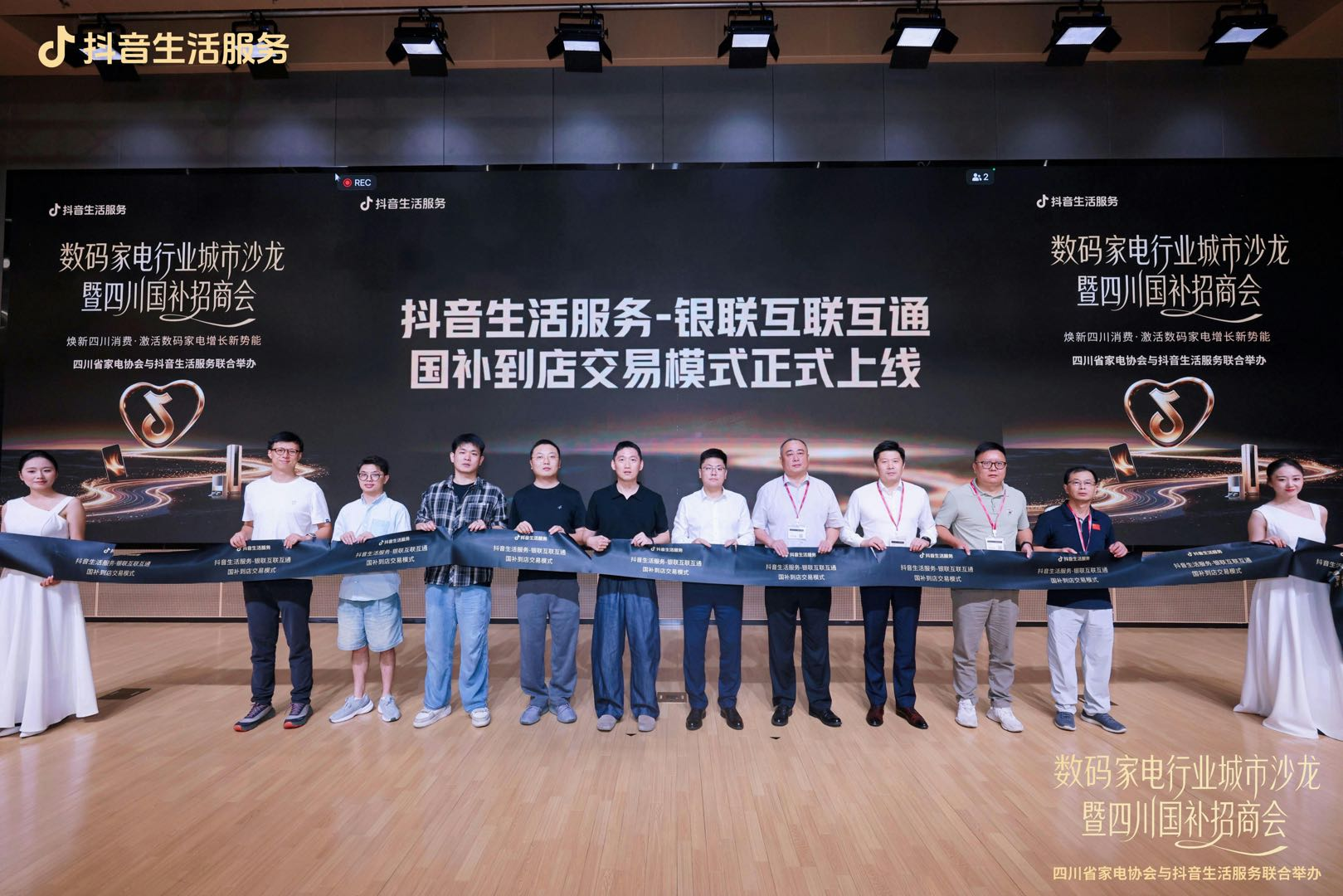
7月23日,数码家电行业城市沙龙暨四川国补招商会在成都举行。本次活动由四川省家用电器商业协会与抖音生活服务联合举办,围绕数码家电行业增长、线下门店获客、国补到店交易等议题展开交流。活动现场,抖音生活服务联合中国银联、银联商务共同推出互联互通国补到店交易模式,并在成都率先上线。用户到店后,可通过银联互联互通渠道完成资质校验、领取补贴权益并支付立减。

现场分享的行业数据显示,家居家电行业线上化率已达57%,行业线上化增速为9.1%。在抖音生活服务平台,数码家电相关搜索需求今年以来日均同比增长86%。这在一定程度上反映出,消费者在购买数码家电时越来越倾向于先通过线上内容了解产品,再做出到店购买决策。

抖音生活服务相关负责人介绍,平台通过短视频、直播等内容场景帮助用户获取商品信息,也为商家提供从内容触达到到店转化的经营链路。数码家电消费兼具线上种草和线下体验双重属性,这使得平台内容场景与线下门店之间的协同具备一定基础。

数据显示,抖音生活服务数码家电行业保持较快增长。2025年全年,行业相关短视频和直播累计曝光量环比增长132%,订单量环比增长107%;2026年上半年,支付GMV同比增长133%。国补政策的持续实施,也在一定程度上带动了相关品类的消费需求。

抖音生活服务国补到店交易模式在成都率先上线

在交易模式层面,本次沙龙重点发布了抖音生活服务国补到店交易模式。该模式依托中国银联与银联商务的以旧换新业务系统及智能化终端能力,将抖音生活服务线上用户引流至线下实体门店,有效促进线下消费转化。

该模式的上线,意味着抖音生活服务的国补消费可进一步与线下门店交易场景衔接。对商家而言,可以沿用门店现有收银与服务流程,通过到店支付、核销与后续结算等环节的衔接,实现补贴权益在到店交易中的承接与闭环。对用户而言,在符合活动规则和补贴资格的情况下,到店后出示抖音生活服务互联互通付款码,即可在一次支付中同步核销商家优惠、平台补贴与国补优惠,完成到店交易闭环。

在成都试点案例中,苏宁易购分享了与抖音生活服务打通在线买单与门店收银系统的实践进展。其通过API接口对接,提升用户核销与支付的效率,并在试点期结合直播等内容触达方式做交易承接。苏宁易购披露,2025年四川区域有22家门店参与试点,累计核销GMV超过1亿元,并在节点活动中实现单日核销GMV超过1000万元。

据介绍,成都为该模式首发城市,后续计划在更多城市逐步推进。抖音生活服务相关负责人表示,未来将持续推进平台能力与线下门店的系统对接,覆盖更多区域的数码家电商家。

注:文/龚作仁,文章来源:Laborer,本文为作者独立观点,不代表亿邦动力立场。

文章来源:Laborer

广告
微信
朋友圈

FAQ回顾

抖音生活服务推出的国补到店交易模式是什么?

该模式由抖音生活服务联合中国银联、银联商务共同推出,依托银联以旧换新业务系统及智能化终端能力,将线上用户引流至线下实体门店。商家可沿用现有收银流程实现补贴承接闭环,符合资质的用户到店支付可同步核销商家优惠、平台补贴与国补优惠,一次完成交易。

国补到店交易模式目前在哪些城市可以使用?

该模式首发城市为成都,目前已率先在成都上线试点。2025年苏宁易购四川区域有22家门店参与试点,累计核销GMV超过1亿元,后续抖音生活服务计划逐步在更多城市推进,覆盖更多区域的数码家电商家。

当前数码家电行业消费有什么新趋势?

当前家居家电行业线上化率已达57%,线上化增速为9.1%,消费者购买数码家电时越来越倾向先通过线上内容了解产品,再到店购买。2026年上半年抖音生活服务数码家电行业支付GMV同比增长133%,行业保持较快增长。

抖音生活服务能为数码家电商家提供哪些经营支持?

抖音生活服务可通过短视频、直播等内容场景帮助商家触达潜在消费者,提供从内容触达到到店转化的完整经营链路。国补到店交易模式还可帮助商家沿用现有收银流程,实现补贴权益的承接与交易闭环,提升经营效率。

这么好看,分享一下?

朋友圈 分享

APP内打开

+1
+1
微信好友 朋友圈 新浪微博 QQ空间
关闭
收藏成功
发送
/140 0

