广告
加载中

京东JoyAI-VL-Interaction 登顶视频理解模型趋势榜 视频 AI 进入“主动交互”时刻

龚作仁 2026-06-29 10:20
龚作仁 2026/06/29 10:20

邦小白快读

EN
全文速览

本文核心信息是京东开源的实时视频视觉语言交互模型JoyAI-VL-Interaction,登上了Hugging Face Trending视频理解类榜首,标志着视频AI正式进入主动交互时代,核心干货内容如下:

1. 该模型解决了传统视频AI被动等待用户提问的痛点,能在连续视频流中自主决定何时回应、何时沉默,遇到复杂任务还能自动委派给后台Agent处理,实现前台持续交互加后台处理复杂任务的协作模式。

2. 技术层面做了两大优化:引入AdaCodec只在关键帧用完整计算,可预测帧用轻量计算,避免计算量随帧数暴涨;采用分层长程记忆机制,能覆盖两小时上下文还不阻塞实时推理。

3. 实际评测表现优异,真人盲评对打豆包胜率77.6%,对打Gemini胜率87.9%,监控预警场景更是100%胜率,在老人看护、直播解说、实时翻译等日常场景都有实用价值。

本次视频AI技术的新突破,给品牌商布局AI相关业务、把握消费趋势提供了明确参考,核心干货如下:

1. 消费与技术趋势层面,用户对视频AI的需求已经从被动问答转向主动实时交互,直播、电商、客服、安防、陪伴等品牌高频应用场景,都需要AI持续在线主动响应,这是接下来产品升级的核心方向。

2. 落地成本层面,京东此次开源的不是孤立的模型权重,而是包含训练方案、400多万条标注数据、完整可部署系统的整套方案,所有模块都支持可插拔修改,品牌商接入AI能力不需要从零补齐工程环节,大幅降低了落地门槛。

3. 场景适配层面,该模型在异常预警、实时解说等对响应速度要求高的场景表现突出,能满足品牌开发安全看护、直播服务等新产品的能力需求,适合品牌基于这套方案快速落地自身业务。

京东开源领先主动交互视频AI模型的事件,给各类卖家带来了新的业务增长机会和方向提示,核心干货如下:

1. 新增业务机会层面,主动交互视频AI可以适配卖家多个核心场景:直播带货中可以主动实时解说商品变化、观众关注点,店铺客服可以主动识别用户的动作需求不用等提问,仓储看店可以主动预警异常入侵或者货品异动,这些都能帮卖家提升用户体验、降低人力成本。

2. 落地成本层面,不同于以往开源模型只提供基础权重,京东开放了完整可部署的整套系统,卖家哪怕没有强大的技术团队,也可以基于这套现成方案修改适配自身场景,节省了大量开发成本。

3. 方向提示层面,当前行业已经明确从被动视频问答转向主动交互,如果卖家不跟进相关技术升级,未来很可能在用户体验上落后于竞争对手,需要尽早关注相关技术的落地应用。

视频AI进入主动交互时代的行业变化,给工厂推进数字化转型、挖掘新商业机会提供了不少启示,核心干货如下:

1. 生产场景适配层面,工厂的生产流水线监控、厂区安防巡检、实时产量计数等场景,本身就需要AI主动持续检测异常,不需要人工每次触发提问,该模型的主动交互能力刚好匹配这类生产需求,解决了传统AI预警滞后、需要人工触发的痛点。

2. 数字化转型启示:工厂推进AI落地不需要从零开发整套系统,京东这套开源方案已经解决了实时推理、上下文存储、任务调度等核心问题,还开放了可修改的完整模块,工厂可以低成本快速适配自身的生产场景,降低了数字化改造的门槛。

3. 新产品商业机会:主动交互视频AI技术的成熟,让工厂可以开发更多符合市场需求的新产品,比如带主动异常预警的家用老人看护摄像头、带主动安全检测的工厂监控设备等,帮助工厂拓展新的产品线和营收方向。

本次行业事件给AI服务商明确了行业发展趋势、客户痛点以及可参考的落地方案,核心干货如下:

1. 行业发展趋势:当前客户对视频AI的需求已经从传统的被动问答转向主动流式交互,客户需要能持续在场、主动判断实时响应的AI产品,而不是只能等待用户提问的问答工具,开源社区的热度也证明主动交互是接下来视频AI的核心增长点。

2. 客户核心痛点:过去很多开源多模态模型只提供模型权重和基础推理代码,客户真正落地的时候,需要自己补齐视频流接入、推理优化、语音模块对接、会话管理、Agent调度等大量工程环节,落地成本和门槛非常高,这是当前客户的核心痛点。

3. 可参考的解决方案:京东这套开源方案已经解决了核心问题:用AdaCodec解决实时推理的计算压力问题,用分层长程记忆解决长上下文存储问题,还开放了可插拔的完整模块,服务商可以直接基于这套方案快速给客户做定制化开发,降低自身的服务成本。

JoyAI-VL-Interaction登顶趋势榜的事件,给AI平台的运营和发展方向提供了不少参考,核心干货如下:

1. 当前开发者的真实需求:平台上的开发者不满足于只获得模型权重,更需要能直接跑起来、可以灵活修改、能快速接入自身业务系统的完整方案,过去只开放权重的开源模型已经不符合开发者的真实需求。

2. 平台运营和招商方向:平台可以重点引入这类提供完整工程能力的开源AI模型,吸引更多有实际落地需求的开发者入驻,提升平台的下载量和活跃度,也能更好地满足平台用户的需求,形成正向循环。

3. 风向规避提示:当前行业已经明确将研发和落地重心从传统视频问答转向主动流式交互视频AI,如果平台还继续重点推广传统被动问答类的视频模型,就会跟不上开发者的需求,需要及时调整内容推荐、榜单排序的方向,匹配最新的技术发展趋势。

本次事件给AI领域研究者提供了视频AI方向的最新产业动向和技术、模式参考,核心干货如下:

1. 产业新动向:视频AI已经完成了从“看见什么”的图片问答,到“发生了什么”的视频理解,现在正式进入“什么时候该回应、该做什么”的主动交互阶段,整个多模态AI的研究热点,也正在从静态图文理解走向视频、环境的连续交互,这是接下来领域的核心研究方向。

2. 技术方向参考:针对实时交互的核心痛点,文章给出了经过验证的可行技术思路:用AdaCodec对关键帧和可预测帧差异化计算解决计算量爆炸问题,用分层长程记忆解决长上下文存储不阻塞推理的问题,“前台实时观察+后台Agent委派任务”的架构,也为后续研究提供了新的框架思路。

3. 开源模式启示:传统开源多模态模型大多只开放模型权重,本次京东开放完整系统加训练数据的开源模式,更符合产业落地的实际需求,也获得了开源社区的高度认可,为后续研究成果的开源推广提供了新的可参考模式。

返回默认

声明:快读内容全程由AI生成,请注意甄别信息。如您发现问题,请发送邮件至 run@ebrun.com 。

我是 品牌商 卖家 工厂 服务商 平台商 研究者 帮我再读一遍。

Quick Summary

This article covers JoyAI-VL-Interaction, JD.com's open-source real-time interactive video-language model that recently topped Hugging Face's trending list for video understanding, marking the official entry of video AI into the era of active interaction. Key takeaways are as follows:

1. Unlike traditional video AI that passively waits for user queries, this model can autonomously decide when to respond and when to stay silent during continuous video streaming. It can also automatically delegate complex tasks to backend agents, enabling a collaborative framework of continuous front-end interaction and back-end complex task processing.

2. Two key technical optimizations enable this performance: First, it introduces AdaCodec to run full computation only on key frames while using lightweight calculation for predictable frames, preventing computational overhead from spiking with increasing frame counts. Second, it uses a hierarchical long-term memory mechanism that can retain up to two hours of context without blocking real-time inference.

3. The model delivers strong benchmark performance: it won 77.6% of human blind tests against Doubao, 87.9% against Gemini, and achieved a 100% win rate in monitoring and early warning scenarios. It has practical applications in daily use cases including elderly care, live streaming commentary, and real-time translation.

This breakthrough in video AI technology provides clear guidance for brands looking to deploy AI-powered business and capture emerging consumer trends. Key takeaways are as follows:

1. In terms of consumer and technology trends, user demand for video AI has shifted from passive question-and-answer to active real-time interaction. High-frequency brand use cases including live streaming, e-commerce, customer service, security, and companion services all require AI that stays continuously online and responds proactively, making this the core direction for upcoming product upgrades.

2. On deployment costs: JD open-sourced not just isolated model weights, but a full stack solution including training pipelines, over 4 million annotated data points, and a complete deployable system. All modules support plug-and-play modification, so brands do not need to build out full engineering capabilities from scratch, significantly lowering the barrier to deployment.

3. For scenario adaptation: The model performs exceptionally well in latency-sensitive use cases such as anomaly detection and real-time commentary, meeting the capability requirements for brands developing new products such as safety care and live streaming services. It is well-suited for brands to quickly adapt the framework to their own business use cases.

JD's open-source release of this leading active interactive video AI model opens new growth opportunities and directional guidance for sellers of all types. Key takeaways are as follows:

1. New business opportunities: Active interactive video AI can be adapted to multiple core seller use cases: it can proactively provide real-time commentary on product updates and audience focus during live-streamed sales, proactively identify user intent without waiting for queries for store customer service, and automatically alert for abnormal intrusions or inventory changes for warehouse and in-store monitoring. All of these use cases help sellers improve user experience and cut labor costs.

2. On deployment costs: Unlike traditional open-source models that only provide base weights, JD has released a complete, ready-to-deploy full stack system. Even sellers without large in-house technical teams can modify and adapt this off-the-shelf solution to their own scenarios, saving substantial development costs.

3. Strategic guidance: The industry has clearly shifted from passive video Q&A to active interaction. Sellers that do not follow this technology upgrade will likely fall behind competitors in user experience, so they should prioritize early exploration of deploying this technology.

The industry shift toward active interactive video AI offers valuable insights for factories advancing digital transformation and unlocking new business opportunities. Key takeaways are as follows:

1. For production scenario adaptation: Use cases common to manufacturing including production line monitoring, facility security patrols, and real-time output counting already require AI to proactively and continuously detect anomalies, rather than relying on manual trigger prompts. The model's active interaction capability directly matches these production needs, solving the pain points of lagged alerts and manual triggering that plague traditional AI solutions.

2. Insights for digital transformation: Factories do not need to build a full AI system from scratch to deploy AI. JD's open-source solution has already solved core problems including real-time inference, context storage, and task scheduling, and offers fully customizable open modules. Factories can quickly adapt the solution to their own production scenarios at low cost, lowering the barrier to digital transformation.

3. New product business opportunities: The maturation of active interactive video AI technology allows factories to develop new market-aligned products, such as home elderly care cameras with proactive anomaly alerts, and factory monitoring devices with active safety detection. This helps factories expand their product lines and open new revenue streams.

This industry event clarifies development trends, core customer pain points, and reference deployment frameworks for AI service providers. Key takeaways are as follows:

1. Industry development trends: Customer demand for video AI has shifted from traditional passive Q&A to active streaming interaction. Customers want AI products that stay continuously present, proactively judge context, and respond in real time, rather than Q&A tools that only respond when prompted. The excitement in the open-source community confirms that active interaction will be the core growth area for video AI going forward.

2. Core customer pain points: Most existing open-source multimodal models only provide model weights and basic inference code. When customers actually deploy the technology, they need to build out a huge number of engineering components from scratch, including video stream integration, inference optimization, voice module integration, session management, and agent scheduling. This creates extremely high deployment costs and barriers, which is the core pain point for customers today.

3. Reference solution: JD's open-source solution has already solved core problems: it uses AdaCodec to address computational pressure for real-time inference, and hierarchical long-term memory to store long context without blocking inference. It also offers fully pluggable complete modules, so service providers can directly build on this framework to deliver fast customized development for clients, lowering their own service costs.

JoyAI-VL-Interaction's topping of the Hugging Face trending list offers valuable insights for the operation and development strategy of AI platforms. Key takeaways are as follows:

1. The real needs of developers: Developers on AI platforms are no longer satisfied with only accessing model weights. They increasingly need complete solutions that can run out of the box, be flexibly modified, and integrate quickly into their own business systems. Traditional open-source models that only release weights no longer meet developers' actual needs.

2. Guidance for platform operation and developer recruitment: Platforms can prioritize onboarding open-source AI models that offer full engineering capabilities, to attract more developers with actual deployment needs, boost platform download volume and activity, better meet platform user demand, and form a positive growth cycle.

3. Guidance for trend alignment: The industry has clearly shifted R&D and deployment focus from traditional video Q&A to active streaming interactive video AI. Platforms that continue to prioritize promoting traditional passive Q&A video models will fall out of step with developer demand, and should adjust their content recommendation and ranking algorithms to align with the latest technology trends.

This event offers insights into the latest industry trends, technical directions, and open-source models for AI researchers working on video AI. Key takeaways are as follows:

1. New industry trends: Video AI has evolved from image-level visual question answering ("what can you see") to general video understanding ("what is happening"), and has now officially entered the active interaction phase ("when should I respond, and what should I do"). The research focus of the broader multimodal AI field is also shifting from static text-image understanding to continuous interaction with video and real-world environments, making this the core research direction for the field going forward.

2. Reference technical directions: For the core pain points of real-time interaction, this work provides validated, feasible technical approaches: it uses AdaCodec to apply differentiated computation to key frames and predictable frames to solve the problem of computational explosion, and hierarchical long-term memory to store long context without blocking inference. Its "front-end real-time observation + back-end agent task delegation" architecture also provides a new framework for future research.

3. Insights for open-source models: Most traditional open-source multimodal models only release model weights. JD's open-source model, which releases a full system plus training data, better matches the actual needs of industry deployment and has earned strong recognition from the open-source community. This provides a new reference model for the open-source dissemination of future research outcomes.

Disclaimer: The "Quick Summary" content is entirely generated by AI. Please exercise discretion when interpreting the information. For issues or corrections, please email run@ebrun.com .

I am a Brand Seller Factory Service Provider Marketplace Seller Researcher Read it again.

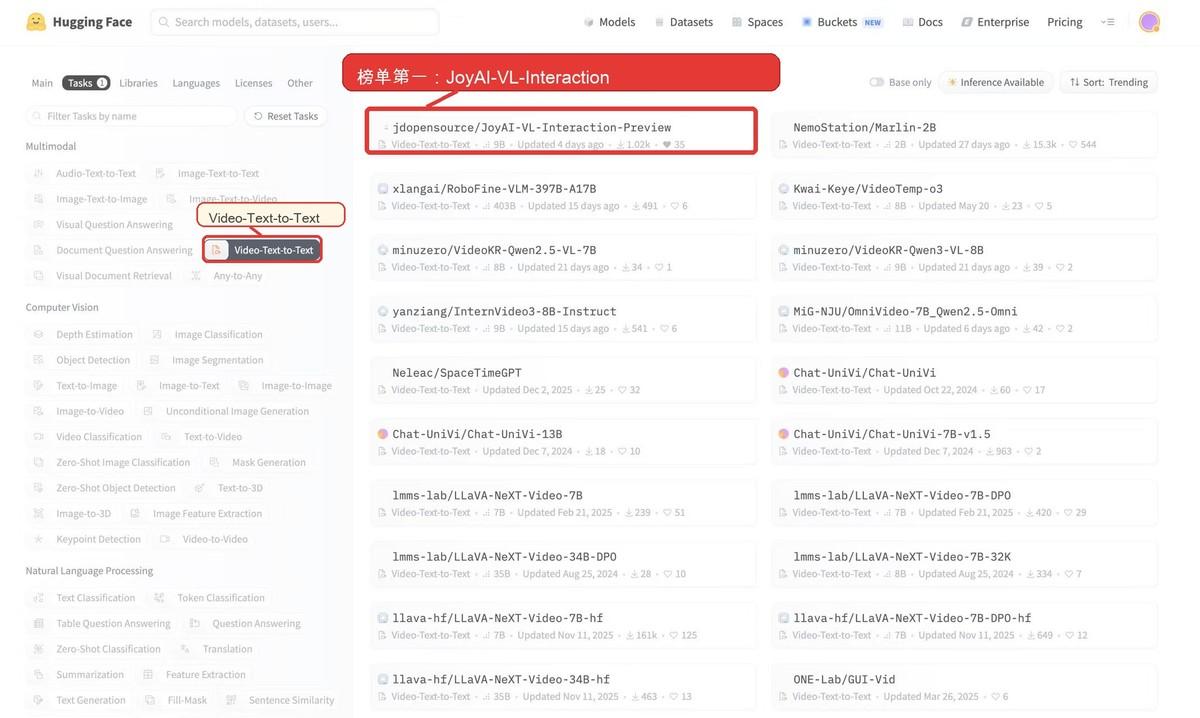
近日,京东开源的实时视频视觉语言交互模型JoyAI-VL-Interaction在 Hugging Face社区获得关注,并登上Hugging Face Trending视频理解类第一。

这并不是一个普通的模型热度信号。它说明开发者正在寻找的,已经不只是“能看懂视频”的AI,而是能够在连续视频流中主动判断、实时响应、持续交互的AI。

从“你问我答”到“主动开口”

过去大多数视频AI,本质上仍停留在“你问,它答”的阶段。用户不开口,模型就等待;即便接入摄像头,也更像一个会看画面的聊天框。

但真实世界里的很多关键时刻,并不会等待人类提问。老人跌倒时,不会先问一句“我有没有危险”;直播比赛进球时,不会等观众输入“刚才发生了什么”;屏幕上出现字幕时,也不应该要求用户每一帧都重新发送翻译指令。

这些场景需要的不是传统问答,而是一双全程在线、能够判断什么时候该开口的“眼睛”。JoyAI-VL-Interaction试图解决的正是这个问题:让模型在连续的视频流中自主决定何时回应、何时沉默、何时把复杂任务交给后台Agent。

换句话说,它不仅学会了什么时候该闭嘴,也学会了什么时候必须开口。

视频AI正在进入“流式交互”阶段

在看护场景中,老人正常活动时,模型可以保持沉默;一旦发现异常,则立即预警。

在实时翻译场景中,用户只需说一句“把字幕翻译成中文”,模型就会持续关注画面。每当新字幕出现,它会主动完成翻译,而不是翻完第一句后就停下来等待下一条指令。

这意味着视频AI正在从“轮次对话”走向“流式交互”。过去,交互节奏主要由用户控制;现在,“要不要开口”这个决定,开始交给模型自己。

对视频理解来说,实时性是绕不开的硬门槛。图片可以慢慢看,但视频中的很多事件都有窗口期。预警晚几秒,价值就会大幅下降;直播解说慢半拍,体验就不成立。

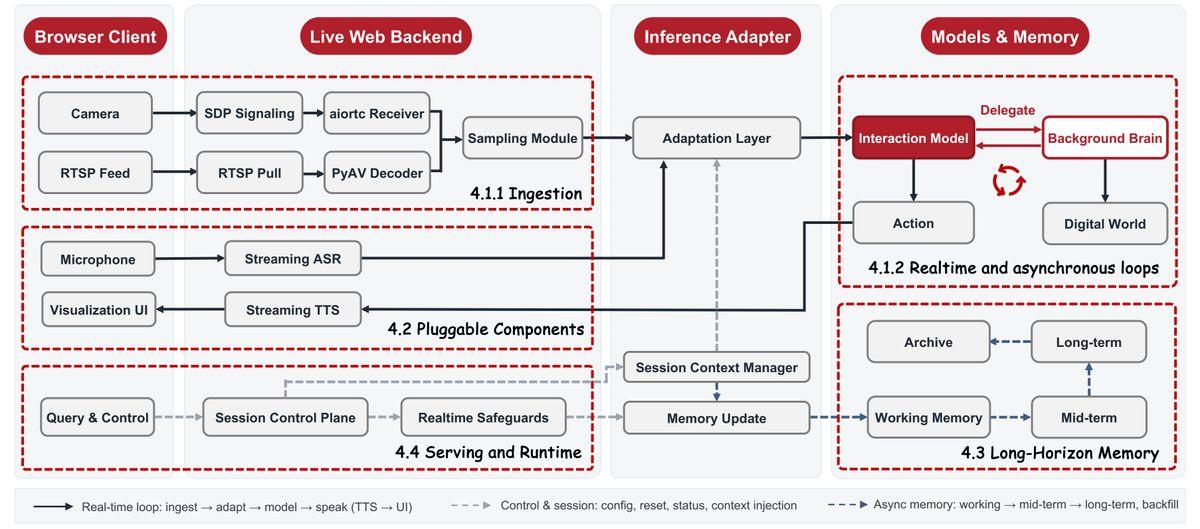
为了解决实时推理中的计算压力,JoyAI-VL-Interaction引入了AdaCodec:它并不对每一帧都投入完整视觉token,而是在画面发生明显变化的关键帧上使用完整token,在中间可预测帧上使用轻量P-token。这样一来,计算量更接近随画面变化增长,而不是随着视频帧数线性爆炸。

同时,模型还采用了分层长程记忆机制:短期记忆保留最近的原始视觉信息,中期记忆保存文本摘要,长期记忆进一步压缩信息。多层记忆叠加后,可以覆盖约两小时上下文,并且压缩过程异步进行,不会阻塞实时推理。

在真实流式场景中验证能力

据京东披露的评测结果,JoyAI-VL-Interaction覆盖了监控预警、实时计数、实时翻译、时间感知、直播导览解说等真实流式场景。

在58个真人盲评案例中,JoyAI-VL-Interaction对比豆包视频通话助手的总体胜率为77.6%,对比Gemini视频通话助手的总体胜率为87.9%。其中,在监控预警场景中,JoyAI-VL-Interaction对两个基线均取得100% 胜率。

以摔倒检测为例,该模型可以在人倒下的瞬间触发提醒,体现出主动交互模型在安全类场景中的价值。对于这类应用而言,关键不只是识别是否准确,更在于能否在正确时间响应。它的优势不只在于“答得对”,更在于“来得及”和“跟得住”。

另一个值得关注的能力,是任务委派。当模型遇到数学推导、网页复刻、代码生成等复杂任务时,可以将任务交给后台大模型或Agent处理,自己则继续保持前台视频交互。

前台负责持续观察真实世界,后台负责处理复杂任务;等结果返回后,再自然接回对话。这让JoyAI-VL-Interaction不再只是一个视频问答助手,而更像一套“前台实时陪伴 + 后台任务执行”的协作系统。

开源的不只是模型权重,而是一套系统

也正因此,JoyAI-VL-Interaction在 Hugging Face上获得高下载量并不意外。开发者真正需要的,不只是论文中的能力展示,而是能跑起来、改得动、接得进业务系统的东西。

京东此次开源的也不是孤立权重,而是包括训练recipe、超过400万条时间对齐交互数据,以及完整可部署系统。ASR/TTS语音模块、三层长程记忆、可视化操作界面、后台Agent桥接等模块,也都以可插拔方式开放。

过去很多开源多模态模型,只提供权重和推理代码。真正落地时,视频流接入、推理优化、语音输入输出、会话状态管理、Agent调度等工程环节,仍然需要开发者自己补齐。JoyAI-VL-Interaction的价值在于,它把模型能力和系统能力一起放了出来。

从视频问答走向视频交互

从更大的趋势看,多模态AI正在从图文理解,走向视频、语音、动作和环境交互。

图片问答解决的是“看见什么”,视频理解要解决的是“发生了什么”,而JoyAI-VL-Interaction进一步尝试回答的是:“什么时候该回应,以及接下来该做什么”。这一步很关键。

因为真实世界不是静态截图,而是连续流动的。直播、电商、物流、仓储、安防、客服、教育、陪伴、具身智能等场景,都需要AI持续在场,而不是被动等待问题。

JoyAI-VL-Interaction在 Hugging Face视频理解类模型下载榜登顶,某种程度上说明,开源社区正在把注意力从“视频问答”转向“视频交互”。

当AI不再只是等人提问,而是能够持续观察、主动判断、适时开口,并把复杂任务交给后台执行时,视频AI的产品形态也许会被重新定义。JoyAI-VL-Interaction的走热,可能只是这个变化的开始。

注:文/龚作仁,文章来源:Laborer,本文为作者独立观点,不代表亿邦动力立场。

文章来源:Laborer

广告
微信
朋友圈

这么好看,分享一下?

朋友圈 分享

APP内打开

赞 +1
+1
微信好友 朋友圈 新浪微博 QQ空间
关闭
收藏成功
发送
/140 0