广告
加载中

豆包率先抢跑付费赛道 留给千问、元宝的定价空间不多了

胡镤心 2026-06-24 10:02
胡镤心 2026/06/24 10:02

邦小白快读

EN
全文速览

本次字节跳动旗下国内月活最高的AI原生App豆包,正式推出了完整付费订阅的专业版服务,核心干货信息整理如下:

1. 功能差异:豆包专业版搭载旗舰级豆包2.1 Pro大模型,在编程、智能体、视觉语言模型三大方向达到生产级应用水平,核心升级了办公任务模式,可自主拆解工作任务,支持本地设备操作、内置Office套件、多领域技能调用、定时任务、小型应用生成,能直接交付工作成果,满足专业生产力需求。

2. 定价与选择:专业版采用阶梯定价,入门标准版每月68元,远低于海外ChatGPT Plus的135元每月,同时原有免费版功能不变还会持续迭代,普通日常用户依旧可以免费使用,只有重度专业用户可按需选择付费升级。

豆包率先布局AI付费赛道,为国内AI品牌的商业化运营、定价策略、用户运营提供了可参考的样本,相关干货整理如下:

1. 用户分层与消费趋势:当前AI用户已经明显分化,普通用户仅需要满足日常问答需求,而专业生产力场景的重度用户Token消耗量远高于普通用户,且愿意为高阶能力付费,用户分层运营是AI品牌发展的必然趋势。

2. 定价与品牌策略:豆包采取远低于海外竞品的阶梯定价,提前抢占了国内用户AI付费的心理账户,同时保留免费版持续迭代,既保障普通用户体验,又分离高耗能用户控制算力成本,整体策略非常清晰。

3. 风险提示:推出付费服务后豆包MAU首次出现下滑,内测阶段付费用户反馈付费版与免费版差异不足、缺少个性化功能,品牌推出付费服务前需要提前打磨体验,拉开产品差异。

豆包抢跑AI付费赛道,给国内AI服务相关卖家释放了明确的市场信号,机会与风险干货整理如下:

1. 市场机会:当前国内AI付费市场已经正式启动,用户对AI生产力工具存在明确付费需求,分层运营的商业化模式已经跑通雏形,将高消耗的专业用户和普通免费用户区隔,既可以控制高额算力成本,又能满足不同层级用户的需求,模式具备可行性。

2. 风险提示:豆包入门版68元每月的定价已经挤占了后续竞品的定价空间,新进入者的定价空间被大幅压缩,同时如果付费版和免费版体验差异不足,会引发用户不满,导致转化率低、用户流失,甚至影响整个品类的用户信心。

3. 可借鉴的做法:不必急于追求付费渗透率,初期可以把验证产品功能价值作为核心目标,逐步推进商业化,降低转型风险。

豆包推出成熟的付费AI生产力工具,为工厂推进数字化转型、挖掘效率提升机会提供了相关干货,整理如下:

1. 可用的商业机会:当前AI工具已经跨越生产级质变点,豆包专业版的资料整理、数据分析、定时任务、流程自动化等能力,可以直接应用在工厂的运营管理环节,帮助工厂降本提效,工厂可以引入这类工具快速推进办公、运营的数字化升级。

2. 数字化转型启示:AI已经可以实现自主拆解任务、调用多工具完成工作,不需要工厂投入大量资金自研,就可以用到成熟的高阶AI能力,工厂可以借助现成的AI工具快速落地数字化改造,降低转型门槛。

3. 如果工厂计划布局自有AI服务,可参考豆包的成本控制思路,对不同使用频次的用户和场景进行分层,平衡成本与用户体验。

从豆包推出付费专业版可以看出国内AI服务行业的新发展趋势,相关干货整理如下:

1. 行业发展趋势:国内AI行业已经从初期的免费流量争夺,转向商业化变现阶段,产品定位从通用问答工具转向生产力工具,能直接交付工作成果的专业AI服务是未来核心增长方向。

2. 核心客户痛点:一方面AI厂商面临巨额算力成本压力,头部产品单日算力成本可达数千万元,单纯免费模式已经难以为继;另一方面C端付费用户核心痛点是付费版与免费版差异不足、缺少个性化功能,体验达不到预期,转化率难以提升。

3. 可行解决方案:可以采用用户分层运营模式,通过付费墙分离重度高耗能专业用户和普通日常用户,针对专业用户推出高阶模型和生产力功能,采取阶梯定价拉低入门门槛,初期优先验证功能价值,不必急于追求变现指标。

豆包作为头部AI原生平台推出付费体系,为AI平台的运营、商业化带来诸多参考,干货内容整理如下:

1. 用户需求变化:当前AI平台用户已经不再满足于基础的免费问答,对专业生产力场景有明确的高阶需求,平台需要针对这类需求推出对应的产品服务,抓住商业化转型机会。

2. 可参考的最新做法:采用用户分层运营策略,保留免费版持续迭代满足普通用户需求,推出付费专业版服务重度高耗能用户,既控制了高额的算力成本,又能覆盖不同层级用户的需求;定价上采取低于海外竞品的阶梯定价,抢占用户付费心理账户,形成先发竞争优势。

3. 风险规避要点:推出付费服务前需要充分内测,拉大付费版与免费版的体验差异,避免用户不满引发流失,初期不要把付费渗透率作为核心考核,先验证功能价值再推进商业化,降低转型风险。

豆包率先推出完整付费订阅体系,是国内大模型产业商业化的重要标志性事件,相关研究参考干货整理如下:

1. 产业新动向:国内头部大模型产品已经正式结束流量争夺阶段,进入商业化变现落地期,产业方向从做大用户流量转向做深生产力价值,AI产品从流量产品转型为生产力工具,订阅制付费成为主流商业化方向。

2. 行业新问题:大模型产业的基础设施投入极高,字节跳动2026年计划投入700亿美元用于AI基础设施,头部产品单日算力成本数千万元,原有免费模式难以覆盖高额成本,而推出付费后用户接受度存在不确定性,已经出现MAU下滑、内测用户体验不佳等问题,商业化路径仍待验证。

3. 商业模式创新参考:分层订阅制通过付费墙区隔不同需求的用户,既控制了算力成本,又保障了不同层级用户的体验,是大模型行业应对高成本压力的创新性探索,对整个产业的商业模式设计有重要参考价值。

返回默认
声明:快读内容全程由AI生成,请注意甄别信息。如您发现问题,请发送邮件至 run@ebrun.com 。

我是 品牌商 卖家 工厂 服务商 平台商 研究者 帮我再读一遍。

Quick Summary

Doubao, the AI-native app owned by ByteDance with the largest monthly active user (MAU) base in China, has officially launched a full paid subscription for its professional version. Below is a summary of key takeaways:

1. **Feature Differences**: Powered by the top-tier Doubao 2.1 Pro large language model, Doubao Professional reaches production-level performance in three core areas: programming, AI agents, and vision-language models. Its core upgrade is a dedicated office task mode that can independently decompose work tasks. It supports local device operations, has built-in Office tools, multi-domain skill invocation, scheduled tasks, and small application generation, enabling users to directly deliver finished work outputs and meet professional productivity demands.

2. **Pricing & Options**: The professional version adopts tiered pricing, with the entry standard tier priced at 68 RMB per month — far lower than ChatGPT Plus’s 135 RMB monthly fee. Meanwhile, the original free version remains fully functional and will continue to be updated. Casual everyday users can still use it for free, while heavy professional users can choose to upgrade to paid services based on their needs.

Doubao is an early mover in China’s AI paid services track, providing a reference case for commercial operation, pricing strategy and user management for domestic AI brands. Key takeaways are summarized below:

1. **User Segmentation and Consumption Trends**: AI users in China are now clearly segmented: ordinary users only need to meet basic daily question-and-answer needs, while heavy users for professional productivity scenarios consume far more tokens than general users and are willing to pay for advanced capabilities. User分层运营 is an inevitable trend for AI brand development.

2. **Pricing and Brand Strategy**: Doubao’s tiered pricing, set far lower than overseas competitors, allows it to pre-empt domestic users’ mental budget for AI paid services. By keeping the free version updated continuously, it protects the experience for ordinary users while separating high-consumption users to control computing costs, resulting in a very clear overall strategy.

3. **Risk Warning**: After launching paid services, Doubao’s MAU saw its first decline. Beta test users also feedback that the gap between the paid and free versions is not large enough, and personalized features are lacking. This shows brands need to refine user experience in advance and clearly differentiate product tiers before launching paid services.

Doubao’s early entry into the AI paid track has sent a clear market signal to domestic AI service sellers. Below is a summary of opportunities and risks:

1. **Market Opportunities**: China’s AI paid market has officially launched, and users have clear willingness to pay for AI productivity tools. The segmented commercialization model has already proven its preliminary viability: separating high-consumption professional users from free general users helps control high computing costs while meeting the needs of users at different tiers, making the model feasible.

2. **Risk Warning**: Doubao’s 68 RMB per month entry-level price point has already squeezed pricing space for future competitors, significantly compressing the room for new entrants. In addition, if the experience gap between paid and free versions is too small, it will trigger user dissatisfaction, leading to low conversion rates, user churn, and even damage to user confidence in the entire category.

3. **Best Practices to Learn From**: Sellers do not need to rush to pursue paid penetration. In the early stage, they should focus on verifying the functional value of the product, advance commercialization gradually, and reduce transformation risks.

Doubao’s launch of a mature paid AI productivity tool offers relevant insights for factories pursuing digital transformation and efficiency improvement opportunities. Key takeaways are summarized below:

1. **Available Business Opportunities**: AI tools have now crossed the threshold to production-level usability. Doubao Professional’s capabilities in data organization, data analysis, scheduled tasks, and process automation can be directly applied to factory operation and management, helping factories cut costs and improve efficiency. Factories can introduce such tools to quickly advance digital upgrades for office and operation work.

2. **Insights for Digital Transformation**: AI can now independently decompose tasks and invoke multiple tools to complete work. Factories do not need to invest heavily in proprietary in-house development to access mature advanced AI capabilities. They can use ready-made AI tools to quickly implement digital transformation and lower the barrier to adoption.

3. For factories planning to build their own AI services, they can reference Doubao’s cost control approach: segment users and scenarios by usage frequency to balance costs and user experience.

Doubao’s launch of its paid professional version reveals new development trends in China’s AI service industry. Key takeaways are summarized below:

1. **Industry Development Trends**: China’s AI industry has shifted from the early stage of fighting for free traffic to the commercialization stage. Product positioning is also shifting from general-purpose question-and-answer tools to productivity tools, and professional AI services that can directly deliver work outputs will be the core growth driver going forward.

2. **Core Pain Points for Clients**: On one hand, AI vendors face enormous pressure from computing costs: daily computing costs for leading products can reach tens of millions of RMB, making a pure free model unsustainable. On the other hand, the core pain point for C-end paid users is the insufficient differentiation between paid and free versions, a lack of personalized features, underwhelming experience, and difficulty improving conversion rates.

3. **Viable Solutions**: Players can adopt a segmented user operation model: separate heavy high-consumption professional users from ordinary daily users via a paywall, launch advanced models and productivity features targeted at professional users, adopt tiered pricing to lower the entry barrier, and prioritize verifying functional value in the early stage rather than rushing to hit monetization targets.

As a leading AI-native platform launching a full paid system, Doubao provides many references for AI platform operation and commercialization. Key takeaways are summarized below:

1. **Changing User Demand**: AI platform users are no longer satisfied with basic free Q&A, and have clear advanced demand for professional productivity scenarios. Platforms need to launch corresponding products and services to meet these demands and seize the opportunity for commercial transformation.

2. **Updated Best Practices to Reference**: Adopt a segmented user operation strategy: keep the free version updated continuously to meet ordinary users’ needs, and launch a paid professional version to serve heavy high-consumption users. This approach controls high computing costs while covering the needs of users at different tiers. For pricing, adopt tiered pricing lower than overseas competitors to pre-empt users’ mental budget for AI paid services and build a first-mover competitive advantage.

3. **Risk Mitigation Points**: Conduct sufficient beta testing before launching paid services, and expand the experience gap between paid and free versions to avoid user dissatisfaction and churn. Do not take paid penetration as the core performance indicator in the early stage; verify functional value first before advancing commercialization to reduce transformation risk.

Doubao’s early launch of a complete paid subscription system is an important milestone for the commercialization of China’s large model industry. Below is a summary of key insights for research:

1. **New Industry Trends**: China’s leading large model products have officially exited the phase of competing for user traffic and entered the stage of commercialization and implementation. The industry’s focus has shifted from growing user scale to deepening productivity value, and AI products are transforming from traffic products to productivity tools, with subscription-based paid models becoming the mainstream commercialization direction.

2. **New Industry Challenges**: Infrastructure investment for the large model industry is extremely high: ByteDance plans to invest $70 billion in AI infrastructure by 2026, and leading products incur tens of millions of RMB in daily computing costs. The original free model can no longer cover these high costs, while user acceptance of paid services remains uncertain. Issues including declining MAU and underwhelming beta experience have already emerged, so the commercialization path still needs further validation.

3. **Reference for Business Model Innovation**: Tiered subscription uses a paywall to separate users with different needs, which controls computing costs while protecting the experience of users at all tiers. It is an innovative exploration for the large model industry to cope with high cost pressure, and offers important reference value for business model design across the entire industry.

Disclaimer: The "Quick Summary" content is entirely generated by AI. Please exercise discretion when interpreting the information. For issues or corrections, please email run@ebrun.com .

I am a Brand Seller Factory Service Provider Marketplace Seller Researcher Read it again.

【亿邦原创】6月24日,字节跳动旗下AI助手豆包正式推出专业版订阅服务。这是国内月活最高的AI原生App首次建立完整的付费订阅体系。

豆包专业版基于最新发布的豆包2.1系列大模型打造。与免费版接入的2.1 Turbo模型不同,专业版用户直接使用旗舰级的豆包2.1 Pro模型。据官方信息,豆包2.1 Pro在Coding(编程)、Agent(智能体)、VLM(视觉语言模型)三大方向上均已跨越“生产级质变点”。

专业版最核心的功能升级是办公任务模式,支持AI理解工作目标后自主拆解任务,并调用本地电脑、浏览器、文档、表格、网页等工具持续执行。

具体能力包括:

l本地电脑与浏览器操作:在用户明确授权后,协助使用电脑里的应用、浏览器和文件,完成资料整理、文件归类、文档处理、跨应用协作等操作;

l内置Office办公套件:整合在线文档、表格、PPT功能,可与豆包配合连续多轮修改打磨;

l Skills技能调用:首批上线文档、表格、PPT、创意设计、浏览器操作、可视化及金融行业专业技能;

l定时任务:支持在指定时间或周期内自动执行相关工作,如定期整理资料、生成报告等;

l应用与网站生成:可快速搭建数据仪表盘、项目管理看板、活动报名系统等。

这一模式的核心变化,是真正成为生产力工具,直接交付成果。

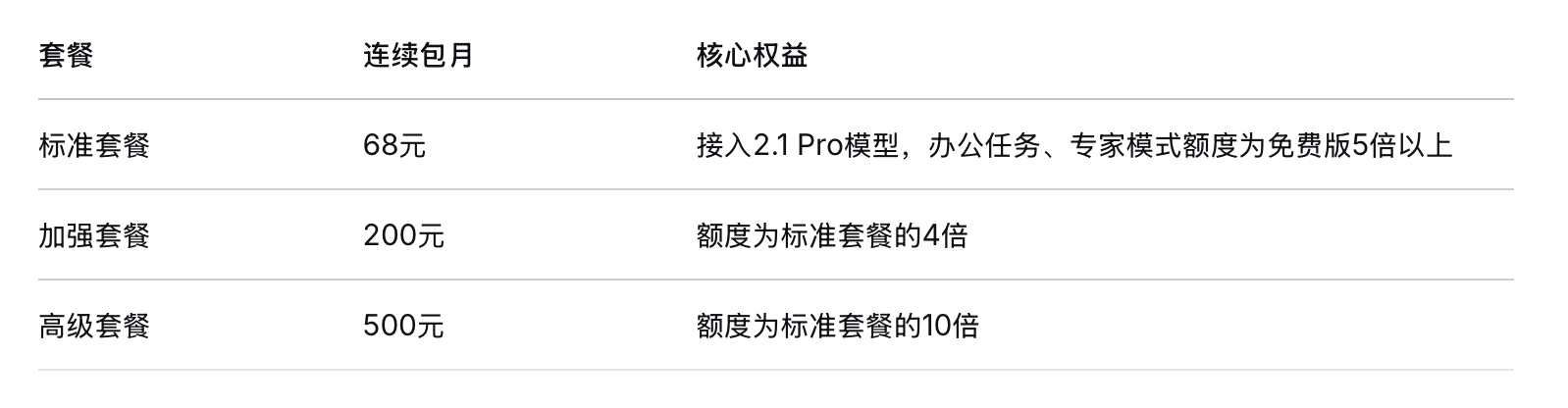
豆包专业版采用“三级阶梯定价方案:

横向对比,豆包标准版68元/月远低于ChatGPT Plus约135元/月的门槛;最高档500元/月的包年费用5088元,仅为ChatGPT Pro年费(约16295元)的三分之一。在国内,Kimi设置了四档(49元/月、99元/月、199元/月、699元/月);通义千问、腾讯元宝的C端基础功能目前仍免费。

豆包官方明确表示,免费版功能不变且将持续迭代,“对于大部分用户的日常生活场景,豆包现有的功能和额度已经可以满足使用”。

豆包选择在这个时间点推出付费服务,背后有清晰的商业逻辑。

6月23日火山引擎Force原动力大会上,火山引擎CEO谭待披露,截至2026年6月,豆包大模型日均Token调用量已突破180万亿。此前行业分析,豆包单日算力成本高达数千万元。同时,字节跳动2026年计划投入高达700亿美元用于数据中心和AI基础设施。在如此巨大的成本压力下,单纯依靠免费模式已难以为继。

但豆包的策略并非急于变现。据介绍,2026年字节“暂不拿付费渗透率当核心考核指标”,首要任务是“验证专业版的功能价值能否获得市场认可”。换句话说,付费是为了把“耗能大户”从免费池子里分离出来,单独服务、单独定价。

从产品定位看,专业版面向的是生产力场景——软件开发、数据分析、专业设计、流程自动化、金融分析、科学研究等。这些场景的Token消耗量远高于日常问答,如果继续免费,算力成本将无限放大。通过付费墙把高频、高消耗的专业用户与日常用户区隔开,既保证了免费用户的体验不受影响,也为重度用户提供了更高阶的服务能力。

当然,豆包专业版的市场接受度目前仍存在不确定性。

今年5月初,豆包在App Store页面披露付费订阅方案后,月活跃用户出现规模化增长以来的首次下跌——5月MAU降至3.3亿,环比下滑1.81%。

在专业版内测阶段,付费用户反馈的问题集中在“缺少个性化功能”“付费版与免费版差异不大”“体验不佳”等方面,故实际转化率仍有待观察。

豆包专业版的上线,对豆包自身而言,是一次从流量平台向生产力平台的转型。但如果付费用户反馈持续不佳,不仅会影响豆包自身的商业化进程,还可能拖累整个行业对“AI付费”的信心。

对竞品来说,也是喜忧参半。一方面,豆包率先建立了付费体系,抢占了用户对“AI付费”的心理账户;另一方面,豆包标准版68元/月的定价低于Kimi入门版(49元/月除外)和ChatGPT Plus,挤占竞品的定价空间。

未来几个月,专业版的实际使用体验和用户留存率,将是最值得关注的指标。

文章来源:亿邦动力

广告
微信
朋友圈

这么好看,分享一下?

朋友圈 分享

APP内打开

+1
+1
微信好友 朋友圈 新浪微博 QQ空间
关闭
收藏成功
发送
/140 0