广告
加载中

从AI工具到AI专家 京东工业发布工业AI大模型2.0

亿邦动力 2026-04-15 10:49
亿邦动力 2026/04/15 10:49

邦小白快读

EN
全文速览

京东工业发布工业AI大模型JoyIndustrial 2.0,从AI工具升级为AI专家,具备工作闭环能力,能独立完成商品、履约等核心任务。

1. AI专家主动洞察需求、参与决策、推进组织协同,提升业务效率和体验。

2. 能力布局分供给侧(AI设计与制造、AI商品与价格、AI销售与交易、AI履约与运营)和需求侧(AI驱动数智化服务,包括战略咨询、技术服务)。

3. 规划阶段:1.0 AI工具(如工品查解决采购寻源痛点),2.0 AI专家(代表性产品如AI智采管家、AI一站式设计采购专家),未来跃迁3.0 AI超脑实现全链协同。

4. 实际应用在明确场景下融合多业务环节,从需求到决策,同步提升效率。

京东工业AI大模型对品牌商有启示,涉及产品研发和用户行为观察。

1. 供给侧AI设计与制造能力支持产品研发创新,优化生产流程。

2. AI商品与价格能力有助于品牌定价和价格竞争策略,统一工业供应链语言体系。

3. 需求侧AI驱动数智化服务反映消费趋势向数字化转型,如用户需求洞察和采购变革。

4. AI专家主动决策提供用户行为观察,通过深度服务绑定客户价值。

卖家可关注AI大模型带来的增长机会和最新商业模式。

1. 增长市场在供应链效率提升,AI专家推动需求变化,如采购数智化变革带来新机会。

2. 正面影响包括业务效率同步提升,风险提示在组织协同挑战,机会提示如AI履约运营减少风险。

3. 可学习点来自应用场景:AI工具解决寻源痛点,AI专家阶段如AI智采管家提供决策辅助。

4. 最新商业模式是从AI工具到专家跃迁,合作方式在京东工业的数智化服务,如战略咨询和技术合作。

工厂受益于AI大模型在产品生产和数字化推进的启示。

1. 产品生产和设计需求由供给侧AI设计与制造能力支持,优化工业互联智造。

2. 商业机会在提升效率和降低成本,如AI商品与价格、履约运营提供标准化智能下单。

3. 推进数字化和电商启示从AI工具阶段开始,解决供应链痛点,未来跃迁AI超脑启示全链协同。

4. AI专家独立完成核心任务,帮助工厂实现自主进化和效率提升。

服务商应关注工业AI发展趋势和客户痛点解决方案。

1. 行业发展趋势是从AI工具到专家跃迁,未来3.0超脑实现生态进化,提升供应链水平。

2. 新技术如AI大模型JoyIndustrial,代表性产品AI智采管家、AI工业机器人工坊解决寻源和设计痛点。

3. 客户痛点在供应链效率和协同,解决方案包括AI能力布局:供给侧四大核心能力,需求侧数智化服务。

4. AI专家主动洞察需求和推进组织协同,提供智能化解決方案,如一站式设计采购专家。

平台商可参考京东工业AI平台的最新做法和运营管理。

1. 平台的最新做法包括AI专家阶段应用,如AI智采管家、履约大脑,实现自主决策和闭环工作。

2. 商业对平台需求和问题:平台招商机会在需求侧数智化服务合作,如战略咨询和运营增值服务。

3. 运营管理通过AI履约与运营能力优化,标准化智能化下单,规避风险如智能决策辅助。

4. 风向规避和机会提示在规划跃迁中,从工具到专家再到超脑,提升平台生态协同。

研究者可探索工业AI大模型的产业动向和商业模式启示。

1. 产业新动向是从1.0 AI工具(解决供应链痛点)到2.0 AI专家(具备闭环能力)跃迁,未来3.0 AI超脑实现全链协同。

2. 新问题涉及如何通过AI实现需求洞察到决策推进的政策法规建议,启示数智化转型支持。

3. 商业模式包括供给侧一站式工业互联智造和需求侧深度融合服务,推动采购数智化变革。

4. AI大模型构建供应链大脑,如AI需求大脑、商品大脑,根本性提升工业水平,提供研究案例。

返回默认

声明:快读内容全程由AI生成,请注意甄别信息。如您发现问题,请发送邮件至 run@ebrun.com 。

我是 品牌商 卖家 工厂 服务商 平台商 研究者 帮我再读一遍。

Quick Summary

JD Industrial has launched its industrial AI model JoyIndustrial 2.0, evolving from an AI tool to an AI expert capable of independently handling core tasks such as product selection and fulfillment.

1. The AI expert proactively identifies needs, participates in decision-making, and enhances organizational coordination to improve business efficiency and user experience.

2. Capabilities are structured into supply-side (AI design & manufacturing, product & pricing, sales & transactions, fulfillment & operations) and demand-side (AI-driven digital services, including strategic consulting and technical support).

3. Development stages: 1.0 as AI tools (e.g., Gongpincha for sourcing pain points), 2.0 as AI experts (e.g., AI Procurement Assistant and one-stop design-purchasing expert), with future 3.0 aiming for full-chain collaboration.

4. Practical applications integrate multiple business processes in clear scenarios, boosting efficiency from demand identification to decision-making.

JD Industrial's AI model offers insights for brands in product development and user behavior analysis.

1. Supply-side AI design and manufacturing capabilities support R&D innovation and production optimization.

2. AI product and pricing tools aid competitive pricing strategies and unify industrial supply chain terminology.

3. Demand-side digital services reflect shifts toward digital transformation, such as user demand insights and procurement modernization.

4. The AI expert’s proactive decision-making enables deeper customer engagement through behavioral observation and value-added services.

Sellers should note growth opportunities and emerging business models driven by AI advancements.

1. Growth lies in supply chain efficiency gains, with AI experts catalyzing procurement digitalization.

2. Benefits include synchronized efficiency improvements; risks involve organizational coordination challenges, while opportunities span AI-driven fulfillment and risk reduction.

3. Key takeaways: AI tools address sourcing pain points, while AI experts (e.g., AI Procurement Assistant) aid decision-making.

4. The shift from tools to experts enables new collaborations, such as strategic consulting and technical partnerships with JD Industrial.

Factories can leverage the AI model for production optimization and digital transformation.

1. Supply-side AI design and manufacturing capabilities enhance smart production and industrial interconnectivity.

2. Efficiency gains and cost reduction opportunities include AI-powered pricing and standardized intelligent ordering.

3. Digitalization begins with AI tools addressing supply chain pain points, evolving toward full-chain collaboration in future versions.

4. AI experts autonomously handle core tasks, enabling factories to achieve self-improvement and operational efficiency.

Service providers should monitor industrial AI trends and client pain point solutions.

1. Industry evolution spans AI tools to experts, with future 3.0 enabling ecosystem-wide supply chain upgrades.

2. New technologies like JoyIndustrial and products like AI Procurement Assistant tackle sourcing and design challenges.

3. Client pain points center on efficiency and coordination; solutions include supply-side AI capabilities and demand-side digital services.

4. AI experts offer smart solutions (e.g., one-stop design-purchasing) through proactive demand insight and organizational synergy.

Platform operators can learn from JD Industrial’s AI platform strategies and management approaches.

1. Latest practices include AI expert applications (e.g., AI Procurement Assistant, Fulfillment Brain) for autonomous decision-making and closed-loop operations.

2. Business opportunities involve demand-side digital service partnerships, such as strategic consulting and operational value-added services.

3. Operations are optimized via AI fulfillment capabilities, standardized ordering, and risk mitigation through intelligent decision support.

4. Strategic planning emphasizes transitioning from tools to experts to super-brains, enhancing platform ecosystem synergy.

Researchers can explore industrial AI model trends and business model implications.

1. Industry shifts from 1.0 AI tools (solving supply chain pains) to 2.0 AI experts (closed-loop capabilities), with 3.0 aiming for full-chain collaboration.

2. Key questions involve policy support for AI-driven demand insight and decision-making, highlighting digital transformation needs.

3. Business models integrate supply-side smart manufacturing with demand-side deep-service fusion, accelerating procurement digitalization.

4. AI models construct supply chain "brains" (e.g., demand/product brains), fundamentally upgrading industrial capabilities and offering case studies.

Disclaimer: The "Quick Summary" content is entirely generated by AI. Please exercise discretion when interpreting the information. For issues or corrections, please email run@ebrun.com .

I am a Brand Seller Factory Service Provider Marketplace Seller Researcher Read it again.

【亿邦原创】日前,京东工业公布了工业AI大模型JoyIndustrial的新进展——从1.0阶段的“AI工具”跃迁到2.0阶段的“AI专家”。AI专家具备工作闭环能力,能主动洞察需求、参与决策、推进组织协同,独立完成商品、履约、售后等核心场景任务。

京东工业于2025年发布了国内首个工业供应链垂直AI大模型JoyIndustrial,同时围绕供应链核心业务,推出系列应用智能体,将海量垂直“数据”和细分行业“场景”有机结合。

京东工业AI能力布局提现在供给侧和需求侧。

在供给侧,聚焦AI设计与制造、AI商品与价格、AI销售与交易、AI履约与运营四大核心能力,实现一站式工业互联智造、统一工业供应链”语言体系“、标准化智能化下单以及智能履约和运营自主决策。

在需求侧,京东工业正通过AI驱动的数智化服务实现与客户的深度融合与价值绑定,在包括供应链的战略咨询和规划、数智化技术服务、运营与增值服务领域,推动行业采购数智化变革。

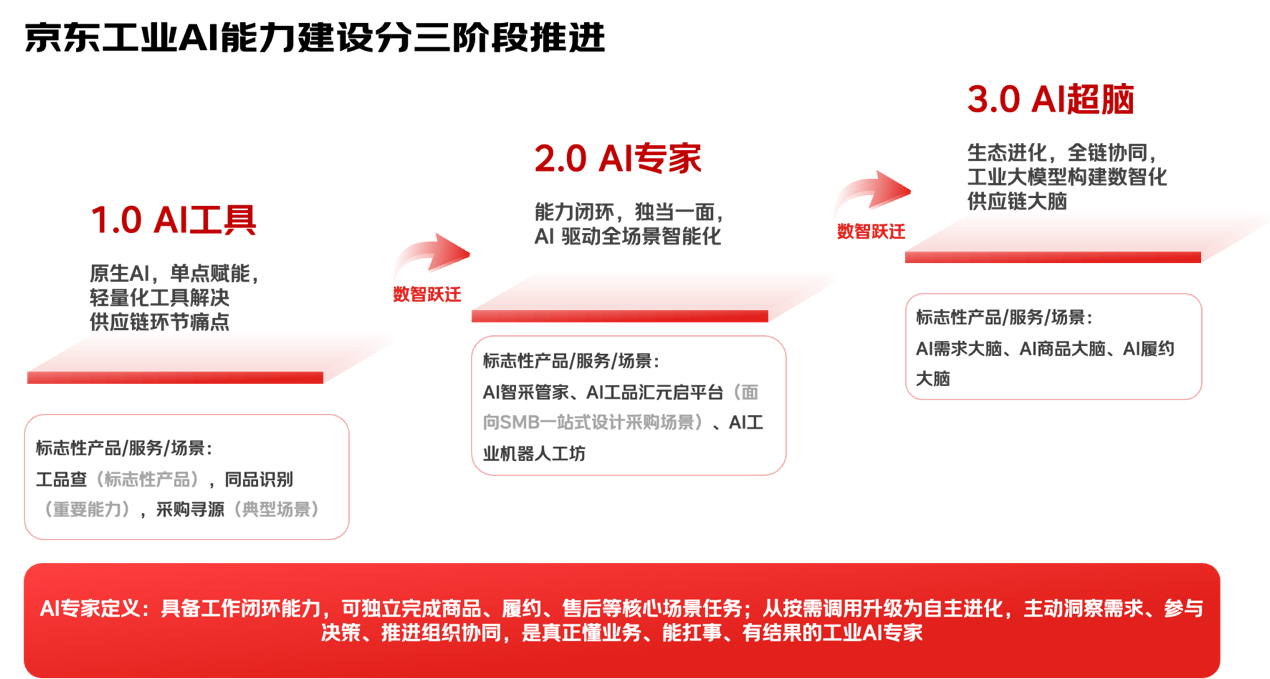
据悉,京东工业对工业AI大模型能力建设的规划是:1.0阶段AI工具,2.0阶段AI专家,3.0阶段AI超脑。

在AI工具阶段,以轻量化工具解决供应链环节痛点。例如在采购寻源场景中,“工品查”可以识别同品。

在AI专家阶段,从按需调用升级为自主进化,能主动洞察需求、参与决策、推进组织协同。

AI专家的代表性产品包括AI智采管家、AI一站式设计采购专家、AI工业机器人工坊等,它们的特色都在于在明确场景下融合多个业务环节,从需求洞察到辅助决策,更为有效地帮助业务实现效率和体验的同步提升。

京东工业技术负责人表示:“京东工业AI能力已经基本完成AI工具的建设和应用布局,在内外部业务实践中取得了扎实的成果,目前正处于向AI专家跃迁的过程中。”

未来,京东工业认为AI专家会跃迁到3.0阶段的AI超脑,即可以实现生态进化,全链协同,和工业大模型构建数智化的供应链大脑,通过AI需求大脑、AI商品大脑、AI履约大脑等产品和服务,根本性地提升工业供应链水平。

文章来源:亿邦动力

广告
微信
朋友圈

FAQ回顾

京东工业AI大模型2.0的AI专家有什么核心能力?

AI专家具备工作闭环能力,能主动洞察需求、参与决策、推进组织协同,独立完成商品、履约、售后等核心场景任务,代表产品包括AI智采管家、AI一站式设计采购专家等。

京东工业AI大模型的发展规划分为哪几个阶段?

规划分为三个阶段:1.0阶段AI工具解决单点痛点,2.0阶段AI专家实现自主决策,3.0阶段AI超脑实现生态进化和全链协同,构建数智化供应链大脑。

京东工业AI能力在供给侧具体应用在哪些方面?

供给侧聚焦AI设计与制造、AI商品与价格、AI销售与交易、AI履约与运营四大核心能力,实现一站式智造、统一供应链语言体系、智能化下单和智能履约决策。

这么好看,分享一下?

朋友圈 分享

APP内打开

赞 +1
+1
微信好友 朋友圈 新浪微博 QQ空间
关闭
收藏成功
发送
/140 0