



广告
加载中

销售额同比下降8.3%!雀巢宠物业务在亚非大区卖不动?

亿邦动力 2026-02-27 16:38
亿邦动力 2026/02/27 16:38

邦小白快读

EN
全文速览

雀巢宠物业务2025年概况:销售额下滑但盈利高企,猫粮成增长引擎,处方粮为新兴机会。

1. 销售额184亿瑞士法郎同比降2.5%,但利润率20.7%远超集团平均,宠物业务为第二大收入来源,占20%总营收。

2. 有机增长2.2%由猫湿粮和猫干粮推动,犬干粮表现疲软,全球市场份额增长主要由欧洲驱动。

3. 区域差异明显:美洲区猫湿粮领先贡献124亿销售,AOA区(含中国)受库存调整降幅达8.3%,仅占3.6%销售,欧洲稳健增长占比29.8%。

处方粮赛道潜力:雀巢押注高利润领域,瞄准未来五年增长。

1. 雀巢聚焦处方粮(如普瑞纳冠能),作为高利润增长点,针对肥胖、糖尿病等健康问题,猫湿粮占全球30%销售。

2. 投资创新策略:2025年投入101亿瑞士法郎最高优先,未来五年全球宠物护理预计4%-5%年增长,需求基于宠物视为家庭成员趋势。

3. 中国市场警示:本土品牌崛起、价格下探和消费理性化加剧竞争,雀巢转向“以消费者需求为核心”模式。

雀巢品牌策略与消费趋势:高端化和处方粮引领产品研发,消费转向情感化需求。

1. 雀巢普瑞纳品牌策略:在成熟市场利用高端化预期提供升级喂养体验和科学配方,以处方粮为核心增长点,针对宠物健康问题开发兽医产品组合。

2. 产品研发重点:猫湿粮表现强劲占销售额30%,欧洲市场猫数量超狗推动需求;处方粮高利润需投资研发与KOL宣传提升认知。

消费趋势洞察:宠物食品需求增长源于宠物家庭化,新兴市场机会显现。

1. 消费行为:多数宠物主人视宠物为家庭成员,通过食物表达爱意,猫粮需求主导全球增长。

2. 区域市场机会:美洲区猫湿粮持续增长支撑稳健表现,新兴市场商业宠物食品普及率提高,普瑞纳拓展跨渠道多价格产品。

3. 风险提示:中国市场竞争激烈源于本土品牌崛起和价格下探,消费理性化挑战跨国品牌定位。

市场机会与风险:区域表现分化,处方粮和新兴市场提供增长点,AOA挑战需应对。

1. 机会提示:美洲区销售124亿瑞士法郎占比36.1%最稳健,猫湿粮新增产能驱动增长;新兴市场在投资支持下实现双位数增长,处方粮赛道高利润可挖掘。

2. 风险规避:AOA区销售额降幅达8.3%,中国市场受库存调整和竞争加剧影响;狗粮疲软抑制主流品牌表现需调整产品线。

政策与应对措施:雀巢模式转型启示策略调整,商业模式创新。

1. 应对策略:雀巢转向“以消费者需求为核心”模式优化销售,处方粮需投资兽医学校和KOL宣传提升采用率。

2. 合作方式:普瑞纳扩大跨渠道销售网络应对新兴市场机遇,利用不同价格带产品吸引用户。

3. 扶持启示:响应全球宠物护理年增长4%-5%预测,聚焦猫粮产品以抵消风险。

生产需求与商业机会:处方粮高利润驱动研发,雀巢投资创新启示规模化生产。

1. 产品需求:处方粮领域快速增长(如肥胖、糖尿病治疗粮),普瑞纳兽医专用粮需求上升;猫湿粮产量需求大占全球30%,美洲区新增产能支持增长。

2. 商业机会:雀巢作为全球第二宠物品牌,处方粮高利润吸引投资;新兴市场普及率提高为生产扩张点,普瑞纳多价格产品组合提供机会。

启示与数字化推进:以需求驱动模式优化生产,高投入回报启示。

1. 生产启示:雀巢2025年投入101亿瑞士法郎最高优先创新,未来五年4%-5%增长预测表明生产需面向高端和处方粮;消费者需求模式转型(如中国市场)启示电商整合。

2. 机会提示:猫湿粮主导需求,地区差异如欧洲猫数量超狗,需优化配方;高利润率20.7%启示聚焦高附加值产品。

行业趋势与客户痛点:宠物护理增长稳定,处方粮解痛点,新技术研发待深化。

1. 行业趋势:全球宠物护理未来五年预计4%-5%年增长率,源于宠物视为家庭成员趋势;雀巢市场份额增长由欧洲驱动,猫湿粮需求占30%。

2. 客户痛点:狗粮疲软表现影响品牌销售,市场竞争加剧(如中国本土品牌崛起、价格下探);宠物健康问题(肥胖、肾病)需解决方案。

解决方案与投资方向:处方粮为重点策略,需求驱动模式提供启示。

1. 解决方案:雀巢处方粮组合针对营养敏感健康问题,利用研发能力开发兽医产品;投资KOL和兽医学校宣传提升处方粮认知。

2. 趋势响应:普瑞纳高端化预期提供升级喂养体验,新兴市场普及率提高需跨渠道方案;雀巢需求驱动模式启示服务优化响应消费理性化。

渠道需求与平台做法:跨渠道销售网络扩展关键,处方粮合作启示招商策略。

1. 商业需求:普瑞纳在新兴市场扩大跨渠道和跨市场销售网络应对普及率提高需求;中国市场模式转型强调以消费者为核心,需平台支持渠道优化。

2. 平台做法:雀巢投资处方粮宣传(兽医学校、KOL)需平台整合资源;区域差异如美洲稳健、AOA萎缩需风控策略。

运营管理与招商启示:多价格带产品组合吸引用户,增长预测指导方向。

1. 招商机会:处方粮高利润领域吸引合作,普瑞纳多价格产品提供切入点;猫湿粮主导需求(占30%)可优先招商。

2. 风控启示:AOA区竞争激烈源自价格下探和本土品牌,平台需规避风险聚焦高增长区如欧洲中单位数增长;全球宠物护理4%-5%预测支持平台扩张。

产业动向与商业模式:雀巢聚焦处方粮和需求驱动,政策启示聚焦投资优先。

1. 产业新动向:宠物护理成雀巢增长最快业务,预计未来五年4%-5%全球增长率;处方粮高利润快速扩张,技术研发主导(如普瑞纳兽医产品)。

2. 商业模式:雀巢转型“以消费者需求为核心”模式,替代分销驱动;优先投资咖啡、宠物护理和营养领域,创新规模化推广。

政策法规建议与启示:高投入回报预示监管方向,区域挑战需研究响应。

1. 政策启示:雀巢投资101亿瑞士法郎最高优先盈利业务,支持处方粮开发为政策建议点;全球宠物视为家庭成员趋势呼吁法规支持健康食品。

2. 研究问题:AOA区萎缩(大中华区库存调整)揭示新兴市场竞争动态;跨国品牌面临本土挑战(价格下探、消费理性化)需产业对策研究。

返回默认

声明:快读内容全程由AI生成,请注意甄别信息。如您发现问题,请发送邮件至 run@ebrun.com 。

我是 品牌商 卖家 工厂 服务商 平台商 研究者 帮我再读一遍。

Quick Summary

Nestlé's Pet Care Business in 2025: Sales declined but profitability remained high, with cat food as the growth engine and prescription diets as an emerging opportunity.

1. Sales fell 2.5% year-on-year to CHF 18.4 billion, yet the business achieved a 20.7% profit margin—significantly above the group average. It is Nestlé's second-largest revenue source, contributing 20% of total revenue.

2. Organic growth of 2.2% was driven by wet and dry cat food, while dry dog food underperformed. Global market share gains were primarily led by Europe.

3. Regional performance varied: The Americas led in wet cat food, contributing CHF 12.4 billion in sales. The AOA zone (including China) saw an 8.3% decline due to inventory adjustments, accounting for only 3.6% of sales. Europe demonstrated steady growth, contributing 29.8%.

Prescription Diet Potential: Nestlé is betting on this high-margin segment for growth over the next five years.

1. Nestlé is focusing on prescription diets (e.g., Purina Pro Plan) as a high-margin growth area, targeting health issues like obesity and diabetes. Wet cat food accounts for 30% of global sales.

2. Investment in innovation: Nestlé allocated CHF 10.1 billion in 2025 as a top priority. The global pet care market is projected to grow 4%-5% annually over the next five years, driven by the trend of pets being treated as family members.

3. China market warning: Rising local brands, price competition, and rationalized consumption are intensifying competition, prompting Nestlé to shift to a "consumer-centric" model.

Nestlé's Brand Strategy and Consumer Trends: Premiumization and prescription diets lead product development, with demand shifting toward emotional needs.

1. Purina brand strategy: In mature markets, Nestlé leverages premiumization to offer upgraded feeding experiences and scientific formulas. Prescription diets are the core growth driver, with veterinary products targeting pet health issues.

2. Product R&D focus: Wet cat food is strong, accounting for 30% of sales. In Europe, higher cat populations than dogs drive demand. High-margin prescription diets require R&D investment and KOL promotion to raise awareness.

Consumer Trend Insights: Pet food demand growth stems from the humanization of pets, revealing opportunities in emerging markets.

1. Consumer behavior: Most pet owners view pets as family members, expressing care through food. Cat food dominates global growth.

2. Regional opportunities: The Americas show steady growth in wet cat food. Emerging markets see rising commercial pet food penetration, with Purina expanding multi-price products across channels.

3. Risk alert: Intense competition in China from local brands and price pressure challenges multinational brand positioning.

Market Opportunities and Risks: Regional performance diverges; prescription diets and emerging markets offer growth, while AOA challenges require response.

1. Opportunities: The Americas contributed CHF 12.4 billion (36.1% of sales) with stable growth driven by new wet cat food capacity. Emerging markets show double-digit growth with investment support. Prescription diets offer high-margin potential.

2. Risk mitigation: AOA sales fell 8.3%, with China impacted by inventory adjustments and competition. Weak dog food performance requires product line adjustments.

Policy and Response Measures: Nestlé's shift to a consumer-centric model informs strategy adjustments and business model innovation.

1. Response strategy: Nestlé is optimizing sales via a "consumer-centric" model. Prescription diets need investment in veterinary schools and KOL promotion to boost adoption.

2. Collaboration: Purina is expanding cross-channel sales networks in emerging markets, leveraging multi-price products to attract users.

3. Support insight: Align with the 4%-5% annual global pet care growth forecast by focusing on cat products to offset risks.

Production Demand and Business Opportunities: Prescription diets' high margins drive R&D; Nestlé's innovation investment signals scalable production needs.

1. Product demand: Rapid growth in prescription diets (e.g., for obesity, diabetes) boosts demand for Purina's veterinary products. Wet cat food requires large-scale production (30% of global sales), supported by new capacity in the Americas.

2. Business opportunities: As the world's second-largest pet brand, Nestlé's high-margin prescription diets attract investment. Rising penetration in emerging markets offers expansion potential, with Purina's multi-price portfolio providing opportunities.

Insights and Digital Advancement: Demand-driven models optimize production; high investment returns highlight priorities.

1. Production insights: Nestlé's CHF 10.1 billion innovation investment in 5 signals focus on premium and prescription diets. Consumer-centric shifts (e.g., in China) suggest e-commerce integration.

2. Opportunity note: Wet cat food leads demand; regional variations (e.g., more cats than dogs in Europe) require配方 optimization. The 20.7% margin underscores focus on high-value products.

Industry Trends and Client Pain Points: Stable pet care growth, prescription diets address needs, but tech R&D requires deepening.

1. Industry trends: Global pet care is projected to grow 4%-5% annually over five years, driven by pet humanization. Nestlé's market share gains are Europe-led, with wet cat food at 30% of demand.

2. Client pain points: Weak dog food performance affects brand sales; competition intensifies (e.g., local brands in China, price pressure). Pet health issues (e.g., obesity, kidney disease) need solutions.

Solutions and Investment Direction: Prescription diets are a key strategy; demand-driven models offer insights.

1. Solutions: Nestlé's prescription portfolios target nutrition-sensitive health issues, leveraging R&D for veterinary products. KOL and veterinary school promotions raise awareness.

2. Trend response: Purina's premiumization offers upgraded experiences; emerging markets need cross-channel solutions. Nestlé's consumer-centric model guides service optimization amid rationalized consumption.

Channel Needs and Platform Strategies: Cross-channel sales network expansion is key; prescription diet collaboration informs merchant recruitment.

1. Commercial needs: Purina is expanding cross-channel networks in emerging markets to meet rising penetration. China's shift to consumer-centric models requires platform support for channel optimization.

2. Platform actions: Nestlé's prescription diet promotions (veterinary schools, KOLs) need platform resource integration. Regional differences (e.g., robust Americas, shrinking AOA) require risk control.

Operations and Merchant Insights: Multi-price product portfolios attract users; growth forecasts guide direction.

1. Merchant opportunities: High-margin prescription diets attract partnerships; Purina's multi-price products offer entry points. Wet cat food (30% of demand) is a priority for recruitment.

2. Risk insights: AOA competition from price pressure and local brands requires focusing on high-growth regions like Europe (mid-single-digit growth). The 4%-5% global growth forecast supports platform expansion.

Industry Dynamics and Business Models: Nestlé focuses on prescription diets and demand-driven approaches; policy insights highlight investment priorities.

1. Industry trends: Pet care is Nestlé's fastest-growing business, with global growth projected at 4%-5% over five years. Prescription diets are expanding rapidly, led by tech R&D (e.g., Purina veterinary products).

2. Business models: Nestlé is shifting from distribution-driven to "consumer-centric" models. Priority investments target coffee, pet care, and nutrition, with innovation scaled for推广.

Policy and Regulatory Implications: High investment returns suggest regulatory directions; regional challenges need research responses.

1. Policy insights: Nestlé's CHF 10.1 billion investment in high-profit businesses supports prescription diet development as a policy recommendation. The pet humanization trend calls for regulations supporting health foods.

2. Research questions: AOA contraction (e.g., Greater China inventory adjustments) reveals emerging market dynamics. Multinational brands face local challenges (price pressure, rational consumption), requiring industry对策 research.

Disclaimer: The "Quick Summary" content is entirely generated by AI. Please exercise discretion when interpreting the information. For issues or corrections, please email run@ebrun.com .

I am a Brand Seller Factory Service Provider Marketplace Seller Researcher Read it again.

【亿邦原创】在全球消费放缓与成本压力持续增加的背景下,雀巢旗下宠物护理业务(冠能、普瑞纳万牌和喜跃)在2025年交出了一份“降速但稳健”的成绩单。

虽然规模略有回落,但宠物业务依旧是雀巢内部最赚钱的板块之一。

01

大中华区库存调整,AOA区宠物业务负增长

财报显示,2025年雀巢宠物护理(PetCare)全年实现销售额 184.06亿瑞士法郎(约为1637.9亿人民币),较上年的188.82亿瑞士法郎,小幅下滑约2.5%;交易运营利润38.08亿瑞士法郎,利润率约20.7%,显著高于集团整体14.2%的平均水平。

雀巢表示,宠物护理业务实现了2.2%的有机增长,这得益于第四季度业绩的改善。增长主要由猫湿粮和猫干粮带动,但部分增幅被犬干粮的疲软表现所抵消。在全球范围内,该业务的市场份额有所增长,主要由欧洲大区驱动。

根据财报,2025年雀巢宠物护理业务销售额占集团总营收约20%,为集团第二大收入来源,仅次于咖啡。盈利能力上,宠物护理业务20%以上的利润率,明显高于乳制品、糖果及等传统板块。雀巢方面称,“我们的咖啡和宠物护理业务是全球增长引擎。”

值得一提的是,在所有业务板块中,雀巢在宠物护理业务投入最多: 101.73亿瑞士法郎,远高于其他板块。

分地区来看,宠物护理业务在整个美洲区表现稳健,是该大区最核心的支柱业务。其2025 年销售额高达124.33亿瑞士法郎,占大区总销售额的 36.1%。

其中,美国的猫湿粮表现领先。在经历了大半年供应受限的影响后,第四季度新增产能的投放助力了增长。需要注意的是,在美洲地区,猫湿粮品类持续保持增长态势;而狗粮市场表现疲软,影响了主流品牌及零食业务。

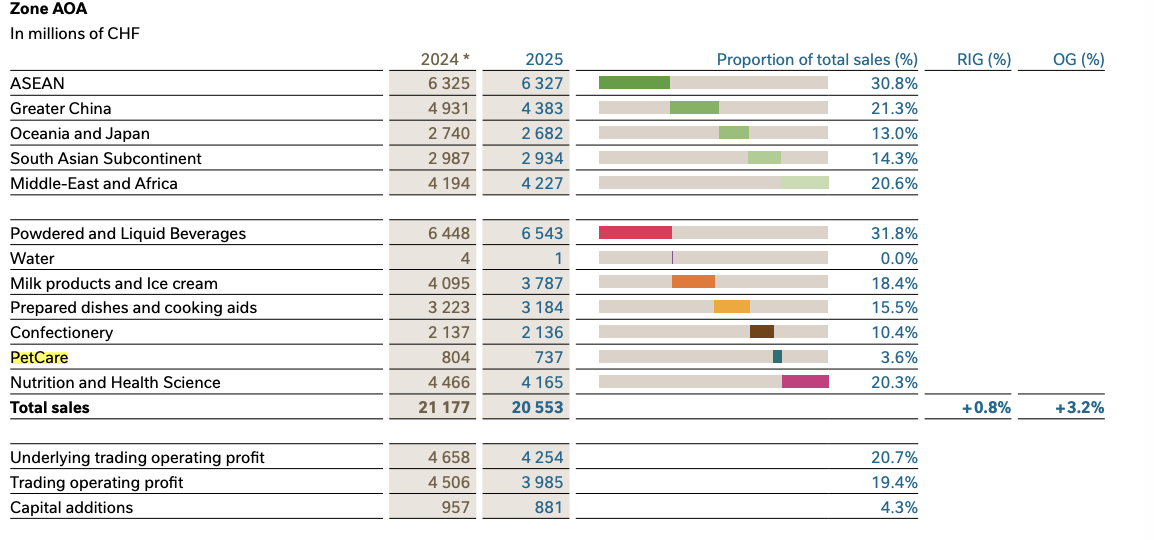
包括中国市场在内的亚洲、大洋洲及非洲大区 (Zone AOA),宠物护理属于边缘业务。2025年销售额仅为7.37亿瑞士法郎,仅占总销售额的3.6%。相比去年的8.04亿瑞士法郎下降不少,呈现萎缩态势。

雀巢指出,这主要受大中华区的库存调整以及发达市场品类疲软的影响。但在战略投资增加的支持下,其他新兴市场实现了强劲的双位数增长。

过去一年里,雀巢在中国市场持续推进业务模式调整,从以分销渠道驱动的增长模式转向“以消费者需求为核心”的模式。当然,这也影响了包括宠物业务在内的销售数字。

此外,中国市场的本土宠物品牌加速崛起、价格带下探,以及消费趋于理性,都让诸如雀巢一样的跨国品牌面临更激烈的竞争。

在欧洲大区,宠物护理也是第一大业务板块,占比达29.8%,紧随其后的是粉末与液体饮料 (29.4%)。不仅如此,宠物护理业务也在该大区实现了中单位数增长。

02

看好高利润、高增长的处方粮赛道

根据2025年年度报告,雀巢表示,正致力于通过更大胆的投资与创新,推动以实际内部增长(RIG)为核心的有机销售增长。“我们优先投资于那些具备强劲增长潜力和极具吸引力的回报曲线,且我们已处于领先地位或具备获胜优势的业务。在这些领域中,具有前景的创新举措将被迅速规模化推广。”

在2025年,雀巢重点锁定的三个领域是:咖啡、宠物护理以及营养与健康。

“宠物护理是雀巢全球增长最快的业务之一,预计全球宠物数量在未来五年将持续增长。整个品类在2025年至2027年间的增长率预计为 4%–5%。”雀巢指出,大多数宠物主人将他们的宠物描述为家庭成员,并越来越多地寻找向这些毛茸茸的朋友表达爱意的方式,而食物正是其中的重要组成部分。

目前,雀巢旗下的普瑞纳(Purina)已经是北美的市场领导者,在全球排名第二。

在成熟市场,普瑞纳正利用消费者对高端化的预期,提供升级的喂养体验和基于科学的饮食配方。

在新兴市场,商业宠物食品的普及率正在提高,普瑞纳将继续扩大跨渠道和跨市场的销售网络,其产品组合通过不同价格区间的多样化产品提供不同切入点。

此外,雀巢还指出,处方粮 (Therapeutic Food)是一个高利润且快速增长的领域。

雀巢正利用领先的研发能力进一步开发由兽医开具的产品组合,作为其针对营养敏感性健康状况的整体治疗方案的一部分。

比如,普瑞纳冠能(Purina Pro Plan)兽医专用粮产品有利于多种健康问题(肥胖和糖尿病,以及胃肠道、泌尿系统、肾脏、肝脏和皮肤问题)。

而为了驱动增长,雀巢正在投资对兽医学校和KOL关键意见领袖的宣传,以提高对这些治疗性产品的认知度和采用率。

值得注意的是,现在猫湿粮约占普瑞纳全球销售额的 30%。比如在欧洲许多市场,猫作为最受欢迎的宠物,其数量超过了狗。

亿邦持续追踪报道该情报,如想了解更多与本文相关信息,请扫码关注作者微信。

文章来源:亿邦动力

广告
微信
朋友圈

这么好看,分享一下?

朋友圈 分享

APP内打开

+1
+1
微信好友 朋友圈 新浪微博 QQ空间
关闭
收藏成功
发送
/140 0