广告
加载中

航天新商务:打通采财壁垒 构建业财协同生态

亿邦智库 2026-10-09 10:19
亿邦智库 2026/10/09 10:19

邦小白快读

EN
全文速览

这篇文章介绍了航天新商务公司如何通过数字化手段解决央企采购与财务协同的痛点,其中包含不少可供借鉴的实操信息。

1. 核心模式:航天新商务打造“采购+财金”协同新模式,实现“交易即结算、结算即入账”的闭环,将原本割裂的采购、结算、入账流程变为自动化流水线,大幅减少人工干预。

2. 代理支付机制:采购单位与航天新商务签订合作协议,并委托航天财务公司代为扣款,省去预付款和借还款手续,不设采购额度上限,提升资金周转效率。这一机制自2020年3月正式运行,已有90多家采购单位签约。

3. 实际效率提升:资金效率提升45%,运营成本降低15万人工时/年,交易全流程100%可追溯,供应商回款周期显著缩短。

4. 差旅平台带来便利:eCASC平台打通出差申请、预订、结算、核销全流程,推行“一证通行、免垫免报”,三年来减少职工个人垫资超9亿元,累计免贴票248万余张,平均票价低于同类平台百余元。

5. 风险预警功能:采购平台上线风险预警,通过大数据分析提示交易风险,防范供应商违标、串标行为,让采购更阳光透明。

面向品牌商,这篇文章的价值在于展示央企采购电商的品牌建设和渠道运营经验,以及消费端用户行为的变化。

1. 品牌建设:航天电子超市以“制度先行、技术驱动、品牌引领”为主线运营,2025年采购额达18亿元,同年获评“2025年度中央企业最具影响力采购电商品牌”,说明在央企采购领域,合规、透明和数字化能力是品牌影响力的重要支撑。

2. 渠道模式:通过代理支付和业财一体化的闭环生态,品牌商可以观察到央企采购渠道正在从传统的分散采购转向集中化、平台化、数字化。平台打通财务系统后,供应商回款周期缩短,渠道合作黏性增强。

3. 产品研发与消费趋势:差旅平台eCASC汇聚酒店资源超5万家,平均票价低于同类平台百余元,显示集中采购与数据打通能显著提升议价能力和服务效率。商业航天元器件电子商城上线半年交易额超3000万元,说明垂直领域元器件采购正在形成新的线上渠道。

4. 用户行为观察:平台强调“用数据说话、用模型决策、用体系管理”,暗示采购决策越来越依赖数据分析和模型,而非个人经验。职工端“一证通行、免垫免报”的设计也反映用户对便捷、零垫资体验的强烈需求。

5. 供应链协同:品牌商应关注“交易即结算”带来的现金流改善,这有助于增强供应商合作意愿,形成更稳定的供应链关系。

对卖家而言,这篇文章揭示了央企采购市场的政策变化、增长机会和风险点,值得仔细研究。

1. 政策与模式变化:航天电子超市推行财务公司代理支付结算模式,替换传统预付款和借还款流程,取消额度上限,这意味着卖家可以更高效地获得回款,减少资金占用。卖家应了解签约和结算规则,积极对接平台。

2. 增长市场:商业航天元器件电子商城于2025年上线,下半年累计交易额突破3000万元,已初步打通设计、采购到供应链的链路。这为元器件供应商提供了进入航天供应链的新渠道。

3. 差旅与劳保市场:差旅平台eCASC覆盖因公出行,三年减少职工垫资超9亿元,酒店资源超5万家,说明差旅服务商有较大合作空间;同时航天电子超市作为办公用品和生产保障物资集中采购平台,2025年采购额达18亿元,相关品类卖家应关注入驻机会。

4. 风险提示:平台上线采购和招标风险预警功能,利用大数据分析防范供应商违标、串标行为。卖家需严守合规底线,避免因数据留痕带来的违规风险。

5. 合作方式:平台提供电子招标询价采购系统、电子竞价平台等多元化交易方式,卖家可结合自身产品特点选择竞价或询价模式参与,并关注拍卖与再生资源交易平台的业务机会。

6. 可学习点:平台强调“用数据说话、用模型决策、用体系管理”,卖家也应重视数据化运营,提升自身数字化能力,适应央企采购的透明化趋势。

工厂类读者可以从这篇文章中找到产品生产与设计的需求信号,以及拥抱数字化供应链的启示。

1. 产品需求方向:航天电子超市集中采购办公用品和生产保障物资,2025年采购额达18亿元。生产这类物资的工厂应关注平台的品类需求和准入标准,争取进入央企采购目录。

2. 差旅与劳保产品机会:差旅平台eCASC覆盖大量酒店和出行服务,相关劳保、出行用品及服务的生产商可研究如何接入该生态,借助集中采购扩大订单。

3. 闲置资产处理与再利用:航天再生资源交易平台常态化开展拍卖业务,面向集团各级单位及社会主体提供服务。工厂若有多余设备或再生资源,可通过该平台处置;同时也可关注平台发布的再生资源需求,开发循环利用产品。

4. 数字化和电商启示:文章展示了“交易即结算、结算即入账”的业财协同模式,说明供应链上下游的数据打通已成为趋势。工厂应加快自身信息化系统建设,与采购平台实现数据对接,才能获得更快的结算效率和更多合作机会。

5. 商业航天元器件需求:商业航天元器件电子商城上线半年交易额破3000万元,为元器件生产工厂提供了直接面向集团级客户的线上销售渠道,工厂可关注其品类和采购方式,调整生产计划。

6. 技术驱动生产:平台依托微服务架构、RPA和智能合约技术实现自动结算,工厂应关注这些技术如何提升交易安全与效率,并在自身供应链管理中借鉴。

服务商关注的是行业趋势、技术应用和客户痛点,这篇文章提供了航天新商务作为数字化采购服务方的完整案例。

1. 行业趋势:央企数字化转型向纵深推进,采购与财务协同成为降本增效新蓝海。“采购+财金”模式正从串联流程变为并联自动化流水线,服务商应把握业财一体化方向。

2. 客户痛点:传统模式下采购单位账期管理被动、供应商回款周期长、财务部门人工对账工作量大。这些痛点推动了代理支付、自动结算和凭证自动生成等服务的需求。

3. 技术方案:航天新商务依托微服务架构和分布式数据库构建高并发业财中台,同时引入RPA与智能合约技术提升自动化与安全性。这为服务商提供了技术选型和架构设计的参考。

4. 解决方案落地:文章描述的四大模块矩阵(电子招标询价、差旅平台、电子超市、电子竞价)展示了从采购、差旅到资产处置的全场景数字化解决方案,服务商可学习如何将平台能力模块化并形成协同生态。

5. 风险管控增值服务:平台上线采购和招标风险预警功能,通过大数据分析防范违标、串标,服务商可考虑在数字化采购方案中加入风控模块,增强竞争力。

6. 效果量化:案例给出了资金效率提升45%、运营成本降低15万人工时/年、交易100%可追溯等数据,服务商在对外输出方案时应注重用类似可量化指标说明价值。

平台商关注商业对平台的需求、平台最新做法和运营管理,这篇文章提供了航天新商务的平台建设运营经验。

1. 平台定位与模式:航天新商务是中国航天科技集团下属市场服务公共平台,承担航天电子采购平台建设与运营,打造“采购+财金”协同模式,形成“交易即结算、结算即入账”的闭环生态。这为平台商展示了如何围绕核心交易场景延伸财务管理能力。

2. 平台最新做法:代理支付机制通过“集团委托”方式,让财务公司从采购单位账户代扣款,省去预付款和借还款流程,不设采购额度上限。平台商可借鉴这种与金融机构协同的支付模式。

3. 模块矩阵运营:平台形成电子招标询价采购系统、差旅平台eCASC、航天电子超市、电子竞价平台四大模块。每个模块对应不同场景,但共享底层数据和风控能力。平台商可参考这种多模块协同架构来扩大服务范围。

4. 招商与供给端管理:差旅平台汇聚酒店资源超5万家,电子超市2025年采购额达18亿元,说明平台需要通过覆盖更多供应商来提升供给多样性。平台商应重视供给端招商和资质审核。

5. 运营管理:平台采用“用数据说话、用模型决策、用体系管理”的原则,上线风险预警功能防范违标串标,确保交易阳光透明。这提醒平台商应将合规和风控作为平台运营的核心基础设施。

6. 风险规避:交易全流程100%可追溯,依托微服务架构和分布式数据库保障高并发和准确对账。平台商在自建或升级平台时应重视数据一致性与系统稳定性,避免资金和合规风险。

研究者可以从这篇文章提炼央企数字化转型、业财协同模式、采购电商平台等产业新动向与政策启示。

1. 产业新动向:央企数字化转型从单一系统建设转向采购与财务的协同生态,文章提出“采购+财金”供应链协同新模式,代表业财一体化在央企采购领域的最新实践。

2. 制度创新与政策机制:代理支付模式源于集团公司多部门联合下发的《关于集团公司办公类产品集中采购平台切换及结算模式变更的通知》,体现了通过集团层面制度设计推动业务变革的路径。研究者可关注这种顶层驱动型改革如何落地。

3. 商业模式分析:航天新商务以“交易即结算、结算即入账”为目标,重构采购、结算、入账流程,形成业务流、资金流、信息流“三流合一”的闭环。其四大模块矩阵(电子招标、差旅、超市、竞价)展示了央企平台如何通过多场景覆盖实现规模效应。

4. 技术应用研究:文章提及微服务架构、分布式数据库、RPA、智能合约等技术在业财协同中台中的应用,为研究数字技术如何赋能传统采购结算流程提供了案例素材。

5. 效率与治理效果:数据显示资金效率提升45%,运营成本降低15万人工时/年,交易全流程100%可追溯。研究者可利用这些数据评估业财协同的实际绩效和治理价值。

6. 政策与法规建议启示:案例中风险预警功能防范违标、串标,拍卖业务严格依法依规组织,商业航天元器件商城等新赛道快速落地,提示政策制定者应鼓励央企平台在统一制度框架下探索市场化服务创新,同时强化数据治理和合规监管。

返回默认

声明:快读内容全程由AI生成,请注意甄别信息。如您发现问题,请发送邮件至 run@ebrun.com 。

我是 品牌商 卖家 工厂 服务商 平台商 研究者 帮我再读一遍。

Quick Summary

This article explains how Aerospace New Commerce uses digital tools to resolve pain points in central state-owned enterprise (SOE) procurement and financial coordination, offering practical takeaways.

1. Core model: It builds a new 'procurement + finance' coordination model that creates a closed loop from transaction to settlement and from settlement to accounting. The previously separate processes of procurement, settlement and bookkeeping become an automated pipeline, greatly reducing manual intervention.

2. Agency payment mechanism: Procurement units sign cooperation agreements with Aerospace New Commerce and authorize the Aerospace Finance Company to deduct payments on their behalf, eliminating prepayment and borrowing-repayment procedures, placing no limit on procurement amounts, and improving capital turnover. This mechanism has been running since March 2020, with more than 90 procurement units signed up.

3. Efficiency gains: Capital efficiency is up 45%, operating costs are down by 150,000 labor-hours per year, the entire transaction process is 100% traceable, and supplier payment cycles are significantly shorter.

4. Travel platform convenience: The eCASC platform connects the full chain of business trip application, booking, settlement and expense verification, enabling one-pass travel with no personal advances and no reimbursement claims. Over three years, it has cut employee out-of-pocket advances by more than RMB 900 million, eliminated more than 2.48 million paper receipts, and achieved average ticket prices more than 100 yuan lower than comparable platforms.

5. Risk alert function: The procurement platform has launched risk alerts that use big-data analytics to flag transaction risks, helping prevent supplier non-compliance and bid-rigging and making procurement more open and transparent.

For brands, this article demonstrates the experience of a central SOE in building a procurement e-commerce brand and managing channels, as well as changes in end-user behavior.

1. Brand building: The Aerospace E-Supermarket is run on the principles of institutions first, technology-driven progress and brand leadership. It reached RMB 1.8 billion in procurement in 2025 and was named the Most Influential Central SOE Procurement E-commerce Brand of 2025. This shows that compliance, transparency and digital capability are key pillars of brand influence in central SOE procurement.

2. Channel model: Through agency payment and the integrated finance-business ecosystem, brands can see central SOE procurement channels shifting from traditional decentralized procurement to centralized, platform-based and digital channels. Once financial systems are connected, supplier payment cycles shorten and channel cooperation becomes stickier.

3. Product development and consumption trends: The eCASC travel platform aggregates more than 50,000 hotels and offers average ticket prices more than 100 yuan lower than comparable platforms, showing that centralized procurement and data integration can significantly enhance bargaining power and service efficiency. The Commercial Aerospace Components E-Mall exceeded RMB 30 million in transactions within six months of launch, indicating that vertical component procurement is forming new online channels.

4. User behavior observations: The platform stresses letting data speak, making decisions with models, and managing through systems, implying that procurement decisions rely increasingly on data analytics and models rather than personal experience. The employee-facing design of one-pass travel with no advances and no reimbursement also reflects strong user demand for convenience and zero out-of-pocket costs.

5. Supply chain coordination: Brands should pay attention to the cash-flow improvements brought by the transaction-to-settlement model, which can strengthen suppliers' willingness to cooperate and form more stable supply chain relationships.

For sellers, this article reveals policy changes, growth opportunities and risk points in the central SOE procurement market, and is worth careful study.

1. Policy and model changes: The Aerospace E-Supermarket has adopted a finance-company agency payment and settlement model, replacing traditional prepayment and borrowing-repayment processes and removing purchase amount caps. This means sellers can receive payments more efficiently and reduce capital tie-up. Sellers should understand the contract and settlement rules and actively connect with the platform.

2. Growth market: The Commercial Aerospace Components E-Mall launched in 2025, and its cumulative transactions surpassed RMB 30 million in the second half of the year, initially connecting design, procurement and the supply chain. This gives component suppliers a new channel into the aerospace supply chain.

3. Travel and labor-protection market: The eCASC travel platform, which covers business travel, has reduced employee advances by more than RMB 900 million over three years and aggregated more than 50,000 hotels, indicating substantial room for travel service providers to cooperate. At the same time, the Aerospace E-Supermarket, as a centralized platform for office supplies and production-support goods, reached RMB 1.8 billion in procurement in 2025; sellers in relevant categories should watch for onboarding opportunities.

4. Risk alert: The platform has launched procurement and bidding risk alerts that use big-data analytics to prevent suppliers from violating bid requirements or colluding in tenders. Sellers must keep compliance as a bottom line and avoid the risk of violations created by data trails.

5. Ways to cooperate: The platform offers diversified transaction methods such as electronic tendering/inquiry and e-bidding. Sellers can choose bidding or inquiry modes based on product characteristics and also watch for opportunities in auctions and the recycled-resources trading platform.

6. Learning point: The platform emphasizes letting data speak, making decisions with models, and managing through systems. Sellers should also focus on data-driven operations and improve their digital capability to align with the growing transparency of central SOE procurement.

Factory readers can find signals on product production and design demand in this article, along with lessons for embracing digital supply chains.

1. Product demand direction: The Aerospace E-Supermarket centralizes procurement of office supplies and production-support materials, with procurement volume reaching RMB 1.8 billion in 2025. Factories that produce such goods should monitor the platform's category demand and access standards and aim to enter central SOE procurement catalogs.

2. Travel and labor-protection product opportunities: The eCASC travel platform covers a large number of hotels and travel services. Manufacturers of related labor-protection and travel-use products can study how to plug into this ecosystem and expand orders through centralized procurement.

3. Idle asset disposal and reuse: The Aerospace Recycled-Resources Trading Platform regularly runs auctions and serves group units at all levels as well as external parties. Factories with surplus equipment or recyclable resources can dispose of them through this platform; they can also track the platform's demand for recycled resources and develop circular-use products.

4. Digital and e-commerce implications: The article presents a business-finance coordination model of transaction-to-settlement and settlement-to-accounting, showing that data connectivity across the supply chain has become a trend. Factories should accelerate information system construction and connect with procurement platforms' data to gain faster settlement and more cooperation opportunities.

5. Commercial aerospace component demand: The Commercial Aerospace Components E-Mall exceeded RMB 30 million in transactions within six months of launch, providing component factories with a direct online sales channel to group-level customers. Factories can follow its categories and procurement methods and adjust production plans accordingly.

6. Technology-driven production: The platform relies on microservices architecture, RPA and smart contracts to achieve automated settlement. Factories should track how these technologies improve transaction security and efficiency and apply similar ideas to their own supply chain management.

Service providers focus on industry trends, technology applications and customer pain points; this article offers a complete case study of Aerospace New Commerce as a digital procurement service provider.

1. Industry trend: Central SOE digital transformation is advancing in depth, and procurement-finance coordination has become a new blue ocean for reducing costs and improving efficiency. The procurement-plus-finance model is evolving from a serial process to a parallel automated pipeline, so service providers should grasp the direction of finance-business integration.

2. Customer pain points: In traditional models, procurement units are passive in managing payment terms, suppliers face long payment cycles, and finance departments carry heavy manual reconciliation workloads. These pain points are driving demand for agency payment, automated settlement and automated voucher generation.

3. Technology approach: Aerospace New Commerce builds a high-concurrency finance-business middle platform using microservices architecture and distributed databases, and introduces RPA and smart contracts to improve automation and security. This gives service providers a reference for technology selection and architecture design.

4. Solution implementation: The article describes a four-module matrix—electronic tendering/inquiry, travel platform, e-supermarket and e-bidding—that demonstrates a full-scenario digital solution from procurement and travel to asset disposal. Service providers can learn how to modularize platform capabilities and form a collaborative ecosystem.

5. Risk-control value-added service: The platform has launched risk alerts for procurement and bidding, using big-data analytics to prevent non-compliance and bid-rigging. Service providers should consider embedding risk-control modules into digital procurement offerings to strengthen competitiveness.

6. Quantified outcomes: The case cites metrics such as a 45% increase in capital efficiency, a reduction of 150,000 labor-hours per year in operating costs, and 100% transaction traceability. When marketing solutions, service providers should demonstrate value with similar quantifiable indicators.

Platform operators care about business needs for platforms, the latest practices and operations management; this article provides Aerospace New Commerce's experience in platform building and operation.

1. Platform positioning and model: Aerospace New Commerce is a market-service public platform under China Aerospace Science and Technology Corporation, responsible for building and operating the aerospace e-procurement platform. It has created a procurement-plus-finance coordination model that forms a closed-loop ecosystem where transaction leads to settlement and settlement leads to accounting. This offers platform operators a case in extending financial management capabilities around core trading scenarios.

2. Latest practices: The agency-payment mechanism uses a group-delegation approach in which the finance company deducts payments directly from procurement units' accounts, eliminating prepayment and borrowing-repayment procedures and setting no procurement amount cap. Platform operators can borrow this payment model that works in coordination with financial institutions.

3. Module matrix operation: The platform has built four major modules: an electronic tendering/inquiry system, the eCASC travel platform, the Aerospace E-Supermarket, and an e-bidding platform. Each module targets a different scenario, but all share underlying data and risk-control capabilities. Platform operators may use this multi-module collaborative architecture to expand service scope.

4. Supplier recruitment and supply-side management: The travel platform aggregates more than 50,000 hotels, and the e-supermarket saw RMB 1.8 billion in procurement in 2025, indicating that platforms need to cover more suppliers to improve supply diversity. Platform operators should emphasize supplier recruitment and qualification review.

5. Operations management: The platform follows the principle of letting data speak, making decisions with models, and managing through systems, and has launched risk alerts to prevent bid-rigging and ensure transparent transactions. This reminds platform operators that compliance and risk control are core infrastructure of platform operations.

6. Risk avoidance: The fully traceable transaction process, supported by microservices architecture and distributed databases, ensures high concurrency and accurate reconciliation. When building or upgrading platforms, platform operators should focus on data consistency and system stability to avoid capital and compliance risks.

Researchers can derive insights on central SOE digital transformation, business-finance coordination models, procurement e-commerce platforms and policy implications from this article.

1. New industrial trend: The digital transformation of central SOEs is moving from single-system construction to a procurement-finance ecosystem. The article's procurement-plus-finance supply-chain coordination model represents the latest practice of finance-business integration in central SOE procurement.

2. Institutional innovation and policy mechanisms: The agency-payment model originated from a group-level notice jointly issued by multiple departments on switching the group's centralized procurement platform for office products and changing the settlement model. This reflects a path of driving business reform through institutional design at the group level. Researchers can pay attention to how such top-down reforms are implemented.

3. Business model analysis: Aerospace New Commerce aims to achieve transaction-settlement and settlement-accounting, reconstructing procurement, settlement and bookkeeping processes into a closed loop that unifies business flow, capital flow and information flow. Its four-module matrix—electronic tendering, travel, e-supermarket and e-bidding—shows how central SOE platforms achieve scale effects through multi-scenario coverage.

4. Technology application research: The article discusses the use of microservices architecture, distributed databases, RPA and smart contracts in the finance-business coordination middle platform, providing case material for research into how digital technologies empower traditional procurement and settlement processes.

5. Efficiency and governance outcomes: Data show a 45% improvement in capital efficiency, a reduction of 150,000 labor-hours per year in operating costs, and 100% transaction traceability. Researchers can use these metrics to assess the actual performance and governance value of business-finance coordination.

6. Implications for policy and regulation: In this case, risk alerts prevent bid-rigging, auction operations are organized in strict accordance with laws and regulations, and new tracks such as the commercial aerospace components e-mall are being launched quickly. This suggests that policymakers should encourage central SOE platforms to explore market-based service innovation within a unified institutional framework while strengthening data governance and compliance oversight.

Disclaimer: The "Quick Summary" content is entirely generated by AI. Please exercise discretion when interpreting the information. For issues or corrections, please email run@ebrun.com .

I am a Brand Seller Factory Service Provider Marketplace Seller Researcher Read it again.

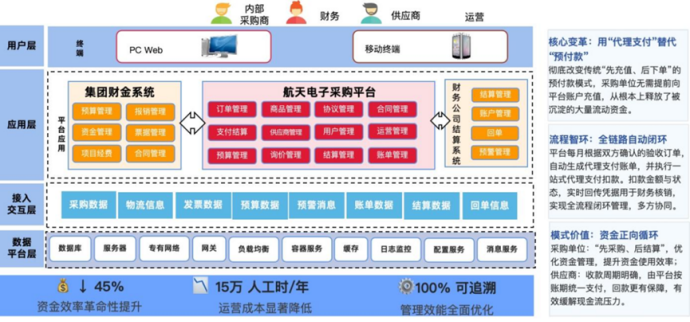
【亿邦原创】在央企数字化转型向纵深推进的背景下,采购与财务两大领域的“协同作战”正在成为降本增效的新蓝海。传统采购模式中,采购订单、收货确认、发票校验、资金支付分属不同系统与部门,流程割裂、数据孤岛、结算滞后长期困扰着采购单位与供应商:采购单位账期管理被动,供应商回款周期拉长,财务部门则被大量人工对账、票据审核和核算凭证工作缠身。航天新商务信息科技有限公司(以下简称航天新商务)于2011年12月组建,作为中国航天科技集团有限公司下属市场服务公共平台(https://www.ispacechina.com/),承担航天电子采购平台的建设与运营工作,打造 “采购 + 财金” 供应链协同新模式,依托数字能力重塑业财逻辑,构建 “交易即结算、结算即入账” 的业财一体化闭环生态,为央企破解采购与财务协同痛点提供航天模式。

代理支付机制重塑结算流程

长期以来,采购结算环节是业财协同的“堵点”。在传统模式下,采购单位需要先向供应商预付款项,再办理繁琐的借还款手续,资金占用周期长;财务部门则要逐笔人工核对订单、入库单与发票,工作量大且易错。早在2019年11月,根据集团公司财务金融部、安全保障部、质量技术部联合下发的《关于集团公司办公类产品集中采购平台切换及结算模式变更的通知》,航天电子超市财务公司代理支付结算模式正式启动[1]。

这一机制的核心是“集团委托”:采购单位与航天新商务公司签订《航天电子超市采购长期合作协议》,并与航天财务公司签署《航天财务公司代理支付委托书》,由航天财务公司从采购单位指定账户代为扣款。2020年3月20日,随着航天投资控股有限公司等12家首批签约单位完成第一次扣款,代理支付结算新模式在全集团正式运行。截至当时,航天电子超市已与五院、七院、八院、长城工业、航投、航科等90多家采购单位完成签约[1]。

与传统预付款方式相比,代理支付结算模式不设置采购额度上限,省去了各采购单位繁琐的借款、还款程序,大幅降低人力成本、提升采购效率,加快了资金周转时效,成为集团公司推进业财融合的成功典范[1]。在此基础上,航天新商务进一步打通采购平台与财务系统、银行系统的数据接口,实现业务数据向财务凭证的自动转换:采购订单完成履约验收后,系统自动触发结算指令,通过代理支付通道完成资金划转,并同步生成财务入账凭证,全程无需人工干预。原本串联的业财流程由此重构为并联的自动化流水线,实现业务流、资金流、信息流的“三流合一”。

技术底座方面,航天新商务依托微服务架构与分布式数据库,构建起高并发、高可用的业财协同中台,确保海量交易数据的实时处理与准确对账;同时引入RPA(机器人流程自动化)与智能合约技术,进一步提升结算环节的自动化水平与安全性。采购平台还上线了采购和招标风险预警功能,通过平台大数据分析提供交易预警及风险提示,有效防范供应商违标、串标行为,为采购全流程阳光透明构建起数字化屏障[2]。

四大模块矩阵释放规模效应

围绕“交易即结算、结算即入账”的闭环目标,航天新商务持续拓展平台功能边界,形成电子招标询价采购系统、劳保差旅平台(eCASC)、航天电子超市、电子竞价平台四大模块协同的数字化采购矩阵[2]。

航天电子超市是集团公司指定的办公用品和生产保障物资集中采购平台。自2017年开始设计开发以来,航天新商务以“制度先行、技术驱动、品牌引领”为主线,秉持"用数据说话、用模型决策、用体系管理"的原则运营。2025年,电子超市采购额达18亿元,同年10月,航天电子超市获评“2025年度中央企业最具影响力采购电商品牌”[3]。

差旅平台eCASC打通了因公出行的“最后一公里”。平台前端与钉钉、飞书、翎信等系统打通销假环节,后端与财务核算报销系统数据互通,构建出差申请、行程预订、对公结算、自动核销全线上闭环。平台推行“一证通行、免垫免报”服务,三年来减少职工个人垫资超9亿元,累计免贴票248万余张;同时汇聚酒店资源突破5万家,平均票价低于同类平台百余元[2][4]。

电子竞价平台让闲置资产变废为宝。2020年疫情期间,针对企业闲置物资处置痛点,航天新商务快速推进系统建设,仅用三四个月完成电子竞价系统立项、建模、开发与上线应用。自2025年 7月起,公司依托航天再生资源交易平台常态化开展拍卖业务,严格依法依规组织交易,着力打造航天特色拍卖服务品牌,面向集团各级单位及社会主体提供高标准的拍卖与再生资源交易服务,推动资源优化配置。作为中国航天科技集团授权的市场服务公共平台、航天电子采购平台唯一建设运营主体,航天新商务自2011年成立以来,深耕数智化采购、再生资源交易、互联网营销等领域,推动技术创新与业务创新深度融合,培育航天电子采购平台、航天再生资源交易平台等数字化服务品牌,为各类企业提供高效合规、专业优质的全生命周期供应链服务 [5]。

面向商业航天与元器件采购新赛道,航天新商务于2025年上线商业航天元器件电子商城,下半年商城累计交易额突破3000万元,凭借全品类覆盖、在线化流程和一站式服务,快速获得集团各级单位认可,初步打通从设计、采购到供应的协同链路,成为集团商业航天及民用元器件采购领域的关键支撑平台[6]。

业财协同生态的构建,带来了实实在在的效率变革:资金效率提升45%,大幅缩短供应商回款周期,增强供应链上下游协同粘性;运营成本降低15万人工时/年,释放财务人员从繁琐核算向价值创造转型;交易全流程100%可追溯,有效防范资金风险与合规风险[2]。

站在新起点,航天新商务公司以“数字赋能航天制造、智慧构建产业互联”为使命,持续深化业财一体化与数智化采购建设。面向未来,平台将从“问题导向”转向“远景导向”,围绕航天强国建设使命和集团高质量发展目标,为集团各企业、广大供应商和职工用户提供更高效、更透明、更协同的供应链服务,为央企构建现代供应链体系、打造“采购+财金”协同生态贡献航天经验。

信息来源

[1] 航天电子采购平台官网:《航天电子超市代理支付结算模式正式上线且首批签约单位扣款成功》https://www.ispacechina.com/zxdt/ptzx/4823.htm

[2] 中国航天科技集团有限公司官网:《航天科技集团长城公司所属航天新商务公司10周年发展纪实》http://m.spacechina.com/n2014789/n2014809/c3400727/content.html

[3] 中国航天科技集团有限公司官网:《航天科技集团长城公司电子超市获评2025年度中央企业最具影响力采购电商品牌》https://www.spacechina.com/n25/n2014789/n2014809/c4460471/content.html

[4] 中国航天科技集团有限公司官网:《航天科技集团长城公司航天新商务迭代差旅平台 提供优质服务》https://www.spacechina.com/n25/n2014789/n2014809/c4693381/content.html

[5] 中国航天科技集团有限公司官网:《航天科技集团长城公司航天新商务公司将依托航天再生资源交易平台组织开展拍卖活动》https://www.spacechina.com/n25/n2014789/n2014809/c4372801/content.html

[6] 中国航天科技集团有限公司官网:《航天科技集团长城公司航天新商务运营商业航天元器件电子商城累计交易额突破3000万元》https://www.spacechina.com/n25/n2014789/n2014809/c4510515/content.html

亿邦智库持续关注央国企数字化采购领域的最新进展,如想了解更多与本文相关信息,请扫码关注作者微信或发送邮箱。联系邮箱:zhangjing@ebrun.com


本文首发于 亿邦动力 官方网站

文章来源:亿邦动力

广告
微信
朋友圈

FAQ回顾

航天新商务信息科技有限公司是做什么的?

航天新商务信息科技有限公司成立于2011年12月,是中国航天科技集团下属的市场服务公共平台,承担航天电子采购平台的建设与运营。公司打造“采购+财金”供应链协同新模式,通过代理支付、数字化采购等手段构建“交易即结算、结算即入账”的业财一体化闭环生态,为央企提供全生命周期供应链服务。

航天电子采购平台包含哪些业务模块?

航天电子采购平台由航天新商务建设运营,主要包括电子招标询价采购系统、劳保差旅平台(eCASC)、航天电子超市、电子竞价平台四大模块。其中航天电子超市2025年采购额达18亿元,差旅平台汇聚酒店资源超5万家,已形成覆盖采购、差旅、闲置资产处置的数字化采购矩阵。

央企采购业财一体化模式如何解决业财协同痛点?

航天新商务推出的代理支付机制让财务公司从采购单位指定账户代为扣款,省去借款还款程序;同时打通采购平台与财务、银行系统接口,实现业务数据自动转化为财务凭证。该模式使资金效率提升45%、运营成本降低15万人工时/年,交易全流程100%可追溯,有效缩短供应商回款周期。

航天财务公司代理支付结算模式是什么?

这是航天新商务2019年11月启动的结算模式,采购单位与航天新商务签订合作协议,并与航天财务公司签署代理支付委托书,由财务公司从指定账户代扣款项。2020年3月20日首批12家签约单位完成首次扣款后正式运行,该模式不设采购额度上限,已与90多家采购单位完成签约,大幅提升采购效率和资金周转时效。

商业航天元器件电子商城对元器件采购有什么作用?

商业航天元器件电子商城是航天新商务2025年上线的元器件线上采购平台,凭借全品类覆盖、在线化流程和一站式服务获得集团各级单位认可,下半年累计交易额突破3000万元,初步打通从设计、采购到供应的协同链路,成为集团商业航天及民用元器件采购领域的关键支撑平台。

这么好看,分享一下?

朋友圈 分享

APP内打开

赞 +1
+1
微信好友 朋友圈 新浪微博 QQ空间
关闭
收藏成功
发送
/140 0