广告
加载中

千问办公国际版公测 阿里AI的全球战争才刚刚开始

亿邦动力胡镤心 2026-08-26 16:07
亿邦动力胡镤心 2026/08/26 16:07

邦小白快读

EN
全文速览

本文核心是公布阿里千问办公国际版开启公测的消息,梳理了阿里AI出海的整体布局,核心干货信息如下:

1.产品实操信息:8月26日千问办公国际版正式开启公测,距离国内版公测仅过去三周,海外个人和企业用户可通过国际官网qwenwork.ai体验,目前已有网页版和PC客户端。产品整合了三个AI智能体平台的核心能力,是开箱即用的一站式AI生产力平台,第三方评测综合得分超过Anthropic和OpenAI的同类产品,性能不输海外头部产品且成本更低,目前已经支持中英文,可通过Google账号和邮箱注册。

2.整体布局信息:阿里已经完成全球32个地域、105个可用区的算力网络布局,计划投入800亿港元加强全栈AI能力建设,后续还将推出更多AI出海产品,阿里AI的全球竞争才刚刚启动。

本文对出海布局AI相关业务的品牌商,提供了市场分析和竞争策略参考,干货如下:

1.市场格局与消费趋势:当前全球AI办公是增量市场,虽由巨头主导但格局未定型,微软依托生态已经触达85%的财富500强企业,付费席位超1500万,OpenAI的全球月活市场份额已经从年初超50%下滑至46.4%,亚洲、中东、拉美等新兴区域AI办公需求旺盛但供给不足,存在较大市场机会。

2.可参考的经营策略:千问办公的差异化路径值得借鉴,产品研发层面整合多平台核心能力打造一站式产品,定价层面主打高性价比切入价格敏感市场,渠道层面提前接入海外主流协作平台,市场选择层面聚焦供给不足的新兴区域,同时做好语言、账号体系的本地化适配,能快速在巨头垄断的市场建立立足点。

本文透露了全球AI办公领域的最新机会和可参考的布局经验,干货如下:

1.市场机会提示:当前全球AI办公属于增量市场,巨头主导但格局未定型,亚洲、中东、拉丁美洲等新兴区域AI办公需求旺盛但本土供给不足,属于尚未被充分挖掘的蓝海市场,存在明显的切入机会。

2.可学习的竞争与应对经验:面对欧美巨头的生态优势,卖家可走差异化路线,主打高性价比产品切入价格敏感型市场,避开头部巨头的核心红海赛道;同时要提前做好本地化适配,对接当地主流的生态平台,适应当地用户的使用习惯。

3.风险提示:欧美核心市场已经被谷歌、微软、OpenAI等巨头凭借生态卡位,新进入者盲目切入会面临极高的竞争风险,需优先选择空白市场占位。

本文对想要对接AI出海浪潮的工厂,提供了不少方向和启示,干货如下:

1.商业机会层面:当前全球AI办公市场增量空间大,中国AI品牌正密集出海,从算力基础设施到终端AI产品,都有大量的配套需求,工厂可围绕出海AI企业的需求布局配套业务,挖掘新的增长曲线,尤其是亚洲、中东等新兴市场的相关需求增长快,可提前布局对接。

2.数字化转型启示:AI已经成为全球科技领域的核心竞争力,工厂需要加快推进数字化和AI化升级,依托AI提升生产和设计效率,才能适配AI品牌出海的个性化配套需求,提升自身的竞争力。

3.出海拓展启示:如果工厂想要自主出海拓展,需要参考千问的策略,优先切入供给不足的新兴市场,主打差异化性价比优势,同时做好本地化适配,更容易打开市场。

本文对服务AI领域的服务商,透露了行业趋势和客户痛点,干货如下:

1.行业发展趋势:当前全球AI办公市场处于高速增长的增量阶段,整体格局尚未定型,已经形成多极竞争态势,美国巨头占据欧美核心市场的模型和入口卡位,中国玩家正依托性价比和开源优势出海,新兴市场存在大量未被满足的需求,给服务商带来了新的增长空间。

2.核心客户痛点:新兴市场的企业和个人用户,对高性价比的AI办公产品需求旺盛,但本土缺乏成熟的AI办公产品供给,同时用户需要开箱即用的一站式解决方案,不想分散对接多个AI工具,现有供给无法满足这类需求。

3.可参考的解决方案:可以依托整合后的全栈AI能力,打造高性价比的一站式AI生产力平台,针对新兴市场做好本地化适配,接入当地主流协作生态,就能快速满足用户需求,打开市场。

本文对布局全球AI业务的平台商,提供了布局参考和风险提示,干货如下:

1.市场需求总结:当前全球企业对AI办公生产力的需求快速增长,新兴市场的需求缺口较大,用户需要适配本土使用习惯、能够对接主流生态的一站式AI平台,现有巨头的覆盖重点在欧美市场,新兴市场的需求尚未被满足。

2.可参考的平台布局做法:需要提前布局全球算力基础设施,搭建覆盖多区域的算力节点网络,为上层产品提供支撑;针对不同区域做本地化适配,支持多语言、本土主流账号体系,接入当地常用协作工具;构建从模型到平台再到终端产品的完整矩阵,有序推出产品逐步抢占市场。

3.风向规避提示:欧美主流市场已经被头部巨头凭借生态优势卡位,新进入平台不要盲目切入,要优先选择需求未被满足的新兴市场,走差异化竞争路线,降低竞争风险。

本文记录了全球AI竞赛的最新产业动向,对相关领域研究提供了不少干货,内容如下:

1.产业最新动向:当前全球AI竞赛已经形成多极竞争格局,美国科技巨头在模型层和欧美企业入口卡位,中国AI玩家已经完成出海布局准备,开始凭借性价比和开源优势切入全球AI办公市场,阿里已经搭建完成从全球算力网络到模型、平台、终端产品的完整AI出海矩阵,千问办公国际版是阿里第一个面向海外企业用户的AI产品,标志着中国AI正式开启全球市场竞争。

2.竞争格局新变化:当前全球AI办公依然是增量市场,虽然巨头占据先发优势,但格局并未定型,市场份额处于动态变化中,OpenAI的市场份额已经出现明显下滑,新玩家依然有充足的切入空间。

3.新商业模式总结:中国AI玩家开辟了新的竞争路径,差异化定位新兴市场,主打高性价比+一站式整合,依托全栈技术能力控制成本,打开价格敏感型市场的空间,这一新模式值得深入研究。

返回默认

声明:快读内容全程由AI生成,请注意甄别信息。如您发现问题,请发送邮件至 run@ebrun.com 。

我是 品牌商 卖家 工厂 服务商 平台商 研究者 帮我再读一遍。

Quick Summary

This article announces the public beta launch of the international version of Alibaba's Qwen Office and outlines Alibaba's overall AI global expansion layout. Key takeaways are as follows:

1. Product details: The public beta of Qwen Work AI officially launched on August 26, just three weeks after the domestic beta release. Individual and enterprise users worldwide can access the service via the official global website qwenwork.ai, which currently offers a web version and a PC client. Integrating core capabilities from three AI agent platforms, Qwen Work AI is an out-of-the-box, all-in-one AI productivity platform. Third-party evaluations rank its overall performance above similar products from Anthropic and OpenAI: it matches the performance of leading overseas products while offering lower costs. It currently supports both Chinese and English, and allows registration via Google accounts or email addresses.

2. Overall expansion layout: Alibaba has already completed the construction of a computing power network covering 32 global regions and 105 availability zones. It plans to invest HK$80 billion to strengthen its full-stack AI capabilities, and will launch more AI products for global markets. The global competition of Alibaba's AI business is just getting started.

This article provides market analysis and competitive strategy references for brands expanding AI-powered business globally. Key insights include:

1. Market landscape and consumer trends: The global AI office market is currently a growing incremental space, dominated by large tech players but yet to reach a stable structure. Microsoft, leveraging its ecosystem, has reached 85% of Fortune 500 companies with over 15 million paid seats. OpenAI's global monthly active user market share has dropped from over 50% at the start of the year to 46.4%. Emerging regions including Asia, the Middle East and Latin America see strong demand for AI office tools but lack sufficient local supply, creating significant market opportunities.

2. Actionable business strategies: Qwen Office's differentiated approach offers a useful reference. On the product development side, it integrates core capabilities from multiple platforms to build an all-in-one solution. On pricing, it positions itself as a high-cost-performance option to capture price-sensitive markets. On distribution, it integrated early with mainstream overseas collaboration platforms. On market selection, it focuses on under-served emerging regions while completing localization for language and account systems – a strategy that allows new players to quickly establish a foothold in a market dominated by giants.

This article shares the latest opportunities and actionable expansion experience in the global AI office sector. Key takeaways are as follows:

1. Market opportunity alerts: The global AI office market is currently a growing incremental space dominated by large players but with an unsettled landscape. Emerging regions including Asia, the Middle East and Latin America have strong unmet demand for AI office tools with insufficient local supply, making this a largely untapped blue ocean market with clear entry opportunities.

2. Actionable competitive insights: Against the ecosystem advantages of U.S. and European giants, sellers can adopt a differentiated strategy: focus on cost-competitive products to enter price-sensitive markets, and avoid the red-hot core segments dominated by leading giants. At the same time, complete localization early and integrate with local mainstream ecosystem platforms to align with local user habits.

3. Risk warnings: Core markets in the U.S. and Europe are already locked up by giants such as Google, Microsoft and OpenAI through their ecosystem advantages. New entrants face extremely high competition risk if they enter blindly, and should prioritize securing positions in untapped markets first.

This article provides direction and insights for factories looking to tap into the AI global expansion wave. Key takeaways are as follows:

1. Business opportunities: The global AI office market offers large incremental space, and Chinese AI brands are currently expanding overseas in waves. This creates massive supporting demand ranging from computing infrastructure to end-user AI products. Factories can develop supporting businesses tailored to the needs of global AI firms to unlock new growth curves. Demand in emerging regions such as Asia and the Middle East is growing particularly fast, so factories can make early layout and connections to capture these opportunities.

2. Digital transformation insights: AI has become core competitiveness in the global tech industry. Factories need to accelerate digital and AI-powered upgrades, and use AI to improve production and design efficiency. This allows factories to meet the customized supporting requirements of global AI brands and enhance their own competitiveness.

3. Self-directed global expansion insights: For factories looking to expand overseas independently, following Qwen's strategy works well: prioritize entry into under-served emerging markets, focus on differentiated cost-performance advantages, and complete full localization. This approach makes it far easier to open up new markets.

This article shares industry trends and core customer pain points for service providers serving the AI sector. Key insights are as follows:

1. Industry development trends: The global AI office market is currently in a high-growth incremental stage, with an overall landscape that has not yet stabilized and a multi-polar competitive structure taking shape. U.S. giants hold model and entry positions in core U.S. and European markets, while Chinese players are expanding globally relying on their cost-performance and open-source advantages. Large unmet demand in emerging markets has created new growth space for service providers.

2. Core customer pain points: Enterprises and individual users in emerging markets have strong demand for cost-effective AI office products, but lack mature local AI office supply. At the same time, users want an out-of-the-box all-in-one solution instead of integrating multiple separate AI tools, and existing supply cannot meet this demand.

3. Recommended solutions: Service providers can leverage integrated full-stack AI capabilities to build a cost-effective all-in-one AI productivity platform, complete localization for emerging markets, and integrate with local mainstream collaboration ecosystems. This approach allows them to quickly meet user demand and open up the market.

This article provides expansion references and risk warnings for platform operators building global AI businesses. Key insights are as follows:

1. Market demand overview: Global enterprise demand for AI office productivity is growing rapidly, with a large unmet demand gap in emerging markets. Users need all-in-one AI platforms adapted to local usage habits and compatible with mainstream local ecosystems. Current giants focus primarily on U.S. and European markets, leaving emerging market demand unaddressed.

2. Recommended platform expansion practices: Platforms should build global computing infrastructure early, deploy a network of computing nodes covering multiple regions to support upper-layer products. Complete localization for different regions, supporting multi-language settings and local mainstream account systems, and integrating with common local collaboration tools. Build a complete product matrix ranging from models to platforms and end products, and launch offerings in an orderly manner to capture market share step by step.

3. Risk mitigation guidance: Core U.S. and European markets are already locked in by leading giants via their ecosystem advantages. New entrants should not enter blindly; instead, they should prioritize unmet demand in emerging markets and adopt a differentiated competitive strategy to reduce competition risk.

This article documents the latest industry developments in the global AI race, and offers valuable insights for researchers in related fields. Key content is as follows:

1. Latest industry developments: The global AI race has formed a multi-polar competitive structure. U.S. tech giants hold dominant positions at the model layer and in enterprise access across North America and Europe. Chinese AI players have completed preparation for global expansion and have begun entering the global AI office market relying on their cost-performance and open-source advantages. Alibaba has already built a complete AI global expansion matrix spanning global computing networks, models, platforms and end products. The international version of Qwen Office is Alibaba's first AI product targeting overseas enterprise users, marking the official start of Chinese AI's entry into global market competition.

2. New changes in competitive landscape: The global AI office market remains an incremental growth space. While giants hold a first-mover advantage, the market structure is not yet finalized and market shares remain in flux. OpenAI's market share has already seen a notable decline, leaving sufficient entry space for new players.

3. Summary of a new business model: Chinese AI players have developed a new competitive path: differentiate by targeting emerging markets, focus on high cost-performance combined with all-in-one integration, and leverage full-stack technical capabilities to control costs to open up the price-sensitive market. This new model warrants in-depth research.

Disclaimer: The "Quick Summary" content is entirely generated by AI. Please exercise discretion when interpreting the information. For issues or corrections, please email run@ebrun.com .

I am a Brand Seller Factory Service Provider Marketplace Seller Researcher Read it again.

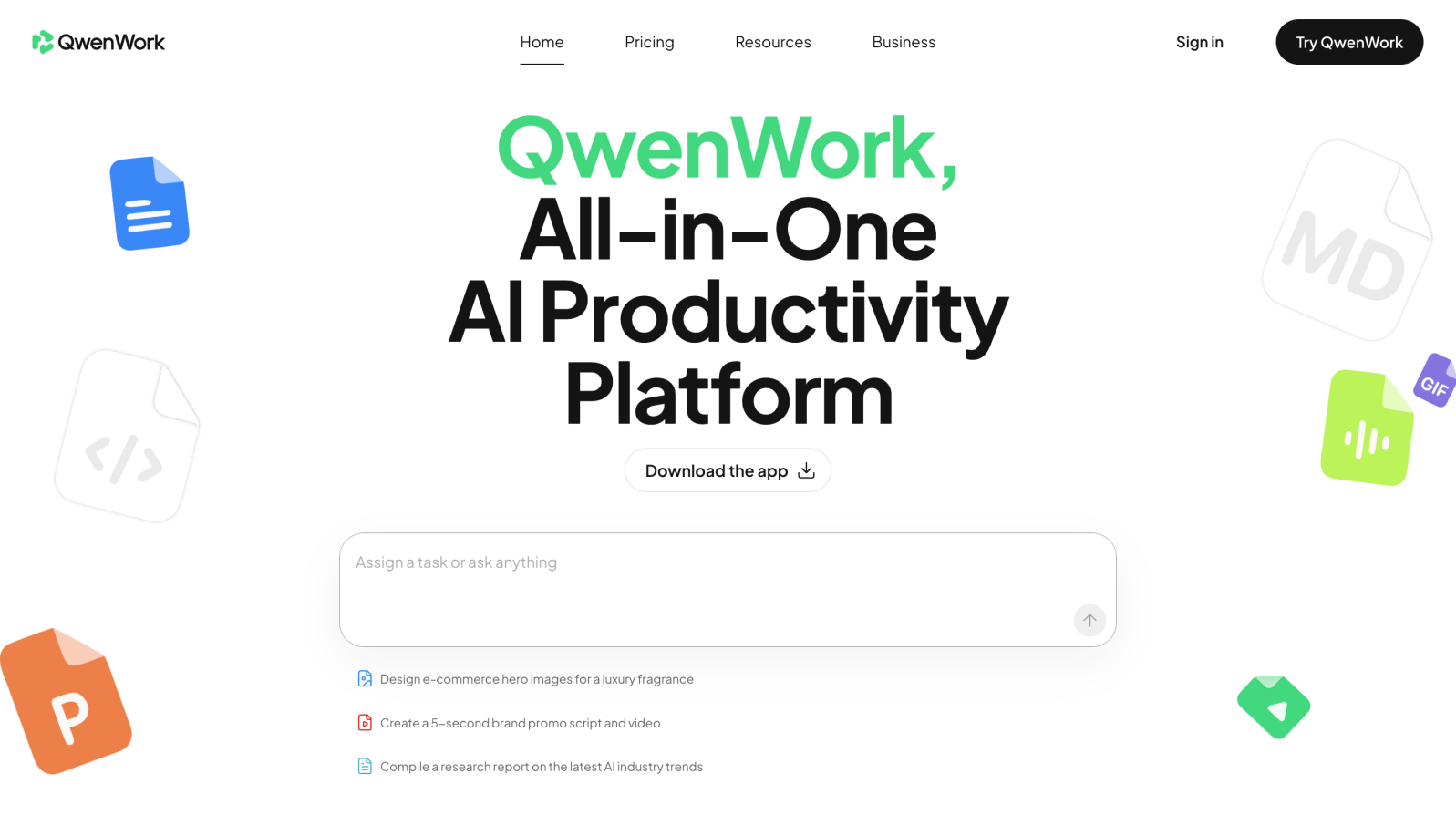
【亿邦原创】8月26日,阿里巴巴旗下Agent产品“千问办公”国际版(QwenWork)正式开启公测,目前网页版和PC客户端已开放。

这一动作距离国内版8月3日公测刚过去三周。

1、千问办公国际版,打响冲锋第一枪

千问办公国际版即将进入的是一个有巨头主导、但格局远未定型的增量市场。

在AI冲击下,海外办公市场也在发生巨变,OpenAI和Anthropic争相瓜分企业办公场景。Tensor Tower数据显示,截至2026年5月,ChatGPT的全球月活用户市场份额已从年初的超50%降至46.4%;Google Gemini凭借与Workspace的生态整合攀升至27.7%;Anthropic Claude凭借在编程、长上下文等生产力场景中的口碑,达到了10.3%。此外,Microsoft 365 Copilot依托Windows和Office生态,触达了85%的财富500强企业,付费席位已超1500万。

千问办公国际版也有自己的差异化策略,它依托阿里全栈AI能力整合出的高性价比Harness方案,试图在一些对价格更敏感、且缺乏本土强大AI办公产品的地区,建立一个差异化的立足点。

在市场选择上,千问办公国际版聚焦亚洲、中东及拉丁美洲等高增长地区,瞄准了AI办公需求旺盛但供给可能不足的市场。

在产品上,千问办公国际版主打高性价比与整合后的Harness能力,整合了QoderWork、MuleRun及悟空三个AI智能体平台的核心能力,提供一款开箱即用的一站式AI生产力平台。杰富瑞(Jefferies)评测结果显示,在五项真实办公任务中,千问办公综合得分95分,超过Anthropic Claude Cowork(94分)和OpenAI Codex(92分),且在所有测评维度均获90分以上。报告特别指出,其能力优势部分得益于Harness(工程框架)的出色表现,这为其提供了“性能不差但成本更低”的竞争资本。

国际版产品目前已经接入Slack、Notion等海外协作与生产力平台,未来还将全面连接企业真实的数据库和工作流。

面向海外市场,千问办公国际版围绕语言、账号与生态进行了本地化适配。产品现已支持中英文,即将拓展西班牙语、葡萄牙语、日语、韩语等更多语言。用户可通过Google账号和邮箱注册,并接入阿里云国际账号体系。

未来还将持续引入更多适配海外场景的Skills和协作工具,围绕全球企业的真实办公场景推出更多产品能力。

2、阿里AI的全球战场

在AI的全球竞赛中,各方都在各显神通——OpenAI和Anthropic在模型层激烈争夺,Google和微软凭借生态优势卡位企业入口,中国玩家则在开源模型和性价比上建立优势。

技术浪潮打过来的时候,没人能站着不动,阿里要的不是不掉队,而是借这波浪潮往上再搏一搏。

2026年5月26日,阿里云在新加坡举办首届“千问大会2026”,正式推出海外版AI产品平台Qwen Cloud,一个专门为Agent设计的云产品。

2026年6月,阿里云在法国巴黎VivaTech大会上宣布法国巴黎、马来西亚柔佛地域正式开服,同时扩建日本东京和墨西哥的数据中心。本轮扩张完成后,阿里云全球布局达到32个地域、105个可用区。这是阿里530亿美元AI基础设施承诺的一部分。2026年8月23日,阿里公告拟配售800亿港元新股,所得款项净额将100%用于投资全栈AI能力,加强AI基础设施建设。

在千问办公国际版之后,QwenApp也在赶来的路上。

从布局上看,阿里已经在全球建了32个节点、105个可用区的算力网络,完成了从模型到平台到产品的出海矩阵搭建。千问办公国际版只是这个矩阵中,第一个面向海外企业用户的产品出口。

阿里AI的全球战事,才刚刚开始。

本文首发于 亿邦动力 官方网站

文章来源:亿邦动力

广告
微信
朋友圈

FAQ回顾

千问办公国际版是什么?

千问办公国际版是阿里巴巴旗下Agent类AI产品,2026年8月26日正式开启公测,海外个人和企业用户可通过国际官网qwenwork.ai体验,网页版、PC客户端已开放,主打高性价比,是一站式AI生产力平台。

千问办公国际版有哪些竞争优势?

千问办公国际版依托阿里全栈AI能力的高性价比Harness方案,杰富瑞评测显示其五项真实办公任务综合得分95分,超过Anthropic Claude Cowork和OpenAI Codex,性能出色成本更低,已适配海外生态,聚焦亚非拉等高增长区域。

当前全球AI办公市场格局是怎样的?

截至2026年5月,ChatGPT全球月活用户市场份额为46.4%,Google Gemini占27.7%,Anthropic Claude占10.3%,Microsoft 365 Copilot已触达85%的财富500强企业,付费席位超1500万,整体格局尚未定型仍有较大增量空间。

阿里巴巴在全球AI领域有哪些布局?

阿里已建成覆盖全球32个地域、105个可用区的算力网络,2026年先后推出海外AI产品平台Qwen Cloud、开启千问办公国际版公测,还拟配售800亿港元新股,所得资金100%投入全栈AI能力及基础设施建设。

这么好看,分享一下?

朋友圈 分享

APP内打开

赞 +1
+1
微信好友 朋友圈 新浪微博 QQ空间
关闭
收藏成功
发送
/140 0