广告
加载中

有棵树更名“行云科技”:董事会内斗告终 行云王维全面主导公司重整

王昱 2026-01-29 18:37
王昱 2026/01/29 18:37

邦小白快读

EN
全文速览

公司更名与控制权变化

1. 有棵树更名为行云科技,自2月11日起生效,证券代码保持不变,股价上涨至7.26元/股,总市值67.42亿元,近一年累计上涨近60%,市盈率达91.76。

2. 此次更名标志着王维领导的深圳市天行云供应链有限公司(行云集团)新管理团队全面接管100天后,完成公司控制权与方向切换,王维持股18%,肖四清持股降至3.28%。

业绩表现与实操进展

1. 2025年前三季度营业收入5895.67万元,同比暴跌82.02%,净利润亏损1385.28万元;第三季度单季收入1638.33万元,下降83.59%,亏损1572.98万元,降幅高达5169.86%。

2. 管理团队完成对26家子公司公章、营业执照的控制,并签署四方协议实缴1亿元资金支持业务拓展;但部分子公司未交接,涉及资产6470.76万元,并卷入1亿元仲裁案件。

历史教训与未来展望

1. 公司历史亏损超40亿元,2024年扭亏后第三季度又转亏;粗放模式如多平台铺货导致库存积压和合规压力,最终2024年被退市风险警示和法院重整。

2. 新团队接管后,治理冲突结束,但业务修复和战略转型面临挑战,需时间检验。

品牌服务与渠道建设

1. 行云集团作为全球商品B2B服务平台,提供品牌服务,包括出海服务、渠道服务和分销体系,服务近3000个国内外消费品牌,覆盖近15万SKU的数字供应链。

2. 品牌渠道建设体现在全球仓储网络,持有170个仓库总面积130万平方米,为中小零售商提供高效支持,助力品牌拓展国际市场。

消费趋势与用户行为启示

1. 跨境电商趋势变化:市场竞争加剧和平台规则趋严导致毛利压缩,从有棵树案例可见,品牌需关注精细化运营而非粗放铺货。

2. 用户行为观察:服务于50万中小零售商,反映数字化需求上升;重整后行云科技可能强化品牌合作,为品牌商提供新机遇。

商业机会与风险

1. 机会:行云集团的重整带来品牌合作可能,如供应链整合提升服务效率;资本布局如借壳上市AMEX或港股IPO传闻,可能吸引更多品牌投资。

2. 风险:公司业绩下滑和仲裁案件提示品牌商需关注合作伙伴财务稳定性,避免类似危机影响品牌声誉。

政策解读与风险提示

1. 退市风险警示和法院重整政策:2024年因无力偿债被裁定重整,天行云作为产业投资人介入,股权结构改变,卖家可借鉴规避类似风险。

2. 风险提示:业绩持续亏损(如第三季度亏损5169.86%)、仲裁案件金额1亿元,提示卖家应对物流拖欠和合规问题。

增长市场与机会

1. 消费需求变化:行云集团服务全球零售商,反映跨境电商机会;新管理团队资金支持业务拓展,卖家可学习其重整策略抓住增长点。

2. 可学习点:从有棵树粗放模式失败(多平台铺货致亏损)转向精细化运营,卖家应关注供应链优化和成本控制。

事件应对与商业模式

1. 控制权冲突事件应对:新团队通过临时股东大会成功接管,卖家可学习治理优化;最新商业模式如行云集团B2B服务体系,提供合作机会。

2. 扶持政策与机会提示:公司实缴1亿元资金用于业务拓展,为卖家带来潜在合作;重整后可能开放招商,卖家可关注新管理动向。

产品生产与商业机会

1. 行云集团数字供应链服务覆盖15万SKU,涉及电子产品、户外装备等品类,工厂可通过其B2B平台寻找合作机会,服务近50万中小零售商。

2. 商业机会体现在全球仓储网络(170仓库、130万平方米),工厂可融入供应链体系,提升产品分销效率。

推进数字化启示

1. 从有棵树案例启示:粗放生产模式导致库存积压和亏损,工厂应推进数字化如实时库存管理;行云科技重整强调数字化供应链重要性。

2. 电商应用:行云集团体系提供物流和出海服务,工厂可借鉴其电商整合经验,优化产品设计和生产流程以降低成本。

风险与机遇

1. 行业风险提示:公司业绩下滑和仲裁案件显示供应链中断可能,工厂需确保合作伙伴稳定性;重整进展如子公司控制完成带来新机遇。

行业发展趋势

1. 跨境电商整合趋势:行云集团收购有棵树并重整,反映行业洗牌和B2B服务崛起;数字供应链成为新方向,覆盖近15万SKU。

2. 全球化趋势:服务50万零售商和3000品牌,显示国际扩张需求;仓储物流网络(170仓库)凸显行业数字化升级。

新技术与客户痛点

1. 客户痛点:从有棵树案例可见库存积压、合规压力(如平台规则趋严致毛利压缩)和现金流紧张;这些痛点普遍存在服务对象。

2. 解决方案:行云集团提供出海、品牌和物流服务,作为综合体系;其数字供应链技术可帮助服务商开发类似工具应对痛点。

机遇与挑战

1. 服务机遇:公司重整后业务拓展资金1亿元,带来合作空间;赴美上市计划(如借壳CHEB)可能刺激新技术投资。

2. 挑战:业绩压力和仲裁案件提示服务商需关注风险管理;行业动向如控制权冲突教育服务商优化治理服务。

平台需求与问题

1. 商业对平台需求:文章提到平台规则趋严导致卖家毛利压缩(如有棵树案例),平台商需平衡规则以支持卖家增长。

2. 问题:跨境电商平台环境竞争加剧,卖家多账号铺货模式不可持续,平台商应加强风控如规避类似业绩下滑风险。

平台最新做法与运营管理

1. 平台招商启示:行云集团服务50万零售商,平台商可学习其渠道管理;新管理团队实缴资金支持业务,提示平台加强扶持政策。

2. 运营管理:公司治理冲突(如财报延期)影响平台稳定,平台商需优化运营规避类似干扰;重整后行云科技资产交接完成,提供运营优化案例。

风向规避与机会

1. 风险规避:业绩暴跌和仲裁案件(1亿元)提示平台商监控卖家财务健康;退市风险警示显示政策合规重要性。

2. 机会:资本布局如行云集团借壳上市,平台商可借鉴;B2B服务模式兴起,平台可探索类似合作方式。

产业新动向与新问题

1. 新动向:跨境电商重整案例(如天行云介入有棵树),反映行业整合趋势;控制权冲突(2025年董事会换届)暴露治理问题。

2. 新问题:业绩持续下滑(第三季度亏损5169.86%)、合规压力加剧,引发产业对粗放模式可持续性思考。

政策法规建议与启示

1. 政策启示:退市风险警示和法院重整法规应用,为研究提供案例;重整方案(如股权稀释至肖四清3.28%)建议完善法规保护小股东。

2. 商业模式:行云集团B2B服务体系(覆盖物流、品牌服务)显示新模式崛起;有棵树历史从铺货模式失败到服务导向转型,提供商业研究素材。

研究与数据应用

1. 数据点:收入暴跌82.02%、亏损超40亿元累计,可供定量分析;仓储和SKU数据(170仓库、15万SKU)支持产业趋势建模。

2. 代表案例:行云集团作为民企500强,王维主导重整,为研究资本运作提供实例;肖四清创业史和失败教训,加深对创业风险理解。

返回默认

声明:快读内容全程由AI生成,请注意甄别信息。如您发现问题,请发送邮件至 run@ebrun.com 。

我是 品牌商 卖家 工厂 服务商 平台商 研究者 帮我再读一遍。

Quick Summary

Company Rebranding and Control Shift

1. Youkeshu has been renamed to Xingyun Technology, effective February 11, with its stock code unchanged. The share price rose to 7.26 yuan/share, bringing the total market cap to 6.742 billion yuan—a nearly 60% increase over the past year—and a P/E ratio of 91.76.

2. The rebranding marks the completion of a 100-day transition under a new management team led by Wang Wei from Shenzhen Tianxingyun Supply Chain Co., Ltd. (Xingyun Group), which has now fully taken control. Wang Wei holds an 18% stake, while Xiao Siqing's stake has been reduced to 3.28%.

Performance and Operational Progress

1. In the first three quarters of 2025, revenue plummeted 82.02% year-on-year to 58.9567 million yuan, with a net loss of 13.8528 million yuan. Q3 revenue alone was 16.3833 million yuan, down 83.59%, and losses widened dramatically by 5,169.86% to 15.7298 million yuan.

2. The new management has taken control of seals and business licenses for 26 subsidiaries and signed a four-party agreement to inject 100 million yuan in capital for business expansion. However, some subsidiaries remain unintegrated, involving assets worth 64.7076 million yuan, and the company is embroiled in an arbitration case involving 100 million yuan.

Historical Lessons and Future Outlook

1. The company has accumulated over 4 billion yuan in historical losses. Although it turned profitable in 2024, it fell back into loss in Q3 2025. Past issues—such as a scattergun approach to multi-platform expansion leading to inventory buildup and compliance pressure—resulted in a delisting risk warning and court-led restructuring in 2024.

2. With the new team in place, governance conflicts have ended, but business recovery and strategic transformation remain challenging and will require time to validate.

Brand Services and Channel Development

1. As a global B2B product service platform, Xingyun Group offers brand services including cross-border support, channel management, and distribution systems. It serves nearly 3,000 consumer brands and manages a digital supply chain covering approximately 150,000 SKUs.

2. The brand’s channel infrastructure is supported by a global warehouse network of 170 facilities spanning 1.3 million square meters, providing efficient support for small and medium-sized retailers and helping brands expand internationally.

Consumer Trends and User Behavior Insights

1. Cross-border e-commerce trends indicate intensified competition and stricter platform rules compressing margins. The Youkeshu case underscores the need for brands to prioritize精细化运营 over indiscriminate expansion.

2. User behavior insights: Serving 500,000 small and medium retailers reflects rising demand for digital solutions. Post-restructuring, Xingyun Technology may strengthen brand partnerships, creating new opportunities for brand owners.

Business Opportunities and Risks

1. Opportunities: Xingyun Group’s restructuring may lead to enhanced brand collaboration, such as supply chain integration improving service efficiency. Rumors of a backdoor listing on AMEX or an IPO in Hong Kong could attract further brand investment.

2. Risks: Declining performance and ongoing arbitration highlight the importance for brands to assess partners' financial stability to avoid reputational damage.

Policy Interpretation and Risk Alert

1. Policy context: In 2024, Youkeshu entered court-led restructuring due to insolvency, with Tianxingyun stepping in as an industrial investor. The resulting equity structure changes offer lessons for sellers in avoiding similar risks.

2. Risk alerts: Persistent losses (e.g., a 5,169.86% YoY decline in Q3) and a 100 million yuan arbitration case underscore the need for sellers to address logistics delays and compliance issues.

Growth Markets and Opportunities

1. Shifting consumer demand: Xingyun Group’s service to global retailers reflects cross-border e-commerce opportunities. The new management’s 100 million yuan capital injection supports business expansion, offering sellers a model for restructuring strategies.

2. Key takeaways: Learn from Youkeshu’s failed scattergun model—shift to精细化运营, with a focus on supply chain optimization and cost control.

Event Response and Business Models

1. Managing control conflicts: The new team’s successful takeover via an interim shareholders’ meeting offers lessons in governance optimization. Xingyun Group’s B2B service system presents new partnership avenues.

2. Support policies and opportunities: The 100 million yuan capital injection for business expansion creates potential collaboration opportunities. Sellers should monitor the new management’s moves as post-restructuring招商 may open up.

Production and Business Opportunities

1. Xingyun Group’s digital supply chain covers 150,000 SKUs across categories like electronics and outdoor gear. Factories can leverage its B2B platform to partner with nearly 500,000 small and medium retailers.

2. Opportunities are evident in the global warehouse network (170 warehouses, 1.3 million sqm), enabling factories to integrate into the supply chain for improved distribution efficiency.

Digital Transformation Insights

1. Lessons from Youkeshu: Indiscriminate production led to inventory pile-up and losses. Factories should adopt digital tools like real-time inventory management, as emphasized in Xingyun Technology’s restructuring.

2. E-commerce applications: Xingyun Group’s logistics and cross-border services offer a model for factories to optimize product design and production processes, reducing costs.

Risks and Opportunities

1. Industry risks: Performance declines and arbitration cases highlight potential supply chain disruptions. Factories must ensure partner stability while monitoring restructuring progress, such as completed subsidiary integrations.

2. New opportunities: The restructuring may open avenues for factories to join a more resilient supply chain.

Industry Trends

1. Cross-border e-commerce consolidation: Xingyun Group’s acquisition and restructuring of Youkeshu reflect industry consolidation and the rise of B2B services, with digital supply chains covering 150,000 SKUs becoming a key direction.

2. Globalization trends: Serving 500,000 retailers and 3,000 brands highlights international expansion needs, supported by a logistics network of 170 warehouses underscoring digital upgrades.

Technology and Client Pain Points

1. Client challenges: Youkeshu’s case reveals common issues—inventory overstock, compliance pressures (e.g., platform rules squeezing margins), and cash flow strains—faced by service providers’ clients.

2. Solutions: Xingyun Group offers integrated cross-border, brand, and logistics services. Its digital supply chain technology can inspire service providers to develop similar tools.

Opportunities and Challenges

1. Service opportunities: Post-restructuring, the 100 million yuan capital injection creates collaboration potential. Rumors of a U.S. listing (e.g., backdoor via CHEB) may spur tech investment.

2. Challenges: Performance pressures and arbitration cases highlight the need for risk management. Industry dynamics, such as control conflicts, educate service providers on optimizing governance services.

Platform Needs and Issues

1. Merchant demands: Stricter platform rules, as seen in Youkeshu’s margin compression, require platforms to balance regulation with supporting seller growth.

2. Issues: Fierce competition in cross-border e-commerce makes multi-account expansion unsustainable. Platforms should enhance risk controls to avoid similar performance declines.

Platform Strategies and Operations

1. Merchant recruitment insights: Xingyun Group’s service to 500,000 retailers offers lessons in channel management. The new management’s 100 million yuan capital injection suggests platforms should strengthen support policies.

2. Operational management: Governance conflicts (e.g., delayed financial reports) disrupted stability, highlighting the need for platforms to optimize operations. Xingyun Technology’s asset integration provides a case study.

Risk Mitigation and Opportunities

1. Risk avoidance: Sharp revenue drops and 100 million yuan arbitration cases underscore the need to monitor sellers’ financial health. Delisting warnings emphasize policy compliance.

2. Opportunities: Xingyun Group’s potential backdoor listing offers a model. The rise of B2B services suggests platforms can explore similar collaborations.

Industry Developments and New Issues

1. Trends: Cross-border e-commerce restructuring cases (e.g., Tianxingyun’s intervention in Youkeshu) reflect industry consolidation. Control conflicts (e.g., 2025 board reshuffle) expose governance flaws.

2. Emerging issues: Sustained performance declines (e.g., 5,169.86% loss growth in Q3) and compliance pressures raise questions about the sustainability of粗放 models.

Policy Implications and Insights

1. Regulatory insights: Delisting warnings and court-led restructuring offer case studies. Restructuring outcomes (e.g., equity dilution to 3.28% for Xiao Siqing) suggest regulatory improvements to protect minority shareholders.

2. Business models: Xingyun Group’s B2B service system (covering logistics and brand services) signals a new model崛起. Youkeshu’s transition from failed expansion to service-oriented operations provides research material.

Research and Data Applications

1. Data points: An 82.02% revenue drop and over 4 billion yuan in cumulative losses support quantitative analysis. Warehouse and SKU data (170 facilities, 150,000 SKUs) aid industry trend modeling.

2. Representative case: As a top 500 private enterprise, Xingyun Group’s Wang Wei-led restructuring offers a capital operation case study. Xiao Siqing’s entrepreneurial history and failures deepen understanding of startup risks.

Disclaimer: The "Quick Summary" content is entirely generated by AI. Please exercise discretion when interpreting the information. For issues or corrections, please email run@ebrun.com .

I am a Brand Seller Factory Service Provider Marketplace Seller Researcher Read it again.

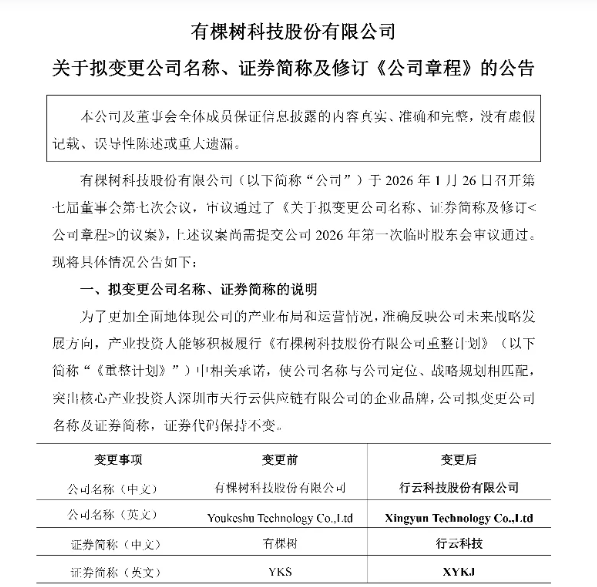
【亿邦原创】1月29日消息,日前,老牌跨境大卖有棵树发布公告称,为匹配公司战略转型与产业投资人品牌定位,自2月11日起,公司全称将由“有棵树科技股份有限公司”变更为“行云科技股份有限公司”,证券简称相应由“有棵树”调整为“行云科技”,证券代码“300209”保持不变。

消息传出后,有棵树股价应声上涨。截至发稿日收盘,有棵树报7.26元/股,总市值约67.42亿元,近一年公司股价累计上涨近60%,市盈率(TTM)达91.76。

此次更名,发生在以王维为实控人的深圳市天行云供应链有限公司(简称“行云集团”)所提名的新管理团队全面接管公司运营满百天之际,这被外界普遍视为公司控制权与发展方向完成实质性切换的重要标志。

据悉,本次主导企业重整、更名事项的行云集团,成立于2015年,作为中国领先的全球商品B2B服务平台,致力于提供全球渠道运营、分销及跨境贸易服务,并打造了集出海服务、品牌服务、渠道服务、跨境物流服务等于一体的全球商品综合服务体系。

该集团曾多次入选“中国民营企业500强”和“中国服务业民营企业100强”,现有全球员工3000余人,为近50万中小零售商、3000余个国内外消费品牌,提供了覆盖近15万SKU的数字供应链服务,并在全球持有超过170个仓库 ,仓储总面积达130万平方米。

回顾行云集团的资本布局,早在2024年9月,其实质控股公司XINGYUN INTERNATIONAL COMPANY LIMITED,就与SPAC公司(美国特殊目的收购公司)Chenghe Acquisition II.Co.(CHEB)签订合并协议,拟通过借壳在美国AMEX挂牌上市。

更早之前,市场亦曾传闻其计划在港股进行上市前融资并推进IPO,募资规模约2亿美元、目标估值约25亿美元,但相关信息并未获得官方确认。

在此背景下,本次“改名事件”及其所象征的业务重整,不仅是一次明确的上市平台确权与“壳资源”定位重塑,有助于淡化有棵树的历史包袱,重构投资者认知与信任,另一方面,或许也可视作行云集团境内外融资路径的一次“对冲式布局”。

在其赴美上市的相关操作受到高度关注的同时,A股上市平台的稳定存在,也为其在不同市场环境下推进融资、并购、上市提供了更具弹性的选择空间。

不过,与控制权理顺形成对比的是,公司基本面仍承受较大压力。与公告同时披露的是有棵树姗姗来迟的2025年Q3财报——各项业绩均表现不佳。

数据显示,前三季度,该公司实现营业收入5895.67万元,同比暴跌82.02%;归属于上市公司股东的净利润为-1385.28万元,上年同期为亏损3056.57万元。

单看第三季度,公司实现营业收入1638.33万元,同比下降83.59%;归母净利润亏损1572.98万元,同比降幅高达5169.86%。

从更长周期来看,公司刚于2024年实现扭亏。去年上半年,公司营业总收入同比大降81.33%,归母净利润为187.7万元,仅保持微弱盈利。而第三季度再度大幅转亏,或将对全年业绩造成负面影响。

在企业治理层面,公司披露了新管理团队对历史遗留问题的整合进展。

截至2025年12月31日,公司已完成对26家子公司公章、营业执照等核心资质的控制,并完成母公司公章、营业执照及信息披露U盾的交接;2025年11月,公司签署四方监管协议,已向子公司实缴1亿元资金,用于支持业务拓展。

与此同时,仍有部分子公司尚未完成业务交接,涉及资产总额6470.76万元、净资产-1059.55万元、营业收入60.12万元,分别占公司2025年前三季度合并报表对应指标的5.52%、-1.11%和1.17%。此外,公司部分子公司因拖欠物流服务费,正卷入一宗金额接近1亿元的仲裁案件。

回溯公司历史,有棵树成立于2010年,创始人为肖四清,早年凭借电子产品、户外装备及家居用品等多品类布局,在深圳供应链优势支持下快速扩张,享受了跨境电商赛道野蛮增长的早期红利,并于2017年借壳上市。

然而,其主要依靠“多平台、多账号、多品类铺货”的粗放型模式驱动发展,随着跨境电商市场竞争加剧、平台规则趋严、供应链与流量成本上升,其毛利空间被不断压缩,业务增长乏力。

而盲目扩张,也导致其库存积压持续恶化、合规压力不断加大,最终致使其盈利结构失衡、现金流高度紧张、业绩持续下滑:2020年至2023年期间,公司累计亏损超40亿元。

2024年4月,深交所向有棵树发出退市风险警示函。同年,因无力清偿到期债务且已严重资不抵债,公司被法院裁定受理重整申请。

根据重整方案,天行云作为牵头产业投资人进入,公司股权结构和实际控制权随之发生根本变化。

2025年3月,有棵树披露详式权益变动报告,王维及其一致行动人合计持有公司18%股份,肖四清持股比例被动稀释至3.28%。

重整完成后,围绕公司控制权与治理权的分歧逐步公开化。

2025年5月,王维等人提议召开临时股东大会并提前进行董事会换届,但遭当时董事会全票否决。直至2025年10月,由王维、刘智辉召集的临时股东大会最终召开,公司完成第七届董事会换届,王维提名的7名董事全部当选,肖四清旗下的原核心管理层全部离任,新团队宣布全面接管公司资产、业务与财务。

公司内部治理冲突的长期拉锯,也直接干扰了日常经营,并导致2025年第三季度财报未能按期披露。

随着更名完成与新董事会全面执掌,行云集团对上市公司的整合进入实质阶段,但其能否在复杂的历史包袱与承压的业绩基础上,推动行云科技实现业务修复与战略转型,仍有待时间与业绩表现进一步检验。


亿邦持续追踪报道该情报,如想了解更多与本文相关信息,请扫码关注作者微信。

文章来源:亿邦动力

广告
微信
朋友圈

FAQ回顾

有棵树更名行云科技的原因是什么?

有棵树更名行云科技是为了匹配公司战略转型与产业投资人行云集团的品牌定位,标志着王维领导的新管理团队完成对公司控制权与发展方向的实质性切换。

行云科技2025年第三季度的业绩表现如何?

2025年第三季度,行云科技营业收入1638.33万元,同比下降83.59%;归母净利润亏损1572.98万元,同比降幅高达5169.86%,公司基本面仍承受较大压力。

行云集团对有棵树的整合取得了哪些进展?

截至2025年12月31日,新管理团队已完成对26家子公司核心资质的控制,并完成母公司公章等交接;2025年11月已向子公司实缴1亿元资金用于业务拓展。

这么好看,分享一下?

朋友圈 分享

APP内打开

赞 +1
+1
微信好友 朋友圈 新浪微博 QQ空间
关闭
收藏成功
发送
/140 0