广告
加载中

慧博科技"个性化自动塞券"6招解法 教你双11精准发券 驱动全周期高效转化

龚作仁 2026-10-19 13:55
龚作仁 2026/10/19 13:55

邦小白快读

EN
全文速览

总1:2026年双11平台优惠规则大改,发券方式也在升级,消费者能省去抢券领券的麻烦,自动收到更贴合需求的专属优惠券。

1. 平台新规方面,天猫淘宝取消跨店满减、改单件官方立减,京东主推官方直降,抖音力推官方立减15%加一件直降,价格管控全面收紧。

2. 新发券玩法是把优惠券自动塞进用户卡包,不用手动领取,也不能截图转卖,平台会按人群精准发券,买过什么品类就发对应品类券。

3. 消费者利好时点包括支付后30分钟自动收到满减券、收货后第7天收到复购券、沉睡老客收到大额召回券等。

总2:要想用好双11的券,可以留意各阶段不同玩法。

1. 蓄水期有派样转正装,试过小样的人会收到正装优惠券。

2. 爆发期有24小时限时阶梯券,如满199减30、满299减60,适合即时凑单。

3. 这类券核销不计入历史最低价,商家不用担心破价,消费者也能更放心享受优惠。

总1:平台价格规则全面收紧,品牌不能靠破价发券冲量,个性化自动塞券可在不损最低价的前提下精准发券,保住价格体系和利润底线。

1. 在定价与价格竞争上,天猫淘宝取消跨店满减,京东主推官方直降,抖音官方立减15%,活动商品价格不得高于校验期最低价,破价发券空间被堵死。

2. 在消费趋势上,平台补贴从按成交转向按人群,88VIP、PLUS等高确定性人群获更多补贴;消费者加购意愿最强在支付后30分钟,收货后第7天开始进入复购决策期。

总2:会员资产运营有清晰打法。

1. 蓄水期用3段人群互斥分层加15分钟梯度塞券唤醒沉睡老客,高净值客户可去短信化静默触达。

2. 预热期按会员等级乘券面分层,高净值发大额无短信券、高频人群发复购激励券、新客发加购引导券,并与平台补贴同向叠加。

3. 爆发期在支付后自动触发阶梯满减券,仅24小时有效,引导即时凑单。

4. 复盘期在收货后第7天按品类发复购券,以30/60/90天复购率评估长期用户价值。

总3:案例效果值得参考。

1. 宠物食品品牌核销率加28%、复购率加30%、运营效率加80%。

2. 美妆品牌客单价加40%、连带购买率加38%、ROI 1比180。

3. 高净值品牌召回1000加老客、ROI 1比200。

总1:2026年双11规则巨变,商家必须读懂政策并迅速调整发券策略。

1. 政策变化上,天猫淘宝取消跨店满减改单件官方立减,京东保留跨店满减但主推官方直降,抖音官方立减15%加一件直降;活动商品标价、券后价不得高于价格校验期最低价,先涨后降被严查。

2. 风险提示明确,不破价怕跑不赢竞品,破价又压利润,破价发券空间已被堵死,需要从价格力转向数据力加服务力。

总2:六个具体打法可按大促阶段落地。

1. 蓄水期:派样人群按品类匹配正装券;沉睡人群按距今180天、180至360天、1至2年互斥分层,15分钟内梯度加码塞券。

2. 预热期:会员按等级分层发券并叠加平台补贴;已购未复购人群发当晚24小时限定券。

3. 爆发期:支付后自动触发满199减30、满299减60类阶梯券,24小时有效。

4. 复盘期:收货后第7天按品类发复购券,避开7至21天竞品截流窗口。

总3:案例与机会同样值得关注。

1. 宠物食品案例核销率加28%、复购率加30%;美妆案例客单价加40%、ROI 1比180。

2. 可向慧博科技按品类、会员结构与历史数据定制双11塞券作战策略。

总1:大促营销打法变化给生产端带来直接启示。

1. 产品组合设计上,支付后30分钟是加购意愿最强窗口,美妆母婴食品等品类适合做满199、满299阶梯组合,工厂应预留礼盒装、搭售款和次抛款来支撑连带率。

2. 小样与试用装价值凸显,派样转正装需要大量试用装作为钩子,但九成用户试完就散,工厂可帮助品牌把试用装与正装券绑定,缩短转化路径。

3. 数据开始反向指导生产,核销率、复购率等数据能直接反映品类受欢迎程度,工厂可据此调整排产、备货与品类结构。

总2:数字化工具在生产协同上有应用空间。

1. 慧博科技用CDP、MA画布、SCRM等工具做全链路消费者运营,工厂不必照搬,但可理解消费数据回流逻辑,按复购周期安排补货。

2. 平台补贴向高净值人群倾斜,高价值老客召回ROI很高,说明高客单产品的产能和库存要匹配会员分层运营。

总3:值得关注的高增长场景来自宠物食品、美妆等品牌。

1. 这些品牌通过精准塞券实现核销率、复购率明显提升,提示工厂在双11备货节奏上重视此类品类的大促需求。

总1:行业趋势与客户痛点清晰可见。

1. 平台价格管控收紧,破价发券失效,发券正从营销费用变成数据运营,数据驱动型服务商迎来窗口期。

2. 客户痛点集中,包括派样数据散落、九成用户试完流失,沉睡老客召回慢,通用券无差异,支付后30分钟和收货后7至21天窗口易被浪费和截流。

总2:慧博科技给出的解法就是可参考的解决方案模板。

1. 核心能力包括不损最低价、不可分享、分钟级自动化、数据可闭环,依托MA画布完成圈人、发券、提醒、核销全流程。

2. 六招覆盖蓄水、预热、爆发、复盘各阶段,分别是派样转正装、沉默资产激活、会员差异化权益、大促第二单、支付后黄金30分钟、收货后第7天复购。

总3:技术架构与合作方向明确。

1. 慧博科技提供全域CDP、全渠道数据治理、集团化会员体系、SCRM、零售AI Agent等能力,服务服装、食品、美妆、母婴、宠物、3C、酒水等行业。

2. 服务商可围绕这些模块思考自身产品切入点,或为客户设计类似的全周期发券运营方案。

总1:从商家反应能看出平台规则的直接影响。

1. 天猫淘宝取消跨店满减改单件官方立减,京东主推官方直降,抖音官方立减15%,价格管控全面收紧,商家破价发券空间变小。

2. 这会在一定程度上抑制商家发券积极性,平台需要考虑给合规发券留出空间。

总2:商家对平台发券能力有明确需求。

1. 券核销不计入最低价、直发卡包不可分享、自动提醒、核销数据回流等都是商家看重的功能。

2. 商家希望会员差异化券与88VIP、PLUS等平台补贴同向叠加且不冲突,补贴能精准落入商家会员人群。

总3:平台运营与风控也有启示。

1. 平台补贴从按成交转向按人群,可配合商家MA画布做人群定向与数据校验。

2. 严查先涨后降是平台一致方向,但也要避免合规商家因不能破价而失去价格竞争力。

总1:产业新动向明显。

1. 平台取消跨店满减、转向官方直降与官方立减,价格管控收紧,低价竞争的政策红利正被收回。

2. 商家被迫从价格力转向数据力加服务力,发券从一项营销费用变成一门数据运营。

总2:文中暴露的新问题值得量化研究。

1. 商家陷入发券刺激与利润底线的两难。

2. 派样用户当期仅约10%转化为正装购买,90%流失;支付后30分钟和收货后第7天至21天是流失高发窗口。

3. 平台补贴从按成交转向按人群,高确定性人群获得更多补贴。

总3:商业模式与规则研究有样本价值。

1. 慧博科技以不损最低价、不可分享、分钟级自动化、数据可闭环为核心,构建MA画布驱动的全周期精准发券模式,是CDP加SCRM加AI Agent范式的应用样本。

2. 活动商品价格不得高于校验期最低价、先涨后降被严查,以及允许特定券不计入最低价的做法,为平台价格治理提供了平衡商家利润与消费者获利的规则思路。

总4:实证案例丰富。

1. 宠物食品品牌核销率加28%、复购率加30%、运营效率加80%。

2. 美妆品牌客单价加40%、连带购买率加38%、ROI 1比180。

3. 高净值品牌召回1000加老客、ROI 1比200。

返回默认
声明:快读内容全程由AI生成,请注意甄别信息。如您发现问题,请发送邮件至 run@ebrun.com 。

我是 品牌商 卖家 工厂 服务商 平台商 研究者 帮我再读一遍。

Quick Summary

The 2026 Double 11 platform discount rules are changing significantly, and coupon distribution is being upgraded. Consumers will no longer need to scramble for or manually claim coupons; they will automatically receive personalized coupons better matched to their needs.

1. Platform rule changes: Tmall and Taobao have replaced cross-store threshold discounts with per-item official discounts; JD.com is prioritizing official direct price cuts; and Douyin is pushing a 15% official instant discount plus per-item markdowns. Price controls are tightening across the board.

2. New coupon mechanic: coupons are automatically loaded into users' coupon wallets. No manual claiming is needed, screenshots and resale are blocked, and platforms issue coupons by audience segment—buying a category triggers coupons for that category.

3. Key consumer moments: threshold coupons arrive automatically 30 minutes after payment, repurchase coupons arrive on the 7th day after delivery, and dormant customers receive high-value win-back coupons.

To use Double 11 coupons effectively, pay attention to the different mechanics at each stage.

1. During the seeding phase, sampling converts to full-size purchases: consumers who try samples receive coupons for the full-size product.

2. During the peak phase, 24-hour limited-time tiered coupons are available, such as RMB 30 off orders over RMB 199 and RMB 60 off orders over RMB 299, ideal for instant top-up purchases.

3. Redemption of these coupons does not count toward the historical lowest price, so merchants do not have to worry about breaking their price system, and consumers can enjoy discounts with greater confidence.

Platform price rules are tightening across the board. Brands can no longer rely on price-breaking coupons to drive volume. Personalized automatic coupon loading allows precise coupon issuance without damaging the lowest-price baseline, protecting the brand's price system and profit margins.

1. Pricing and competition: Tmall and Taobao have removed cross-store threshold discounts; JD.com is prioritizing official direct price cuts; and Douyin is applying a 15% official instant discount. Promotional product prices cannot be higher than the lowest price during the validation period, closing off room for coupons that break the price floor.

2. Consumer trends: platform subsidies are shifting from transaction-based to audience-based, with high-propensity groups such as 88VIP and PLUS receiving more subsidies. Consumers' add-to-cart intent peaks 30 minutes after payment, and the repurchase decision window opens on the 7th day after delivery.

There is a clear playbook for membership asset management.

1. During the seeding phase, use three mutually exclusive audience tiers and 15-minute incremental coupon loading to revive dormant customers; high-value customers can be reached silently without SMS.

2. During the warm-up phase, segment coupons by membership tier and coupon face value: high-value customers receive large-denomination no-SMS coupons, high-frequency customers receive repurchase incentive coupons, new customers receive add-to-cart guidance coupons, and all are stacked in the same direction as platform subsidies.

3. During the peak phase, automatically trigger tiered threshold coupons after payment, valid for only 24 hours, to encourage immediate order topping-up.

4. During the review phase, issue repurchase coupons by category on the 7th day after delivery, and evaluate long-term customer value using 30/60/90-day repurchase rates.

Case results are worth referencing.

1. A pet food brand increased its redemption rate by 28%, repurchase rate by 30%, and operational efficiency by 80%.

2. A beauty brand lifted average order value by 40%, associated purchase rate by 38%, and achieved an ROI of 1:180.

3. A high-value brand won back 1,000+ existing customers with an ROI of 1:200.

The 2026 Double 11 rules have changed dramatically. Merchants must fully understand the policies and quickly adjust their coupon strategies.

1. Policy changes: Tmall and Taobao have removed cross-store threshold discounts and moved to per-item official discounts; JD.com keeps cross-store threshold discounts but focuses on official direct price cuts; Douyin applies a 15% official instant discount plus per-item markdowns. Listed prices and post-coupon prices of promotional products cannot exceed the lowest price from the validation period, and "raise-then-discount" practices are under strict scrutiny.

2. Clear risk warning: without breaking their price floor, merchants fear falling behind competitors; with breaking it, profits are squeezed. The room for price-breaking coupons has been closed, so businesses must shift from price competitiveness to data capability plus service capability.

Six specific tactics can be implemented by promotion stage.

1. Seeding phase: match sample-trial audiences with full-size product coupons by category; segment dormant audiences into mutually exclusive buckets by recency—within 180 days, 180–360 days, and 1–2 years—and increase coupon value progressively within 15 minutes.

2. Warm-up phase: issue coupons by membership tier and stack them with platform subsidies; for purchased-but-not-repurchased customers, send a coupon valid for only 24 hours that evening.

3. Peak phase: after payment, automatically trigger tiered coupons such as RMB 30 off orders over RMB 199 and RMB 60 off orders over RMB 299, valid for 24 hours.

4. Review phase: issue repurchase coupons by category on the 7th day after delivery, avoiding the 7-to-21-day window when competitors may intercept customers.

Cases and opportunities deserve equal attention.

1. In the pet food case, redemption rate rose by 28% and repurchase rate by 30%; in the beauty case, average order value rose by 40% with an ROI of 1:180.

2. Merchants can work with Huibo Technology to customize a Double 11 coupon strategy based on category, membership structure, and historical data.

The changes in promotion marketing tactics have direct implications for production.

1. Product mix design: the 30-minute window after payment is when add-to-cart intent is strongest. Categories such as beauty, mother-and-baby, and food suit tiered bundles at RMB 199 and RMB 299, so factories should reserve gift-box packs, bundle SKUs, and single-use trial formats to support cross-sell rates.

2. The value of samples and trial sizes has increased. Sample-to-full-size conversion needs large numbers of trial products as hooks, but about 90% of users disappear after sampling. Factories can help brands link trial sizes with full-size coupons and shorten the conversion path.

3. Data is beginning to inform production in reverse. Metrics such as redemption and repurchase rates directly reflect category popularity, allowing factories to adjust production scheduling, stocking, and category mix.

Digital tools have room for application in production collaboration.

1. Huibo Technology uses CDP, MA canvas, SCRM and other tools for full-lifecycle consumer operations. Factories do not need to replicate this, but they can understand how consumption data flows back and arrange replenishment according to repurchase cycles.

2. Platform subsidies are tilting toward high-value groups, and the ROI for winning back high-value existing customers is very high. This means production capacity and inventory for high-ticket products should align with tiered member management.

High-growth scenarios worth watching come from pet food, beauty, and other brands.

1. These brands have significantly improved redemption and repurchase rates through precise coupon targeting, signaling that factories should factor in the category's promotional demand when planning Double 11 inventory.

The industry trends and client pain points are clear.

1. Platform price controls are tightening, price-breaking coupons no longer work, and coupon distribution is shifting from a marketing expense to data operations. Data-driven service providers are entering a window of opportunity.

2. Client pain points are concentrated: sample data is scattered, about 90% of trial users are lost, dormant-customer win-back is slow, generic coupons lack differentiation, and the windows of 30 minutes after payment and days 7–21 after delivery are often wasted or intercepted.

Huibo Technology's solution is a referenceable template.

1. Core capabilities include protecting the lowest-price baseline, non-shareable coupons, minute-level automation, and closed-loop data, using an MA canvas to run the full process of audience selection, coupon issuance, reminders, and redemption.

2. Six tactics cover the seeding, warm-up, peak, and review phases: sample-to-full-size conversion, dormant asset reactivation, differentiated membership benefits, second order during the event, the golden 30 minutes after payment, and repurchase on the 7th day after delivery.

The technology architecture and collaboration direction are clear.

1. Huibo Technology provides full-domain CDP, omnichannel data governance, group-level membership systems, SCRM, and retail AI agents, serving industries such as apparel, food, beauty, mother-and-baby, pets, 3C, and alcoholic beverages.

2. Service providers can use these modules to identify their own product entry points or design similar full-cycle coupon operation plans for clients.

Merchants' reactions reveal the direct impact of platform rules.

1. Tmall and Taobao have removed cross-store threshold discounts and switched to per-item official discounts; JD.com is focusing on official direct price cuts; and Douyin is applying a 15% official instant discount. Price controls are tightening, leaving less room for merchants to use coupons to undercut prices.

2. This will to some degree dampen merchants' enthusiasm for issuing coupons, so platforms need to leave room for compliant coupon distribution.

Merchants have clear requirements for platform coupon capabilities.

1. Features merchants value include coupon redemption not counting against the lowest price, direct delivery to coupon wallets without shareability, automatic reminders, and redemption data flowing back.

2. Merchants want differentiated membership coupons to stack in the same direction as platform subsidies such as 88VIP and PLUS without conflict, and they want subsidies to land precisely on merchants' member audiences.

There are also implications for platform operations and risk control.

1. As platform subsidies shift from transaction-based to audience-based, platforms can coordinate with merchants' MA canvases for audience targeting and data validation.

2. Strictly scrutinizing "raise-then-discount" is a consistent direction across platforms, but platforms should also avoid making compliant merchants lose price competitiveness because they are not allowed to break price floors.

Clear new industry dynamics are emerging.

1. Platforms have removed cross-store threshold discounts and shifted toward official direct price cuts and official instant discounts, tightening price controls and withdrawing the policy dividend of low-price competition.

2. Merchants are being pushed from price competitiveness toward data capability plus service capability, and coupon distribution has become a data operation rather than simply a marketing expense.

New problems exposed in this article are worth quantitative research.

1. Merchants face a dilemma between using coupons to stimulate demand and protecting their profit floor.

2. Only about 10% of sampled users convert to full-size purchases in the current period, leaving 90% lost; the 30 minutes after payment and days 7–21 after delivery are high-risk churn windows.

3. Platform subsidies are shifting from transaction-based to audience-based, with high-propensity audiences receiving more subsidies.

The business model and rule design are valuable research samples.

1. Huibo Technology's model is built on protecting the lowest-price baseline, non-shareable coupons, minute-level automation, and closed-loop data, and uses an MA canvas to drive full-cycle precision coupon distribution. It is an applied example of the CDP + SCRM + AI agent paradigm.

2. The requirements that promotional prices cannot exceed the lowest price in the validation period, the strict scrutiny of "raise-then-discount," and the practice of allowing certain coupons not to count toward the lowest price offer a rule-based approach to platform price governance that balances merchant profits and consumer benefits.

The empirical cases are rich.

1. A pet food brand increased its redemption rate by 28%, repurchase rate by 30%, and operational efficiency by 80%.

2. A beauty brand lifted average order value by 40%, associated purchase rate by 38%, and achieved an ROI of 1:180.

3. A high-value brand won back 1,000+ existing customers with an ROI of 1:200.

Disclaimer: The "Quick Summary" content is entirely generated by AI. Please exercise discretion when interpreting the information. For issues or corrections, please email run@ebrun.com .

I am a Brand Seller Factory Service Provider Marketplace Seller Researcher Read it again.

2026年双11临近,平台价格玩法迎来新一轮调整。当天猫、淘宝取消跨店满减、京东主推"官方直降"、抖音力推"官方立减15%",活动商品价格管控同步全面收紧——"破价发券"空间越来越小,商家普遍陷入"发券刺激vs利润底线"的两难困局。基于平台规则与商家经营需求,慧博科技整理发布"个性化自动塞券"解决方案的6大核心场景玩法,以"不损最低价"为基础能力,覆盖双11蓄水-预热-爆发-复盘全链路发券场景,为商家提供"既保利润、又促增长"的解题思路及落地的实践案例。

一、2026双11,平台规则收紧,商家陷入"发券vs破价"两难

2026年双11平台价格规则出现新一轮调整:

• 天猫、淘宝:取消跨店满减,改"单件官方立减";

• 京东:保留跨店满减,主推"官方直降";

• 抖音:以"官方立减15% + 一件直降"为主。

与此同时,价格管控全面收紧:活动商品的标价、券后价不得高于价格校验期内的最低价,"先涨后降"被严查,"破价发券"的空间越来越小。

规则变化直接造成了商家最典型的两难——想发券刺激,又怕破价压利润;不破价,又怕跑不赢竞品。

相关业内观察人士指出,本轮规则调整的本质,是把"低价竞争"的政策红利收回,倒逼商家从"价格力"转向"数据力 + 服务力"。"发券"这件事,正从一项"营销费用"变成一门"数据运营"。

二、解法:把"撒胡椒面"变成"精准塞券"

慧博科技基于平台规则变化及所服务商家实际经营需求,整理发布结合双11从蓄水到复盘覆盖大促全周期阶段的6个"个性化自动塞券"核心场景玩法,帮助服务商家精准发券,实现在对的节点,把券发到对的人手里,把"通用券"变成"专属券",最终达到既能保利润,又能促进增长的目标。

慧博科技个性化自动塞券的核心思路是:基于全域行为数据,在MA(营销自动化)画布中圈定目标人群,把优惠券直发用户卡包——不损最低价、无需手动领取、分钟级自动响应。

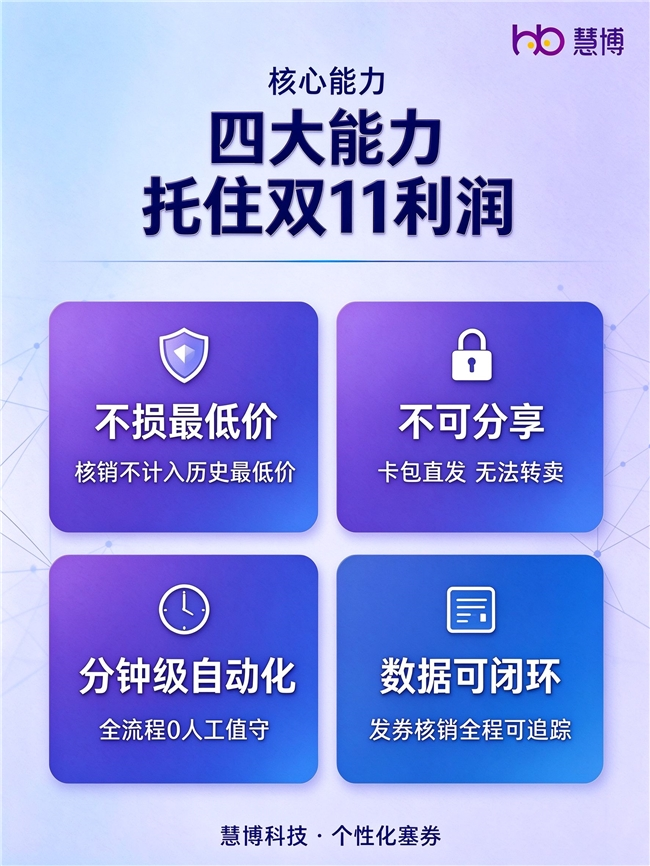
玩法策略背后是慧博科技【个性化自动塞券】的四大核心能力:

• 不损最低价:商家所发的此类优惠券核销不计入商品历史最低价(以平台最新规则为准),发券不必"以破价为代价";

• 不可分享:券进入卡包后无法被转卖、被截图转发,营销资源100% 落到目标人群;

• 分钟级自动化:MA画布圈人—发券—提醒—核销全流程自动完成,0人工值守;

• 数据可闭环:发券、核销、订单全程可追踪,落地一张专属报表的"发券效果"账本。

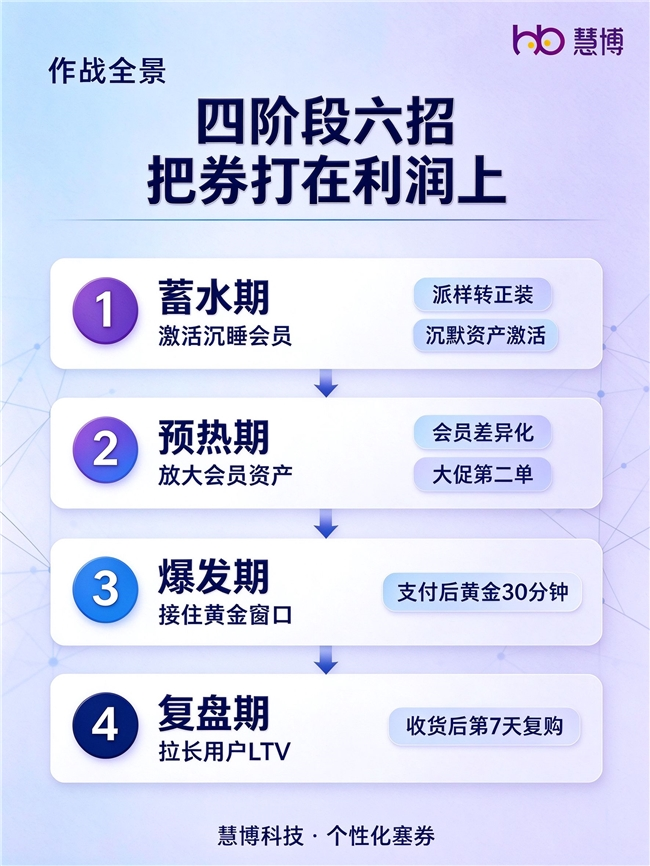
三、6大核心场景玩法详解:四步六招,把券打在利润上

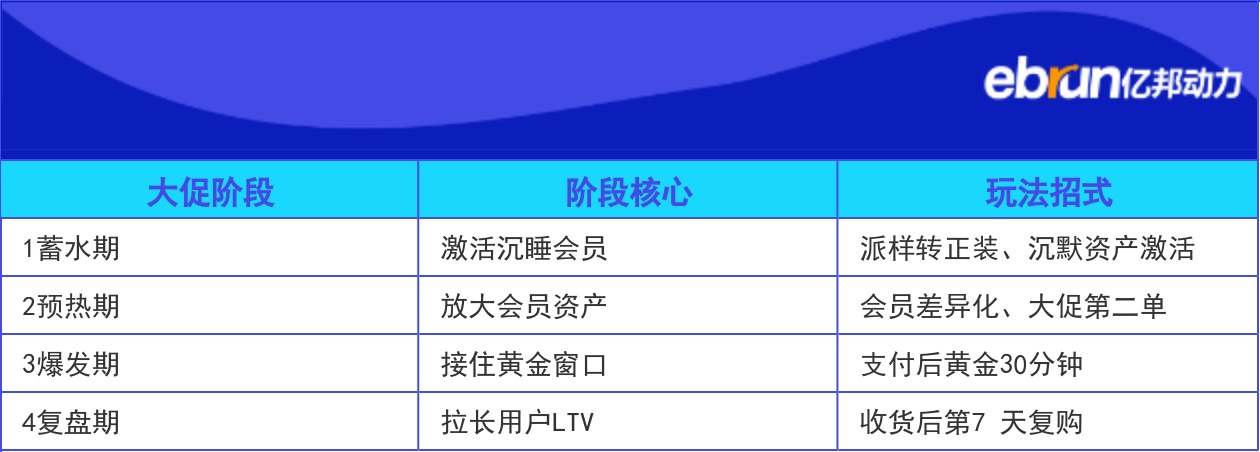
四阶段六招,把券打在利润上

大促阶段 阶段核心 玩法招式
1蓄水期 激活沉睡会员 派样转正装、沉默资产激活
2预热期 放大会员资产 会员差异化、大促第二单
3爆发期 接住黄金窗口 支付后黄金30分钟
4复盘期 拉长用户LTV 收货后第7 天复购

第一阶段|【蓄水期】:把「试过的人」和「睡着的会员」激活

场景玩法1 · 派样转正装

—— 一张品类券,把试过的人稳稳留在你这里

大促前,美妆、食品、母婴品牌普遍做"送小样、换首购"。行业复盘数据显示,曾有品牌送出的试用装中,当期仅约10% 的用户转化为正装购买,剩下90% 的"试过"用户"试完就散了"。

卡点通常在三处:派样数据散落在不同系统;通用优惠券"撒胡椒面";等商家想起来再触达,竞品的券已先一步接走。

慧博科技个性化自动塞券给出的解法是:先解决「找得到人」,再解决「券发得准」,最后解决「人接得住」。

双11塞券策略:

1. 圈人配券:按品类精准匹配正装优惠券——如圈定"近90天派样未转正""365–720天派样沉默"两类人群,按试用品类精准匹配正装商品券,不群发、不撒网。

2. 卡包直发 + 不可分享:通过MA画布自动触发,券直塞用户卡包、不可被截图转卖;每一步都有数据回流,ROI一目了然。

618实证案例|慧博科技某宠物食品品牌客户通过"派样人群精准圈选 + 品类券卡包直发"全链路自动化,实现核销率 +28%、复购率 +30%、运营效率 +80%。

场景玩法2· 沉默资产激活

——3 段人群分级,15分钟梯度塞券叫醒老客

沉睡老客召回是每次大促的必做动作。通用券、短信+链接、缺乏时效性,是常见的失效原因。

要解开这个难题,可以慧博科技个性化自动塞券的「3段人群互斥分层 +15分钟梯度塞券」策略玩法解决。

双11塞券策略:

1.3 段人群互斥分层:把沉睡人群拆成"近180天未购 /180–360天 /1–2年"三类互斥人群,券面互不重叠。

2.15分钟梯度塞券:以3C数码类目为例,大促前可先发200元优惠券第一次触达召回,15分钟内自动补塞300元优惠券——双券叠加刺激高价值人群消费。高净值人群可"去短信化",直发卡包静默触达。

618实证案例|慧博科技某高净值品牌客户通过15分钟梯度塞券策略,召回1000+ 老客、塞券成功率100%、ROI 1:200。

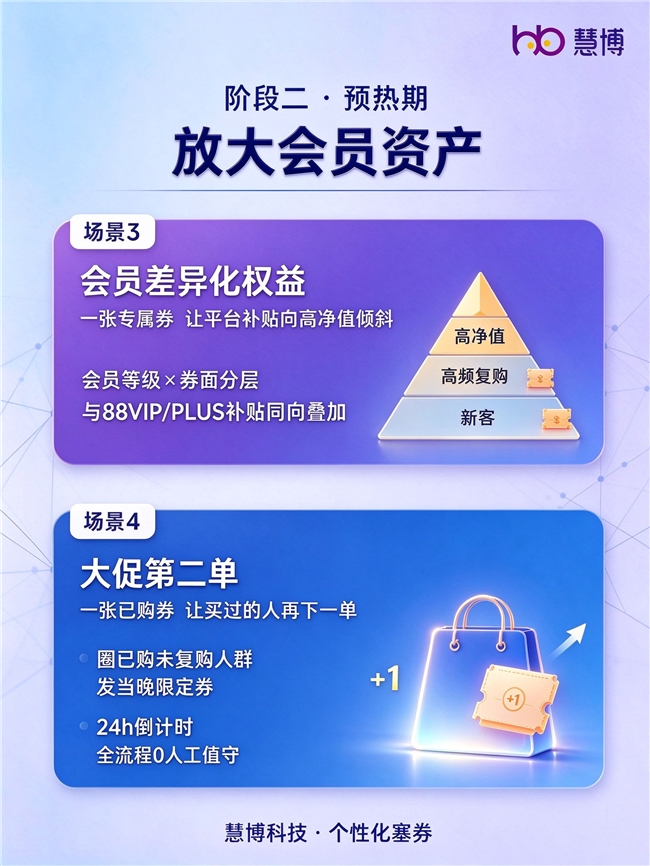
第二阶段|【预热期】:把「会员资产」和「已购人群」二次放大

场景3 · 会员差异化权益

—— 一张专属券,让平台补贴向你的高净值人群倾斜

2026年双11,平台补贴的方向正在悄悄变化——从"按成交"转向"按人群"。88VIP、PLUS等高确定性人群可拿到更多补贴,但商家的通用优惠券仍在"平均撒",体现不出会员差异。

慧博科技个性化自动塞券的解法,是把优惠券「平均撒」换成「分层发」——让每一档会员,都领到「专属的那一张」。

双11塞券策略:

1. 会员等级 × 券面分层:高净值人群发大额无短信券、高频人群发复购激励券、新客发加购引导券——每一档等级都有专属动作。

2. 与平台补贴同向叠加:与88VIP/ PLUS等平台补贴券同向叠加,不冲突,补贴精准落入商家的会员人群。

3. 数据回流看ROI:每一档会员的券后GMV、复购率、连带率——一张报表讲清"谁在给你赚钱"。

场景4 · 大促第二单

—— 一张已购券,让「买过的人」再下一单

大促第一波已购人群,对品牌已有认知,是当晚最容易再下一单的"半步之遥"人群。但现实中,这批人常被通用优惠群发混同对待,错过当晚的二次成交窗口。

要接住这批人,靠的不是再投广告,而是一张「刚好对症」的优惠券——双11当晚,两步落地。

双11塞券策略:

1. 圈"已购未复购"+ 发当晚限定券:大促当晚最精准的高潜二次成交人群——看过、加购过、付过款、但还没再下一单。与平台跨店满减/官方立减叠加,不冲突、不破价。

2.24h倒计时 +MA全自动:当晚有效,引导即下即结;圈人—发券—提醒—核销全流程0 人工值守。

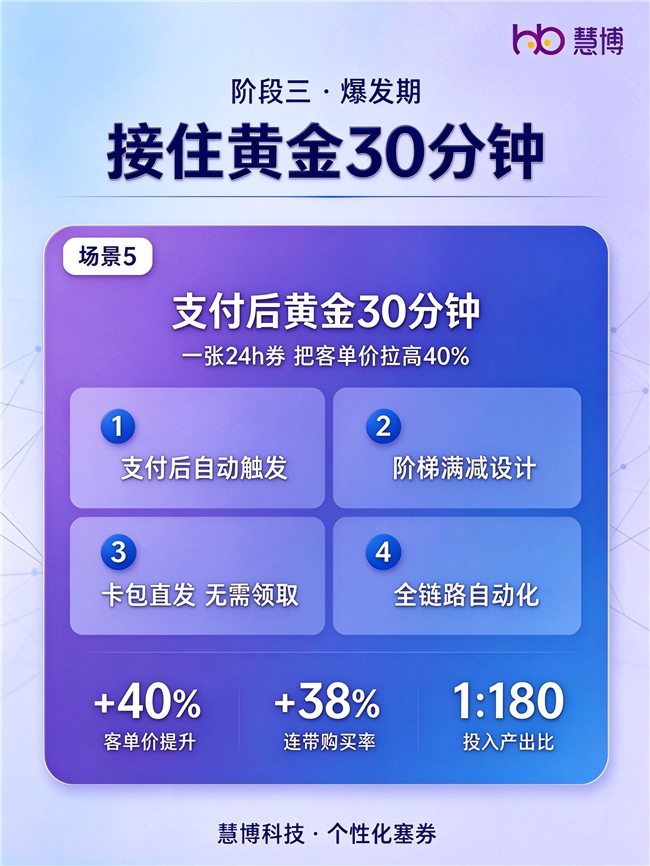
第三阶段| 【爆发期】:把「黄金30分钟」的加购意愿接住

场景5 · 支付后黄金30分钟

—— 一张24h券,把客单价拉高40%

美妆、母婴、食品等"一站式采购"品类,用户付完款的那一刻加购意愿最强——这30分钟是大促当天最容易"被浪费"的30分钟。

可现实中,支付后没有即时福利引导、传统发券无时效性且权益单一、人工触达又跟不上——黄金窗口的连带机会就这样流失。

慧博科技个性化自动塞券要做的,就是把这30分钟从「人工跟不上」变成「系统自动接」——四步落地。

双11塞券策略:

1. 支付后自动触发:全店用户完成支付,系统自动触发塞券,无需人工,精准抓住即时消费意愿。

2. 阶梯满减设计:满199减 30、满299减 60美妆全品类券,仅24h有效期,引导即时凑单。

3. 高效触达无门槛:优惠券自动直发淘宝卡包,同步个性化短信提醒,用户无需手动领取。

4. 全链路自动化:触发—发券—直塞—提醒,全流程MA画布自动完成,且不影响最低价保利润。

618实证案例|慧博科技某美妆品牌客户实测——客单价 +40%、连带购买率 +38%、ROI 1:180。

第四阶段 |【复盘期】把「单次客单」拉成「长期价值」

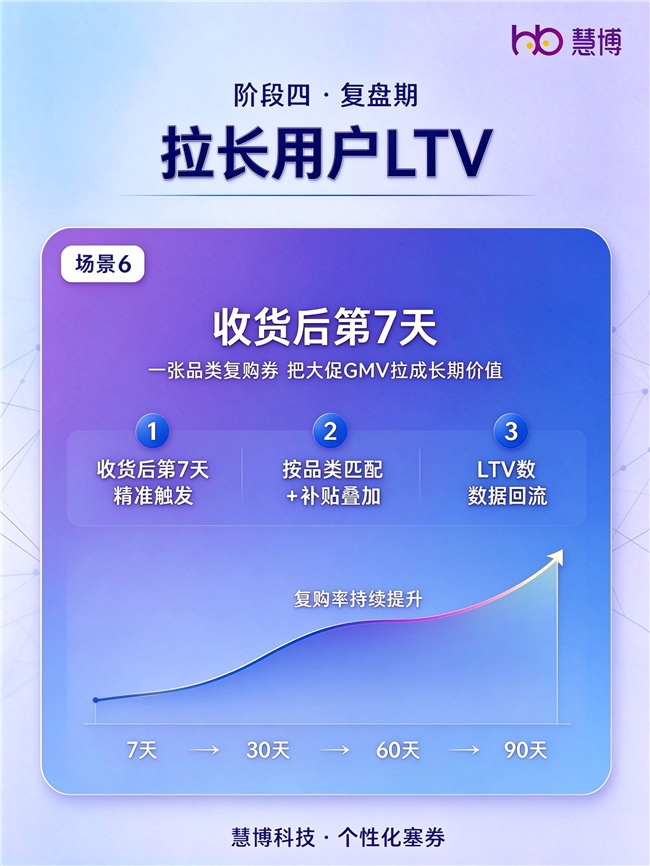
场景6 · 收货后第7 天

—— 一张品类复购券,把大促GMV拉成长期LTV

用户确认收货后,是复购决策的黄金窗口——真正的"复购"从收货那天起算的第7 天开始。但很多商家的"利润尾巴"从这里丢掉:复购券没按品类区分、收货到再次下单的7–21天决策窗口易被竞品截流。

双11塞券策略:

1. 收货后第7 天精准触发:MA画布按收货时间自动排程,到点即发——复购窗口不靠人工盯。

2. 按品类匹配 + 平台补贴叠加:买了什么品类、推什么正装相关券——不做"无关推荐";可与跨店满减/官方立减同向叠加,不冲突、不破价。

3.LTV数据回流:30/ 60/ 90天的复购率看得清——大促当天的GMV变成长期价值。

把大促当天的成交,转化为接下来30/ 60/ 90天的复购。拉长LTV,就是把单次客单变成长期利润。

四、写在最后:让每一张优惠券,都打在利润上

对品牌商家而言,"发券"这件事正从一项"营销费用"变成一门"数据运营"——谁能把券发对,谁就能在大促中既保利润、又促增长。

慧博科技个性化自动塞券解决方案的六招解法,通过蓄水期叫醒试过的人和睡着的人,预热期放大会员与已购资产,爆发期接住支付后的黄金30分钟,复盘期用第7 天的复购拉长LTV——帮助商家更好的实现优惠券的精准布局,让每一张优惠券都打在利润上,而不是撒在流量里。

目前,各大电商平台的双11预售已陆续开启,机会不等人。我们会按你的品类、会员结构与历史数据,给出一份专属的「双11塞券作战策略」——让今年的每一张店铺优惠券,都替你赚钱,为你的大促业绩添砖加瓦。

五、关于北京慧博科技

【北京慧博科技 | 全域消费者AI运营服务商】

北京慧博科技有限公司(简称"慧博科技")是中大型品牌的全域消费者AI运营服务商。成立于2013年,是国家高新技术企业、专精特新企业,深耕零售全域消费者数字化领域十余年。公司现阶段核心战略聚焦中大型消费品牌,专注为服装、食品、美妆、母婴、宠物、3C、酒水等多个行业等全赛道头部及成长型品牌,提供全域CDP数据中台、全渠道数据治理、集团化会员体系、公私域一体化SCRM、零售AI Agent智能运营等项目级定制落地服务,目前已累计落地数千家中大型品牌数字化标杆项目。在技术路线上,慧博把Agentic AI技术融入品牌消费者运营工作流,让AI跃升为品牌经营的原生能力,形成AI时代消费者运营的新范式

注:文/龚作仁,文章来源:Laborer,本文为作者独立观点,不代表亿邦动力立场。

文章来源:Laborer

广告
微信
朋友圈

FAQ回顾

2026年双11各平台价格规则有哪些变化?

2026年双11平台价格规则迎来新一轮调整:天猫、淘宝取消跨店满减,改为单件官方立减;京东保留跨店满减,主推官方直降;抖音以官方立减15%、一件直降为主。同时平台价格管控全面收紧,活动商品标价和券后价不得高于价格校验期内的最低价,先涨后降被严查,商家破价发券的空间大幅压缩。

什么是个性化自动塞券?

个性化自动塞券是慧博科技提出的电商大促精准发券解决方案,基于全域行为数据在MA营销自动化画布中圈定目标人群,将优惠券直发用户卡包。核心能力包括不损最低价(核销不计入历史最低价)、不可分享、分钟级自动化响应和数据可闭环追踪,让商家在双11等大促中实现对的人、对的节点、对的券,兼顾利润与增长。

大促期间商家如何做到既发券又不破价?

商家可采用个性化自动塞券方式,通过MA画布圈定目标人群,将优惠券直发用户卡包。这类券核销不计入商品历史最低价,发券无需以破价为代价;券进入卡包后不可被转卖或截图转发,营销资源精准落到目标人群,有效解决2026年双11平台价格管控收紧下"发券刺激vs利润底线"的两难困局。

大促期间如何召回沉睡会员?

慧博科技推荐"3段人群互斥分层+15分钟梯度塞券"策略:将沉睡人群拆分为近180天未购、180-360天、1-2年三类互斥人群,券面互不重叠。以3C类目为例,大促前先发200元优惠券首次触达,15分钟内自动补塞300元优惠券叠加刺激。618实证案例中,某高净值品牌客户通过该策略召回1000+老客,塞券成功率100%,ROI达1:200。

慧博科技是做什么的?

北京慧博科技有限公司成立于2013年,是国家高新技术企业、专精特新企业,定位为中大型品牌的全域消费者AI运营服务商。核心业务包括全域CDP数据中台、全渠道数据治理、集团化会员体系、公私域一体化SCRM、零售AI Agent智能运营等,服务服装、食品、美妆、母婴、宠物、3C、酒水等行业,已累计落地数千家中大型品牌数字化标杆项目。

这么好看,分享一下?

朋友圈 分享

APP内打开

赞 +1
+1
微信好友 朋友圈 新浪微博 QQ空间
关闭
收藏成功
发送
/140 0