





广告
加载中

关于Swisse Beauty Skin Regeneration+产品相关情况的说明

龚作仁 2026-10-19 12:06
龚作仁 2026/10/19 12:06

邦小白快读

EN
全文速览

总:Swisse一款美容补充剂因两个批次铅超标在澳洲被召回,中国官方渠道销售不受影响。

1. 事件核心:受影响批号为144520和143217,公司主动从澳洲可控环节召回,涉及产品从未进入中国市场。

2. 健康风险评估:按每日2粒计算,铅暴露量超每日允许暴露限值5微克/天,超标幅度为0.24微克,约相当于普通膳食铅摄入量的3%到5%;持续服用最坏情景下血铅浓度最大增幅约0.2微克/分升,该增幅无法检出,且对所有人群无临床意义。

3. 消费者应对:目前在中国正规渠道购买的Swisse产品符合澳大利亚TGA要求,品质安全。如手中有相关批号,可停止使用并联系官方渠道咨询。

总:Swisse通过主动召回、科学披露和渠道隔离,为品牌危机公关提供参考样板。

1. 品牌公关:发现批次问题后主动召回,并声明对质量瑕疵零容忍,抢占公信力;随后发布说明,有效安抚市场和消费者。

2. 渠道建设:明确区分澳洲可控召回与中国正规渠道,强调涉事批次未入华,保护核心销售市场,减少品牌连带损失。

3. 质量宣传:引用TGA的专业算例说明铅暴露量超标幅度极低、无临床意义,用权威数据平衡安全担忧,强化高标准的品牌形象。

4. 用户信任:将消费者安全放首位,主动曝光小风险,反而凸显企业责任,为产品持续销售奠定信任基础。

总:对卖家而言,该事件是一次进口健康产品质量合规与风险应对的实战提醒。

1. 政策解读:TGA发布二级召回,但涉事批次仅限澳洲特定批号,未进入中国市场;中国正规渠道商品合规,风险未波及其他市场。

2. 应对措施:立即排查在售商品是否涉及144520、143217批号,从正规供货渠道采购并留存检测报告和溯源凭证,遇召回公告先下架相关批次,再等待官方澄清。

3. 风险与机会:跨境保健品监管日趋严格,卖家应重视供应商质量审计和批次追溯能力。合规产品仍可正常销售,并可把安全性作为卖点,增强消费者信任。

总:工厂可从Swisse因铅轻微超标主动召回中,得到产品质量和批次管理的具体启示。

1. 生产与设计需求:严控原料重金属杂质,配方设计时需计算每日允许暴露量(PDE)并预留安全余量,避免批间波动超标。

2. 质量管理:建立高于法规要求的出厂内控线,对每批成品进行元素杂质检测,发现问题及时隔离并主动召回,预防风险扩大。

3. 数字化与电商:采用一物一码和批次追溯系统,与渠道分销数据打通,使问题批次能快速精确定位流向,降低召回成本和品牌损失。

总:Swisse质量事件为服务商提供了服务品牌客户的新角度,多维需求正在凸显。

1. 行业趋势:海外监管机构对膳食补充剂元素杂质限量关注增强,企业会加大检测、合规和追溯投入,相关服务市场扩大。

2. 客户痛点:品牌首要是评估铅超标的临床意义和舆论后果,其次是向消费者解释“轻微超标但无健康影响”,避免品牌受损。

3. 解决方案:检测机构可提供PDE计算与批批检测,咨询公司可协助撰写TGA召回说明和安抚话术,技术商可搭建批次级全链路追踪平台,帮助客户实现快速响应。

总:平台商可从本次召回中提炼对进口健康类商品的质量监督与风险管理方法。

1. 平台需求:商家和消费者都希望平台能及时隔离涉事批次,提供官方渠道查验入口,降低购买疑虑。

2. 最新做法:平台可建立海外监管召回事件同步机制,一旦TGA等发布公告,自动匹配在售同品牌同批次商品并做下架或提示。

3. 招商运营:优先支持具有主动召回能力和完整资质文件的品牌,将安全合规作为入驻加分项,并定期复核商家的批次供应信息,提升整体品质保障。

总:Swisse事件是观察保健品跨国召回与风险沟通的重要案例。

1. 新动向:企业主动召回并非总是重大安全事件,而可依托监管机构量化风险,让“超标但无临床意义”的事实降低恐慌。

2. 政策建议:各国监管公告缺乏跨境映射,容易让消费者误以为涉事产品进入其他市场。建议推动全球药品和补充剂召回信息互通,并明确风险等级与背景数值。

3. 商业模式思考:主动召回和透明披露正在成为品牌质量管理的一部分;企业把质量内控与供应链追溯能力建设作为长期投资,以降低品牌危机成本,形成可持续的信任模式。

返回默认
声明:快读内容全程由AI生成,请注意甄别信息。如您发现问题,请发送邮件至 run@ebrun.com 。

我是 品牌商 卖家 工厂 服务商 平台商 研究者 帮我再读一遍。

Quick Summary

Summary: Swisse has recalled a beauty supplement in Australia after two batches were found to contain lead levels exceeding permissible limits. Sales through official Chinese channels are unaffected.

1. Core facts: The affected batches are 144520 and 143217. The company voluntarily recalled the products from controllable segments of its Australian supply chain, and the affected products never entered the Chinese market.

2. Health risk assessment: At the recommended dosage of two capsules per day, lead exposure would exceed the daily permissible exposure limit of 5 micrograms by 0.24 micrograms, equivalent to roughly 3% to 5% of typical dietary lead intake. In a worst-case scenario of continuous use, the maximum increase in blood lead concentration would be approximately 0.2 micrograms per deciliter—a change too small to detect and clinically insignificant for all population groups.

3. Consumer guidance: Swisse products purchased through legitimate Chinese retail channels meet Australian TGA requirements and are safe for consumption. Consumers holding products from the affected batch numbers should stop using them and contact official channels for assistance.

Summary: Through proactive recall, science-based disclosure, and channel isolation, Swisse has provided a reference model for brand crisis management.

1. Brand communications: The company voluntarily initiated a recall upon discovering the batch issue and declared zero tolerance for quality defects, securing credibility. It then issued a detailed explanatory statement that effectively reassured both the market and consumers.

2. Channel strategy: By clearly distinguishing the controlled Australian recall from official Chinese sales channels and emphasizing that the affected batches never entered China, the brand protected its core sales market and minimized collateral damage.

3. Quality messaging: Citing TGA's professional calculations to demonstrate that the lead exceedance was minimal and clinically insignificant, the brand used authoritative data to temper safety concerns while reinforcing its high-quality standards.

4. Consumer trust: By placing consumer safety first and voluntarily disclosing a small risk, the company highlighted its corporate responsibility, laying a foundation of trust for continued product sales.

Summary: For sellers, this incident serves as a practical reminder of quality compliance and risk management for imported health products.

1. Policy interpretation: The TGA issued a Class 2 recall, but the affected batches are limited to specific Australian batch numbers and never entered the Chinese market. Products sold through official Chinese channels remain compliant, and the risk has not spread to other markets.

2. Action steps: Sellers should immediately verify whether their inventory includes batches 144520 or 143217, source products only from authorized supply chains, and retain test reports and traceability documentation. When a recall notice is issued, affected batches should be delisted immediately pending official clarification.

3. Risk and opportunity: Regulatory scrutiny of cross-border health supplements is intensifying. Sellers should strengthen supplier quality audits and batch-traceability capabilities. Compliant products can continue to sell normally, and sellers can leverage safety credentials as a selling point to build consumer confidence.

Summary: Factories can draw concrete lessons from Swisse's voluntary recall over a minor lead exceedance in the areas of product quality and batch management.

1. Production and design requirements: Tighten controls on heavy-metal impurities in raw materials. Formulation design should include calculation of the permitted daily exposure (PDE) with a built-in safety margin to prevent batch-to-batch variation from causing exceedances.

2. Quality management: Establish internal release thresholds that are stricter than regulatory requirements, conduct elemental impurity testing on every batch, and promptly isolate and proactively recall any non-conforming product to prevent risk escalation.

3. Digitalization and e-commerce: Implement one-item-one-code and batch-level traceability systems integrated with distribution data, enabling rapid and precise identification of where affected batches have flowed, thereby reducing recall costs and brand damage.

Summary: The Swisse quality incident gives service providers a new perspective on serving brand clients, with multiple service needs now coming to the fore.

1. Industry trends: Overseas regulators are increasing scrutiny of elemental impurity limits in dietary supplements. Companies will step up investment in testing, compliance, and traceability, expanding the relevant service market.

2. Client pain points: Brands first need to assess the clinical significance of the lead exceedance and its reputational fallout. They then need to communicate to consumers that the exceedance is slight and poses no health risk, without damaging brand equity.

3. Solutions: Testing laboratories can offer PDE calculations and batch-by-batch testing; consulting firms can assist in drafting TGA-compliant recall notices and consumer reassurance messaging; technology providers can build batch-level, full-chain traceability platforms to enable rapid client response.

Summary: Online platforms can extract quality supervision and risk-management methods for imported health products from this recall.

1. Platform needs: Both merchants and consumers expect platforms to promptly isolate affected batches and provide official verification channels to reduce purchase concerns.

2. Best practices: Platforms can establish a synchronization mechanism for overseas regulatory recall events—when announcements such as TGA recalls are published, automatically match same-brand, same-batch products in circulation and delist or flag them.

3. Merchant management: Prioritize brands with demonstrated proactive recall capability and complete qualification documentation, making safety compliance a positive factor in merchant onboarding. Regularly re-verify merchants' batch supply information to strengthen overall quality assurance.

Summary: The Swisse incident is an instructive case study for understanding cross-border recalls and risk communication in the health products sector.

1. New dynamics: A voluntary recall does not always signal a major safety failure. Companies can rely on regulators' quantitative risk assessments to let the fact of "exceedance but clinically insignificant" dampen public panic.

2. Policy recommendations: Regulatory recall notices lack cross-border mapping, which can lead consumers to mistakenly believe affected products have entered other markets. There is a case for promoting global interoperability of drug and supplement recall information, with clearly stated risk levels and baseline reference values.

3. Business model implications: Proactive recalls and transparent disclosure are becoming an integral part of brand quality management. Companies that treat quality internal controls and supply-chain traceability as long-term investments can lower crisis-related costs and build a sustainable model of consumer trust.

Disclaimer: The "Quick Summary" content is entirely generated by AI. Please exercise discretion when interpreting the information. For issues or corrections, please email run@ebrun.com .

I am a Brand Seller Factory Service Provider Marketplace Seller Researcher Read it again.

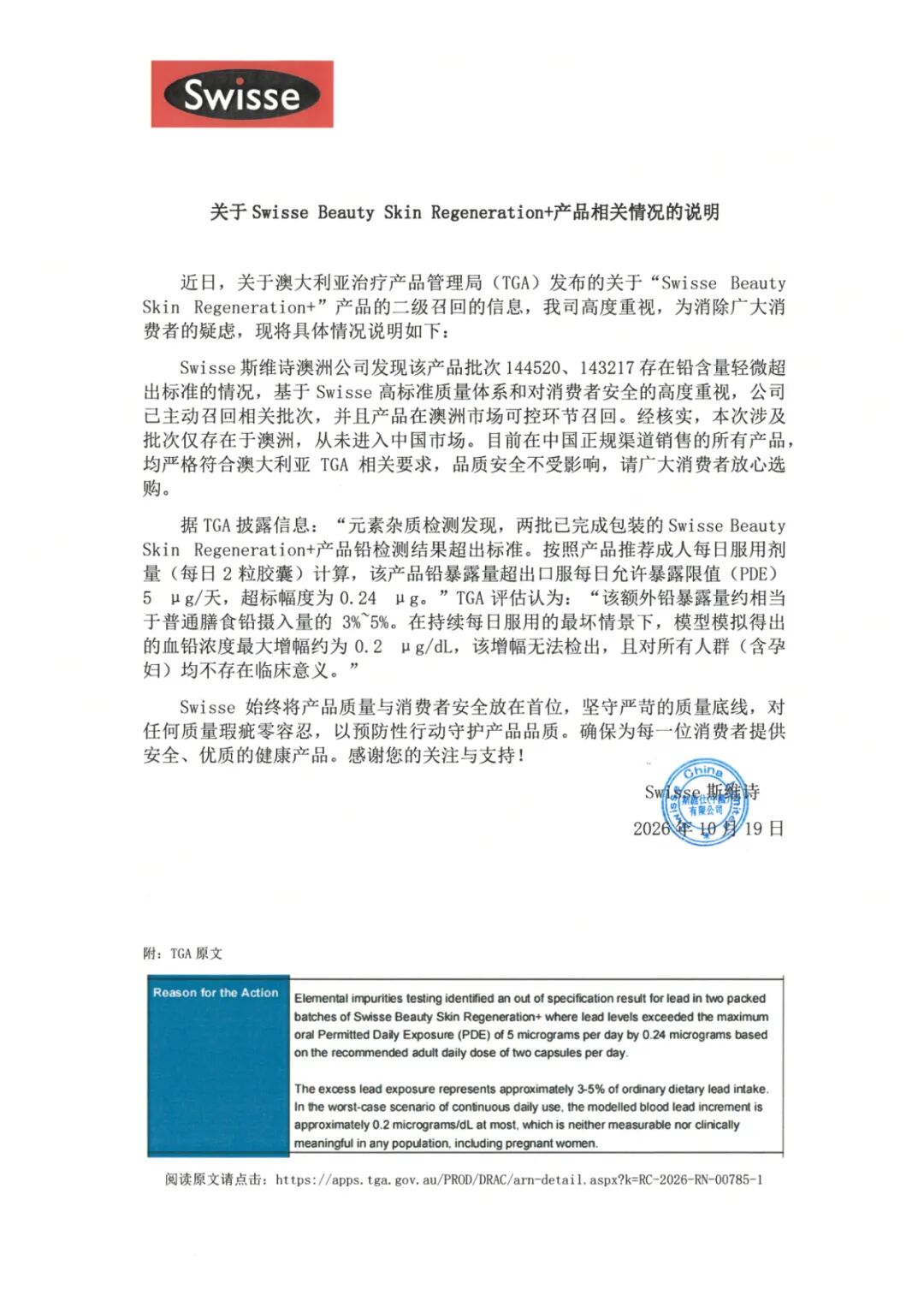
近日,关于澳大利亚治疗产品管理局(TGA)发布的关于“Swisse Beauty Skin Regeneration+”产品的二级召回的信息,我司高度重视,为消除广大消费者的疑虑,现将具体情况说明如下:

Swisse斯维诗澳洲公司发现该产品批次144520、143217存在铅含量轻微超出标准的情况,基于Swisse高标准质量体系和对消费者安全的高度重视,公司已主动召回相关批次,并且产品在澳洲市场可控环节召回。经核实,本次涉及批次仅存在于澳洲,从未进入中国市场。目前在中国正规渠道销售的所有产品,均严格符合澳大利亚TGA相关要求,品质安全不受影响,请广大消费者放心选购。

据TGA披露信息:“元素杂质检测发现,两批已完成包装的Swisse Beauty Skin Regeneration+产品铅检测结果超出标准。按照产品推荐成人每日服用剂量(每日2粒胶囊)计算,该产品铅暴露量超出口服每日允许暴露限值(PDE)5μg/天,超标幅度为0.24μg。”TGA评估认为:“该额外铅暴露量约相当于普通膳食铅摄入量的3%~5%。在持续每日服用的最坏情景下,模型模拟得出的血铅浓度最大增幅约为0.2μg/dL,该增幅无法检出,且对所有人群(含孕妇)均不存在临床意义。”

Swisse始终将产品质量与消费者安全放在首位,坚守严苛的质量底线,对任何质量瑕疵零容忍,以预防性行动守护产品品质。确保为每一位消费者提供安全、优质的健康产品。感谢您的关注与支持!

Swisse斯维诗

2026年10月19日

注:文/龚作仁,文章来源:Laborer,本文为作者独立观点,不代表亿邦动力立场。

文章来源:Laborer

广告
微信
朋友圈

FAQ回顾

Swisse Beauty Skin Regeneration产品为什么被召回?

Swisse Beauty Skin Regeneration产品因批次144520和143217在元素杂质检测中发现铅含量轻微超出标准,Swisse斯维诗澳洲公司基于严格的质量标准主动发起二级召回,涉及产品仅在澳洲市场可控环节召回,未进入中国市场。

Swisse被召回的批次在中国有销售吗?

没有。经核实,本次涉及召回的Swisse Beauty Skin Regeneration批次144520和143217仅存在于澳大利亚市场,从未进入中国。目前中国正规渠道销售的所有Swisse产品均严格符合澳大利亚TGA相关要求,品质安全不受影响。

Swisse产品铅超标对健康有什么影响?

据TGA披露,该产品铅暴露量超出口服每日允许暴露限值(PDE)5μg/天,超标幅度为0.24μg,额外铅暴露量约相当于普通膳食铅摄入量的3%~5%。在最坏情景下血铅浓度最大增幅约0.2μg/dL,该增幅无法检出,对所有人群包括孕妇均无临床意义。

TGA是什么机构?

TGA是澳大利亚治疗产品管理局(Therapeutic Goods Administration),负责监管澳大利亚的治疗产品,包括药品、医疗器械和保健品等。Swisse Beauty Skin Regeneration产品召回信息就是由该机构发布的,其对铅超标情况进行了评估并披露了相关数据。

这么好看,分享一下?

朋友圈 分享

APP内打开

赞 +1
+1
微信好友 朋友圈 新浪微博 QQ空间
关闭
收藏成功
发送
/140 0

