广告
加载中

顺丰同城承接顺丰集团无人车运力网络 场景规模带来想象空间

龚作仁 2026-10-13 13:46
龚作仁 2026/10/13 13:46

邦小白快读

EN
全文速览

无人配送已进入规模化商用阶段,顺丰同城承接集团无人车资源后,能为普通用户带来更高效、更稳定的配送体验。

1. 规模可观:顺丰同城无人车已覆盖全国124个城市,运营车辆超1000台,月均活跃行程超6万趟;全行业活跃Robovan已超万台,街头常见无人车身影。

2. 成本下降:无人车整车成本已降至5万至10万元,月度使用成本较人工约低40%,订单越多成本越被摊薄,有利于降低配送费用。

3. 场景更广:无人车已从快递末端扩展至商超、餐饮、校园园区等场景,支持7×24小时作业,尤其在夜间和低客流区域能弥补人力不足,并在大促高峰时削峰填谷。

无人配送正在重塑最后一公里履约,品牌商可关注即时零售场景中的体验提升与成本优化。

1. 消费趋势:即时零售市场快速崛起,消费者对配送时效和稳定性要求更高,无人车不受天气和复杂路况制约,能提升履约稳定性和用户满意度。

2. 场景合作:餐饮商超、校园园区等标准化场景已落地,快餐商家可与无人车企业合作打造空中+地面立体化智慧餐配方案,扩展外卖和即时零售覆盖半径。

3. 成本空间:无人车月度使用成本较人工约低40%,长期看有助于降低品牌商的末端履约成本,为价格竞争和服务升级留出空间。

对卖家而言,无人车运力扩张带来配送成本降低和履约能力提升,也提示即时零售与私域流量运营的新机会。

1. 市场增长:即时零售催生大量短途配送需求,无人车成本优势明显,卖家可借助平台无人运力降低配送成本,尤其在订单高峰期获得稳定运力。

2. 机会点:顺丰同城作为中立第三方,可接入连锁品牌商户、中小商户的私域流量,卖家可结合无人车共享运力拓展夜间及低客流区域的配送业务,提升覆盖能力。

3. 风险与应对:无人车商业化仍处于内部试点阶段,路权政策尚在完善中,卖家应关注政策进展,选择与有规模化运营能力的平台合作,稳妥尝试无人配送服务。

无人车规模增长为制造端带来明确商业机会,工厂可围绕整车、零部件及专业装备进行布局。

1. 需求规模:预计2030年底活跃无人配送车将超百万台,快递场景渗透率有望接近50%,无人车整车需求巨大,当前整车成本已降至5万至10万元。

2. 产品设计:无人车需适配快递末端接驳、网点集散、餐饮商超、校园园区等多样化场景,工厂应开发标准化、模块化车型,并关注车辆维保等运营服务需求。

3. 数字化启示:头部企业已用AI+无人打造第二曲线,工厂推进数字化时可借鉴无人车运营中的线路规划、车辆管理等软件能力,形成软硬一体解决方案。

无人配送正从工具升级为独立运力平台,服务商可围绕技术、运营和平台化寻找机会。

1. 行业趋势:无人车成本大幅下降,规模化应用拐点已到,顺丰同城承接集团资源并推出无人车共享运力服务,行业进入资源整合阶段。

2. 客户痛点:配送成本高、夜间和低客流运力不足、履约稳定性差是即时配送的主要痛点,无人车+人工混合调度可有效缓解。

3. 解决方案:可提供无人车租赁、代运营、共享运力池和行业解决方案;也可研发线路规划、车辆管理等软件系统,以及车辆维保等线下运营服务。

4. 平台机会:从使用无人车到运营无人车,再向无人货运撮合平台演进,服务商可参与上下游撮合,对接车企、装备供应商和下游客户。

顺丰同城无人车布局为平台商提供了运力整合、共享运营和撮合模式参考。

1. 平台需求:即时配送平台需要规模化稳定运力,无人车作为固定成本资产,可提高资源利用率,7×24小时作业能弥补人力缺口,降低综合配送成本。

2. 最新做法:顺丰同城通过租赁框架协议承接集团无人车资源,统一为集团内外客户提供无人配送;并推出无人车共享运力服务,扩大共享运力池。

3. 商业模式参考:打造无人货运撮合平台,上游对接车企和无人化装备供应商,中游扮演代运营商帮车企找客户、提供维保,下游提供软硬件一体化无人配送服务。

4. 风控启示:路权政策、安全责任规则仍在完善,目前以内部试点为主,平台商应关注政策节奏,逐步推进对外商业化。

无人配送正进入规模化与平台化阶段,顺丰同城案例展示了新的商业模式和政策议题。

1. 产业动向:截至2025年底,物流行业活跃Robovan已超万台,顺丰同城覆盖124城、运营超1000台,无人车从工具试点升级为规模化运力,并在618大促中发挥削峰填谷作用。

2. 成本逻辑:骑手成本随订单量线性增长,无人车是固定成本,订单规模越大成本越摊薄,月度成本较人工约低40%,改变了配送行业的成本结构。

3. 商业模式:共享运力、内部租赁、无人货运撮合平台等模式出现,从使用无人车到运营无人车,再向独立运力平台演进,为平台化研究提供新样本。

4. 政策启示:路权政策、安全责任、基建规划是无人车渗透率提升的关键,相关政策加速出台将带来百万台级市场,也需关注无人配送的监管框架。

返回默认
声明:快读内容全程由AI生成,请注意甄别信息。如您发现问题,请发送邮件至 run@ebrun.com 。

我是 品牌商 卖家 工厂 服务商 平台商 研究者 帮我再读一遍。

Quick Summary

Autonomous delivery has entered the stage of large-scale commercial deployment. By integrating the Group's self-driving vehicle resources, SF City Express can deliver a more efficient and reliable experience for everyday users.

1. Significant scale: SF City Express' autonomous vehicles now cover 124 cities nationwide, with over 1,000 vehicles in operation and more than 60,000 active trips per month. Across the industry, active Robovans have surpassed 10,000 units, making autonomous vehicles a common sight on city streets.

2. Lower costs: The cost of a complete autonomous vehicle has dropped to RMB 50,000–100,000, and monthly operating costs are roughly 40% lower than those of human labor. The more orders, the more costs are amortized, helping to reduce delivery fees.

3. Broader scenarios: Autonomous vehicles have expanded from last-mile parcel delivery to supermarkets, restaurants, and campus zones. They support 7×24 operations, especially compensating for labor shortages at night and in low-demand areas, while smoothing peaks during promotional seasons.

Autonomous delivery is reshaping last-mile fulfillment, offering brands opportunities to improve customer experience and optimize costs in instant retail.

1. Consumer trend: The instant retail market is growing rapidly, with consumers demanding faster, more reliable delivery. Autonomous vehicles, unaffected by weather or complex road conditions, can enhance fulfillment consistency and user satisfaction.

2. Scenario partnerships: Standardized settings such as restaurants, supermarkets, and campuses have been deployed. Quick-service restaurants can partner with autonomous vehicle companies to create integrated air-and-ground smart meal delivery solutions, expanding the reach of food delivery and instant retail.

3. Cost headroom: Monthly operating costs for autonomous vehicles are about 40% lower than human labor, which can reduce brands' last-mile fulfillment expenses over time, creating room for price competition and service upgrades.

For sellers, the expansion of autonomous delivery capacity lowers delivery costs and strengthens fulfillment capabilities, while also pointing to new opportunities in instant retail and private-domain traffic operations.

1. Market growth: Instant retail is generating strong demand for short-distance delivery, and autonomous vehicles offer clear cost advantages. Sellers can use platform-based autonomous capacity to reduce delivery costs and secure stable capacity during peak order periods.

2. Opportunity: As a neutral third-party platform, SF City Express can access the private-domain traffic of chain merchants and SMBs. Sellers can combine shared autonomous capacity with nighttime and low-demand area delivery to expand coverage.

3. Risk and response: Autonomous delivery commercialization is still in pilot phases, with right-of-way policies still evolving. Sellers should monitor policy developments, choose partners with large-scale operational experience, and adopt autonomous delivery services prudently.

The rapid growth of autonomous vehicles creates clear commercial opportunities for manufacturers, who can position themselves around complete vehicles, components, and specialized equipment.

1. Demand scale: By 2030, the number of active autonomous delivery vehicles is expected to exceed one million, with penetration in the express delivery scenario potentially nearing 50%. Demand for complete vehicles is enormous, and vehicle costs have already dropped to RMB 50,000–100,000.

2. Product design: Autonomous vehicles must accommodate diverse scenarios such as parcel terminal transfer, sorting center distribution, restaurants, supermarkets, and campuses. Factories should develop standardized, modular vehicle models and address operational service needs like maintenance.

3. Digital insights: Leading companies are using AI and unmanned technology to build second growth curves. When advancing digitalization, factories can draw on software capabilities from autonomous vehicle operations—such as route planning and fleet management—to create integrated hardware-and-software solutions.

Autonomous delivery is evolving from a tool into an independent capacity platform, opening opportunities for service providers in technology, operations, and platformization.

1. Industry trend: The sharp decline in autonomous vehicle costs signals that the inflection point for large-scale adoption has arrived. SF City Express' integration of Group resources and launch of shared autonomous capacity services indicate that the industry is entering a phase of resource consolidation.

2. Customer pain points: High delivery costs, insufficient nighttime and low-demand capacity, and unstable fulfillment are key challenges in instant delivery. Mixed human-autonomous dispatch can effectively alleviate these issues.

3. Solutions: Service providers can offer autonomous vehicle leasing, managed operations, shared capacity pools, and industry-specific solutions. They can also develop software for route planning and fleet management, as well as offline services such as vehicle maintenance.

4. Platform opportunity: The path runs from using autonomous vehicles to operating them, and then to evolving into freight-matching platforms. Service providers can participate in upstream-downstream matching, connecting vehicle manufacturers, equipment suppliers, and downstream customers.

SF City Express' autonomous vehicle strategy offers platform operators a reference model for capacity integration, shared operations, and matchmaking.

1. Platform demand: Instant delivery platforms need large-scale, stable capacity. Autonomous vehicles, as fixed-cost assets, can improve resource utilization, and their 7×24 operations can fill labor gaps and lower comprehensive delivery costs.

2. Latest practice: SF City Express has signed a leasing framework agreement to take over the Group's autonomous vehicle resources and provide unified autonomous delivery services for both internal and external customers. It has also launched shared autonomous capacity services to expand the capacity pool.

3. Business model reference: Build an autonomous freight-matching platform that connects vehicle manufacturers and unmanned equipment suppliers upstream, serves as a contract operator in the middle to help carmakers find customers and provide maintenance, and delivers integrated hardware-and-software autonomous delivery services downstream.

4. Risk control insights: Right-of-way policies and safety liability rules are still being refined, and current deployments are mainly internal pilots. Platform operators should closely track policy developments and gradually advance external commercialization.

Autonomous delivery is entering a phase of scaling and platformization, and the SF City Express case illustrates emerging business models and policy issues.

1. Industry dynamics: As of the end of 2025, active Robovans in the logistics industry surpassed 10,000 units, while SF City Express covered 124 cities with more than 1,000 vehicles. Autonomous vehicles have evolved from tool-based pilots into scaled capacity, playing a peak-shaving role during major promotional events like 618.

2. Cost logic: Rider costs grow linearly with order volume, whereas autonomous vehicles are a fixed cost—the larger the order scale, the more costs are amortized. With monthly costs roughly 40% lower than human labor, autonomous delivery is changing the cost structure of the delivery industry.

3. Business models: Models such as shared capacity, internal leasing, and autonomous freight-matching platforms are emerging. The trajectory—from using autonomous vehicles to operating them, and then to independent capacity platforms—provides a new sample for platformization research.

4. Policy implications: Right-of-way rules, safety liability, and infrastructure planning are critical to the penetration of autonomous vehicles. More rapid policy rollouts could unlock a market of millions of vehicles, but the regulatory framework for autonomous delivery must also be closely examined.

Disclaimer: The "Quick Summary" content is entirely generated by AI. Please exercise discretion when interpreting the information. For issues or corrections, please email run@ebrun.com .

I am a Brand Seller Factory Service Provider Marketplace Seller Researcher Read it again.

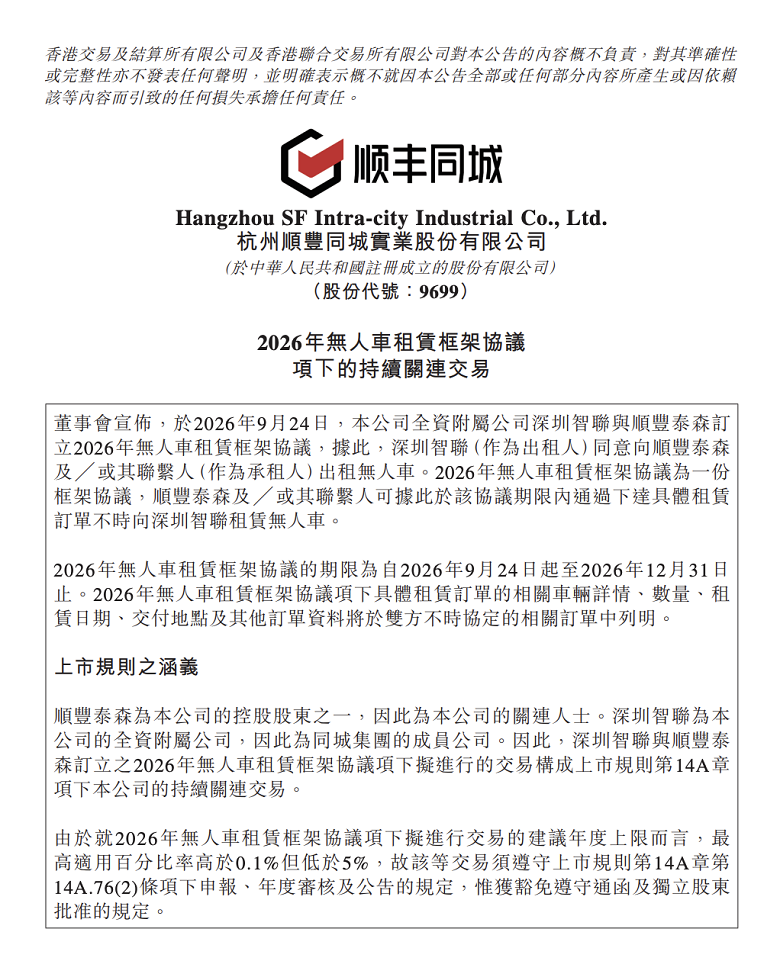
9月24日,顺丰同城(9699.HK)在港交所披露一则关连交易公告:其全资附属公司深圳智联(出租人)于2026年9月24日与控股股东顺丰泰森及/或其联系人(承租人)签订2026年无人车租赁框架协议,截至2026年12月31日止年度的建议年度上限为人民币2850万元。

公告还提到,协议“旨在促进同城集团与顺丰集团资源共享,支持无人车运营平台发展,提升议价能力,深化‘最后一公里’配送合作,推动业务增长及多元化”,意味着顺丰同城开始承接集团层面的无人车业务,并且以可计价、可结算的方式,在顺丰集团体系内制度化运作。业内开始审视:无人配送对即时配送而言价值几何?无人运力是否到了商业化的关键节点?顺丰同城自身的独立第三方定位,为无人车业务开展带来什么样的想象空间?

无人车已在财报叙事中占据相当分量

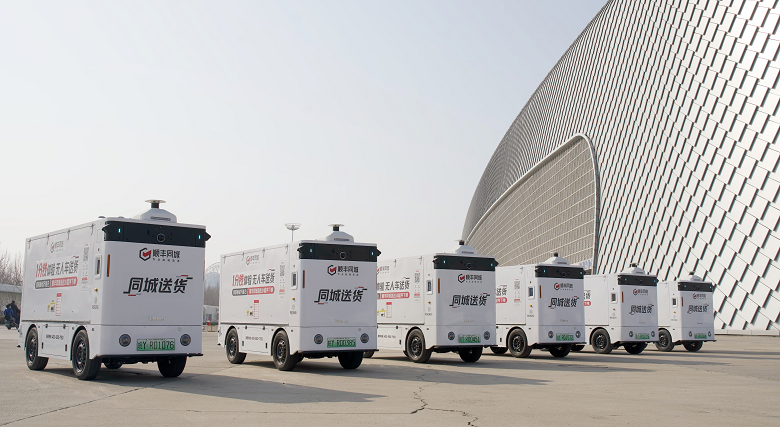
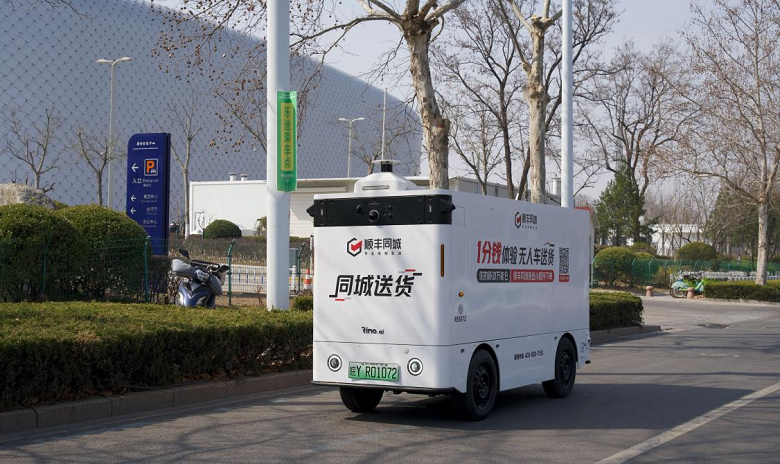
《智行未来:物流无人车商业化应用与场景重塑展望》白皮书指出,截至2025年年底,我国物流行业活跃Robovan数已超过万台。其中,几大快递物流运营商扮演了领跑角色,街头巷尾常见印着快递logo的无人车身影。在本次租赁协议落地之后,顺丰同城无人车业务开始上升到集团层面,投放规模、业务场景、组织布局均得到大幅拓展,已具备行业头部的体量。

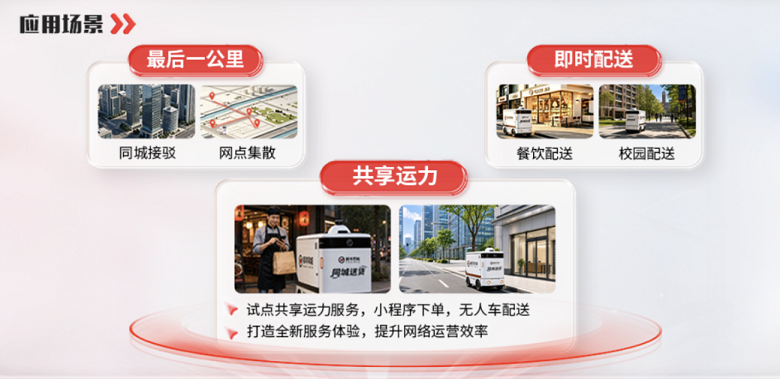
此前,顺丰同城发布2026年中期业绩报告,其无人车网络已覆盖全国124个城市,运营车辆规模超1,000台,月均活跃行程数超6万趟。签署租赁协议之后,顺丰同城将承接集团内无人车资源,规模登上新台阶。同时应用场景从快递末端接驳,扩展至网点集散、餐饮商超、校园园区等标准化片段,并且与顺丰集团更多业务进行协同联动。

规模和场景双升级,标志着无人车从早期的工具试点,升级为规模化的运力资源,尤其在618大促等订单高峰期间,扮演了“削峰填谷”的角色。

同时,顺丰同城立足自身即时配送业务特征,持续创新物流无人车的价值场景,例如创新试点无人车共享运力服务,包括同城重货配送、B2B城配服务等;与快餐商家合作构建“空中+地面”立体化无人智慧餐配方案,不受天气变化与复杂路况制约;与顺丰速运、云迹科技合作探索楼宇机器人,补齐“最后100米”等。这些场景进一步拓展了无人车的适用范围,提升车辆使用率与网络整体运营效率。此次租赁框架协议,补足了顺丰集团运力体系拼图,也被视为无人车业务对外商业化运营前的“内部试点”。

无人配送改变了成本逻辑和业务逻辑

除了内部协同,无人车能为即时配送带来什么价值?顺丰同城2026年中期业绩报告显示其盈利质量稳步提升,归因于规模效应、精益化运营与AI技术应用的全链协同,这一表述清晰地传递出背后成本结构的方向性变化,对行业具备很大参考意义。

从降本的角度看,骑手成本是变动成本,随订单量线性增长;无人车是固定成本,订单数量越大、应用场景越丰富,其成本会进一步摊薄。中物联智慧物流分会报告佐证了这一观点:截至2026年一季度,随着无人配送车保有量持续提升,整车成本降至5万元至10万元,月度使用成本较人工约低40%。因此在新消费催动即时零售市场快速崛起的背景下,作为即时配送平台的顺丰同城,天然具备无人车落地的规模优势和场景优势。

今年,顺丰同城推出了“无人车共享运力服务”,而本次关连交易进一步放大了“共享运力池”,以更高效的资源调配实现经济效益:

一方面,顺丰同城承接集团无人车整体运营,在扩大无人车运力网络的同时,统一为顺丰集团内部或外部客户提供无人配送服务,可7×24小时全天候作业,尤其是夜间、低客流区域等传统人力较难覆盖的环节,实现单车使用率与网络运营效率最大化,减少闲置时间,加速固定成本摊薄;另一方面,无人车带来履约稳定性的提升和自动化的提效,为其进一步商业化提供了基础,顺丰同城在集团内部探索无人车共享或租赁模式,有望带来更多的收入增量。

可以说,共享运力服务让无人车从内部的降本工具,开始具备独立创造收入的雏形,这点已经从顺丰同城“AI+无人”的“第二曲线”得到验证。

独立第三方定位带来的想象空间

从内部工具到集团协同之后,无人车“走出去”的前景是否明朗?《智行未来:物流无人车商业化应用与场景重塑展望》预计,随着无人驾驶路权政策加速出台、无人车相关基建规划落地,2030年底活跃无人配送车将超百万台,在快递场景的渗透率有望接近50%,用车需求将大幅提升。

在这一赛道下,顺丰同城凭借自身不绑定任何平台的中立第三方稀缺定位,能够接入并整合来自连锁品牌商户、中小商户等私域流量,以及与各大本地生活平台、新零售生态、品牌生态等外部合作,在为无人车提供持续订单密度的同时,带来全场景高频复用率,进一步摊薄成本,再加大对无人车队的投入,形成“滚雪球”的正向循环。

同时,顺丰同城在无人车领域的目标似乎不止于“卖运力”。据消息人士透露,顺丰同城希望打造综合化的无人货运撮合平台,在上游对接车企、无人化装备供应商,通过自主研发软件能力如线路规划、车辆管理等,打造行业解决方案;在中游面向车企扮演代运营商的角色,帮助车企找客户、拓市场,提供车辆维保等线下运营服务;面向下游客户,立足在即时配送主业中积累的行业know-how,贴合场景需求,提供软硬件一体化的无人配送服务。

可以看到,从“使用无人车”到“运营无人车”,再向独立的无人运力平台演进,顺丰同城正在建立清晰的商业化逻辑。规模优势、场景优势和定位优势,为顺丰同城无人车业务带来更大想象空间,甚至有望成为行业领先的无人运力平台。当无人车经济模型进一步细化,路权和安全责任进一步完善,无人物流车行业或将迎来自己的“滴滴时刻”。

注:文/龚作仁,文章来源:Laborer,本文为作者独立观点,不代表亿邦动力立场。

文章来源:Laborer

广告
微信
朋友圈

FAQ回顾

顺丰同城的无人车业务目前有多少车辆和覆盖范围?

顺丰同城2026年中期业绩报告显示,其无人车网络已覆盖全国124个城市,运营车辆规模超1000台,月均活跃行程数超6万趟。承接集团无人车资源后,规模进一步扩大,场景从快递末端接驳扩展至网点集散、餐饮商超、校园园区等标准化片段。

无人配送车相比人工配送的成本优势有多大?

中物联智慧物流分会报告显示,截至2026年一季度,无人配送车整车成本已降至5万元至10万元,月度使用成本较人工约低40%。无人车属于固定成本,订单量越大、场景越丰富,成本越被摊薄,因此成为即时配送平台降本增效的重要工具。

顺丰同城的“无人车共享运力服务”具体是怎么运作的?

顺丰同城通过承接集团无人车整体运营,统一为顺丰集团内部或外部客户提供无人配送服务,可7×24小时全天候作业,覆盖夜间、低客流区域等传统人力难覆盖的环节。共享运力池能提高单车使用率,减少闲置时间,并探索对外共享或租赁模式,带来收入增量。

无人车在物流行业的未来规模有多大?

根据《智行未来:物流无人车商业化应用与场景重塑展望》白皮书预测,随着无人驾驶路权政策加速出台和基建规划落地,到2030年底活跃无人配送车将超过100万台,在快递场景的渗透率有望接近50%。这意味着无人运力需求将大幅提升,具备规模优势的平台将受益。

顺丰同城在无人车领域的长期目标是什么?

顺丰同城希望打造综合化的无人货运撮合平台:上游对接车企和无人化装备供应商,提供线路规划、车辆管理等软件能力;中游为车企担任代运营商,帮助拓展客户和提供维保;下游为客户提供软硬件一体化的无人配送服务,从“使用无人车”转向“运营无人车”。

这么好看,分享一下?

朋友圈 分享

APP内打开

赞 +1
+1
微信好友 朋友圈 新浪微博 QQ空间
关闭
收藏成功
发送
/140 0