





广告
加载中

荣耀亲选智能手表6i正式发布:二百元价位段的质感之选 大屏长续航兼具

龚作仁 2026-09-29 11:59
龚作仁 2026/09/29 11:59

邦小白快读

EN
全文速览

这款手表主打二百元价位的高性价比,核心亮点集中在大屏、长续航和日常便利功能。

1.价格与屏幕:首发价235元起,2.08英寸AMOLED屏,屏占比82.3%,峰值亮度1000nits,户外阳光下也能看清。

2.续航:典型使用最长20天,重度使用16天,开启常亮显示6天;长续航保证夜间佩戴记录不中断,短途出行不用带充电器。

3.日常功能:支持NFC支付、门禁卡、电动车钥匙和蓝牙通话,抬腕即可处理通勤、归家和接电话。

4.健康管理:全天候心率、血氧、睡眠、压力监测,并提供免费自适应情绪表盘;数据只作日常健康参考。

从这款产品可读出荣耀亲选在二百元档位的品牌策略:用接近旗舰的显示与续航配置做大众化手表,用设计和生态功能制造差异化。

1.品牌定位、定价与渠道:235元定价强调“质感之选”,以完整功能组合进入二百元大众市场;首发放在荣耀亲选官方渠道,利于积累首批用户和口碑。产品研发以屏幕、续航和常用健康功能建立性价比认知。

2.设计与消费趋势:白昼鎏金和夜湖之镜两款配色构成昼夜主题,适配通勤、校园与休闲穿搭;可换表盘表带满足个性化需求,显示年轻用户追求风格可变。

3.用户行为洞察:NFC支付、门禁、电动车钥匙和蓝牙通话覆盖高频出行场景,说明目标用户看重少拿手机的便利;全天候健康监测和长续航对应夜间持续佩戴习惯。

4.生态合作:手表电动车钥匙适配小牛电动、台铃等品牌,体现硬件互联拓展使用场景的合作方式。

本次新品发布提供了一个观察二百元智能手表需求窗口的机会,卖家可重点关注功能组合、场景化卖点和生态兼容带来的销售角度。

1.增长市场:二百元价位段被寄望成为走量市场,产品以2.08英寸大屏、20天长续航和NFC/蓝牙通话组合覆盖平价全能需求,这类组合容易成为搜索和比价中的卖点。

2.消费需求变化:消费者不再只关注计步,开始要求大屏显示、户外可读、夜间健康监测和出行便捷;销售话术应从手环替代转向完整手表体验。

3.机会提示:手表支持NFC门禁、支付和电动车钥匙,适合面向通勤人群、校园用户和骑行用户推广;免费情绪表盘和近百种运动模式可作为差异化介绍。

4.风险与应对:文章明确健康数据仅用于日常健康管理参考,介绍时不能夸大医疗功能;同时注意不同手机系统适配,可强调安卓、苹果和鸿蒙用户均能配对,降低购买顾虑。

这款产品透露出大众智能手表在显示、续航和外观工艺上的硬件要求,为供应链和制造商带来明确的器件与设计方向。

1.屏幕需求:2.08英寸AMOLED、82.3%屏占比、1.85mm黑边、1000nits峰值亮度、60Hz刷新率和303PPI,指向大尺寸、高亮度、窄边框的显示模组需求。

2.结构与外观工艺:方形大屏搭配金属表冠,表冠需有清晰物理反馈;两款表圈撞色处理增加了金属或喷涂工艺的定制需求,表带快拆设计则催生多材质、多颜色配件的生产机会。

3.电池与续航设计:典型20天、重度16天、AOD 6天的续航目标,对电源管理、低功耗芯片和电池容量提出要求,同时夜间持续佩戴理念影响产品功耗与充电方案设计。

4.生态模块:NFC、蓝牙通话、电动车钥匙适配等功能需要集成相应通信与安全模块;运动健康App需兼容Android、iOS与HarmonyOS,意味着数据接口和认证测试需求增加。

服务商可围绕缓解用户续航焦虑、户外阅读不便、手机依赖和生态锁定等痛点,为智能穿戴产品提供技术与运营支持。

1.行业趋势:二百元档智能手表开始集成大屏、长续航、NFC、蓝牙通话和全天候健康监测,显示低价不低配是现阶段竞争方向。

2.客户痛点:夜间充电会打断连续健康记录,短途出差带充电器麻烦;户外强光下表盘难读;手机在包里时接电话不便。

3.解决方案方向:以1000nits高亮度和自动感光适应户外与暗光环境;以20天典型续航支持整夜佩戴和短途出行;用NFC与蓝牙通话减少取手机动作。

4.合规与差异化服务:健康数据被明确限定为日常参考,服务商可在数据可视化、报告解读和隐私保护上提供辅助,同时帮助客户开发情绪表盘、运动自动识别等增值功能。

对智能穿戴相关平台而言,这款产品显示平台需要同时抓住硬件卖点、生态兼容和健康数据入口,才能增加用户黏性。

1.平台机会:荣耀亲选官方渠道首销,说明自有商城承担新品首发与流量聚集角色;平台可围绕235元性价比智能手表建立入门级穿戴品类运营活动。

2.生态做法:手表App兼容Android、iOS与HarmonyOS,跨系统配对降低用户换机流失风险;平台应把换机数据同步作为留存与迁移的运营卖点。

3.运营管理:NFC门禁、支付和电动车钥匙等功能涉及出行场景,平台可联合小牛电动、台铃等品牌做场景化营销;表带和表盘自由搭配则适合开展配件、皮肤类内容运营。

4.风控提示:健康监测数据仅用于日常参考,平台在上架、详情页和活动推广中需避免医疗功效暗示,同时注意不同手机系统下的功能兼容与安全审核。

该产品可以作为研究大众智能手表市场定位、功能下沉与生态合作模式的案例,重点观察二百元价位如何平衡成本与体验。

1.产业新动向:二百元价位开始出现2.08英寸AMOLED大屏、20天长续航、NFC与蓝牙通话的完整组合,说明智能手表功能正从高端向大众市场快速渗透。

2.商业模式:荣耀亲选采用亲选渠道首发、低价硬件吸引用户,再通过运动健康App沉淀数据、表盘表带配件和生态互联增加附加价值的模式;与电动车品牌的适配也展示了跨界合作扩大使用场景的方式。

3.新问题与启示:健康数据被标注为仅作日常参考,揭示智能健康设备的医疗边界问题;长续航与AOD的续航差异也带来显示常亮与功耗的设计权衡问题。

4.研究建议:可进一步研究用户在二百元档选择智能手表的关键功能优先级,以及跨手机系统兼容策略对品牌忠诚度的影响。

返回默认
声明:快读内容全程由AI生成,请注意甄别信息。如您发现问题,请发送邮件至 run@ebrun.com 。

我是 品牌商 卖家 工厂 服务商 平台商 研究者 帮我再读一遍。

Quick Summary

This watch focuses on high cost-performance at the 200-yuan price point, with core highlights centered on a large screen, long battery life, and everyday convenience features.

1. Price and display: Starting at 235 yuan, it features a 2.08-inch AMOLED screen with an 82.3% screen-to-body ratio and 1,000 nits peak brightness, ensuring readability even in direct sunlight.

2. Battery life: Up to 20 days in typical use, 16 days under heavy use, and 6 days with always-on display enabled; the long battery life supports uninterrupted overnight wear and allows short trips without a charger.

3. Everyday features: Supports NFC payments, access cards, e-bike keys, and Bluetooth calling, allowing users to handle commuting, entering home, and answering calls with a wrist raise.

4. Health management: Provides 24/7 heart rate, blood oxygen, sleep, and stress monitoring, plus a free adaptive emotion watch face; data is intended for everyday health reference only.

This product reveals Honor Select's brand strategy in the 200-yuan segment: using near-flagship display and battery configurations to create a mass-market watch, while differentiating through design and ecosystem features.

1. Brand positioning, pricing, and channels: The 235-yuan price emphasizes "quality choice," entering the 200-yuan mass market with a full feature set; the initial launch on Honor Select's official channel helps build an early user base and word-of-mouth. Product development establishes cost-performance perception through screen, battery, and commonly used health functions.

2. Design and consumer trends: The two colorways, Daylight Gold and Night Lake Mirror, form a day-and-night theme suited to commuting, campus, and casual wear; interchangeable watch faces and straps cater to personalization, reflecting young users' desire for style flexibility.

3. User behavior insights: NFC payment, access control, e-bike keys, and Bluetooth calling cover high-frequency travel scenarios, indicating that target users value the convenience of not reaching for their phones; all-day health monitoring and long battery life correspond to overnight wear habits.

4. Ecosystem collaboration: The watch's e-bike key feature is compatible with brands such as NIU and Tailg, demonstrating a hardware-interconnection approach to expanding usage scenarios.

This new product launch offers an opportunity to observe demand in the 200-yuan smartwatch segment; sellers should focus on the sales angles provided by feature combinations, scenario-based selling points, and ecosystem compatibility.

1. Growth market: The 200-yuan price band is expected to become a volume-driven market; this product combines a 2.08-inch large screen, 20-day battery life, and NFC/Bluetooth calling to cover affordable all-in-one needs, making it easy to highlight in search and price comparisons.

2. Changing consumer demand: Consumers are no longer focused only on step counting; they now demand large displays, outdoor readability, nighttime health monitoring, and travel convenience; sales messaging should shift from band replacement to a complete watch experience.

3. Opportunity cues: The watch supports NFC access, payment, and e-bike keys, making it suitable for promoting to commuters, campus users, and cyclists; the free emotion watch face and nearly 100 sports modes can be introduced as differentiators.

4. Risks and responses: The article clearly states that health data is for everyday health management reference only, so medical functions must not be overstated; also, attention should be paid to compatibility across phone systems, emphasizing that Android, Apple, and HarmonyOS users can pair with ease to reduce purchase hesitation.

This product reveals the hardware requirements for mass-market smartwatches in terms of display, battery life, and exterior craftsmanship, providing clear component and design directions for suppliers and manufacturers.

1. Screen demand: A 2.08-inch AMOLED, 82.3% screen-to-body ratio, 1.85mm bezel, 1,000 nits peak brightness, 60Hz refresh rate, and 303PPI point to demand for large, high-brightness, narrow-bezel display modules.

2. Structure and exterior finishing: A square large screen paired with a metal crown requires clear physical feedback from the crown; the two-tone bezel treatment creates customization needs for metal or spray-coating processes, while the quick-release strap design generates production opportunities for multi-material, multi-color accessories.

3. Battery and endurance design: The targets of 20 days typical use, 16 days heavy use, and 6 days with AOD place demands on power management, low-power chips, and battery capacity; meanwhile, the concept of overnight wear affects product power consumption and charging scheme design.

4. Ecosystem modules: NFC, Bluetooth calling, e-bike key adaptation, and other features require integrated communication and security modules; the sports and health app must be compatible with Android, iOS, and HarmonyOS, implying increased demand for data interfaces and certification testing.

Service providers can offer technical and operational support for smart wearables by addressing pain points such as battery anxiety, outdoor readability issues, phone dependency, and ecosystem lock-in.

1. Industry trend: Smartwatches in the 200-yuan range are beginning to integrate large screens, long battery life, NFC, Bluetooth calling, and all-day health monitoring, indicating that "low price but not low specs" is the current competitive direction.

2. Customer pain points: Charging at night interrupts continuous health records; carrying a charger for short trips is inconvenient; watch faces are hard to read in strong outdoor light; answering calls is difficult when the phone is in a bag.

3. Solution directions: Use 1,000 nits of brightness and automatic light sensing to adapt to outdoor and low-light environments; support all-night wear and short trips with 20 days of typical battery life; reduce phone-grabbing actions through NFC and Bluetooth calling.

4. Compliance and differentiated services: Health data is explicitly limited to everyday reference; service providers can assist with data visualization, report interpretation, and privacy protection, while helping clients develop value-added features such as emotion watch faces and automatic workout detection.

For platforms related to smart wearables, this product shows that platforms need to capture hardware selling points, ecosystem compatibility, and health data entry points simultaneously to increase user stickiness.

1. Platform opportunity: The launch on Honor Select's official channel indicates that the proprietary mall plays a role in new product debuts and traffic aggregation; platforms can build entry-level wearable category operations around the 235-yuan cost-effective smartwatch.

2. Ecosystem approach: The watch app is compatible with Android, iOS, and HarmonyOS; cross-system pairing reduces the risk of user churn when switching phones; platforms should use cross-device data sync as an operational selling point for retention and migration.

3. Operations management: Features such as NFC access, payment, and e-bike keys involve travel scenarios; platforms can partner with brands like NIU and Tailg for scenario-based marketing; interchangeable straps and watch faces suit content operations around accessories and themes.

4. Risk control: Health monitoring data is for everyday reference only; platforms must avoid medical efficacy claims in listings, detail pages, and promotional activities, while also paying attention to feature compatibility and security review across different phone systems.

This product can serve as a case study for examining market positioning, feature democratization, and ecosystem collaboration models in the mass-market smartwatch segment, with a focus on how the 200-yuan price point balances cost and experience.

1. Industry dynamics: The 200-yuan segment is now seeing the full combination of a 2.08-inch AMOLED display, 20-day battery life, NFC, and Bluetooth calling, indicating that smartwatch features are rapidly penetrating from high-end to mass-market tiers.

2. Business model: Honor Select adopts a model of launching on its own channel, attracting users with low-cost hardware, then creating added value through the sports and health app for data accumulation, watch face and strap accessories, and ecosystem connectivity; adaptation to e-bike brands also demonstrates cross-industry collaboration to expand usage scenarios.

3. New issues and implications: Health data is labeled as for everyday reference only, revealing the medical boundary issue in smart health devices; the battery life difference between long endurance and AOD also highlights the design trade-off between always-on display and power consumption.

4. Research suggestions: Further research could explore users' key feature priorities when choosing a smartwatch in the 200-yuan range, as well as the impact of cross-phone-system compatibility strategies on brand loyalty.

Disclaimer: The "Quick Summary" content is entirely generated by AI. Please exercise discretion when interpreting the information. For issues or corrections, please email run@ebrun.com .

I am a Brand Seller Factory Service Provider Marketplace Seller Researcher Read it again.

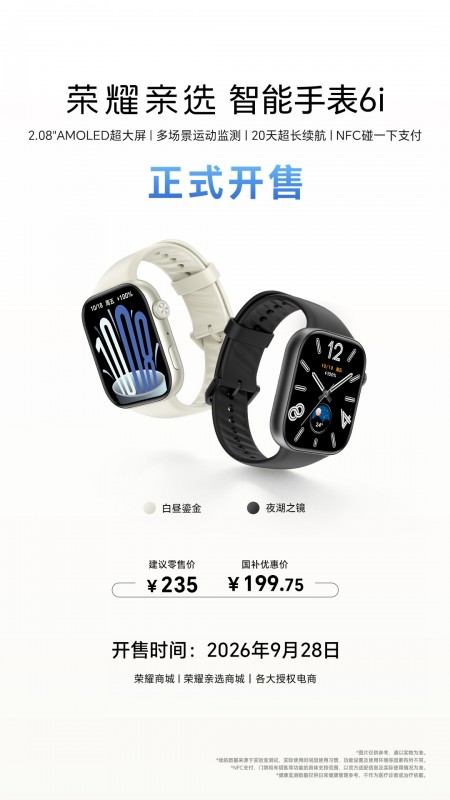
9月28日,荣耀亲选智能手表6i正式发布,同日在荣耀亲选官方渠道开启首销,定价235元起。这款面向大众市场的方形智能手表配备2.08英寸AMOLED超大屏、NFC与蓝牙通话,典型使用续航最长可达20天,并支持全天候心率、血氧与睡眠等健康管理功能,在二百元价位段提供了较为完整的功能组合。

荣耀亲选智能手表6i配备了一块2.08英寸AMOLED的超大屏幕,信息显示更加舒展,全新的表盘图案在屏幕上显示的面积更大,消息、时间与健康数据的显示更加清晰。屏幕拥有82.3%屏占比与1.85mm超窄黑边,正面几乎只剩显示区域;屏幕峰值亮度可达1000nits,日间户外抬腕也能读清内容。内置的感光传感器支持暗光自适应,夜间或低照度环境下,屏幕随环境自动调整亮度,抬腕不会突然刺眼。60Hz刷新率与303 PPI则让滑动操作更顺畅,文字细节也更清晰。

荣耀亲选智能手表6i推出白昼鎏金与夜湖之镜两款配色,共同构成“昼夜轮转”的设计主题:一款对应明亮的白天,一款对应沉静的夜晚。白昼鎏金色调明亮温柔,搭配米白、浅卡其等低饱和穿搭不显突兀;夜湖之镜偏沉稳,通勤、休闲与轻运动场合均能适配。两款配色在表圈处做了不同的撞色处理,配合方形大屏与金属表冠,金属表冠在转动时具备清晰的物理反馈,整体质感实现越级提升。荣耀亲选智能手表6i支持表带自由搭配,更换表带或表盘即可切换腕上风格;相比传统条形手环,也更贴近一块完整手表的佩戴形态,日常佩戴时能适配通勤、校园与休闲等多种穿搭。

荣耀亲选智能手表6i覆盖日常出行中的高频场景,支持NFC支付、电子门禁卡与手表电动车钥匙,早高峰进站、回到小区门口或出入校园,抬腕靠近感应区即可完成,不必从包里取出手机和实体卡。其中手表电动车钥匙已适配小牛电动、台铃等品牌,覆盖日常骑行需求。荣耀亲选智能手表6i同时支持蓝牙通话,手机放在包中时来电可直接抬腕接听,做家务、伏案办公或轻运动时都无须腾出手找手机。两项功能组合,让日常高频使用的场景得到全覆盖。

荣耀亲选智能手表6i支持全天候心率与血氧监测,并提供睡眠、压力、女性生理周期与呼吸相关功能,帮助用户了解日常身体状态,夜间持续佩戴后,睡眠与心率数据可在手表及荣耀运动健康App同步查看,相关数据仅用于日常健康管理参考。运动方面,手表提供近100种运动模式与5种运动自动识别,步行、跑步、骑行、椭圆机与划船机等项目无须每次手动开启记录。荣耀亲选智能手表6i还首次上线免费的自适应情绪表盘,依据0—50、51—80、81—100三档压力区间呈现不同状态。以往压力数据需要用户进入运动健康App后才能查看,这项功能把状态反馈带到手表正面,抬腕即可获得直观参考。

续航表现上,荣耀亲选智能手表6i在典型使用场景最长可达20天,重度使用最长可达16天,开启AOD常亮显示后最长可达6天。长续航的价值不止于降低充电频次,更在于夜间可以持续佩戴,整段的睡眠、心率与压力记录不会因为充电而中断,短途出差或旅行也无须额外携带充电器。

荣耀亲选智能手表6i可通过荣耀运动健康App与手机建立连接,App端兼容Android、iOS与HarmonyOS三类系统,安卓、苹果与鸿蒙用户均可完成配对。手表与手机配对后,运动与健康数据持续同步,更换手机品牌仍可继续使用,原有数据不受影响。


注:文/龚作仁,文章来源:Laborer,本文为作者独立观点,不代表亿邦动力立场。

文章来源:Laborer

广告
微信
朋友圈

FAQ回顾

荣耀亲选智能手表6i有哪些核心配置和功能?

荣耀亲选智能手表6i配备2.08英寸AMOLED大屏,支持NFC支付、门禁卡和电动车钥匙,以及蓝牙通话;支持全天候心率、血氧、睡眠、压力监测和近100种运动模式,典型使用续航最长20天,售价235元起。

荣耀亲选智能手表6i的续航表现怎么样?

荣耀亲选智能手表6i典型使用场景续航最长20天,重度使用最长16天,开启AOD常亮显示后最长6天。长续航使夜间可连续佩戴,睡眠、心率和压力记录不会因充电中断,短途出差或旅行也无须额外携带充电器。

荣耀亲选智能手表6i支持哪些手机系统?

荣耀亲选智能手表6i通过荣耀运动健康App与手机连接,App兼容Android、iOS与HarmonyOS三类系统,安卓、苹果和鸿蒙用户均可配对使用。更换手机品牌后手表可继续使用,原有运动与健康数据不受影响。

荣耀亲选智能手表6i的NFC功能可以做什么?

荣耀亲选智能手表6i支持NFC支付、电子门禁卡和手表电动车钥匙,可用于地铁进站、小区门禁、校园出入和日常骑行;电动车钥匙已适配小牛电动、台铃等品牌,抬腕靠近感应区即可完成操作。

荣耀亲选智能手表6i和传统智能手环有什么区别?

荣耀亲选智能手表6i采用方形大屏和金属表冠,更接近完整手表的佩戴形态,相比传统条形手环,屏幕显示面积更大,支持表盘和表带自由搭配,能适配通勤、校园、休闲和轻运动场景;同时具备NFC、蓝牙通话等功能。

这么好看,分享一下?

朋友圈 分享

APP内打开

赞 +1
+1
微信好友 朋友圈 新浪微博 QQ空间
关闭
收藏成功
发送
/140 0

