





广告
加载中

退机票可以少点“肉疼”了! 飞猪为88VIP、F4及以上会员补贴12%手续费

龚作仁 2026-09-17 10:16
龚作仁 2026/09/17 10:16

邦小白快读

EN
全文速览

中秋、国庆假期机票预订高峰来临,飞猪推出的退票手续费补贴及配套旺季出行保障权益,可帮助普通消费者减少行程变动带来的损失,大家可重点关注相关实操规则合理享受权益。

1.退票补贴权益规则:飞猪F4/F5/F6会员、全量88VIP会员,在飞猪APP或淘宝APP飞猪入口购买本人出行的国内机票,航班起飞前申请退票可享受航司退票标准外的88折优惠,即飞猪补贴12%的手续费,该权益可与航司自有退改权益叠加,每人每自然年可享5次,按航段数扣减次数,例如原手续费1045元的机票,符合条件可立省125.4元。

2.配套旺季保障权益:节假日期间的租车订单,若商家确认订单后无法提供车辆,飞猪会第一时间改派保障用车,按日租金3倍或订单全额二者就高的标准补偿,若消费者自行另订同级别车辆,飞猪除支付补偿金外,还承担上不封顶的预订差价。

飞猪围绕机票退改痛点推出补贴权益、升级双节配套服务保障的动作,为各领域品牌开展用户运营、传递品牌价值、优化权益设计提供了可借鉴的实践样本。

1.痛点锚定的品牌营销思路:机票退改贵、退改难是消费者长期面临的核心痛点,航司因航班座位不可存储、时效性强的属性,需靠阶梯费率对冲座位空置成本,飞猪锚定这一供需矛盾点,推出自担成本的12%退票手续费补贴,成为行业首个补贴退票手续费的在线旅游平台,通过真金白银让利强化用户“购票安心”的品牌认知,也获得了民航专家的公开认可,有效传递了有温度的品牌形象。

2.高价值用户运营逻辑:权益优先覆盖88VIP、F4及以上的高价值会员群体,明确设置年度使用次数、适用场景规则,支持与航司权益叠加,可覆盖亿级用户规模,在合理控制成本的前提下有效提升高价值用户的粘性。

3.场景化产品延伸思路:针对双节出行旺季,同步升级租车、接送机等场景的保障标准,通过履约兜底+高额补偿的规则,强化用户对品牌的旺季出行信任感。

飞猪在双节前夕升级退票保障及配套出行服务规则,为平台上的机票、租车等航旅类卖家解读平台政策、抓住旺季消费机会、规避经营风险提供了明确指引。

1.政策与机会解读:平台当前重点解决消费者退改损失大、旺季履约不稳定的核心决策顾虑,其中机票板块由平台承担成本,为高价值会员提供12%的退票费补贴,权益可叠加航司自有政策,覆盖亿级消费群体,将有效降低用户购票决策门槛,带动国内机票预订量的整体增长,卖家可借势承接流量红利。

2.经营要求与风险提示:租车类卖家需提前梳理旺季运力库存,保障订单履约,若商家确认订单后无法提供车辆,平台将直接改派保障用车,同时向消费者支付日租金3倍或订单全额就高的补偿金,若消费者另行预订同级别车辆,平台还需承担上不封顶的差价成本,无车接单将引发高额赔付风险。

3.经营优化方向:卖家可主动匹配平台的保障规则,优化自身退改、履约服务标准,配合平台提升用户消费体验。

飞猪升级出行服务保障体系的系列动作,可为航旅产业链上游的服务供应类生产主体挖掘商业机会、对接线上平台渠道、优化服务供给设计提供明确参考。

1.服务设计需求方向:当前消费者假期出行的核心顾虑集中在退票损失高、旺季租车等服务履约不稳定,航空服务、地面出行服务的供应主体可结合平台补贴政策,优化自身服务规则设计,比如此前东航推出的起飞前14天免退改费规则,可与平台补贴形成叠加效应,进一步降低用户购票决策顾虑。

2.商业机会提示:双节出行旺季来临,平台通过保障权益撬动超5亿注册用户、6400万88VIP用户的出行消费,租车、接送机等地面出行服务供应主体,可提前匹配平台保障标准做好运力储备,对接平台的保障用车调度需求,承接旺季流量增量。

3.数字化运营启示:供应主体可打通与平台的会员权益、订单履约数据链路,确保退改权益、履约保障能精准触达符合条件的用户,提升服务响应效率。

飞猪推出退票手续费补贴、升级旺季履约保障的实践,清晰传递了航旅服务行业的发展趋势、核心客户痛点与可行解决方案,为航旅类服务商开发服务产品、优化服务供给提供了参考。

1.行业核心痛点梳理:当前航旅消费存在两大核心堵点,其一是机票退改环节,消费者面临退票贵、退票难的潜在损失,而航司受座位不可存储、时效性强的属性约束,需靠阶梯退改费率对冲座位空置的运营成本,供需两端的矛盾长期存在;其二是节假日旺季履约环节,租车等高频出行业务容易出现商家接单后无法供车的问题,消费者临时换车的时间、资金成本较高。

2.可落地的解决方案参考:针对退改痛点,可在不改变航司现有成本规则的前提下,为高价值用户提供一定比例的手续费补贴,设置合理的年度使用次数平衡成本与体验,支持与航司权益叠加;针对旺季履约痛点,可建立平台级的兜底调度机制,搭配明确的高额补偿、上不封顶差价承担规则,降低消费者维权成本。

3.行业趋势提示:中国航空运输协会正牵头编制机票退改专项团体标准,计划年内正式发布,退改服务规范化、旺季履约保障化将成为行业服务升级的核心方向。

飞猪在双节旺季前升级全场景服务保障体系的系列动作,为同类在线服务平台优化会员运营、完善服务规则、合规规避经营风险提供了可参考的实践样本。

1.平台服务升级的可借鉴做法:在会员权益设计上,锚定消费者退票贵的核心痛点,针对88VIP、F4及以上高价值会员推出平台自担成本的12%退票手续费补贴,权益覆盖单程直飞、经停、中转、往返等全类型国内机票行程,支持与航司自有权益叠加,设置每自然年5次的使用上限平衡投入成本,整体可覆盖亿级用户规模;在履约保障上,针对租车场景建立无车兜底机制,由平台统一调度保障用车,设置“日租金3倍/订单全额就高补偿+上不封顶差价承担”的赔付规则,充分保障消费者权益。

2.运营与合规方向参考:在中国航空运输协会牵头编制的机票退改专项团体标准年内即将发布的背景下,平台主动提前升级退改服务标准、让利消费者,既契合政策引导方向,也能通过差异化服务强化高价值会员粘性,形成相比同业的服务优势。

3.经营风险提示:平台需提前做好旺季服务的履约兜底预案,避免因商家服务能力不足引发用户投诉,同时所有权益规则需公开透明,明确适用范围、次数限制,减少后续消费纠纷。

飞猪推出国内机票退票手续费补贴、升级双节旺季履约保障的系列动作,反映了我国航旅产业的最新发展动向,为行业研究、政策优化提供了鲜活的市场化实践样本。

1.产业发展新动向:在线旅游平台开始以自担成本补贴消费者的方式,介入长期存在的机票退改供需矛盾,飞猪也成为国内首个补贴消费者机票退票手续费的在线旅游平台。区别于航司自主推出的退改优惠(如东航推出的起飞前14天免退改费政策),平台层面的补贴可跨航司覆盖全品类国内机票产品,支持与航司权益叠加,覆盖亿级用户规模,代表着航旅平台从传统流量竞争转向服务价值竞争的新趋势。

2.行业待解的核心问题:当前机票退改环节仍存在供需两端的平衡难题,消费者面临退票贵、错购错填场景损失大的问题,航司则受座位不可存储、时效性强的属性约束,需要靠阶梯费率对冲运营成本;节假日租车等场景还存在履约不稳定、消费者维权成本高的问题。

3.政策与行业启示:当前中航协正牵头编制机票退改专项团体标准,计划年内发布,飞猪的市场化探索为标准落地提供了实践参考,民航专家也呼吁更多平台参与让利消费者,共同助力航旅消费增长。

返回默认
声明:快读内容全程由AI生成,请注意甄别信息。如您发现问题,请发送邮件至 run@ebrun.com 。

我是 品牌商 卖家 工厂 服务商 平台商 研究者 帮我再读一遍。

Quick Summary

As booking volumes surge ahead of the Mid-Autumn Festival and National Day holidays, Fliggy has launched a refund fee subsidy program and supporting peak-season travel protections to reduce losses for travelers facing itinerary changes. Consumers are advised to review the specific eligibility rules to make full use of these benefits.

1. Refund subsidy rules: Fliggy F4/F5/F6 members and all 88VIP members who purchase domestic flights for personal travel via the Fliggy app or the Fliggy portal on Taobao are eligible for an extra 12% discount on top of standard airline refund policies when requesting a refund before departure, equivalent to a 12% refund fee subsidy covered by Fliggy. The benefit can be combined with airlines’ own refund and change policies, with a cap of 5 uses per calendar year, counted by flight segment. For example, a ticket originally incurring a 1,045 yuan refund fee would generate 125.4 yuan in savings for eligible users.

2. Supporting peak-season protections: For car rental orders placed during the holiday period, if a merchant is unable to provide a vehicle after confirming a booking, Fliggy will immediately arrange a replacement vehicle and pay compensation equal to the higher of 3 times the daily rental rate or the full order amount. If the consumer independently books a same-class vehicle elsewhere, Fliggy will cover the full price difference with no upper limit, on top of the standard compensation.

Fliggy’s launch of refund fee subsidies and upgraded service guarantees for the upcoming holiday period offers a replicable model for brands across sectors to inform user operations, brand value communication, and benefits design.

1. Pain point-focused brand marketing: High and cumbersome flight refund fees have long been a core consumer pain point. Airlines rely on tiered refund fee structures to offset the cost of unsold seats, given the non-inventory, time-sensitive nature of flight capacity. Fliggy targeted this supply-demand mismatch by covering 12% of refund fees at its own cost, becoming the first online travel platform (OTP) in the industry to subsidize flight refund charges. The tangible financial incentive reinforces consumer perception of the brand as a “worry-free booking” option, has earned public recognition from civil aviation experts, and effectively projects a customer-centric brand image.

2. High-value user operation logic: The benefit prioritizes high-value member groups including 88VIP and Fliggy F4+ members, with clearly defined annual usage limits and applicable scenarios, and is stackable with airline policies. Covering hundreds of millions of eligible users, the program effectively boosts high-value user retention while keeping costs under reasonable control.

3. Scenario-based product extension: For the peak holiday travel season, Fliggy has also upgraded protection standards for adjacent scenarios including car rentals and airport transfers. Its fulfillment guarantee and high-compensation rules strengthen consumer trust in the brand as a reliable option for peak-period travel.

Fliggy’s upgraded refund protections and supporting travel service rules ahead of the holiday period provide clear guidance for flight, car rental and other travel category sellers on the platform to interpret platform policies, capture peak-season consumption opportunities, and mitigate operational risks.

1. Policy and opportunity analysis: The platform is prioritizing two core consumer concerns that deter booking decisions: high refund-related losses and unreliable peak-season fulfillment. For flight bookings, the platform is covering the cost of a 12% refund fee subsidy for high-value members, stackable with airlines’ own policies and accessible to hundreds of millions of consumers. The policy will effectively lower the threshold for booking decisions, drive overall growth in domestic flight bookings, and create traffic opportunities for sellers to capture.

2. Operational requirements and risk alerts: Car rental sellers must audit peak-season capacity inventory in advance to ensure order fulfillment. If a merchant fails to provide a vehicle after confirming an order, the platform will directly arrange a replacement vehicle and pay consumers compensation equal to the higher of 3 times the daily rental rate or the full order amount. If the consumer books a same-class vehicle from another provider, the platform will also cover the uncapped price difference; accepting orders without available capacity will trigger high compensation liability risks.

3. Operational optimization direction: Sellers can proactively align with the platform’s protection rules, upgrade their own refund/change and fulfillment service standards, and collaborate with the platform to improve overall consumer experience.

Fliggy’s series of upgrades to its travel service guarantee system provides clear reference for upstream service supply entities in the aviation and travel industry chain to identify business opportunities, connect with online platform channels, and optimize service offering design.

1. Service design demand signals: Core consumer concerns for holiday travel currently center on high refund losses and unreliable fulfillment of peak-season services such as car rentals. Aviation and ground transport service providers can align with the platform’s subsidy policies to optimize their own service rules. For example, China Eastern Airlines’ existing policy of waiving refund/change fees for cancellations made 14 days before departure can create a compounded benefit with the platform’s subsidy, further reducing consumer hesitancy to book.

2. Business opportunity cues: As the holiday travel peak approaches, the platform is leveraging its benefit packages to drive travel consumption among its over 500 million registered users and 64 million 88VIP members. Ground transport service providers including car rental and airport transfer operators can align capacity reserves with the platform’s protection standards in advance, connect to the platform’s guaranteed vehicle dispatch system, and capture incremental peak-season traffic.

3. Digital operation takeaways: Supply entities can integrate their member benefit and order fulfillment data pipelines with the platform, to ensure refund benefits and fulfillment guarantees are accurately delivered to eligible users and improve service response efficiency.

Fliggy’s launch of refund fee subsidies and upgraded peak-season fulfillment guarantees clearly illustrates core industry pain points, development trends and actionable solutions in the aviation and travel service sector, providing reference for travel service providers to develop service products and optimize supply.

1. Core industry pain points: Two key bottlenecks currently hinder travel consumption. First, in the flight refund process, consumers face potential losses from high and difficult-to-process refunds, while airlines are constrained by the non-storable, time-sensitive nature of seat inventory, relying on tiered refund fees to offset the operational cost of unsold seats, creating a persistent supply-demand mismatch. Second, during peak holiday periods, high-frequency services such as car rentals frequently see merchants fail to provide vehicles after accepting bookings, imposing high time and financial costs on consumers who need to secure last-minute alternatives.

2. Actionable solution references: For refund pain points, providers can offer a proportional fee subsidy for high-value users without altering airlines’ existing cost structures, set reasonable annual usage caps to balance cost and experience, and allow stacking with airline benefits. For peak-season fulfillment pain points, providers can establish platform-level backup dispatch mechanisms, paired with clear high-compensation rules and uncapped price difference coverage, to reduce consumer costs for dispute resolution.

3. Industry trend signals: The China Air Transport Association (CATA) is leading the development of a dedicated group standard for flight refund and change services, scheduled for official release within the year. Standardized refund services and robust peak-season fulfillment guarantees will become core directions for industry service upgrades.

Fliggy’s series of upgrades to its full-scenario service guarantee system ahead of the peak holiday season offers a replicable practical model for peer online service platforms to optimize member operations, refine service rules, and mitigate compliance and operational risks.

1. Replicable practices for platform service upgrades: For member benefit design, Fliggy targeted the core consumer pain point of high flight refund fees, launching a platform-funded 12% refund fee subsidy for high-value members including 88VIP and F4+ users. The benefit covers all types of domestic flight itineraries, including direct, stopover, connecting and round-trip flights, is stackable with airlines’ own benefits, and is capped at 5 uses per calendar year to balance input costs, while reaching hundreds of millions of eligible users. For fulfillment guarantees, it established a backup mechanism for car rental scenarios where no vehicle is available, with unified platform dispatch of guaranteed vehicles and a compensation rule of "the higher of 3 times the daily rental rate or the full order amount, plus uncapped price difference coverage" to fully protect consumer rights.

2. Operational and compliance reference: Against the backdrop that CATA’s upcoming dedicated group standard for flight refunds and changes will be released within the year, Fliggy’s proactive early upgrade of refund service standards and consumer concessions align with policy guidance, while strengthening high-value member stickiness via differentiated services and building a service advantage over peers.

3. Operational risk reminders: Platforms should prepare peak-season fulfillment backup plans in advance to avoid user complaints caused by insufficient merchant service capacity. All benefit rules must be public and transparent, with clearly defined eligibility scopes and usage limits, to reduce subsequent consumer disputes.

Fliggy’s launch of domestic flight refund fee subsidies and upgraded peak holiday season fulfillment guarantees reflects the latest development trends in China’s aviation and travel industry, providing a vivid market-based practice sample for industry research and policy optimization.

1. New industry development trends: Online travel platforms have begun to intervene in the long-standing supply-demand mismatch around flight refunds and changes by covering subsidy costs for consumers, with Fliggy becoming the first domestic OTP to subsidize consumers’ flight refund fees. Different from airlines’ own refund promotions (such as China Eastern’s policy of waiving refund/change fees 14 days before departure), platform-level subsidies cover all categories of domestic flight products across airlines, are stackable with airline benefits, and reach hundreds of millions of users. This marks a new trend for travel platforms shifting from traditional traffic competition to service value competition.

2. Core unresolved industry issues: The flight refund segment still faces supply-demand balance challenges: consumers bear high losses from expensive refunds and incorrect bookings or form submissions, while airlines are constrained by the non-storable, time-sensitive nature of seat inventory, relying on tiered fee structures to offset operational costs. Scenarios such as holiday car rentals also suffer from unreliable fulfillment and high consumer dispute resolution costs.

3. Policy and industry implications: As CATA leads the development of a dedicated group standard for flight refunds and changes scheduled for release this year, Fliggy’s market-based exploration provides practical reference for standard implementation. Civil aviation experts have also called on more platforms to offer concessions to consumers to jointly support growth in travel consumption.

Disclaimer: The "Quick Summary" content is entirely generated by AI. Please exercise discretion when interpreting the information. For issues or corrections, please email run@ebrun.com .

I am a Brand Seller Factory Service Provider Marketplace Seller Researcher Read it again.

中秋、国庆假期即将到来,机票预订正值高峰期。然而,一旦行程临时有变,退票手续费就成了一笔让人肉疼的损失。

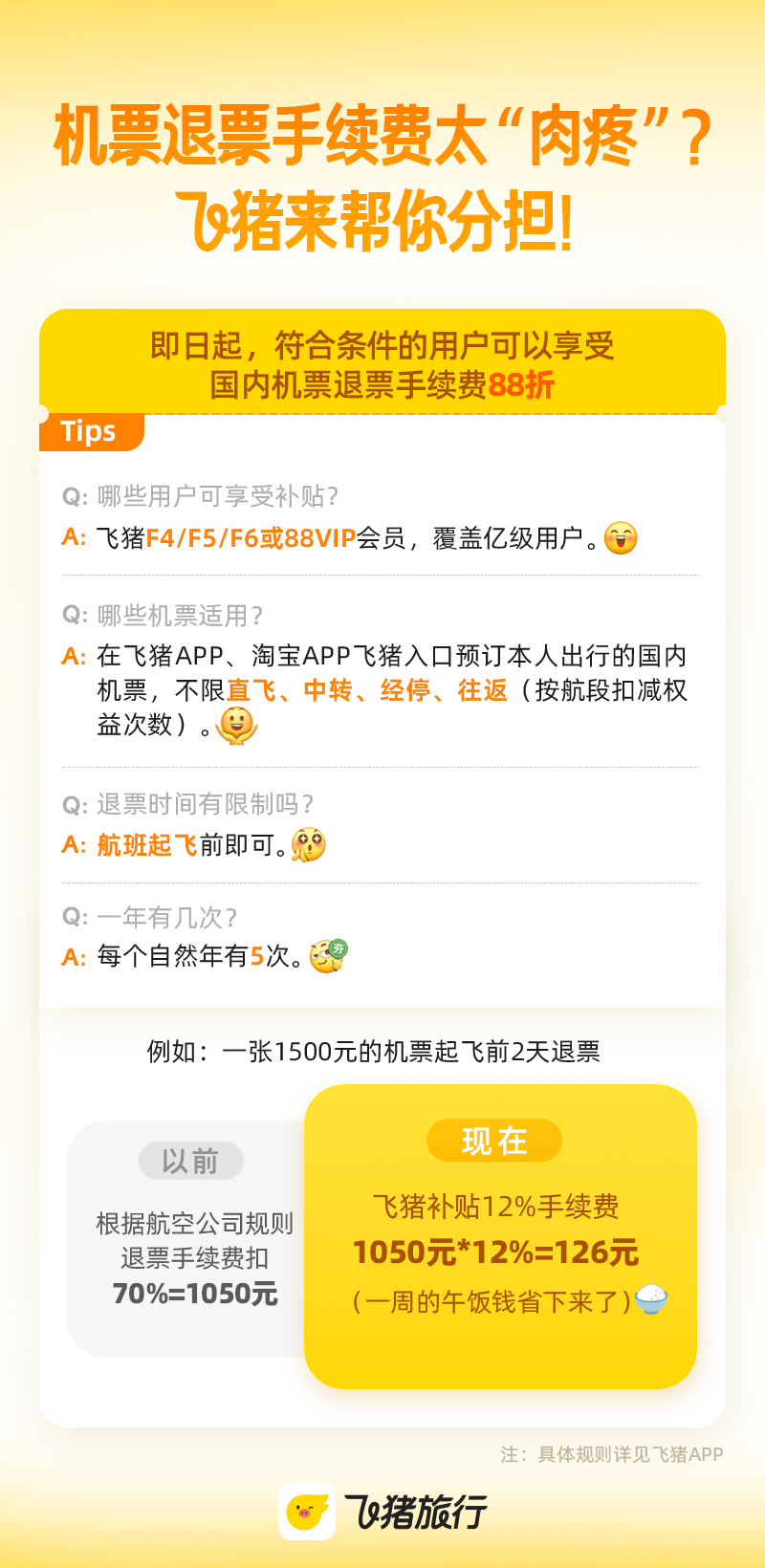
为让旅客购票更安心、退票更从容,飞猪近日升级国内机票退票保障标准:针对飞猪F4、F5、F6及全量88VIP会员先行试水,如其在飞猪APP、淘宝APP飞猪入口购买本人出行的国内机票,在航班起飞前申请退票,退票手续费可享受航空公司标准以外的88折优惠。即飞猪方面提供12%的手续费补贴。

查阅细则可见,该退票保障标准适用于国内机票的单程直飞、经停、中转和往返行程,且可与航空公司权益(如有)叠加。另外,每人每自然年拥有5次该权益,并按照航段数扣减权益次数。

(图:飞猪上线国内机票退票费补贴)

举例来说,一位消费者在飞猪花1978元购买了9月26日上海飞乌鲁木齐的某航班机票,若9月19日临时有事去不了申请自愿退票,根据航司退票规则,该机票的退票手续费为1045元。但是,若该消费者是飞猪F4、F5、F6或88VIP会员,其退票手续费可立省125.4元。

公开数据显示,目前飞猪拥有超5亿注册会员,88VIP会员规模约6400万。这意味着,飞猪的这项退票保障标准可覆盖亿级消费者。

机票退改手续费一直是消费者的“痛点”、航空公司的“难点”。一方面,相对严苛的标准和高昂的手续费,尤其是错购、错填等特殊场景,给消费者带来了不必要的损失;另一方面,航班座位具有不可存储、时效性强的特点,起飞时座位一旦空置便无法二次销售,阶梯费率有助于航空公司对冲运营成本。

近期,中国航空运输协会明确表示,正牵头编制机票退改专项团体标准,计划年内正式发布实施。在此之前,中国东方航空也推出国内机票退改新政,消费者在起飞前14天办理退改均可免手续费。飞猪此次升级国内机票退票保障标准,亦成为首个补贴消费者手续费的在线旅游服务平台。

资深民航专家、广外南国商学院教授郭佳认为,“退票保障”能够更好地让消费者“放心飞”“畅心飞”,作为航旅销售平台,飞猪在让消费者有“获得感”上引领行业创新,此次锚定国内机票“退票难”“退票贵”痛点,通过企业补贴让利消费者,以退票环节的“心理稳定”助力航旅市场,促进消费增长。郭佳还呼吁,希望更多国内航旅平台彰显企业社会责任,加入到“让利于民”的行动中来。

据了解,除升级国内机票退票保障标准之外,针对中秋、国庆假期出游旺季,飞猪针对租车、接送等服务也升级了保障标准。例如,针对节假日取还车的租车订单,消费者下单且确认后商家无法提供车辆,飞猪将第一时间改派保障用车,同时再提供日租金3倍或订单全额的补偿金(二者择其高),如消费者另行预订同级别车辆,飞猪同样提供上述补偿金,并承担预订差价,差价上不封顶。

注:文/龚作仁,文章来源:Laborer,本文为作者独立观点,不代表亿邦动力立场。

文章来源:Laborer

广告
微信
朋友圈

FAQ回顾

哪些用户可以享受飞猪的国内机票退票手续费补贴?

飞猪F4、F5、F6等级会员及全量88VIP会员,在飞猪APP或淘宝APP飞猪入口购买本人出行的国内机票,航班起飞前申请退票,即可享受飞猪提供的12%退票手续费补贴。

飞猪的机票退票手续费补贴使用规则是什么?

该补贴可与航空公司自身的退票权益叠加使用,适用于国内机票单程直飞、经停、中转、往返各类行程,每人每自然年可享受5次权益,权益次数按航段数进行扣减。

节假日在飞猪预订租车遇到商家无法供车有什么保障?

中秋、国庆假期飞猪升级了租车服务保障,若消费者下单确认后商家无法提供车辆,飞猪将第一时间改派保障用车,同时赔付日租金3倍或订单全额的补偿金(二者择高),用户另行预订同级别车辆的差价由飞猪承担,差价上不封顶。

近期国内机票退改领域有哪些惠民举措?

中国航空运输协会正牵头编制机票退改专项团体标准,计划年内正式发布实施;东方航空已推出起飞前14天退改免手续费的新政;飞猪推出12%退票手续费补贴,是国内首个补贴机票退票手续费的在线旅游平台。

这么好看,分享一下?

朋友圈 分享

APP内打开

赞 +1
+1
微信好友 朋友圈 新浪微博 QQ空间
关闭
收藏成功
发送
/140 0

