广告
加载中

网红晚晚入驻淘宝 创立个人女装品牌

龚作仁 2026-08-12 17:02
龚作仁 2026/08/12 17:02

邦小白快读

EN
全文速览

这篇文章核心内容是初代网红晚晚入驻淘宝创立个人女装品牌,以及当下网红转型做自有品牌的新趋势,可获取以下核心干货:

1. 晚晚创立的品牌叫Wanwan Lei,上线首日就卖空了全店整月的备货,一共上线23款产品,价格覆盖从39元的发夹到上千元的成衣不等,其中268元的开衫销量最高;品牌主打将艺术积淀与苏绣、宋锦等非遗元素融入日常服饰。

2. 目前行业已经形成“卖货哪家都行,做品牌还得在淘宝”的共识,过去一年已有超2000位红人涌入淘宝创立服饰品牌,其中超过300位首年成交就突破千万元,越来越多网红从流量带货转向长期品牌经营。

本文披露了当下红人自有品牌的发展新趋势,能给品牌从业者提供很多参考干货:

1. 平台布局逻辑:短视频、社交平台适合种草带货,但要沉淀长期品牌价值、积累用户资产,淘宝才是最优选择,淘宝拥有稳定搜索流量和成熟的电商基础设施,能够支撑红人从网红跃迁为品牌主理人。

2. 产品研发方向:可以借鉴晚晚品牌的差异化思路,将艺术、非遗文化融入日常服饰,同时布局宽价格带,覆盖不同消费能力的用户,还可以借助个人IP打造同款标签,自带流量转化。

3. 行业趋势:红人IP转化为自有品牌已经成为新的消费潮流,过去一年大量红人入淘做品牌,成功率可观,值得品牌商关注这个新赛道。

本文给想要做自有品牌的卖家,尤其是红人卖家指明了新的增长机会,可参考的干货如下:

1. 机会方向:当前内容平台流量内卷加剧,靠单次带货变现的增长已经见顶,将个人IP转化为长期经营的自有品牌是新的增长路径,而淘宝是做自有品牌的最佳场域。

2. 行业数据参考:过去一年已经有超2000位红人涌入淘宝创立服饰品牌,其中超过300位首年成交就突破千万,说明这个赛道的成功率和成长性都很可观。

3. 可借鉴的实操经验:产品端可以结合文化、非遗元素打造差异化竞争力,价格做分层覆盖更多用户,借力个人影响力打造同款标签提升转化,晚晚上线首日售罄全月备货已经验证了这个模式的可行性。

本文给服饰生产工厂披露了新的商业机会和转型方向,干货内容如下:

1. 产品生产设计需求:当前红人新品牌偏向做差异化产品,需要将艺术风格、苏绣、宋锦等非遗工艺融入日常服饰,价格带覆盖广,从几十元的配饰到上千元的高端成衣都有布局,工厂可以针对性调整自身的生产设计能力,对接这类新品牌需求。

2. 商业机会:越来越多红人从内容平台带货转向做自有品牌,过去一年就有超2000位红人在淘宝创立服饰品牌,会释放大量新增的生产订单需求,工厂可以对接这类新品牌获得稳定增量。

3. 转型启示:淘宝是红人做品牌的首选平台,数字化程度高,工厂可以适配淘宝生态商家的需求,加快自身的数字化转型,提升接单和服务能力。

本文披露了网红电商行业的新动向,给电商服务商指明了新的市场机会,干货内容如下:

1. 行业发展新趋势:原本在抖音、小红书等社媒平台做带货的红人,已经开始大规模转型做长期自有品牌,首选落地平台就是淘宝,过去一年淘宝新增了超2000个红人服饰品牌,市场增量非常可观。

2. 客户痛点总结:红人大多只有流量和IP优势,从网红转型品牌主理人,缺成熟的电商运营、品牌打造、供应链对接能力,这类痛点还没有被完全满足,存在大量市场需求。

3. 业务方向:服务商可以围绕红人做品牌的需求,开发适配淘宝生态的运营服务、品牌策划服务、供应链对接服务,切入这个新增长赛道,依托淘宝成熟的基础设施获得业务增长。

本文的案例和行业数据,给各类电商平台的运营和招商带来很多启示,干货内容如下:

1. 商家核心需求:红人做自有品牌,最核心的诉求不是短期流量,而是能够沉淀长期品牌价值和客户资产,实现可持续经营,当前内容平台流量内卷,无法满足这个需求,淘宝的稳定搜索流量和成熟基础设施刚好匹配这个需求。

2. 平台运营方向:平台想要吸引品牌商家入驻,需要完善自身的流量机制和电商基础设施,打造能够帮助商家沉淀品牌资产的场域,而不是只做一次性流量交易。

3. 招商方向:当下大量红人有把IP转化为自有品牌的需求,这个赛道成长性很好,可以作为重点招商方向,参考淘宝的数据,过去一年新增超2000个红人服饰品牌,超300个首年成交破千万,增量空间很大。

本文给网红电商、品牌电商领域的研究者提供了新的产业动向和研究样本,干货内容如下:

1. 产业新动向:网红IP的商业化已经完成升级,从最初的内容涨粉、替其他品牌带货的1.0阶段,进入到打造个人自有品牌、长期经营IP价值的2.0阶段,业内已经形成“卖货找社媒,做品牌找淘宝”的新共识。

2. 典型案例与数据:初代网红晚晚入淘创立品牌,上线首日售罄全月备货,是网红转品牌主理人的典型案例;行业数据显示过去一年超2000位红人入淘做品牌,超300位首年成交破千万,验证了模式的可行性。

3. 新商业模式总结:当前已经形成了“社媒种草积累IP+淘宝沉淀经营品牌+IP赋能产品差异化”的新商业模式,是网红IP商业化的新升级,具备很高的研究价值。

返回默认
声明:快读内容全程由AI生成,请注意甄别信息。如您发现问题,请发送邮件至 run@ebrun.com 。

我是 品牌商 卖家 工厂 服务商 平台商 研究者 帮我再读一遍。

Quick Summary

This article centers on pioneering Chinese influencer Wanwan launching her own women's fashion brand Wanwan Lei on Taobao, and the emerging trend of influencers transitioning to build their own brands. Key takeaways are:

1. Wanwan's eponymous brand Wanwan Lei sold out its entire one-month inventory on launch day. The debut collection includes 23 SKUs, with prices ranging from ¥39 hair clips to thousands of RMB for ready-to-wear garments. A ¥268 cardigan was the top-selling item. The brand positions itself as blending Wanwan's artistic background with traditional Chinese intangible cultural heritage techniques such as Suzhou embroidery and Song brocade into everyday wear.

2. A widespread industry consensus has formed that while any platform can work for short-term product sales, Taobao remains the go-to choice for building a sustainable brand. Over the past year, more than 2,000 influencers have launched their own apparel brands on Taobao, with over 300 generating more than ¥10 million in revenue in their first year. A growing number of influencers are shifting their focus from short-term affiliate marketing to long-term brand building.

This article outlines new industry trends for influencer-owned brands, offering valuable insights for brand practitioners:

1. Platform strategy: Short-video and social platforms are ideal for content marketing and driving immediate sales, but Taobao is the optimal choice for building long-term brand equity and accumulating user assets. With its stable search traffic and mature e-commerce infrastructure, Taobao supports influencers in making the transition from content creators to brand founders.

2. Product development direction: Brands can adopt Wanwan's differentiation strategy, which integrates art and traditional Chinese cultural heritage elements into everyday apparel. A broad price range to target consumers of different spending power, paired with IP-linked product labeling to leverage existing influencer traffic for conversion, is also a viable approach.

3. Industry trend: Turning influencer IP into owned brands has become a major new consumer trend. The large influx of influencers to Taobao and strong performance of new brands over the past year make this a high-potential new track worthy of brand players' attention.

This article highlights new growth opportunities for sellers, especially influencer sellers looking to launch their own brands, with the following key takeaways:

1. Growth direction: As competition for traffic intensifies on content platforms, growth from one-off affiliate commission sales has hit a ceiling. Turning personal influencer IP into a long-term owned brand offers a new growth path, and Taobao is the best ecosystem for building this type of business.

2. Industry benchmark data: Over 2,000 influencers launched apparel brands on Taobao in the past year, with more than 300 surpassing ¥10 million in first-year revenue, demonstrating that the track offers solid success rates and strong growth potential.

3. Actionable takeaways: Brands can build competitive differentiation by integrating cultural and traditional heritage elements into products, adopt tiered pricing to reach a broader customer base, and leverage personal influence to create IP-linked product labels that boost conversion. Wanwan selling out her full one-month inventory on launch day validates the viability of this model.

This article outlines new business opportunities and transformation directions for apparel manufacturers, with key insights as follows:

1. Adjusting production and design capabilities: New influencer-owned brands increasingly prioritize differentiated products that integrate artistic styles and intangible cultural heritage techniques such as Suzhou embroidery and Song brocade into everyday apparel, with a wide price range covering accessories starting at tens of RMB and high-end ready-to-wear above ¥1,000. Factories can adjust their production and design capabilities to match the demand from these emerging brands.

2. New business opportunities: As a growing number of influencers shift from social media affiliate marketing to launching their own brands, with more than 2,000 launching apparel brands on Taobao in the past year, this trend will generate significant new production order demand. Factories can partner with these new brands to secure stable incremental revenue.

3. Transformation insights: As Taobao is the preferred platform for influencer-owned brands with high-level digital infrastructure, factories can accelerate their own digital transformation to better match the needs of Taobao ecosystem merchants, and improve their order acquisition and service capabilities.

This article outlines new trends in the influencer e-commerce industry and highlights emerging market opportunities for e-commerce service providers:

1. New industry trend: Influencers who previously focused on affiliate marketing on social platforms such as Douyin and Xiaohongshu are now transitioning to building long-term owned brands at scale, with Taobao as their preferred launch platform. Taobao added more than 2,000 new influencer-owned apparel brands in the past year, representing very substantial market growth.

2. Unmet client needs: Most influencers only bring traffic and their existing IP to their brands; they lack mature capabilities in e-commerce operation, brand building and supply chain connection. These unmet needs create large untapped market demand.

3. New business direction: Service providers can develop Taobao ecosystem-compatible services covering operation, brand strategy, and supply chain matching to meet the needs of influencers building their own brands, enter this high-growth new track, and drive business growth supported by Taobao's mature infrastructure.

This article's case study and industry data offer valuable insights for operation and merchant acquisition teams at all types of e-commerce platforms:

1. Core merchant demand: The top priority for influencers launching owned brands is not short-term traffic, but the ability to build long-term brand equity and customer assets for sustainable growth. Current content platforms, which suffer from cutthroat traffic competition, cannot meet this need, while Taobao's stable search traffic and mature infrastructure are a perfect match.

2. Platform operation direction: To attract brand merchants, platforms need to improve their traffic mechanisms and e-commerce infrastructure to build an ecosystem that helps merchants accumulate brand equity, rather than focusing solely on one-off traffic transactions.

3. Merchant acquisition priority: A large number of influencers currently want to convert their IP into owned brands, making this a high-growth track worthy of being a key merchant acquisition target. Per Taobao's data, more than 2,000 new influencer apparel brands launched on the platform last year, with over 300 crossing ¥10 million in first-year revenue, indicating significant room for growth.

This article provides new industry trends and research samples for scholars studying influencer e-commerce and branded e-commerce:

1. New industry shift: The commercialization of influencer IP has upgraded, evolving from the 1.0 phase of growing followers and marketing other brands' products to a 2.0 phase focused on building owned brands and harvesting long-term IP value. A new industry consensus has formed: "Go to social platforms for sales, go to Taobao for building a brand."

2. Representative case and industry data: Pioneering influencer Wanwan's launch of her brand, which sold out all one-month inventory on opening day, is a representative case of influencers transitioning to brand founders. Industry data shows more than 2,000 influencers launched brands on Taobao in the past year, with over 300 generating more than ¥10 million in first-year revenue, validating the viability of this model.

3. New business model summary: A new business model has emerged: "social media seeding to build IP + Taobao to operate and scale the brand + IP to drive product differentiation". This represents a new upgrade of influencer IP commercialization with high research value.

Disclaimer: The "Quick Summary" content is entirely generated by AI. Please exercise discretion when interpreting the information. For issues or corrections, please email run@ebrun.com .

I am a Brand Seller Factory Service Provider Marketplace Seller Researcher Read it again.

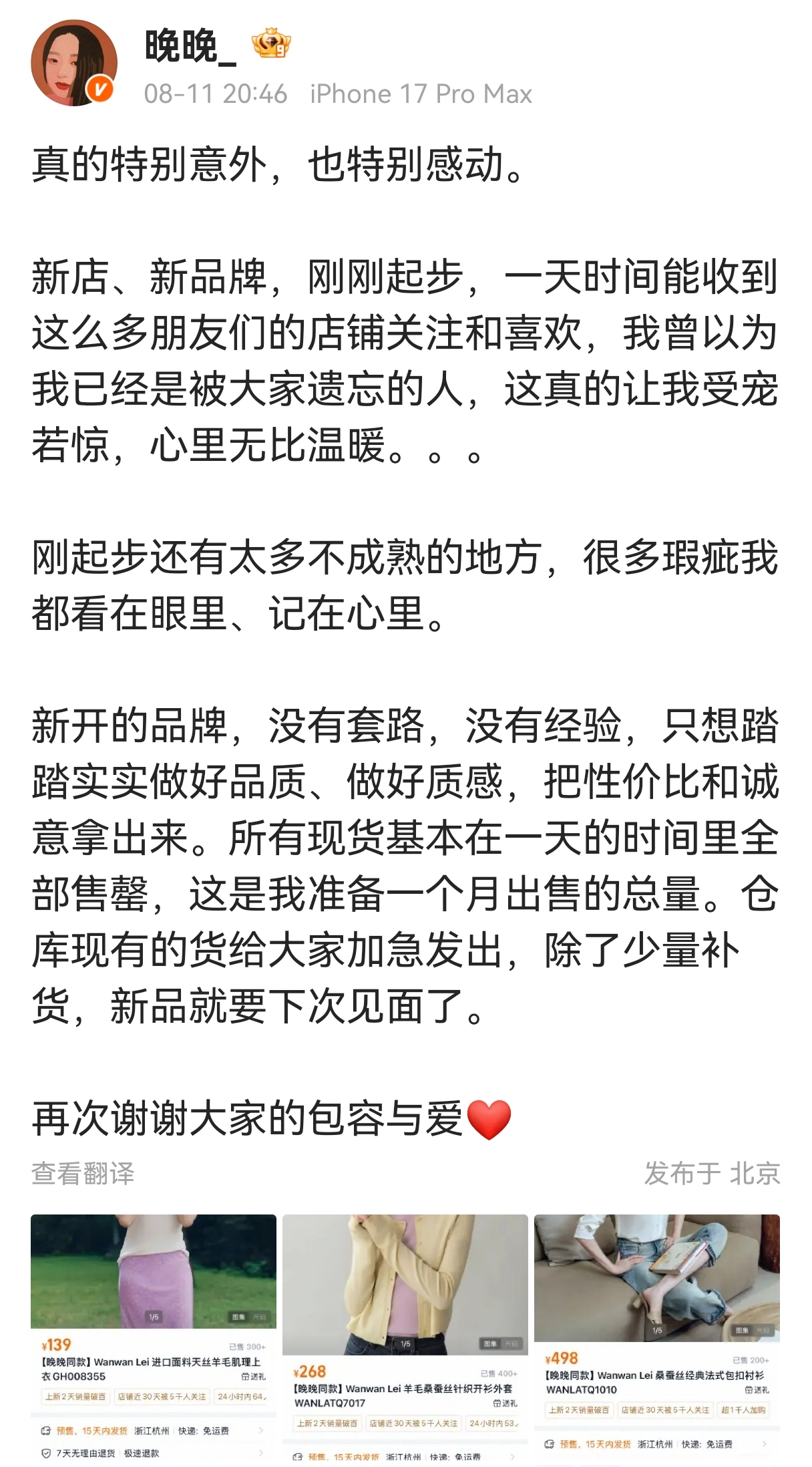
上线首日,全店售空。日前,初代“豆瓣女神”晚晚,在淘宝创立了个人女装品牌“Wanwan Lei”。上线首日,就卖完了整个月的备货,全店库存一售而空。此前,她也在其他平台做过带货直播,但创立个人品牌,还是首选淘宝,说明“卖货哪家都行,做品牌还得在淘宝”已经成为业内共识。

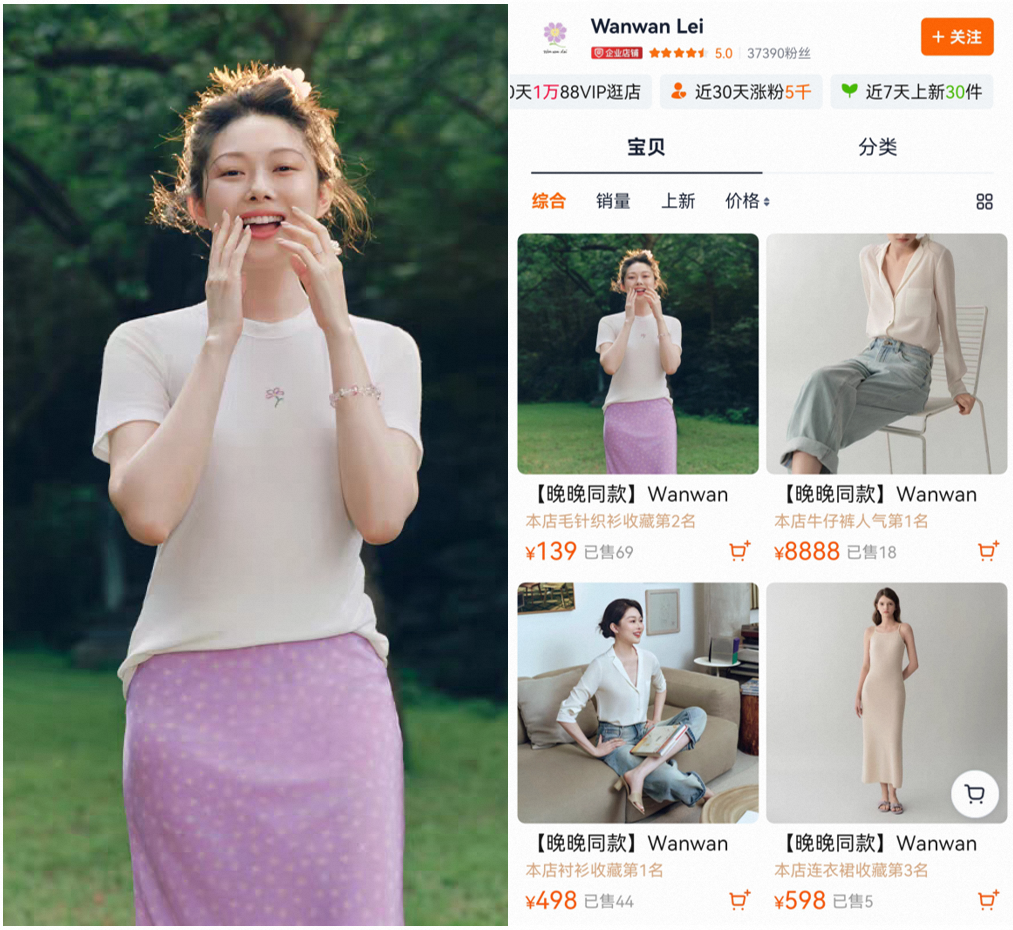
「Wanwan Lei」淘宝店已上线23款服装,价格带从39元发夹到上千元的亮片真丝套装不等,价格丰俭由人,其中售价268元的开衫销量最高。晚晚在品牌介绍中强调,希望将艺术积淀与苏绣、宋锦、扬州绒花等非遗元素融入日常服饰。

图说:淘宝全店售罄,晚晚发微博致谢

值得关注的是,晚晚此前在抖音、小红书等社媒平台做过直播,都以为其他品牌带货为主。但创立个人女装品牌后,她首选入驻淘宝开店。这背后正是平台属性的不同:短视频和社交媒体天然适合种草带货,但要做自己的品牌,沉淀长期的品牌价值和客户资产,还是得在淘宝。

作为初代网红的代表人物,晚晚入淘并非孤例。过去一年,已有超2000位红人涌入淘宝创立自己的服饰品牌,全年超300位首年成交破千万。当内容平台流量内卷加剧,越来越多红人选择将个人IP转化为长期经营的品牌;淘宝稳定的搜索流量、成熟的电商基础设施,让红人从“网红”跃迁为“品牌主理人”。

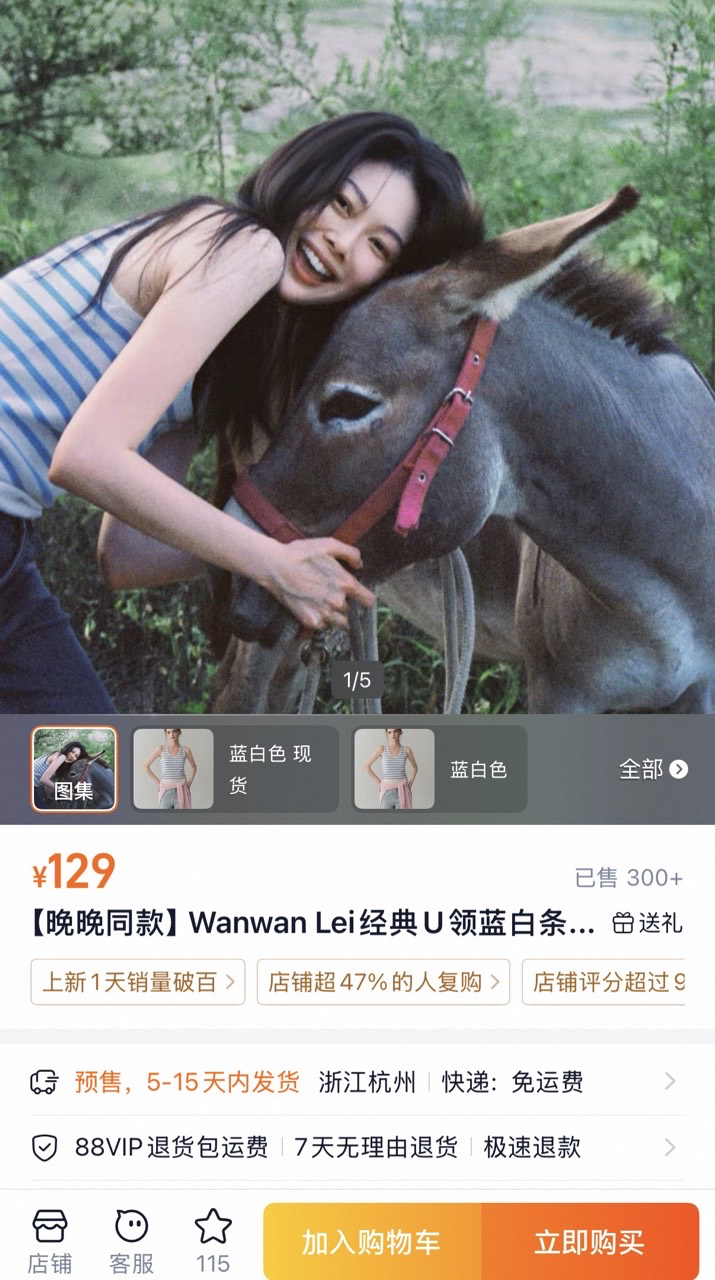
图说:「Wanwan Lei」的商品图用上了晚晚的生活照,并打上了“晚晚同款”字样

对「Wanwan Lei」而言,一天内全店售罄只是起点。在淘宝这个既能承接话题热度、又能沉淀品牌资产的场域,晚晚已经迈出了从流量走向品牌的关键一步。

注:文/龚作仁,文章来源:Laborer,本文为作者独立观点,不代表亿邦动力立场。

文章来源:Laborer

广告
微信
朋友圈

FAQ回顾

为什么网红创立个人品牌多选择入驻淘宝?

短视频和社交媒体仅适合种草带货,淘宝拥有稳定的搜索流量、成熟的电商基础设施,可帮助商家沉淀长期的品牌价值和客户资产,过去一年已有超2000位红人入淘创立服饰品牌。

晚晚的个人女装品牌有什么特色?

晚晚的个人女装品牌名为Wanwan Lei,已上线23款服饰,价格覆盖39元发夹至上千元亮片真丝套装,品牌主打将艺术积淀与苏绣、宋锦、扬州绒花等非遗元素融入日常服饰。

晚晚的个人女装品牌上线首日销售表现如何?

晚晚的个人女装品牌Wanwan Lei在淘宝上线首日就售完整个月备货,全店库存一售而空,其中售价268元的开衫销量最高。

这么好看,分享一下?

朋友圈 分享

APP内打开

赞 +1
+1
微信好友 朋友圈 新浪微博 QQ空间
关闭
收藏成功
发送
/140 0