



广告
加载中

130亿件次日达或当日达!亚马逊Prime全球配送速度再创新高

王昱 2026-02-11 16:23
王昱 2026/02/11 16:23

邦小白快读

EN
全文速览

亚马逊Prime会员配送速度创历史新高,提供大量实惠和便利。

1. 2025年全球超过130亿件商品实现当日或次日送达,其中美国市场达80亿件,同比增长逾30%,生鲜杂货和日常必需品占比一半。

2. Prime会员通过快速免费配送累计节省1050亿美元全球,美国会员人均节省550美元,接近年度会员费四倍,并减少64次实体店购物行程,节省超过55小时时间成本。

3. 服务从2005年覆盖100万种商品两日达,发展到2025年覆盖35个品类、超过3亿种商品,所有订单受A-to-z保障支持,数千万种商品免费当日或次日达。

4. 技术优化如AI预测需求,缩短运输距离,提升效率,并根据地区和季节动态调整选品。

亚马逊服务影响消费趋势和品牌机会,提供营销和渠道建设启示。

1. 消费趋势显示Prime会员对线上高频购物依赖增强,如美国会员减少实体店购物64次,生鲜杂货和日常必需品占比高,农村地区复购率最高的50种商品中有49种为必需品。

2. 品牌渠道建设可通过亚马逊扩展,如生鲜杂货整合进当日达体系,覆盖数千个城市,提供“新鲜保障”,无需重复结账或最低消费门槛,2025年生鲜及必需品当日送达达40亿件。

3. 用户行为观察显示节省时间金钱是加入Prime主因,品牌可借此优化定价策略,如免费配送吸引会员,农村市场增长机会大,2025年农村当日达客户数量翻倍。

亚马逊扩张带来增长机会和政策利好,提示风险和合作方式。

1. 增长市场机会包括农村覆盖拓展,通过40亿美元投资改造配送站,在44个州4000多个地区提供当日次日达免费服务,日常必需品如咖啡、纸巾首次实现快速配送。

2. 消费需求变化显示生鲜杂货需求上升,2025年40亿件生鲜必需品当日达,卖家可合作扩展品类,如数千种易腐商品整合。

3. 政策解读包括亚马逊履约网络升级,不额外收费,风险提示如全球电商竞争加剧,速度效率成核心差异化;合作方式为加入Prime体系,利用AI优化选品和运营。

亚马逊履约网络提供产品生产和电商启示,揭示商业机会。

1. 产品生产和设计需求突出日常必需品高需求,如农村复购率前50商品中49种为必需品,工厂可优化相关产品;生鲜杂货整合需易腐商品处理,如提供“新鲜保障”。

2. 商业机会在于合作亚马逊平台,如通过超快速配送服务Amazon Now,覆盖印度、墨西哥等国际市场,30分钟内送达生鲜和热点商品,工厂可生产本地热门品。

3. 推进数字化启示包括AI技术优化库存和履约,预测区域需求,工厂可借鉴缩短供应链;品类扩展启示如从少数商品到35品类3亿种,提供电商整合机会。

行业趋势聚焦新技术和客户痛点解决方案。

1. 新技术应用如AI模型预测需求,优化库存布局,将商品存储靠近消费者,缩短运输距离,提升效率,并根据季节变化动态调整选品。

2. 行业发展趋势包括超快速配送服务Amazon Now在国际扩展如印度、墨西哥,主打30分钟内送达日常必需品和生鲜,Prime会员享折扣配送费;2025年“少于一天送达”商品数量增70%。

3. 客户痛点为速度需求,解决方案包括亚马逊投资40亿美元扩展农村网络,覆盖更多地区;配送效率提升,如数千万种商品当日达,规模达实体零售商40倍。

平台最新做法强化运营和招商,应对商业需求。

1. 平台招商和运营管理突出基础设施投资40亿美元改造农村配送站,拓展服务至4000多个中小城市和乡村,免费提供当日次日达,覆盖生鲜、电子产品等多品类。

2. 商业需求回应包括解决速度效率问题,如AI优化履约布局,缩短运输;平台风向规避如竞争核心聚焦配送效率,在全球电商加剧背景下强化竞争优势。

3. 平台最新做法是整合服务,如生鲜杂货与日常商品在同一订单,免除多重门槛;国际合作扩展Amazon Now服务,测试于美国和英国;所有订单受A-to-z保障支持。

产业新动向展示商业模式演变和政策启示。

1. 产业新动向包括Prime从2005年快递权益发展到2025年综合会员体系,整合速度、选择与节省,覆盖35品类3亿商品,依赖AI技术优化。

2. 新问题如全球电商竞争加剧,配送效率成核心差异化;政策启示涉及农村扩展投资,带来社会影响如减少出行时间55小时,会员节省时间金钱主因。

3. 商业模式研究显示战略聚焦基础设施投资、服务半径拓展、商品结构优化,2025年数据如130亿件快速送达,生鲜占比高;政策建议可借鉴动态调整选品。

返回默认

声明:快读内容全程由AI生成,请注意甄别信息。如您发现问题,请发送邮件至 run@ebrun.com 。

我是 品牌商 卖家 工厂 服务商 平台商 研究者 帮我再读一遍。

Quick Summary

Amazon Prime delivery speed hits record highs, offering substantial savings and convenience.

1. In 2025, over 13 billion items were delivered same-day or next-day globally, with 8 billion in the US alone—a more than 30% year-over-year increase. Groceries and daily essentials accounted for half of these deliveries.

2. Prime members globally saved a cumulative $105 billion through fast, free shipping. US members saved an average of $550 per person—nearly four times the annual membership fee—while reducing in-store shopping trips by 64 and saving over 55 hours in time.

3. The service has evolved from covering 1 million items with two-day delivery in 2005 to encompassing 35 categories and over 300 million items in 2025. All orders are backed by the A-to-z Guarantee, with tens of millions of items eligible for free same-day or next-day delivery.

4. Technology optimizations, such as AI-driven demand forecasting, have shortened transport distances, improved efficiency, and enabled dynamic product selection based on region and season.

Amazon's services influence consumer trends and present brand opportunities, offering insights for marketing and channel strategy.

1. Consumer trends indicate Prime members' growing reliance on frequent online shopping; for instance, US members made 64 fewer in-store trips. Groceries and daily essentials dominate orders, with 49 of the top 50 repurchased items in rural areas being essentials.

2. Brands can expand their reach via Amazon's channels, such as the integration of groceries into the same-day delivery system, which covers thousands of cities and offers a "Freshness Guarantee" with no re-checkout or minimum spend. In 2025, 4 billion grocery and essential items were delivered same-day.

3. User behavior shows that saving time and money are key reasons for joining Prime. Brands can leverage this by optimizing pricing strategies, such as offering free shipping to attract members, with significant growth potential in rural markets where same-day delivery customers doubled in 2025.

Amazon's expansion creates growth opportunities and policy benefits, while highlighting risks and collaboration methods.

1. Growth opportunities include rural coverage expansion, supported by a $4 billion investment to upgrade delivery stations, enabling free same-day or next-day delivery in over 4,000 areas across 44 states. Daily essentials like coffee and paper towels are now available for fast delivery.

2. Shifting consumer demand shows rising interest in groceries, with 4 billion fresh essentials delivered same-day in 2025. Sellers can collaborate to expand categories, such as integrating thousands of perishable items.

3. Policy updates include upgrades to Amazon's fulfillment network at no extra cost. Risks involve intensifying global e-commerce competition, where speed and efficiency are key differentiators. Sellers can join the Prime system and leverage AI for product selection and operations optimization.

Amazon's fulfillment network offers insights for product manufacturing and e-commerce, revealing commercial opportunities.

1. Production and design needs highlight high demand for daily essentials; for example, 49 of the top 50 repurchased items in rural areas are essentials. Factories can optimize related products, while grocery integration requires handling perishables, such as through "Freshness Guarantee" features.

2. Commercial opportunities lie in partnering with Amazon's platform, such as via ultra-fast delivery services like Amazon Now, which operates in India, Mexico, and other markets, delivering groceries and popular items within 30 minutes. Factories can produce locally trending goods.

3. Digitalization insights include using AI to optimize inventory and fulfillment by predicting regional demand, which factories can adopt to shorten supply chains. Category expansion—from a few items to 35 categories and 300 million products—offers e-commerce integration opportunities.

Industry trends focus on new technologies and solutions for customer pain points.

1. New technology applications, such as AI models for demand forecasting, optimize inventory placement by storing goods closer to consumers, reducing transport distances, improving efficiency, and enabling dynamic product selection based on seasonal changes.

2. Industry developments include the global expansion of ultra-fast delivery services like Amazon Now in India and Mexico, offering 30-minute delivery for essentials and groceries, with Prime members receiving discounted fees. In 2025, "less-than-one-day delivery" items increased by 70%.

3. Customer pain points revolve around speed needs. Solutions include Amazon's $4 billion investment to expand rural networks, covering more regions, and enhancing delivery efficiency—such as offering same-day delivery for tens of millions of items, scaling 40 times larger than physical retailers.

The platform's latest strategies enhance operations and merchant recruitment to meet commercial demands.

1. Merchant recruitment and operations management emphasize a $4 billion infrastructure investment to upgrade rural delivery stations, extending services to over 4,000 small cities and towns with free same-day or next-day delivery across categories like groceries and electronics.

2. Responses to commercial demands include addressing speed and efficiency issues through AI-optimized fulfillment layouts that shorten transport. Risk mitigation involves focusing on delivery efficiency as a core competitive advantage amid intensifying global e-commerce competition.

3. The platform's latest approach integrates services, such as combining grocery and everyday items in single orders with no multiple thresholds. International expansion includes testing Amazon Now in the US and UK, with all orders supported by the A-to-z Guarantee.

Industry developments reveal business model evolution and policy implications.

1. New trends show Prime's evolution from a 2005 shipping benefit to a 2025 comprehensive membership system integrating speed, selection, and savings, covering 35 categories and 300 million items, supported by AI optimization.

2. Emerging issues include heightened global e-commerce competition, where delivery efficiency is a key differentiator. Policy implications involve rural expansion investments, yielding social impacts like 55 hours of reduced travel time, with time and savings being primary member benefits.

3. Business model research indicates a strategy centered on infrastructure investment, service radius expansion, and product assortment optimization. 2025 data—such as 13 billion fast deliveries with high grocery shares—offers insights; policy recommendations could adopt dynamic product selection methods.

Disclaimer: The "Quick Summary" content is entirely generated by AI. Please exercise discretion when interpreting the information. For issues or corrections, please email run@ebrun.com .

I am a Brand Seller Factory Service Provider Marketplace Seller Researcher Read it again.

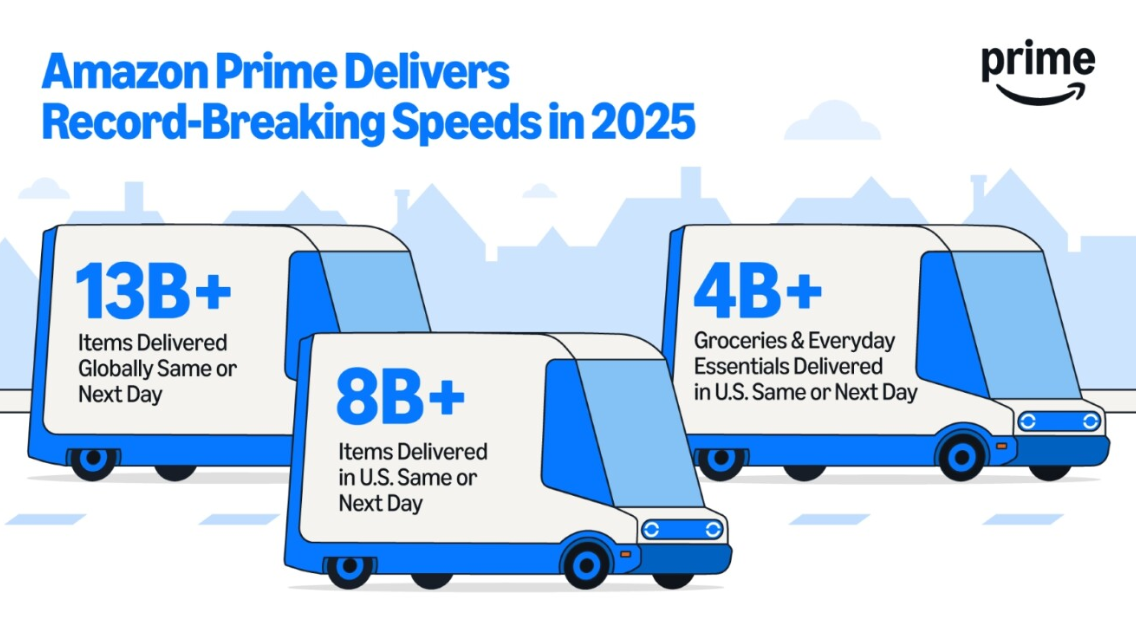
【亿邦原创】2月11日消息,亚马逊日前宣布,2025年,其为全球Prime会员提供了有史以来最快的配送速度,这已是连续第三年刷新纪录。数据显示,2025年全球范围内共有超过130亿件商品实现当日或次日送达。在美国市场,Prime会员当日或次日收到的商品数量超过80亿件,同比增长逾30%,其中生鲜杂货和日常必需品占比达到一半。

快速、免费配送一直是Prime会员体系的核心权益之一。亚马逊披露,2025年Prime会员在全球范围内通过快速、免费配送累计节省约1050亿美元;在美国,会员人均节省550美元,接近年度会员费的四倍。

与此同时,随着配送效率提升和选品扩充,Prime会员对线上高频购物的依赖程度进一步增强。数据显示,2025年美国Prime会员平均减少64次前往实体门店的购物行程,相当于节省超过55小时的时间成本。

Prime会员服务于2005年推出,最初提供覆盖约100万种商品的免费两日达服务,商品以DVD、CD和图书为主。经过20年发展,目前Prime已覆盖35个品类、超过3亿种商品,所有订单均受亚马逊A-to-z保障计划支持,其中数千万种商品可实现免费当日或次日送达。配送网络的持续扩展与商品结构的升级,使Prime逐步从“快递权益”演变为集速度、选择与价格优势于一体的综合会员体系。

亚马逊全球商店首席执行官Doug Herrington表示,节省时间和金钱是消费者加入Prime的重要原因之一。通过将快速、免费配送扩展至更多乡村社区,并将生鲜杂货与处方药纳入服务体系,公司希望实现速度、选择与节省三者兼顾。

为进一步提升Prime会员价值,亚马逊在2025年加快了履约网络和服务模式的升级。在覆盖范围方面,公司将现有农村配送站改造为多功能混合枢纽,在美国44个州的4000多个中小城市、城镇及乡村地区拓展当日达与次日达服务,且不向Prime会员额外收费。

这一举措基于公司对农村配送网络的40亿美元投资,使咖啡、纸巾、电池等日常必需品在更多地区首次实现当日或次日送达。数据显示,在农村地区复购率最高的50种商品中,有49种为日常必需品;2025年农村地区当日达月均客户数量较上一年接近翻倍。

目前,亚马逊当日达服务已在美国实现广泛覆盖,可实现当日送达的Prime商品数量达到数百万种,规模最高可达典型大型实体零售商商品选择的40倍。随着网络扩张,2025年“少于一天送达”的商品数量同比增长70%。

在品类拓展方面,亚马逊将数千种易腐生鲜商品整合进现有当日达体系,使数千个美国城市和城镇的Prime会员可在同一订单中选购生鲜食品及电子产品、玩具、服饰等商品,无需重复结账或满足多个最低消费门槛。所有生鲜商品均提供“新鲜保障”承诺。2025年,美国市场实现当日或次日送达的生鲜及日常必需品数量达到创纪录的40亿件。

在国际市场,亚马逊持续推进超快速配送服务“Amazon Now”,目前已在印度、墨西哥和阿联酋扩展,并在美国和英国开展初步测试。该服务主打30分钟内送达日常必需品、生鲜食品及本地热门商品,Prime会员可享受折扣配送费。

此外,亚马逊正通过人工智能技术优化库存与履约布局。公司利用AI模型预测不同区域、不同时间段的商品需求结构,在履约网络中实现更精准的备货与调配,将商品存储在更接近消费者的位置,以缩短运输距离、提升配送效率,并根据地区和季节变化动态调整选品结构。

整体来看,亚马逊在2025年通过加大基础设施投资、拓展服务半径、优化商品结构以及引入AI技术,进一步强化了Prime会员在速度与选择上的竞争优势。在全球电商竞争持续加剧的背景下,配送效率和履约能力仍被视为平台差异化竞争的重要核心。


亿邦持续追踪报道该情报,如想了解更多与本文相关信息,请扫码关注作者微信。

文章来源:亿邦动力

广告
微信
朋友圈

这么好看,分享一下?

朋友圈 分享

APP内打开

+1
+1
微信好友 朋友圈 新浪微博 QQ空间
关闭
收藏成功
发送
/140 0