广告
加载中

2022数字经济城市发展百强榜出炉 杭州稳居数字经济一线

亿邦动力 2022-11-29 10:11
亿邦动力 2022/11/29 10:11

邦小白快读

EN
全文速览

本文核心信息是赛迪顾问发布2022数字经济城市发展百强榜,杭州首超广州位列第四,稳居数字经济一线,核心发展动力来自浙江自贸试验区杭州片区在五大数字领域的创新突破,干货整理如下:

1.该榜单是赛迪顾问连续第六年发布,划分一线到四线四个等级,能够全面反映中国数字经济发展阶段特征,权威性较强。

2.杭州片区在数字贸易、数字产业、数字金融、数字物流、数字治理五个方向都取得了亮眼成果,公布了前三季度各领域的核心增长数据,整体数字经济核心产业营收占全省近五成,数字服务贸易占全省近八成,发展势头强劲,是杭州数字经济领跑的核心支撑。

杭州数字经济的快速发展,给品牌商带来了多方面的市场机会和发展空间,核心干货整理如下:

1.渠道建设层面,杭州片区集聚了全国三分之二以上跨境电商零售进出口平台、全省三分之一跨境电商出口知名品牌,还有阿里巴巴、亚马逊等30余家头部数贸企业,跨境支付网络覆盖全球90%以上地区,服务70%以上跨境电商企业,非常利于品牌布局出海渠道,拓展国际市场。

2.产业落地层面,杭州已经形成钱塘生物医药、萧山区数字内容、滨江区集成电路三大高增长产业集群,实际利用外资增速远超全省平均,营商环境优越,数字消费基础好,适合新品牌研发落地数字化产品,抓住数字经济消费风口。

3.政策层面,杭州有多项制度创新成果,监管便利化程度高,能够降低品牌运营的合规成本。

杭州数字经济的发展给各类内贸、跨境卖家提供了很多新机会和利好条件,核心干货整理如下:

1.市场机会层面,杭州拥有完善的跨境电商产业生态,不仅有大量流量平台和头部企业资源,还建成了连接108个跨境电商海外服务站点、283个海外仓的数字化物流网络,形成了完整的出海产业链,非常适合卖家开展跨境出口业务,拓展海外增量市场。

2.政策与合规层面,杭州片区有多项国家级创新试点,包括本外币合一银行结算账户、数字人民币试点等,还形成了137项制度创新成果,其中多项可供复制推广,像“未来工厂保税仓库”智慧监管等模式,能够大大降低卖家的合规和运营成本。

3.增长趋势层面,前三季度杭州数字服务贸易增长4.8%,跨境人民币结算增长32%,整体市场保持稳定增长,态势向好。

杭州数字经济的发展,对工厂拓展业务、推进数字化转型带来很多机会和启示,核心干货整理如下:

1.商业合作机会层面,杭州已经形成多个高增长优势产业集群,前三季度钱塘生物医药、萧山数字内容、滨江集成电路营收分别增长10.4%、30.5%、16.2%,今年杭州片区新引进项目67个,总投资约300亿元,产业链配套需求旺盛,各类配套工厂可以寻求落地和合作机会,分享产业增长红利。

2.数字化转型启示层面,杭州在智能制造、跨境供应链等领域推进数字化集成创新,形成了“未来工厂保税仓库”等成熟的数字化管理成果,工厂可以借鉴相关经验,推进自身生产、仓储、监管全链条的数字化改造,提升运营效率。

3.出海转型机会层面,依托杭州完善的跨境电商生态和数字物流网络,工厂可以直接对接跨境销售渠道,降低出海的物流和支付成本,推进自有品牌出海。

杭州数字经济全领域融合发展的态势,给To B服务商提供了很多行业趋势和方向参考,核心干货整理如下:

1.行业发展趋势:当前数字经济已经从单一的数字产业发展,延伸到贸易、金融、物流、产业、治理全领域深度融合,杭州作为数字经济一线城市,头部企业集聚,多个产业集群保持高速增长,市场对数字服务的需求旺盛,赛道空间广阔。

2.客户核心痛点:大量布局杭州的跨境电商、生物医药、智能制造类企业,都存在跨境支付结算、跨境物流协同、数字化合规监管对接等需求,目前市场虽然已有基础服务,但仍有差异化服务的拓展空间。

3.解决方案参考:杭州已经探索出本外币合一结算、空港数字防疫智控、智慧保税监管等多类成熟的创新解决方案,服务商可以借鉴相关成果,优化自身针对数字经济和跨境领域企业的服务产品,匹配客户需求。

杭州数字经济的发展实践,给平台商的招商、运营、风险规避带来很多参考信息,核心干货整理如下:

1.市场需求方向:当前杭州各类数字经济企业,对跨境结算服务、数字化物流对接、合规监管对接等配套服务需求旺盛,平台如果布局数字贸易、跨境电商领域,将获得很大的增长空间,杭州的区位优势也能给平台带来丰富的客户资源。

2.招商运营方向:杭州片区多个重点产业集群保持高速增长,外资流入增速远超全省平均,今年新引进总投资300亿元的67个新项目,招商需求旺盛,平台可以针对性招引数字贸易、生物医药、集成电路类企业,依托区域增长红利获得自身发展。

3.运营与风险规避:杭州在数字治理领域形成了137项制度创新成果,其中5项入选国家级复制推广名单,平台可以借鉴这些数字化智慧监管的经验,优化平台自身的合规运营管理,有效规避监管风险。

杭州数字经济赶超发展的实践,呈现出很多值得研究的产业新动向和制度创新成果,核心干货整理如下:

1.产业竞争新动向:在2022数字经济城市百强榜中杭州首超广州位列第四,体现出国内数字经济领域城市竞争的新态势,杭州依托自贸试验区推进全领域数字化发展的路径,形成了“核心产业带动+全领域融合”的发展模式,值得深入研究。

2.制度创新样本:浙江自贸试验区杭州片区在跨境电商、生物医药、临空经济等多个领域,开展全链条集成创新,形成了137项创新成果,5项被国家级复制推广,为我国自贸试验区数字化改革、数字经济开放发展提供了成熟的研究样本,对各地制定相关政策有重要启示。

3.商业模式创新:杭州探索出“头部平台带动+区域产业集群+全链条生态配套”的数字经济商业模式,依托数字技术打通贸易、金融、物流、监管全链条,这种新模式的可复制性和发展潜力都值得深入研究。

返回默认
声明:快读内容全程由AI生成,请注意甄别信息。如您发现问题,请发送邮件至 run@ebrun.com 。

我是 品牌商 卖家 工厂 服务商 平台商 研究者 帮我再读一遍。

Quick Summary

This article covers key insights from CCID Consultant's 2022 Top 100 Chinese Cities by Digital Economy Development ranking, where Hangzhou overtook Guangzhou to claim 4th place and secured its position as a first-tier digital economy hub. Hangzhou's strong growth is driven by innovation breakthroughs across five key digital sectors in the Hangzhou Area of China (Zhejiang) Pilot Free Trade Zone (FTZ). Key takeaways are as follows:

1. This is the 6th consecutive year CCID Consultant has released the ranking, which divides cities into four tiers from first- to fourth-tier. Widely considered authoritative, it offers a comprehensive overview of the developmental characteristics of China's digital economy at its current stage.

2. The Hangzhou FTZ Area has delivered standout performance across five core digital sectors: digital trade, digital industry, digital finance, digital logistics, and digital governance. Core growth data for the first three quarters of the year shows that core digital economy industries in the area account for nearly 50% of Zhejiang province's total core digital revenue, while digital service trade from the area makes up nearly 80% of the province's total. This robust performance serves as the core pillar of Hangzhou's leading position in digital economy.

Hangzhou's rapid digital economy growth has opened up a wide range of market opportunities and room for expansion for brand owners. Key takeaways are as follows:

1. For channel development: The Hangzhou FTZ Area is home to more than two-thirds of China's cross-border e-commerce (CBEC) retail import and export platforms, and one-third of Zhejiang province's well-known CBEC export brands. It also hosts over 30 leading digital trade enterprises including Alibaba and Amazon. Its cross-border payment network covers more than 90% of the world's regions and serves over 70% of China's CBEC companies, making it an ideal location for brands to build global go-to-market channels and expand into international markets.

2. For industry localization: Hangzhou has developed three fast-growing industrial clusters: Qiantang's biopharmaceuticals, Xiaoshan District's digital content, and Binjiang District's integrated circuits. Its actual utilized foreign capital grows far faster than the provincial average, it boasts a pro-business environment and a strong foundation for digital consumption, making it well-suited for new brands to develop and launch digital products and capitalize on the booming digital consumer trend.

3. For policy support: Hangzhou has delivered a number of institutional innovation achievements that facilitate regulatory processes, helping brands reduce compliance costs for their operations.

Hangzhou's digital economy development has created extensive new opportunities and favorable conditions for both domestic and cross-border sellers. Key takeaways are as follows:

1. Market opportunities: Hangzhou has a fully developed CBEC industrial ecosystem. In addition to abundant access to traffic platforms and leading enterprise resources, it has built a digital logistics network connected to 108 overseas CBEC service sites and 283 overseas warehouses, forming a complete go-global industrial chain that is ideal for sellers looking to launch cross-border export business and tap into incremental overseas markets.

2. Policy and compliance: The Hangzhou FTZ Area hosts a number of national-level innovation pilots, including integrated domestic and foreign currency bank settlement accounts and central bank digital currency (e-CNY) trials. It has also generated 137 institutional innovation outcomes, many of which are eligible for nationwide replication, such as the "future factory bonded warehouse" smart regulation model. These can significantly reduce sellers' compliance and operational costs.

3. Growth outlook: In the first three quarters of the year, Hangzhou's digital service trade grew 4.8% and cross-border RMB settlement grew 32%, putting the overall market on a stable, positive growth trajectory.

Hangzhou's digital economy development brings extensive opportunities and insights for factories looking to expand business and advance digital transformation. Key takeaways are as follows:

1. Business collaboration opportunities: Hanghoff has developed multiple fast-growing high-value industrial clusters. In the first three quarters of the year, Qiantang biopharmaceuticals, Xiaoshan digital content, and Binjiang integrated circuits recorded revenue growth of 10.4%, 30.5%, and 16.2% respectively. The Hangzhou FTZ Area attracted 67 new projects this year with total investment of around 30 billion yuan, creating strong demand for industrial chain supporting facilities. Component factories of all types can explore localization and collaboration opportunities to share in the industry's growth dividends.

2. Digital transformation insights: Hangzhou has advanced integrated digital innovation in smart manufacturing and cross-border supply chains, developing mature digital management outcomes such as the "future factory bonded warehouse" model. Factories can draw on this experience to carry out full-chain digital upgrades covering production, warehousing and regulatory compliance to improve operational efficiency.

3. Go-global transformation opportunities: Leveraging Hangzhou's fully developed CBEC ecosystem and digital logistics network, factories can connect directly to cross-border sales channels, cut logistics and payment costs for global expansion, and launch their own branded products overseas.

Hangzhou's trend of full-sector integrated digital economy development offers valuable industry trend and direction insights for B2B service providers. Key takeaways are as follows:

1. Industry development trends: Digital economy has evolved beyond standalone digital industry development to deep, cross-sector integration across trade, finance, logistics, manufacturing and governance. As a first-tier digital economy city, Hangzhou is home to a concentration of leading enterprises and multiple fast-growing industrial clusters, creating strong market demand for digital services and leaving significant room for growth in the sector.

2. Core customer pain points: A large number of CBEC, biopharmaceutical and smart manufacturing enterprises based in Hangzhou have unmet needs for cross-border payment settlement, cross-border logistics coordination, and digital compliance and regulatory docking. While basic services are already available on the market, there is still significant room to develop differentiated value-added services.

3. Solution references: Hangzhou has already developed and tested a range of mature innovative solutions, including integrated domestic and foreign currency settlement, airport digital epidemic prevention and control, and smart bonded regulation. Service providers can draw on these outcomes to optimize their service offerings for digital economy and cross-border enterprises and better match customer demand.

Hangzhou's digital economy development experience offers valuable insights for platforms on investment attraction, operation, and risk mitigation. Key takeaways are as follows:

1. Market demand direction: A wide range of digital economy enterprises in Hangzhou have strong demand for supporting services including cross-border settlement, digital logistics docking, and compliance and regulatory docking. Platforms that enter the digital trade and CBEC sectors will enjoy substantial room for growth, and Hangzhou's advantageous location provides access to abundant customer resources.

2. Investment attraction and operation direction: Multiple key industrial clusters in the Hangzhou FTZ Area are maintaining fast growth, and foreign capital inflow growth far outpaces the provincial average. Sixty-seven new projects with total investment of 30 billion yuan were attracted this year, creating strong demand for further investment attraction. Platforms can target digital trade, biopharmaceutical, and integrated circuit enterprises for recruitment, and leverage regional growth dividends to drive their own development.

3. Operation and risk mitigation: Hangzhou has developed 137 institutional innovation outcomes in digital governance, 5 of which have been selected for national replication. Platforms can draw on this experience in digital smart regulation to optimize their own compliance operations management and effectively mitigate regulatory risks.

Hangzhou's catch-up growth in digital economy presents many noteworthy new industrial trends and institutional innovation outcomes worthy of academic and policy research. Key insights are as follows:

1. New trends in industrial competition: Hangzhou overtook Guangzhou to rank 4th in CCID Consultant's 2022 Top 100 Digital Economy Cities ranking, reflecting a new dynamic in urban competition within China's digital economy sector. Hangzhou's path of advancing full-sector digital development anchored by the FTZ has formed a "core industry drive + full-sector integration" development model that merits in-depth research.

2. A blueprint for institutional innovation: The Hangzhou Area of Zhejiang FTZ has carried out full-chain integrated innovation across multiple sectors including CBEC, biopharmaceuticals, and airport-facing economy. It has produced 137 innovation outcomes, 5 of which have been selected for national replication. This provides a mature research sample for digital reform and open development of digital economy in China's FTZs, and offers important insights for policy-making across regions.

3. Business model innovation: Hangzhou has developed a new digital economy business model described as "leading platform drive + regional industrial cluster + full-chain ecosystem support", where digital technology integrates the full chain of trade, finance, logistics, and regulation. The replicability and growth potential of this new model warrant in-depth research.

Disclaimer: The "Quick Summary" content is entirely generated by AI. Please exercise discretion when interpreting the information. For issues or corrections, please email run@ebrun.com .

I am a Brand Seller Factory Service Provider Marketplace Seller Researcher Read it again.

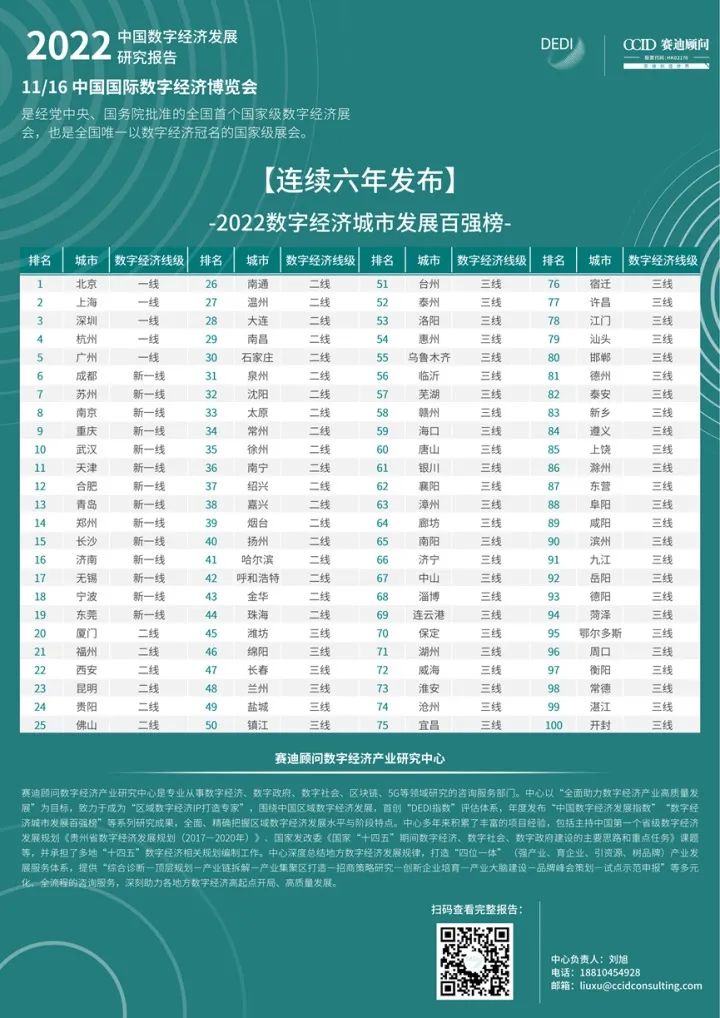
近日,工信部中国电子信息产业发展研究院直属机构赛迪顾问发布“2022数字经济城市发展百强榜”,其中杭州首超广州位列第四,稳居数字经济一线。位次赶超的背后,是数字经济创新的不断加码。浙江自贸试验区杭州片区一直以来锚定高质量打造具有浙江辨识度的数字自贸区,在推进数字贸易、数字产业、数字金融、数字物流、数字治理上创新发展,取得了新进展,亮点纷呈。

(关于数字经济城市发展百强榜:赛迪顾问连续第六年发布该榜单,榜单划分出“一线、新一线、二线、三线”四大线级,全面科学反映中国数字经济发展进程及阶段特征。)

聚焦数字贸易

杭州片区集聚全国三分之二以上跨境电商零售进出口平台、全省三分之一跨境电商出口知名品牌和阿里巴巴、亚马逊等30余家数贸头部企业,前三季度实现数字贸易额1670.6亿元、服务贸易额2118.3亿元、数字服务贸易额1206.8亿元,分别占全省的41.2%、56.9%、79.1%,其中服务贸易同比增长10.3%、数字服务贸易同比增长4.8%。杭州跨境电商综试区作为全国132个跨境电商综试区唯一代表亮相进博会中央展区。

聚焦数字产业

今年以来,杭州片区围绕争创综合性国家科学中心、打造“五大产业生态圈”、建设“两地四中心”、重塑全国数字经济第一城等重点工作,在更大范围内促进杭州创新链和产业链发展。前三季度,自贸区杭州片区新引进项目67个、总投资约300亿元、开工率达70%。自贸区所在的钱塘区生物医药产业、萧山区数字内容产业、滨江区集成电路产业营收分别增长10.4%、30.5%、16.2%;三区实际利用外资30.8亿美元、增长30.3%,增速超全省平均13.4个百分点;全市数字经济核心产业营收达1.16万亿元,占全省的49.6%。

聚焦数字金融

全国首批本外币合一银行结算账户体系试点累计开设账户2.3万户,办理人民币资金收付2.6万亿元、外币资金收付122.9亿美元。数字人民币试点全面嵌入亚运场景,钱包开设数、交易笔数和金额、线下场景数在全国新获批城市中名列前茅。跨境支付服务网络覆盖全球90%以上国家(地区),服务全国70%以上的跨境电商企业,前三季度全市跨境人民币结算5895亿元、同比增长32%、占全省的55.5%。

聚焦数字物流

发挥航空物流在全球贸易领域的基础性作用,建成投用机场三期,落地运营全省首条第五航权国际货运航线,率先启用空港数字防疫智控系统,支持菜鸟、顺丰等龙头企业建设国际、国内数字化骨干物流网络,用数字化服务平台连接108个跨境电商海外服务站点和283个海外仓,构建集航空运输、分拨运转、保税仓储、快递配送等于一体的全方位数字物流产业链,加快打造面向全球的“123快货物流圈”。前三季度,实现航空货邮吞吐量62.1万吨、占全省的83.2%、位列全国第五,其中国际(地区)货邮吞吐量10万余吨,占全省的77%。

聚焦数字治理

坚持以数字化改革撬动各领域体制机制创新,聚焦跨境电商、生物医药、临空经济、知识产权、智能制造等领域开展全链条、矩阵式、成闭环的集成创新,形成“未来工厂保税仓库”智慧监管、入境特殊物品安全联合监管机制等137项成果,其中5项入选国家及各部委复制推广名单,13项入选省自贸试验区制度创新最佳案例,39项入选省自贸试验区“十大进展”。

文章来源:亿邦动力

广告
微信
朋友圈

FAQ回顾

2022数字经济城市发展百强榜是哪家机构发布的?

2022数字经济城市发展百强榜由工信部中国电子信息产业发展研究院直属机构赛迪顾问发布,是赛迪顾问连续第六年发布该榜单,划分四大线级,全面科学反映中国数字经济发展进程及阶段特征。

杭州在2022数字经济城市发展百强榜中排名如何?

杭州在2022数字经济城市发展百强榜中首超广州位列第四,稳居数字经济一线,位次赶超的背后是当地数字经济创新的不断加码,多领域数字经济发展成果亮眼。

浙江自贸试验区杭州片区的核心发展定位是什么?

浙江自贸试验区杭州片区锚定高质量打造具有浙江辨识度的数字自贸区,重点推进数字贸易、数字产业、数字金融、数字物流、数字治理五大领域的创新发展。

杭州数字贸易发展情况怎么样?

杭州片区集聚全国三分之二以上跨境电商零售进出口平台、30余家数贸头部企业,2022年前三季度实现数字贸易额1670.6亿元,占浙江省总量的41.2%。

这么好看,分享一下?

朋友圈 分享

APP内打开

赞 +1
+1
微信好友 朋友圈 新浪微博 QQ空间
关闭
收藏成功
发送
/140 0