





广告
加载中

王少康分享组织级AI的底层逻辑:身份、权限、标准是前提

龚作仁 2026-09-24 07:03
龚作仁 2026/09/24 07:03

邦小白快读

EN
全文速览

总:AI办公已进入组织级智能体阶段,WPS Comate从单点工具升级为数字员工,落地前提是身份识别、权限继承、安全管控和过程审计。对普通用户而言,这意味着办公软件不再只是打字排版工具,而是能进入核心流程、代为执行任务的AI助手。

1. 效率提升案例:产品质检报告从2天压缩到10分钟,人才盘点从一年一次变为每天可看,某省国资监管数据从一年一次汇总变为每周更新。中山政务平台用60万份私域文档生成公文,起草时间从3小时缩至40分钟,格式错误率下降75%。

2. 技术基础:企业上下文被拆成知识、数据、时间、关系、规则/流程、边界六类,对应数据堵点、经验堵点、行动堵点,AI需要结合这些上下文才能安全执行任务。

3. 市场标志:2026年一季度WPS国内办公套件份额达32.1%,反超微软的28.5%;WPS AI在表格处理榜单排名第一,说明AI办公已是实际竞争焦点。

总:组织级AI办公正在成为办公软件品牌竞争的新赛道,品牌商应关注产品定位、研发方向、用户需求变化和市场份额信号。

1. 品牌定位从办公组件AI、知识基座AI升级为智能体AI,WPS Comate定位为组织级数字员工,进入核心办公流程。这提示品牌商以“执行者”形象建立差异化,而非仅提供功能。

2. 产品研发方向强调企业上下文六类拆解,解决数据堵点、经验堵点、行动堵点;通过私有化部署、多模型路由适配中国用户,品牌商可据此设计本地化能力。

3. 用户行为观察显示政务和企业客户更看重安全、标准、评测和业务连接能力;WPS通过首批信通院评估、参与标准研制来增强信任,品牌商可借鉴“标准先行”的背书策略。

4. 市场份额上WPS以32.1%反超微软的28.5%,且WPS AI在表格场景跑分领先,说明AI能力已成为竞争关键,品牌商需加快智能体产品布局。

总:组织级AI办公带来新的销售机会和合规要求。卖家可关注办公智能体市场的增长、客户需求变化、合作入口以及潜在风险。

1. 增长市场:2026年一季度国内办公套件份额WPS反超微软,办公套件成为智能体进入日常办公的核心入口,组织级AI部署需求上升。

2. 消费需求变化:企业客户希望AI解决数据、经验、行动堵点,案例显示质检报告从2天到10分钟、人才盘点每日可看、国资数据每周更新,卖家可针对这些场景推荐方案。

3. 合作与扶持:WPS Comate和WPS 365展示组织级AI方案,可通过私有化部署、多模型路由等模式服务客户;参与信通院评估和标准研制,卖家可把“通过标准评估”作为销售卖点。

4. 风险提示:AI落地前提是身份识别、权限继承、安全管控和过程审计,卖家需要帮助客户满足安全和合规要求,否则难以进入核心流程。

总:工厂可关注组织级AI在生产管理场景的落地方式,以及推进数字化所需的配套条件。

1. 产品质检报告生成从2天压缩到10分钟,说明AI能大幅缩短质检文档处理时间,工厂可评估将智能体接入质检流程。

2. 人才盘点从一年一次变为每天可看、国资监管数据从一年一次变为每周更新,提示AI可让工厂的报表、人力数据、监管数据保持高频更新,管理层决策更及时。

3. 数字化启示:WPS将企业上下文拆成知识、数据、时间、关系、规则/流程、边界六类,对应数据堵点、经验堵点、行动堵点;工厂推进数字化需先打通这些堵点,并确保身份识别、权限继承、安全管控和过程审计。

4. 商业机会:办公套件作为智能体入口,支持私有化部署和多模型路由,工厂可结合WPS AI在表格场景的领先能力,优化生产报表、质检记录等操作环节。

总:服务商面对的客户正在从单点AI工具转向组织级智能体,行业趋势、新技术、客户痛点和解决方案都很清晰。

1. 行业趋势:AI办公从单点功能增强转向组织流程与治理体系重构,办公套件成为智能体进入日常办公的核心入口;中国路径强调本地文件、协同入口、私有化部署与多模型路由。

2. 新技术:WPS Comate进化为执行者,作为组织级数字员工进入核心流程;企业上下文六类拆解(知识、数据、时间、关系、规则/流程、边界)是关键技术框架。

3. 客户痛点:数据堵点、经验堵点、行动堵点;AI落地前提是身份识别、权限继承、安全管控和过程审计,服务商需帮助客户建立这些底座。

4. 解决方案:WPS 365围绕组织级AI展示了完整落地路径,包括标准评估(信通院首批评估)、统一身份标识、参与标准研制;服务商可基于这些方案为客户提供部署和集成服务。

总:组织级AI对平台提出更高要求,平台商需关注客户对安全、标准、评测和业务连接能力的诉求,以及平台的最新做法。

1. 平台需求:AI办公落地的前提是身份识别、权限继承、安全管控和过程审计;平台必须解决企业上下文中的边界问题,才能让AI进入核心流程。

2. 平台最新做法:WPS将Comate升级为组织级数字员工,把企业上下文拆成知识、数据、时间、关系、规则/流程、边界六类,并通过WPS 365展示组织级AI办公方案。

3. 标准与风控:信通院发布智能体能力评估体系,WPS通过首批评估并获统一身份标识,平台应跟进标准和评估,防范合规风险;同时关注本地文件、私有化部署和多模型路由等中国路径。

4. 招商与生态:WPS在国内办公套件市场份额反超微软,表格处理AI跑分领先,这些信号可帮助平台商判断生态合作方向,优先引入具备组织级AI能力的厂商。

总:组织级AI办公正在形成产业新动向,并提出安全、标准、治理等新问题,值得研究者关注。

1. 产业新动向:AI办公从单点功能增强转向组织流程与治理体系重构;办公套件成为智能体进入日常办公的核心入口,中国路径强调本地文件、协同入口、私有化部署与多模型路由。

2. 新问题:AI进入核心流程面临身份识别、权限继承、安全管控和过程审计等前提;企业上下文需拆解为知识、数据、时间、关系、规则/流程、边界六类,对应数据堵点、经验堵点、行动堵点。

3. 政策法规与标准:中国信通院推出智能体能力评估体系,WPS通过首批企业级办公智能体评估并获统一身份标识;相关主体参与《人工智能 办公大模型系统建设指南》《人工智能关键技术 办公大模型系统技术要求》研制,标准正在推进。

4. 商业模式:WPS以32.1%份额反超微软,WPS AI在表格场景跑分领先;政务案例显示AI可大幅提升公文生成效率,商业模式从卖工具转向组织级数字员工和服务。

返回默认
声明:快读内容全程由AI生成,请注意甄别信息。如您发现问题,请发送邮件至 run@ebrun.com 。

我是 品牌商 卖家 工厂 服务商 平台商 研究者 帮我再读一遍。

Quick Summary

Overview: AI-powered office software has entered the organizational-level agent stage. WPS Comate has evolved from a point tool into a digital employee, with identity recognition, permission inheritance, security controls, and process auditing as prerequisites. For ordinary users, this means office software is no longer just for typing and layout, but an AI assistant that can enter core workflows and execute tasks on their behalf.

1. Efficiency gains: Product quality inspection reports can now be generated in 10 minutes instead of 2 days; talent reviews can be viewed daily instead of once a year; and state-owned asset supervision data for one province moved from annual aggregation to weekly updates. The Zhongshan government platform used 600,000 private-domain documents to generate official documents, reducing drafting time from 3 hours to 40 minutes and cutting formatting errors by 75%.

2. Technical foundation: Enterprise context is broken down into six categories – knowledge, data, time, relationships, rules/processes, and boundaries – corresponding to data bottlenecks, experience bottlenecks, and action bottlenecks. AI must combine these contextual elements to execute tasks safely.

3. Market signal: In Q1 2026, WPS's share of China's domestic office suite market reached 32.1%, surpassing Microsoft's 28.5%. WPS AI also ranked first in spreadsheet-processing benchmarks, showing that AI capability has become the real competitive focus in office software.

Overview: Organizational-level AI office software is becoming a new competitive track for office software brands. Brand teams should watch product positioning, R&D direction, shifting user needs, and market-share signals.

1. Positioning has moved from component-level AI and knowledge-base AI to agent-based AI. WPS Comate is positioned as an organizational digital employee that enters core office workflows, suggesting brands should differentiate around an "executor" image rather than offering mere features.

2. Product development should emphasize the six-way decomposition of enterprise context to resolve data, experience, and action bottlenecks. By supporting private deployment and multi-model routing to fit Chinese users, brands can design localization capabilities accordingly.

3. User-behavior observations show government and enterprise clients value security, standards, evaluation, and business connectivity. WPS has strengthened trust by passing the first round of CAICT evaluations and participating in standards development; brands can adopt a "standards-first" endorsement strategy.

4. In market share, WPS surpassed Microsoft with 32.1% versus 28.5%, and WPS AI leads in spreadsheet benchmarks. AI capability has become the key battleground, so brands need to accelerate their agent-product roadmaps.

Overview: Organizational-level AI office software creates both new sales opportunities and compliance requirements. Sellers should track the growth of the office-agent market, changes in customer demand, partnership entry points, and potential risks.

1. Growing market: In Q1 2026, WPS overtook Microsoft in China's domestic office-suite market share. Office suites are becoming the core entry point for agents in daily work, driving demand for organizational-level AI deployments.

2. Changing customer demand: Enterprise clients want AI to solve data, experience, and action bottlenecks. Cases include quality inspection reports cut from 2 days to 10 minutes, talent reviews available daily, and state-asset data updated weekly. Sellers can recommend solutions targeting these scenarios.

3. Partnerships and support: WPS Comate and WPS 365 demonstrate organizational-level AI offerings that can serve customers through private deployment and multi-model routing. WPS has also participated in CAICT evaluations and standards work; sellers can use "passed standard evaluation" as a sales point.

4. Risk reminder: AI deployment requires identity recognition, permission inheritance, security controls, and process auditing. Sellers need to help customers meet security and compliance requirements; otherwise, AI cannot enter core workflows.

Overview: Factories can look at how organizational-level AI is deployed in production management scenarios and what supporting conditions are needed for digitalization.

1. Product quality inspection reports were cut from 2 days to 10 minutes, showing that AI can sharply reduce quality-document processing time. Factories can evaluate integrating an agent into their inspection workflow.

2. Talent reviews moved from once a year to daily visibility, and state-owned asset supervision data moved from annual to weekly updates. This suggests AI enables high-frequency reporting, HR data, and regulatory data, giving management faster decision-making.

3. Digitalization implications: WPS divides enterprise context into six categories – knowledge, data, time, relationships, rules/processes, and boundaries – corresponding to data, experience, and action bottlenecks. Factories need to remove these bottlenecks and ensure identity recognition, permission inheritance, security controls, and process auditing.

4. Business opportunity: The office suite acts as an entry point for agents, with support for private deployment and multi-model routing. Factories can combine WPS AI's leading spreadsheet capabilities to optimize production reports, inspection records, and other operational steps.

Overview: Service providers' clients are moving from point AI tools to organizational-level agents. The industry trend, new technologies, customer pain points, and solution paths are all becoming clear.

1. Industry trend: AI office is shifting from single-feature enhancement to the restructuring of organizational workflows and governance systems. Office suites have become the core entry point for agents in daily work; China's path emphasizes local files, collaboration entries, private deployment, and multi-model routing.

2. New technology: WPS Comate has evolved into an executor, entering core processes as an organizational digital employee. The six-way decomposition of enterprise context (knowledge, data, time, relationships, rules/processes, and boundaries) is a key technical framework.

3. Customer pain points: data bottlenecks, experience bottlenecks, and action bottlenecks. AI deployment requires identity recognition, permission inheritance, security controls, and process auditing, so service providers need to help clients build these foundations.

4. Solutions: WPS 365 demonstrates a complete landing path for organizational-level AI, including standard evaluation (first CAICT evaluation), unified identity identifiers, and participation in standards development. Service providers can use these solutions to deliver deployment and integration services.

Overview: Organizational-level AI places higher demands on platforms. Marketplace operators need to pay attention to customers' requirements for security, standards, evaluation, and business connectivity, as well as the latest platform practices.

1. Platform requirements: AI office deployment is premised on identity recognition, permission inheritance, security controls, and process auditing. Platforms must solve boundary issues in enterprise context before AI can enter core workflows.

2. Latest platform practices: WPS has upgraded Comate into an organizational digital employee, decomposed enterprise context into six categories (knowledge, data, time, relationships, rules/processes, boundaries), and showcased organizational-level AI office solutions through WPS 365.

3. Standards and risk control: CAICT has released an agent capability evaluation system; WPS passed the first batch of evaluations and obtained a unified identity identifier. Platforms should follow standards and evaluations to manage compliance risk, while also paying attention to China-specific paths such as local files, private deployment, and multi-model routing.

4. Ecosystem and partner recruitment: WPS has overtaken Microsoft in China's domestic office-suite market share and leads in spreadsheet AI benchmarks. These signals can help platform operators decide where to focus ecosystem partnerships and give priority to vendors with organizational-level AI capabilities.

Overview: Organizational-level AI office software is creating new industrial dynamics and raising new questions around security, standards, and governance that deserve researchers' attention.

1. New industrial dynamics: AI office is moving from single-feature enhancement to the restructuring of organizational workflows and governance systems. Office suites have become the core entry point for agents in daily work; China's path emphasizes local files, collaboration entries, private deployment, and multi-model routing.

2. New questions: AI entering core workflows must meet prerequisites such as identity recognition, permission inheritance, security controls, and process auditing. Enterprise context needs to be decomposed into six categories – knowledge, data, time, relationships, rules/processes, and boundaries – corresponding to data, experience, and action bottlenecks.

3. Policy, regulation, and standards: China's CAICT has launched an agent capability evaluation system. WPS passed the first batch of enterprise-level office agent evaluations and obtained a unified identity identifier. Relevant parties participated in drafting the "Guide for Building AI Office Large Model Systems" and the "Technical Requirements for AI Office Large Model Systems" under the key AI technologies framework, indicating that standards are being advanced.

4. Business models: WPS surpassed Microsoft with 32.1% market share, and WPS AI leads in spreadsheet benchmarks. Government cases show that AI can greatly improve the efficiency of official document generation. Business models are shifting from selling tools to providing organizational digital employees and services.

Disclaimer: The "Quick Summary" content is entirely generated by AI. Please exercise discretion when interpreting the information. For issues or corrections, please email run@ebrun.com .

I am a Brand Seller Factory Service Provider Marketplace Seller Researcher Read it again.

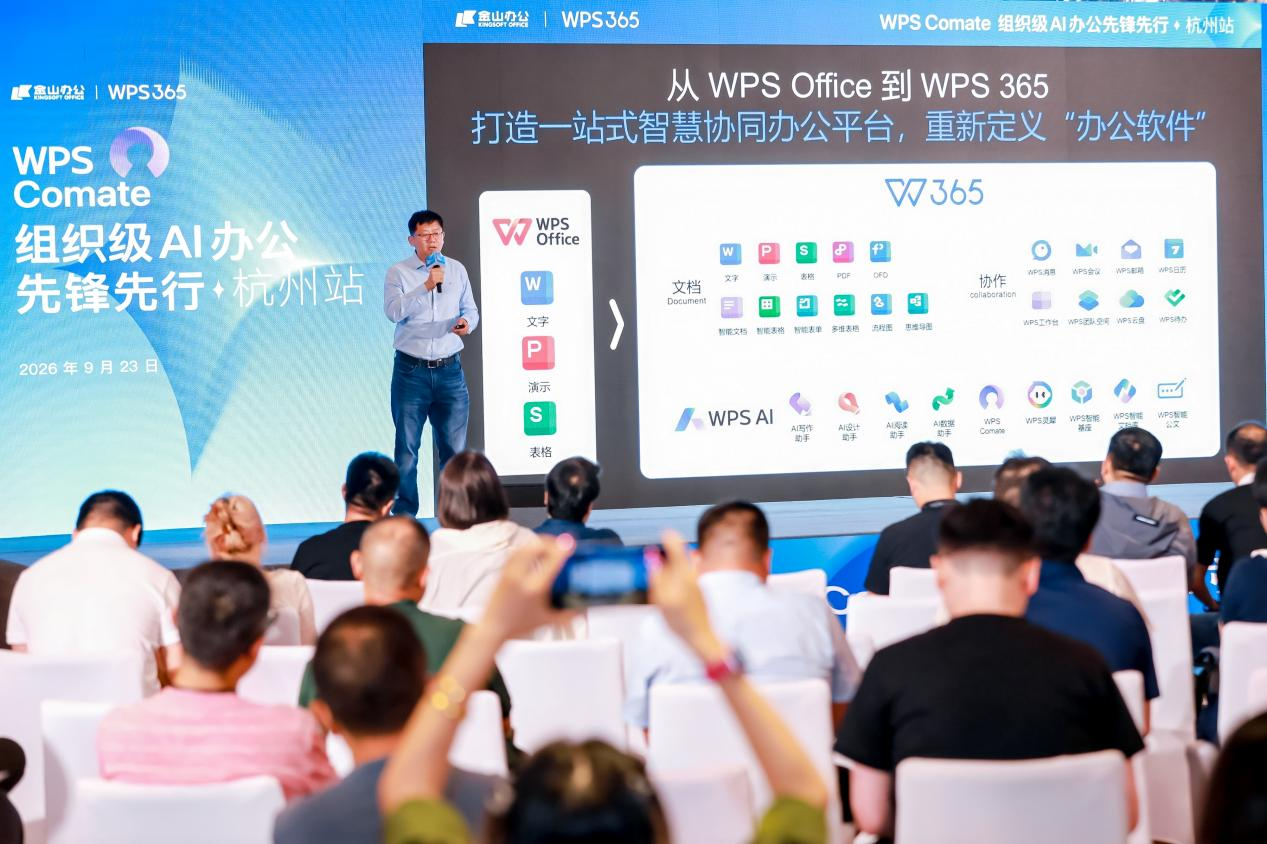
9月23日,WPS Comate组织级AI办公先锋先行城市峰会杭州站举行。金山办公副总裁王少康在演讲中表示,WPS已从办公组件AI、知识基座AI进入智能体AI阶段;WPS Comate将进化为“执行者”,作为组织级数字员工进入核心办公流程。AI办公落地前提仍是身份识别、权限继承、安全管控和过程审计。

(图为金山办公副总裁王少康在现场演讲)

国际研究机构的判断提供了外部佐证。Omdia近日发布中国企业级智能体报告,将WPS Comate列入“通用型”代表厂商,并称办公套件正成为智能体进入日常办公的核心入口;中国路径更强调本地文件、协同入口、私有化部署与多模型路由。

WPS Comate杭州站的展示围绕这一思路展开。它把企业上下文拆成知识、数据、时间、关系、规则/流程、边界六类,对应三个老堵点:数据堵点、经验堵点、行动堵点。演示和方案样例显示,产品质检报告可由2天压缩到10分钟,人才盘点可由一年一次变为每天可看,某省国资监管数据可由一年一次汇总变为每周更新。

因此标准成为杭州站的重要议题。中国信通院云计算与数字化研究所开源与智能化安全部高级业务主管吴江伟介绍了智能体能力评估体系,WPS Comate已通过信通院首批企业级办公智能体与智能编程助手评估。此前,WPS灵犀、WPS Comate获得《人工智能智能体互联》系列标准下的统一身份标识。标准在推进,WPS相关主体深度参与GB/Z 244-2026《人工智能 办公大模型系统建设指南》和SJ/T 12114-2026《人工智能关键技术 办公大模型系统技术要求》研制。

业务能不能跑顺,市场已有答案。2026年一季度,国内办公套件市场份额按终端用户授权数测算,WPS为32.1%,反超微软的28.5%。表格是办公软件的硬场景,SpreadsheetBench V2 Full榜单显示,WPS AI以50.86%综合成绩排名第一,并通过官方Verified验证,超过Claude Opus 4.6、GPT-5.2、Gemini 3.1 Pro。中山市政务平台基于60万份私域文档生成公文,起草时间由3小时缩短至40分钟,格式错误率下降75%。

杭州站释放的信号很明确:AI办公正在从单点功能增强,转向组织流程与治理体系的重构。安全、标准、评测和业务连接能力,将共同决定AI能否进入核心流程。WPS 365此次围绕组织级AI办公的展示,为行业观察AI从“可用”走向“敢用”提供了参照。

本文首发于 亿邦动力 官方网站

文章来源:Laborer

广告
微信
朋友圈

FAQ回顾

组织级AI是什么?

组织级AI是面向企业整体办公流程的智能体应用形态,金山办公已从办公组件AI、知识基座AI进入智能体AI阶段。WPS Comate以“执行者”身份成为组织级数字员工,进入核心办公流程,并围绕知识、数据、时间、关系、规则/流程、边界拆解企业上下文,对应数据、经验、行动三大堵点。

WPS Comate是什么?

WPS Comate是金山办公推出的组织级智能体产品,定位于核心办公流程中的数字员工。Omdia发布的《中国企业级智能体报告》将其列入“通用型”代表厂商,并指出办公套件正成为智能体进入日常办公的核心入口,中国路径更强调本地文件、协同入口、私有化部署与多模型路由。

AI办公落地需要具备哪些前提条件?

AI办公落地需要具备的前提条件是身份识别、权限继承、安全管控和过程审计。金山办公副总裁王少康在WPS Comate组织级AI办公先锋先行城市峰会杭州站表示,只有具备这四项底层能力,智能体才能安全地进入企业核心办公流程,从“可用”走向“敢用”。

国内办公套件市场份额中,WPS和微软谁更高?

2026年一季度,按终端用户授权数测算,金山办公WPS在国内办公套件市场的份额为32.1%,反超微软的28.5%。这一数据反映出WPS在AI办公竞争中的市场优势地位。

办公智能体领域有哪些权威标准和评估?

办公智能体领域已有中国信通院智能体能力评估体系,WPS Comate通过首批企业级办公智能体与智能编程助手评估;WPS灵犀、WPS Comate获得《人工智能智能体互联》系列标准下的统一身份标识;WPS相关主体还参与GB/Z 244-2026《人工智能 办公大模型系统建设指南》和SJ/T 12114-2026《人工智能关键技术 办公大模型系统技术要求》研制。

这么好看,分享一下?

朋友圈 分享

APP内打开

赞 +1
+1
微信好友 朋友圈 新浪微博 QQ空间
关闭
收藏成功
发送
/140 0

