广告
加载中

得物户外用户数复合增长率达65% 品牌营收增长82%

廖紫琳 2026-09-18 16:07
廖紫琳 2026/09/18 16:07

邦小白快读

EN
全文速览

这份由得物App联合欧睿国际发布的《2026得物户外年轻人消费解读》,梳理了当下年轻人户外消费的最新特征,能为普通人了解户外消费趋势、规划户外参与提供实用参考。

1.核心基础数据:当前得物平台户外用户数年复合增长率达65%,入驻户外品牌营收年复合增长率达82%;女性消费者占比达48%,2026年以来女性户外消费增速比男性高24%,高校学生占户外消费者的35%。

2.户外参与的真实动因:44%的参与者是被户外运动本身的乐趣吸引,33%的人是刷到社交媒体上的户外真实体验内容产生参与兴趣,平台上59%的户外搜索由场景关键词驱动。

3.日常消费提示:61%的户外消费属于临时起意购买,83%的用户会同时参与两项以上户外运动,超6成用户选择工作日晚间、周末等碎片化时间参与,越野跑鞋、登山鞋、登山杖、抓绒服是销量增长较快的装备,平台社区内容带有商品链接,可实现种草后即时购买。

这份最新发布的年轻人户外消费报告,为户外品牌布局年轻市场、优化渠道运营、调整产品策略提供了明确的方向参考与实证依据。

1.核心客群特征:得物平台户外用户保持65%的年复合增速,带动入驻品牌实现82%的年复合营收增长;平台女性户外消费者占比达48%,2026年以来女性消费增速高出男性24%,高校学生占户外消费者的35%,是品牌获取年轻新客的核心阵地。

2.消费趋势变化:年轻人户外消费入口已从找商品转向找场景,59%的户外搜索由场景关键词驱动;61%的消费是临时起意的即时购买,83%的用户同时参与两项以上户外运动,超6成用户利用碎片化时间参与,推动户外消费从季节性、大促节点集中消费转向日常全时段消费。

3.经营参考:骆驼通过“造浪计划”切入校园市场实现月销破千万;“社区+电商”模式可帮助品牌实现种草即转化,支撑日常长销;越野跑鞋、登山鞋等细分装备增长迅猛,可作为产品研发重点方向。

这份报告披露了得物户外赛道的高增长红利与消费新特征,为户外品类卖家指明了选品方向、运营策略与增量机会。

1.赛道增长机会:当前得物平台户外用户年复合增长率达65%,带动入驻品牌实现82%的年复合营收增长,属于高速增长赛道;细分品类中越野跑鞋同比增长108%、登山杖同比增长85%、登山鞋同比增长76%、抓绒服同比增长62%,都是需求上涨明显的增量品类。

2.消费需求变化:83%的户外消费者会同时参与两项以上户外运动,超6成用户选择工作日晚间、周末等碎片化时间参与活动,61%的消费属于临时起意的即时购买,户外消费需求全年均匀分布,不再集中于传统户外旺季或大促节点。

3.经营方法参考:可借鉴骆驼切入校园市场的玩法,挖掘占比达35%的高校学生客群;依托平台“社区+电商”链路,用场景化内容种草,匹配用户即时下单的消费路径,实现日常常态化销售。

这份年轻人户外消费报告,为户外用品生产工厂指明了产品设计方向、市场对接机会与渠道合作参考。

1.高需求产品方向:当前线上户外赛道增长迅猛,得物平台户外品牌营收年复合增速达82%,细分品类中越野跑鞋同比增长108%、登山杖同比增长85%、登山鞋同比增长76%、抓绒服同比增长62%,相关产品订单需求上涨明显;且83%的消费者同时参与两项以上户外运动,适配多场景的轻量化户外装备更受市场欢迎。

2.针对性设计参考:平台女性户外消费者占比达48%,2026年以来女性消费增速高出男性24%,贴合女性身形、审美偏好的户外产品有较大增量空间;高校学生占户外消费者的35%,适配校园入门场景、高性价比的户外装备需求旺盛。

3.供货合作启示:品牌经营正从大促集中备货转向日常常态化供货,工厂可对接得物平台的户外品牌,匹配其全时段供货需求,建立长期稳定的供货合作。

这份得物联合欧睿发布的户外消费报告,为户外行业服务商、电商服务商点明了行业增长趋势、客户核心痛点与服务落地方向。

1.行业服务机会:当前得物平台户外用户年复合增速达65%,带动入驻品牌实现82%的年复合营收增长,户外赛道处于高速扩张期,大量新老品牌有入驻运营、用户增长、销量提升的服务需求。

2.客户核心痛点:年轻人户外消费逻辑已发生转变,消费入口从商品导向转为场景导向,59%的搜索来自场景关键词,61%的消费为临时起意的即时购买,消费节奏从季节性、节点性集中消费转向全时段日常消费,传统依赖大促、单纯铺货卖货的经营模式已不再适配。

3.服务落地方向:可帮助品牌搭建社区内容种草体系,平台70%的用户会浏览社区内容,80%的社区动态直接附带商品链接,20%的平台GMV由社区行为直接贡献;也可参考骆驼“造浪计划”的校园玩法,帮助品牌对接年轻客群。

这份户外年轻人消费报告梳理了得物在户外赛道的运营成果,为各类内容电商、交易平台做户外品类运营提供了可复制的经验与方向参考。

1.户外赛道的平台价值:得物数据显示,平台户外用户数年复合增长率达65%,带动入驻户外品牌实现82%的年复合营收增长,户外品类是拉动平台用户规模增长、提升品牌入驻吸引力、做大平台交易规模的核心增量赛道。

2.可借鉴的运营经验:要适配年轻人户外消费从商品导向到场景导向的转变,搭建“社区+电商”的完整转化链路——得物平台70%的用户会浏览社区内容,80%的社区动态附带商品链接,20%的GMV由社区行为直接贡献,可有效承接用户从场景种草到即时购买的需求,转化临时起意消费,帮助品牌实现日常长销,提升平台经营稳定性。

3.运营重点方向:要重点挖掘女性用户、高校学生用户的价值,针对性推出商家扶持计划,重点引入越野跑鞋等高增长细分品类的商家,丰富平台供给。

这份得物与欧睿国际联合发布的年轻人户外消费报告,为户外消费产业研究提供了最新的实证数据、产业新动向与商业模式参考。

1.产业增长最新数据:当前线上户外赛道保持高增长态势,得物渠道户外用户年复合增长率达65%,对应平台上户外品牌营收年复合增长率达82%;用户结构呈现新特征,女性消费者占比达48%,2026年以来女性消费增速高出男性24%,高校学生占户外消费者比重达35%,成为户外消费的核心增量群体。

2.产业发展新动向:年轻人户外消费入口从商品导向转向场景导向,59%的户外搜索由场景关键词驱动;消费动因中33%来自社交媒体真实体验内容的种草,61%为临时起意购买,83%的用户同时参与两项以上户外运动,超6成用户利用碎片化时间参与,推动户外消费从季节性集中消费转向日常化全时段消费。

3.商业模式新探索:得物“社区+电商”的短转化链路可直接贡献20%的GMV,适配户外消费日常化特征;骆驼“造浪计划”的校园营销案例为产业触达年轻群体提供了新样本,细分装备的高增长也反映出产业垂直细化的趋势。

返回默认

声明:快读内容全程由AI生成,请注意甄别信息。如您发现问题,请发送邮件至 run@ebrun.com 。

我是 品牌商 卖家 工厂 服务商 平台商 研究者 帮我再读一遍。

Quick Summary

Published by Dewu App in partnership with Euromonitor International, the *2026 Dewu Report on Outdoor Consumption Among Young Consumers* outlines the latest patterns of young people’s outdoor spending, offering practical insights for general readers to understand outdoor consumption trends and plan their own outdoor participation.

1. Core baseline data: The compound annual growth rate (CAGR) of outdoor users on Dewu reaches 65%, driving an 82% revenue CAGR for outdoor brands on the platform. Women account for 48% of outdoor consumers; since the start of 2026, women’s outdoor spending has grown 24 percentage points faster than men’s. College students make up 35% of all outdoor consumers on the platform.

2. Actual motivations for outdoor participation: 44% of participants are drawn by the inherent fun of outdoor sports, while 33% developed interest after seeing real outdoor experience content on social media. 59% of outdoor-related searches on Dewu are driven by scenario-based keywords.

3. Practical consumption tips: 61% of outdoor purchases are impulse buys; 83% of users take part in two or more types of outdoor sports, and over 60% of users participate during fragmented time windows such as weekday evenings and weekends. Fast-growing equipment categories include trail running shoes, hiking boots, trekking poles and fleece jackets. Product links embedded in the platform’s community content enable immediate purchase right after users discover products through shared content.

The newly released report on young consumers’ outdoor spending provides clear directional guidance and empirical evidence for outdoor brands to penetrate the youth market, optimize channel operations and adjust product strategies.

1. Core customer profile: Dewu’s outdoor user base is growing at a 65% CAGR, driving an 82% annual revenue CAGR for resident brands on the platform. Women make up 48% of outdoor consumers, and their spending growth has outpaced men’s by 24 percentage points since early 2026; college students account for 35% of outdoor consumers, making Dewu a core channel for brands to acquire young new customers.

2. Shifts in consumption trends: Young consumers’ entry point for outdoor spending has shifted from searching for specific products to searching for activity scenarios, with 59% of outdoor searches driven by scenario-based keywords. 61% of purchases are unplanned, on-demand transactions; 83% of users participate in two or more outdoor sports, and over 60% engage in outdoor activities during fragmented time. These trends are shifting outdoor consumption away from seasonal, promotion-driven concentrated purchasing toward year-round, daily spending.

3. Operational takeaways: Outdoor brand Camel leveraged its "Wave-Making Program" to tap into the campus market, achieving monthly sales exceeding RMB 10 million. The platform’s "community + e-commerce" model enables immediate conversion right after content-driven product discovery, supporting stable long-tail daily sales. Fast-growing subcategories such as trail running shoes and hiking boots represent high-priority directions for product R&D.

The report reveals the high-growth opportunities and new consumption patterns in Dewu’s outdoor sector, providing clear guidance on product selection, operational strategies and incremental growth opportunities for outdoor category sellers.

1. Sector growth opportunities: Dewu’s outdoor user base is growing at a 65% CAGR, driving an 82% revenue CAGR for resident brands, marking a high-growth track. Among subcategories, trail running shoes are up 108% year-over-year (YoY), trekking poles up 85% YoY, hiking boots up 76% YoY, and fleece jackets up 62% YoY — all representing high-demand incremental categories.

2. Shifts in consumer demand: 83% of outdoor consumers participate in two or more outdoor sports; over 60% of users take part during fragmented time slots such as weekday evenings and weekends; 61% of purchases are unplanned, impulse transactions. Outdoor demand is now evenly distributed across the year, no longer concentrated in traditional peak outdoor seasons or major promotion periods.

3. Operational best practices: Sellers can reference Camel’s campus market playbook to tap into the college student segment, which accounts for 35% of outdoor consumers. Leveraging the platform’s "community + e-commerce" pathway, sellers can use scenario-based content to drive product discovery, align with users’ on-demand purchase behavior, and build consistent, year-round sales.

The report on young consumers’ outdoor spending provides clear direction for outdoor product manufacturers on product design, market alignment opportunities and channel partnership strategies.

1. High-demand product priorities: The online outdoor sector is growing rapidly, with outdoor brands on Dewu recording an 82% revenue CAGR. Among subcategories, trail running shoes are up 108% YoY, trekking poles up 85% YoY, hiking boots up 76% YoY, and fleece jackets up 62% YoY, driving notably strong order demand for related products. Additionally, 83% of consumers participate in two or more outdoor sports, making lightweight, multi-scenario outdoor equipment particularly popular in the market.

2. Targeted design references: Women account for 48% of outdoor consumers on the platform, and their spending growth has outpaced men’s by 24 percentage points since early 2026, indicating significant incremental potential for outdoor products tailored to women’s fit and aesthetic preferences. College students make up 35% of outdoor consumers, creating strong demand for cost-effective entry-level outdoor gear suited to campus scenarios.

3. Supply partnership insights: As brand operations shift from concentrated inventory stocking for promotion events to year-round, normalized supply, factories can partner with outdoor brands on Dewu to meet their full-cycle supply needs and build long-term, stable supply relationships.

Published jointly by Dewu and Euromonitor, the outdoor consumption report identifies industry growth trends, core client pain points and service delivery directions for outdoor industry and e-commerce service providers.

1. Industry service opportunities: Dewu’s outdoor user base is growing at a 65% CAGR, driving an 82% revenue CAGR for resident brands. The outdoor sector is in a phase of rapid expansion, creating strong demand among both new and established brands for services related to platform onboarding, user growth and sales improvement.

2. Core client pain points: Young consumers’ outdoor purchasing logic has shifted: the entry point for consumption has moved from product-oriented search to scenario-oriented search, with 59% of searches driven by scenario-based keywords; 61% of purchases are unplanned, on-demand transactions; and consumption patterns have shifted from seasonal, promotion-focused spending to year-round, daily purchasing. Traditional operational models that rely heavily on major promotions and straightforward product listing are no longer effective.

3. Service implementation directions: Providers can help brands build community content seeding systems: 70% of Dewu users browse community content, 80% of community posts include direct product links, and 20% of platform GMV is directly generated by community interactions. Providers can also reference Camel’s "Wave-Making Program" campus marketing playbook to help brands connect with young consumer groups.

The report on young outdoor consumers summarizes Dewu’s operational results in the outdoor sector, offering replicable experience and directional guidance for content e-commerce platforms and transactional marketplaces operating in the outdoor category.

1. Platform value of the outdoor sector: Dewu’s data shows the platform’s outdoor user base is growing at a 65% CAGR, driving an 82% revenue CAGR for resident outdoor brands. The outdoor category is a core incremental track for driving platform user growth, increasing attractiveness to brand partners, and expanding overall platform transaction volume.

2. Replicable operational experience: Platforms should adapt to young consumers’ shift from product-oriented to scenario-oriented outdoor consumption by building an end-to-end "community + e-commerce" conversion pathway. On Dewu, 70% of users browse community content, 80% of community posts include product links, and 20% of GMV is directly driven by community interactions. This structure effectively captures user demand from scenario-based product discovery to immediate purchase, converts impulse transactions, helps brands achieve stable daily sales, and improves overall platform operational stability.

3. Key operational priorities: Platforms should prioritize unlocking value from female users and college student users, launch targeted merchant support programs, and focus on recruiting merchants in high-growth subcategories such as trail running shoes to diversify platform supply.

Co-published by Dewu and Euromonitor International, the report on young consumers’ outdoor spending provides up-to-date empirical data, emerging industry dynamics and business model insights for outdoor consumption industry research.

1. Latest industry growth data: The online outdoor sector maintains strong growth momentum: Dewu’s outdoor user base is growing at a 65% CAGR, corresponding to an 82% revenue CAGR for outdoor brands on the platform. User demographics show new characteristics: women account for 48% of outdoor consumers, with their spending growth outpacing men’s by 24 percentage points since early 2026; college students make up 35% of outdoor consumers, emerging as a core incremental consumer group.

2. Emerging industry trends: Young consumers’ entry point for outdoor spending has shifted from product-oriented search to scenario-oriented search, with 59% of outdoor searches driven by scenario-based keywords. In terms of consumption motivation, 33% of participation is driven by real experience content shared on social media; 61% of purchases are unplanned impulse buys; 83% of users participate in two or more outdoor sports; and over 60% of users engage in outdoor activities during fragmented time. Together, these trends are driving a shift from seasonal concentrated consumption to year-round, daily outdoor spending.

3. New business model exploration: Dewu’s short "community + e-commerce" conversion pathway directly contributes 20% of platform GMV, aligning well with the daily nature of outdoor consumption. The case of Camel’s "Wave-Making Program" campus marketing provides a new sample for the industry to reach young consumer groups, while the rapid growth of niche equipment segments also reflects the broader trend of vertical specialization in the industry.

Disclaimer: The "Quick Summary" content is entirely generated by AI. Please exercise discretion when interpreting the information. For issues or corrections, please email run@ebrun.com .

I am a Brand Seller Factory Service Provider Marketplace Seller Researcher Read it again.

【亿邦原创】日前,得物App与欧睿国际共同发布《2026得物户外年轻人消费解读》(以下简称《报告》)。

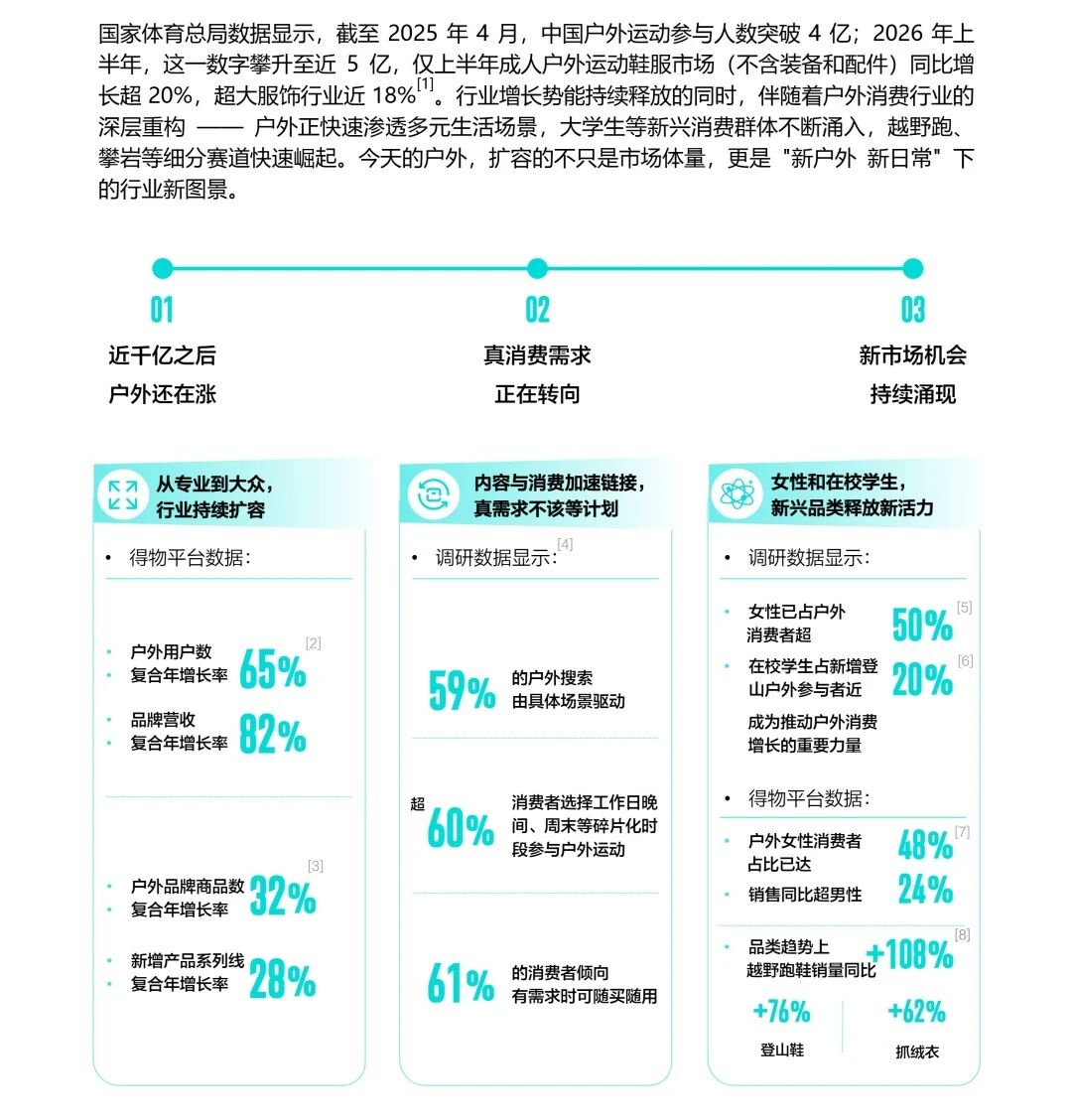
《报告》显示,今年得物户外用户数复合增长率达65%,品牌营收复合年增长率达82%。在用户画像上,得物户外女性消费者占比已经达到48%,男女消费者比例接近各半;2026年以来,女性消费者销售增速高于男性24%。

一方面,年轻人的户外消费正在发生结构性变化,消费入口从“商品”转向“场景”。44%的消费者因运动本身的吸引力而参与户外活动,33%的消费者则是因为刷到社交媒体上的户外真实体验内容而产生兴趣。在得物社区,59%的运动户外搜索由场景关键词驱动。

校园被视为年轻人接触户外运动的重要起点。《报告》显示,得物户外消费者中高校学生占比达到35%。骆驼通过“造浪计划”切入校园市场,月销售额突破千万元,得物校园人群占比达到33%。得物的人群结构,为品牌获取年轻用户提供了基础。

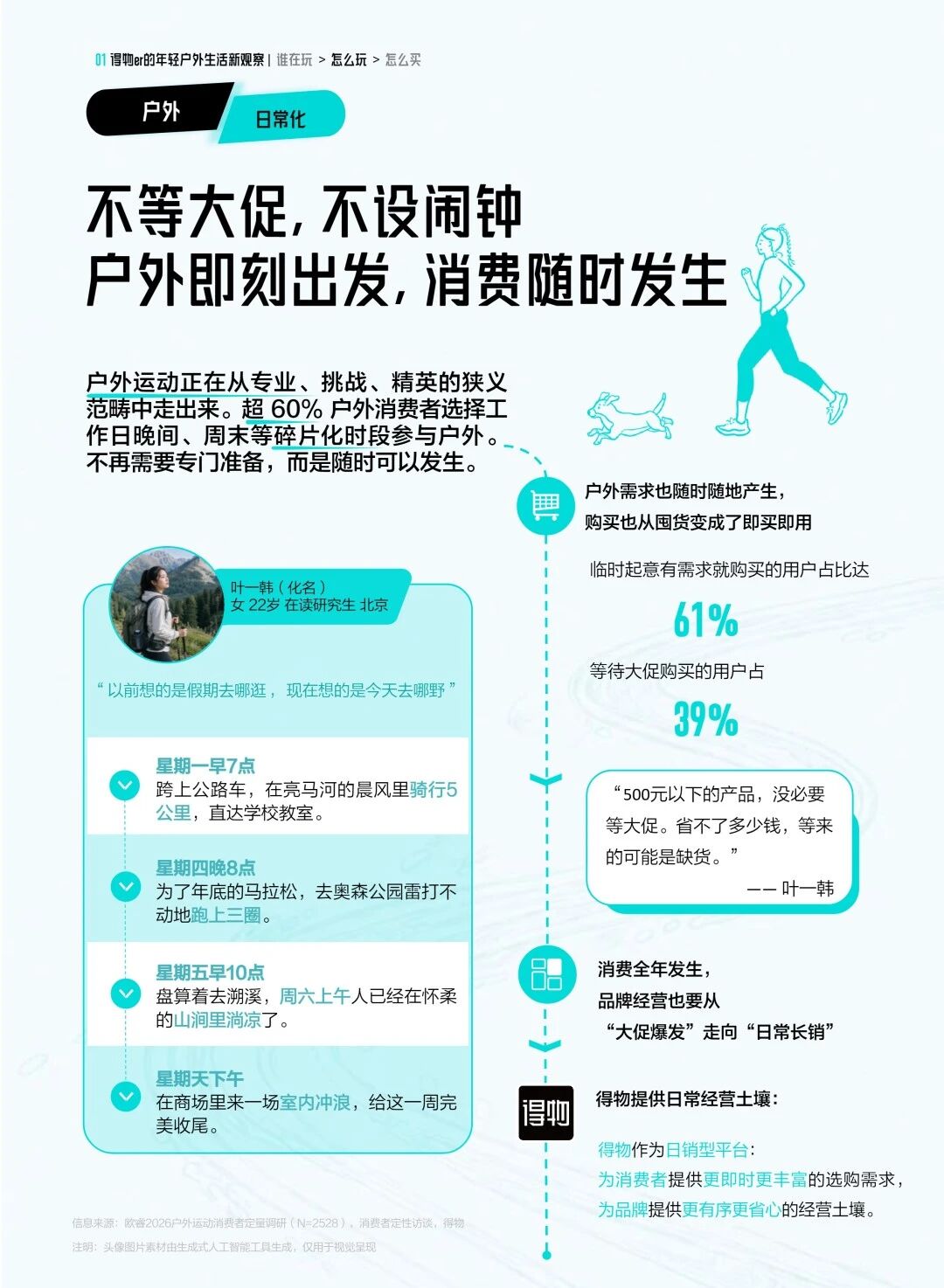
另一方面,消费场景的变化,也带来了消费节奏的变化。61%的户外消费者属于临时起意购买,83%的用户同时参与两项以上户外运动,超过60%的消费者选择工作日晚间、周末等碎片化时间参与户外活动。

这意味着,户外消费正从相对集中的季节性、节点性消费,逐渐融入年轻人的日常生活。消费全年随时发生,得物“社区+电商”的模式,帮助消费者种草即买,助力品牌经营从大促爆发转向日常长销。

据得物数据显示,70%的用户会浏览社区,80%的动态直接带商品链接,20%的GMV由社区行为直接贡献。在得物,细分户外装备也迎来增长:越野跑鞋同比增长108%,登山鞋同比增长76%,登山杖同比增长85%,抓绒服同比增长62%。

亿邦持续追踪报道该情报,如想了解更多与本文相关信息,请扫码关注作者微信。

本文首发于 亿邦动力 官方网站

文章来源:亿邦动力

广告
微信
朋友圈

FAQ回顾

当前年轻人户外消费有哪些新趋势?

年轻人户外消费入口正从“商品”转向“场景”,44%消费者因运动本身参与户外,33%因社交媒体体验内容种草;消费从季节性、节点性采购转向日常随时发生,61%消费者临时起意购买,83%用户同时参与两项以上户外运动。

得物平台户外品类的增长表现如何?

得物平台户外用户数复合增长率达65%,带动合作户外品牌营收复合年增长率达82%;平台户外女性消费者占比48%,2026年以来女性消费增速高于男性24%,高校学生用户占比达35%,用户结构年轻均衡。

得物“社区+电商”模式对户外品牌经营有什么价值?

得物“社区+电商”模式可实现用户种草即买,平台70%用户会浏览社区内容,80%社区动态直接附带商品链接,20%的GMV由社区行为直接贡献,能够助力户外品牌从依赖大促爆发转向日常长效经营。

得物平台哪些户外装备品类增长较快?

得物平台细分户外装备品类增长显著,其中越野跑鞋同比增长108%,登山鞋同比增长76%,登山杖同比增长85%,抓绒服同比增长62%,多个细分品类均呈现出较高的增长态势。

这么好看,分享一下?

朋友圈 分享

APP内打开

+1
+1
微信好友 朋友圈 新浪微博 QQ空间
关闭
收藏成功
发送
/140 0