





广告
加载中

品牌入华电商先行:ALO、VEJA、Mardi等超100个首店开在天猫

龚作仁 2026-08-19 12:37
龚作仁 2026/08/19 12:37

邦小白快读

EN
全文速览

本文核心内容是,当前有超过100个海外品牌进入中国市场时,普遍选择电商先行模式,将首家官方店开在天猫,成为海外品牌入华的新趋势。

1. 今年已有包括高端运动品牌ALO、婚纱女王VERA WANG、法国环保鞋VEJA、马斯克带火的Eight Sleep、韩国潮流品牌Mardi Mercredi等超过100个海外品牌入驻天猫,覆盖运动户外、服饰、居家、宠物用品、专业器具等十多个品类,绝大多数都把天猫作为中国市场的独家官方首发渠道。

2. 对普通消费者来说,之前想要购买这些海外品牌,大多只能找代购或者通过线下买手店,不仅价格高还容易买到假货,现在天猫开了官方旗舰店,有平台和品牌共同提供的正品背书,消费者可以放心购买,不用再找代购奔波。

3. 不少热门海外品牌已经陆续官方入驻,像被名人带火的新兴品牌、韩国热门潮流品牌都能在天猫找到官方店,消费者可以直接下单购买。

本文揭示了当前海外品牌入华的全新趋势,给计划进入中国市场的品牌提供了明确的路径参考,对品牌的渠道建设和运营有较高的参考价值。

1. 当前海外品牌入华已经形成电商先行,天猫首店的新路径,替代了过去先线下开店、先找代理分销的传统模式,这种模式的经营效率更高,不确定性更低。

2. 天猫作为首发渠道,不仅承担销售功能,还能为品牌提供正品信任背书,解决消费者通过代购、社交种草认识品牌后的信任问题,同时整合了搜索、交易、用户资产沉淀和全国市场覆盖能力,能帮助品牌快速搭建中国市场的运营体系。

3. 公开数据显示,这种模式能有效缩短品牌从入驻到起势的路径,今年天猫618就有127个开店5年内的新品牌冲进行业榜前10,对新入华品牌来说是确定性更强的路径,越来越多品牌放弃代理改为直营,天猫就是直营的核心阵地。

本文披露的海外品牌入华新趋势,给国内各类相关卖家带来了明确的机会提示和风险提示,可作为经营调整的参考。

1. 当前超100个海外品牌入华都选择天猫首发,大多采用直营模式,需要本土化的运营配套支持,熟悉天猫平台运营的代运营卖家、服务卖家可以获得大量新的客户合作机会。

2. 本次入华的海外品牌覆盖十多个品类,从大众潮流服饰到专业垂直领域的器具都有,大量新品牌入华带动了供应链、仓储物流、直播带货等相关需求,给对应领域的卖家带来了新的增长机会。

3. 越来越多原代理运营的品牌改为直营,原先依靠代理分销拿货的零售卖家需要调整经营策略,要么对接品牌官方合作,要么转型寻找新的货源方向,规避代理渠道变化带来的经营风险。

4. 目前天猫是新品牌入华的核心阵地,想要和海外品牌合作的卖家优先布局天猫,更容易获得合作机会。

本文展现的海外品牌入华新浪潮,给国内生产制造工厂带来了新的商业机会和转型启示,可作为工厂调整发展方向的参考。

1. 本次入华的超100个海外品牌覆盖十多个品类,从服饰鞋包到家居用品、专业生产器具都有,很多品牌进入中国市场后会选择本土化生产来降低成本,给符合品质要求的国内工厂带来了大量代工合作的商业机会。

2. 海外品牌入华选择电商渠道运营,对供应链的响应速度要求更高,需要工厂适配小单快反、柔性生产的模式,这推动国内工厂加快生产端的数字化改造,适配电商品牌的需求,提升自身竞争力。

3. 大量细分领域的海外头部品牌选择入华,说明国内这些细分赛道的消费需求正在快速崛起,有自主研发能力的工厂可以参考海外品牌的产品设计方向,开发适配国内消费者需求的同类产品,抓住细分赛道的增长机会。

4. 电商先行模式可以帮助品牌快速测试市场反应,工厂可以和新入华品牌合作探索数字化的新品测试、柔性生产新模式,提升自身的运营效率。

本文揭示了海外品牌入华赛道的新变化,给面向品牌服务的各类服务商指明了新的行业趋势和客户需求方向,带来了新的业务增量。

1. 当前海外品牌入华的核心趋势是电商先行、直营化运营,替代了过去线下先行、代理分销的模式,原来服务代理分销、线下渠道的服务商需要及时调整业务方向,转向服务品牌直营的电商运营需求,抓住新的客户增量。

2. 新入华海外品牌的核心痛点是缺乏中国市场的用户洞察、全渠道触达能力和信任背书,服务商可以围绕天猫平台的运营规则,推出品牌入驻、店铺运营、正品推广、用户资产运营等配套服务,匹配品牌的核心需求。

3. 本次入华的品牌覆盖从大众潮流到专业垂直的十多个品类,不同品类的运营需求差异较大,垂直领域的专业服务商可以针对不同品类推出垂直化的运营解决方案,打造自身的差异化竞争力,获得更多客户。

4. 新品牌入华后从入驻到起势的周期明显缩短,服务商可以推出快速起店、流量运营、冲榜等配套服务,匹配新品牌的发展节奏。

海外品牌入华选择电商先行的新趋势,给国内电商平台的招商、运营和发展带来了很多启示,可作为平台调整策略的参考。

1. 当前大量海外品牌入华优先选择天猫作为首发渠道,核心是认可天猫覆盖全国各线城市的触达能力、数字化运营优势、消费群体洞察能力,以及平台自带的正品背书信任价值,其他想要争夺海外品牌入驻的平台,需要针对性补全这些能力短板,提升对海外品牌的吸引力。

2. 海外品牌入华的需求已经从原来的代理分销转向品牌直营运营,平台需要针对海外直营品牌推出更适配的招商政策、运营扶持工具,降低品牌入华的运营门槛,吸引更多品牌入驻。

3. 本次入华的品牌中有大量细分垂直领域的全球头部品牌,说明细分赛道的吸引力在提升,平台可以针对性开展垂直品类招商,丰富平台的品类供给,打造自身的差异化竞争力。

4. 这种模式验证了平台作为品牌入华第一站的可行性,平台可以加大对海外品牌的招商力度,同时规范平台内的正品运营管理,规避假货乱象带来的信任风险,维护平台和品牌的口碑。

本文展现了海外品牌进入中国市场的全新路径模式,为零售产业、品牌国际化领域的研究提供了新的研究样本,明确了新的产业动向。

1. 产业新动向层面,传统海外品牌入华的路径是先线下布局、后线上拓展,先开放代理分销、后转为直营,当前已经转变为电商先行、直营优先、平台首店的全新模式,这是中国电商基础设施成熟后,品牌入华模式的重要重构,值得深入研究。

2. 新的商业模式下,电商平台已经不再只是简单的销售渠道,还承担了信任背书、用户资产沉淀、本土市场洞察、全链路运营的多重功能,有效缩短了品牌从入驻到起势的周期,降低了品牌入华的风险,提升了经营的确定性,改变了品牌入华的价值链结构。

3. 这一趋势也反映出中国消费市场的两大变化,一是消费升级下细分品类的需求崛起,吸引了全球各垂直领域的品牌进入,二是消费者对正品的需求不断提升,推动品牌放弃代理选择直营模式,这些都可以作为消费市场研究的新方向。

4. 该趋势也给政策制定带来启示,相关部门可以围绕海外品牌电商入华出台配套扶持政策,进一步扩大进口消费,推动国内消费市场升级。

返回默认
声明:快读内容全程由AI生成,请注意甄别信息。如您发现问题,请发送邮件至 run@ebrun.com 。

我是 品牌商 卖家 工厂 服务商 平台商 研究者 帮我再读一遍。

Quick Summary

This article highlights a new trend: over 100 international brands entering China are now adopting an "e-commerce first" strategy, launching their first official Chinese stores on Tmall.

1. This year alone, more than 100 overseas brands including premium activewear brand ALO, bridal designer VERA WANG, French eco-friendly sneaker brand VEJA, Elon Musk-popularized Eight Sleep and Korean streetwear label Mardi Mercredi have opened stores on Tmall, covering more than 10 categories spanning sports and outdoors, apparel, home goods, pet products and specialized equipment. The vast majority have chosen Tmall as their exclusive official launch channel in China.

2. Previously, Chinese consumers could only purchase these brands via daigou (personal shoppers abroad) or offline multi-brand boutiques, which charged premium prices and carried a high risk of buying counterfeits. Now, with official flagships on Tmall backed by dual brand and platform authenticity guarantees, consumers can shop with confidence without relying on third-party resellers.

3. A growing number of popular overseas brands, including celebrity-backed emerging labels and trending Korean streetwear brands, now have official stores on Tmall available for direct purchase.

This article outlines a new trend for international brands entering China, providing clear strategic guidance for brands planning to enter the market with valuable insights for channel development and operations.

1. Overseas brands entering China have now established a new "e-commerce first, Tmall first store" path, replacing the traditional model of opening physical stores first and partnering with distribution agents. This new model delivers higher operational efficiency and lower uncertainty.

2. As a launch channel, Tmall not only facilitates direct sales but also provides an official authenticity guarantee that resolves consumer trust issues for brands already known to Chinese shoppers via daigou and social media recommendations. It also integrates search, transaction, user asset accumulation and national market coverage, enabling brands to quickly build a full operational system for the Chinese market.

3. Public data shows this model effectively shortens the path from market entry to traction. During this year's Tmall 618 shopping festival, 127 new brands that had launched within five years ranked among the top 10 in their industry categories. This is a more predictable path for newly entering brands, and a growing number of brands are abandoning agency partnerships to shift to direct operation, with Tmall as their core direct-to-consumer hub.

The new trend of international brands entering China revealed in this article provides clear opportunity and risk alerts for domestic sellers, serving as a reference for operational adjustments.

1. Currently, more than 100 overseas brands entering China have chosen to launch on Tmall, most operating via direct-to-consumer models that require localized operational support. This creates substantial new partnership opportunities for third-party Tmall operation specialists and other service-focused sellers familiar with the platform's ecosystem.

2. The newly entering brands cover more than 10 categories ranging from mass-market streetwear to specialized vertical equipment. The influx of new brands drives growing demand for supply chain, warehousing and logistics, and live-stream commerce services, opening new growth opportunities for sellers in corresponding sectors.

3. A growing number of previously agency-operated brands are shifting to direct operation. Retail sellers that previously sourced goods via distribution agents will need to adjust their business strategies: either secure official partnership with the brands, or pivot to new sourcing channels to mitigate operational risks brought by channel restructuring.

4. Tmall is the core hub for new international brands entering China. Sellers seeking partnerships with overseas brands are more likely to secure opportunities by prioritizing布局 on Tmall.

This new wave of international brands entering China presented in the article brings new business opportunities and transformation insights for domestic manufacturing factories, serving as a reference for factories adjusting their development direction.

1. More than 100 newly entering overseas brands cover over 10 categories, from apparel and footwear to home goods and specialized production equipment. Many of these brands will opt for localized manufacturing to cut costs after entering the Chinese market, bringing substantial new OEM partnership opportunities for domestic factories that meet quality requirements.

2. International brands entering China choose e-commerce operation, which requires faster supply chain response and pushes factories to adapt to small-batch, fast-turnaround flexible production models. This drives domestic factories to accelerate digital transformation in production to meet the needs of e-commerce brands and improve their own competitiveness.

3. The fact that many leading global overseas brands in niche segments are entering China indicates that consumer demand in these domestic niche tracks is growing rapidly. Factories with independent R&D capabilities can reference the product design directions of these overseas brands, develop similar products suited to Chinese consumer demand, and capture growth opportunities in niche segments.

4. The e-commerce-first model allows brands to quickly test market response, and factories can partner with newly entering overseas brands to explore new digital models for new product testing and flexible production, improving their own operational efficiency.

This article reveals new changes in the track of international brands entering China, points out new industry trends and customer demand directions for various brand-facing service providers, and brings new business growth.

1. The core current trend for overseas brands entering China is e-commerce-first direct operation, replacing the traditional model of offline-first agency distribution. Service providers that originally served agency distribution and offline channels need to adjust their business direction in time to shift to serving the e-commerce operation needs of directly operated brands, and capture new customer growth.

2. The core pain points for newly entering overseas brands are the lack of Chinese market user insights, omni-channel reach capabilities and trust endorsement. Service providers can develop supporting services such as brand onboarding, store operation, authenticity promotion, and user asset management aligned with Tmall's operating rules, to match the core needs of these brands.

3. The newly entering brands cover more than 10 categories from mass-market fashion to professional vertical segments, with very different operational needs across categories. Professional service providers focused on vertical segments can develop vertical operation solutions for different categories, build their own differentiated competitiveness, and acquire more customers.

4. The cycle from onboarding to market traction for newly entering brands has shortened significantly. Service providers can launch supporting services such as fast store setup, traffic operation, and ranking campaigns to match the growth pace of new brands.

The new trend of overseas brands choosing e-commerce-first to enter China brings a lot of inspiration for the investment attraction, operation and development of domestic e-commerce platforms, and can be used as a reference for platforms to adjust their strategies.

1. Currently, a large number of overseas brands entering China prioritize Tmall as their launch channel, primarily because they recognize Tmall's ability to reach consumers across all tier cities nationwide, its advantages in digital operation and consumer insight, and the built-in trust value of the platform's authenticity guarantee. Other platforms looking to attract overseas brand entry need to address these capability gaps to improve their appeal to international brands.

2. The demand of overseas brands entering China has shifted from agency distribution to brand direct operation. Platforms need to launch more tailored investment policies and operational support tools for international direct operation brands, lower the operational threshold for brands entering China, and attract more brands to settle in.

3. Among the newly entering brands are many global leading brands in niche vertical segments, which indicates that niche tracks are growing in attractiveness. Platforms can carry out targeted category-specific investment attraction to enrich their product assortment and build differentiated competitiveness.

4. This model verifies the feasibility of platforms serving as the first stop for brands entering China. Platforms can increase investment attraction for overseas brands, while standardizing in-platform authenticity operation management, mitigating trust risks brought by counterfeit chaos, and protecting the reputation of both the platform and brands.

This article presents a brand new path model for overseas brands entering the Chinese market, provides new research samples for research in retail industry and brand internationalization, and clarifies new industry trends.

1. In terms of new industry trends, the traditional path for overseas brands entering China was offline layout first, online expansion later, and opening agency distribution first before shifting to direct operation. Now it has transformed into a brand new model of e-commerce first, direct operation priority, and platform first store. This is an important restructuring of the brand entry model after the maturation of China's e-commerce infrastructure, and it is worthy of in-depth research.

2. Under the new business model, e-commerce platforms are no longer just simple sales channels, but also undertake multiple functions of trust endorsement, user asset accumulation, local market insight, and full-link operation. This effectively shortens the cycle from brand entry to market traction, reduces the risk of brands entering China, improves operational certainty, and changes the value chain structure of brand entry into China.

3. This trend also reflects two major changes in China's consumer market: first, the rise of demand for niche categories driven by consumption upgrading, which has attracted global brands from various vertical fields to enter; second, consumers' growing demand for authentic products, which has pushed brands to abandon agency models and choose direct operation. These can all serve as new directions for consumer market research.

4. This trend also brings inspiration for policy formulation: relevant authorities can introduce supporting policies around the e-commerce entry path for overseas brands to further expand import consumption and promote the upgrading of the domestic consumer market.

Disclaimer: The "Quick Summary" content is entirely generated by AI. Please exercise discretion when interpreting the information. For issues or corrections, please email run@ebrun.com .

I am a Brand Seller Factory Service Provider Marketplace Seller Researcher Read it again.

8月12日,高端运动生活方式品牌ALO独家入驻天猫。据公开数据,开售1分钟成交破千万,首日粉丝突破14万。

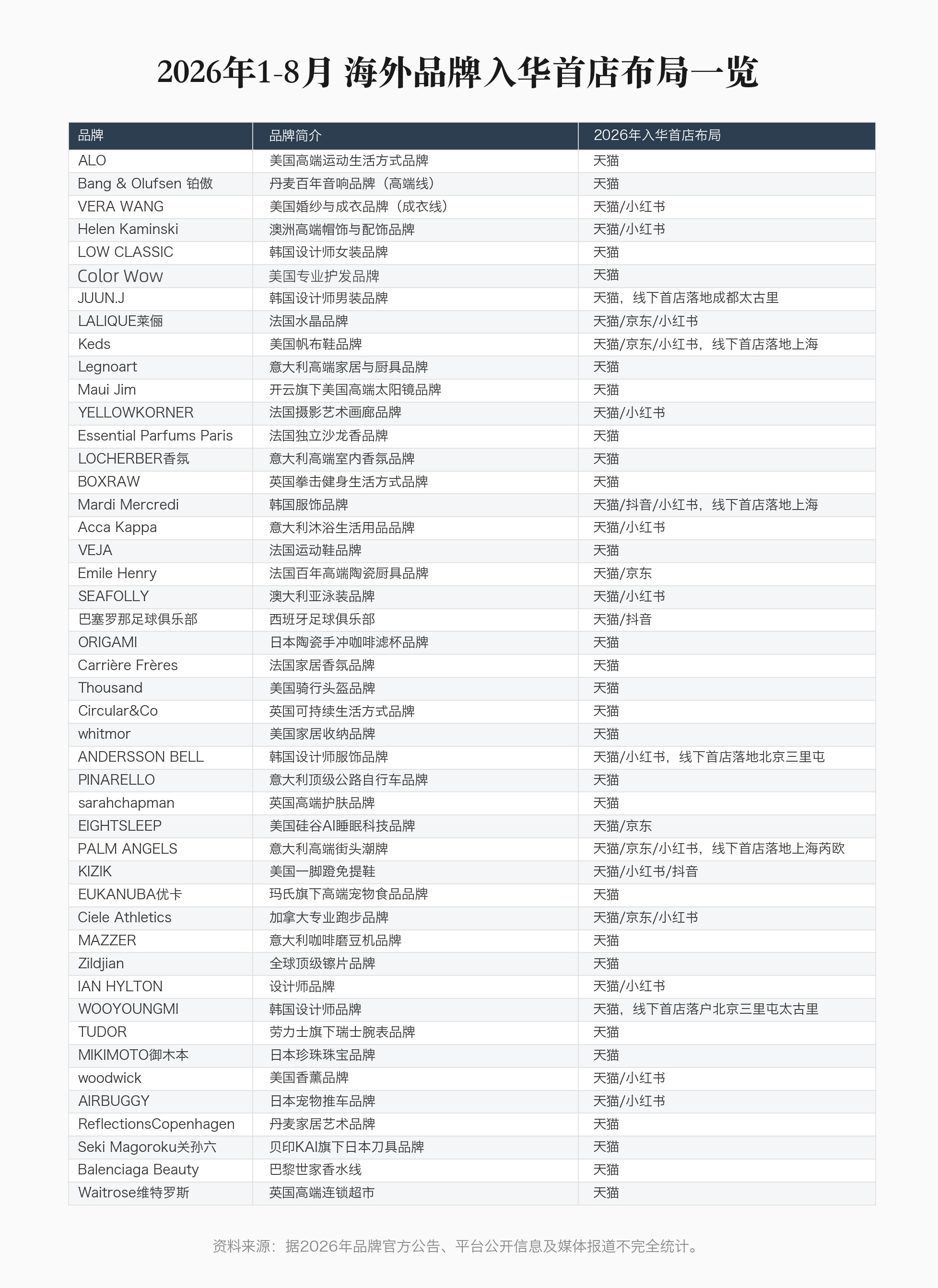
这并非个例。今年以来,Eight Sleep、Mardi Mercredi、VERA WANG、Bang&Olufsen等超过100个海外品牌选择“电商先行”,再逐步拓展中国市场。VEJA、LOW CLASSIC等品牌官方旗舰店独家上线天猫。这些品牌覆盖运动户外、奢侈品牌、设计师时装、居家生活、宠物用品、乐器等十多个品类。

“婚纱女王”VERA WANG今年夏天正式在中国市场推出全新时装线,并把天猫作为官方平台和电商首发渠道。法国环保运动鞋品牌VEJA 5月入驻天猫,开设中国首家官方旗舰店,也是独家官方电商渠道。此前,VEJA在全球100多个国家通过买手店、连锁百货等渠道分销,亚太区负责人Artaud Frenoy表示:“欧美和巴西三大市场成熟后转向亚洲,直营是核心策略。”

被马斯克、扎克伯格带火的硅谷AI睡眠品牌Eight Sleep在4月官宣进入中国市场,不设经销商、不开线下门店。CTO Massimo Andreasi Bassi表示,天猫拥有覆盖全国各线城市的触达能力,以及数字化运营与消费群体洞察上的优势。

以“小雏菊”图案走红的韩国潮流服饰品牌Mardi Mercredi,在2025年关闭此前由代理商运营的门店,近日以直营方式宣布重返中国。在上海直营首店开幕之前,品牌已率先在天猫等电商平台开设官方旗舰店。韩国设计师品牌LOW CLASSIC、ANDERSSON BELL,澳大利亚高端帽饰品牌Helen Kaminski,被马斯克带火的“一脚蹬”KIZIK免提鞋,都在今年首次入华,并第一时间入驻天猫。

专业垂直领域也不乏新的入局者。全球知名镲片品牌Zildjia、意大利专业咖啡磨豆机品牌MAZZER、日本美浓烧陶瓷滤杯ORIGAMI,这些在各自领域深耕多年的品牌,今年都通过天猫作为第一站触达中国消费者。

电商先行、天猫首店,正在成为海外品牌进入中国市场的新路径。

这背后不只是销售渠道的迁移。当消费者通过社交媒体、代购或明星同款认识一个品牌后,天猫旗舰店首先承担的是“信任确认”的功能,为品牌提供最直接的正品背书。同时,它把搜索、交易、用户资产沉淀和全国市场覆盖整合在同一套体系里,成为品牌入华经营效率更高的阵地。

公开数据显示,今年天猫618,有127个开店5年内的品牌冲进行业榜前10,其中不少是从细分赛道跑出来的新面孔。品牌从入驻到起势的路径正在缩短。对海外品牌而言,把天猫作为入华第一站,也成了一条更接近确定性的路径。

注:文/龚作仁,文章来源:Laborer,本文为作者独立观点,不代表亿邦动力立场。

文章来源:Laborer

广告
微信
朋友圈

FAQ回顾

海外品牌进入中国市场的新路径是什么?

电商先行、将天猫作为入华首店是当前海外品牌进入中国市场的新路径,已有超100个海外品牌选择该模式,覆盖运动户外、奢侈品、设计师时装等十多个品类。

海外品牌选择天猫作为入华首站有哪些优势?

天猫拥有覆盖全国各线城市的触达能力,兼具数字化运营与消费群体洞察优势,可为品牌提供正品背书,整合搜索、交易、用户资产沉淀等功能,大幅提升入华经营效率。

法国运动鞋品牌VEJA入华的官方电商渠道是什么?

法国环保运动鞋品牌VEJA2024年5月入驻天猫,开设中国首家官方旗舰店,天猫也是其独家官方电商渠道,该品牌此前在全球100多个国家通过买手店等渠道分销。

ALO品牌入驻天猫后的销售表现如何?

高端运动生活方式品牌ALO于2024年8月12日独家入驻天猫,开售1分钟成交破千万,首日粉丝突破14万,是海外品牌电商先行入华的典型案例。

这么好看,分享一下?

朋友圈 分享

APP内打开

赞 +1
+1
微信好友 朋友圈 新浪微博 QQ空间
关闭
收藏成功
发送
/140 0

