广告
加载中

飞猪推出旅行AI助手“飞猪帮帮”:完成从“聊得好”到“办成事”的升级

郑雅 2026-08-12 15:00
郑雅 2026/08/12 15:00

邦小白快读

EN
全文速览

本文核心信息是飞猪推出新一代旅行AI产品飞猪帮帮,完成从“聊得好”到“办成事”的升级,能为普通用户提供全旅程的旅行AI服务,实操性很强。

1. 产品核心功能分为三个板块:帮我想可根据模糊需求生成行程,还能复制攻略链接直接生成定制行程,支持多轮调整;帮我订可满足个性化订购需求,能筛选符合描述的商品,一次性组合购买不同票种;帮我办可代办值机选座、改签、升房、入境卡填写等全流程琐事。

2. 产品体验优势:AI可以在App多个位置随时唤起,一站式完成所有操作不用跳转;支持自然语言搜索不用拼凑关键词;结果可用率较上一代提升超70%,平均耗时减少近10%,体验更流畅可靠。

飞猪此次AI升级,为旅游行业品牌商带来了消费趋势参考和AI赋能的新方向,干货内容如下:

1. 消费趋势变化:当前消费者越来越偏好个性化、一站式的全旅程旅行服务,不再满足于零散的信息和预定服务,需要AI能承接模糊化的个性化需求,直接完成全流程履约,品牌产品研发和营销需要贴合这一趋势。

2. AI赋能商家的新实践:飞猪围绕AI生态布局,今年5月已经面向酒店商家免费开放智能助理,解决商家盯价格、库存、营销消耗大量人力的痛点,测试数据显示,酒店使用AI诊断后,采纳了80%以上的AI建议,有效降低运营成本。

3. 品牌升级参考:飞猪提出OTA要从在线旅行社进化为全智能旅行代理,这一定位为旅游行业品牌的战略升级提供了方向参考。

飞猪此次AI升级为平台内的旅游卖家带来了新的增长机会和扶持支持,相关干货内容如下:

1. 平台扶持政策:飞猪将AI赋能生态作为核心布局方向,已经在今年5月面向酒店类商家免费开放AI智能助理,帮助卖家处理盯价格、盯库存、做营销、分账等繁琐运营工作,节省人力成本,还能提供经营决策建议,测试中商家对AI建议的采纳率超过80%,效果得到验证。

2. 新的流量机会:飞猪帮帮的AI搜索可以承接用户的模糊个性化需求,比如帮我找能看故宫金顶的酒店,AI会自动将用户需求转化为库存匹配,能帮助卖家的特色商品更好触达精准用户,获得更多转化机会。

3. 机会提示:卖家可以尽快对接飞猪的AI能力,沉淀自身的AI资产,借助平台AI升级获得更多增长空间,适配新的AI流量规则。

本文介绍的飞猪AI升级实践,为旅游产业链相关工厂提供了需求方向和数字化转型启示,干货内容如下:

1. 产品生产和设计需求变化:当前消费端的需求越来越个性化、场景化,用户更倾向提出模糊的场景需求,而非标准化产品,比如指定景观的住宿、定制化行程,这要求上游生产设计端需要柔性化调整,增加个性化产品的供给,适配AI匹配的新需求结构。

2. 商业机会:AI推动旅游全链路数字化升级,上游供应链工厂可以接入飞猪这类大平台的AI体系,将自身产品信息标准化为AI可调用的资产,获得更多精准的用户触达机会,拓展销售渠道。

3. 数字化转型启示:飞猪的AI升级路径显示,通用大模型无法直接满足垂类需求,需要结合自身业务资产做垂类后训练和适配,工厂推进数字化和电商升级时,也需要结合自身业务场景打磨能力,不能直接套用通用方案。

本文透露出旅游AI服务领域的行业发展趋势、客户痛点和可参考的解决方案,干货内容如下:

1. 行业发展趋势:旅游AI已经走过了单点信息服务、全程规划陪伴两个阶段,现在正式进入全旅程履约服务阶段,OTA的核心定位也从在线旅行社转向全智能旅行代理,全链路AI办事是未来的核心发展方向。

2. 当前行业核心客户痛点:C端用户的痛点是找不到能满足个性化需求、直接代办全流程事项的AI服务,反复跳转界面效率低;B端商家的痛点是日常运营中盯价格、库存、营销等繁琐工作消耗大量人力成本,需要AI解放人力。

3. 可参考的解决方案:飞猪采用Multi-Agent架构,将AI嵌入全服务流,融合自然语言界面和图形界面,同时搭建实时训练环境和结果纠错验证体系,有效提升结果可用率,这套落地方案可供旅游服务商参考。

飞猪新一代旅行AI的升级实践,为旅游类平台商提供了产品升级、运营管理、招商等多方面的参考,干货内容如下:

1. 用户与商家对平台的新需求:用户端需要平台提供全流程一体化的AI服务,能直接办成事,不需要只提供信息链接;商家端需要平台开放AI能力,帮助降低运营成本,沉淀自身的数字化资产。

2. 平台产品升级的可参考做法:不需要将AI放在首页角落单独做聊天机器人,而是要将AI嵌入全服务流,在搜索、行程、订单等多个页面都可唤起,实现一站式服务;同时要针对垂类场景做模型后训练,搭建结果验证纠错体系,保障结果可靠性。

3. 平台运营与招商启示:平台可以通过免费向商家开放AI智能助理的方式,吸引商家入驻,提升商家留存和运营效率,同时围绕用户体验、生态繁荣、组织重塑三个方向布局AI,能帮助平台构建核心竞争力,规避通用AI落地效果差的风险。

本文介绍的飞猪AI升级实践,反映了在线旅游行业AI转型的产业新动向、新商业模式探索,对研究者有较高参考价值,干货内容如下:

1. 产业新动向:AI时代OTA行业正在发生内核变革,传统在线旅行社正在向全智能旅行代理转型,AI应用的发展路径清晰,从单点信息提效,到全程规划陪伴,再到现在的全旅程履约办事,飞猪明确了围绕提升用户体验、繁荣生态、重塑组织的三个方向AI布局。

2. 新商业模式探索:飞猪帮帮采用将自然语言界面与图形界面融合的方式,把AI Agent嵌入全服务流,依托平台十年沉淀的供应链能力,实现了从需求理解到履约的全链路AI服务,形成了可复制的垂类AI落地路径。

3. 行业新命题:本文提出旅行AI落地的核心考验是能否直达真实供给、对接交易系统、应对物理世界的意外,同时总结了飞猪沉淀的三项核心能力,为产业研究提供了新的研究方向和真实案例数据。

返回默认
声明:快读内容全程由AI生成,请注意甄别信息。如您发现问题,请发送邮件至 run@ebrun.com 。

我是 品牌商 卖家 工厂 服务商 平台商 研究者 帮我再读一遍。

Quick Summary

This article highlights Fliggy's launch of its new-generation travel AI product, Fliggy Assistant, which marks an upgrade from "conversational capability" to "end-to-end task completion". The product delivers highly practical full-journey AI travel services for general users.

1. It features three core functional modules: Trip Planner generates custom itineraries based on vague user需求, can create tailored plans directly from copied travel guide links, and supports multiple rounds of adjustment. Booking Assistant fulfills personalized booking needs by filtering products matching user descriptions and enabling combined purchase of different ticket types in one transaction. Service Assistant handles end-to-end routine tasks including check-in and seat selection, ticket changes, room upgrades, and arrival card filling.

2. Key user experience advantages: The AI can be invoked anytime across multiple locations in the app, allowing users to complete all operations in one stop without page redirection. It supports natural language search, eliminating the need for users to piece together exact keywords. Compared to the previous generation, the availability of valid results has improved by over 70%, while average processing time has dropped by nearly 10%, delivering a smoother, more reliable experience.

Fliggy's latest AI upgrade offers new insights into consumer trends and AI empowerment directions for travel industry brands, with key takeaways as follows:

1. Shifting consumer trends: Consumers today increasingly prefer personalized, one-stop full-journey travel services, and are no longer satisfied with fragmented information and booking services. They require AI that can address vague personalized demands and complete end-to-end fulfillment directly. Brand product development and marketing need to align with this trend.

2. New practices in AI-enabled merchant support: As part of its AI ecosystem layout, Fliggy opened free access to its AI-powered smart assistant for hotel merchants in May this year, solving the pain point of massive labor consumption for managing pricing, inventory and marketing. Test data shows that after using AI diagnostics, hotels adopt over 80% of AI-generated recommendations, effectively cutting operating costs.

3. Reference for brand upgrading: Fliggy proposes that OTAs should evolve from online travel agencies to fully intelligent travel agents—a positioning that provides strategic direction for industry brands' own upgrading.

Fliggy's AI upgrade brings new growth opportunities and support for travel sellers on its platform, with key takeaways as follows:

1. Platform support policies: Fliggy has positioned AI-enabled ecosystem development as its core strategic focus, and opened free access to its AI smart assistant for hotel merchants in May this year. The tool helps sellers handle tedious daily operations including price monitoring, inventory tracking, marketing management and settlement to cut labor costs, while also providing data-backed business decision recommendations. Tests confirmed the effectiveness of the tool, with merchants adopting over 80% of AI-generated suggestions.

2. New traffic opportunities: Fliggy Assistant's AI search can accommodate users' vague personalized demands—for example, "find a hotel with a view of the Forbidden City's golden roof". The AI automatically matches user需求 to available inventory, helping sellers' specialty products reach targeted users more effectively and unlock more conversion opportunities.

3. Opportunity note: Sellers are advised to integrate Fliggy's AI capabilities as early as possible to build their own AI-enabled assets, capitalize on the platform's AI upgrade to expand growth, and adapt to the new AI-driven traffic rules.

Fliggy's AI upgrading practice provides demand direction and digital transformation inspiration for factories across the travel industry chain, with key takeaways as follows:

1. Changing product development and design需求: Consumer demand is growing increasingly personalized and scenario-driven. Users now tend to put forward vague scenario-based需求 rather than seeking standardized products—for example, accommodation with a specific view, or custom itineraries. This requires upstream producers and designers to make flexible adjustments, increase the supply of personalized products, and adapt to the new demand structure matched by AI.

2. New business opportunities: AI is driving end-to-end digital upgrading of the travel industry. Upstream supply chain factories can access the AI system of large platforms like Fliggy, standardize their product information as AI-callable assets, gain more opportunities to reach targeted users, and expand sales channels.

3. Insights for digital transformation: Fliggy's upgrading path shows that general-purpose large models cannot directly meet vertical industry需求, and require vertical post-training and adaptation combined with proprietary business assets. When advancing digital and e-commerce upgrading, factories also need to refine capabilities based on their own business scenarios, rather than directly applying generic one-size-fits-all solutions.

This article reveals industry trends, core customer pain points and reference solutions for the AI travel service sector, with key takeaways as follows:

1. Industry development trends: Travel AI has already gone through two phases—single-point information service and end-to-end trip planning companionship—and has now officially entered the full-journey fulfillment service phase. OTAs' core positioning is also shifting from online travel agency to fully intelligent travel agent, with end-to-end AI-powered task completion set as the core development direction going forward.

2. Core current industry pain points: For end consumers, the main pain point is the lack of AI services that can meet personalized需求 and directly handle full-process tasks, leading to low efficiency from repeated page redirection. For B-end merchants, the core pain point is that routine work including price monitoring, inventory management and marketing consumes large amounts of labor, creating demand for AI to free up human capacity.

3. Reference solution: Fliggy adopts a Multi-Agent architecture to embed AI across the full service workflow, integrates natural language and graphical interfaces, and builds a real-time training environment alongside a result verification and error correction system, which effectively improves the availability of valid results. This implementation path provides a reference for travel service providers.

The upgrading practice of Fliggy's new-generation travel AI provides references for product upgrading, operation management and merchant recruitment for travel platform operators, with key takeaways as follows:

1. New demands from users and merchants for platforms: On the user side, there is growing demand for end-to-end integrated AI services that can actually complete tasks, rather than only providing information links. On the merchant side, there is demand for platforms to open up AI capabilities to help cut operating costs and build their own digital assets.

2. Reference practices for platform product upgrading: Instead of tucking AI away in a corner of the homepage as a standalone chatbot, platforms should embed AI across the full service workflow, making it accessible on search, itinerary, order and other multiple pages to deliver one-stop service. Platforms also need to conduct post-training of models for vertical scenarios, and build a result verification and error correction system to ensure output reliability.

3. Insights for platform operation and merchant recruitment: Platforms can attract merchant入驻 and improve merchant retention and operational efficiency by opening AI smart assistants to merchants for free. Building AI布局 around the three pillars of user experience, ecosystem prosperity and organizational restructuring also helps platforms build core competitiveness and avoid the risk of poor implementation of general AI.

Fliggy's AI upgrading practice introduced in this article reflects new industry trends and business model explorations in the AI transformation of the online travel industry, offering high reference value for researchers, with key takeaways as follows:

1. New industry trends: The OTA industry is undergoing core transformation in the AI era, with traditional online travel agencies shifting to become fully intelligent travel agents. The development path of AI applications is clear: starting with single-point information efficiency improvement, moving to full-journey planning companionship, and now progressing to full-journey fulfillment. Fliggy has clearly defined its AI布局 around three core goals: improving user experience, growing the ecosystem, and restructuring the organization.

2. Exploration of new business models: Fliggy Assistant integrates natural language interfaces with graphical interfaces, embeds AI agents into the full service workflow, and leverages the platform's 10 years of accumulated supply chain capabilities to deliver end-to-end AI services from demand understanding to order fulfillment, forming a replicable implementation path for vertical industry AI.

3. New industry research questions: This article argues that the core test for travel AI implementation lies in whether it can directly connect to real inventory, interface with transaction systems, and respond to unexpected events in the physical world. It also summarizes three core capabilities accumulated by Fliggy, providing new research directions and real case data for industrial research.

Disclaimer: The "Quick Summary" content is entirely generated by AI. Please exercise discretion when interpreting the information. For issues or corrections, please email run@ebrun.com .

I am a Brand Seller Factory Service Provider Marketplace Seller Researcher Read it again.

【亿邦原创】日前,飞猪宣布推出飞猪帮帮,升级其面向消费者的AI服务能力。据介绍,飞猪帮帮的Slogan为“一句话就出发”,其除了旅行问答和规划外,还可以在行程的前、中、后场景中帮忙办事,比如从做攻略、订机酒,到退订改签、值机选座、升级房型,再到开票报销、生成旅行回忆内容等事项。

飞猪首席执行官庄卓然在会上指出,AI时代,旅行服务的内涵将出现巨大变化。OTA的内核需要从此前互联网时代的Online Travel Agency(在线旅行社),在AI时代进化为Omni-intelligent Travel Agent(全智能旅行代理),即通过一个全能的智能体提供更加个性化的、更加全面的旅游出行服务。

1.飞猪帮帮的三项升级:AI交互AI搜索AI执行

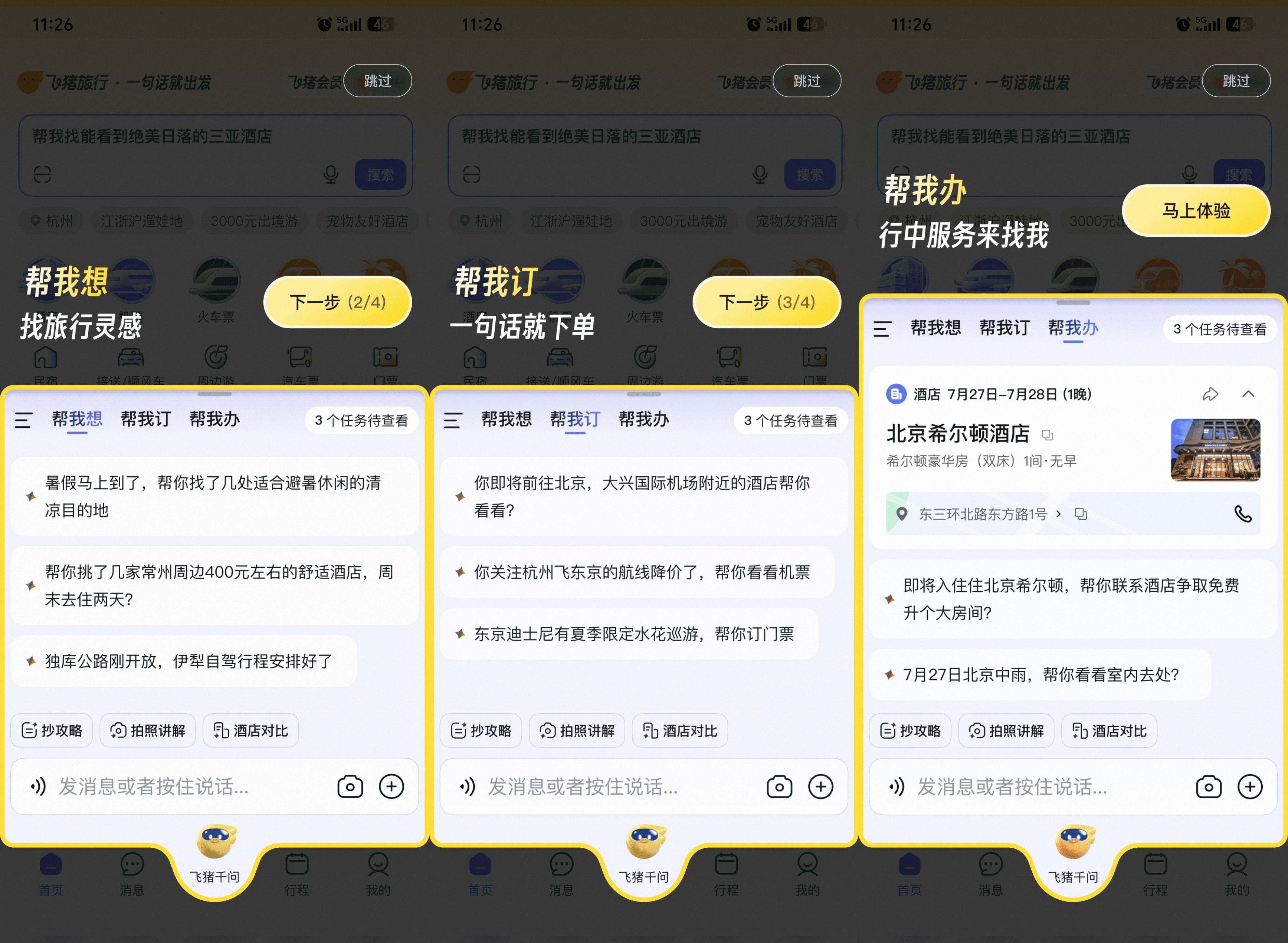
升级后的飞猪App,一个明显变化是,在首页下方新增了飞猪帮帮的智能面板,并分设了“帮我想”“帮我订”“帮我办”三个Tab。

在“帮我想”Tab,飞猪帮帮可以根据消费者模糊的想法,规划出明确的路径,同时保证这一路径是真实可达的。比如规划周末去处、计算旅行预算、规划特色自驾游等。

特别是行程规划阶段,当消费者在其他内容平台搜索旅游攻略时,可以将某篇攻略的链接复制到“帮我想”,并告诉它“抄这个攻略,帮我生成行程规划”,飞猪帮帮就可以形成详细的行程规划。而当消费者在行程设计上有了新想法时,不需要将之前的行程推翻,只需要和AI进行多轮的对话,来调整、改变行程框架即可。

在“帮我订”Tab,消费者可以借助AI能力完成火车票、机票、酒店、民宿、赛事门票、接送机等的订购事宜。比如,消费者可以告诉AI“帮我订能看到故宫金顶的酒店”,飞猪帮帮则会筛选出满足要求的酒店。飞猪帮帮还可以根据目的地,提醒消费者是否需要订相关景点的门票;当家庭出游时,飞猪帮帮可以根据年龄和人数,帮助用户一次性组合购买不同票种。

飞猪帮帮产品负责人张文涛表示,“能聊”和“能订”是两个概念,这中间隔着飞猪沉淀了10年的供应链能力。“当用户告诉AI‘帮我订能看到故宫金顶的酒店’时,AI做了什么呢?首先,这个需求不是一个事实存在的供应链信息,AI需要将用户描述的画面和意向翻译成库存,这个翻译的动作取决于模型的实际能力。其次,对于一些平时在挑选、比价常规链路中很难找的商品或者库存,我们希望通过AI的方式帮用户快速的找到和预定。”他解释道。

“帮我办”Tab强调“你负责出发,AI负责跑腿”,值机选座、酒店入住服务、入境卡预填、改签、问酒店免费升房等事宜均可以通过AI完成。

张文涛认为飞猪帮帮的三项重大升级体现在AI交互、AI搜索、AI执行。

AI交互重点体现在,飞猪帮帮的能力不仅体现在首页下方的智能面板,还可以在搜索栏、行程页、订单页以及机票、酒店、民宿、度假频道等地方随时唤起;用户从规划、挑选到下单,均可以一站式完成,免去了反复跳转多界面的时间成本。

AI搜索的升级则是将原本的搜索框放大为“智能框”,消费者不需要靠拼凑关键词来搜索,而是用一句话的形式向AI表达诉求;消费者也可以多轮追问,逐渐精确筛选的结果。搜索框完成了从只认关键词到听得懂长句子的升级。

AI执行能力的升级则体现在可以帮助消费者直接将事宜办成,而非向消费者提供文字和链接,

整体来看,飞猪帮帮不再采用在App首页一角单独设置AI聊天机器人的交互设计,而是将LUI(自然语言用户界面)和GUI(图形用户界面)融合,把AI Agent的服务像一幅外骨骼一样,嵌入了服务流。

2.飞猪帮帮交付的结果可用率评分较上一代产品提升超70%

在飞猪技术人员看来,飞猪希望飞猪帮帮可以从旅行开始,做一个能为用户全程办事的消费级AI Agent。

从飞猪的AI2C时间路线图来看,飞猪探索出来的路径是从“聊得好”到“办成事”,同时把“陪伴”做深,向“主动服务”的服务深度升级。早期的飞猪AI旅行助手通过解决某个单点问题,通过提供信息价值来实现局部提效;到了2025年4月,飞猪发布了Multi-Agent架构的AI产品“问一问”。价值能力上,完成了从提供信息价值发展到会规划的进阶;服务深度上,从局部提效升级到了全程陪伴阶段。此次发布的飞猪帮帮,AI Agent的能力已经从简单的信息交互层面进入与物理世界相连的服务履约层面,从局部场景延伸至用户全旅程。

据飞猪技术人员现场介绍,飞猪帮帮依然采用Multi-Agent架构,但较上一代旅行AI具有更强的通用性,这让它承接新场景的表现更好、接入新能力的效率更高,模型越强、用量越省,误差积累也更少。此外,飞猪帮帮的记忆力也更强大,还能读懂用户在长期使用飞猪时形成的习惯,提供个性化程度更高的服务。

在作为关键指标的可靠性上,飞猪基于真实供给、专有数据、交易系统和行业经验,对大模型充分后训练,提升了其在旅行垂类场景中的表现;同时为Agent设计了实时训练环境和一整套Harness系统,并搭建了一套即时验证体系查疑纠错,从底层确保Agent交付的结果真实可行。飞猪数据显示,截至目前飞猪帮帮交付的结果可用率评分较上一代产品提升了超70%,可比任务的平均耗时减少近10%。

3.飞猪布局AI的三个领域与沉淀的三项能力

据庄卓然介绍,飞猪正围绕“3个E”(AI for Experience,AI for Ecosystem,AI for Enterprise)展开AI布局,即利用AI提升用户体验、繁荣旅行生态、重塑组织形态,这“3个E”相辅相成。“飞猪帮帮”是“AI for Experience”中的新一步。

在提升用户体验方面,飞猪重点关注“到底通过AI解决C端消费者的哪些需求”的问题。繁荣旅行生态方面,飞猪希望通过AI,让商家在飞猪上积累起AI资产和AI能力。庄卓然以酒店行业为例,考虑到盯价格、盯库存、做营销、分账等事宜极其消耗商家运营资源的痛点,飞猪在今年5月面向酒店商家免费开放了智能助理。测试阶段,有数据显示,一家酒店开通了经营决策功能后,9 天内使用AI诊断超过了23次,最终采纳了80% 以上的AI建议。重塑组织形态方面,庄卓然认为如何把重复的劳动交出去,让人的精力放回到判断、创造有温度的服务上,是更重要的命题。

据悉,面向这“3个E”,飞猪正在沉淀三项能力:快速完成基座模型适配和垂类后训练;打造旅行行业agent的可交互环境、harness和可信的度量体系;将业务资产转化为agent可理解、可调用的数据资产。

庄卓然说:“在旅行领域,AI能不能真的把一件件事办成,取决于它能不能直达真实供给、能否跨越真实的交易系统、扛不扛得住真实物理世界里的意外。” 他还提出,随着智能的快速进步,产品的形态和能力边界也将不断刷新。从飞猪帮帮和其他的AI实践中沉淀的能力、经验和认知,是飞猪走向AI原生的重要资产。

亿邦持续追踪报道该情报,如想了解更多与本文相关信息,请扫码关注作者微信。

文章来源:亿邦动力

广告
微信
朋友圈

FAQ回顾

飞猪帮帮是什么?

飞猪帮帮是飞猪推出的新一代旅行AI产品,主打“一句话就出发”,可覆盖用户旅行前中后全场景,提供行程规划、机酒订购、退改签、值机选座、开票报销等事务办理服务,交付结果可用率较上一代产品提升超70%。

飞猪帮帮可以实现哪些核心功能?

飞猪帮帮设置“帮我想”“帮我订”“帮我办”三个功能模块,可根据用户模糊需求生成可落地的行程规划,完成各类出行相关产品订购,还可代办值机选座、入境卡预填、改签、升房、开票报销等事务。

飞猪帮帮相比上一代旅行AI有什么升级?

飞猪帮帮采用Multi-Agent架构,通用性更强,承接新场景表现更好、接入新能力效率更高,记忆力更强可匹配用户使用习惯提供个性化服务,交付结果可用率提升超70%,可比任务平均耗时减少近10%。

AI时代在线旅游行业的发展趋势是什么?

AI时代OTA的内核将从互联网时代的在线旅行社,进化为全智能旅行代理,通过全能智能体为用户提供更加个性化、全面的旅游出行服务,实现从提供信息到直接完成服务履约的升级。

这么好看,分享一下?

朋友圈 分享

APP内打开

+1
+1
微信好友 朋友圈 新浪微博 QQ空间
关闭
收藏成功
发送
/140 0